Form · MHSWR regulation 3
RAMS template
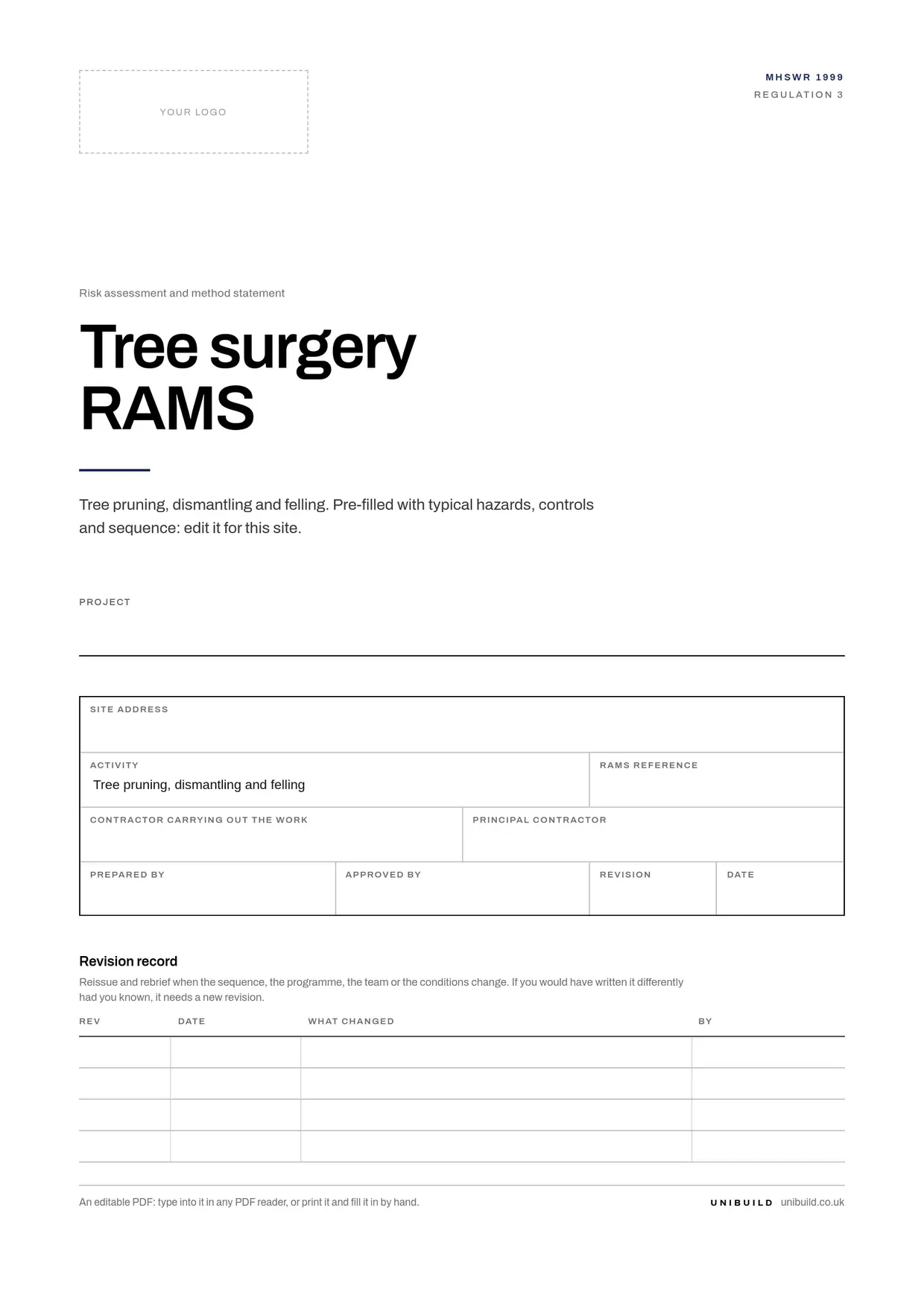
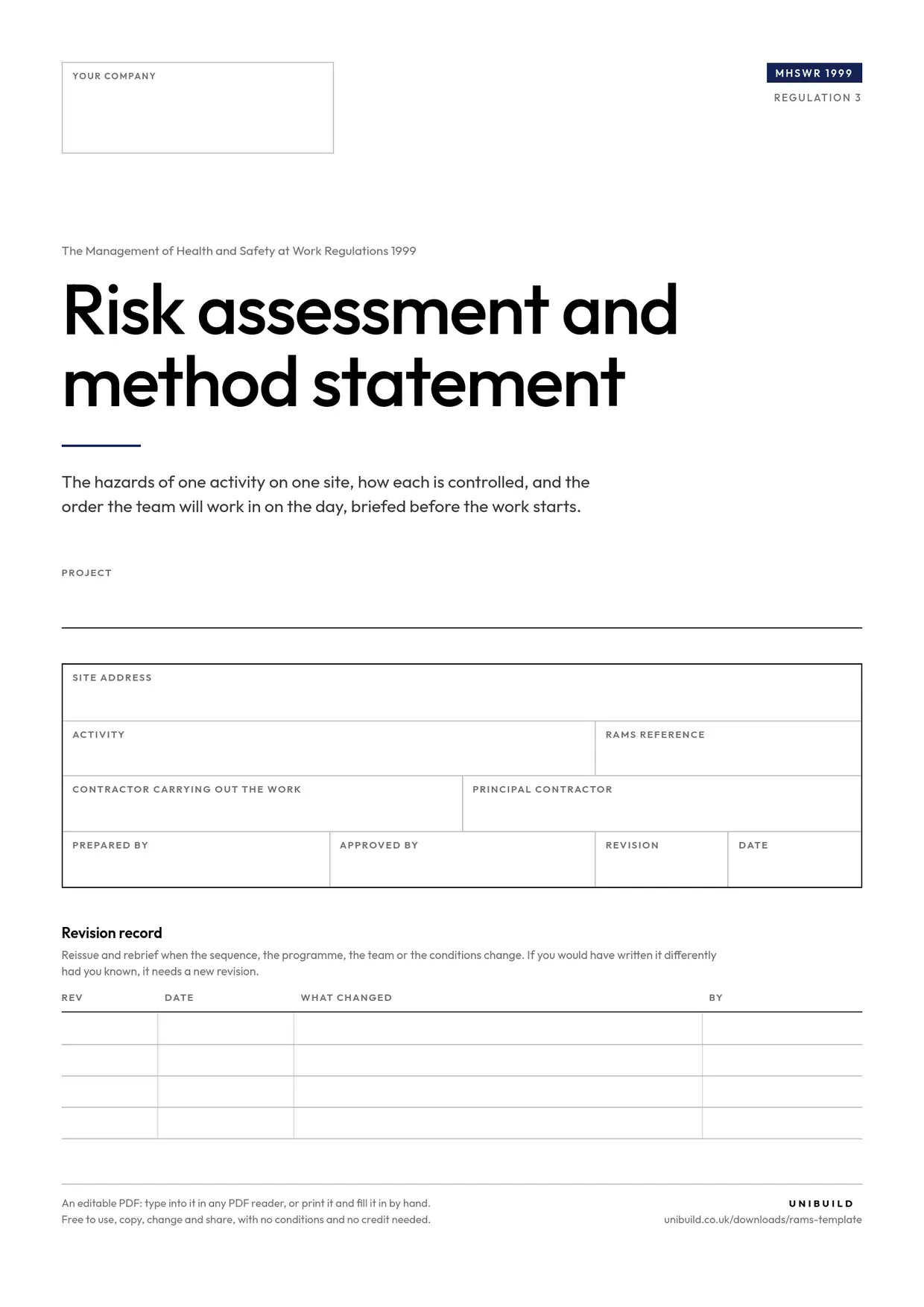
Risk assessment and method statement for one activity: the sequence of work, a five by five risk matrix, PPE, permits, rescue, and a briefing record signed against the revision.

Editable construction templates, forms, checklists and printable site posters for UK sites. Download PDFs to fill in or pin up. Every file is free to use and reuse, with no sign-up.
Editable PDFs for the paperwork a site runs on: RAMS, permits to work, the incident report and site induction forms, the temporary works and plant registers, the waste transfer note and the inspection reports the law requires.
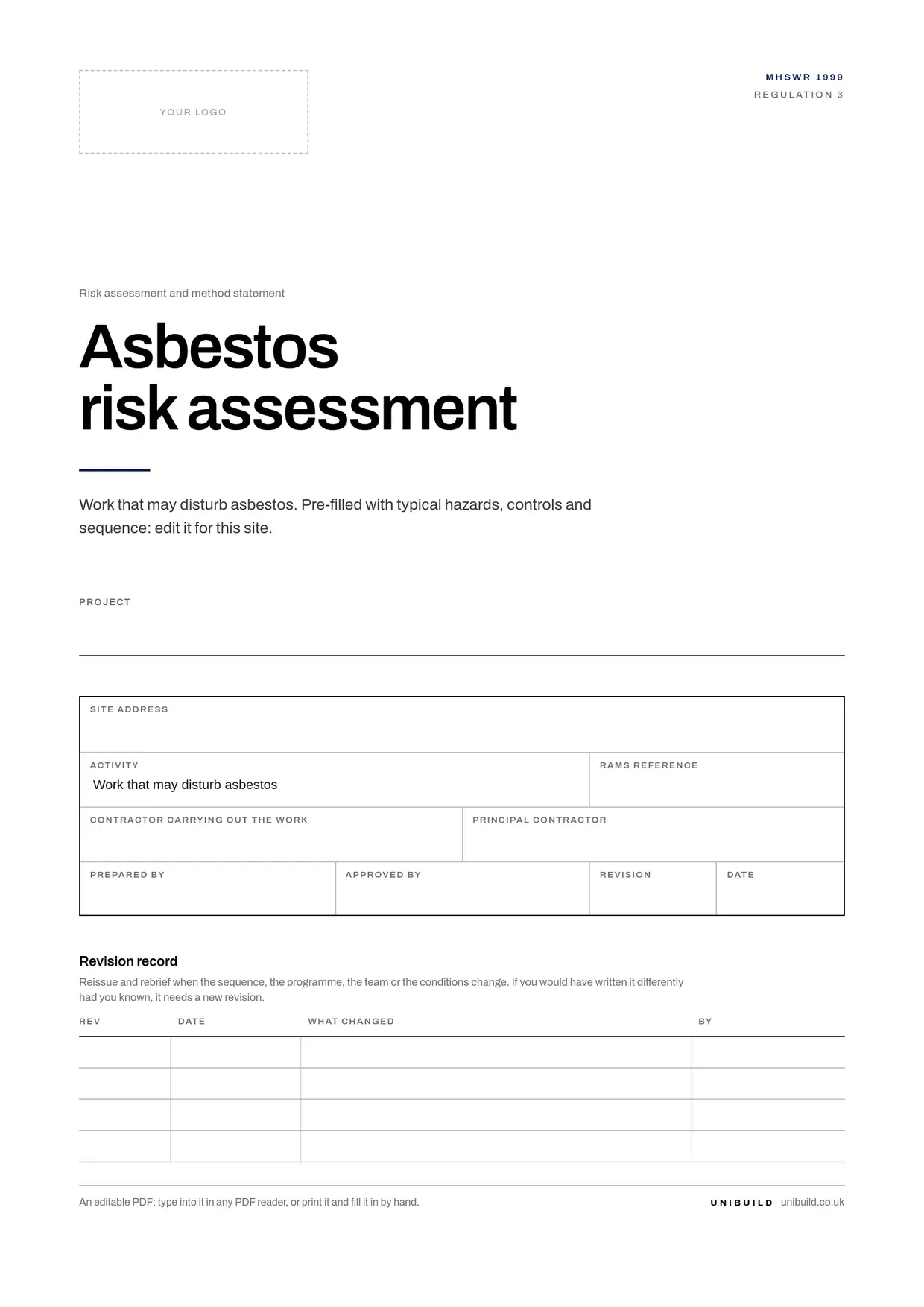
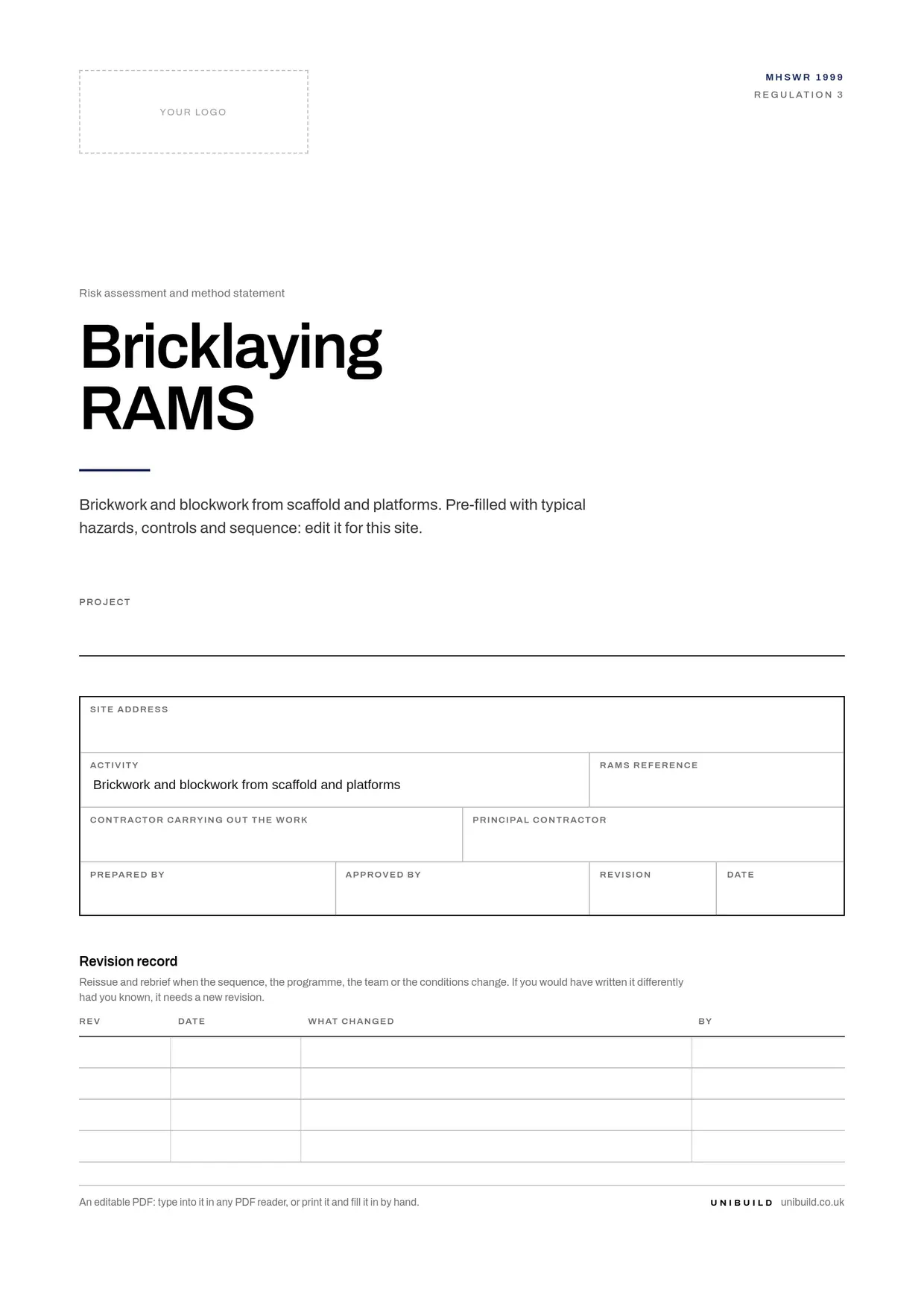
Risk assessment and method statement for one activity: the sequence of work, a five by five risk matrix, PPE, permits, rescue, and a briefing record signed against the revision.
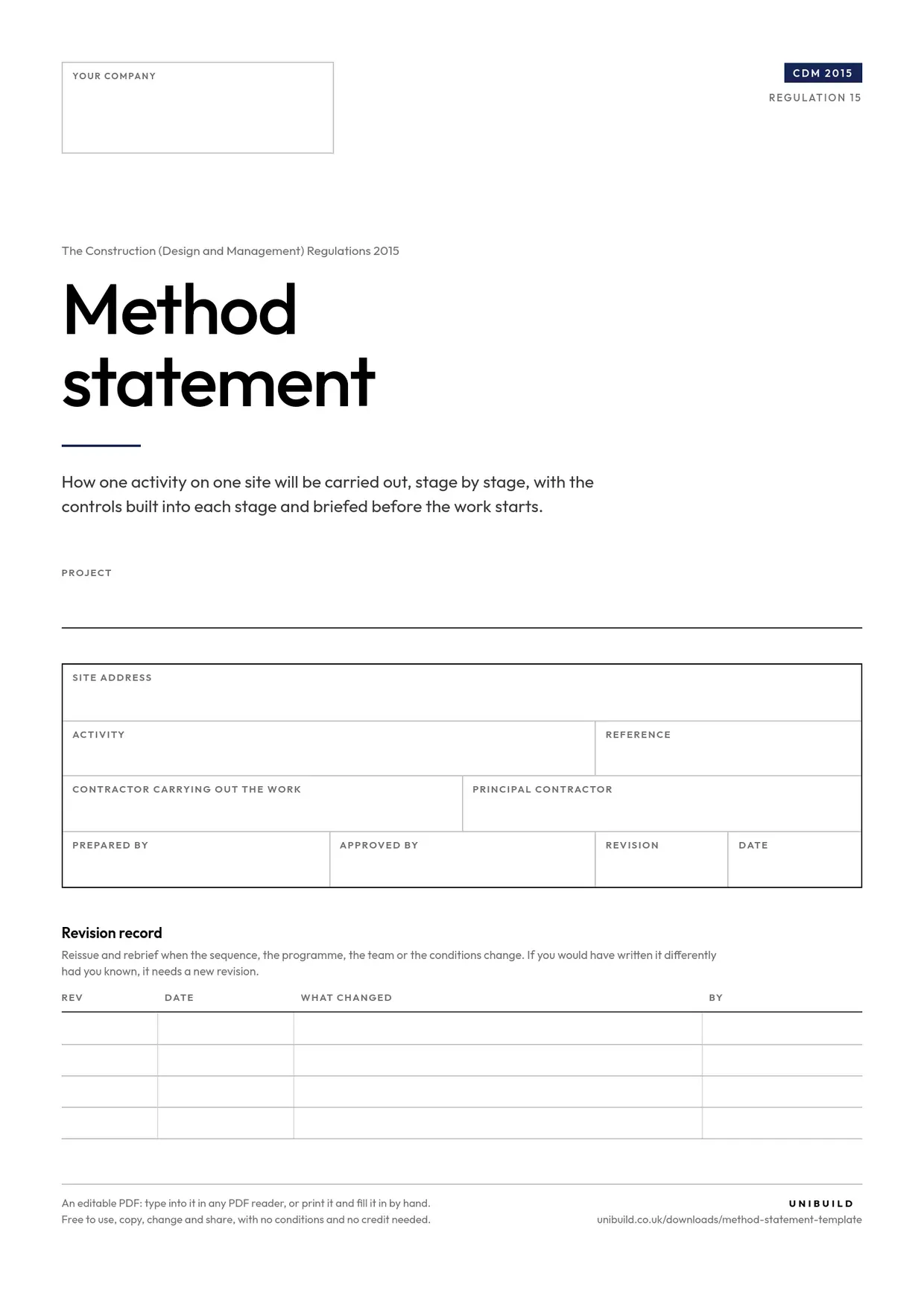
How one activity on one site will be carried out. Two pages of sequence with the controls at each stage, then plant, PPE, permits, rescue and a briefing record.
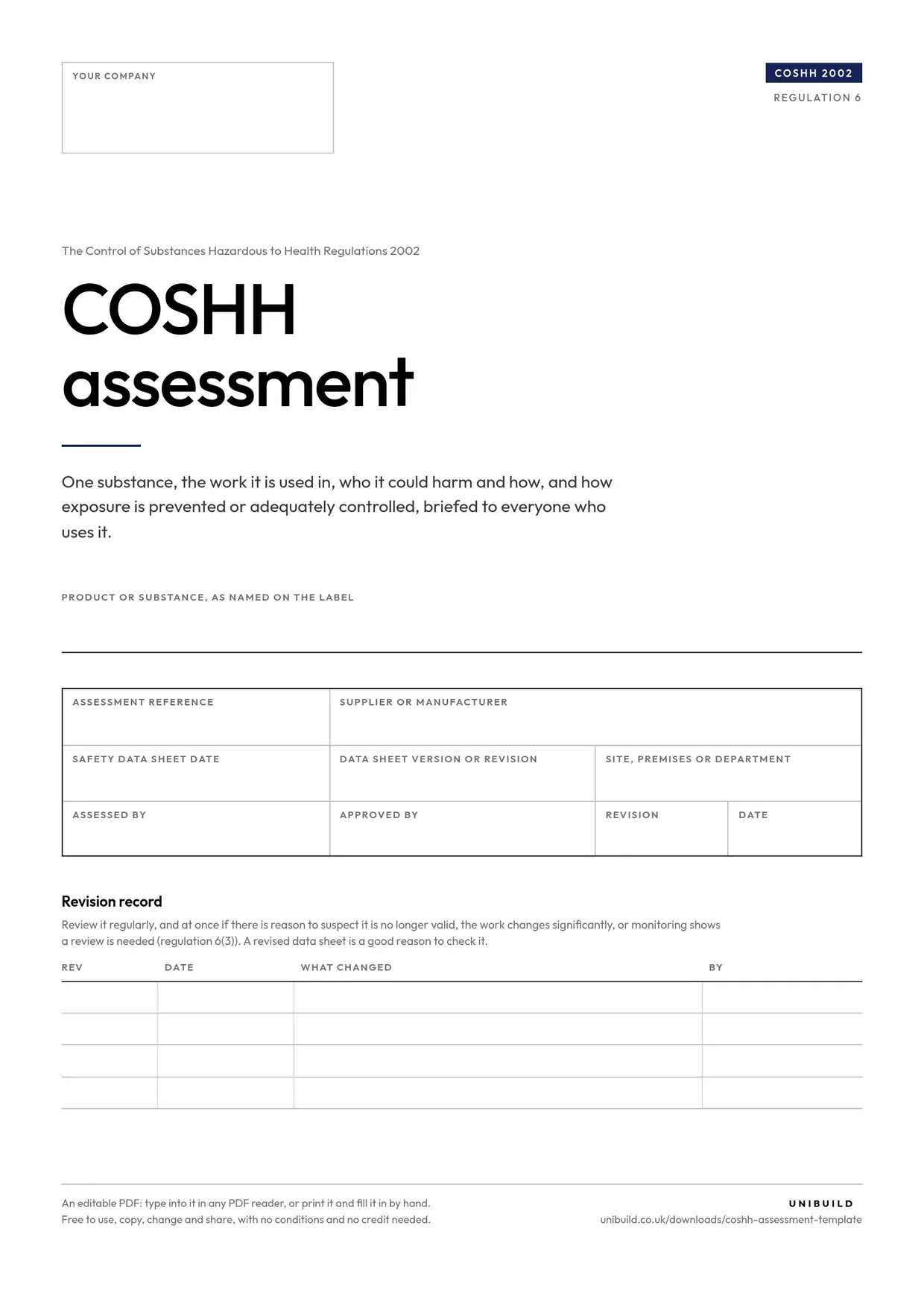
One hazardous substance: its hazards from the data sheet, who is exposed and how, controls in regulation 7 order, PPE and RPE, storage, spills, first aid, monitoring and review.
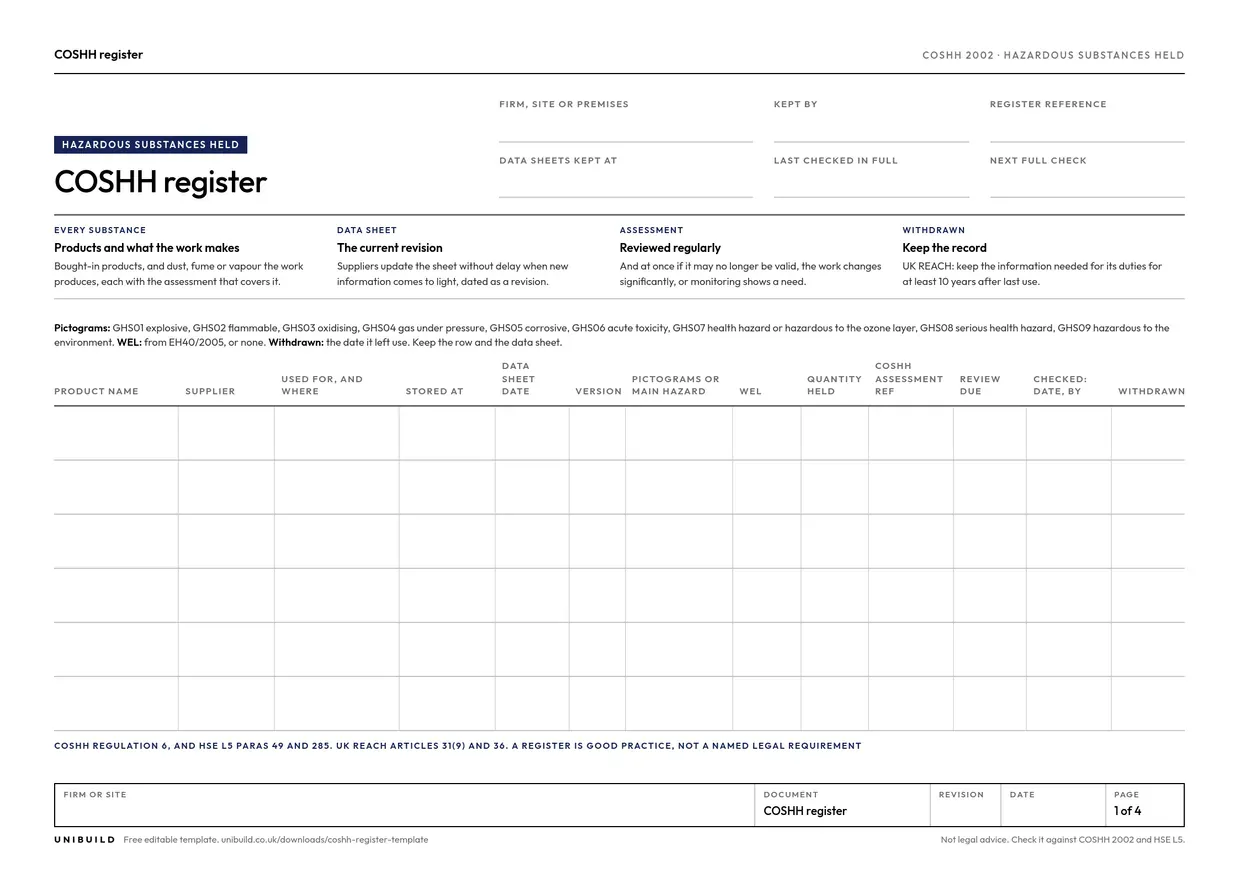
Every hazardous substance held, with its data sheet date, main hazard, WEL, storage, COSHH assessment and review date, plus update and review logs.
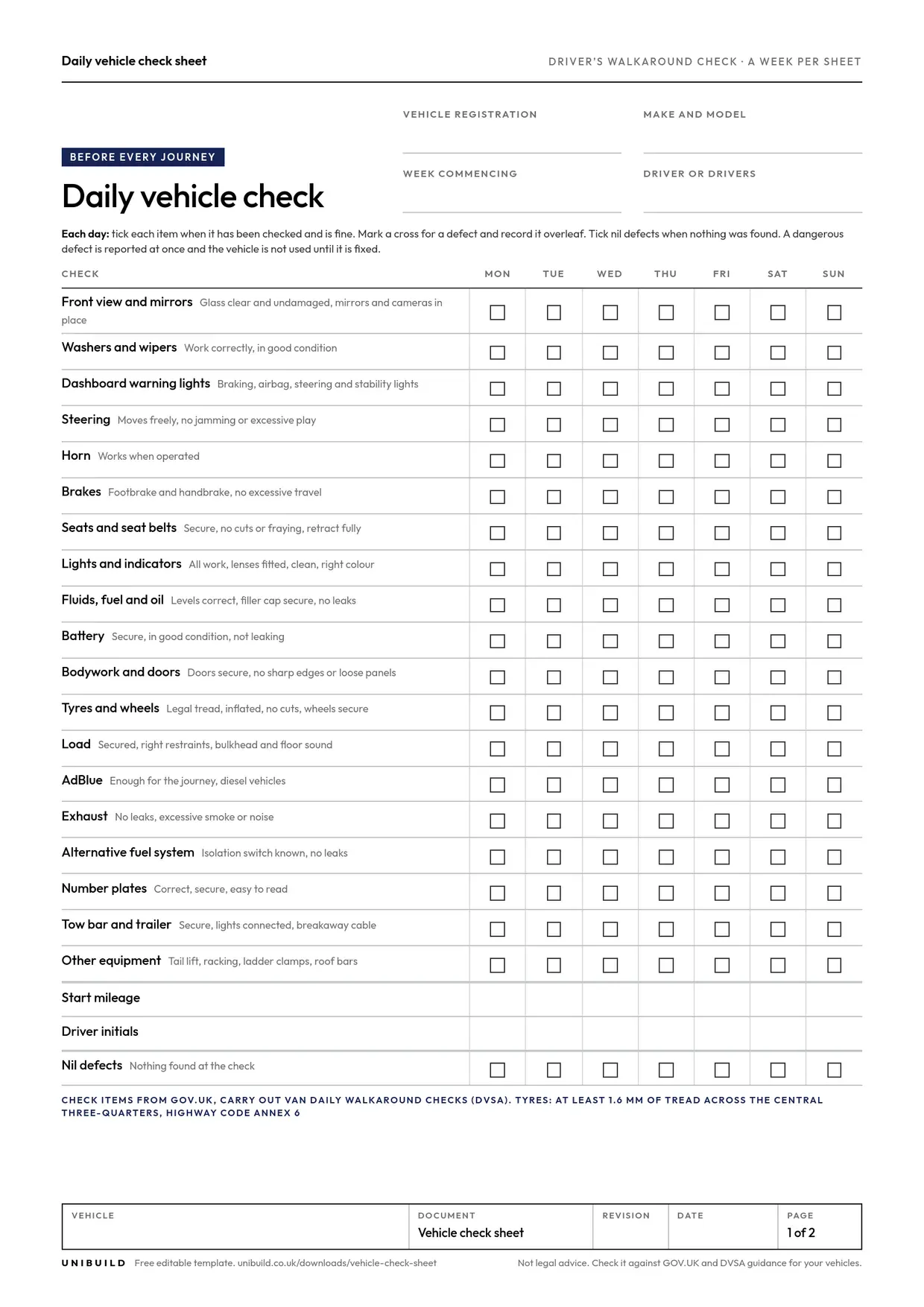
The driver’s walkaround check before each journey, a week per sheet with a column for each day, nil defects, a defect report and each defect put right.
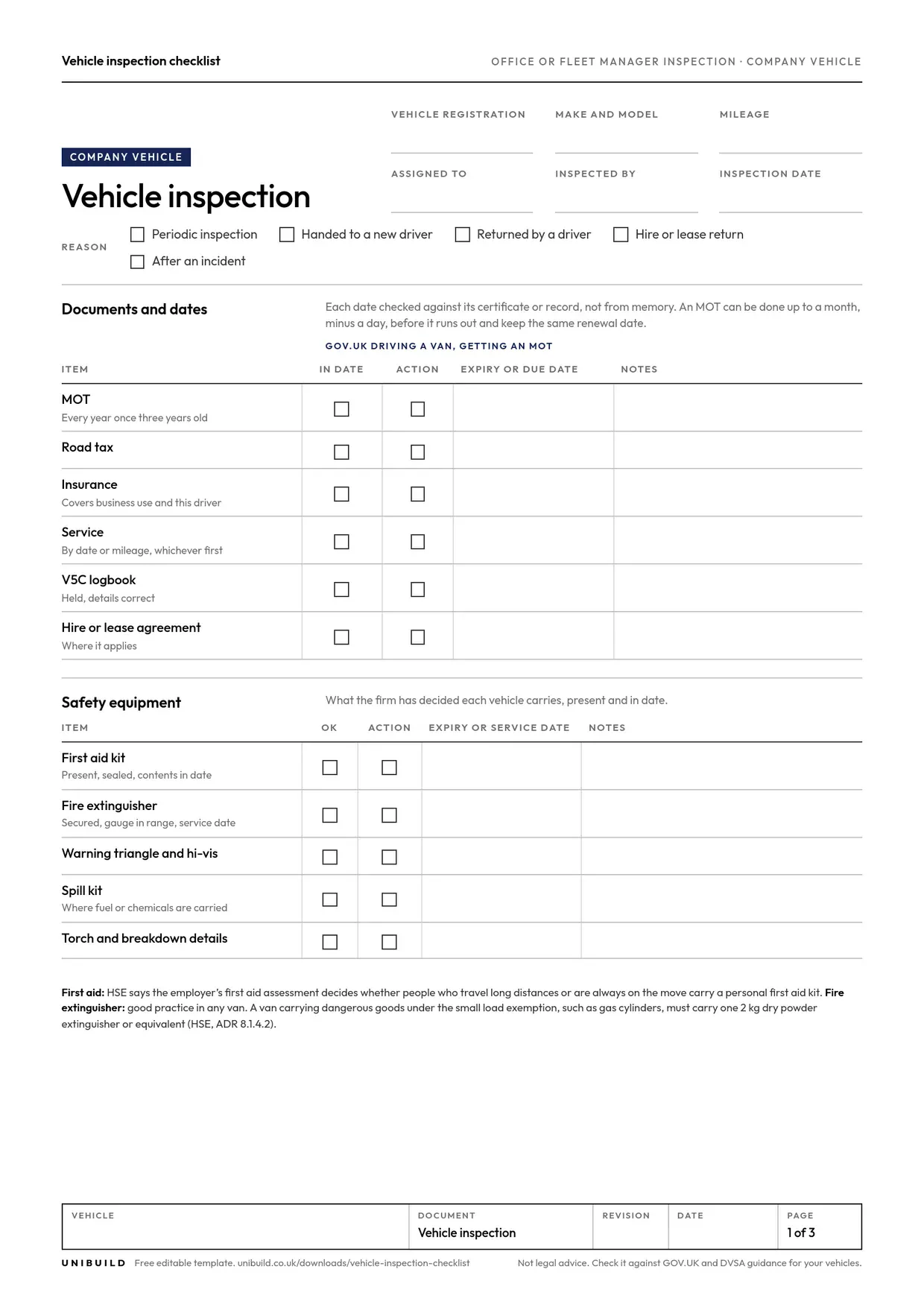
The office or fleet manager inspection: MOT, tax, insurance and service dates, first aid kit and fire extinguisher, condition, a van damage diagram, actions and sign-off.
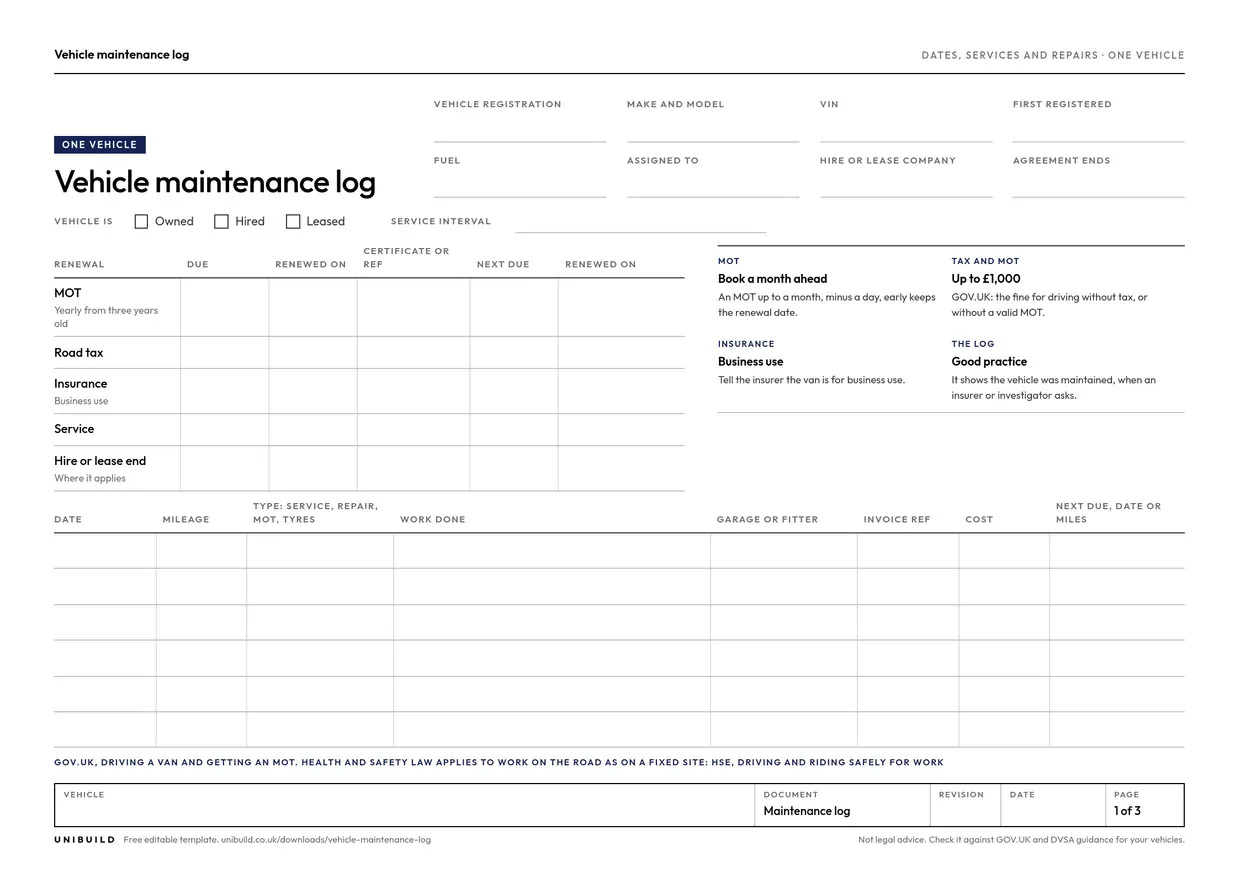
One vehicle’s MOT, tax, insurance and service dates, owned, hired or leased, with a service and repair history, a tyre record and a mileage record.
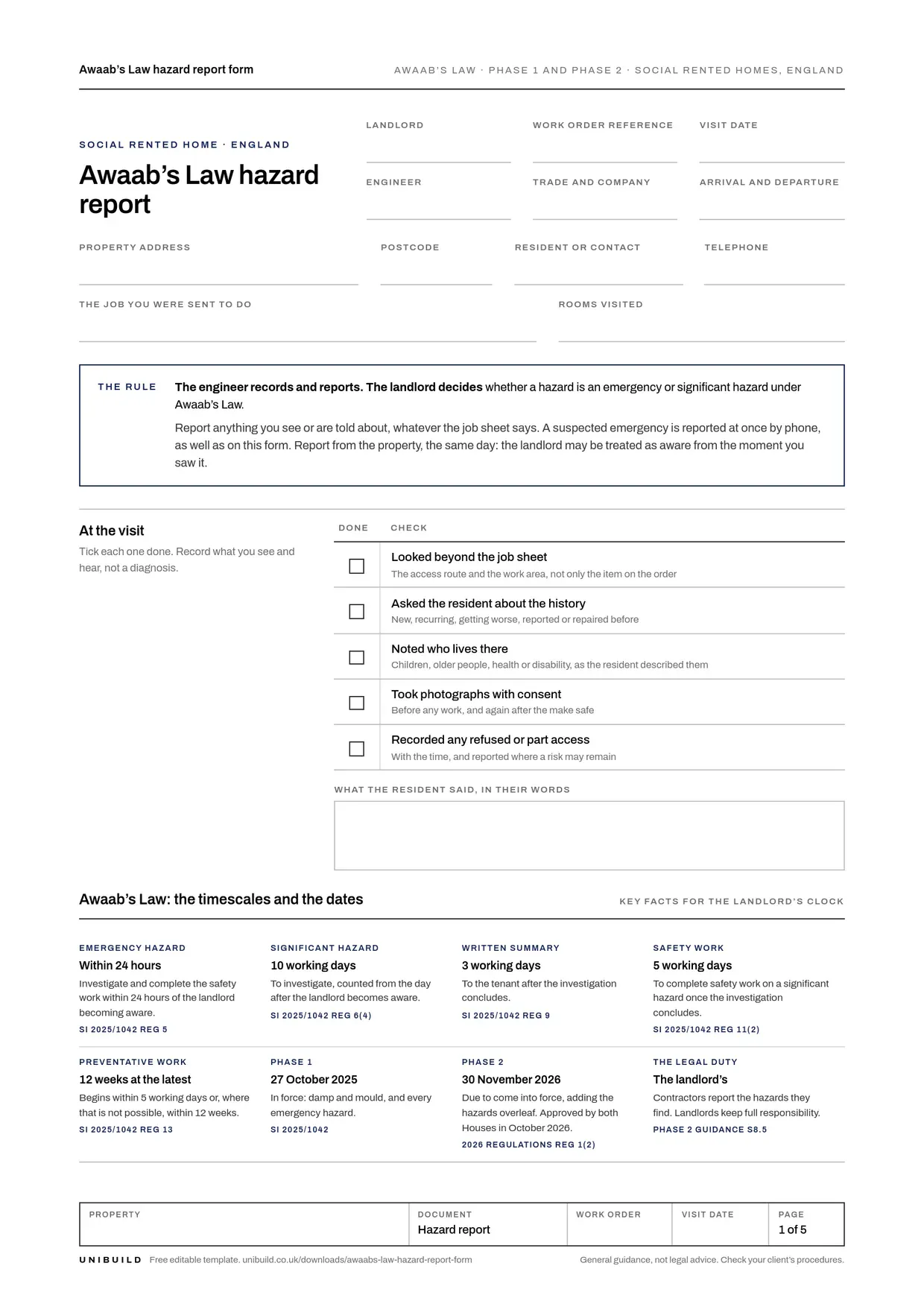
What an engineer records on finding a potential hazard in a social rented home: the job, what the resident said, a phase 1 and phase 2 hazard checklist with urgency, evidence, the report and the office handover.
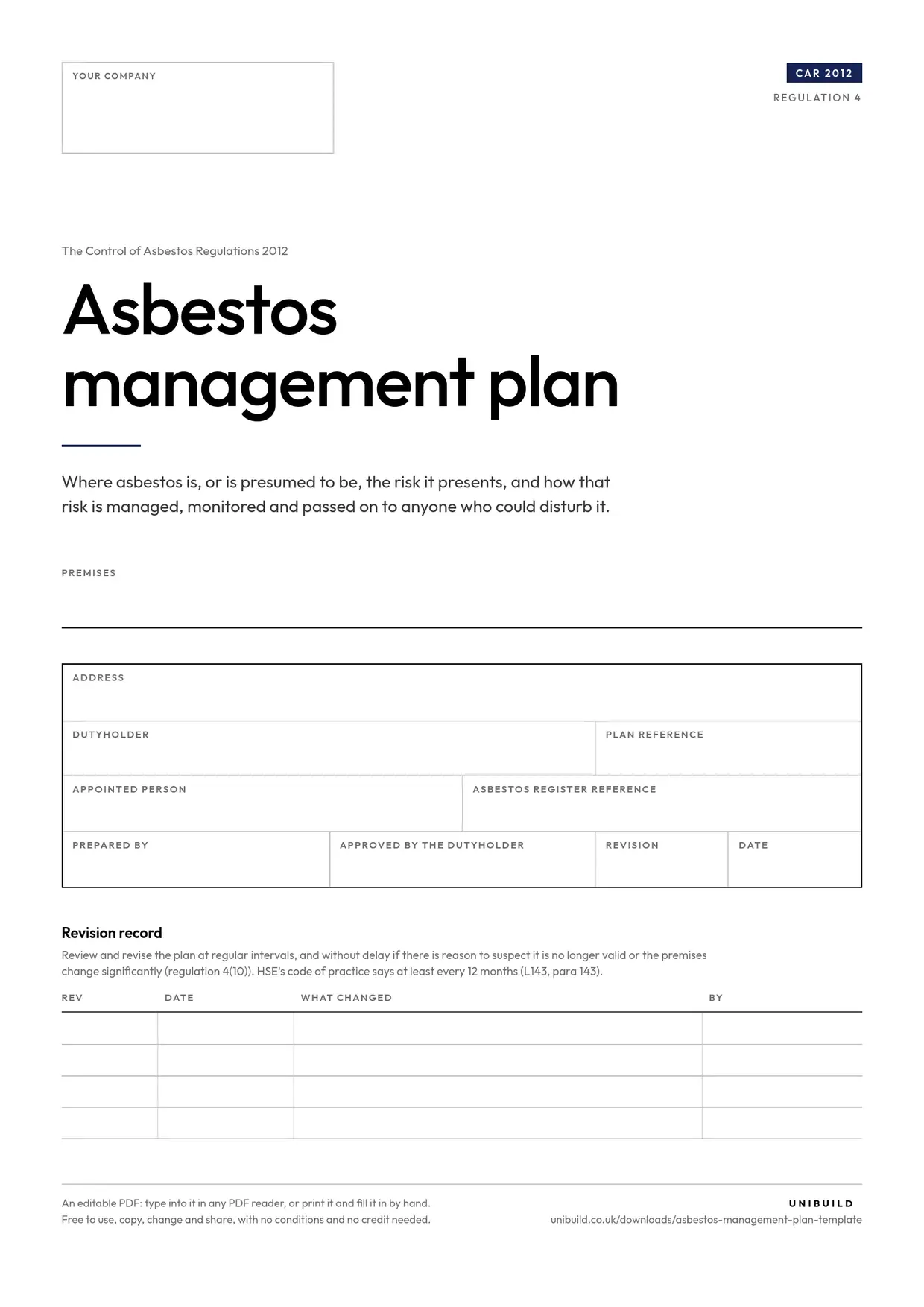
The written plan the duty to manage asks for: the dutyholder, surveys held, the register and priorities, actions, information before work, re-inspection and review.
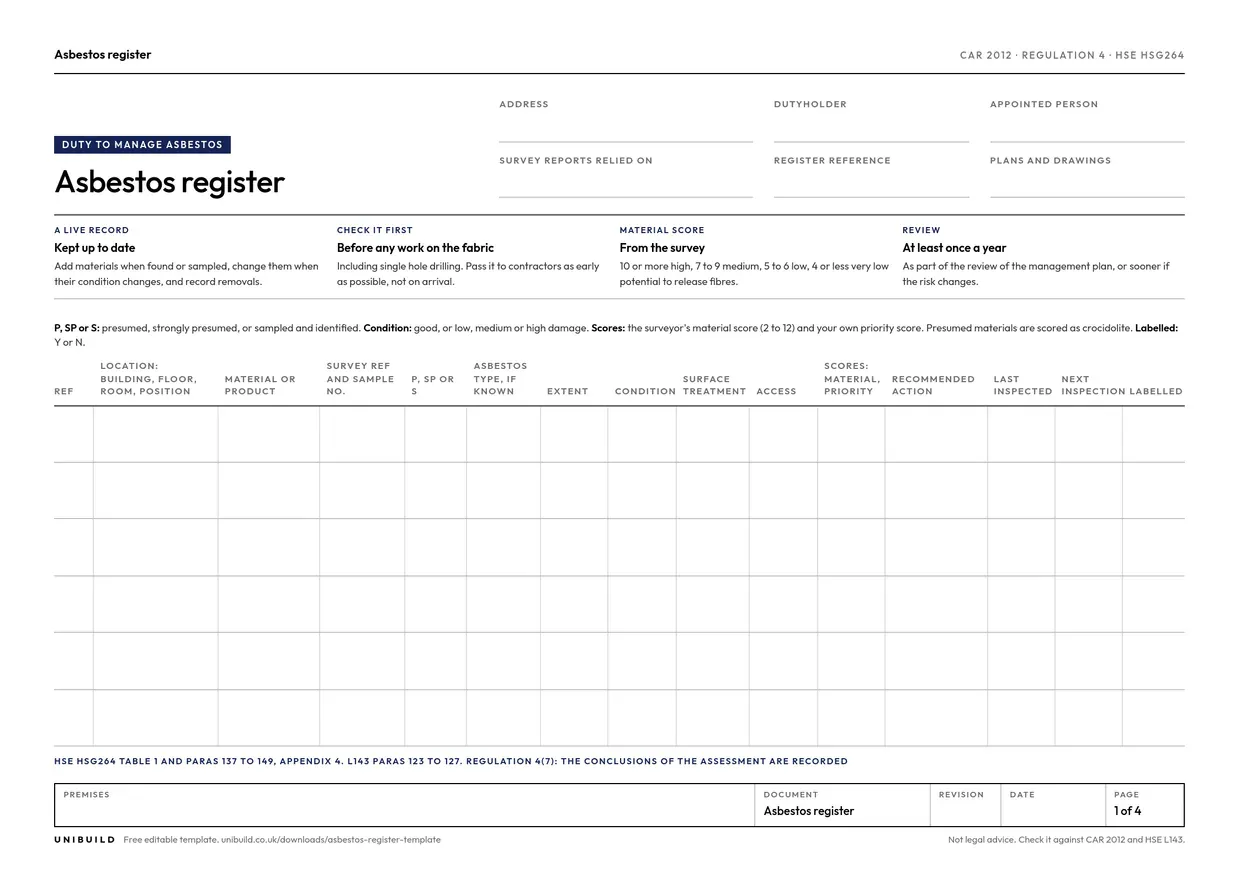
Where asbestos is or is presumed to be, its type, extent and condition, the action and the next inspection, with an inspection log.
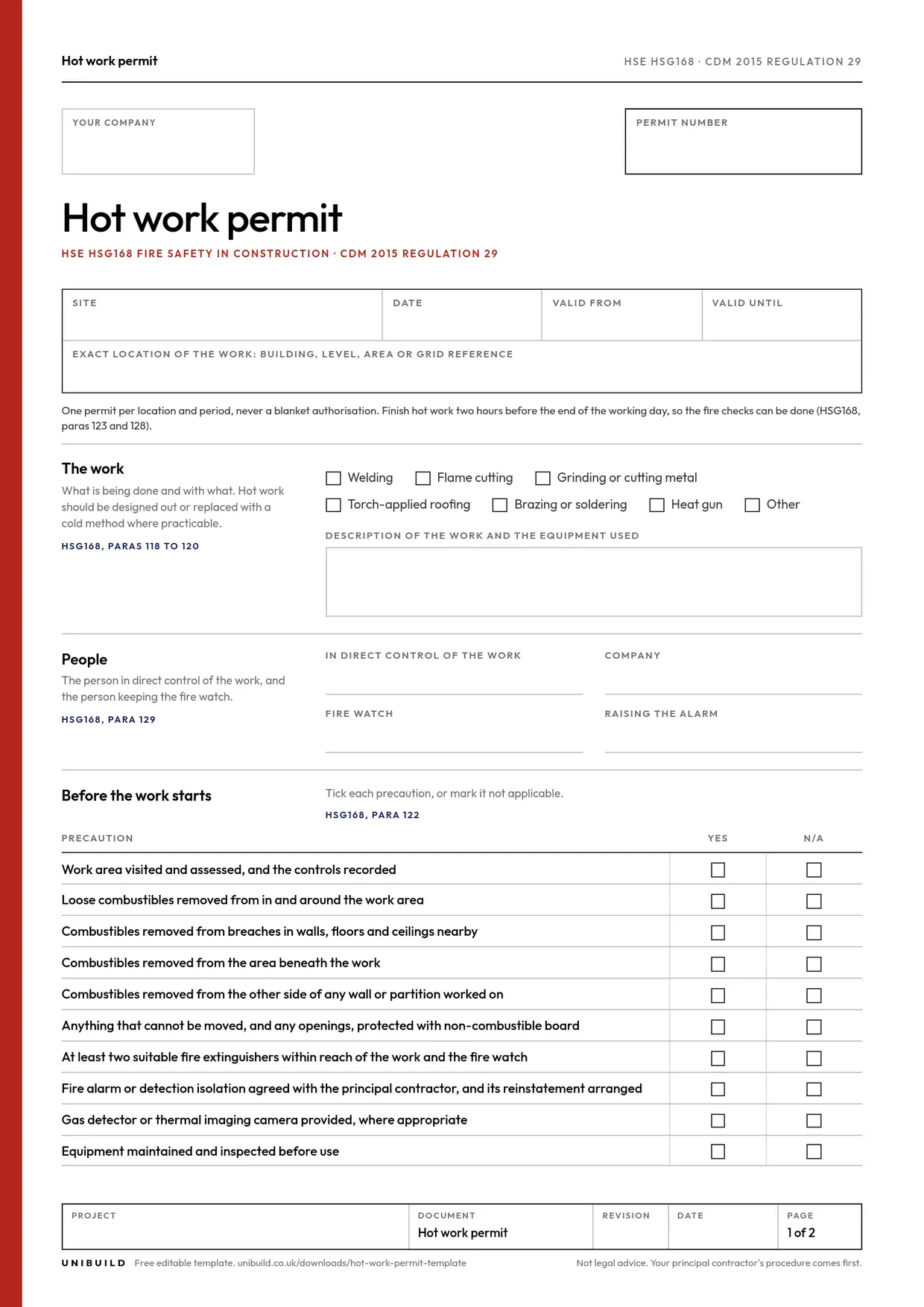
Welding, cutting, grinding and torch-on work: the precautions checked before it starts, the fire watch during and after, and hand-back.
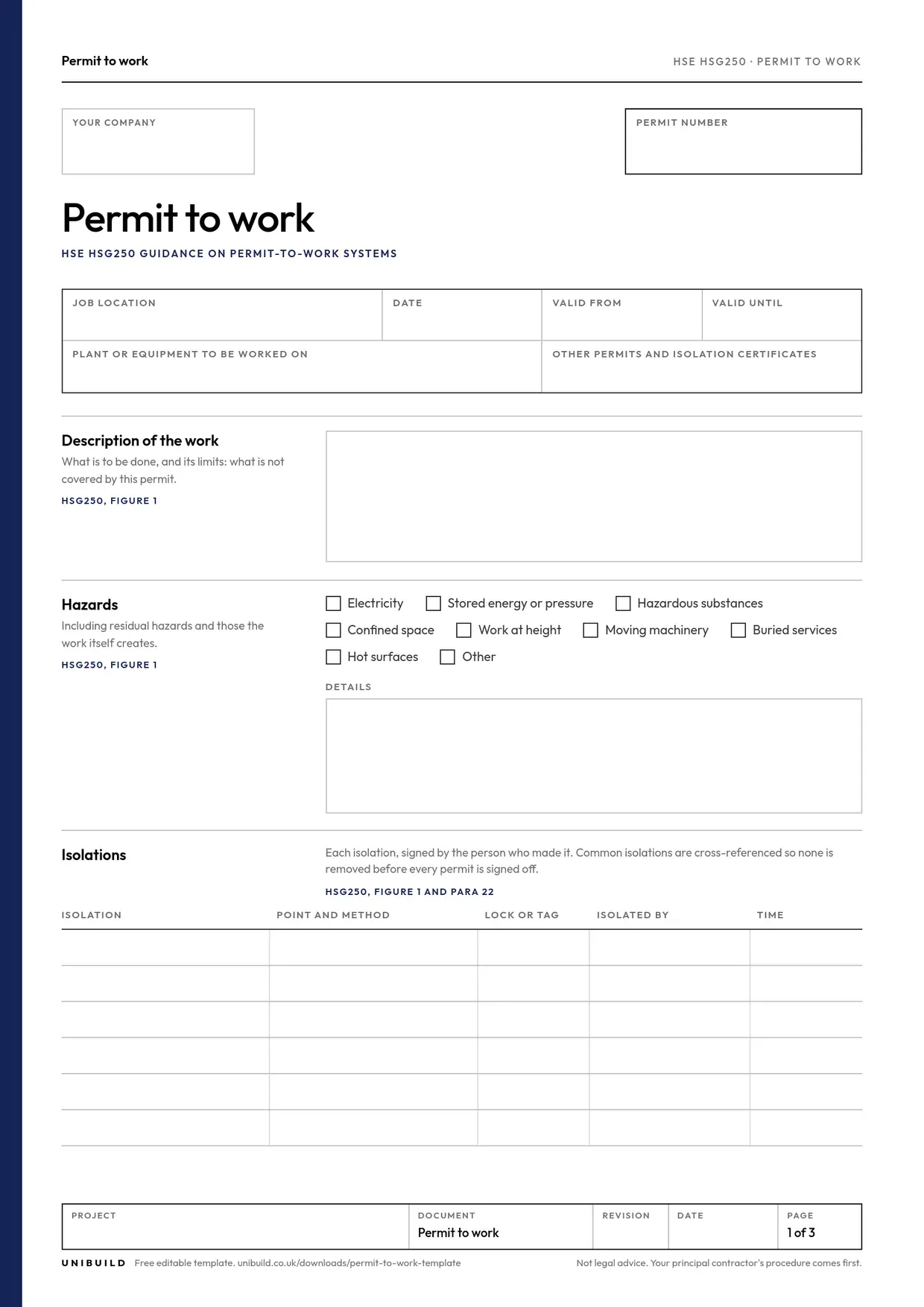
A general permit for high-risk work: the job, hazards, isolations, precautions, issue, acceptance, shift handover, hand-back and cancellation.
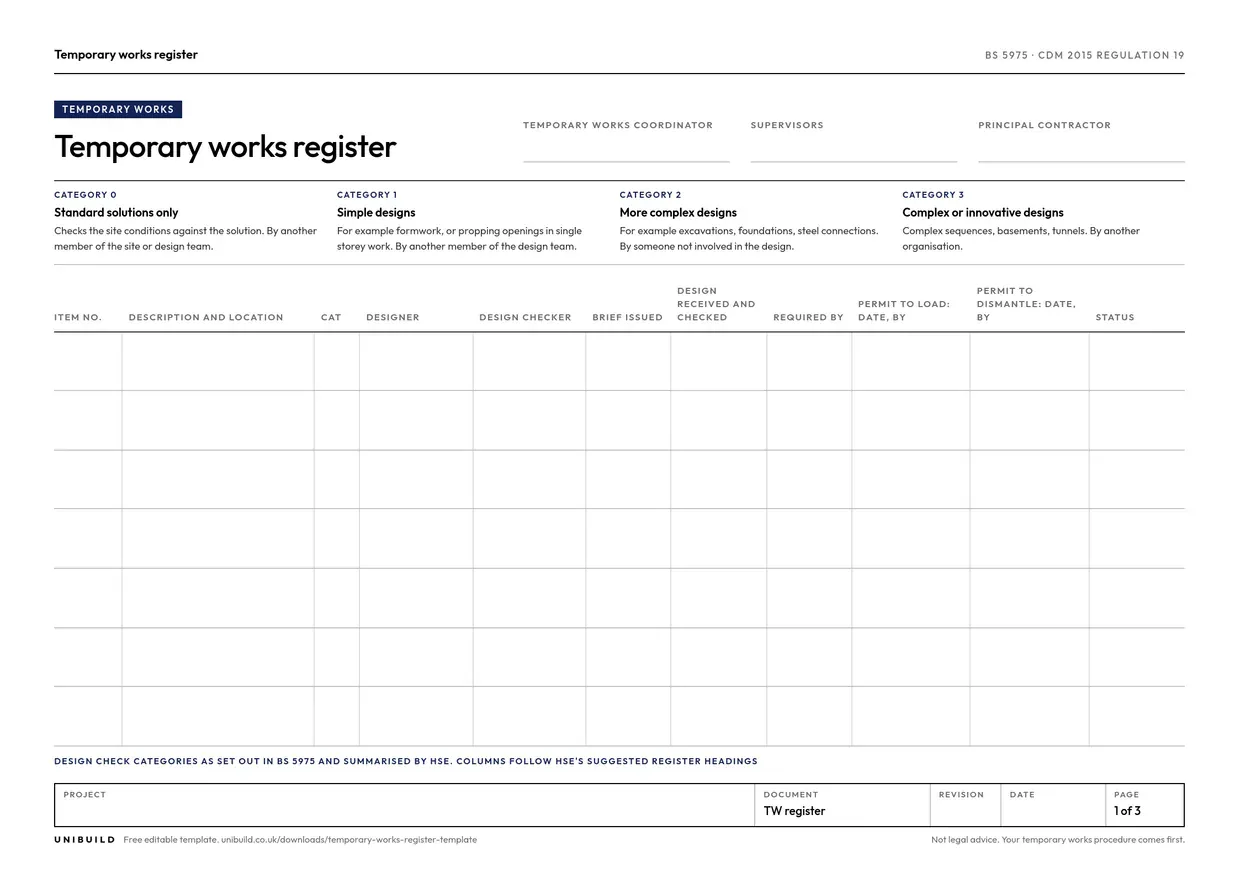
Every temporary works item on the job: design category, designer and checker, permit to load, permit to dismantle and status.
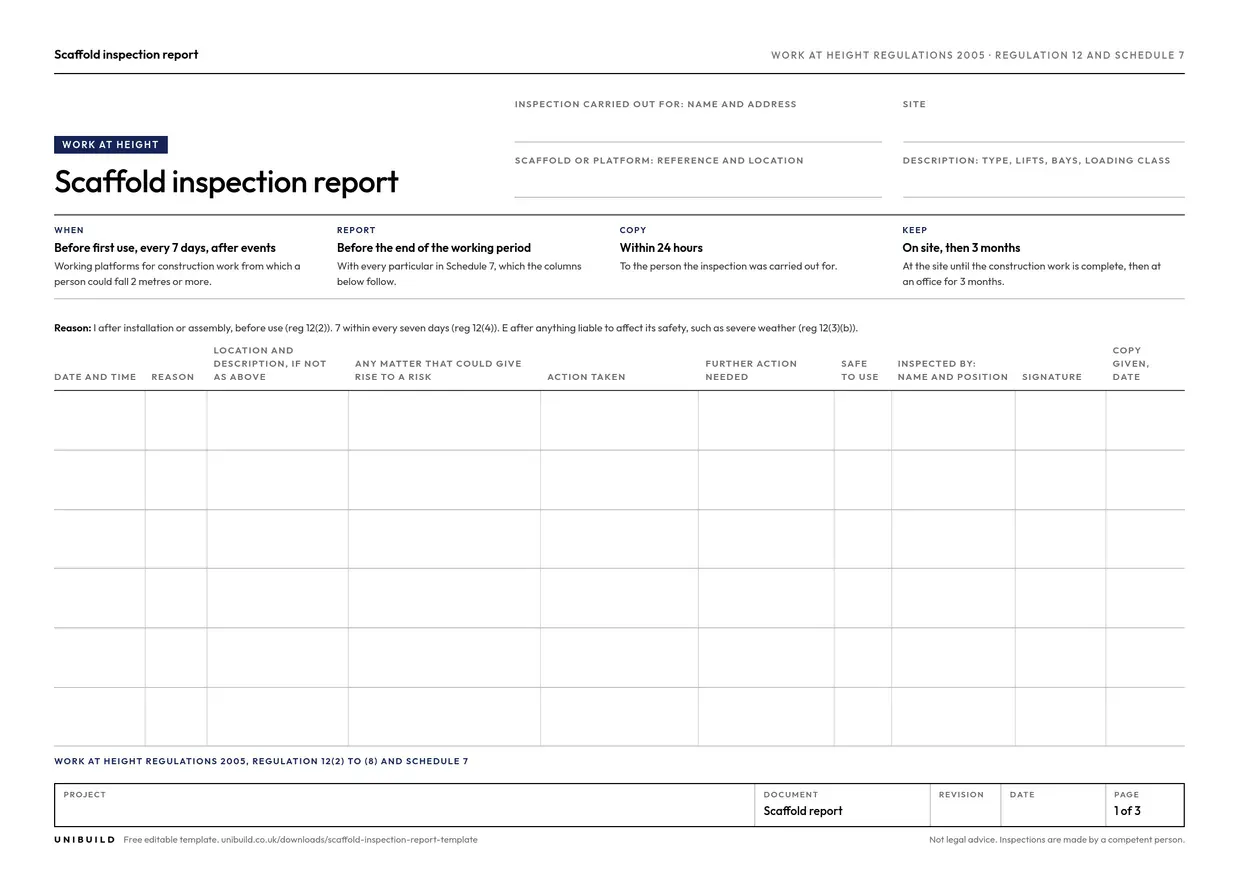
The inspection report the Work at Height Regulations require, with every particular in Schedule 7 as a column, for the seven-day and after-event inspections.
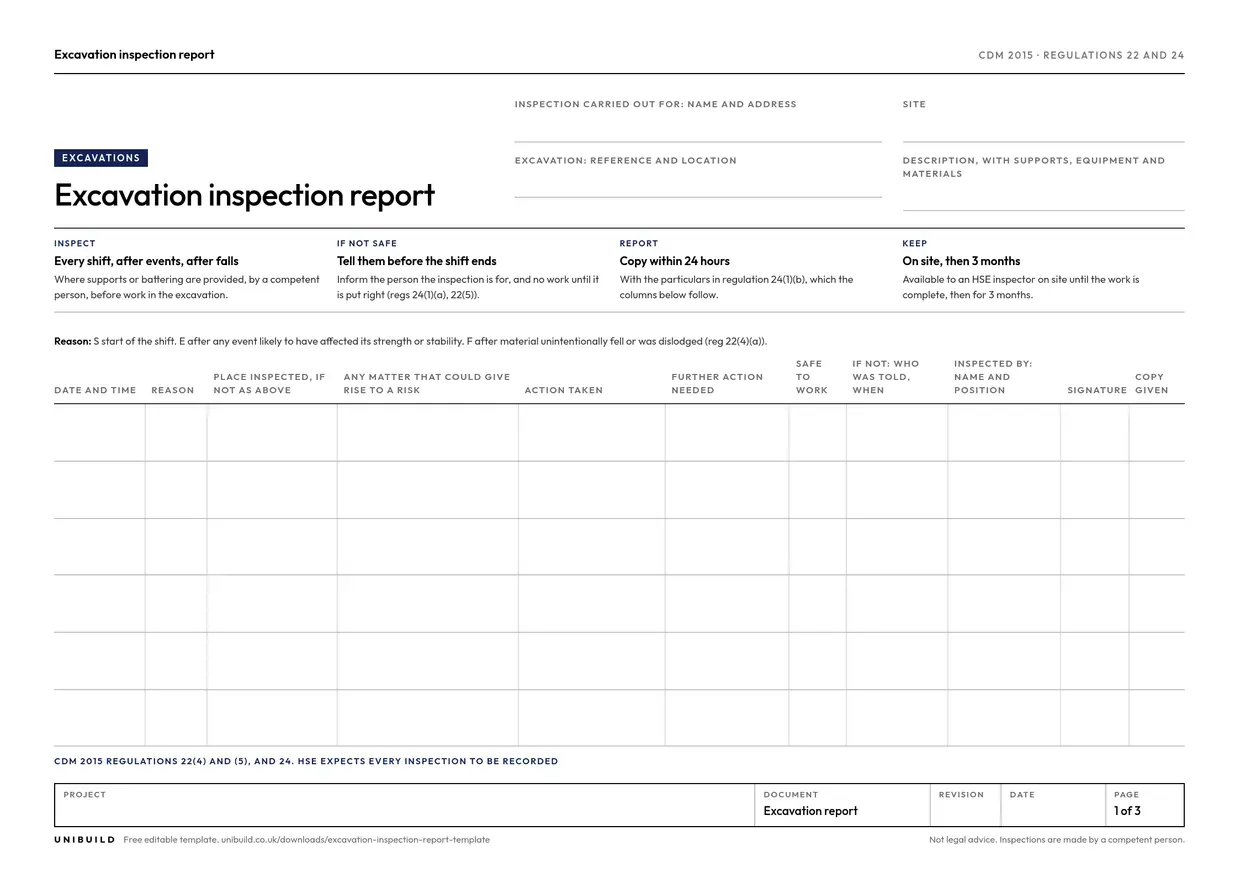
The report CDM 2015 requires after each excavation inspection: start of shift, after an event, after a fall of material.
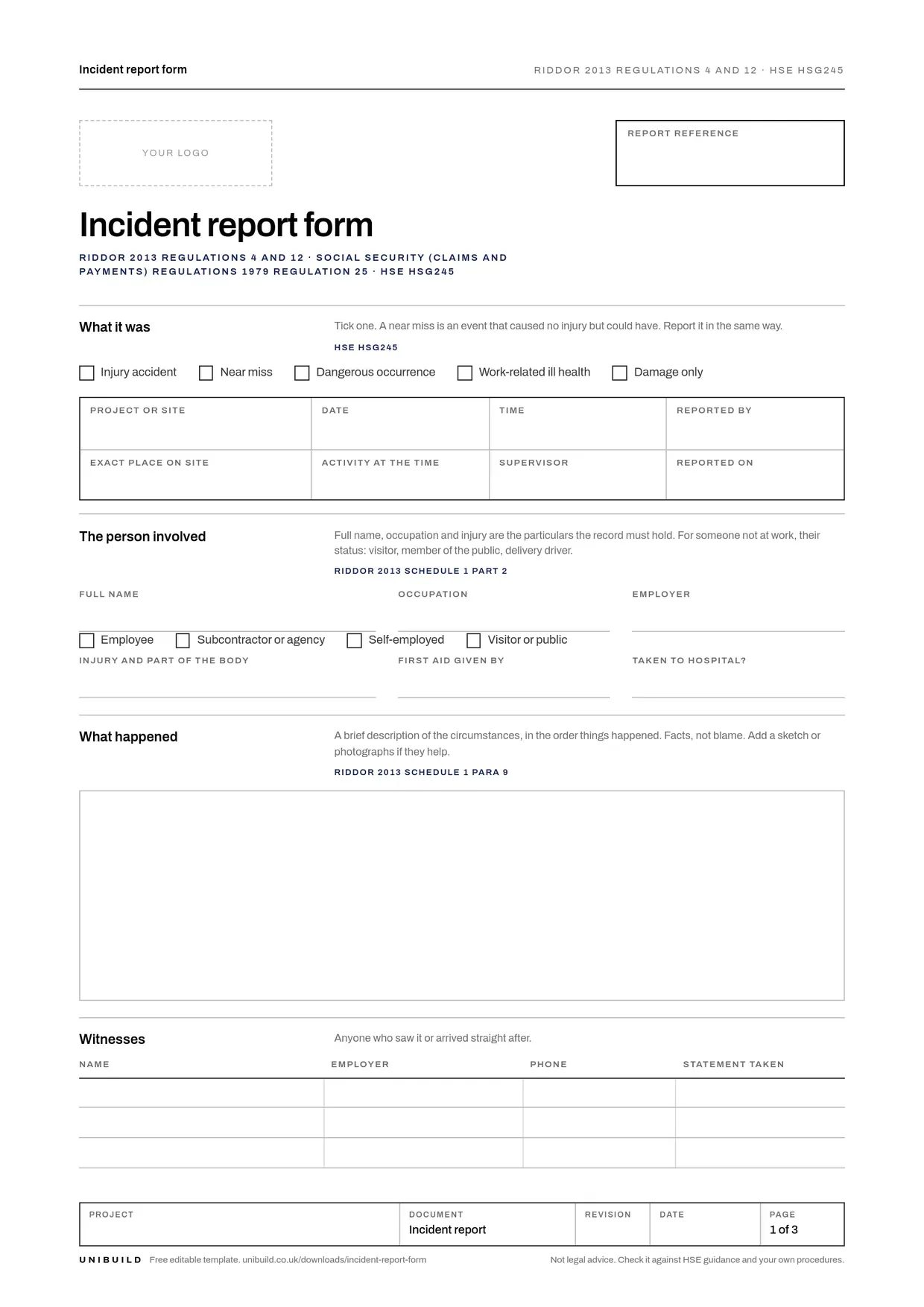
An accident, near miss or dangerous occurrence: the person, the injury, witnesses and first aid, a RIDDOR check against the specified injuries and the seven-day rule with the deadlines, then the investigation, causes and actions.
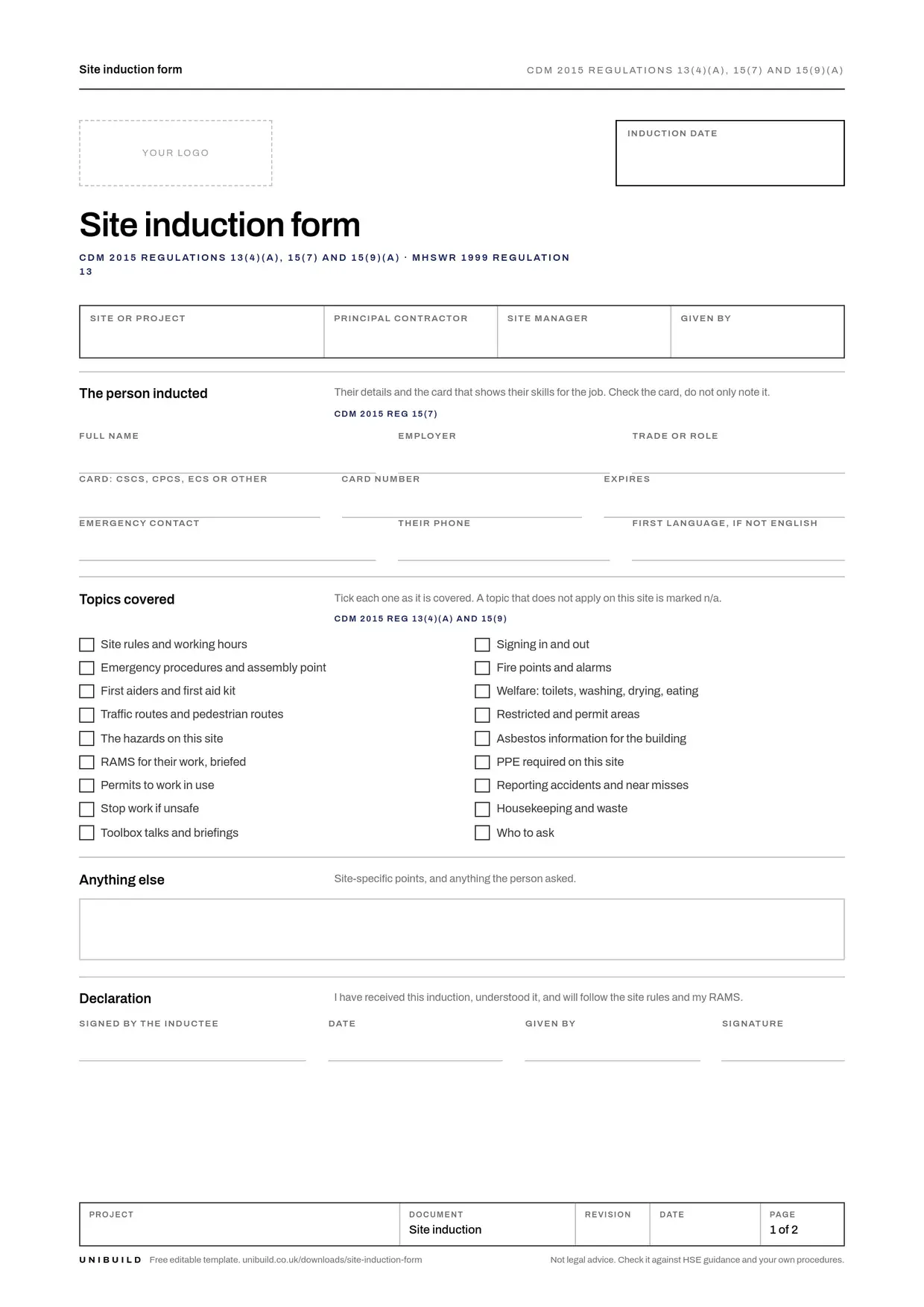
One person’s induction: their details, card and emergency contact, eighteen topics ticked as they are covered, the declaration signed by both, and an induction register for the site.
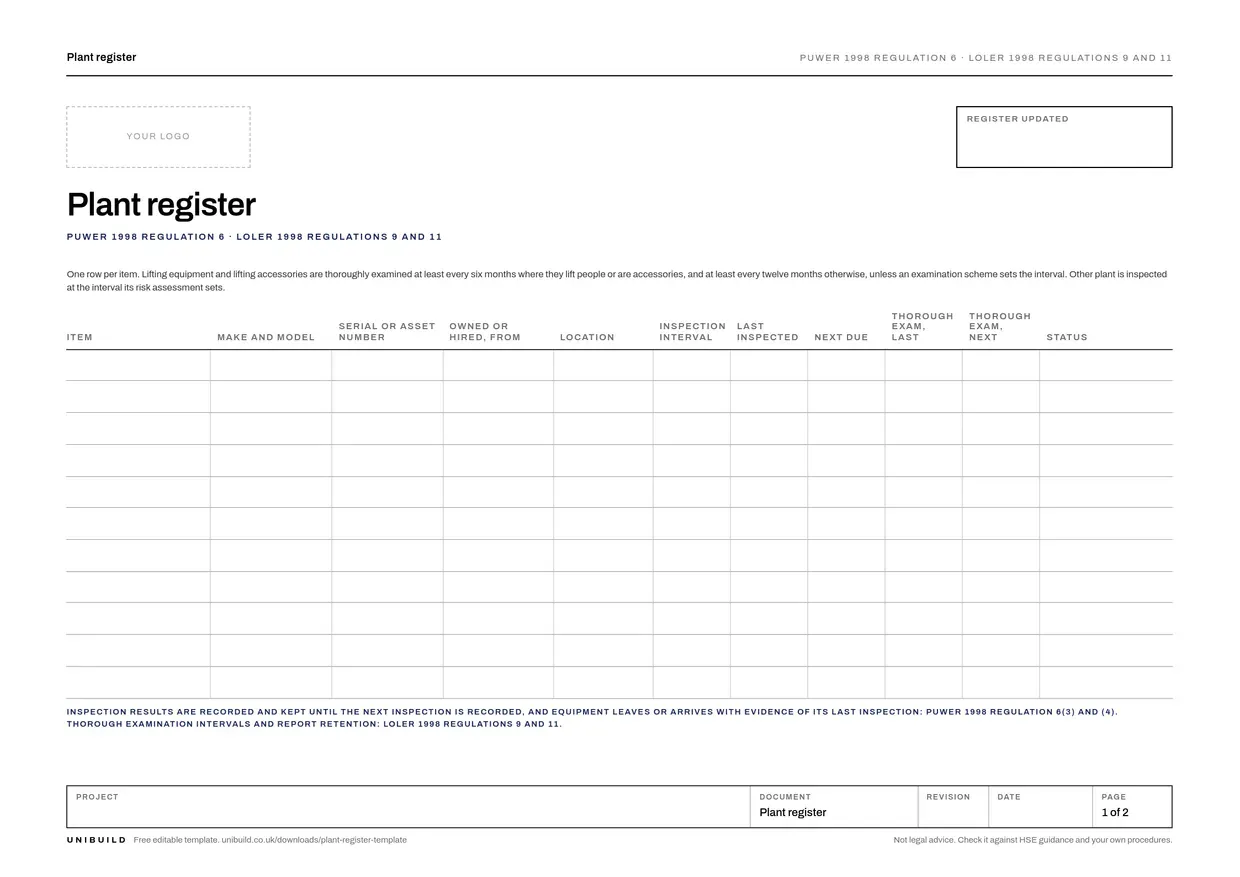
Every item of plant, owned or hired, with its serial number, location, PUWER inspection interval and dates, LOLER thorough examination dates and status, plus an inspection log.
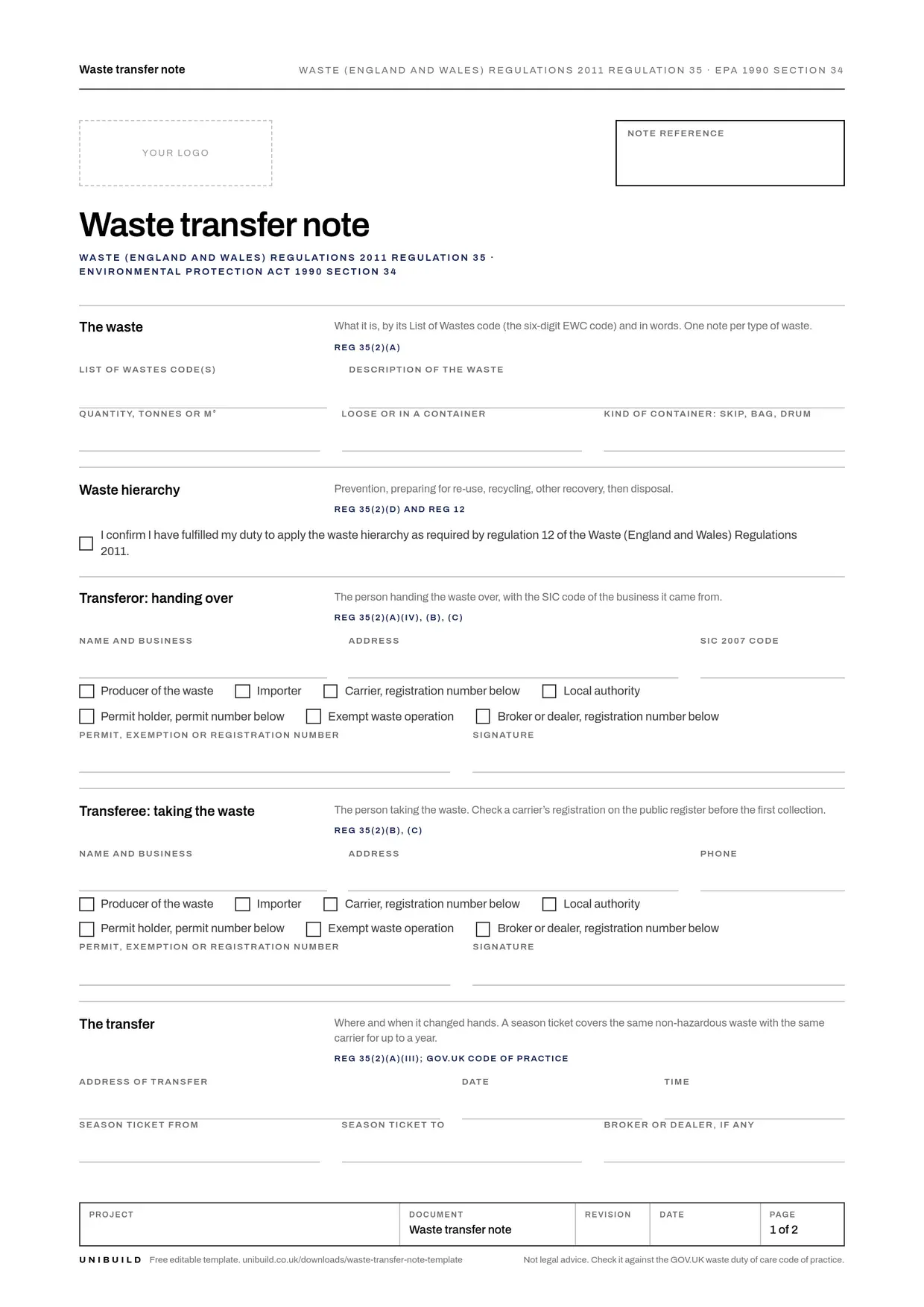
Every item the regulations ask for on a transfer of non-hazardous waste: the List of Wastes code, quantity and container, the SIC code, both parties’ roles and registration numbers, the waste hierarchy declaration, signatures and a season ticket option.
Risk assessments and method statements already filled in for one trade or one hazard: the hazards and controls, the sequence of work, PPE, permits and rescue. Edit them for your site in PDF or Word.
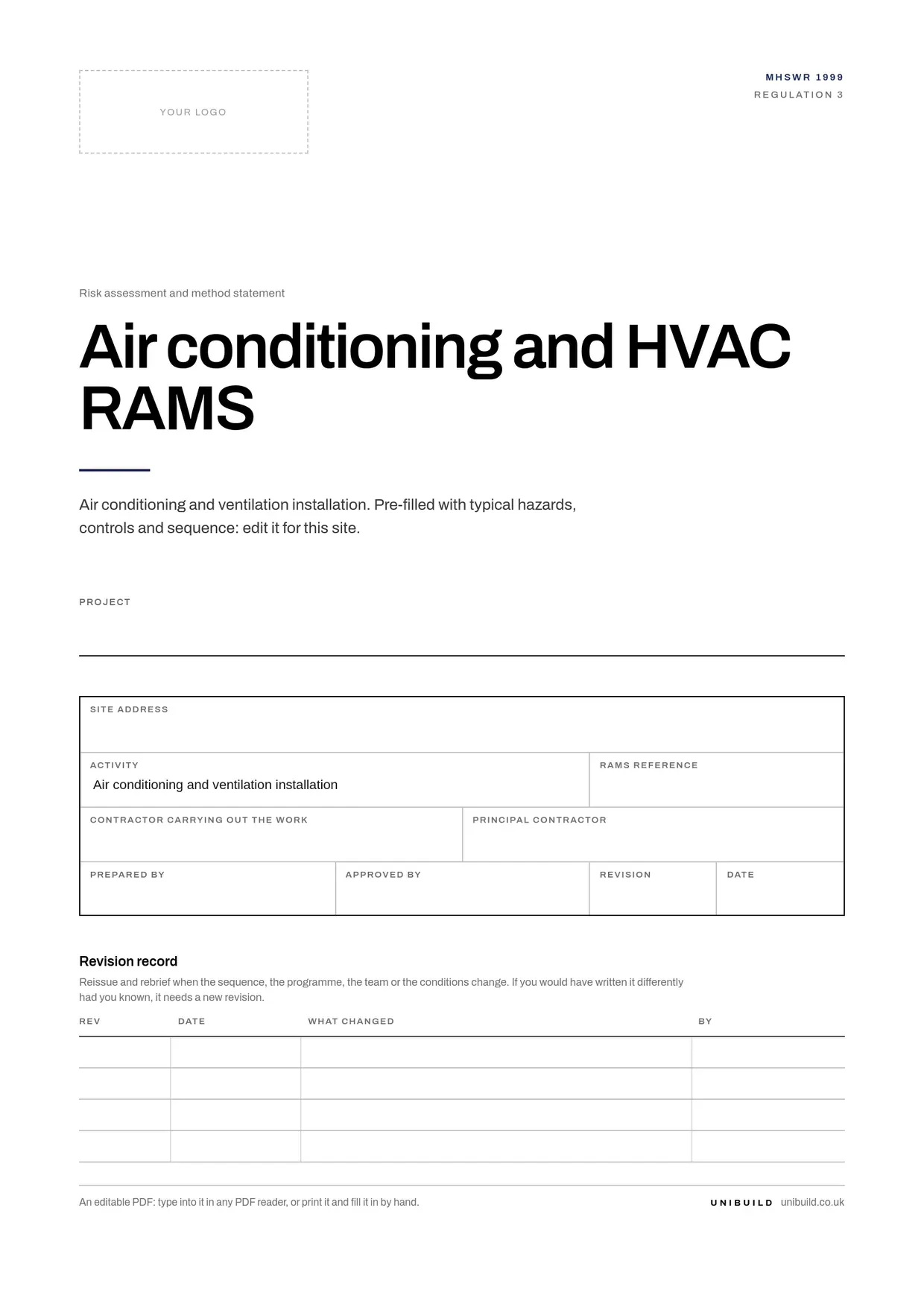
Units and ductwork at height, refrigerant handling, brazing, roof plant and the electrical connection.
Finding asbestos before work starts, deciding whether work is licensed, and controlling non-licensed work.
Laying brick and block from scaffold, heavy blocks, mortar, cutting dust and new walls in wind.
First and second fix, door and fire door installation, saws, wood dust and work from steps and platforms.
Cameras, access control and intruder alarms: ladders and MEWPs, poles, cable routes, live circuits and occupied premises.
Commercial and site cleaning, jet washing and window cleaning: chemicals, slips, ladders and lone work.
Formwork, reinforcement, pump and skip pours, wet cement, power floating and curing, with the sequence for each pour.
Manholes, tanks, voids and chambers: avoiding entry, a safe system of work, gas testing and rescue.
Hazardous substances on site: dusts, solvents, cement, resins and fume, assessed and controlled.
Asbestos surveys and isolations, the demolition sequence, stability, dust, noise and exclusion zones.
Metal stud, plasterboard and suspended ceilings: board handling, cutting dust, podiums and fire-rated walls.
Silica, wood and other construction dust: on-tool extraction, water suppression, RPE, face fit testing and health surveillance.
Safe isolation, live work, testing and inspection, and working near other trades.
Planned and reactive maintenance in occupied buildings: access, isolations, plant rooms, roofs and working alone.
Cabling and fixing devices at height, live systems in occupied buildings, isolations, keeping fire cover and commissioning.
Trained operators, daily checks, routes, overturning, people on foot and lifting with a telehandler.
Taking out old frames, handling heavy glass units, fixing at height, vacuum lifters and sealants.
Excavations, buried services, plant, trench support and inspections at the start of each shift.
Welding, cutting, grinding and torch-on work: permits, fire watch, fume and gas cylinders.
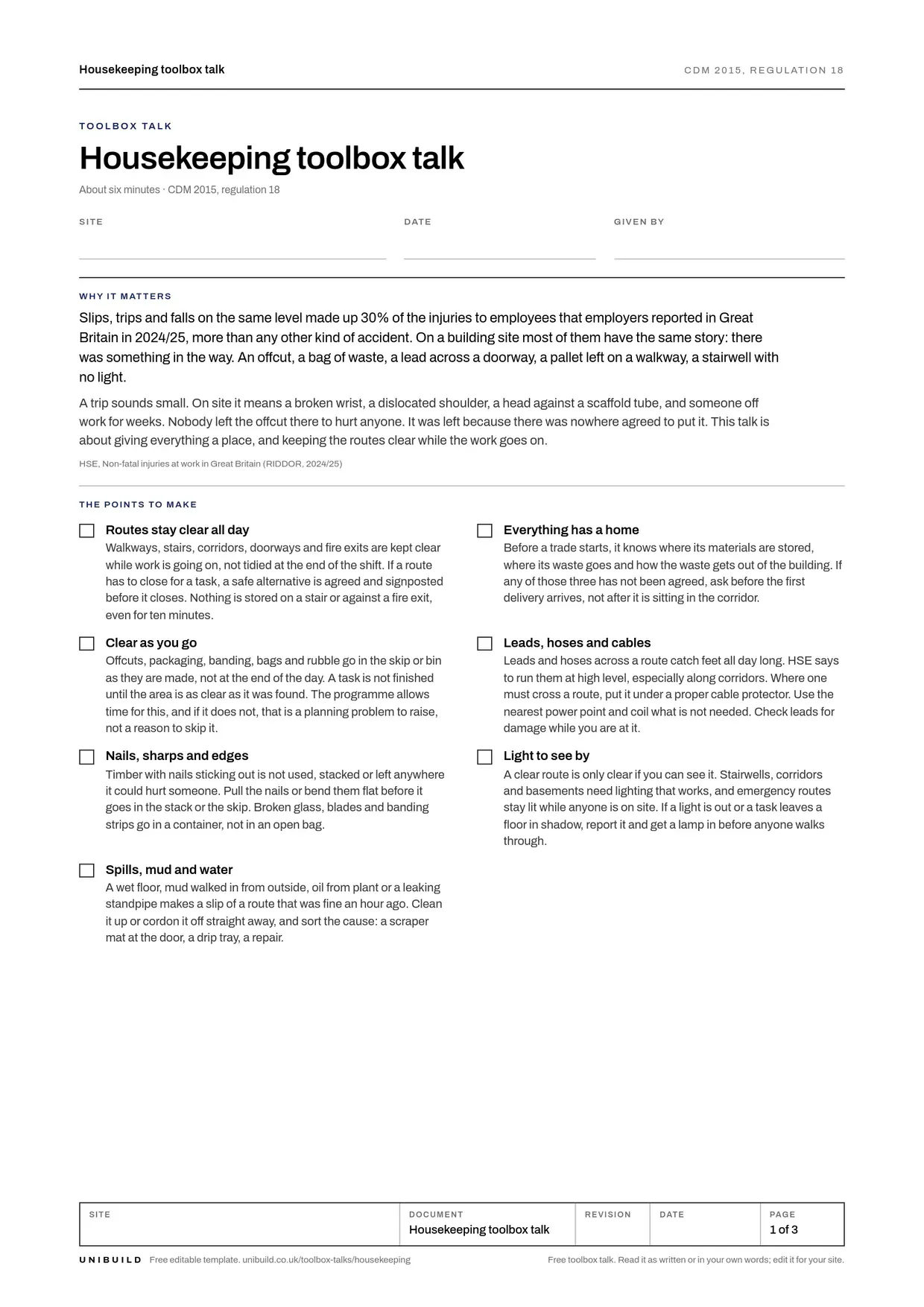
Clear routes, waste, stored materials, trailing leads, lighting and wet floors, checked every day.
Loft, cavity, internal and external wall insulation: fibres and foams, roof voids, ventilation and fire.
Post holes, post drivers and buried services, mowers, strimmers and cut-off saws, paving slabs and herbicides.
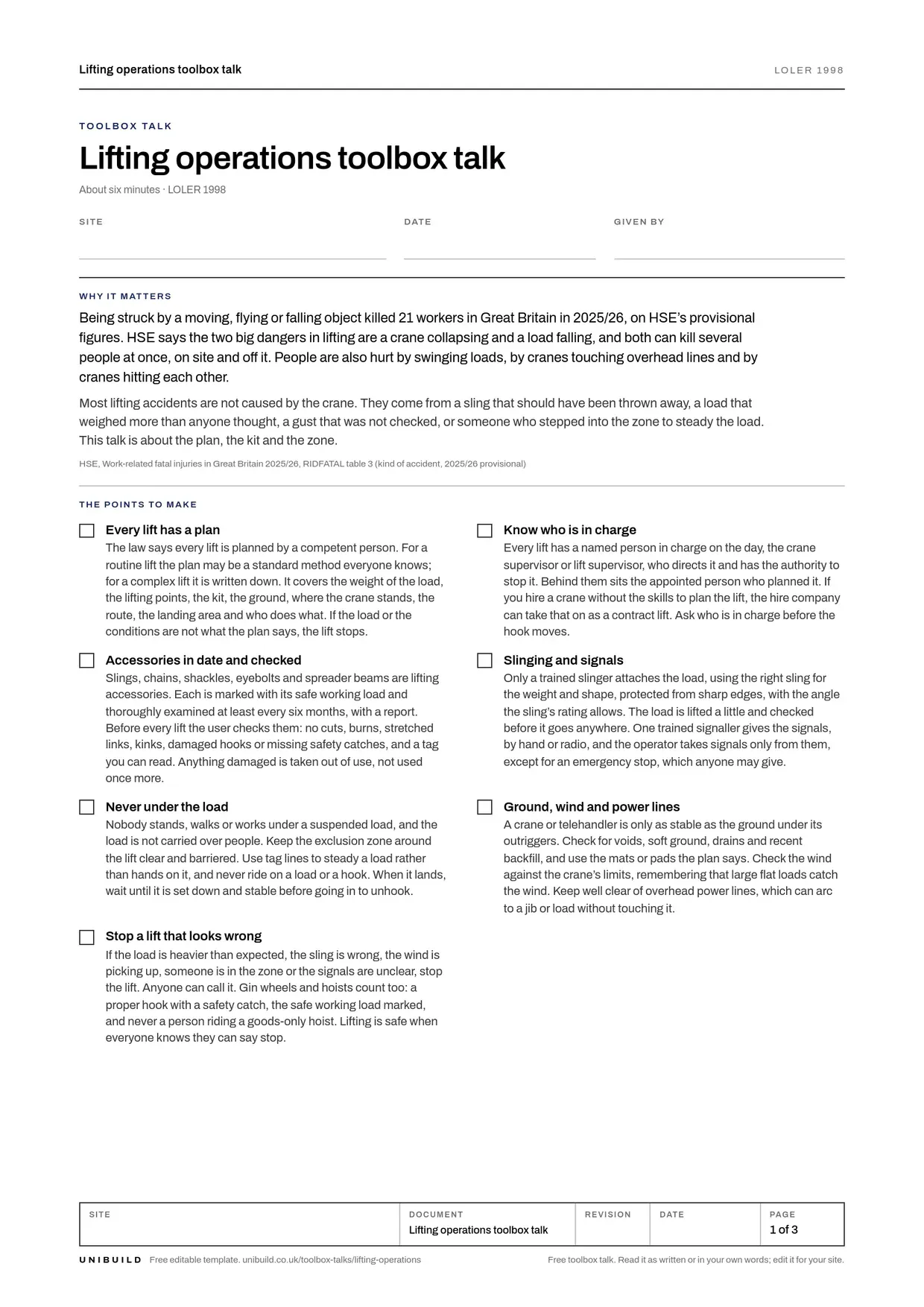
Planning a lift, the appointed person, accessories, thorough examination and lifting near people.
People working alone on site, in empty buildings and out of hours, with check-ins and a plan if they go quiet.
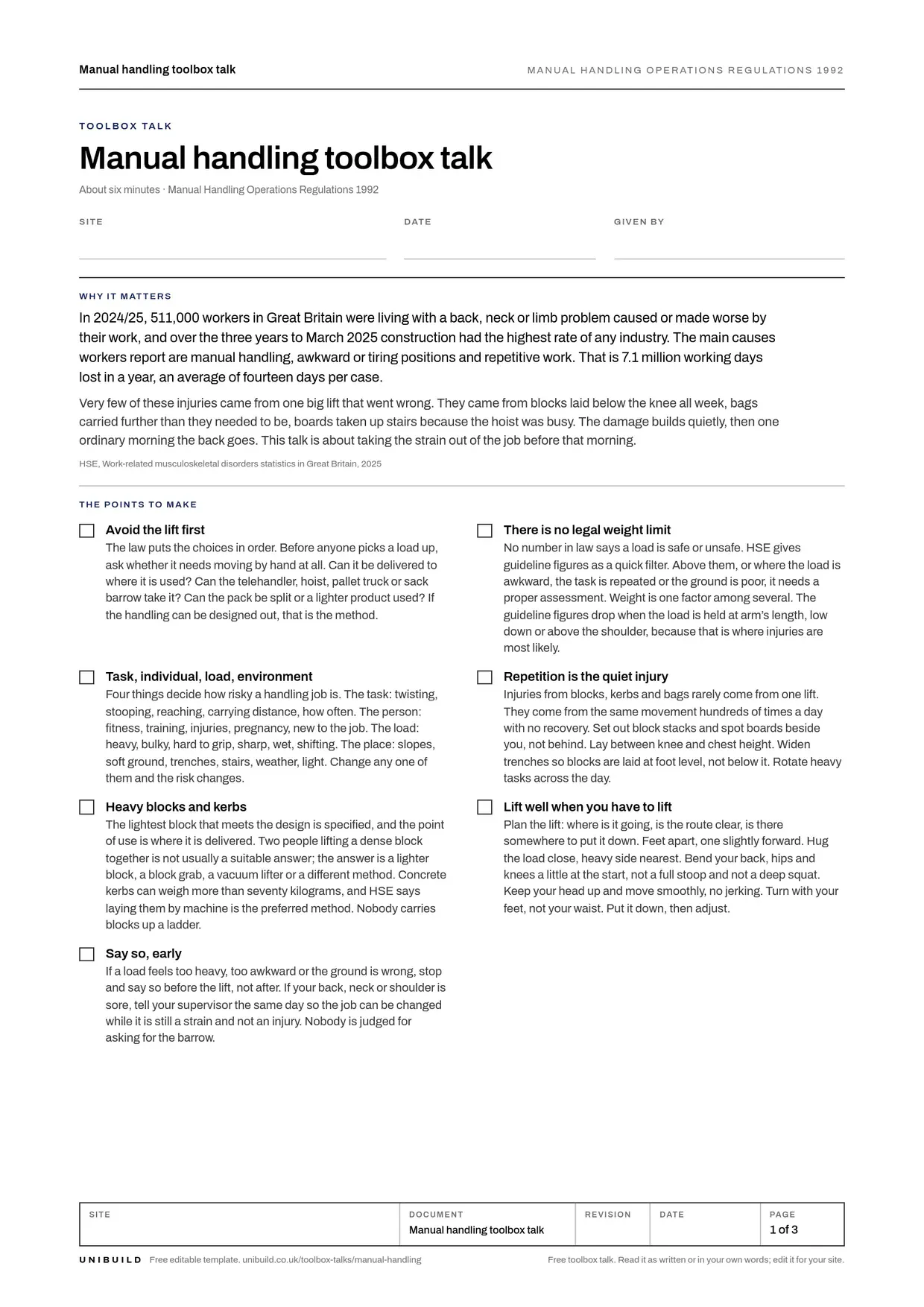
Lifting, carrying, pushing and pulling, assessed by task, individual, load and environment.
Cherry pickers and scissor lifts: ground, overhead hazards, entrapment, harnesses and rescue from the platform.
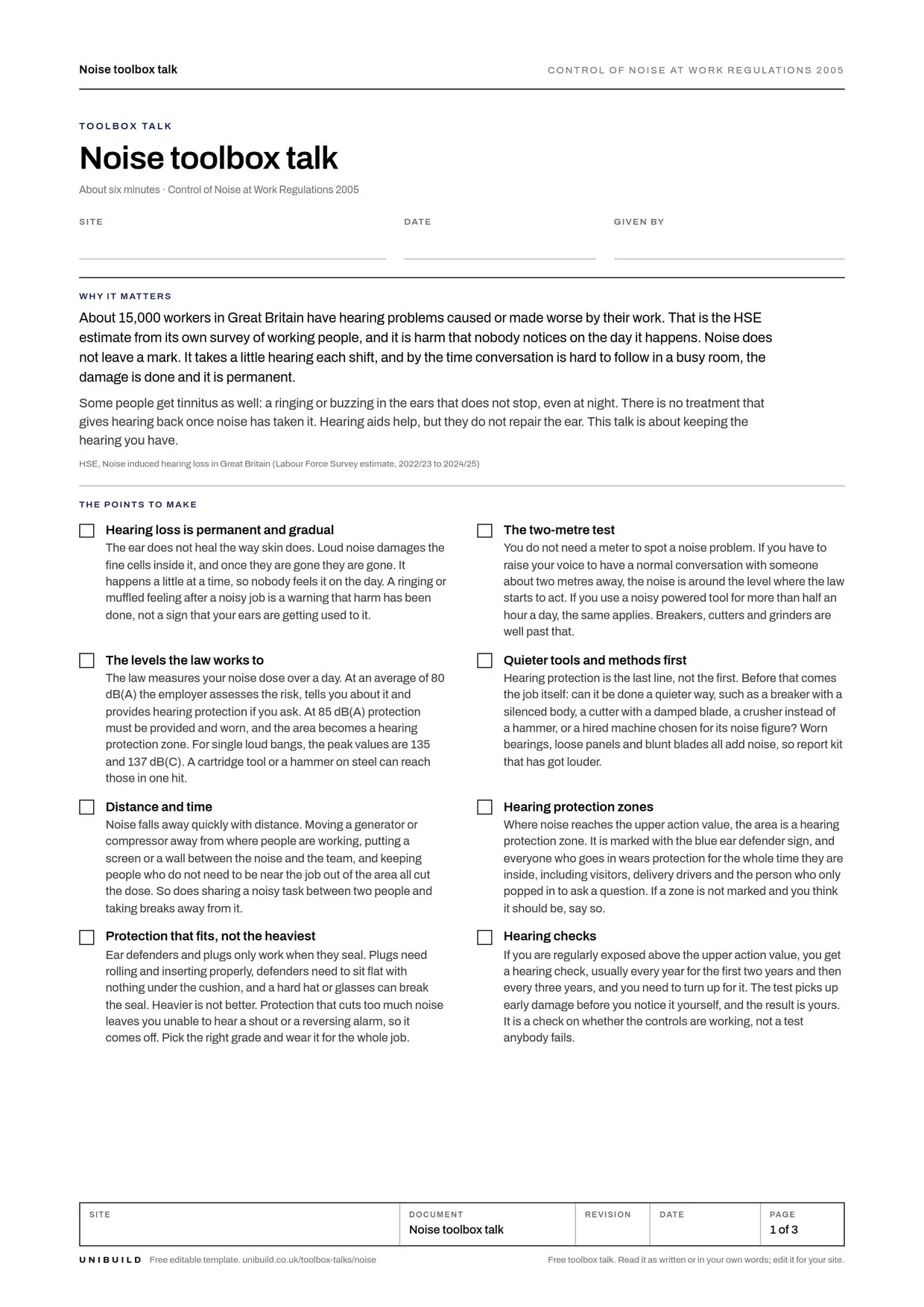
Noise exposure and hand-arm vibration from tools, measured against the action and limit values.
Access equipment, solvents and spray, old lead paint, dust from preparation and occupied buildings.
Rodenticides and insecticides, lofts and voids, bird work at height and disease from droppings.
Mini diggers, excavators and dumpers: trained operators, checks, quick hitches, overturning, people on foot and buried services.
Hop-ups and platforms, mixing and spraying, render on scaffold, lime and cement, and dust from preparation.
Soldering and brazing, gas work, unvented systems, lofts and occupied homes.
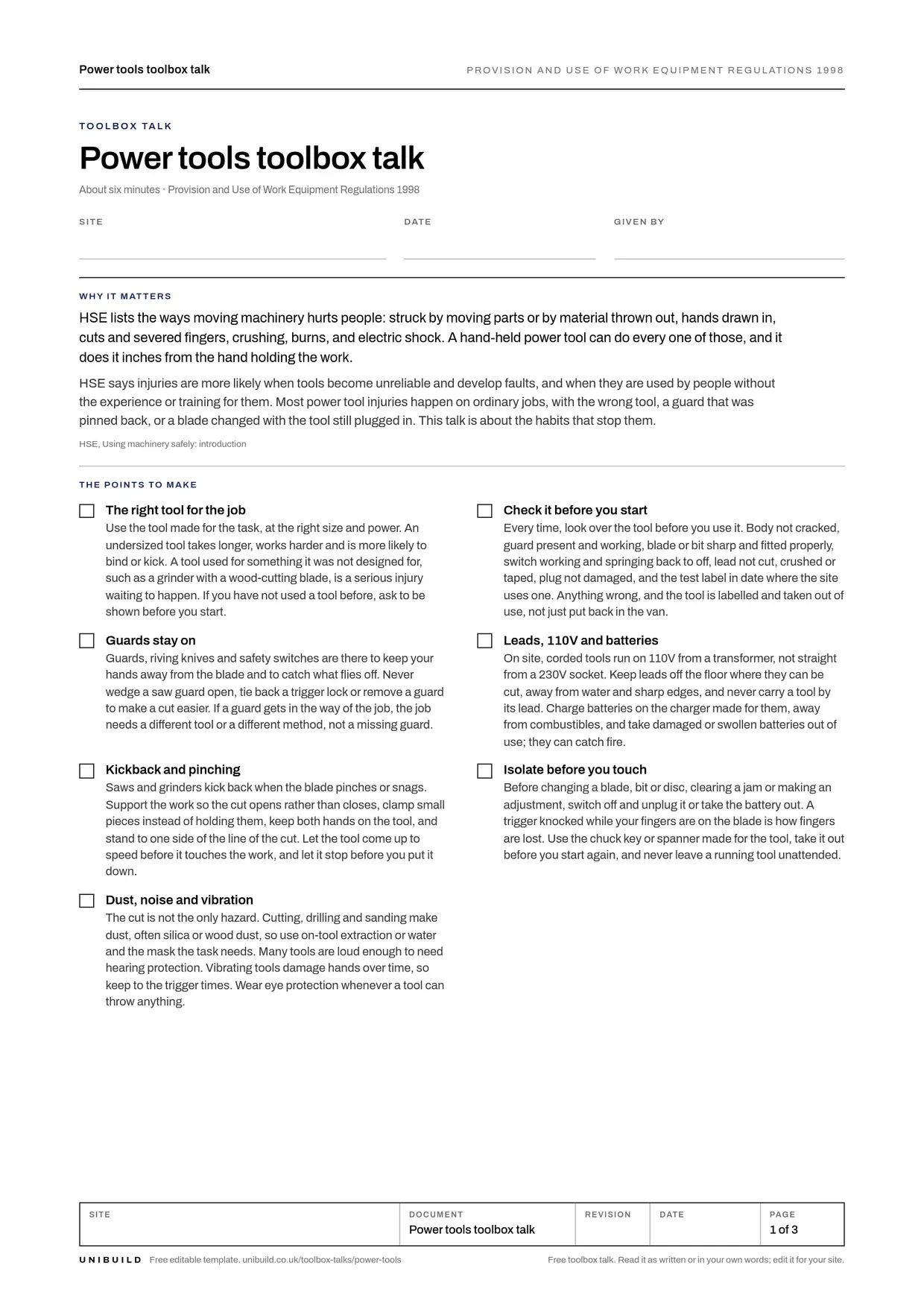
Saws, grinders, drills, fixing tools and hand tools: guarding, 110V and battery supply, kickback, disc speeds and checks.
Work on or near the line: possessions and protection, track safety, plant, overhead lines and conductor rail.
Lofts, extensions and alterations in occupied homes: temporary support, asbestos, services, dust and neighbours.
Pitched and flat roofs, fragile surfaces, edge protection, hot work and getting materials up safely.
Two-rope systems, anchors, rescue from the rope, exclusion zones below and the weather.
Erecting, altering and dismantling tube and fitting and system scaffold, with handover and inspection.
Roof access and edge protection, lifting panels, DC that cannot be switched off, and battery storage.
Structural steel: delivery and lifting, bolting up at height, temporary bracing, MEWPs, nets and decking.
Site hoardings, props, falsework and excavation support: design, checks before loading, wind and the public.
Kneeling work, adhesives and screeds, cutting tile and stone, heavy rolls and boards, and floors others walk on.
Vehicles and people on site and at road works: routes, signallers, reversing, signing and lighting.
Climbing and aerial rescue, chainsaws, felling and dismantling, chippers and the public below.
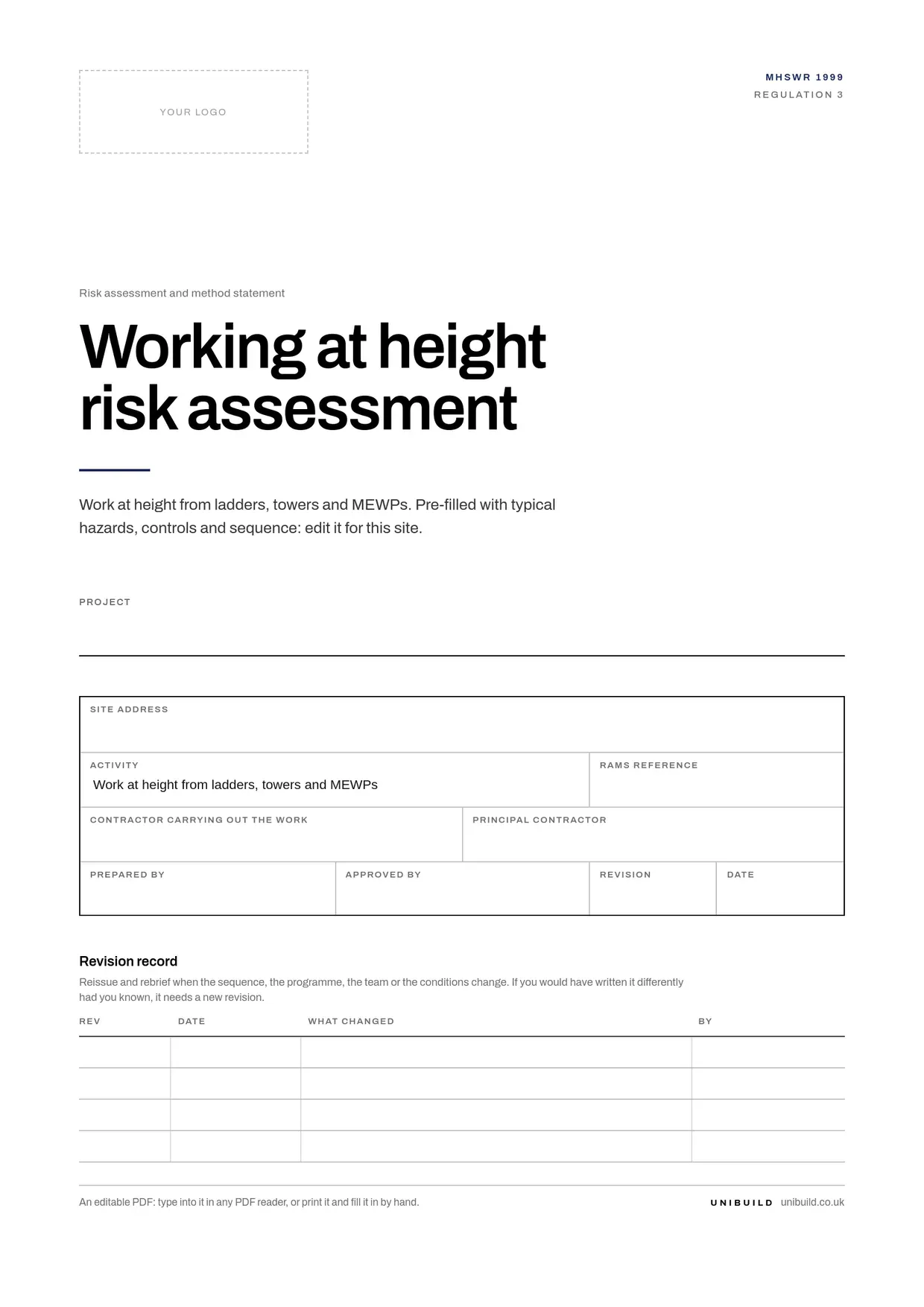
Ladders, towers, MEWPs, scaffolds and roofs, chosen and controlled in the order the law sets.
Toolbox talks written out to be read aloud in five to ten minutes, each with an attendance record on its last page, in PDF and Word. With them, the blank talk template, the attendance sheet and the site register.
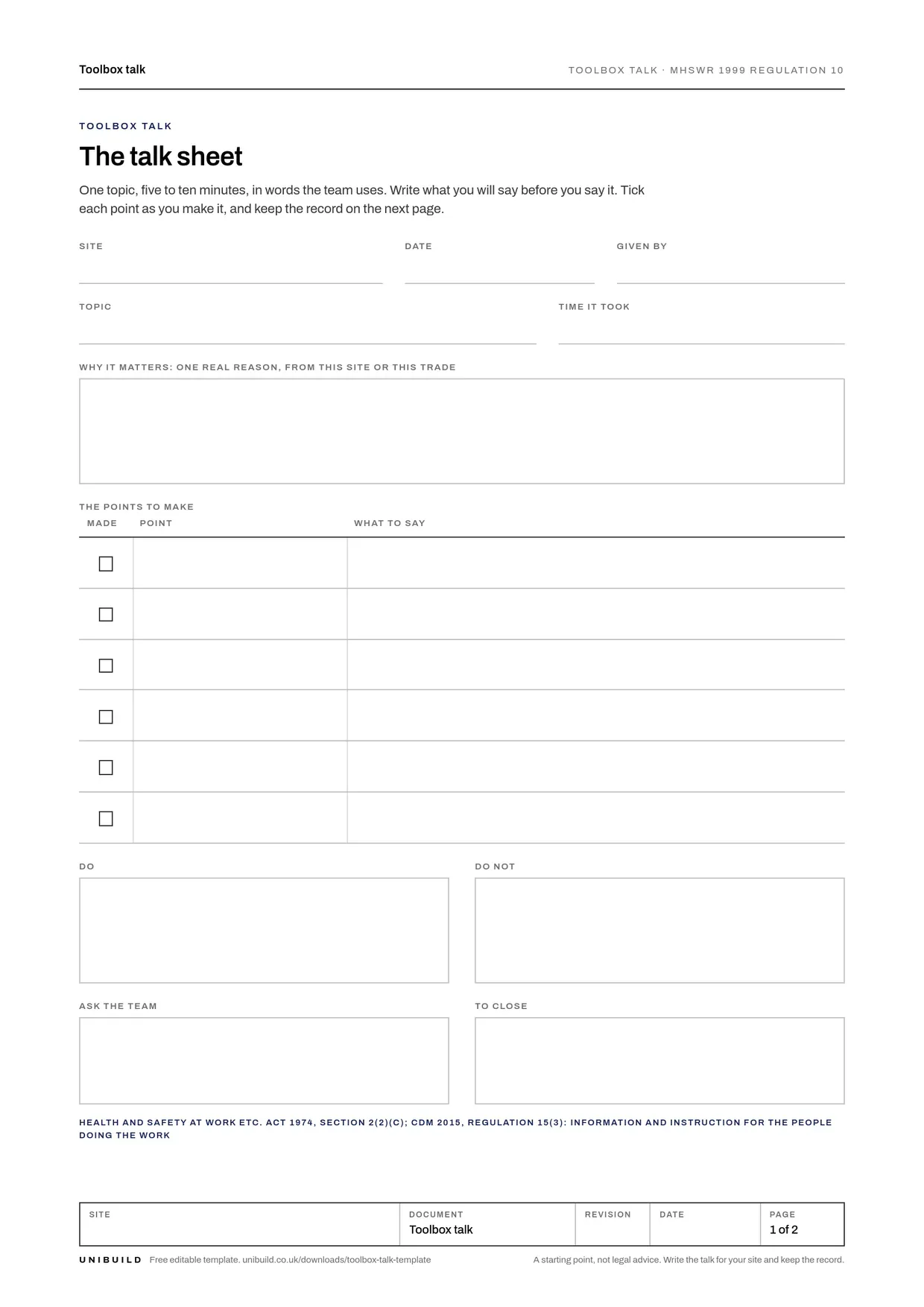
A blank talk sheet: the topic, why it matters, the points to make with a tick box each, do and do not, questions and the close, then an attendance record with signatures, questions raised and actions.
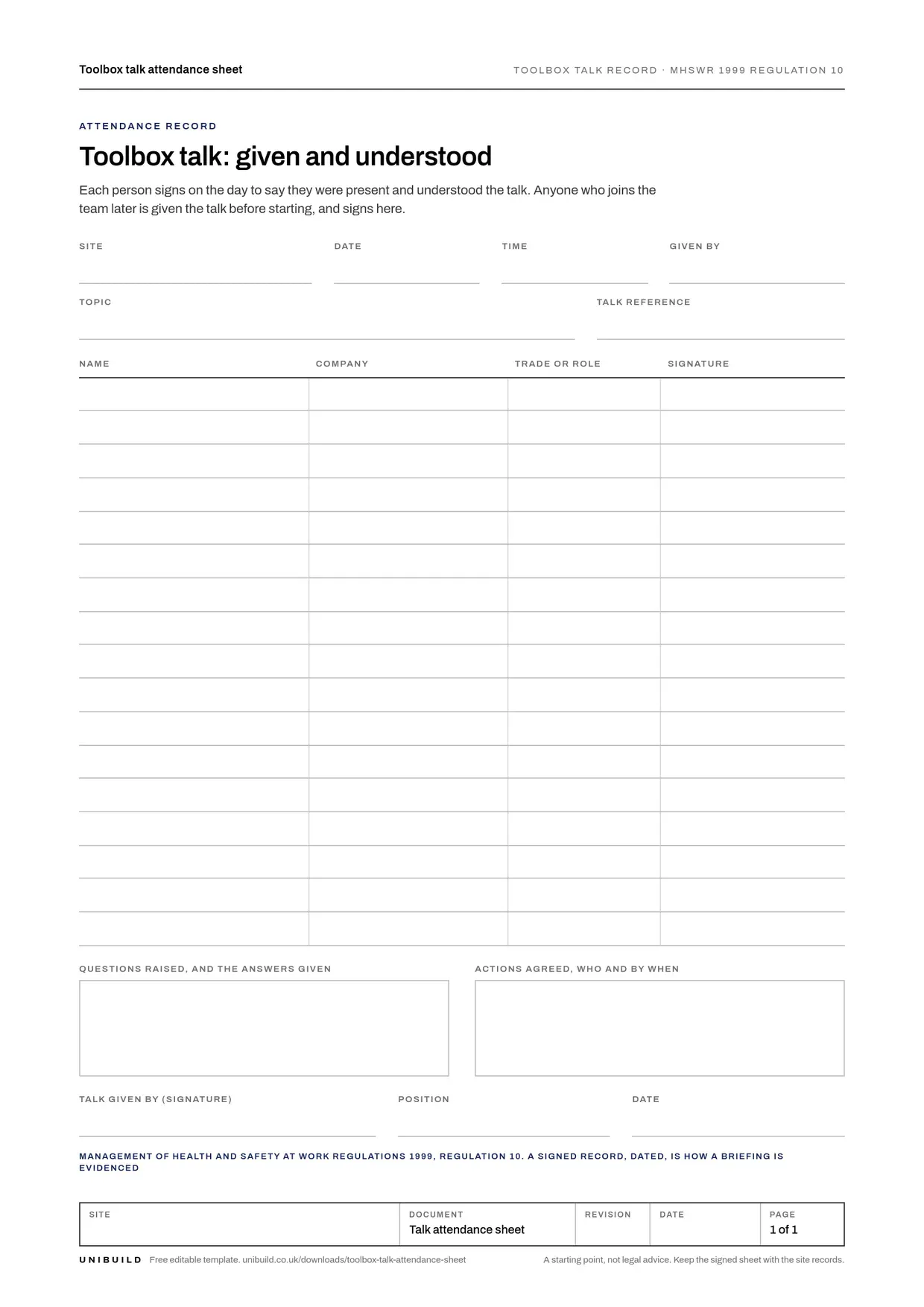
The sign-off sheet on its own: site, date, time, topic and who gave it, twenty rows of names and signatures, the questions raised, the actions and sign-off.
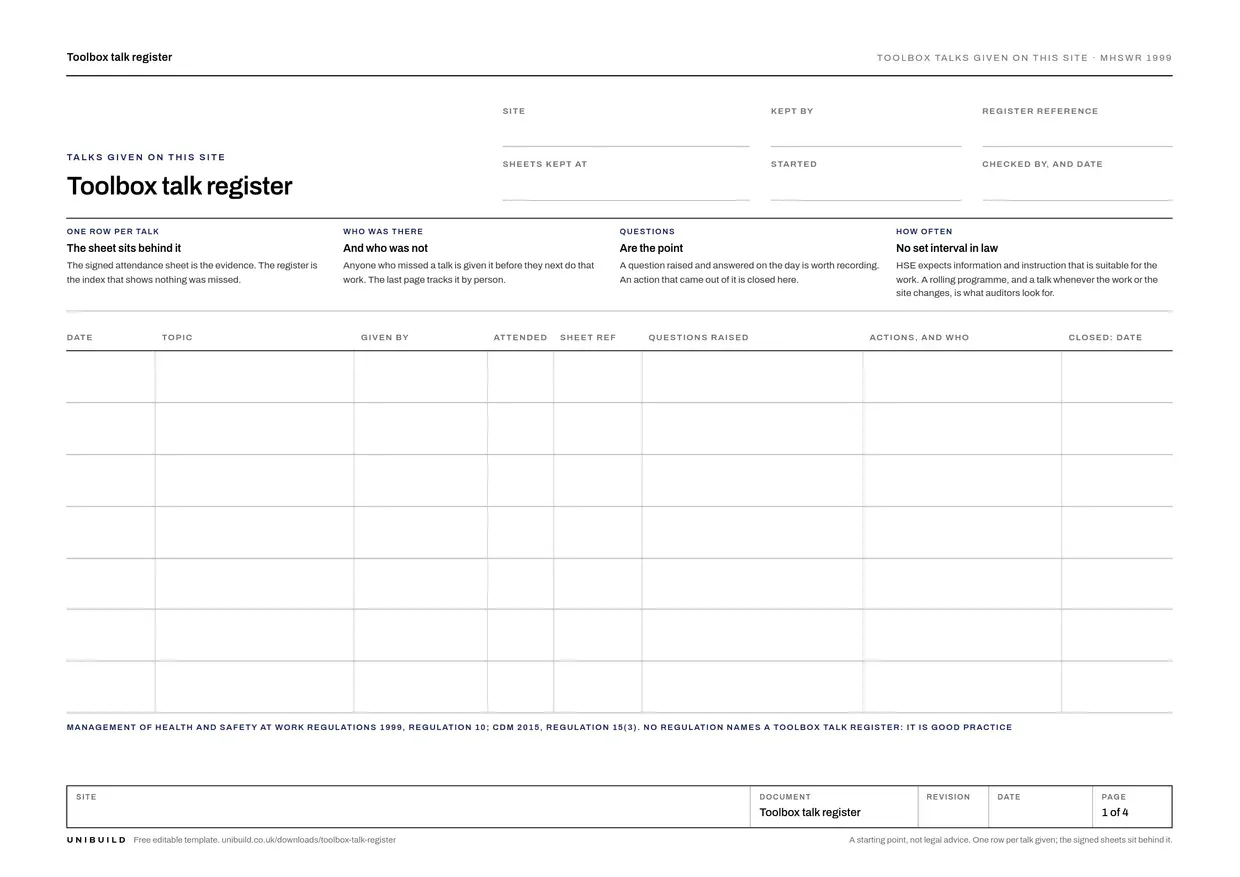
One row per talk given on the site, with the date, topic, who gave it, how many attended and the sheet reference, plus a planner for the year and a page of who has had which talk.
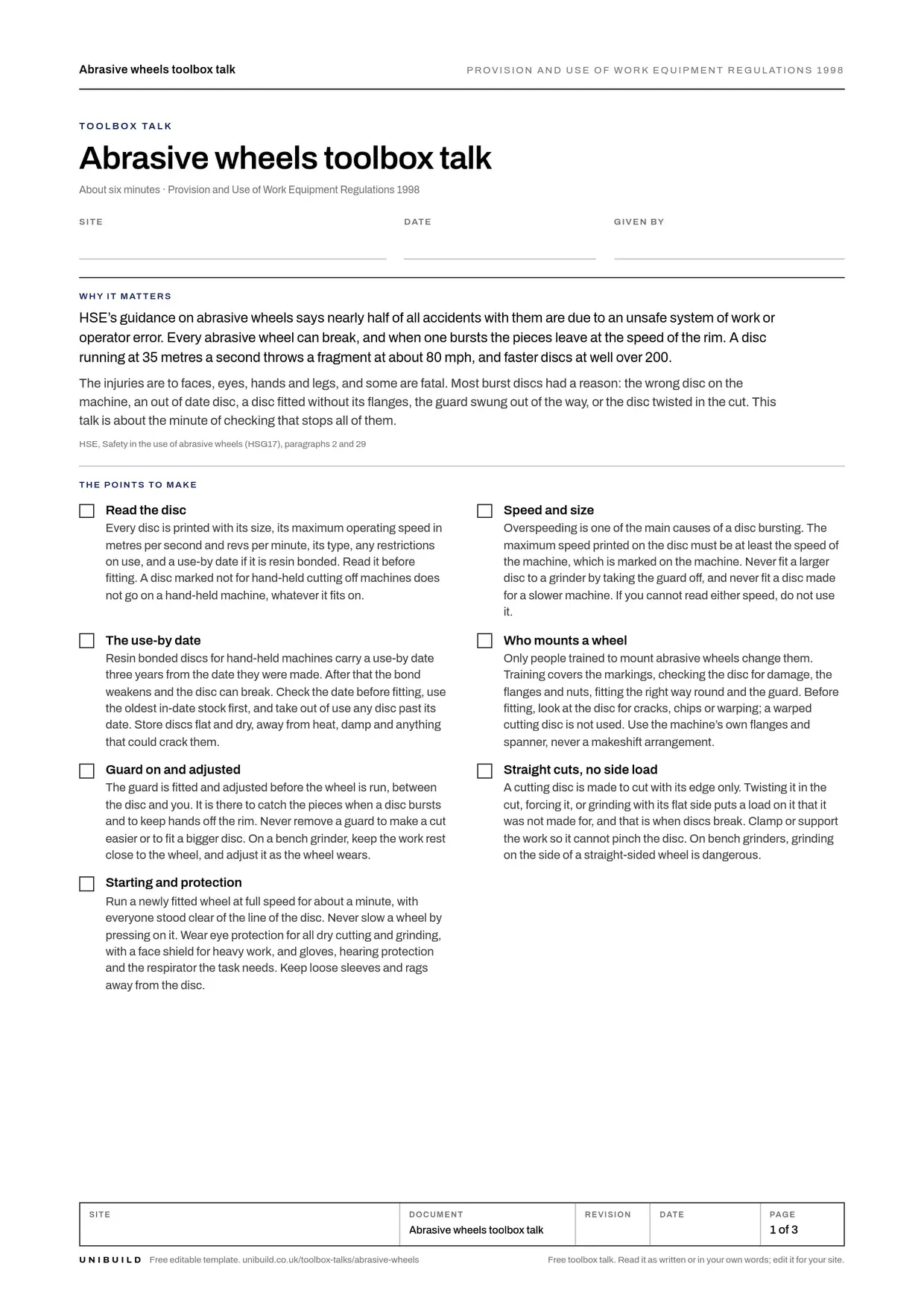
Disc speed and size, who mounts a wheel, the guard, dust and sparks, and why a disc that bursts is so dangerous.
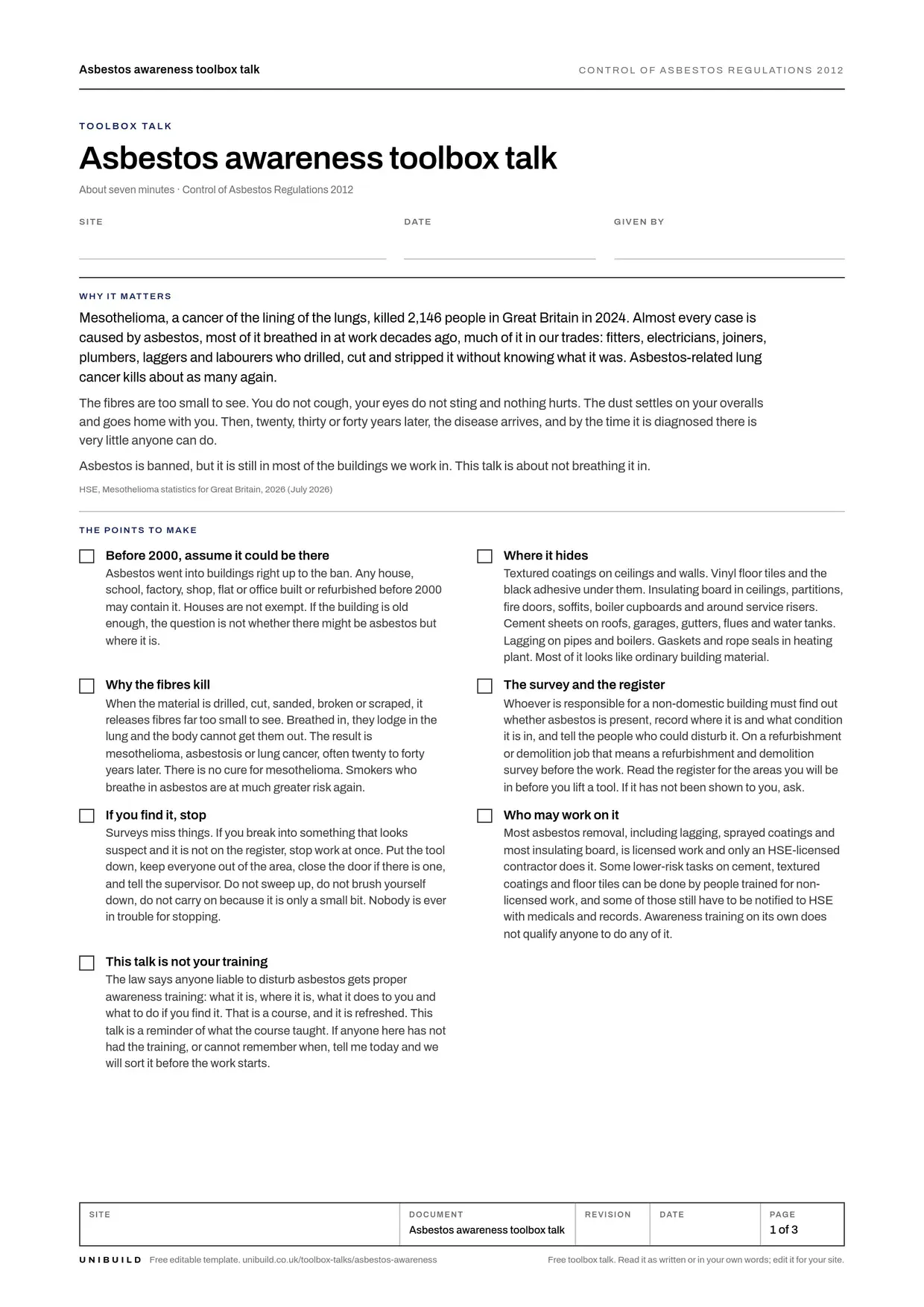
Where asbestos is still found, why disturbing it kills, the survey, and stop work if you find something.
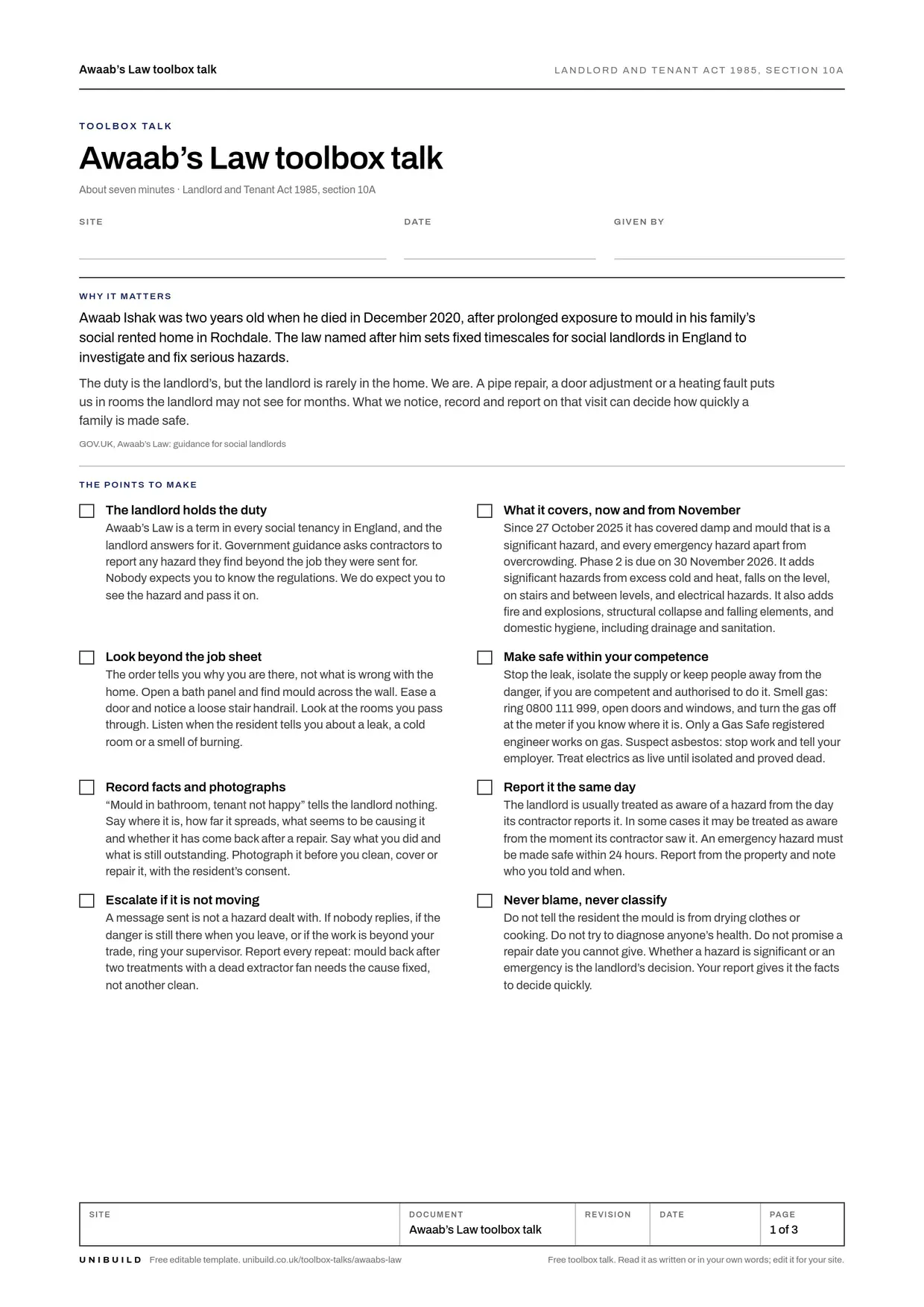
For engineers and trades in social rented homes: look beyond the job sheet, make safe, record the facts and report the same day.
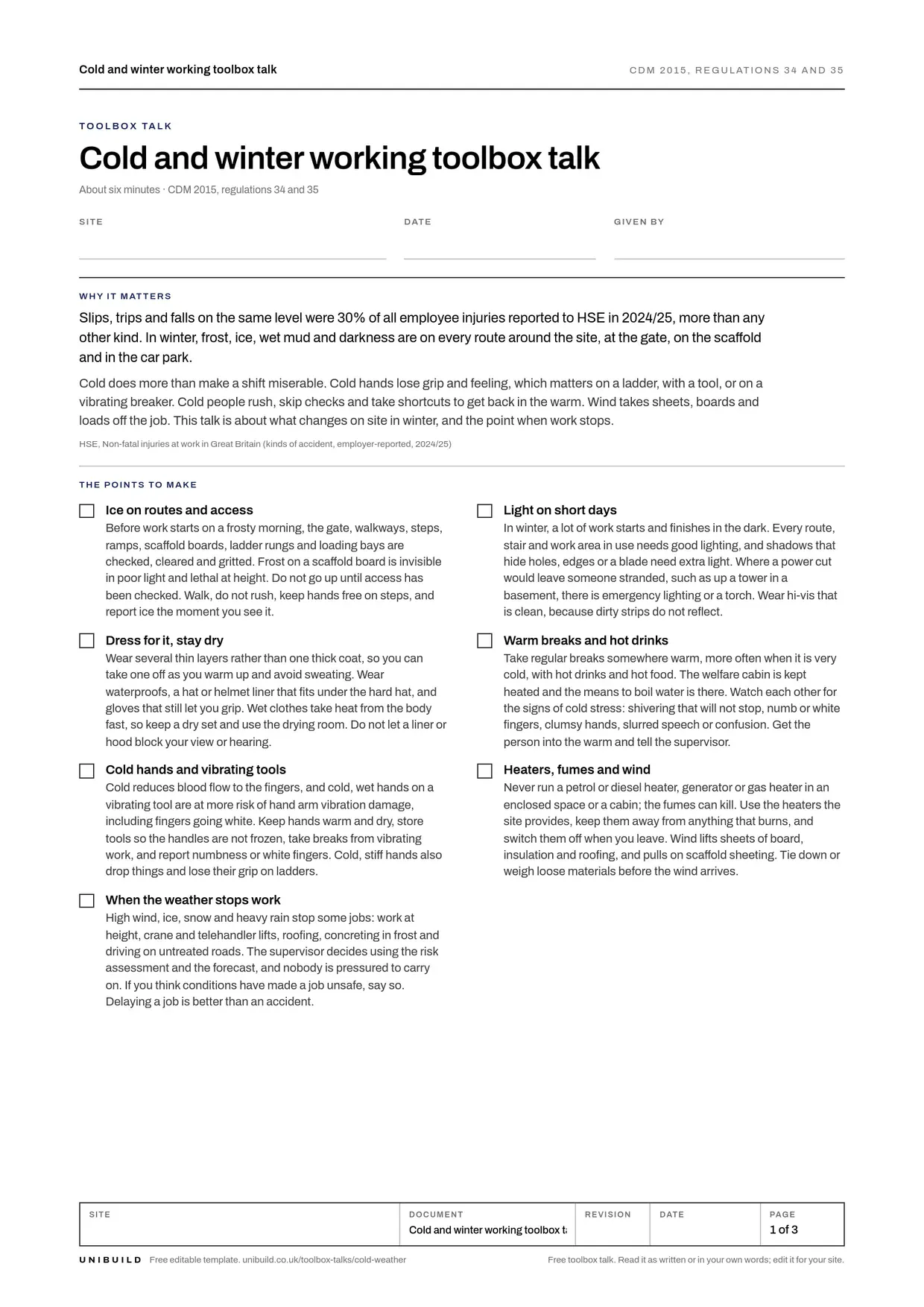
Ice, short days, cold hands and wet clothing: what changes on site in winter, and when work stops.
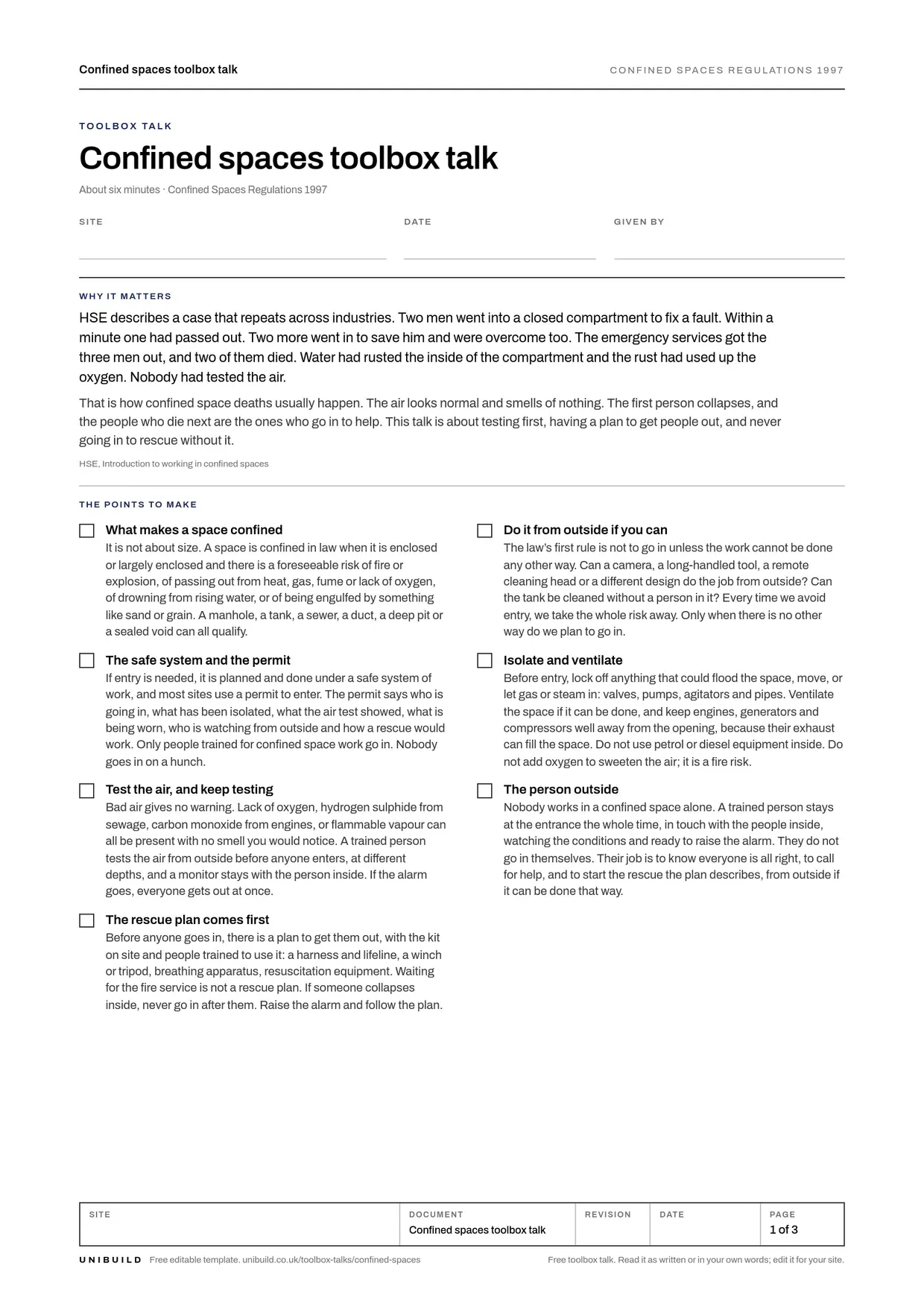
What makes a space confined, why rescuers die too, the permit, the gas test and the rescue plan before anyone goes in.
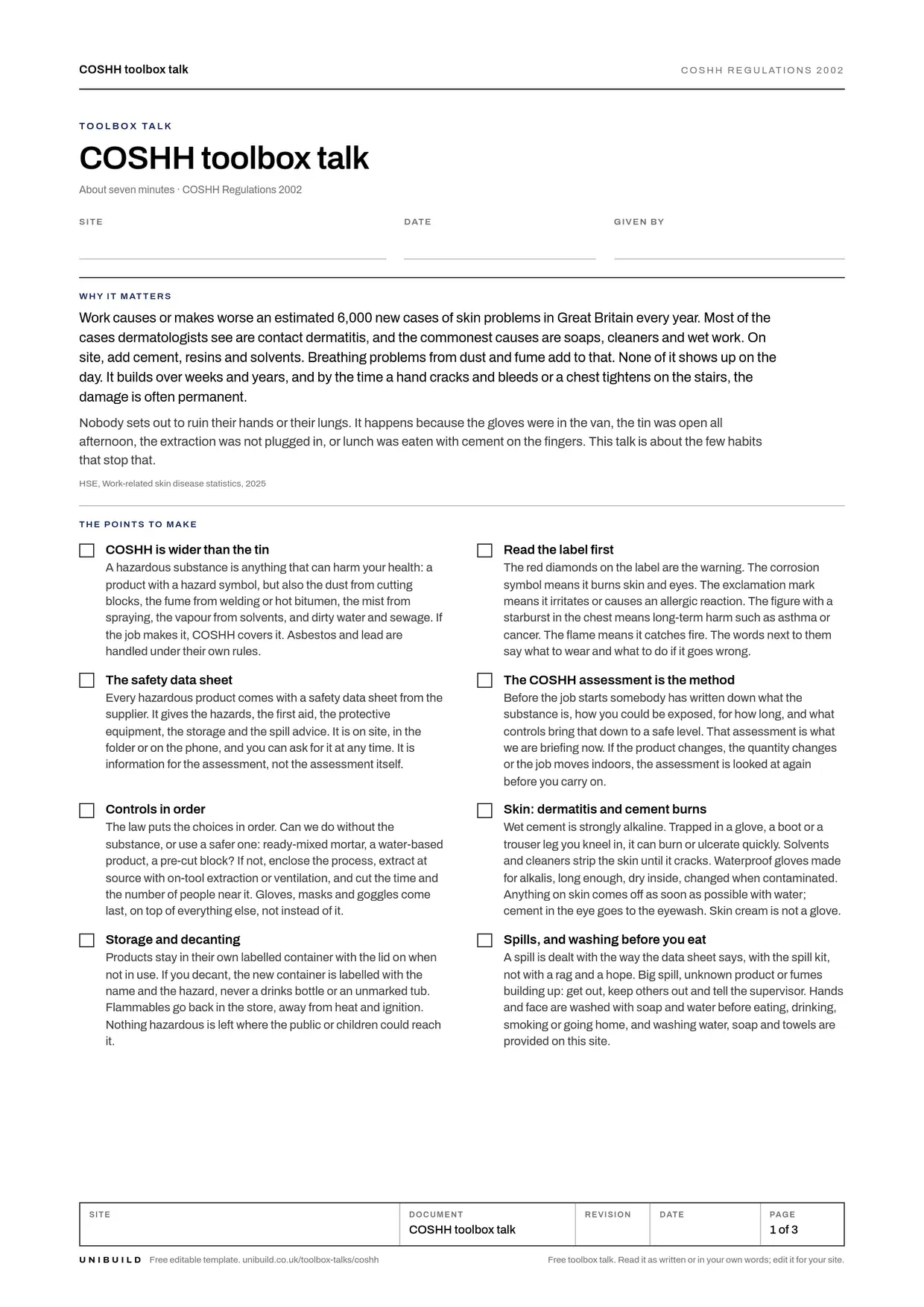
Hazardous substances on site: labels, data sheets, the assessment, controls, skin and what to do in a spill.
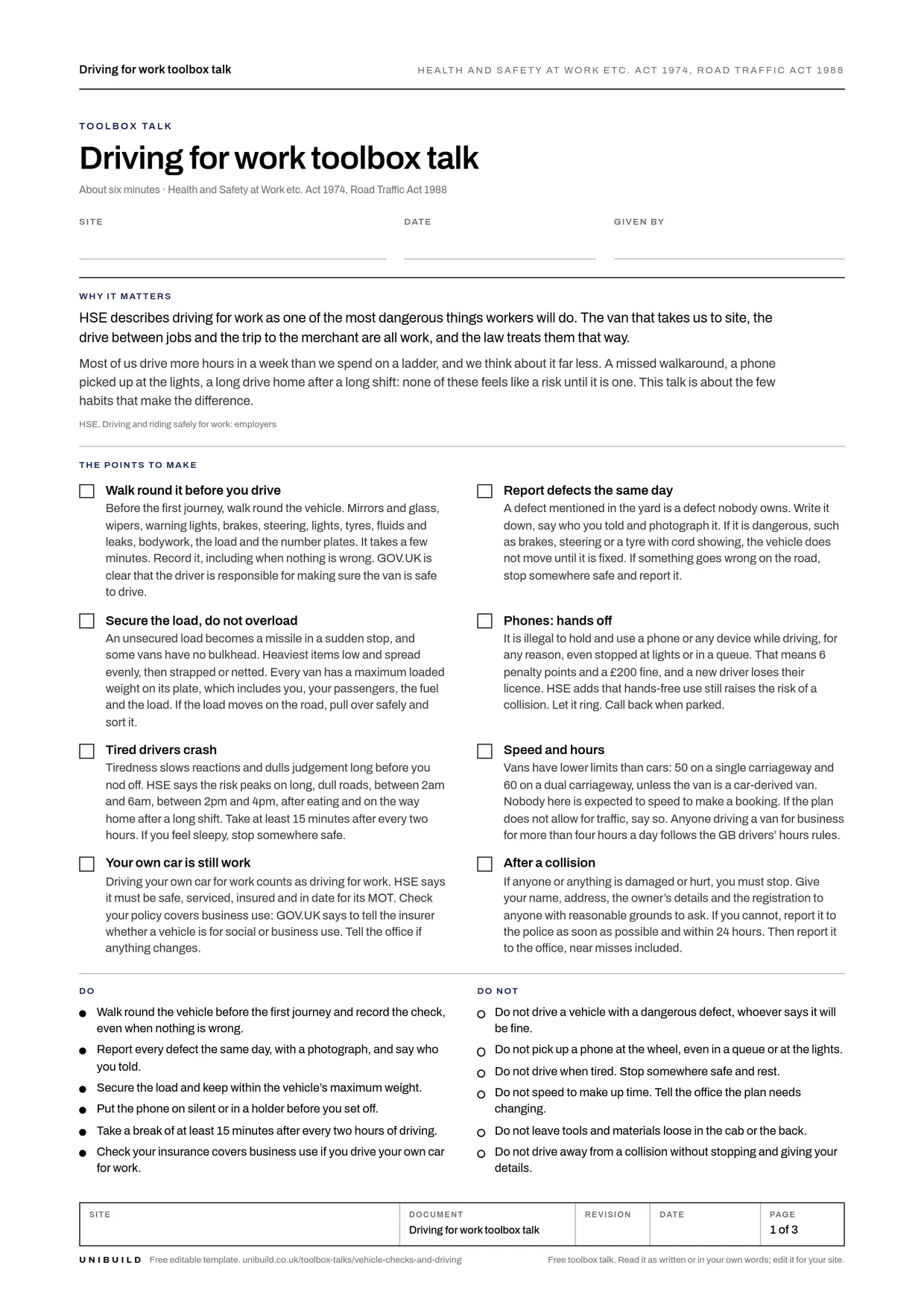
Vehicle checks before the journey, defects, loads, phones, tiredness, speed and what to do after a collision.
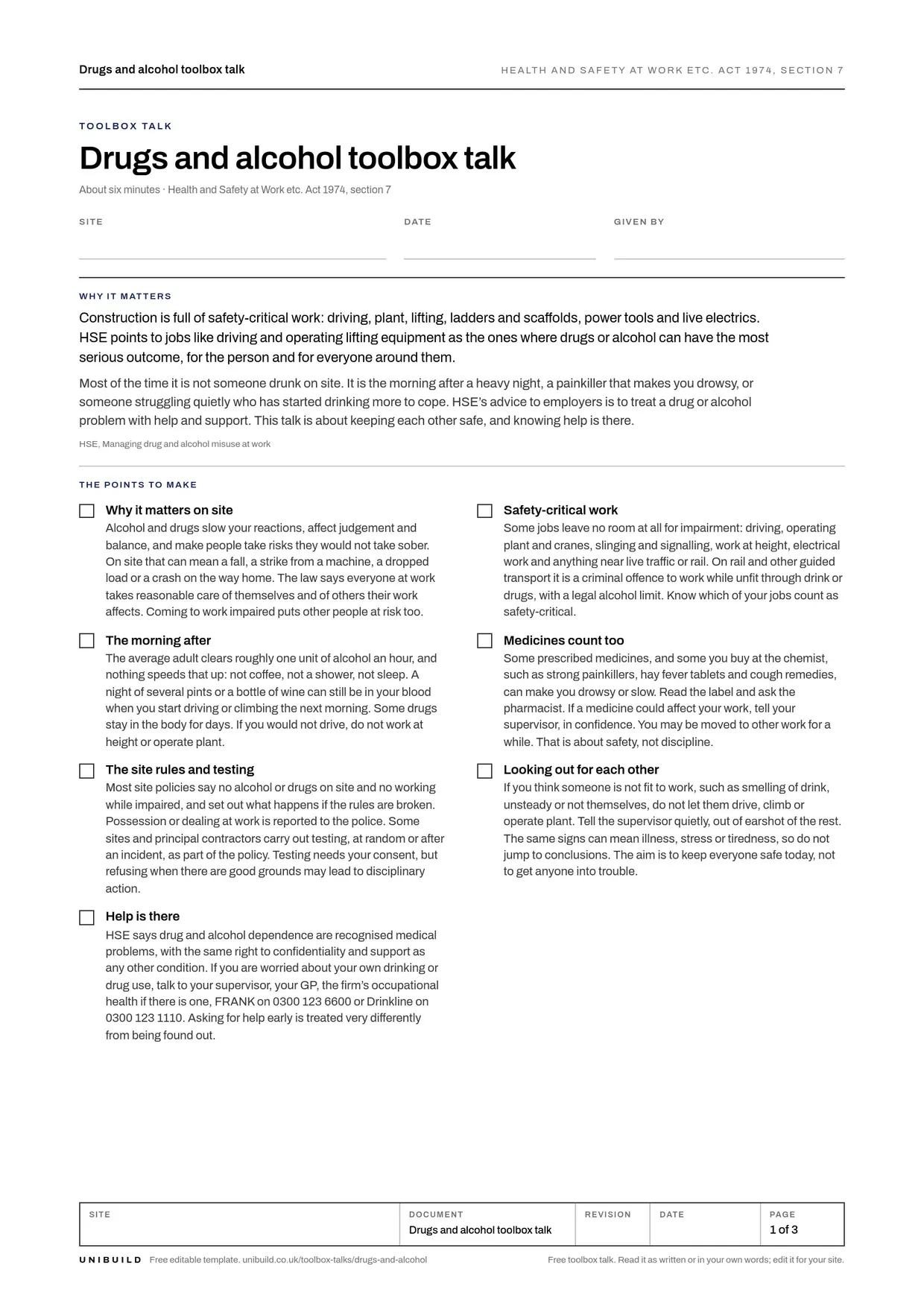
Safety-critical work, the morning after, prescribed medicines, the site policy and asking for help in confidence.
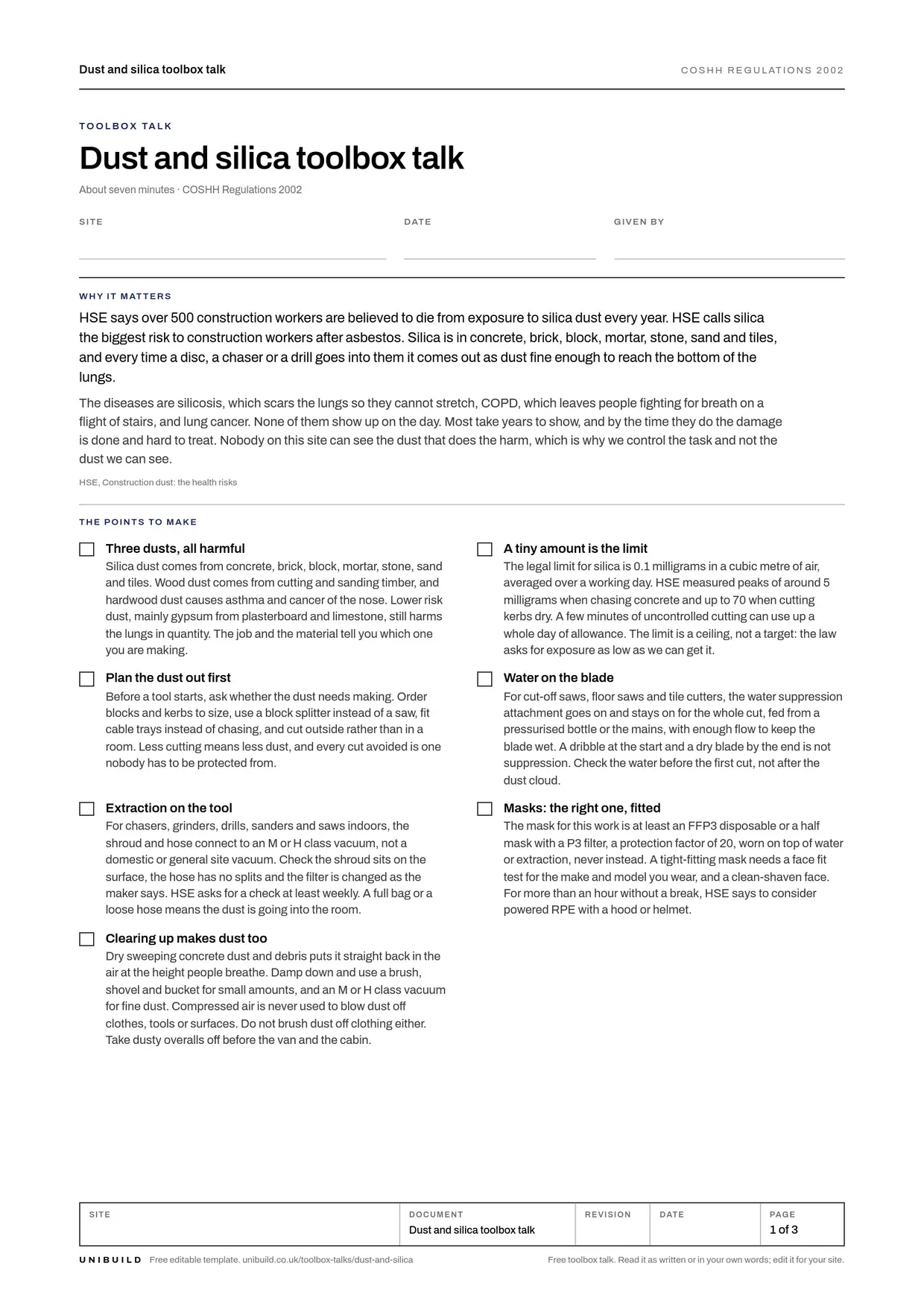
Silica dust kills more site workers than falls. Cutting, water, extraction, masks and face fit.
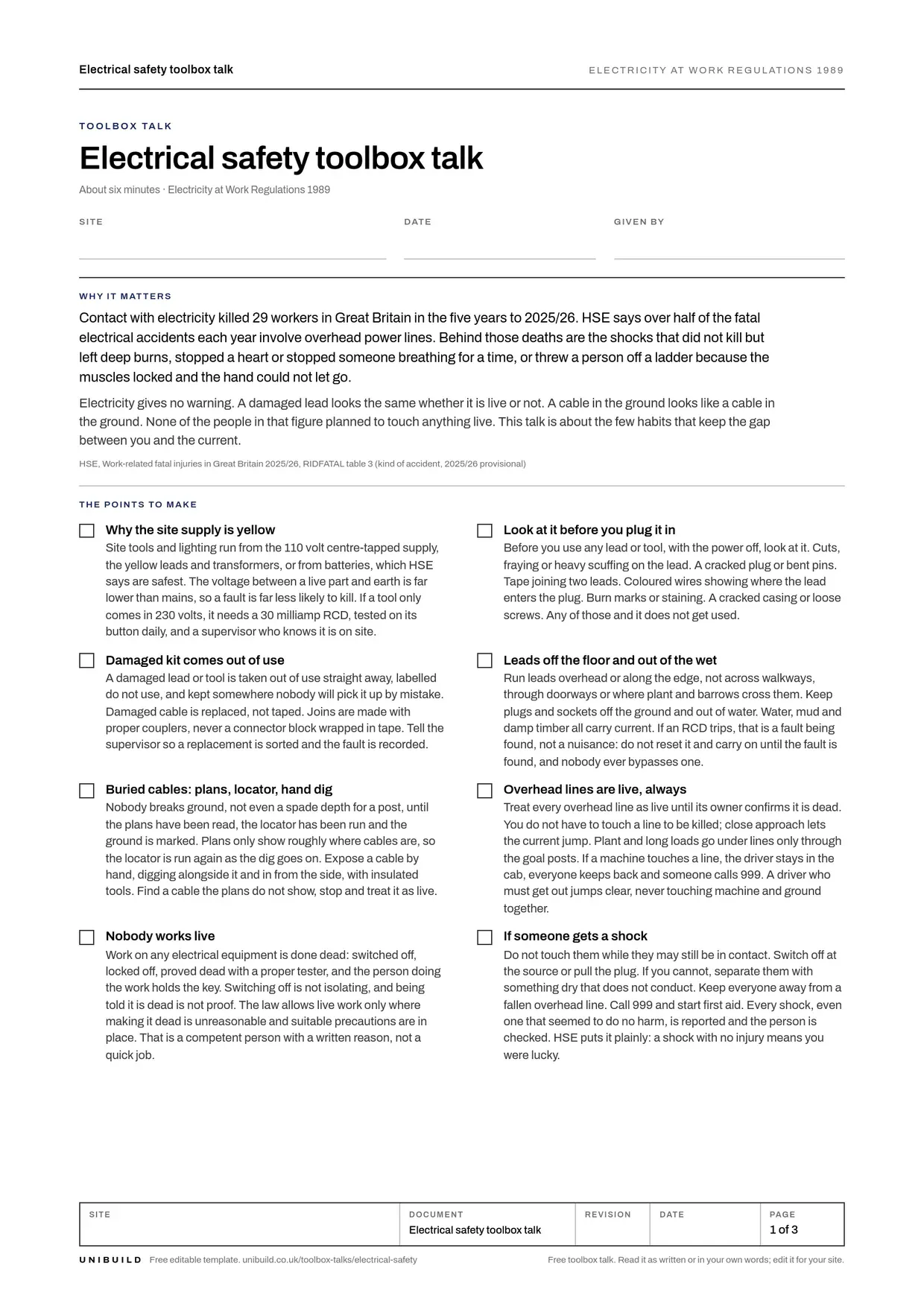
Site electricity, 110V, leads and tools, damaged kit, buried and overhead cables, and never working live.
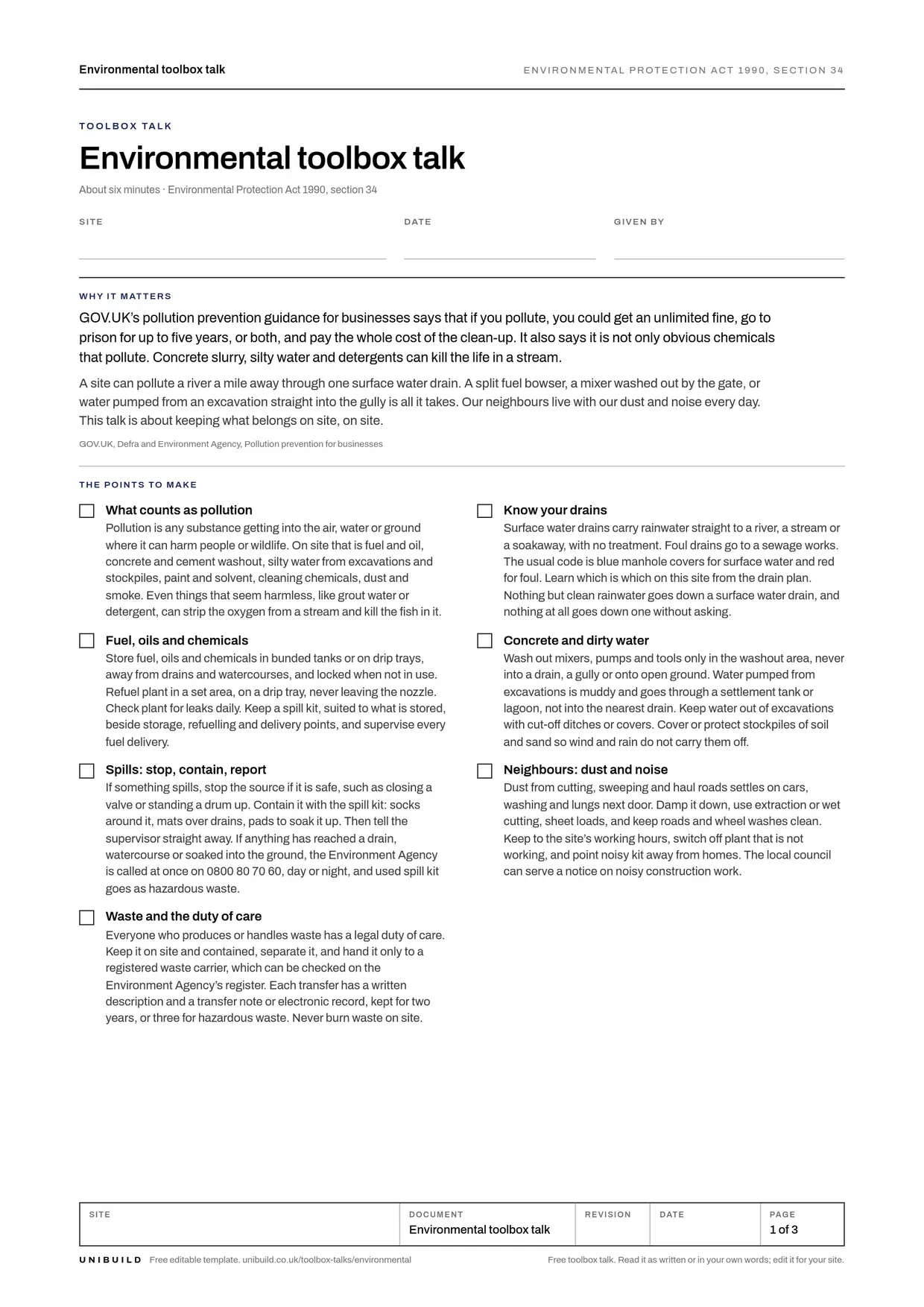
Spills, drains and watercourses, dust and noise for the neighbours, waste and the duty of care, and who to tell.
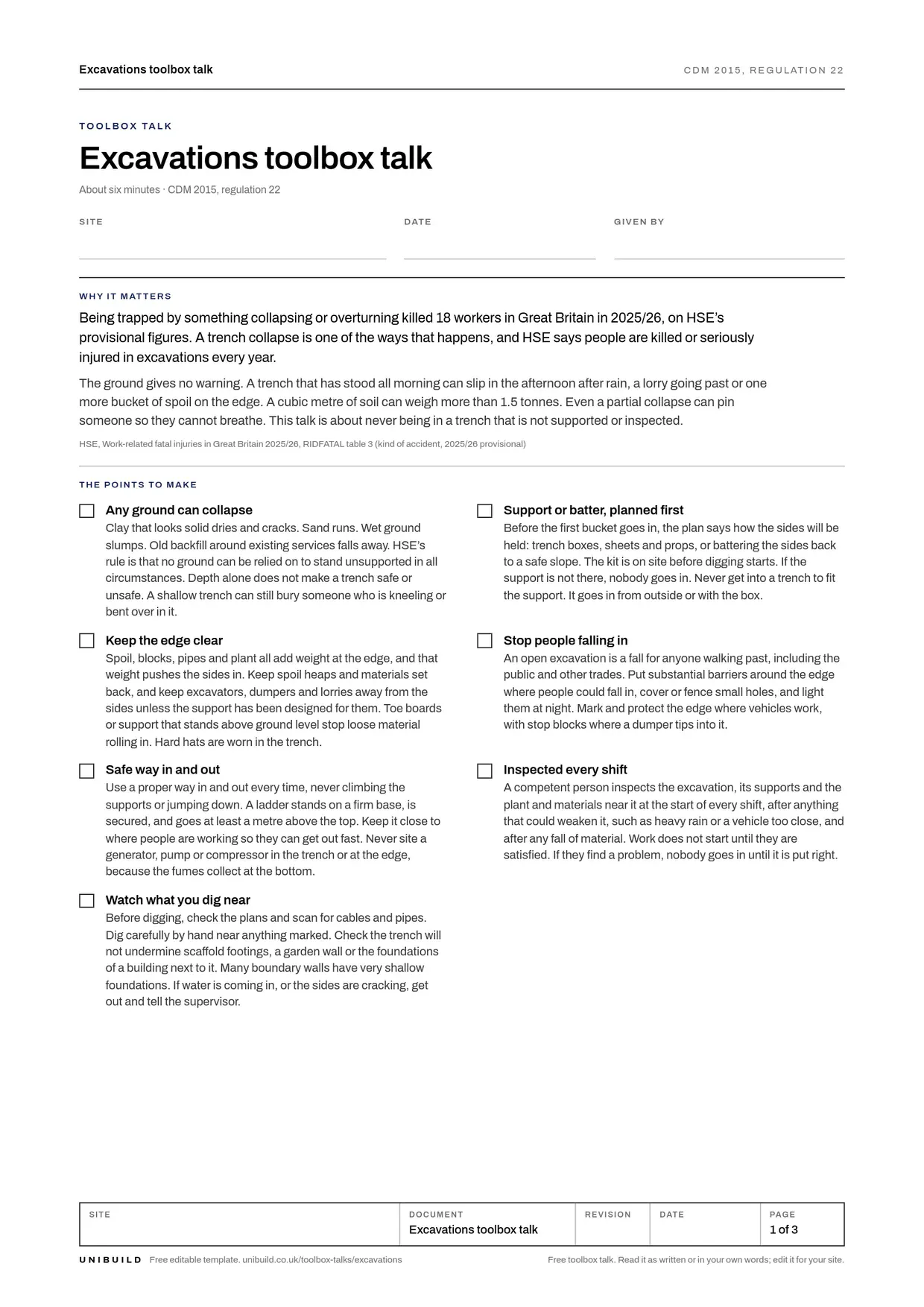
Collapse, buried services, spoil and plant at the edge, getting in and out, and the inspection at the start of every shift.
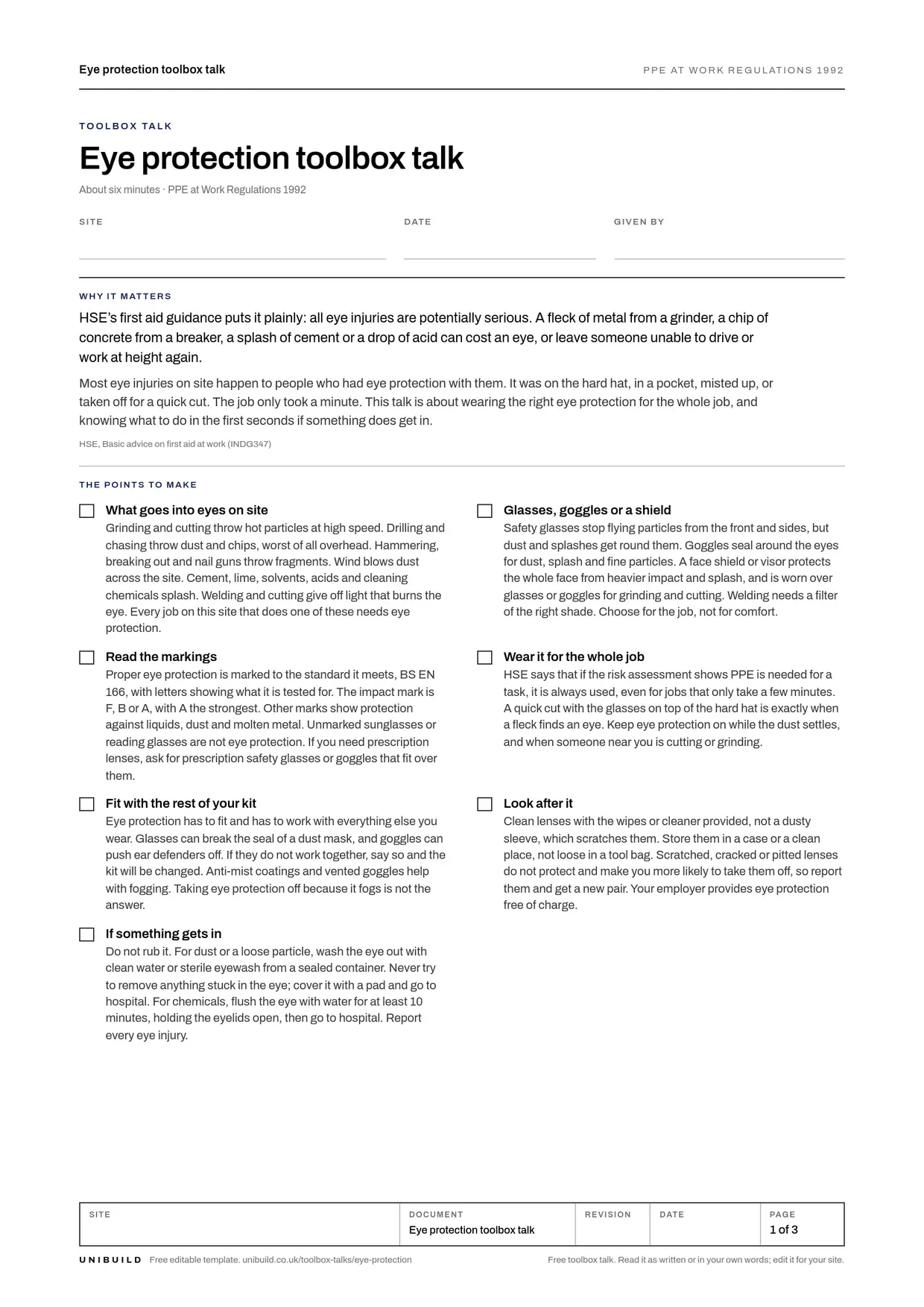
Grinding, cutting, drilling overhead, chemicals and dust: matching the eye protection to the job, and first aid for the eyes.
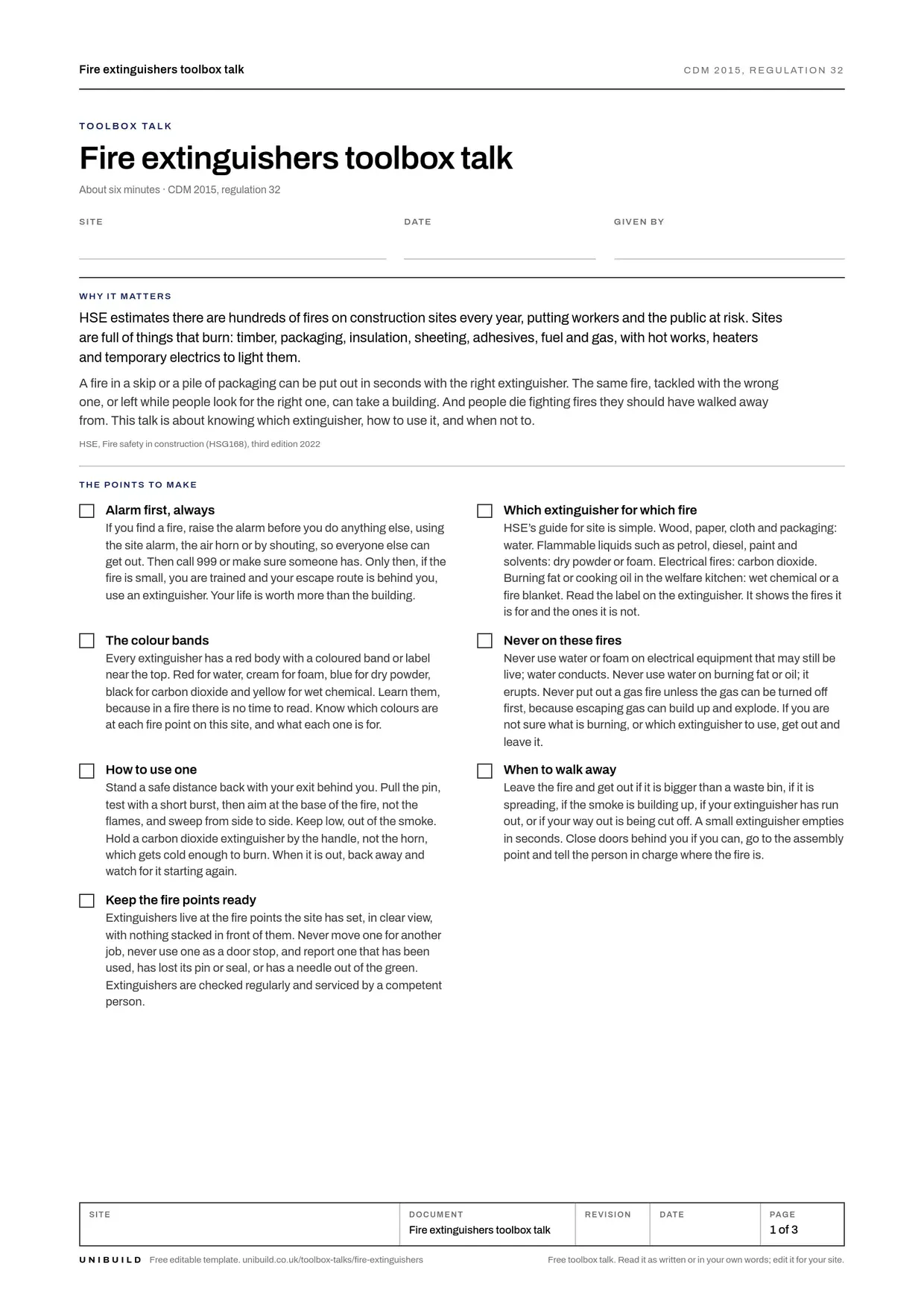
Which extinguisher for which fire, how to use one, and when to leave the fire and raise the alarm instead.
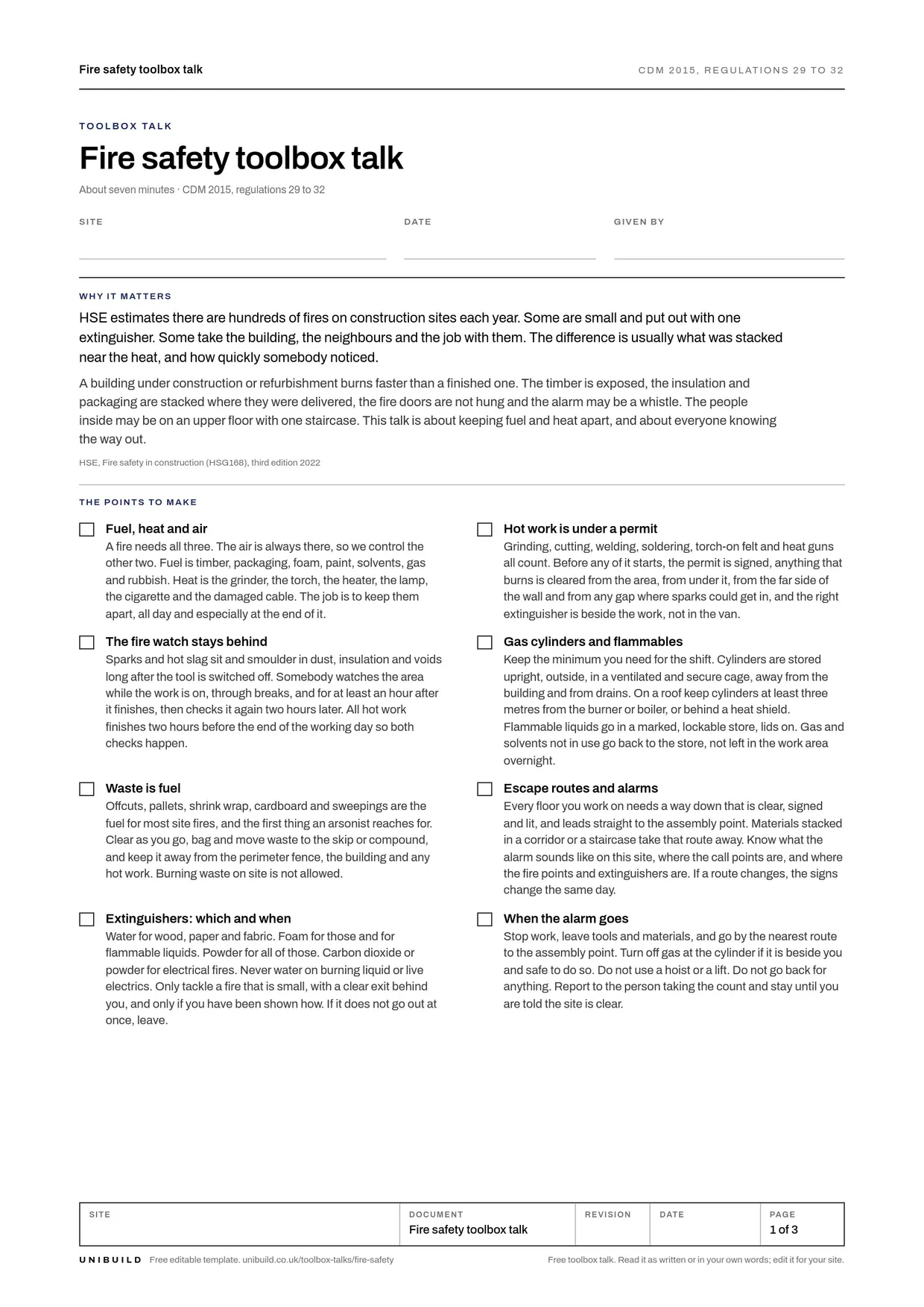
Fire on site: fuel and ignition, hot works, housekeeping, escape routes, alarms and what to do when one starts.
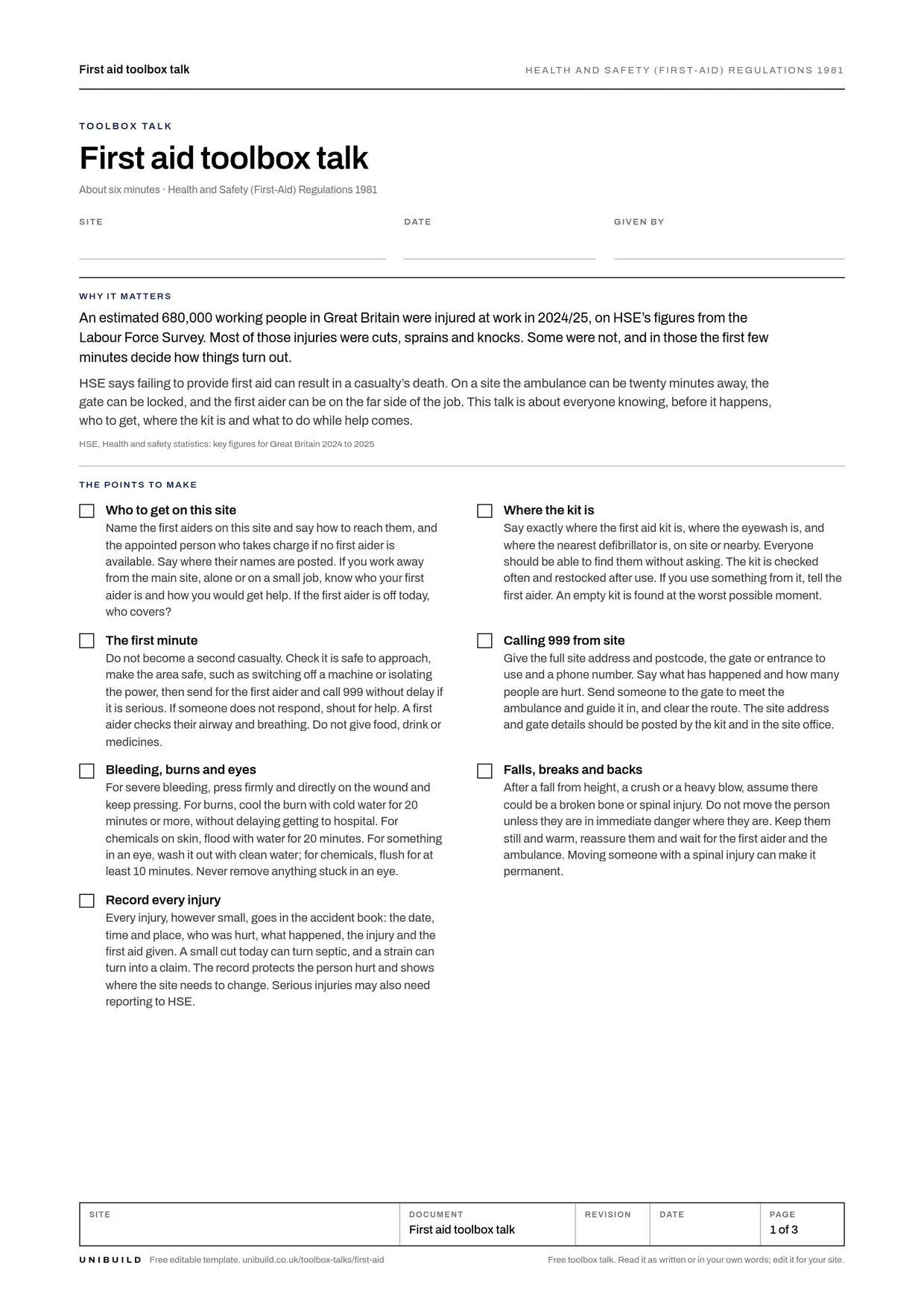
Who the first aiders are, where the kit is, what to do and not do while help comes, and recording every injury.
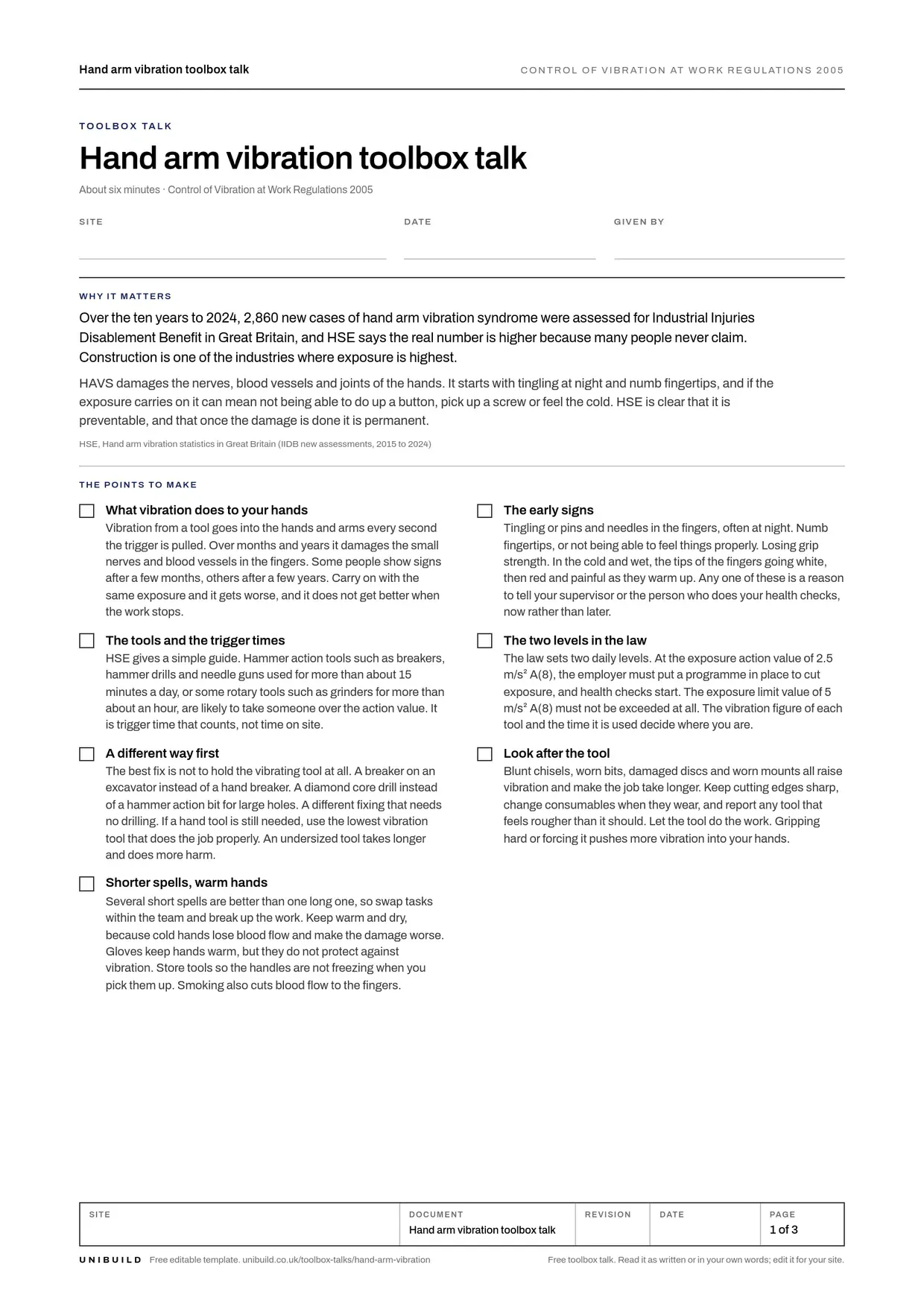
Tingling fingers are the first sign of permanent damage. Trigger time, lower vibration tools, keeping warm and reporting early.
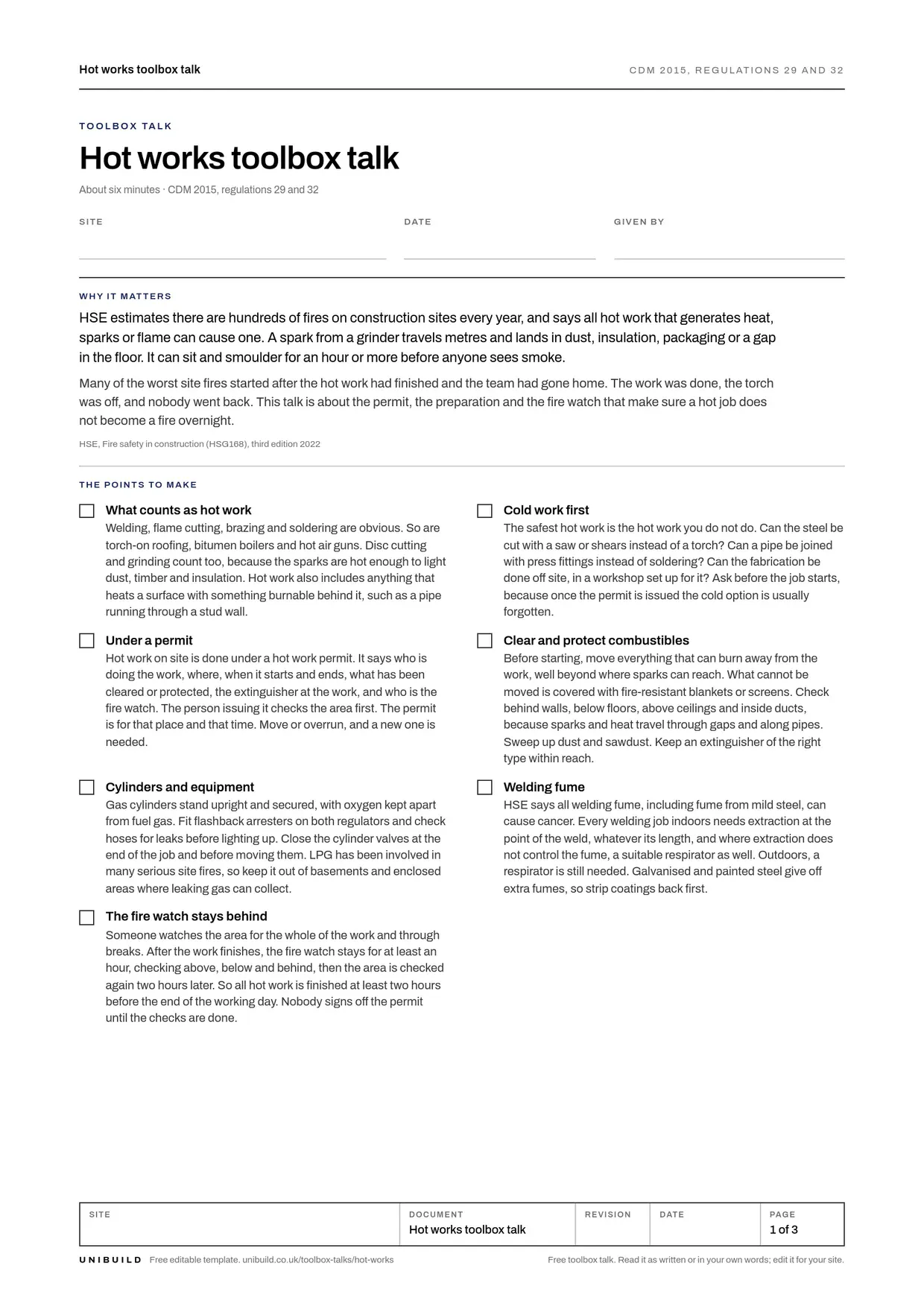
Cutting, welding, grinding and torch-on work: the permit, clearing combustibles, the fire watch and the check afterwards.
A tidy site is a safe site. Routes, waste, materials, leads and lighting, and whose job it is.
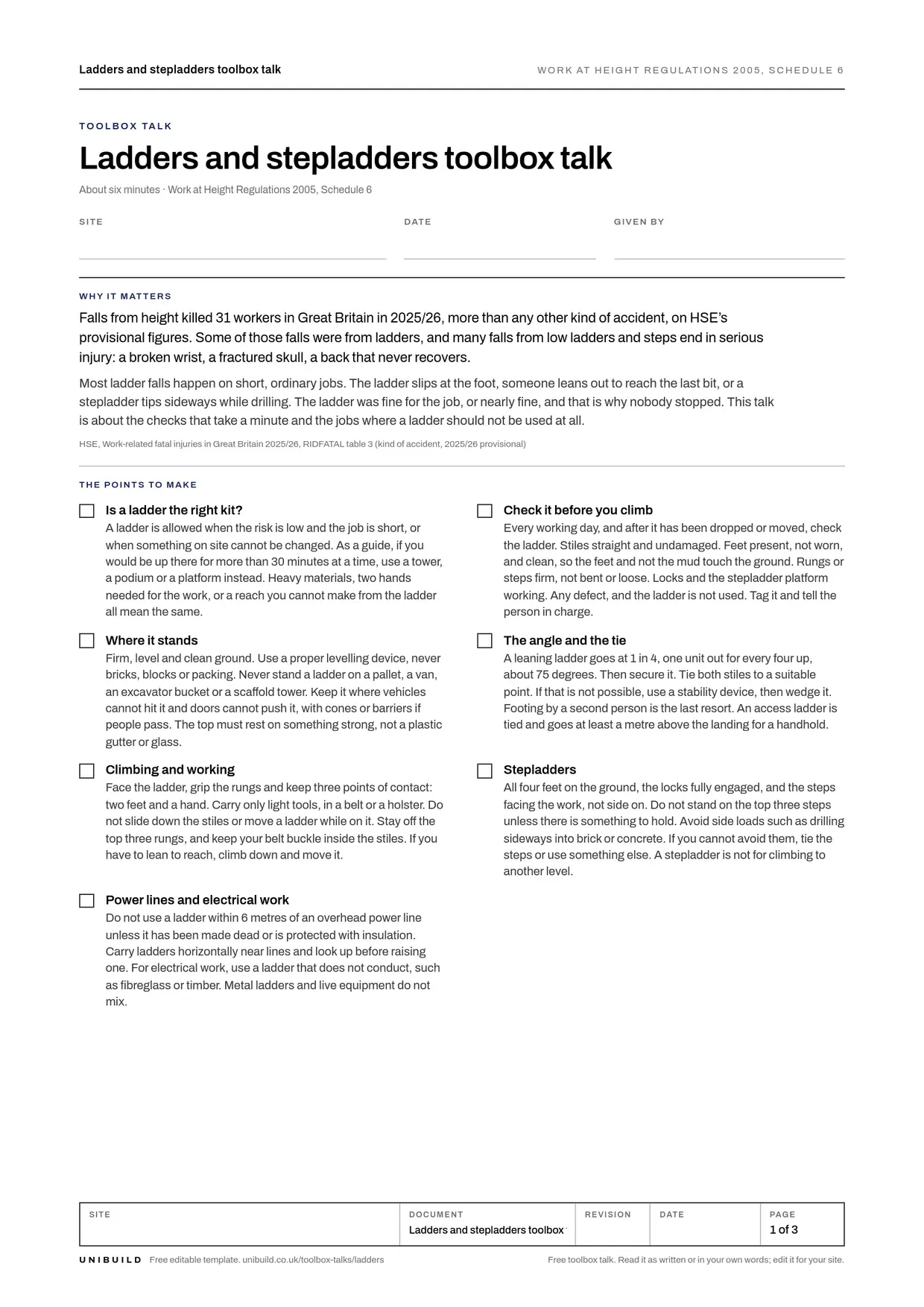
When a ladder is the right kit, the pre-use check, setting it up, three points of contact and the jobs it is not for.
The lift plan, the appointed person, accessories in date, never under a load, and stopping a lift that is going wrong.
Back injuries are the most common site injury. Avoid the lift, assess what is left, and how to lift when you must.
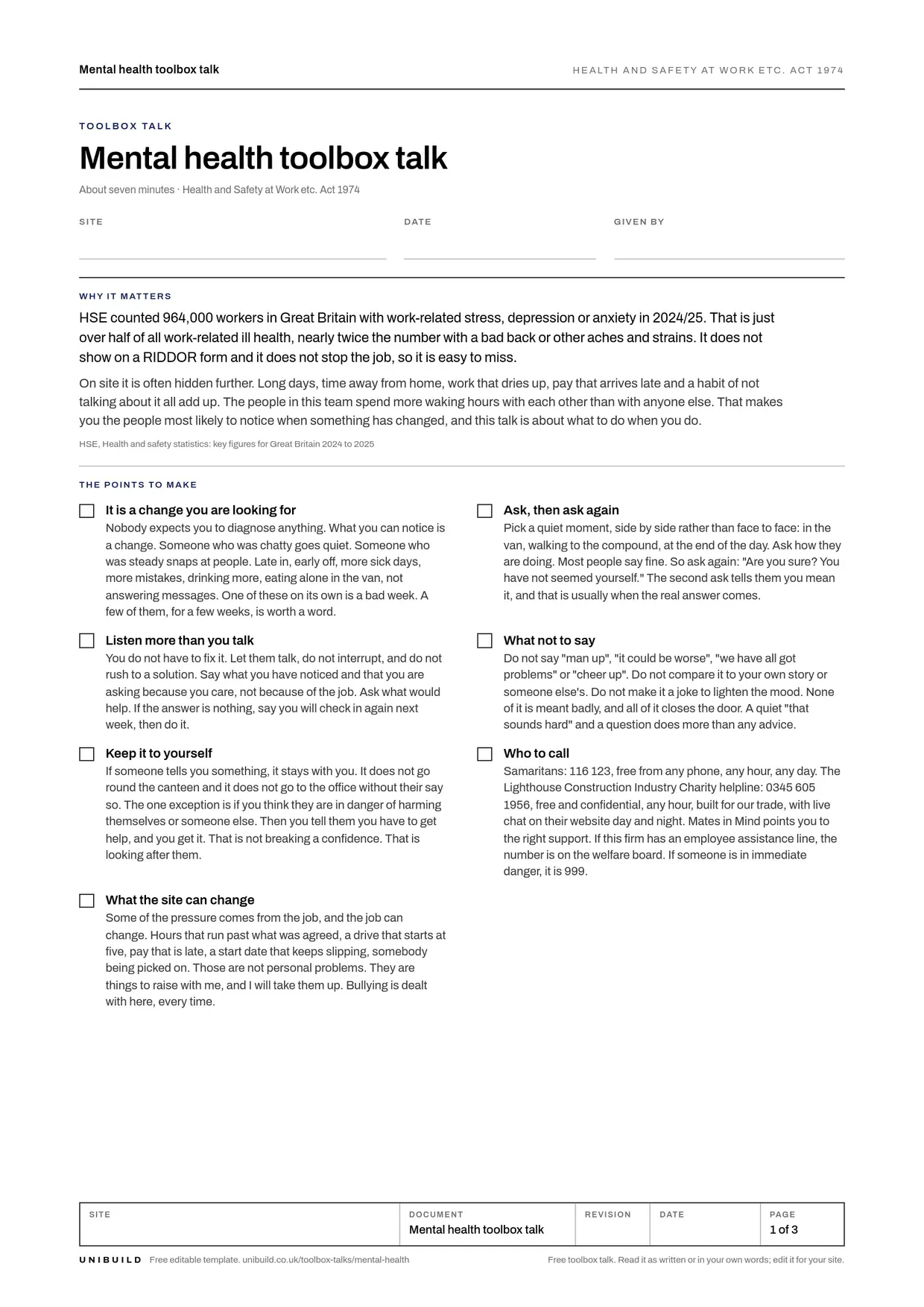
Construction workers are at higher risk of suicide. Spotting the signs, talking, and where to get help.
Hearing loss is permanent. Noisy tools, the action values, quieter ways of working and hearing protection.
The right tool, guards in place, the pre-use check, cables and batteries, kickback, and isolating before changing a blade.
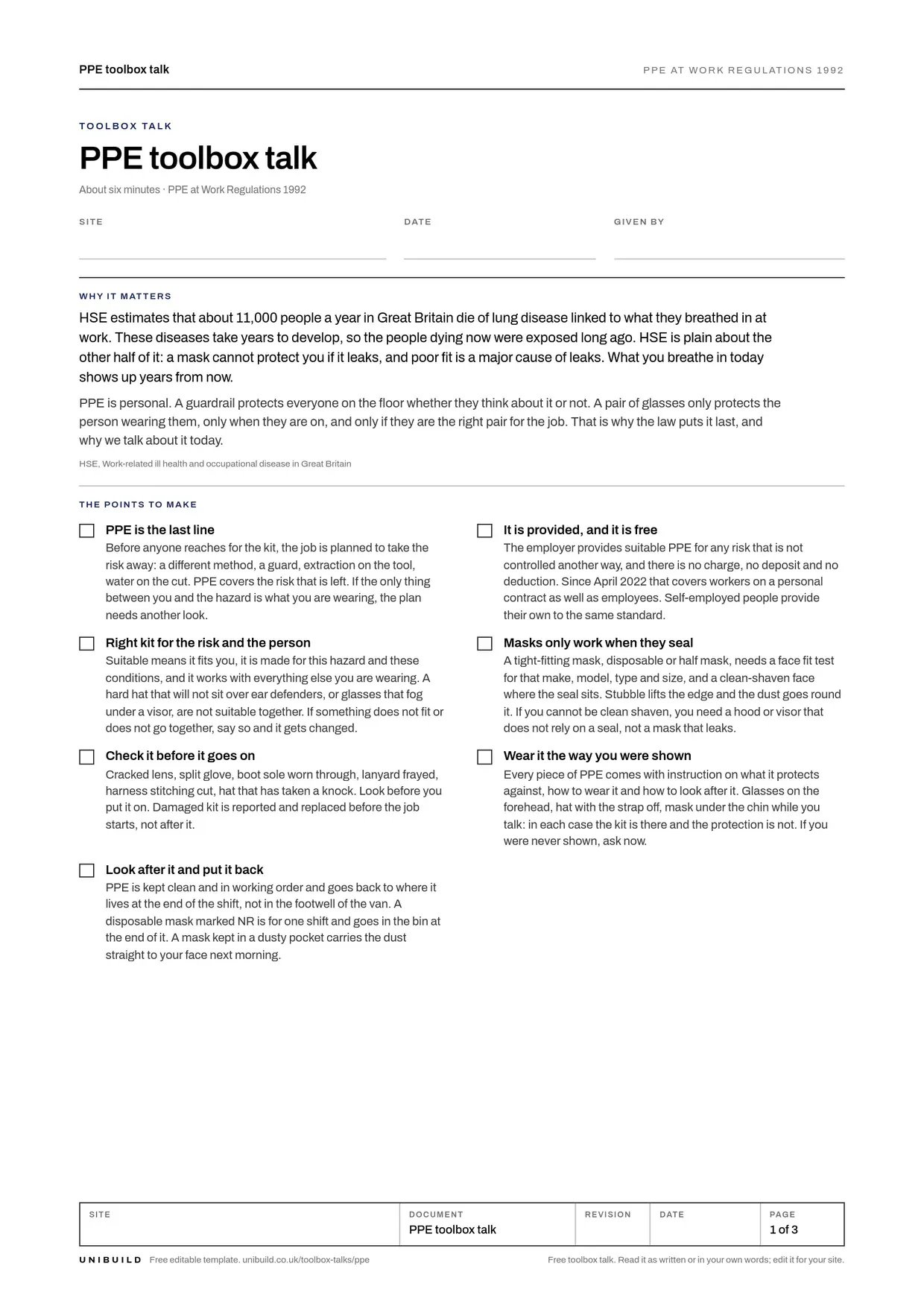
Why PPE is the last line of defence, what each item is for, and how to check, wear and look after it.
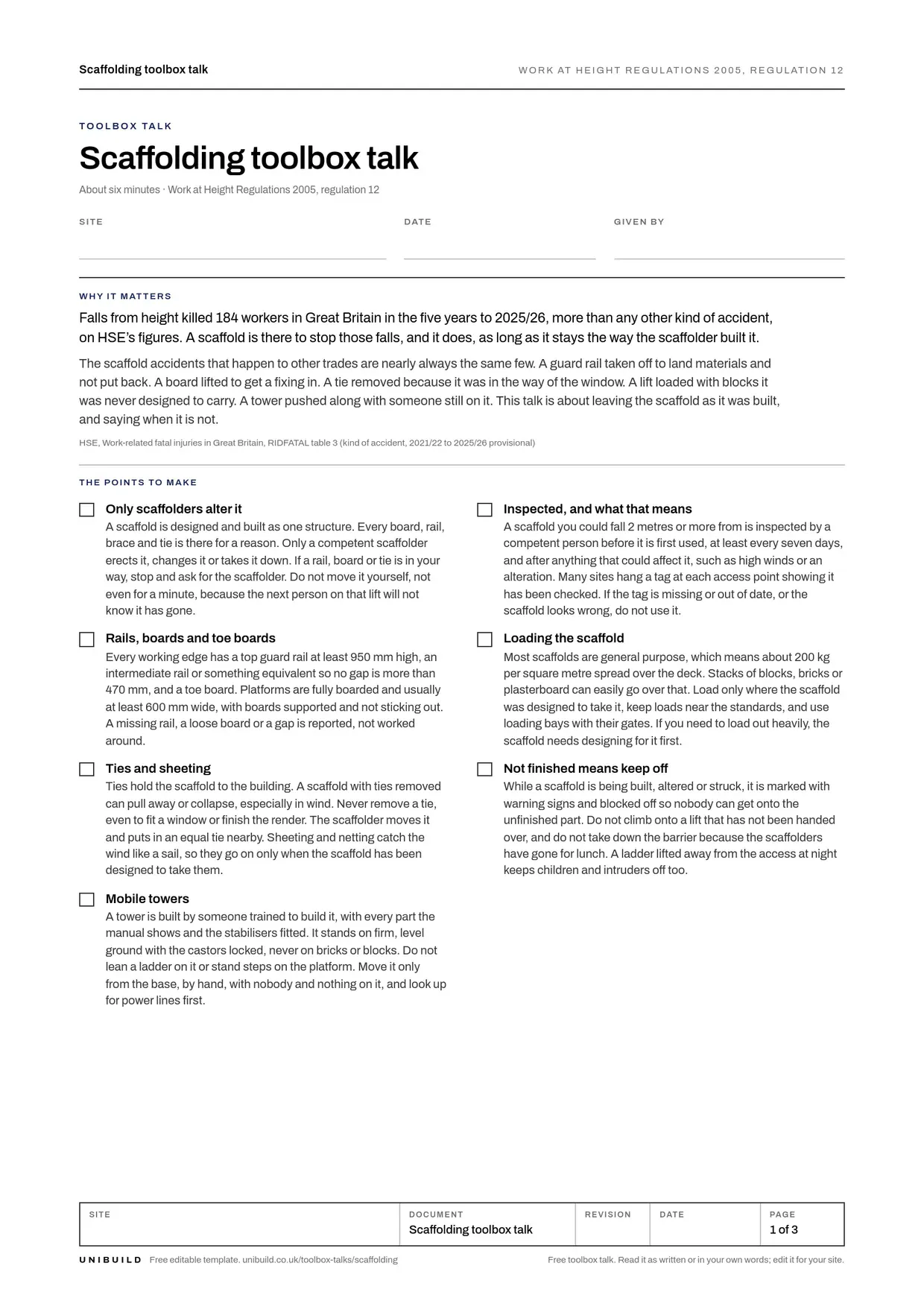
Who may alter a scaffold, the seven-day inspection, tags, loading, ties, and what to do with a scaffold that is not complete.
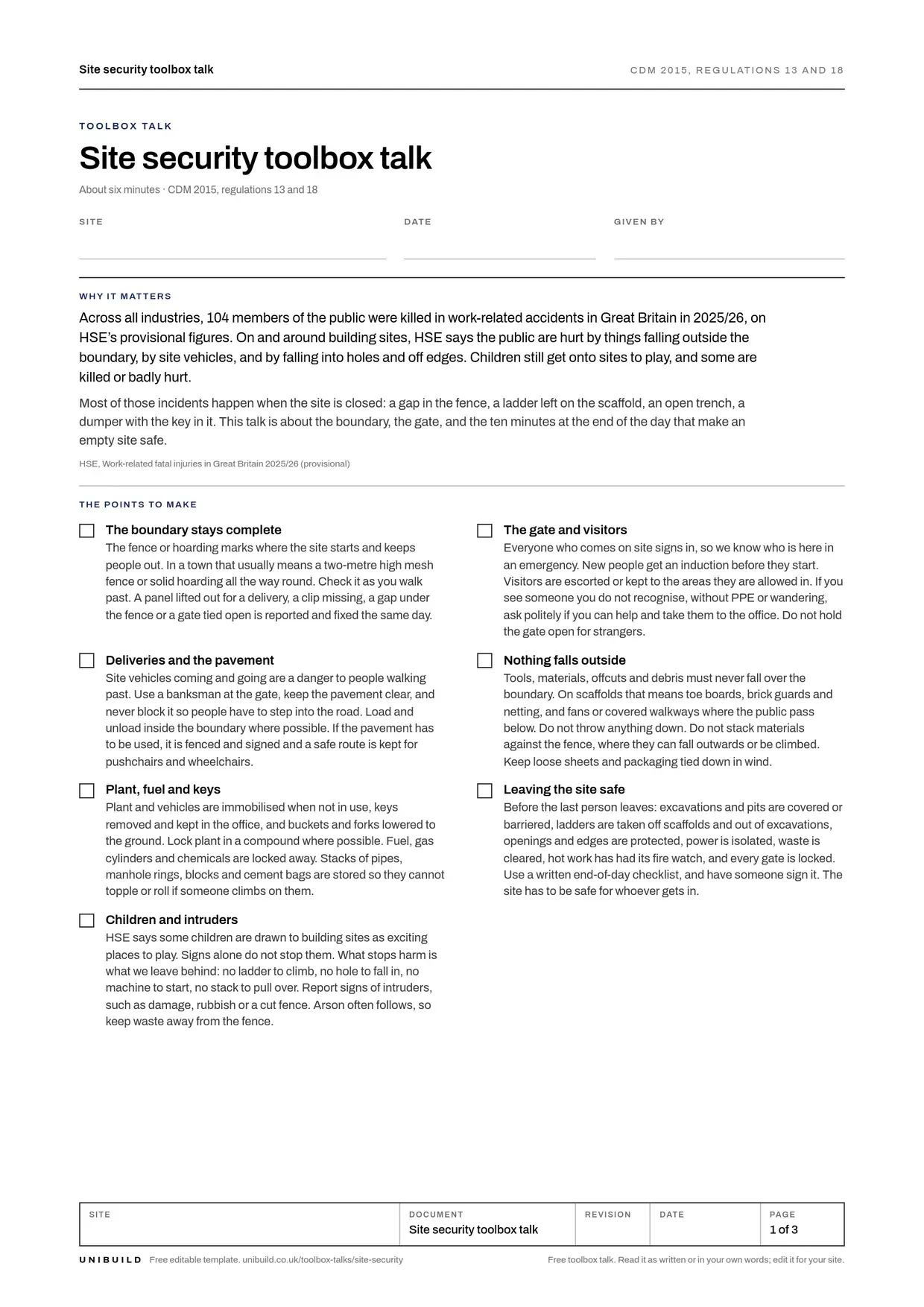
Keeping the public and children out, the gate, visitors, plant keys, and leaving the site safe at the end of the day.
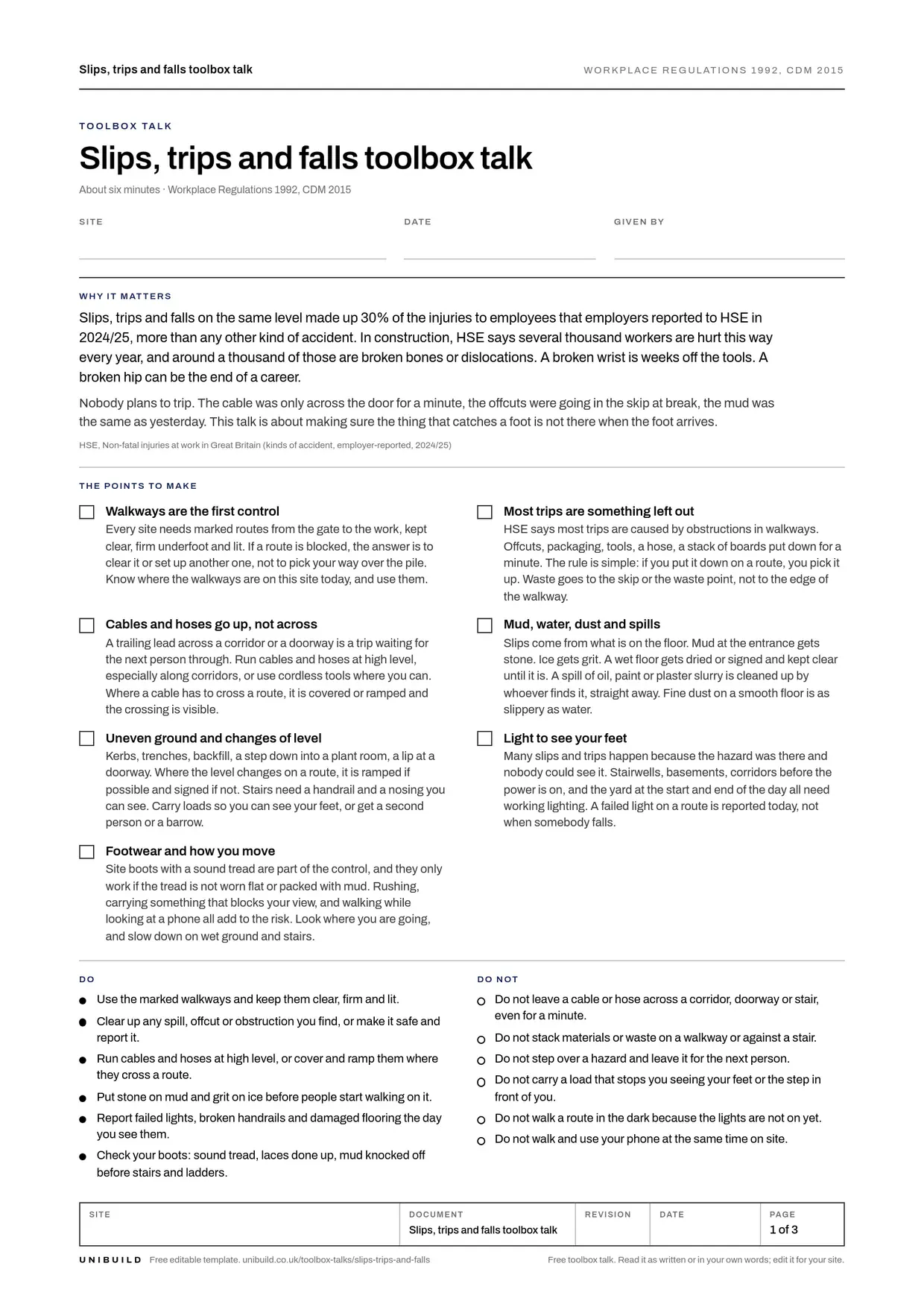
Same-level falls are the most common site accident. What causes them, what stops them, and what to report.
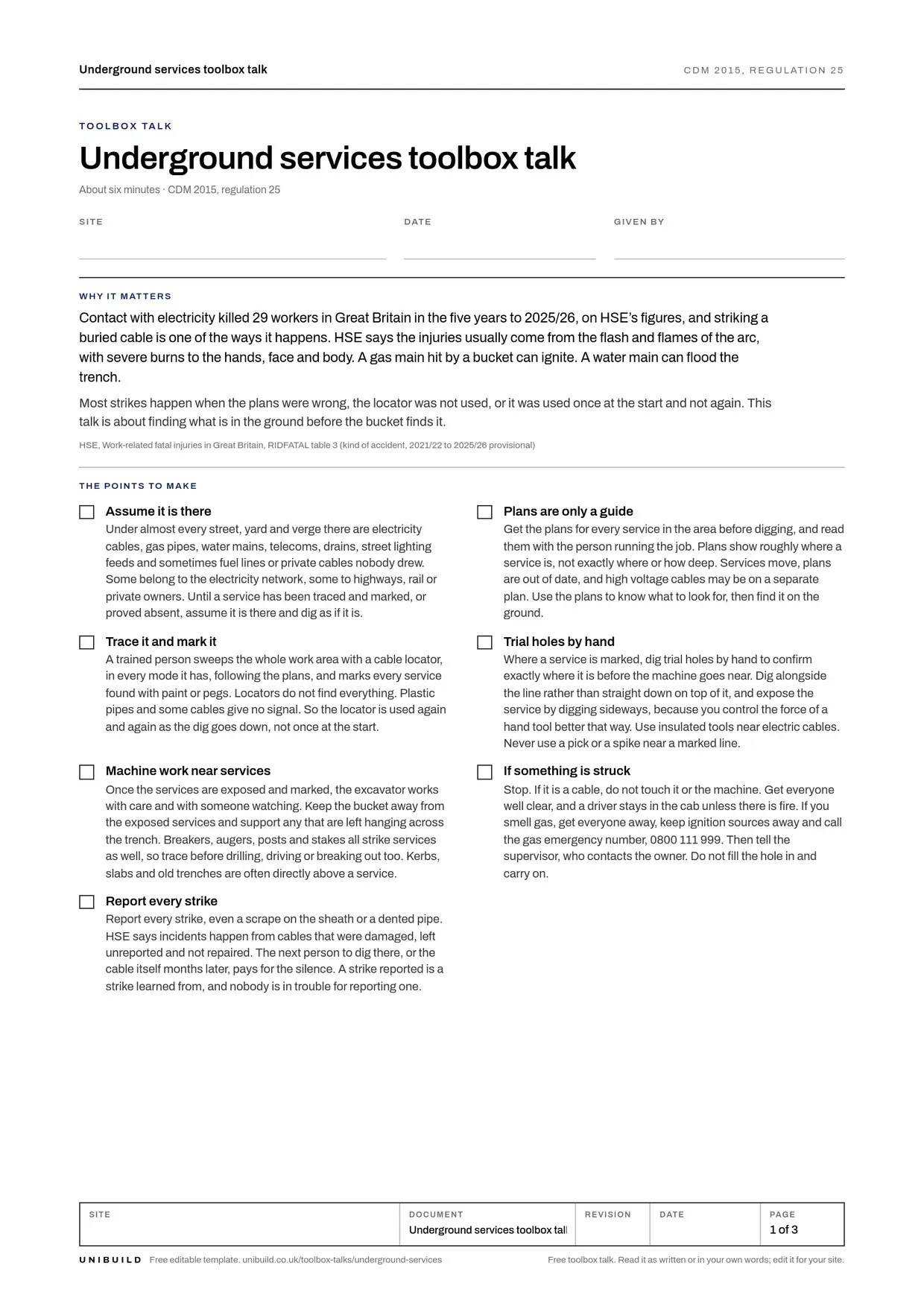
Plans, the cable locator, marking out, trial holes, digging by hand near services and what to do after a strike.
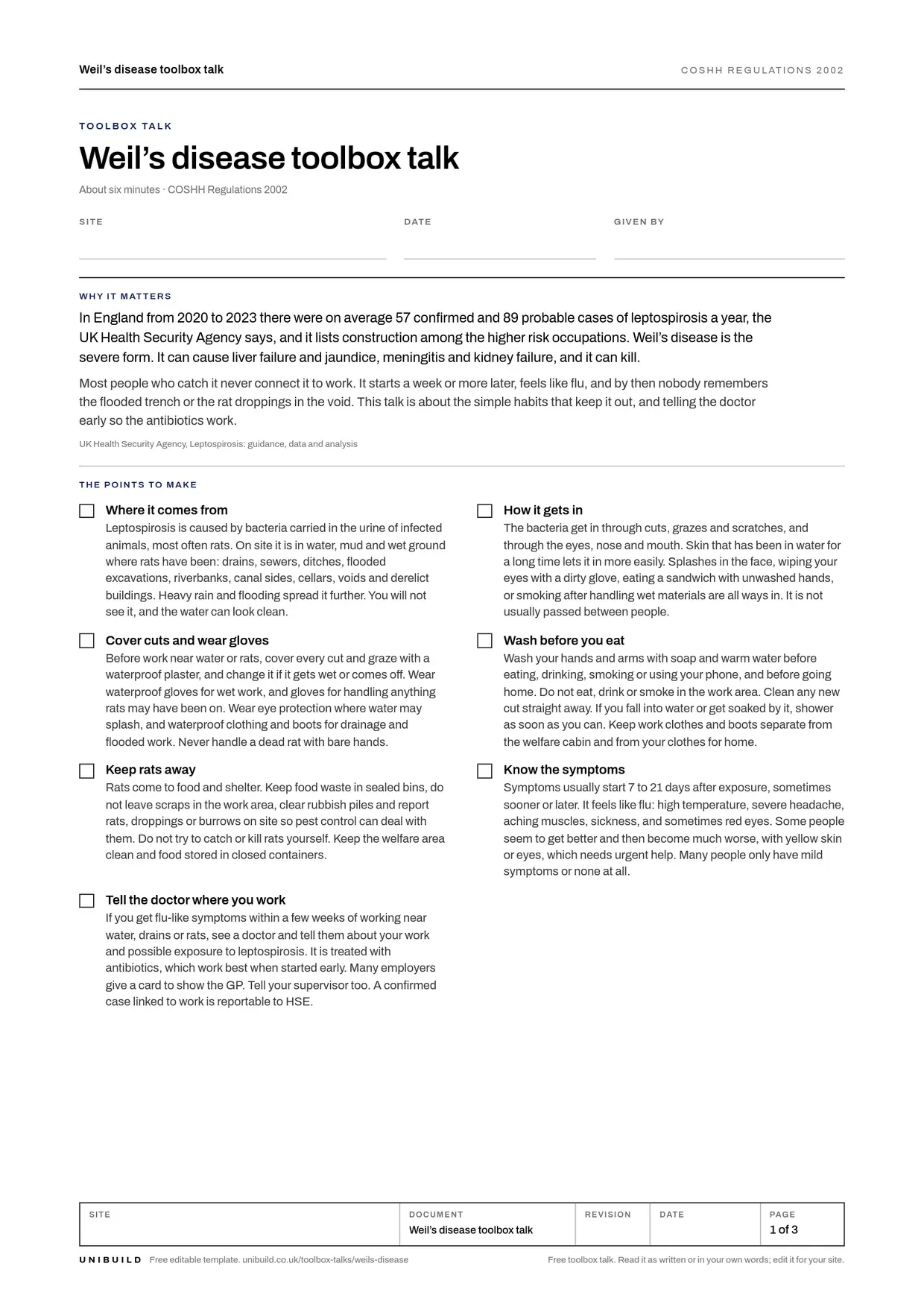
Leptospirosis from rats and water: where it is caught, cuts and gloves, washing, and the symptoms to tell a doctor about.
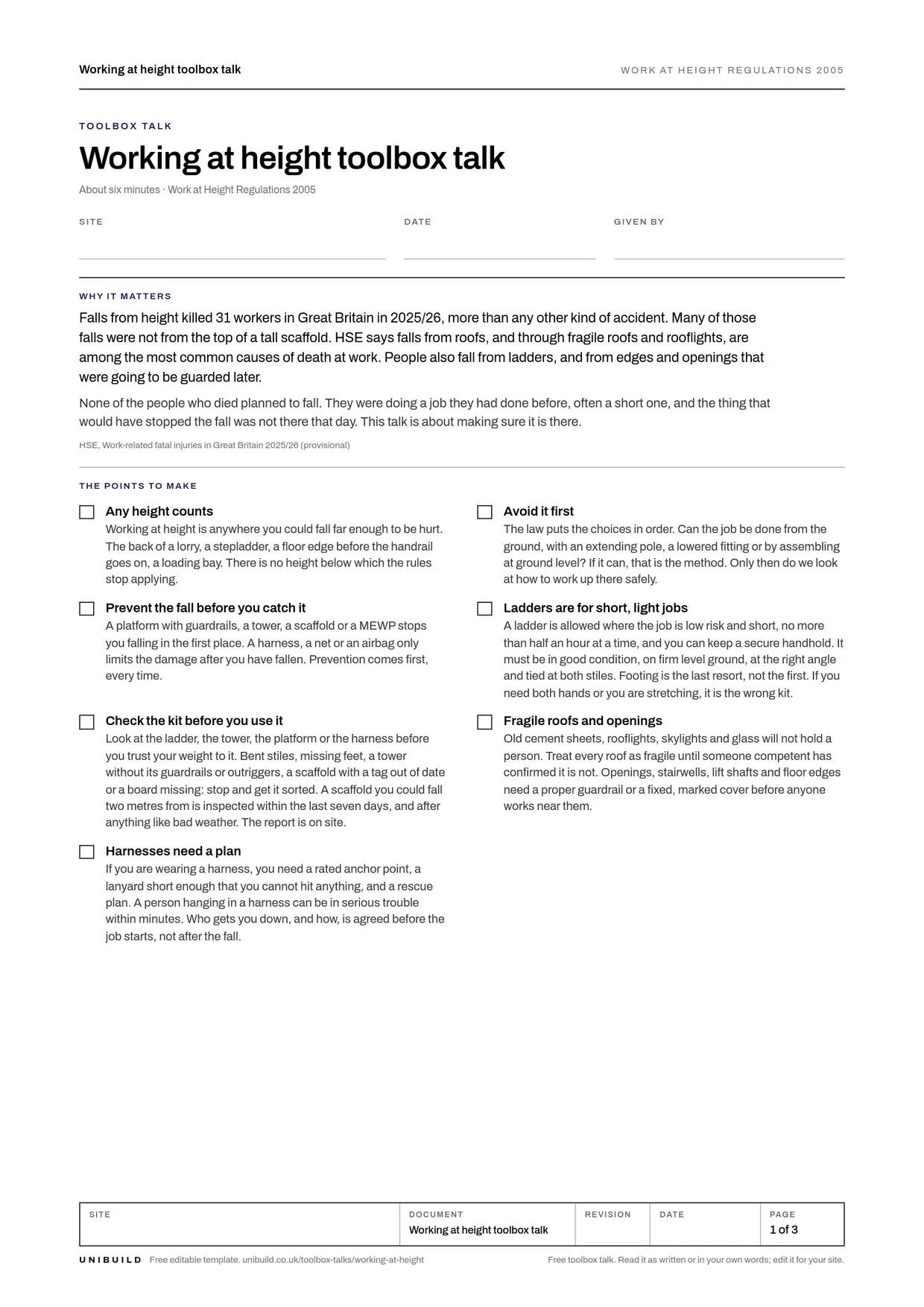
Falls are the biggest killer on site. Ladders, platforms, edges, fragile roofs and what to do before anyone steps up.
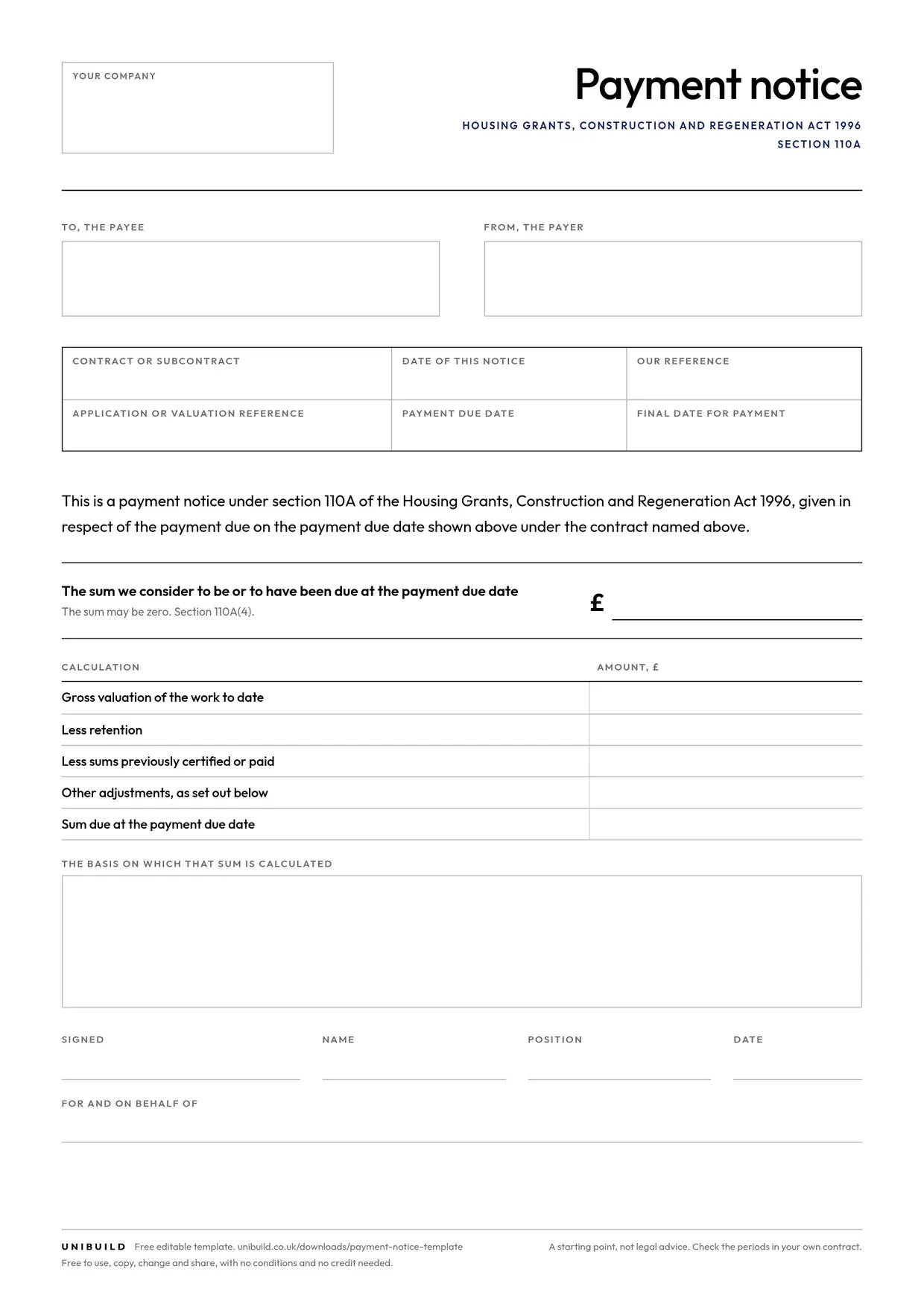
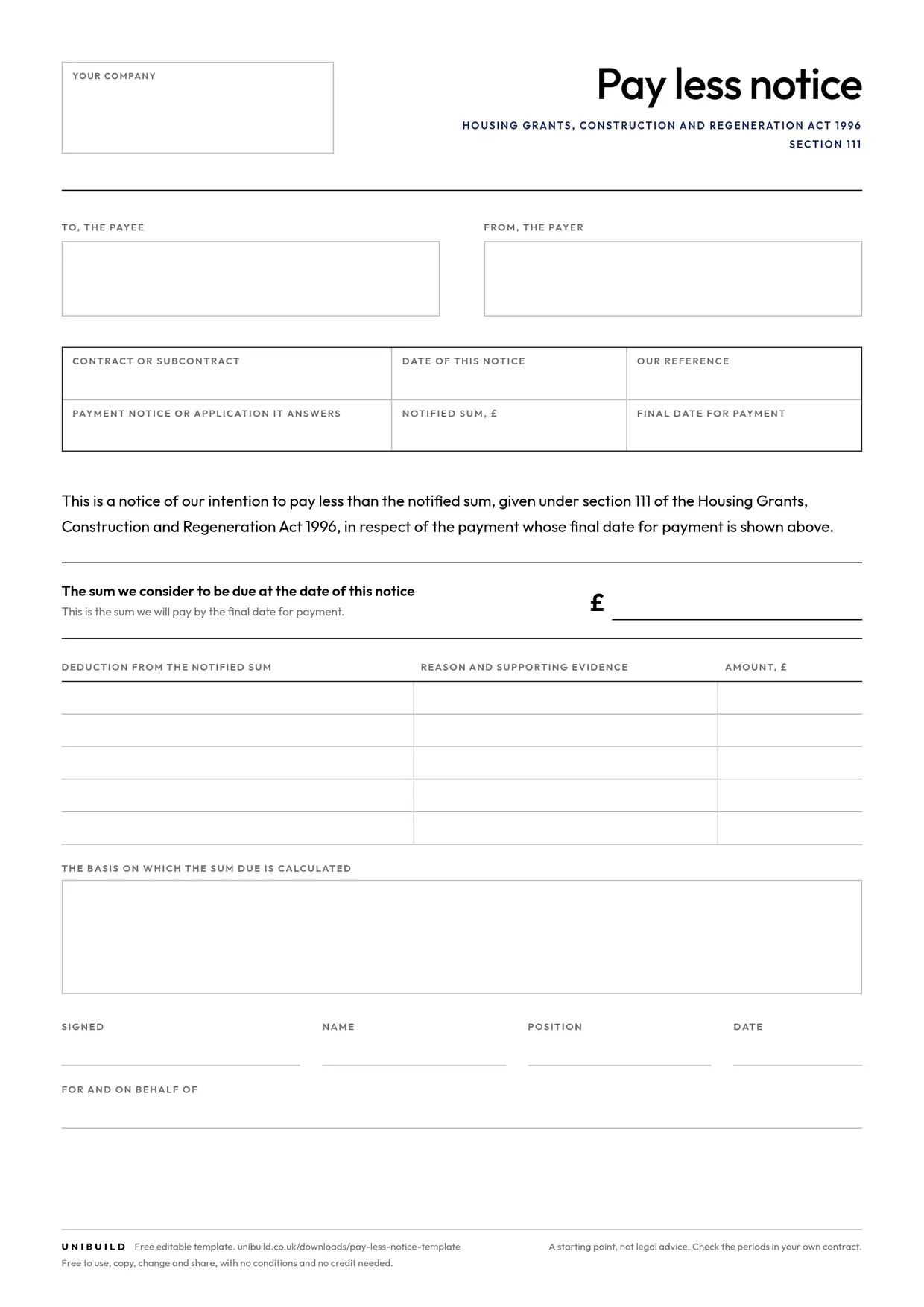
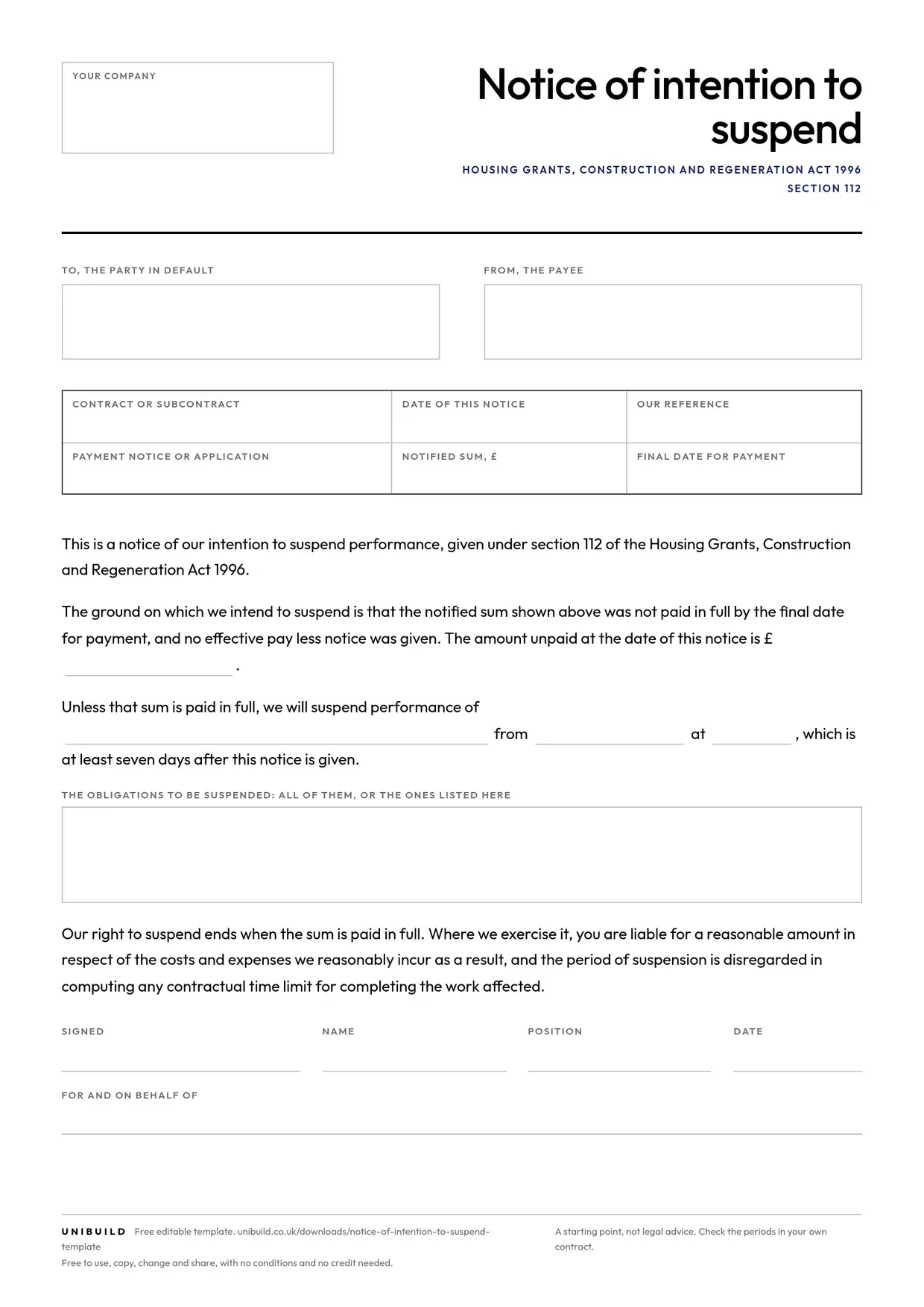
The payment notice, the pay less notice and the notice of intention to suspend, laid out as letters with the statutory wording in place and a guidance page on the timing.
The sum due at the payment due date and the basis on which it is calculated, as the Act requires, with a guidance page on the timing.
The sum due at the date of the notice, each deduction with its reason, and the basis of calculation, with a guidance page on the timing.
Seven days' notice to suspend for non-payment: the ground, the unpaid sum, what stops and from when, and your entitlement to costs and time.
The three documents CDM 2015 asks a project to write, and the O&M manual handed over with them, as editable PDFs and Word documents. Type into them in any PDF reader, or print them and fill them in by hand.
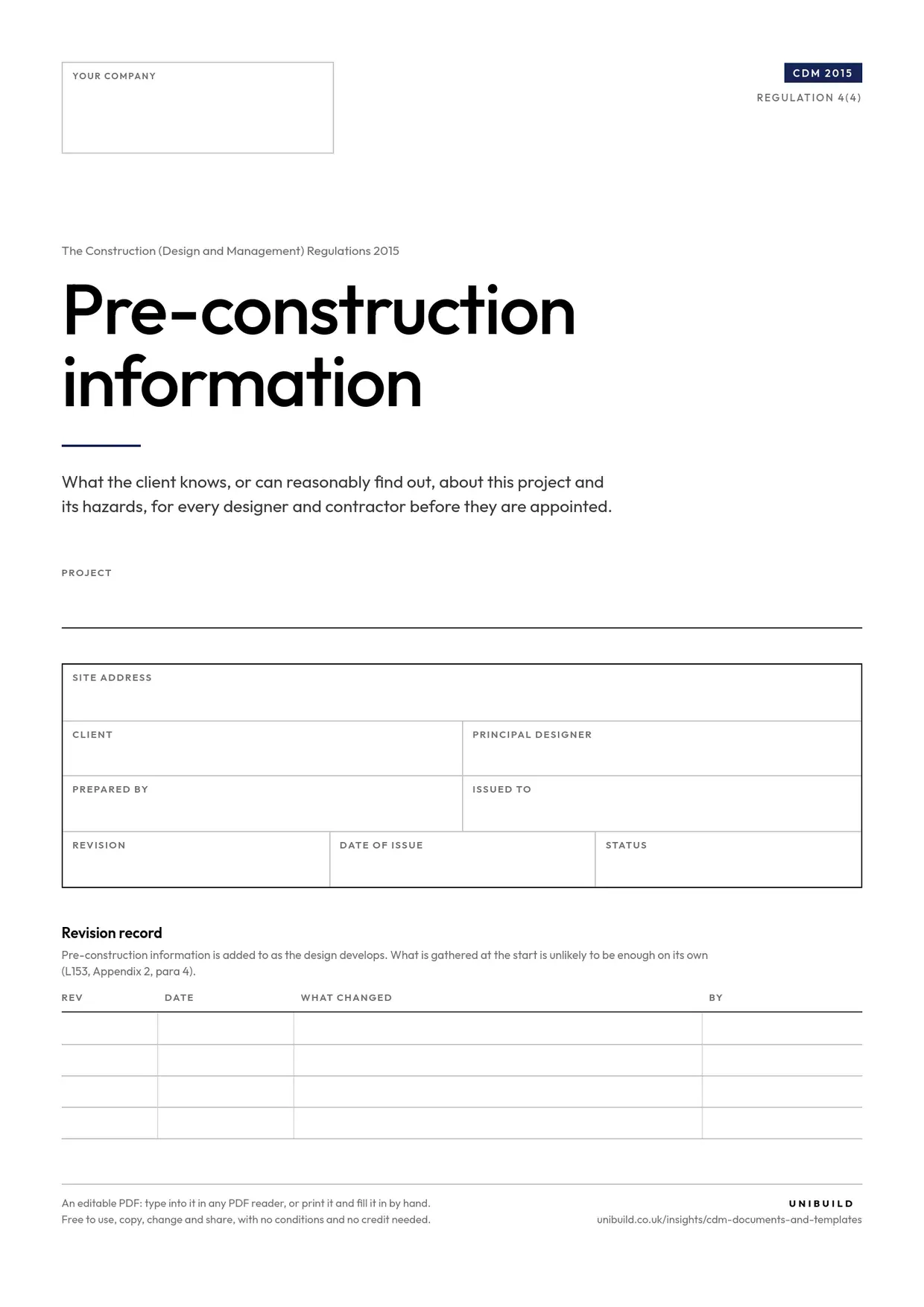
What the client knows about the site and its hazards, for every designer and contractor before they are appointed. Built on HSE L153 Appendix 2, in PDF and Word, with a filled example on its page.
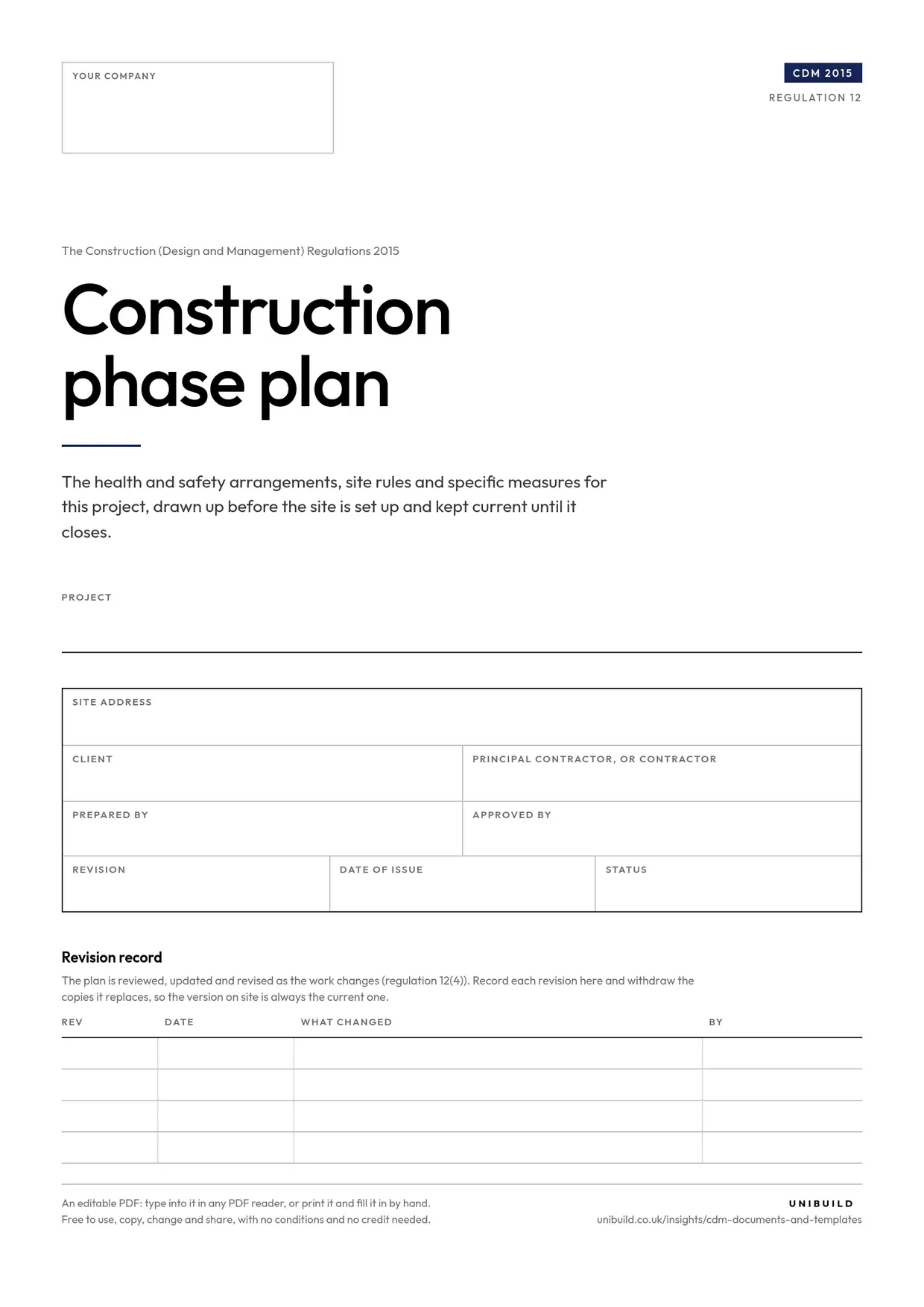
The health and safety arrangements, site rules and Schedule 3 measures for one project, with a revision in the title block of every page. Built on HSE L153 Appendix 3, in PDF and Word, with a filled example on its page.
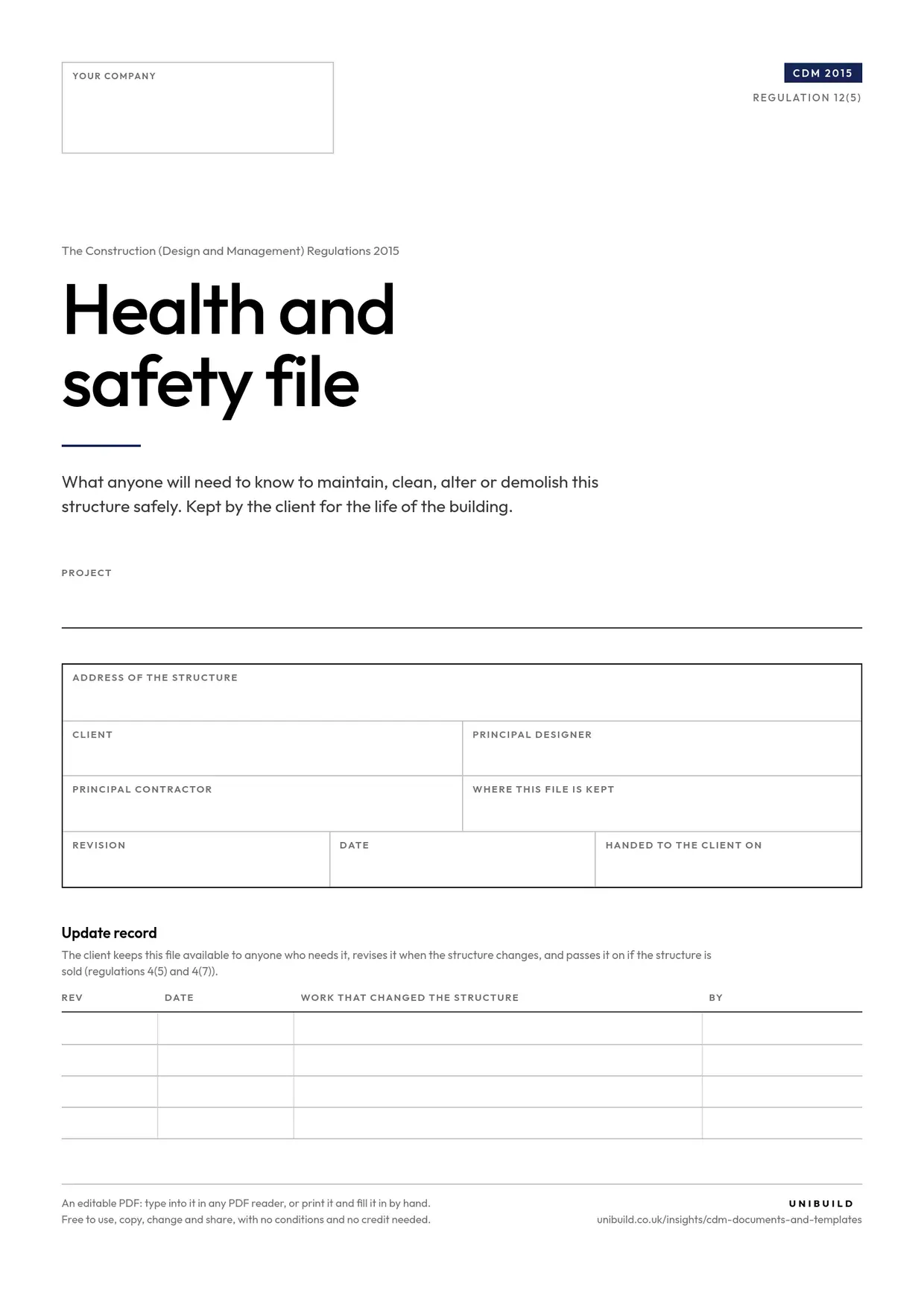
What anyone will need to maintain, alter or demolish the structure safely, under the eight headings in HSE L153 Appendix 4, with a handover record. In PDF and Word, with a filled example on its page.
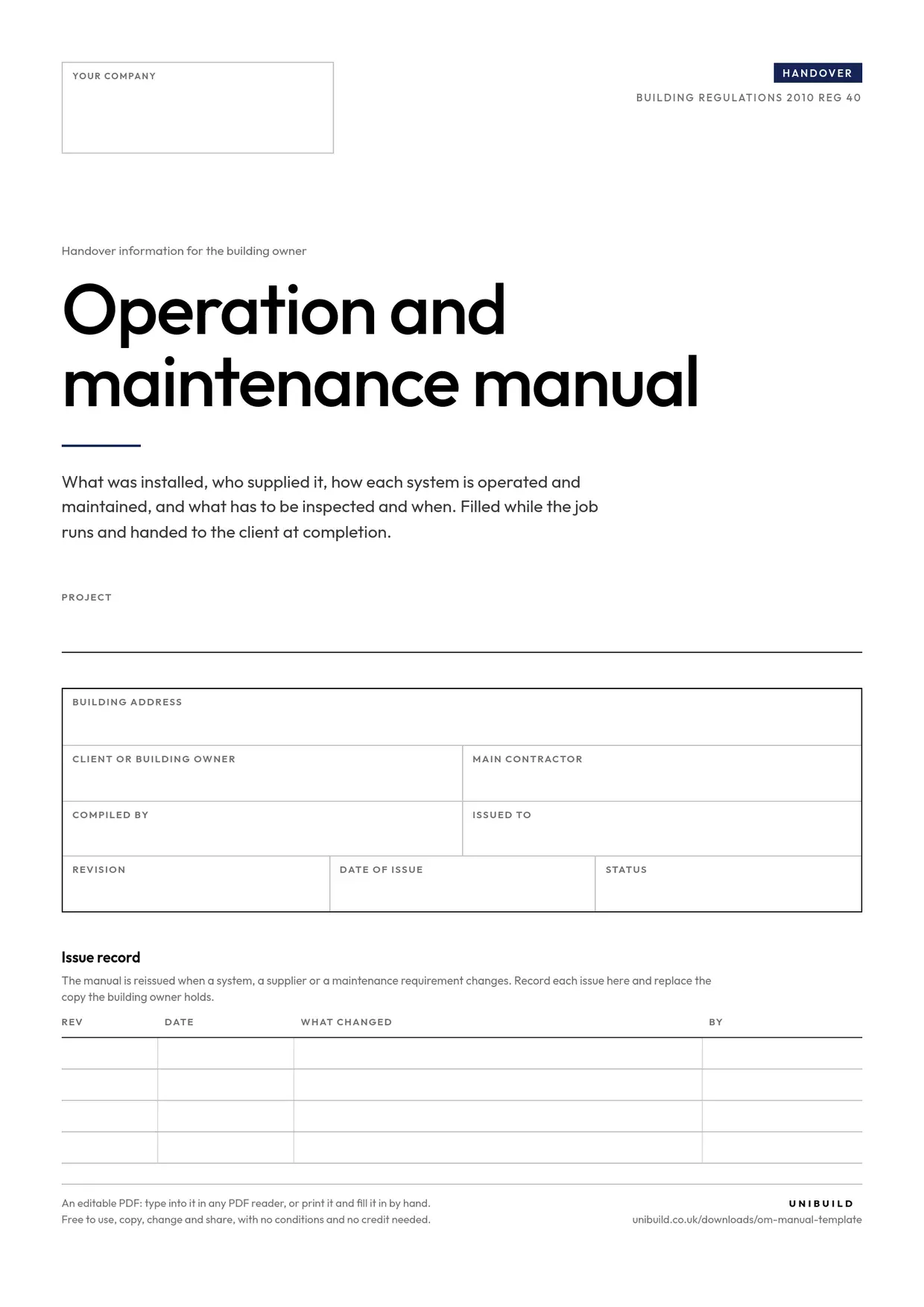
The operation and maintenance manual for a building or an installation: the systems, plant schedule, operating instructions, planned maintenance, certificates, F-gas register, warranties, contacts and handover record. In PDF and Word, with an example.
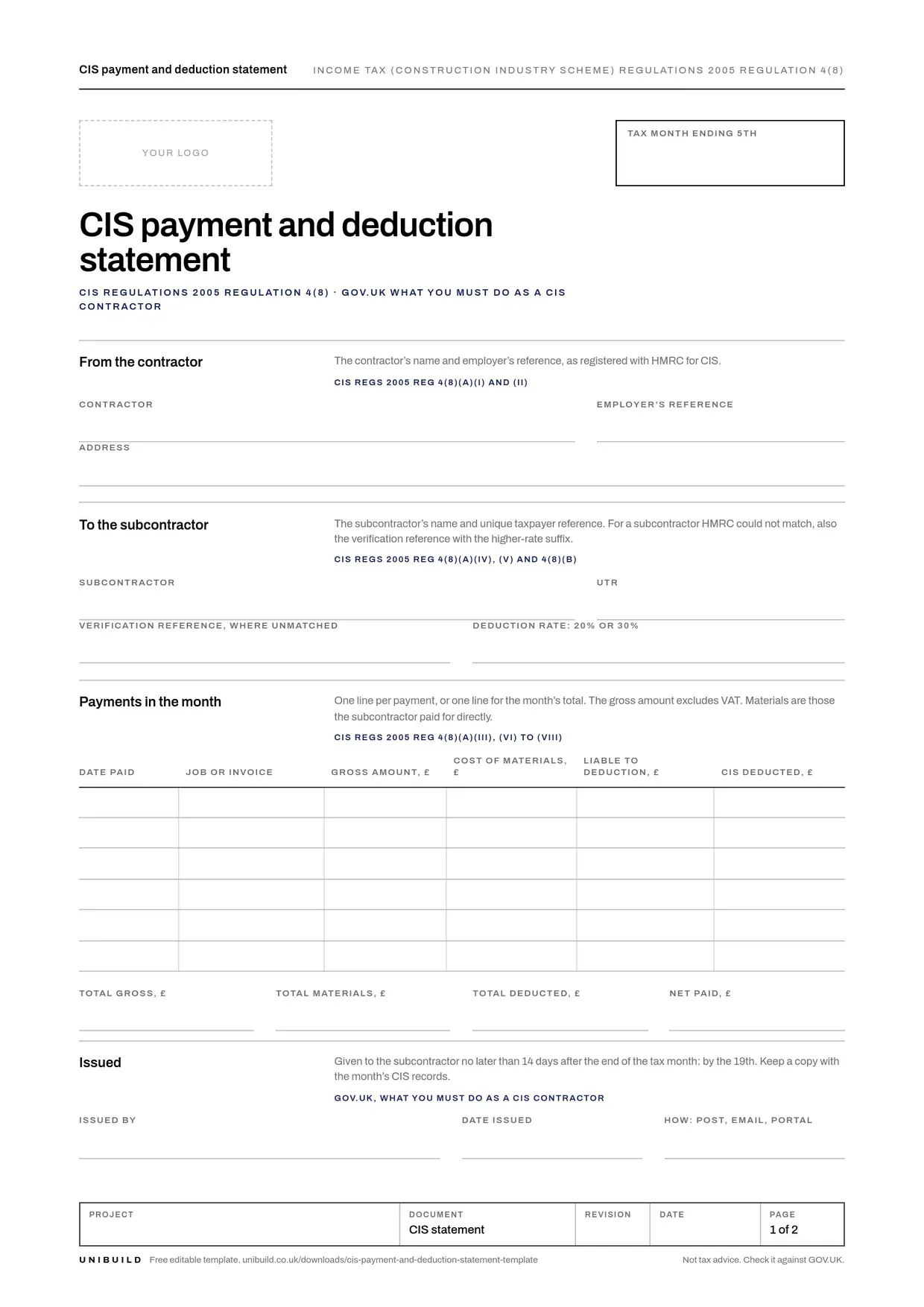
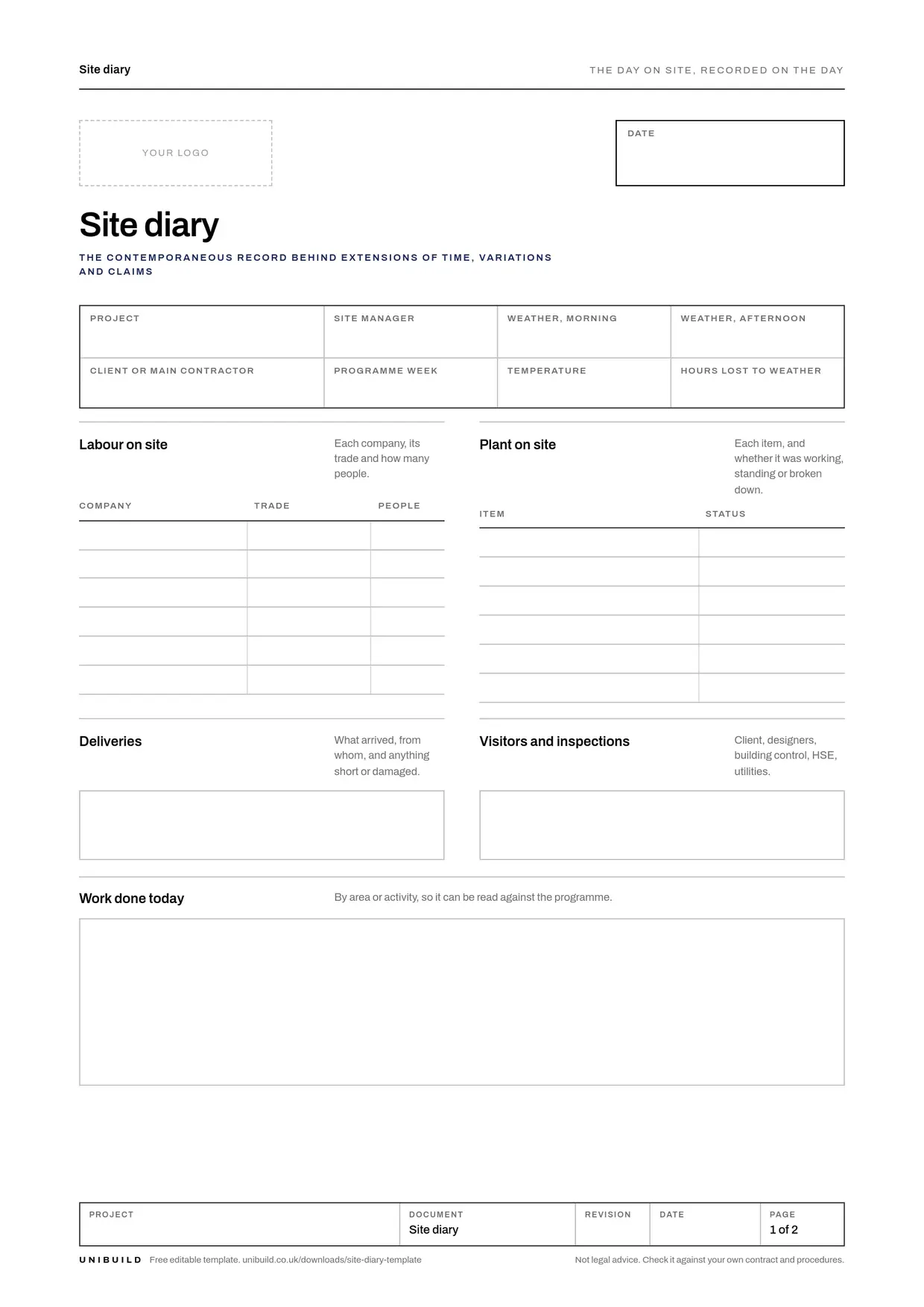
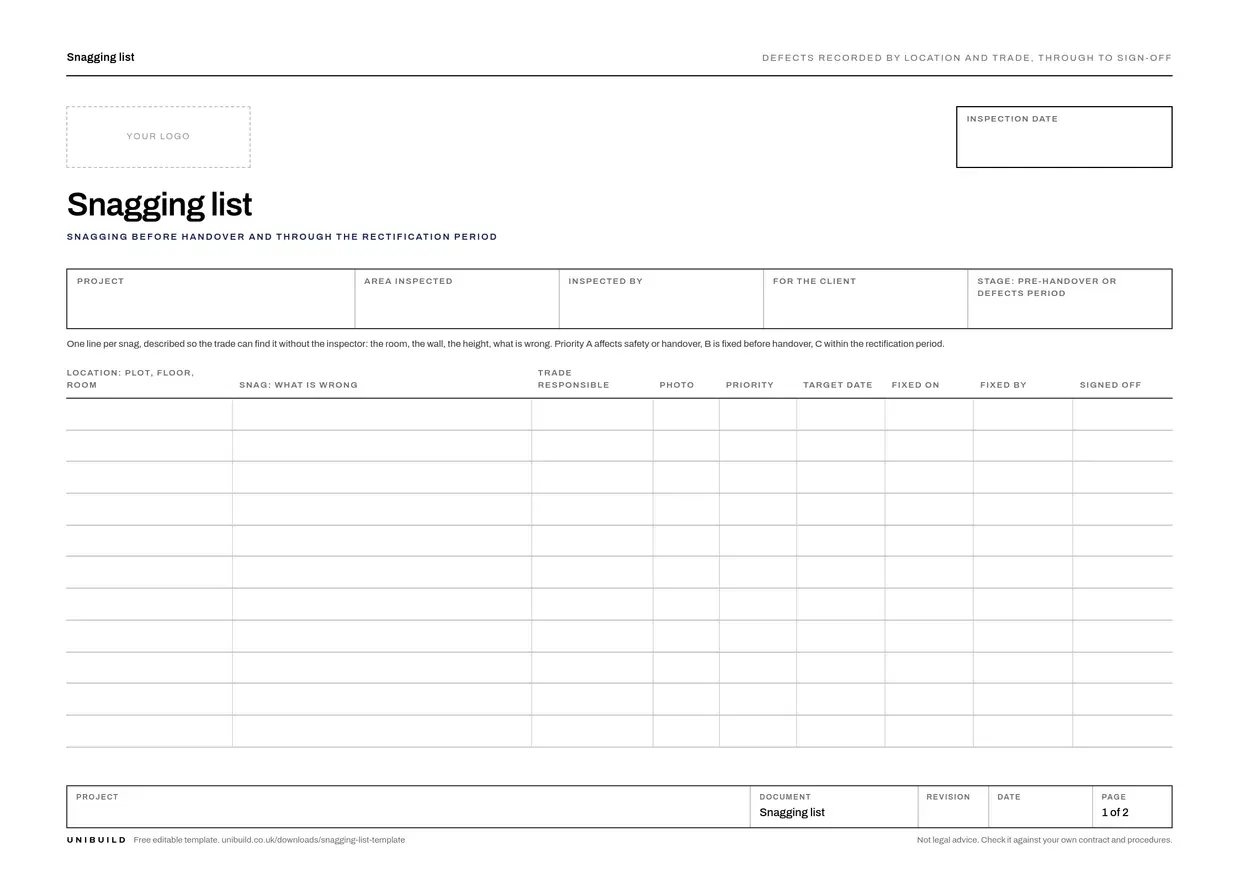
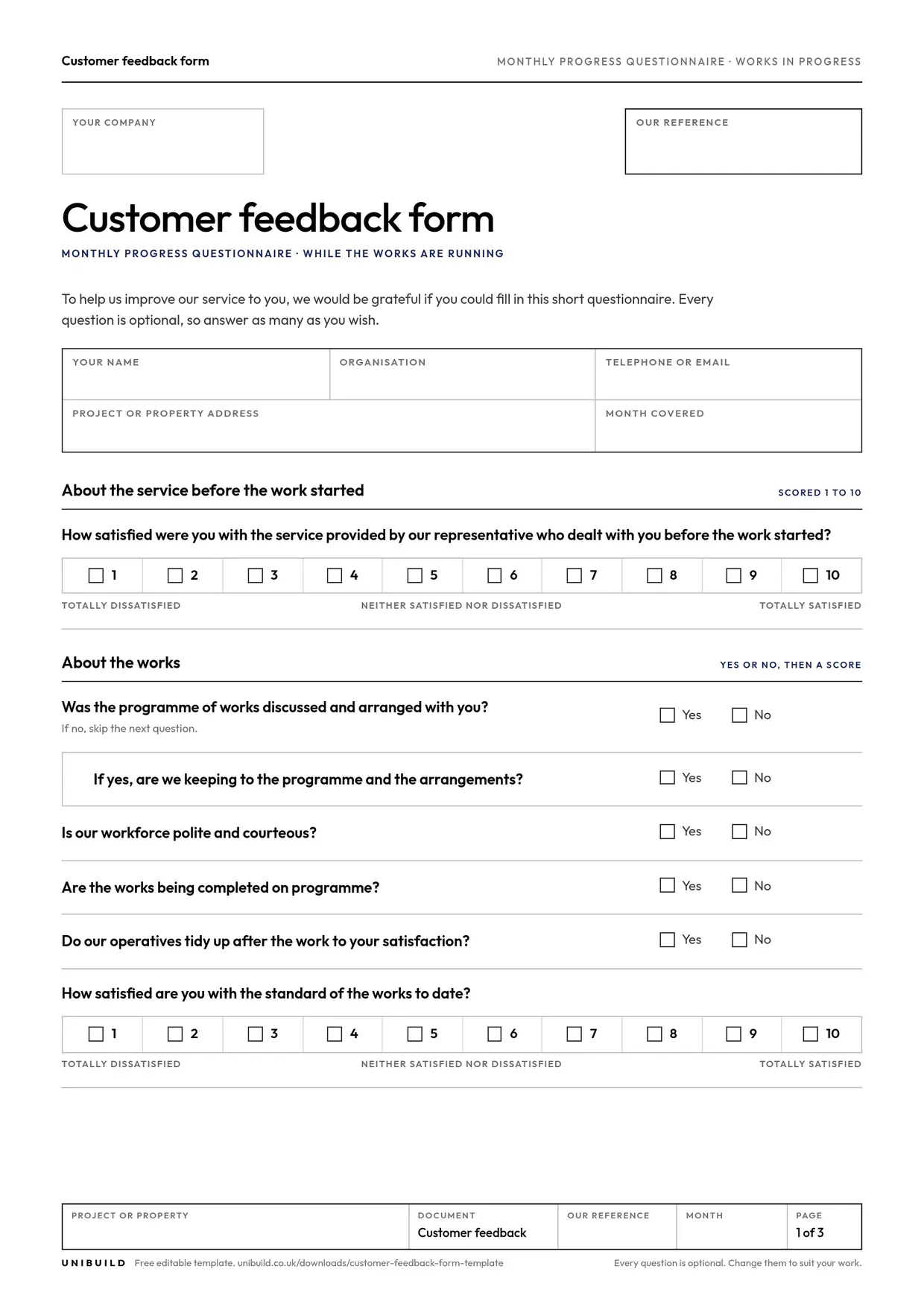
The forms the office runs on: the weekly timesheet and the CIS payment and deduction statement, the staff holiday planner and the training matrix as editable PDFs and as Excel workbooks, the subcontractor approval check sheet, the purchase order and the goods received note, the variation order and the daywork sheet, the site diary and the snagging list, and the customer feedback form and customer satisfaction survey. Free to use and reuse.
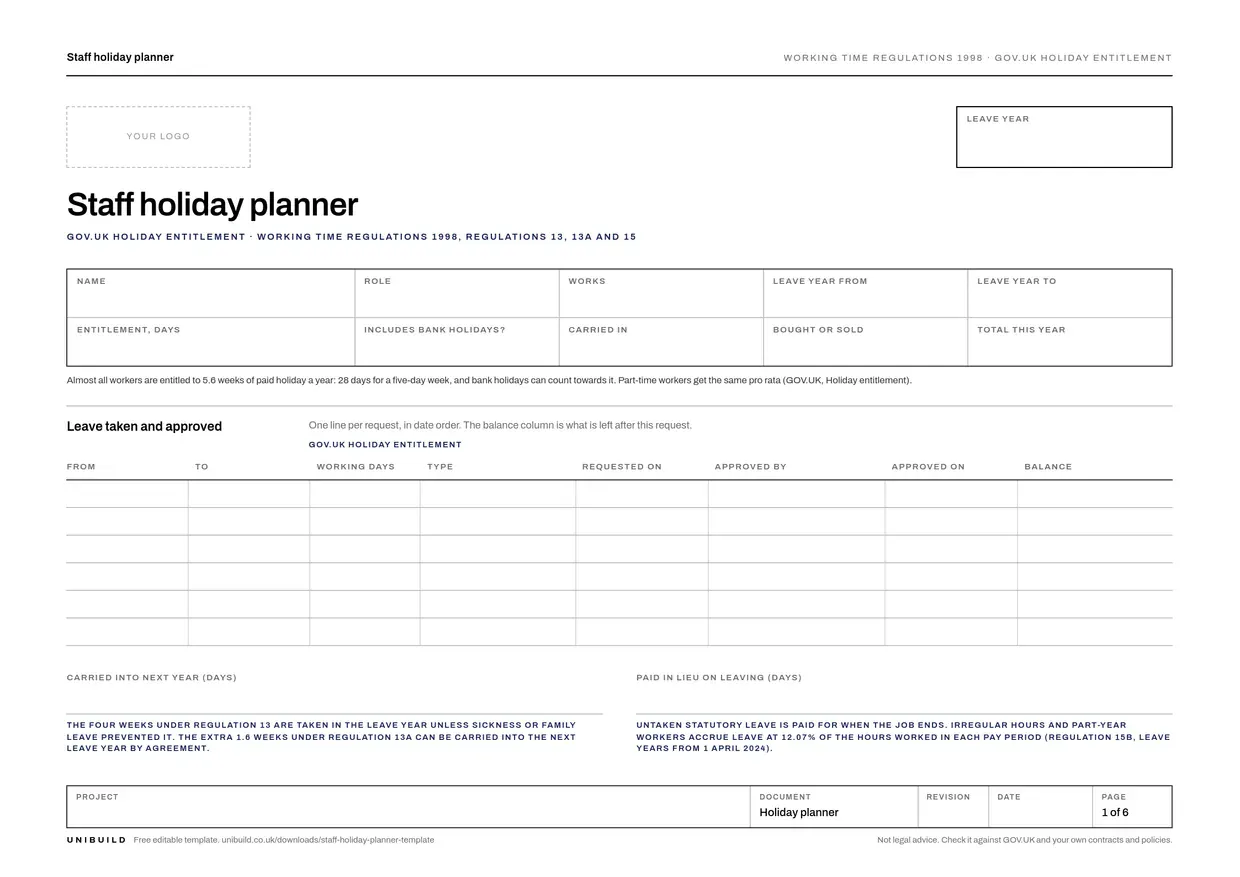
A leave record per person with entitlement, carry-over and every request approved, a team planner a quarter per page, and the 2026 and 2027 bank holidays by nation. As a PDF, Word and an Excel workbook.
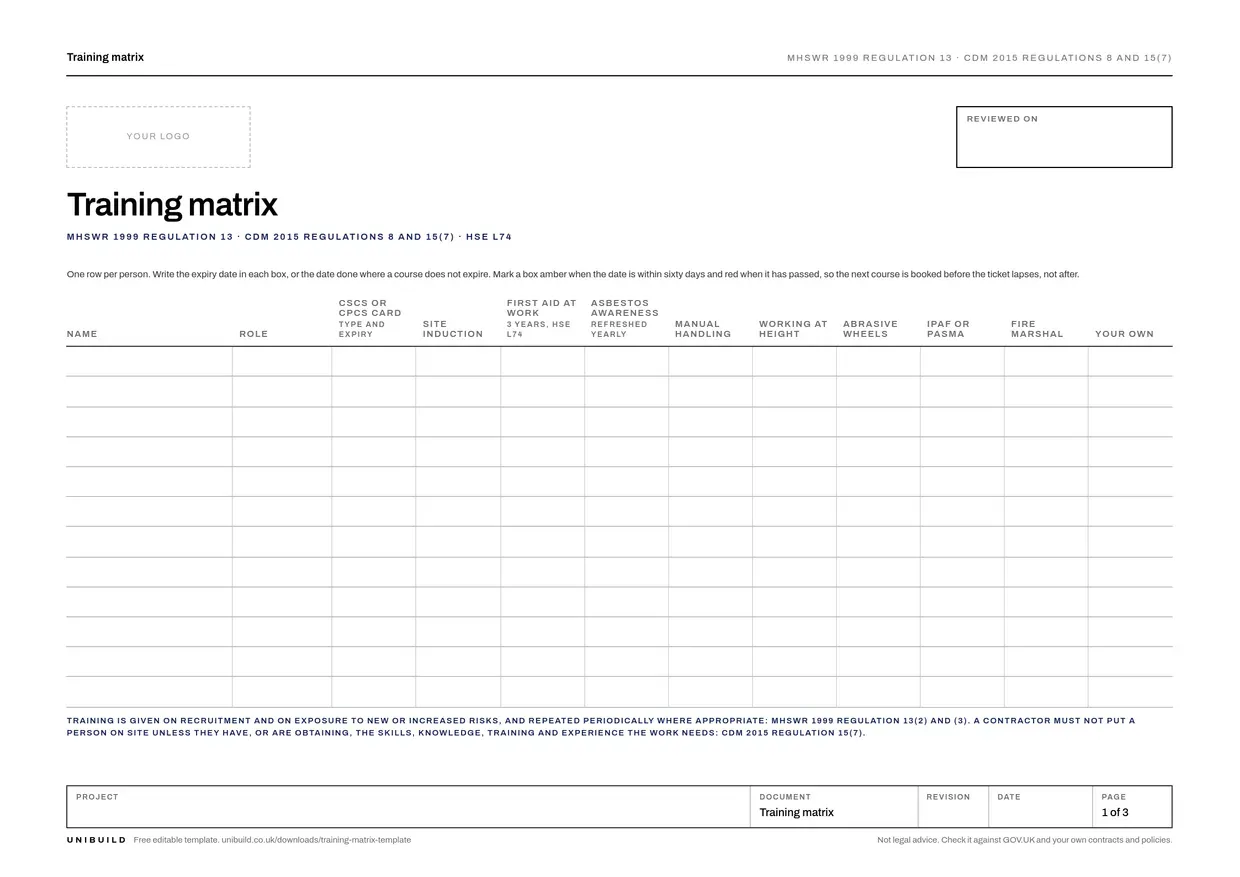
One row per person with the expiry of each card and course, a training record per person, and a training needs grid by role. As a PDF, Word and an Excel workbook that turns a date amber at sixty days and red when it passes.
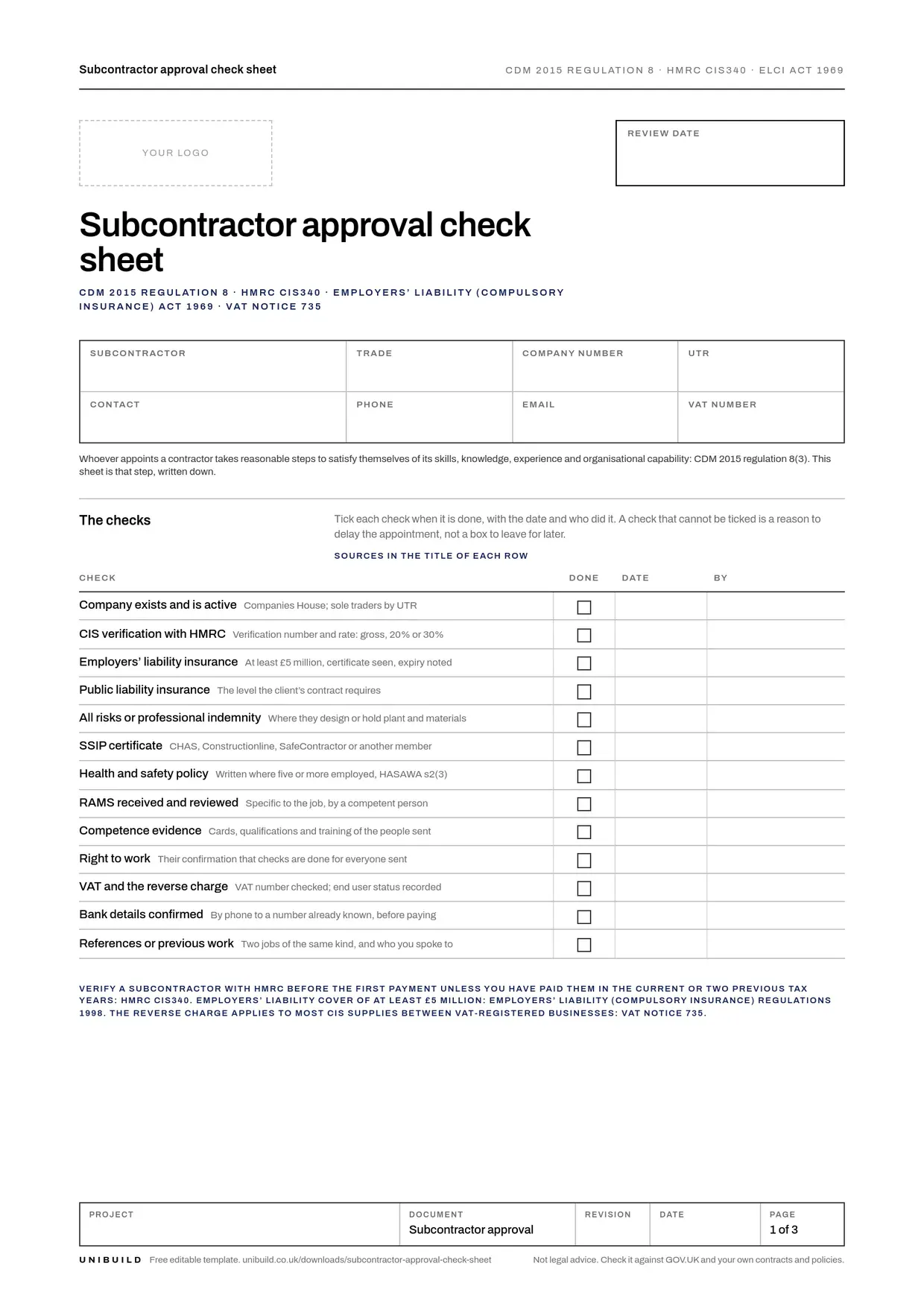
The checks before a subcontractor goes on the approved list: Companies House, CIS verification, insurance, SSIP, the policy, RAMS, competence, right to work, the reverse charge and bank details, then the decision, the register and the review log.
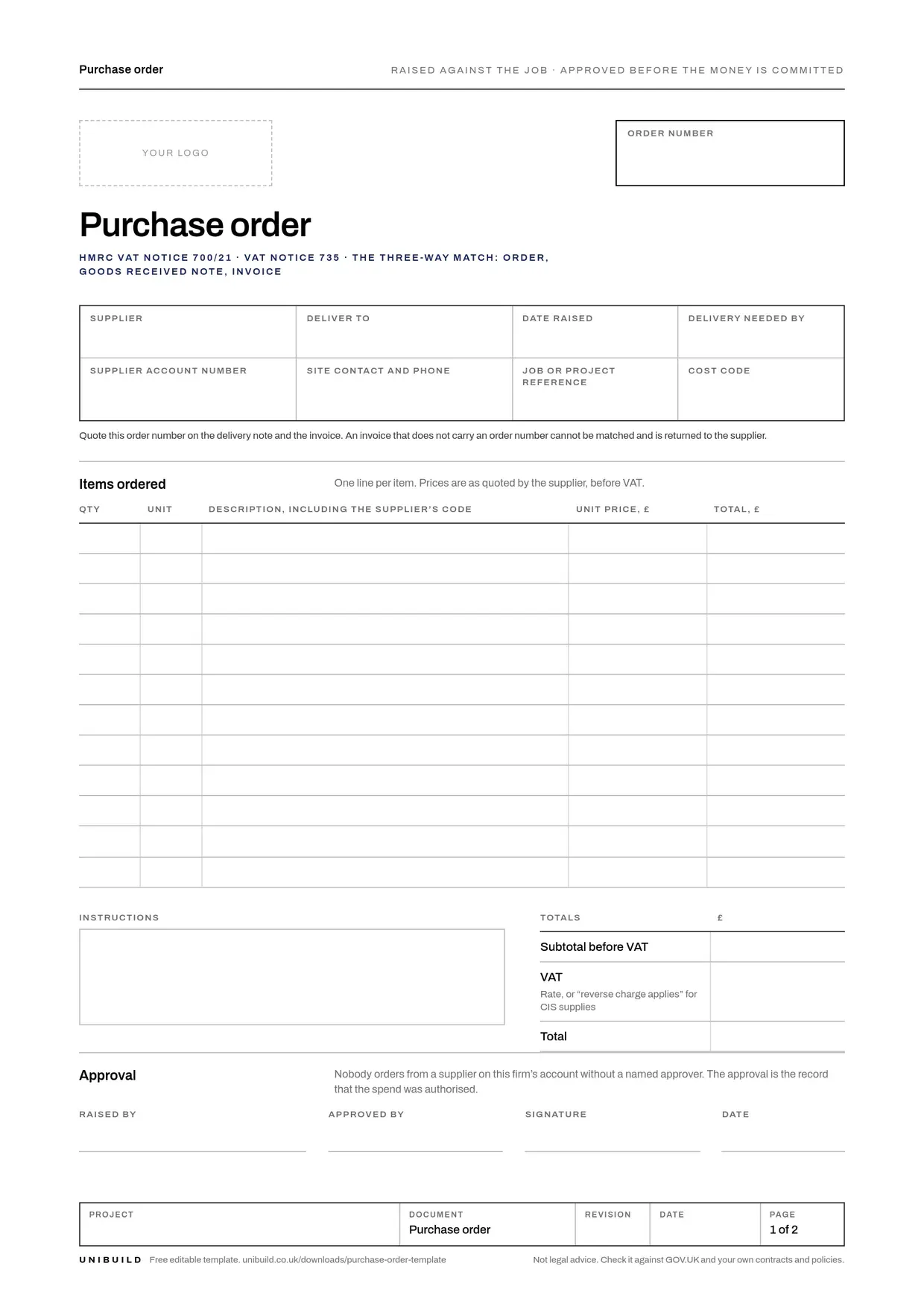
The order number, supplier, delivery address and job reference, the items with quantities and prices, the VAT treatment, the approval before it is sent, and a guidance page on matching the invoice to the order and the goods received note.
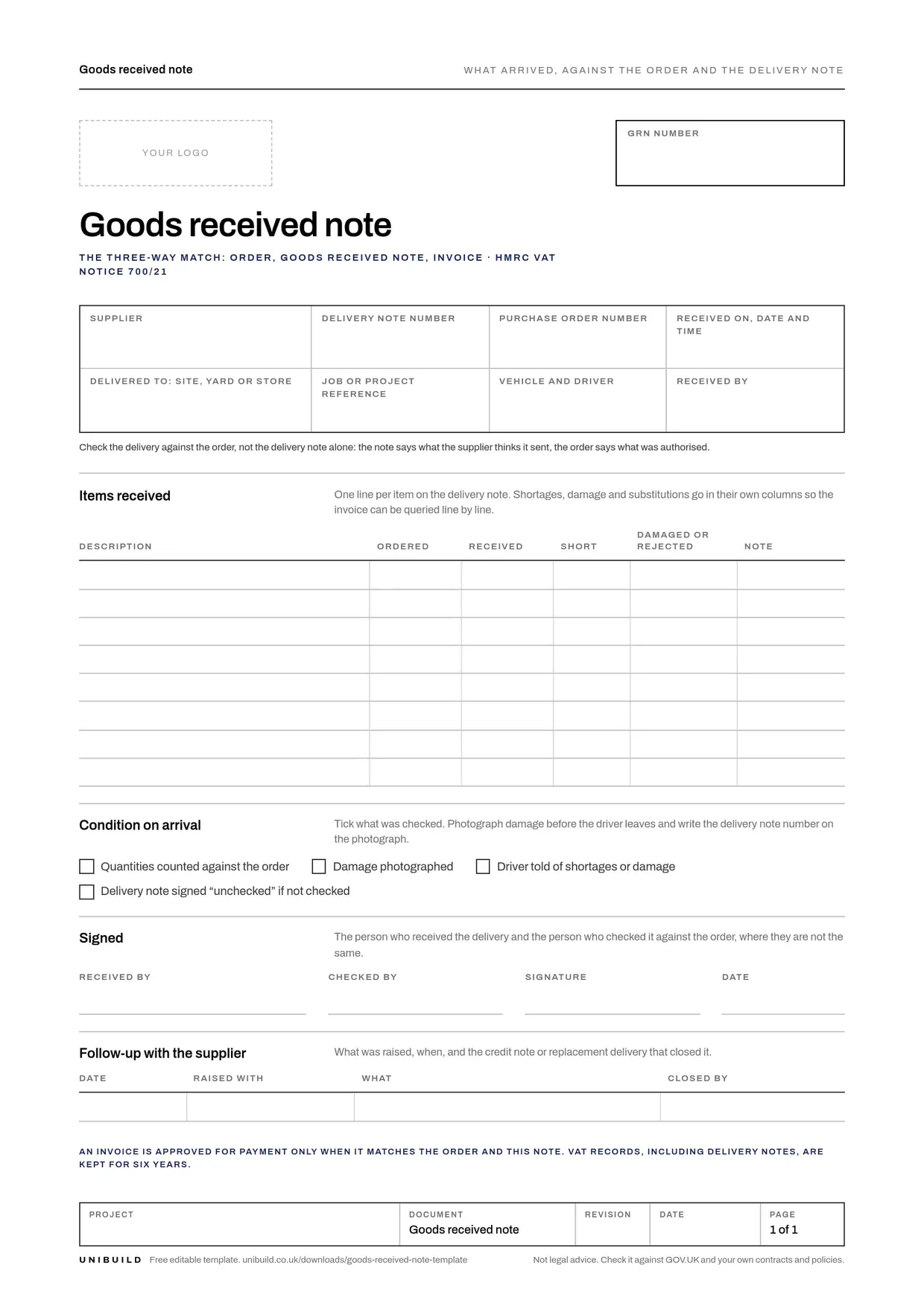
The delivery date and time, supplier, delivery note and order numbers, each item with the quantity ordered, received, short or damaged, the condition checks, the signatures and the follow-up with the supplier.
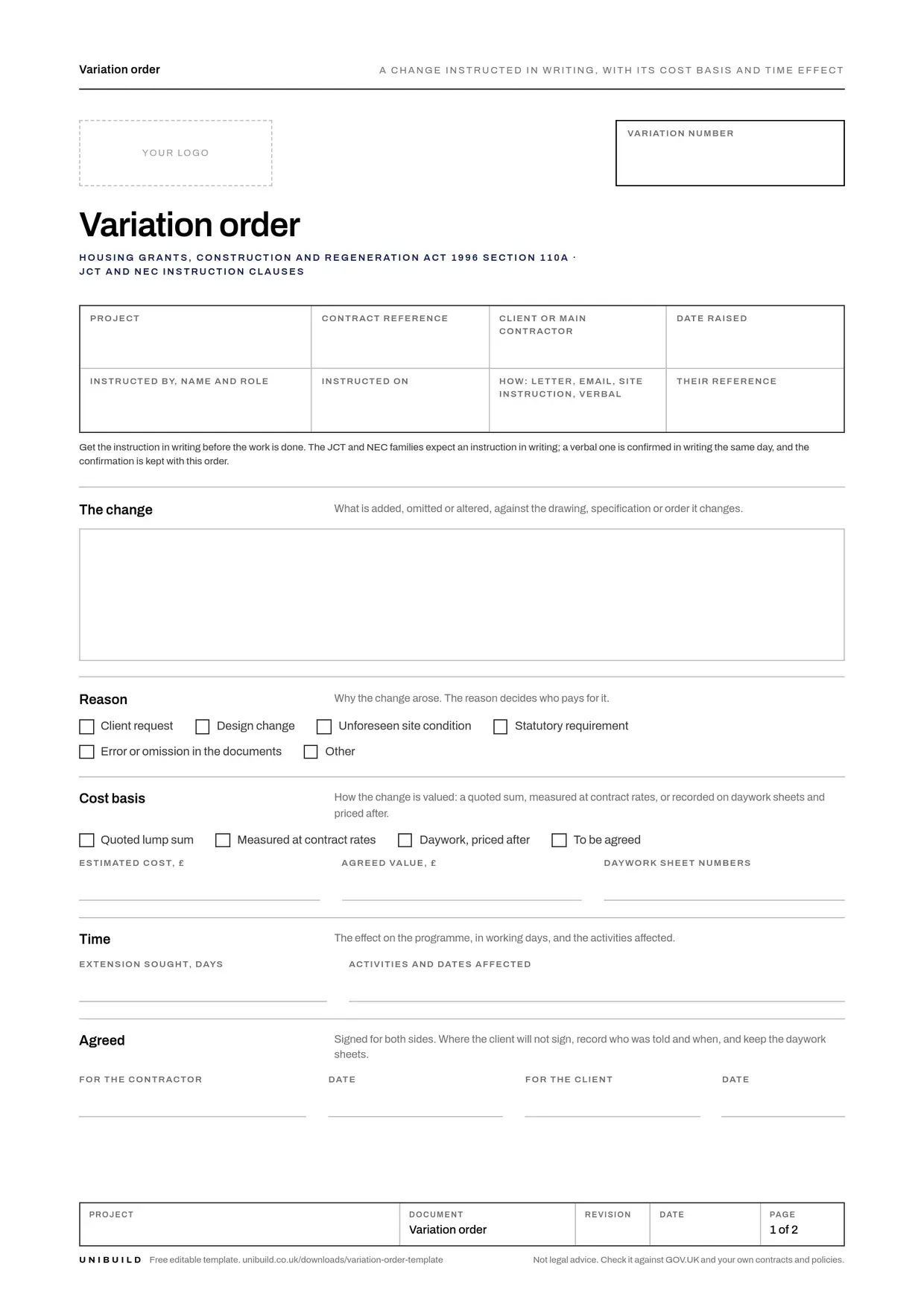
The instruction, who gave it and when, the change against the contract, the reason, the cost basis and estimate, the effect on the programme, and agreement by both sides, with a guidance page on getting the variation paid.
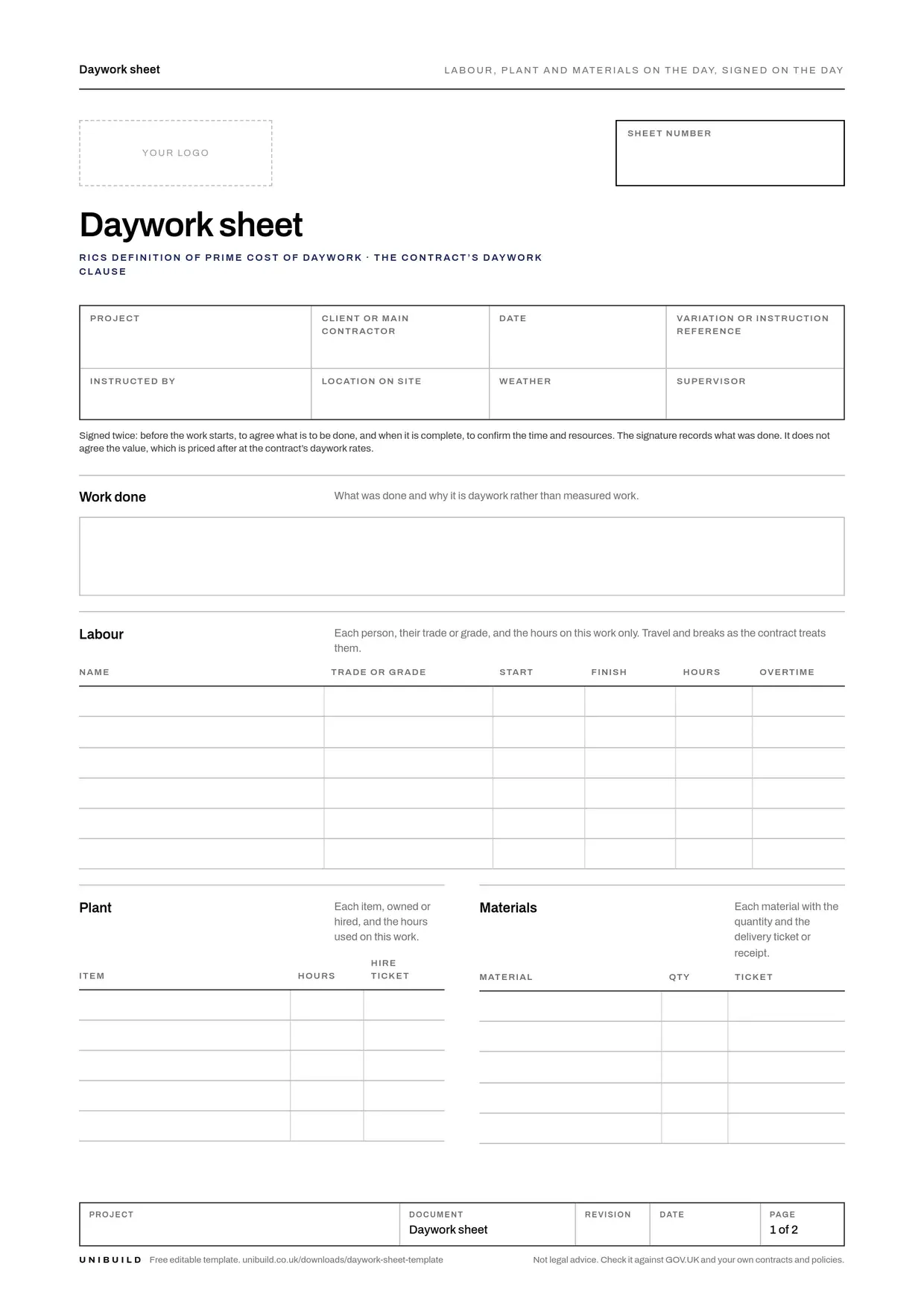
The date, project and instruction, the work done, each person with their trade and hours, the plant and the materials, and the client's representative's signature before and after the work as a record of the time and resources.
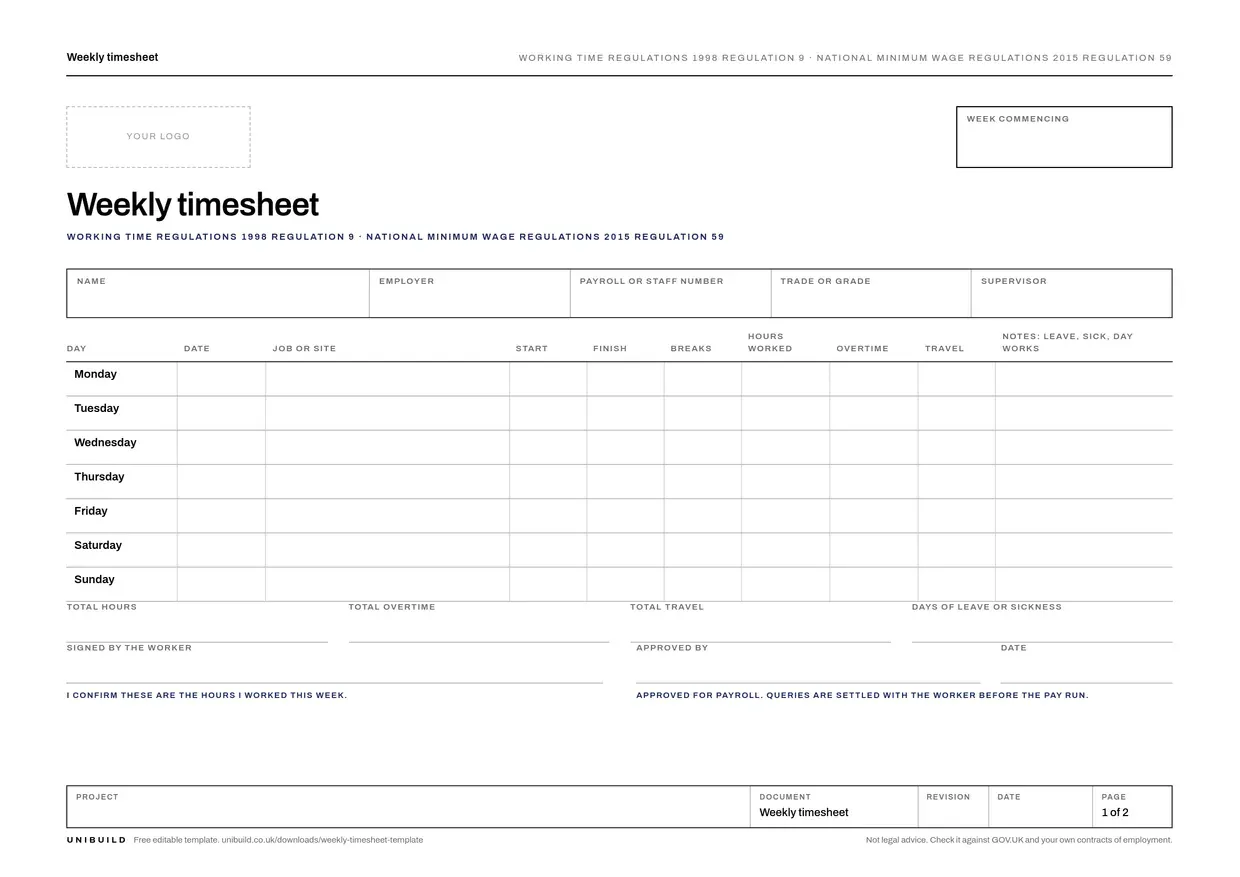
One person’s week with the job, start, finish, breaks, hours, overtime and travel each day, signed by the worker and approved for payroll, plus a gang sheet for a whole crew on one page.
Every particular the regulations require: the contractor’s employer reference, the tax month, the subcontractor’s UTR, each payment with the gross amount, materials, the amount liable to deduction and the CIS deducted, with a guidance page.
One day per sheet: the weather, the labour on site by company and trade, plant, deliveries, visitors and inspections, the work done, instructions received, delays and their causes, health and safety notes and photographs.
Each snag by location with the defect, the trade responsible, photograph, priority, target date, date fixed and sign-off, then a handover sign-off and an end of rectification period sign-off for both sides.
The questionnaire a customer fills in each month while the works run: the service before work started and the works to date scored 1 to 10, the programme, courtesy and tidiness, comments, a complaints line and office follow-up.
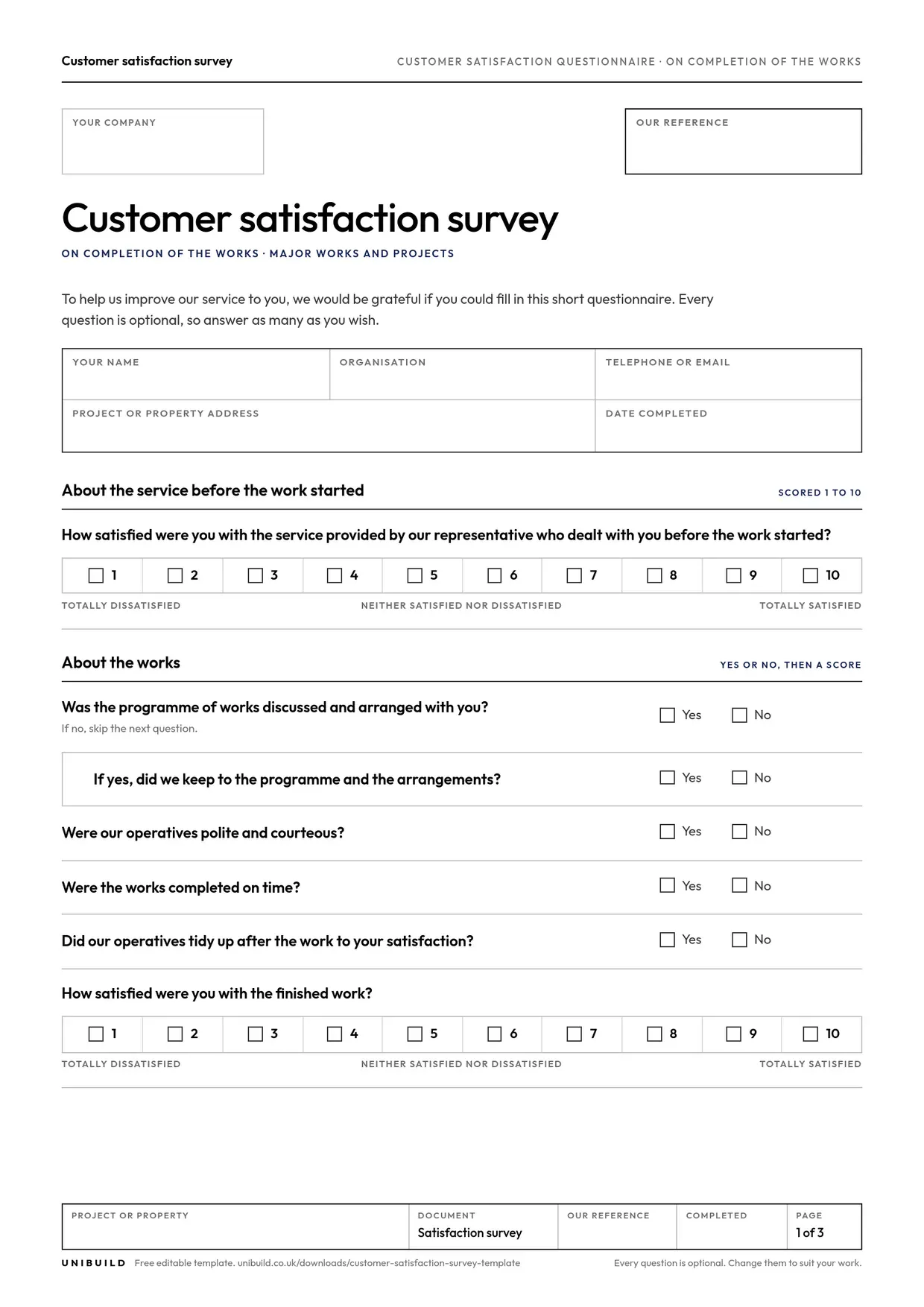
The questionnaire a customer fills in when the works are complete: the service, the finished work and overall satisfaction scored 1 to 10, the programme, time, courtesy and tidiness, whether they would use you again, and comments.
Blank checklists for the site, the people, the plant and the paperwork. Every check names the regulation behind it. Each one also ticks on screen at its own page and downloads with your company on it.
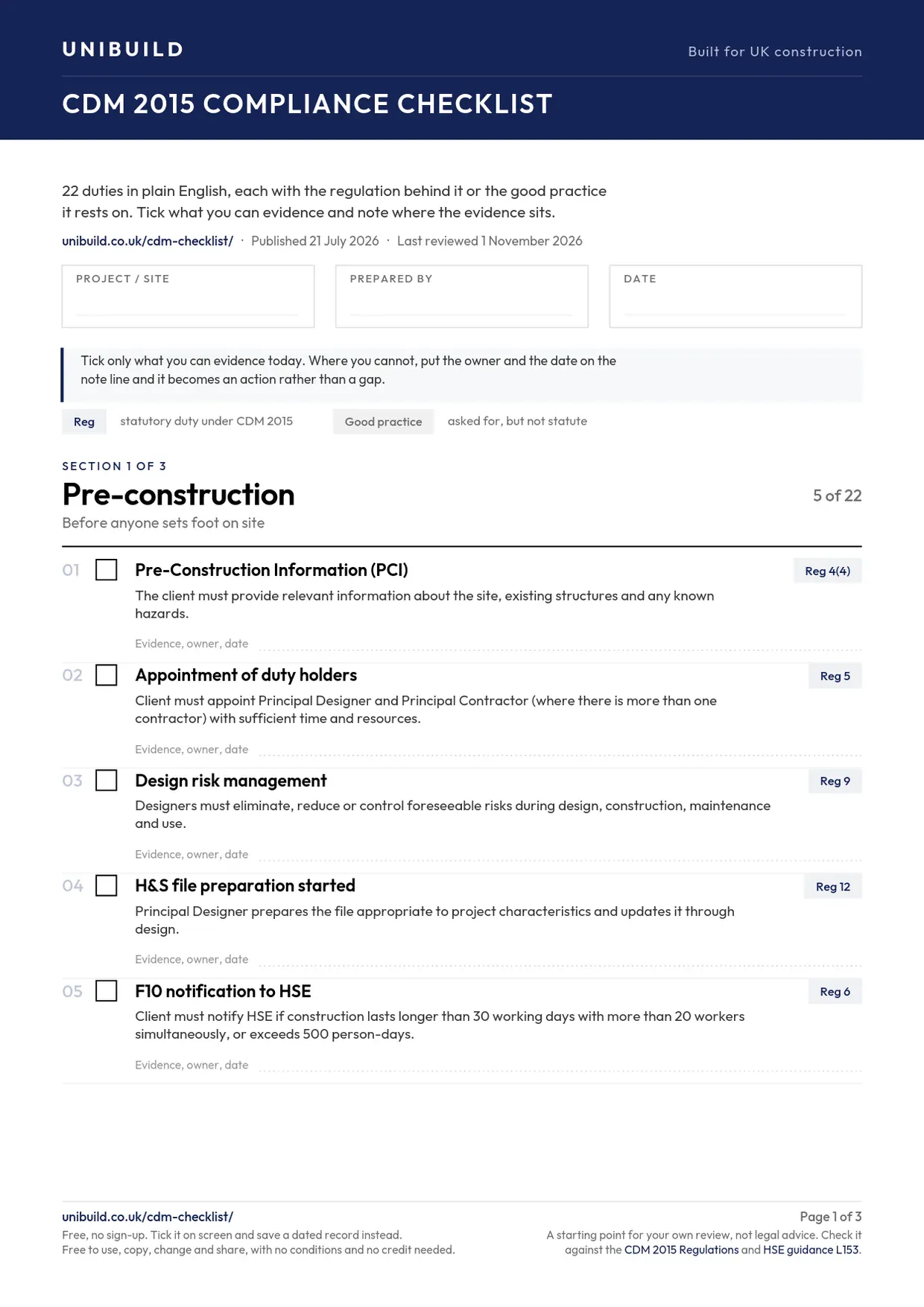
The 22 duty-holder duties, each with the regulation behind it, across pre-construction, the construction phase and the records an audit asks for.
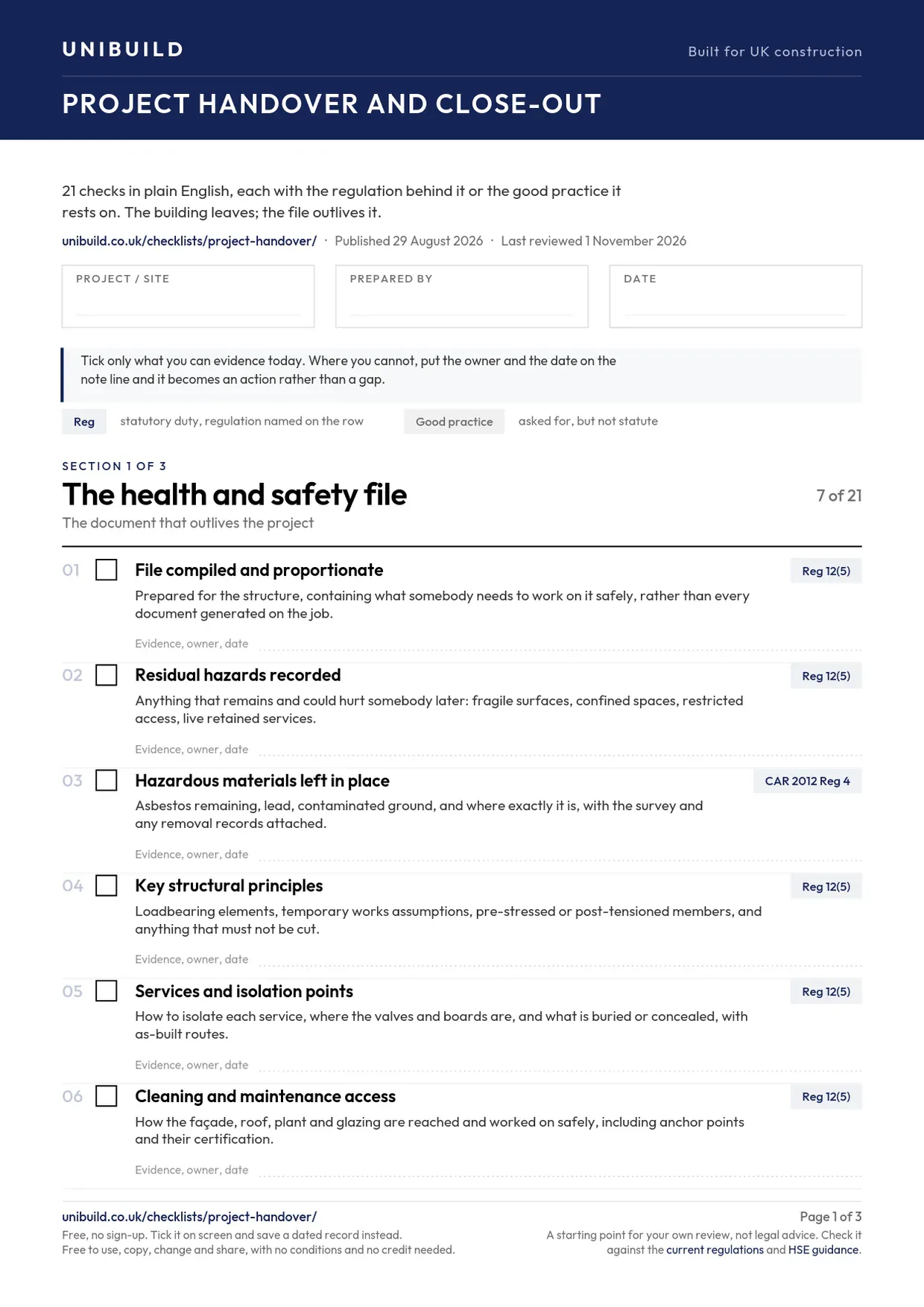
The health and safety file that outlives the job, the technical handover, and closing out properly.
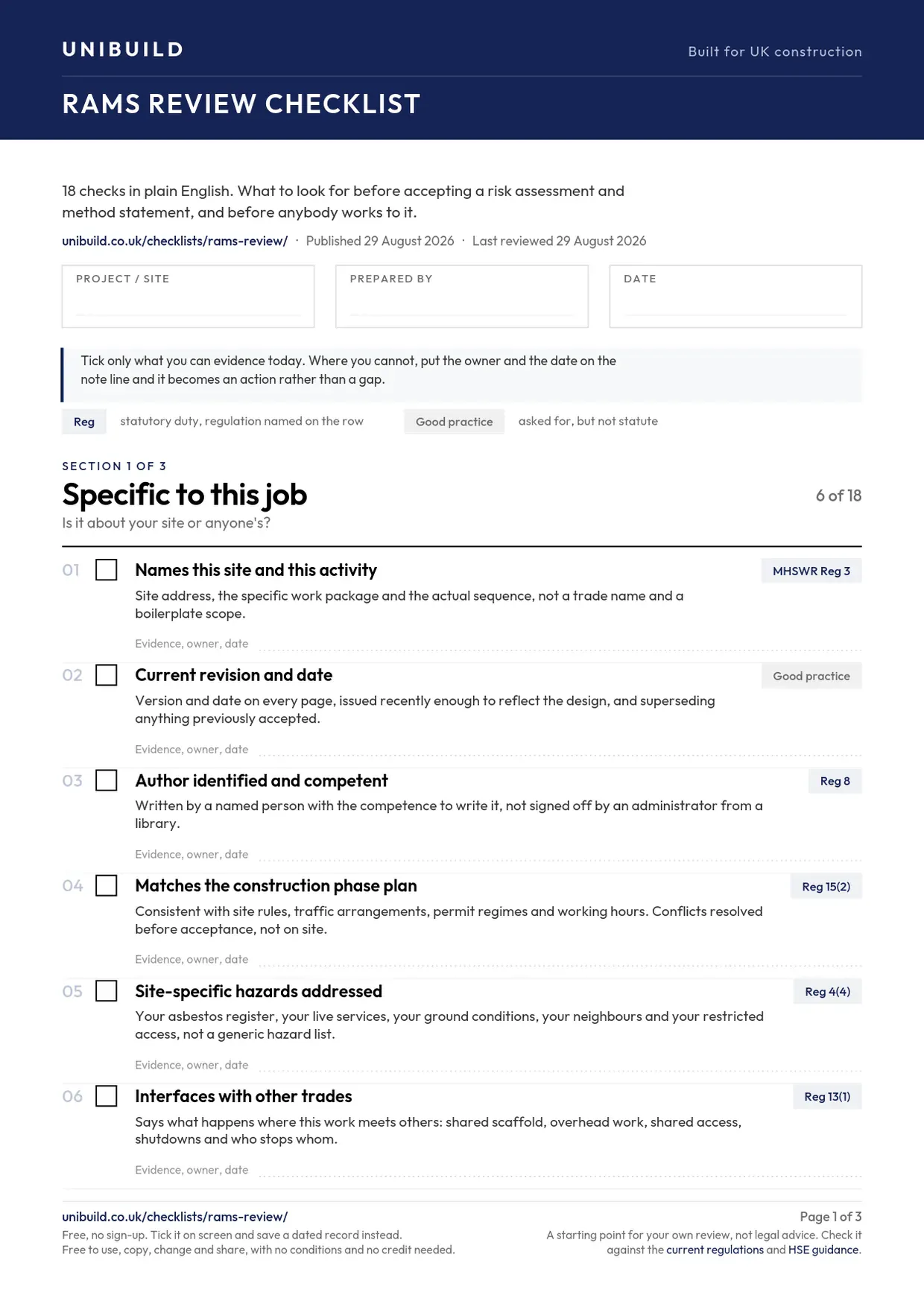
What to look for before accepting a method statement: generic copy, missing controls, no rescue plan.
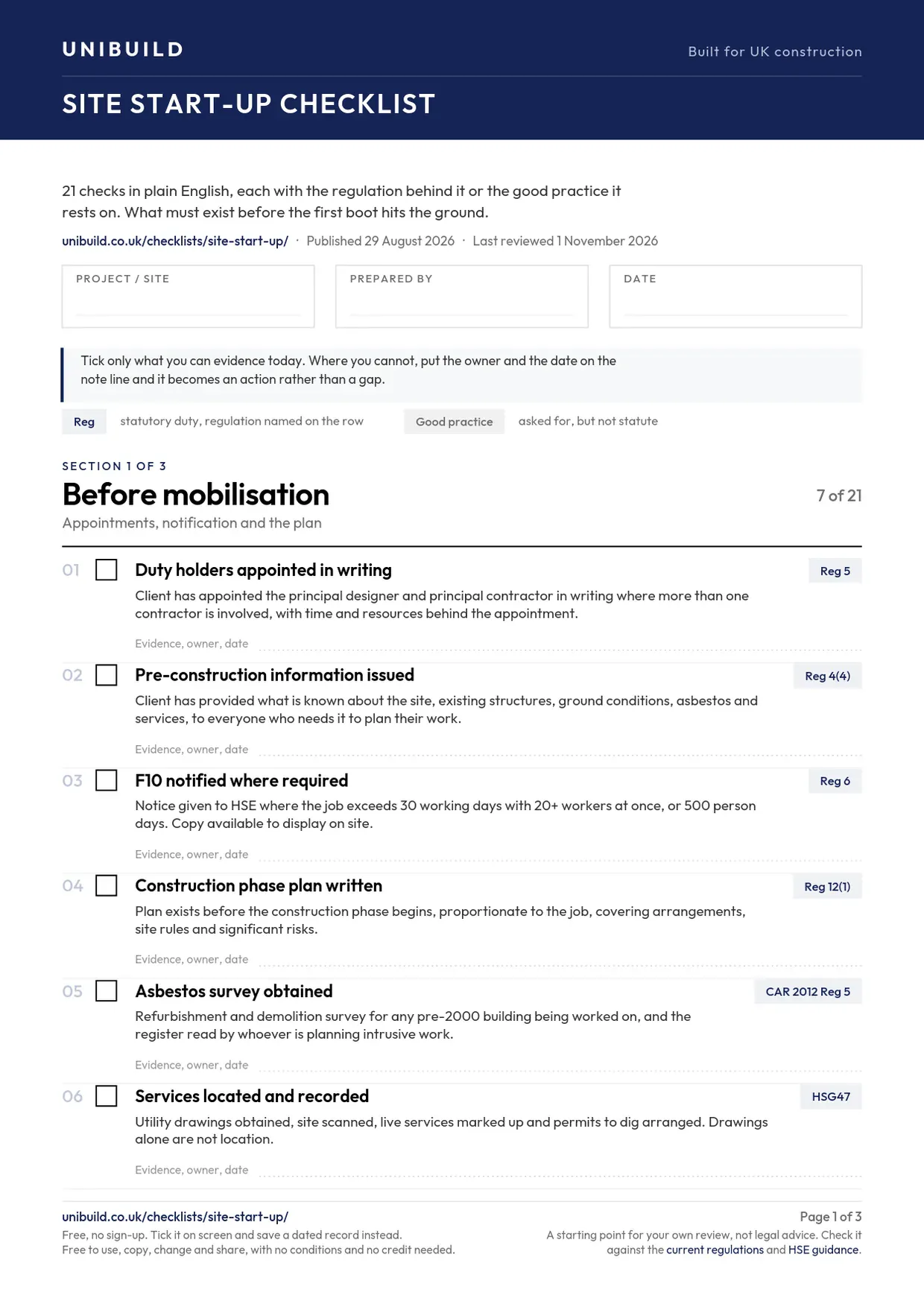
What must be true before the first boot hits the ground, including the three things CDM says cannot wait.
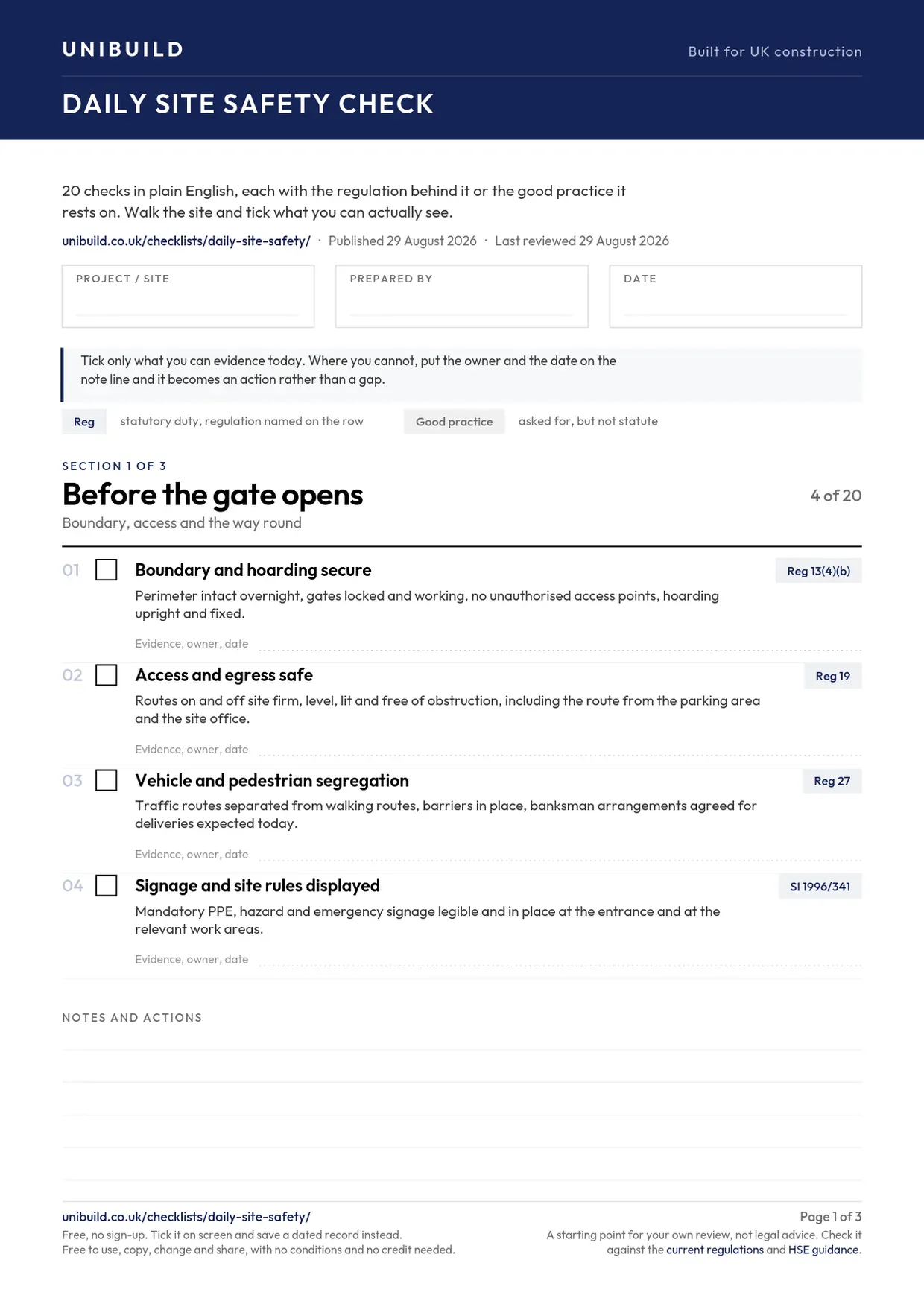
The ten-minute walk: boundary, welfare, fire, edges and housekeeping, plus what to do before you lock up.
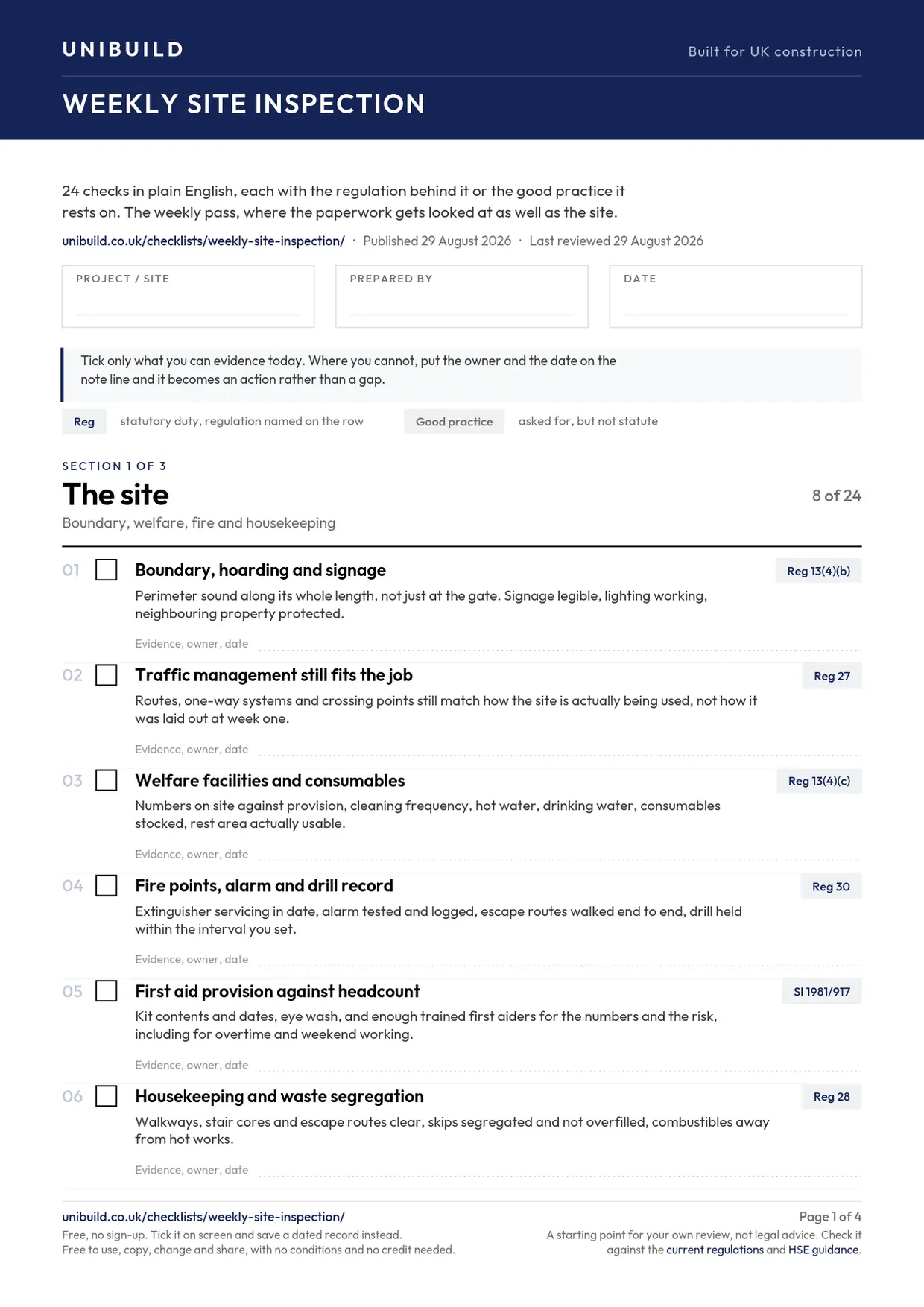
The slower pass where the folder gets opened too: scaffold tickets, thorough examinations, permits and training expiry.
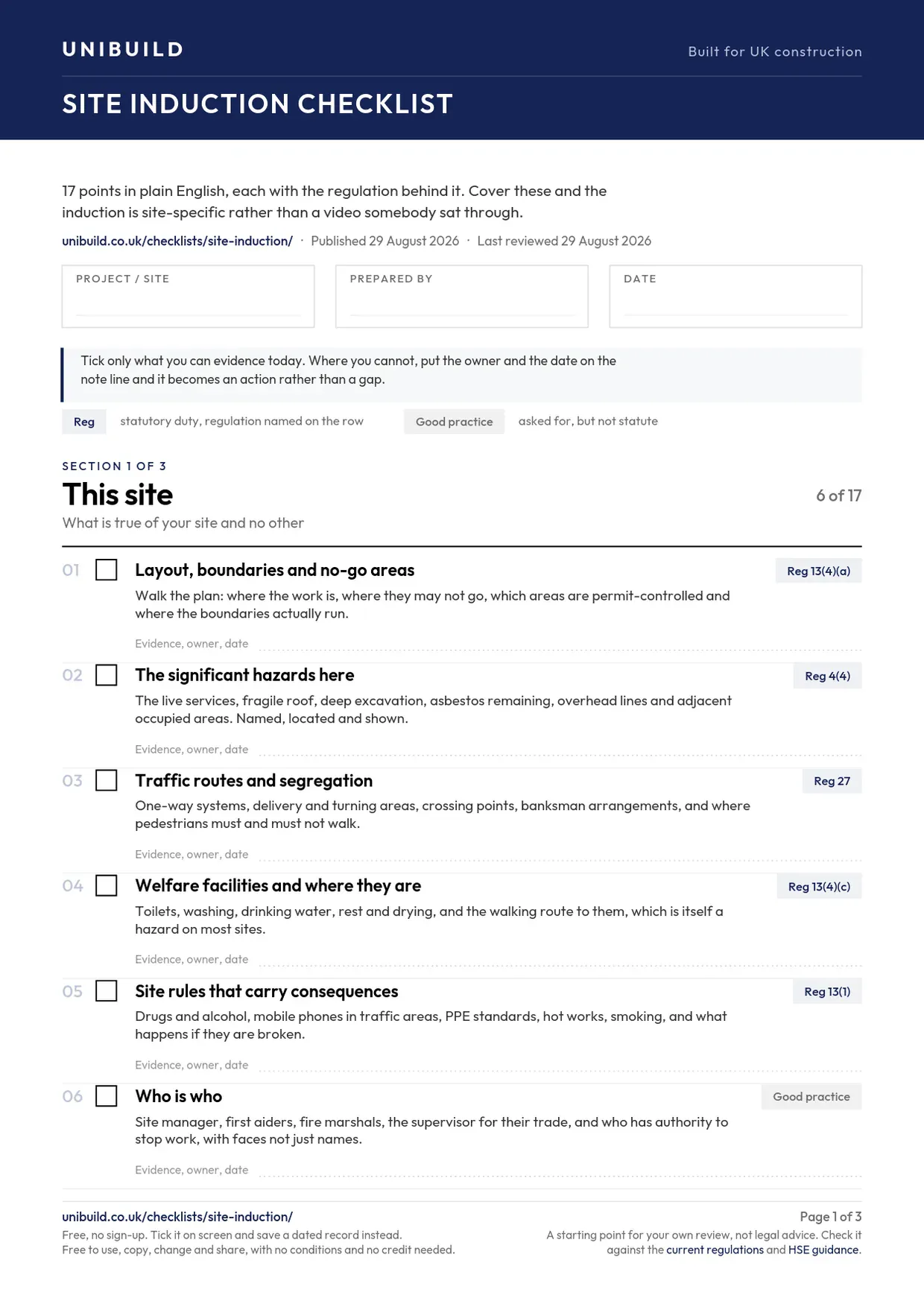
What a site-specific induction has to cover, and what turns one into a signature exercise.
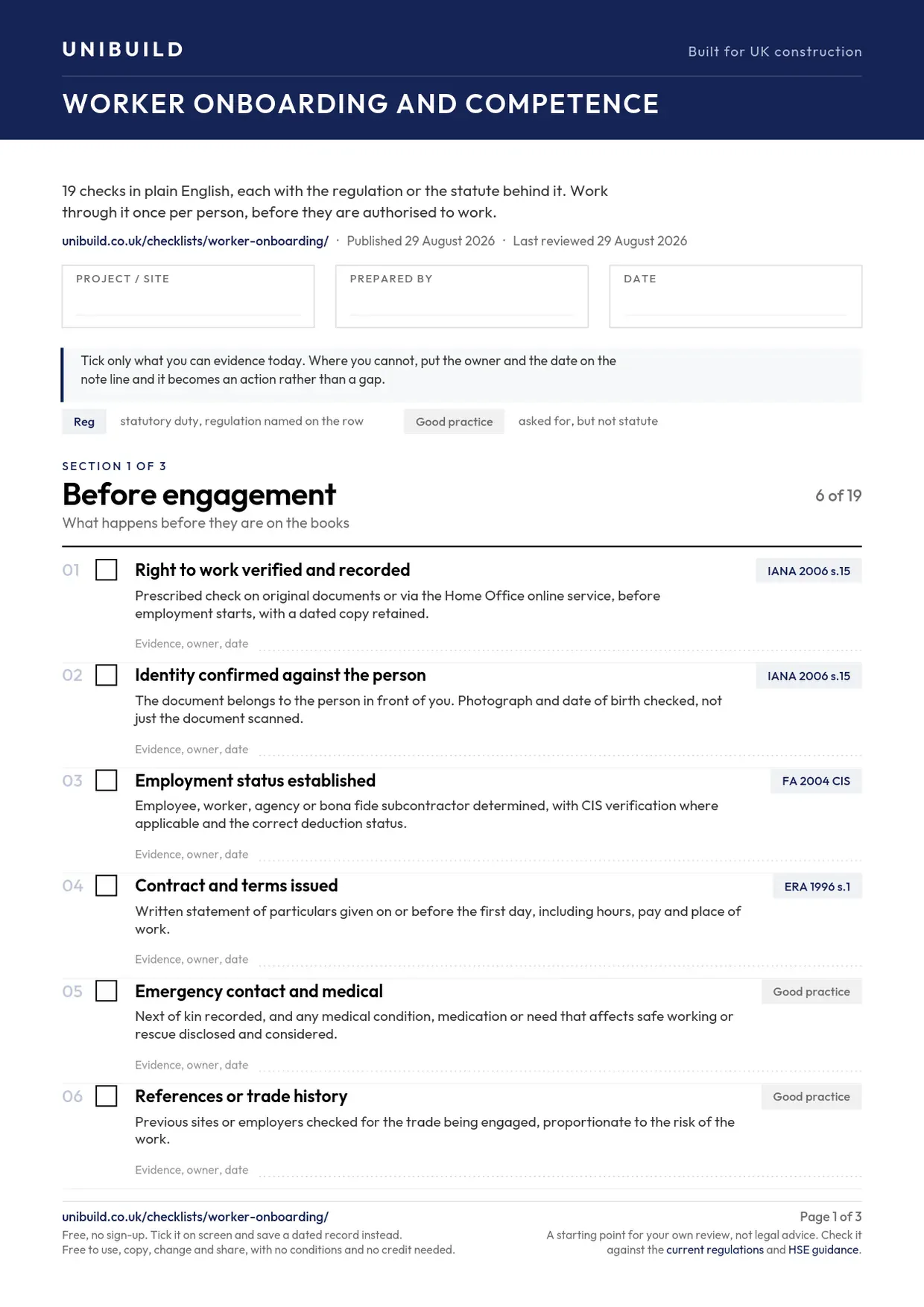
Right to work through to authorised, in one pass: competence, health surveillance, induction and PPE.
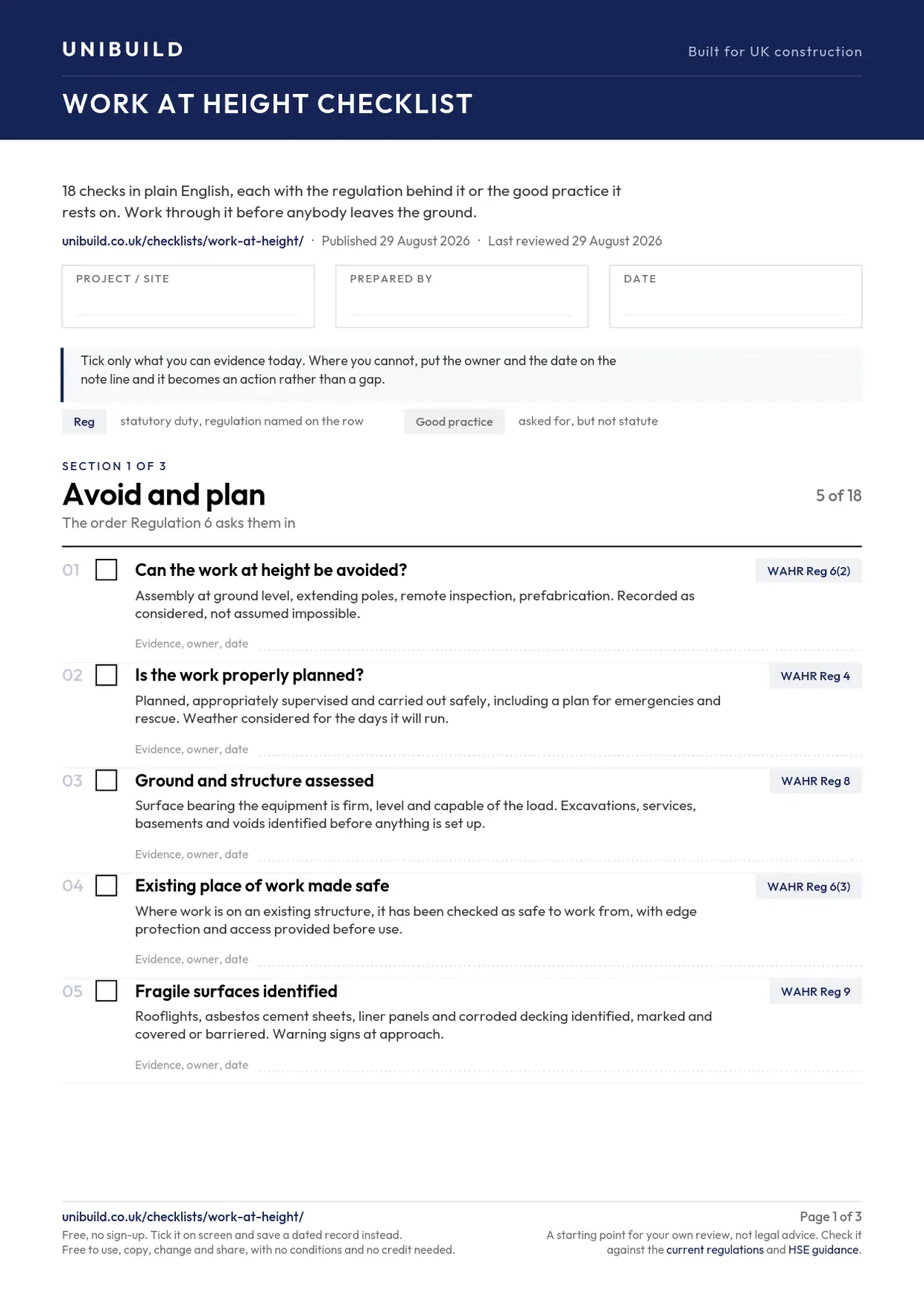
Avoid, prevent, mitigate, in the order Regulation 6 asks them, plus equipment, rescue and the seven-day inspection.
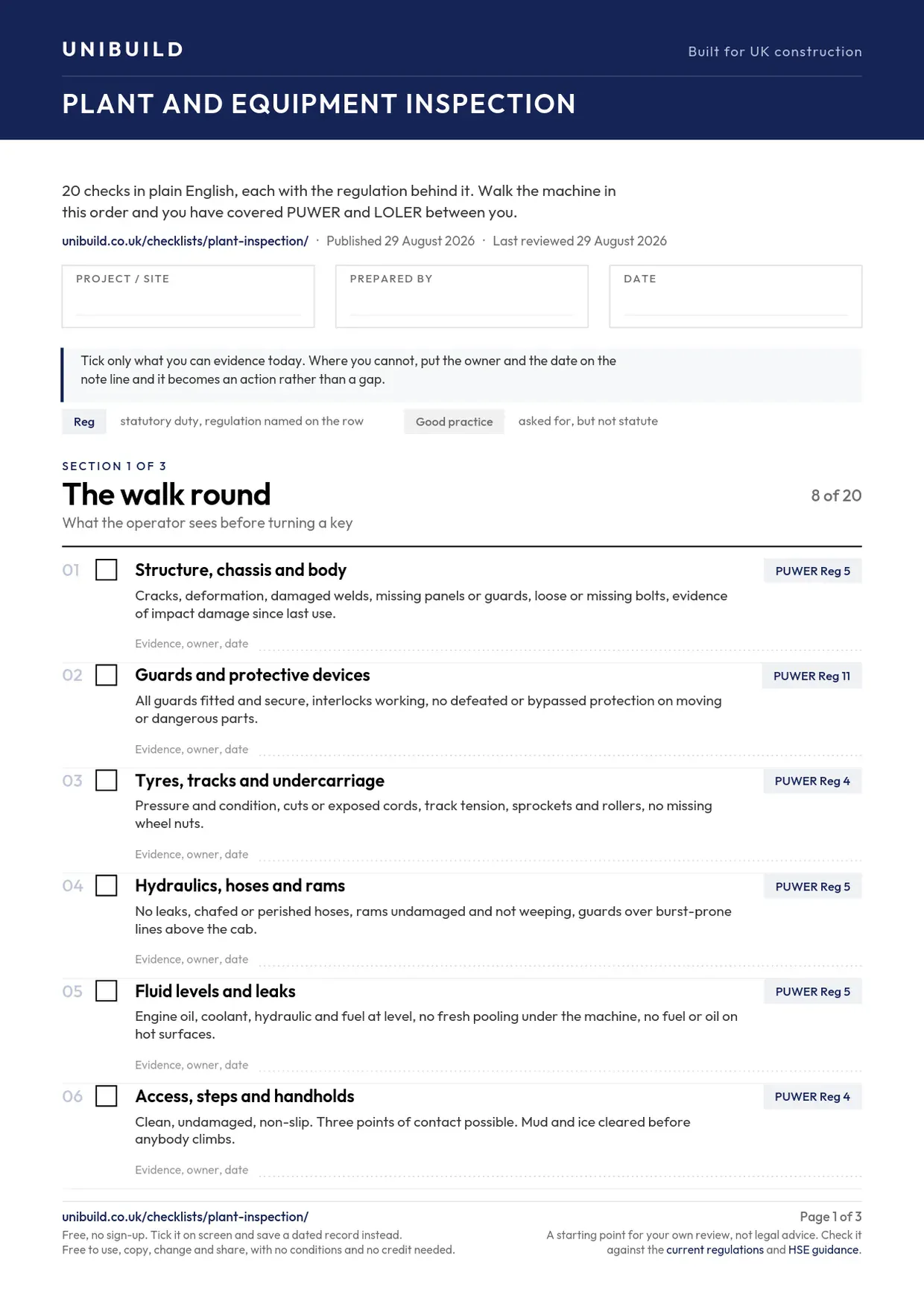
The walk round, the function checks and the paperwork behind them. PUWER and LOLER, per machine.
Free health and safety posters for the site cabin, the welfare unit and the gate: stop work authority, near miss reporting, working at height, ladder safety, mobile phones, mental health awareness and the COSHH symbols. Print them at A4 or A3.
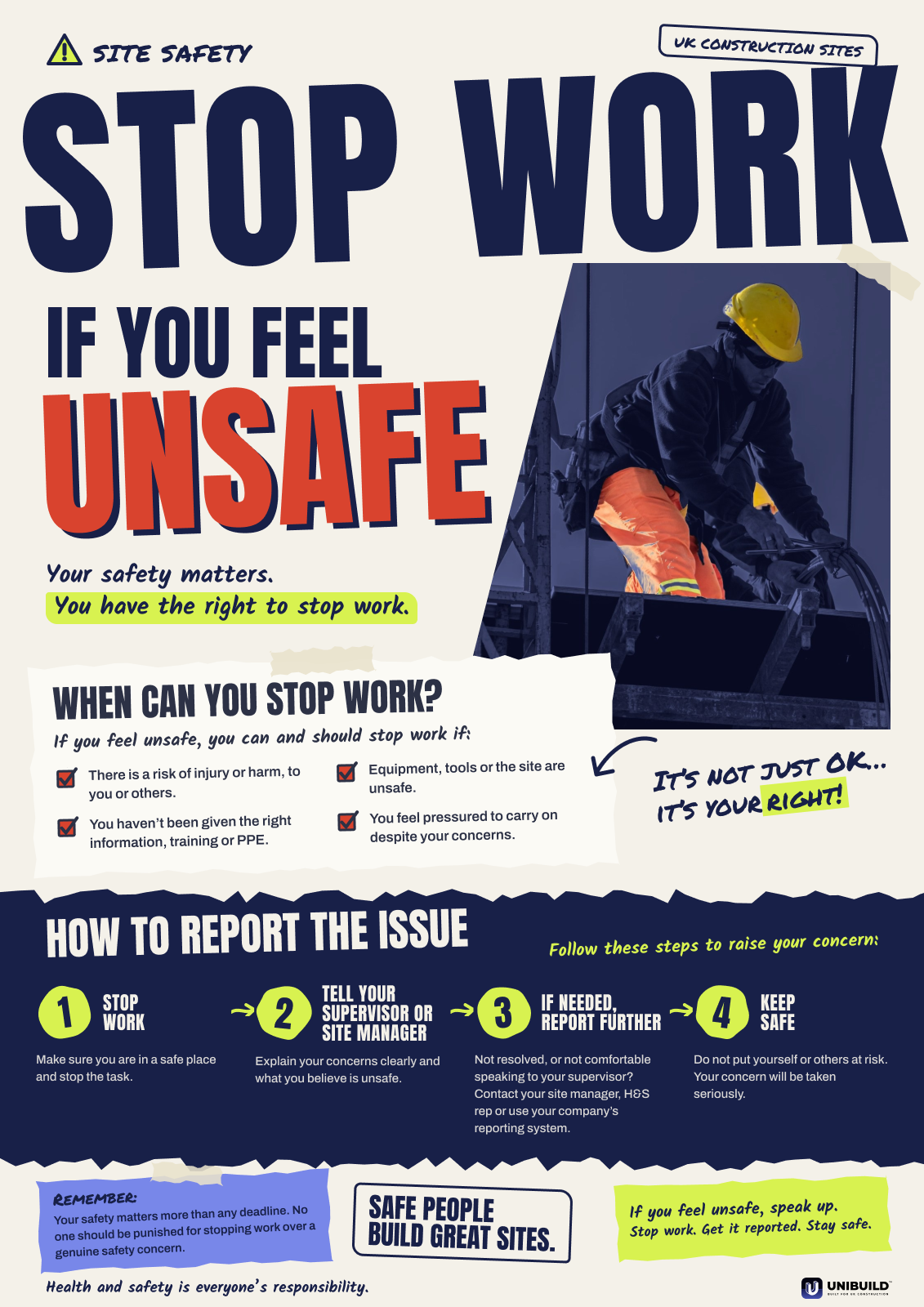
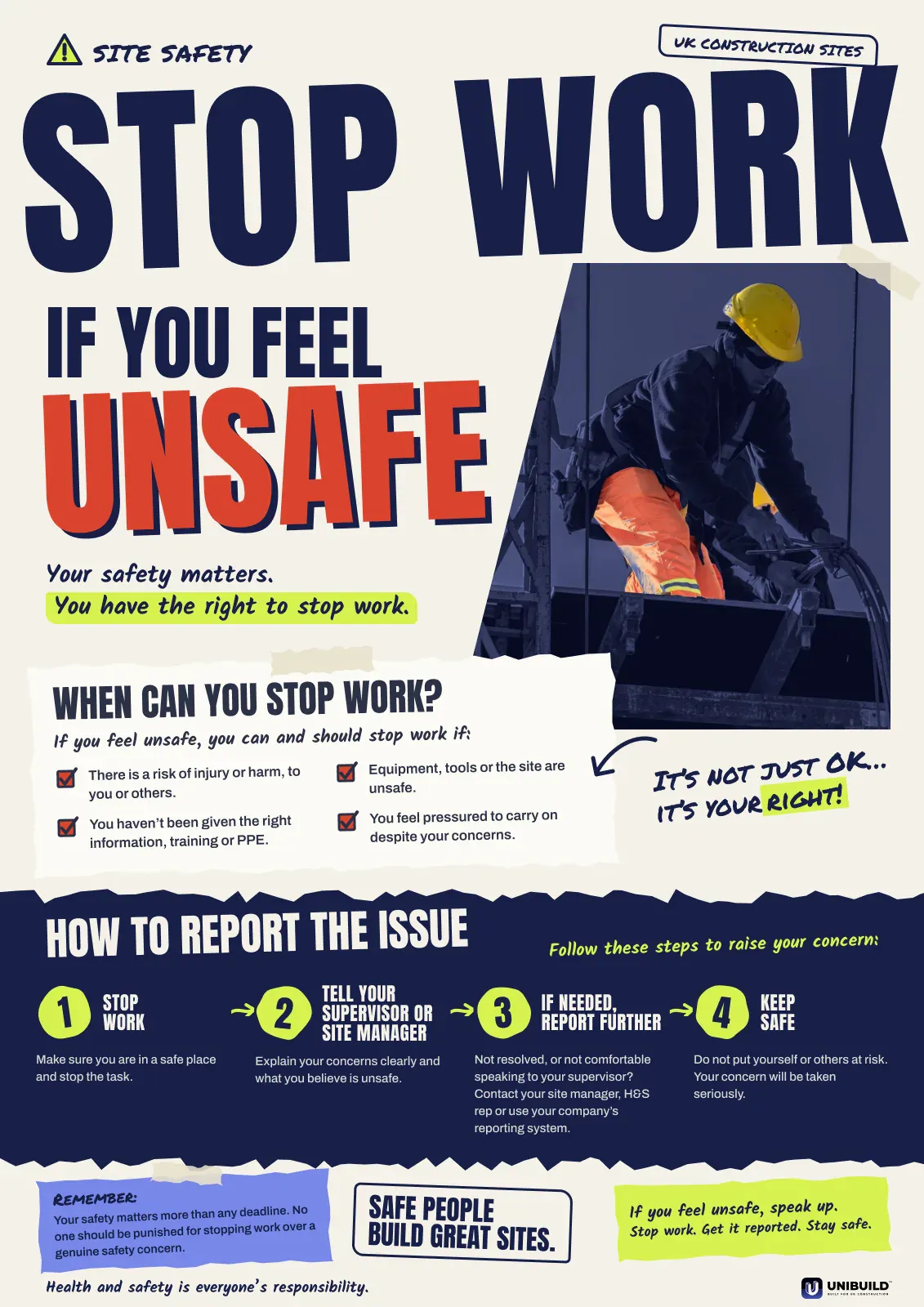
A site safety reminder to stop, tell your supervisor and report concerns when a task feels unsafe.
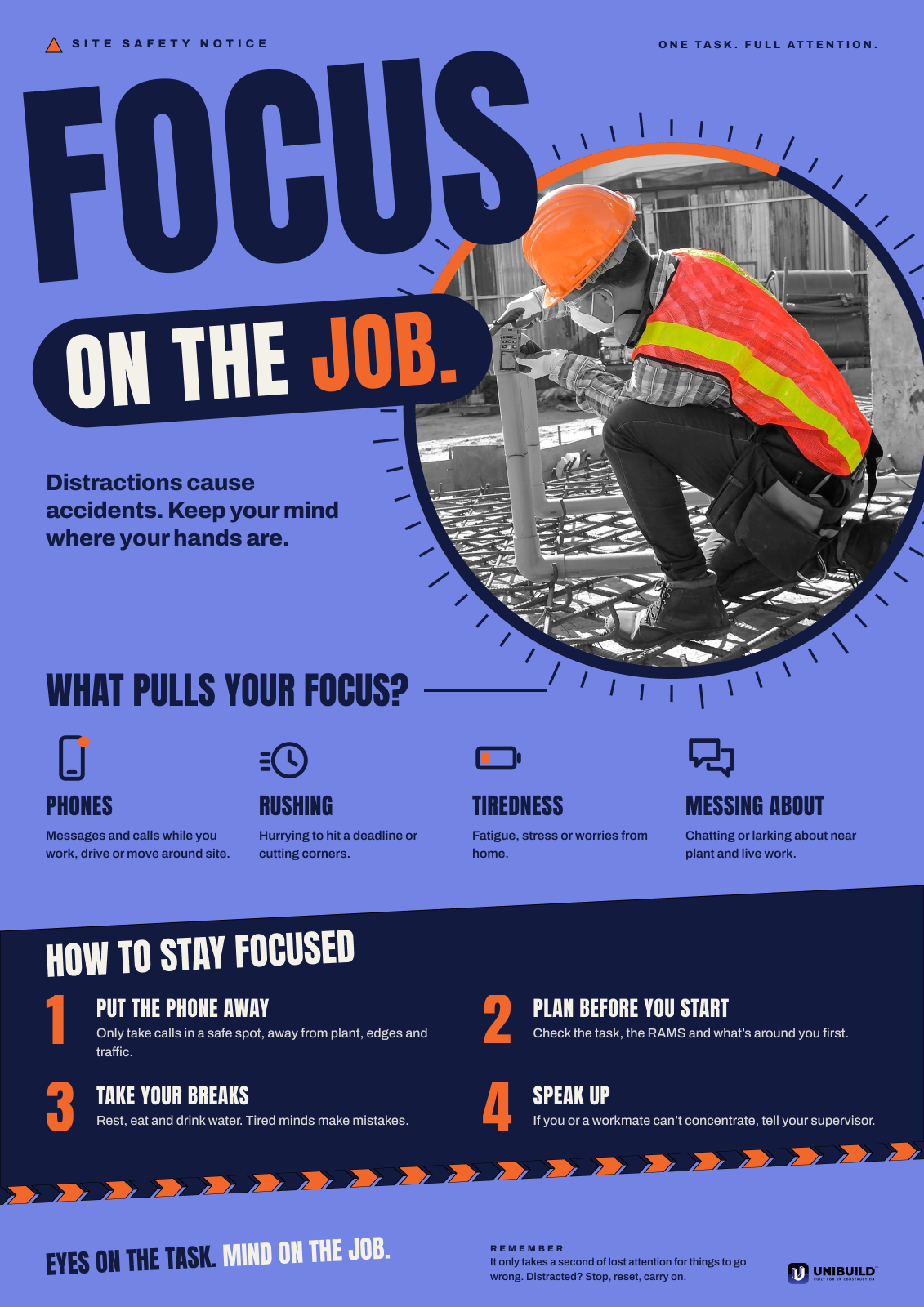
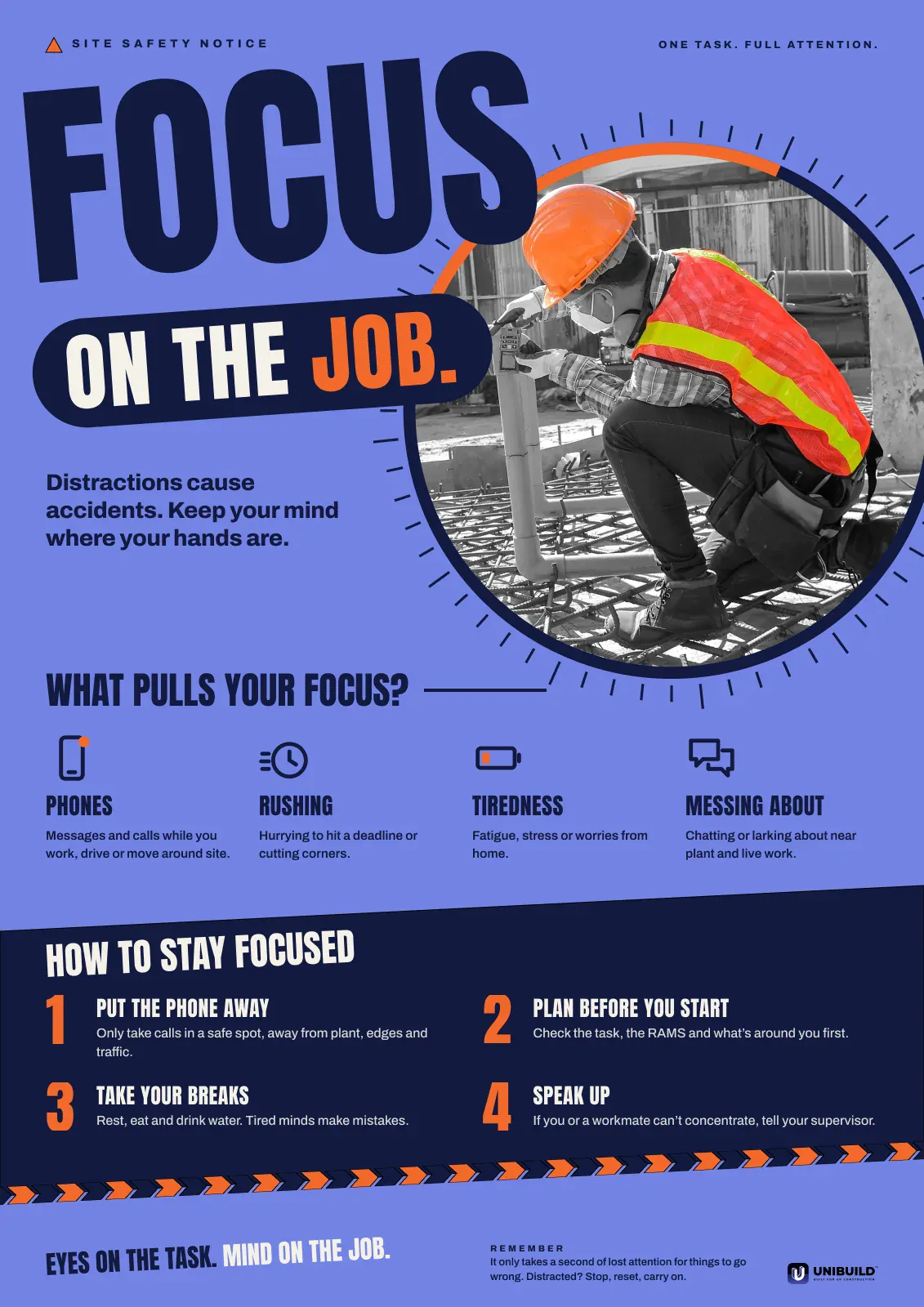
A reminder to give the task your full attention, put the phone away, plan ahead and take breaks.
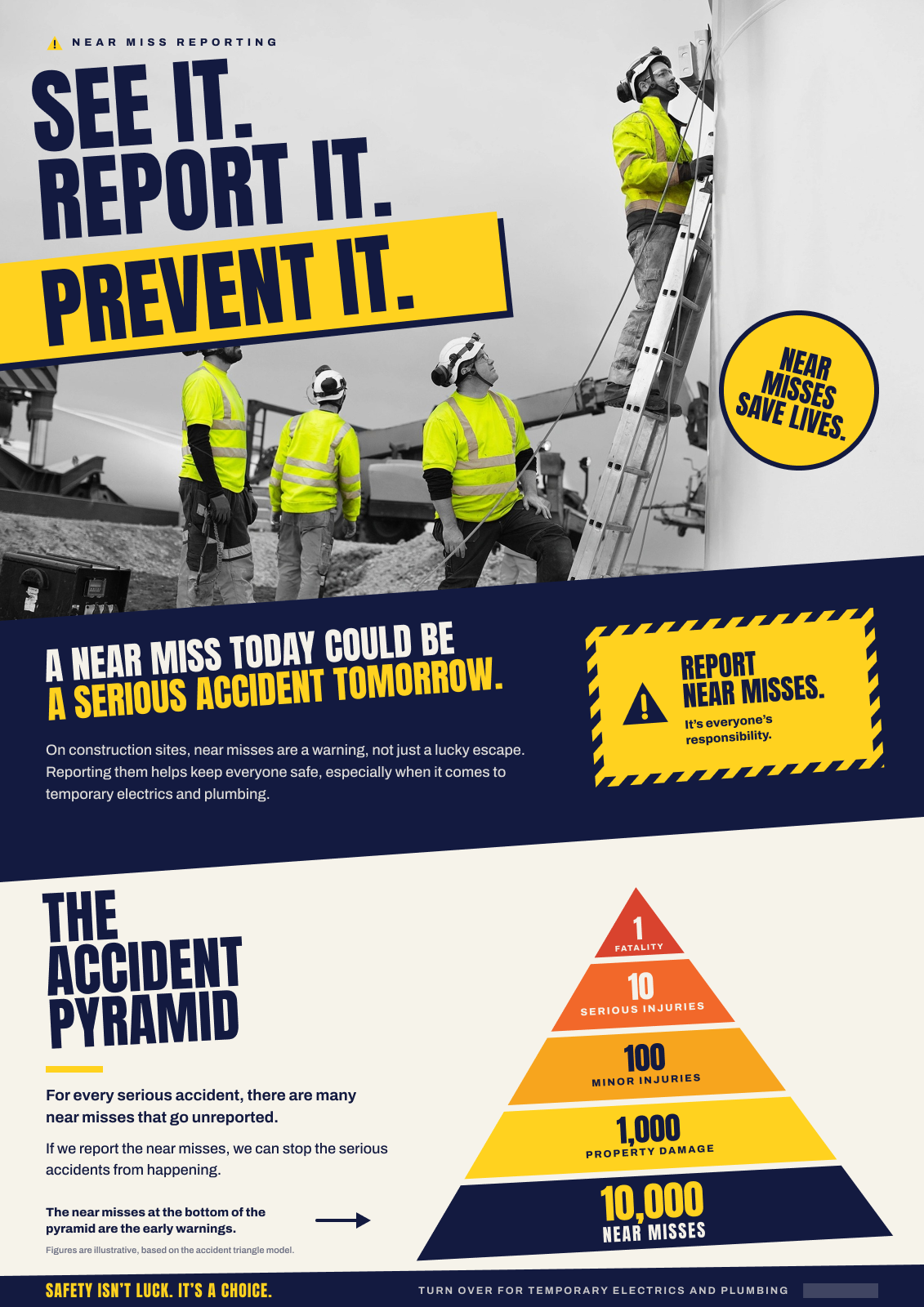
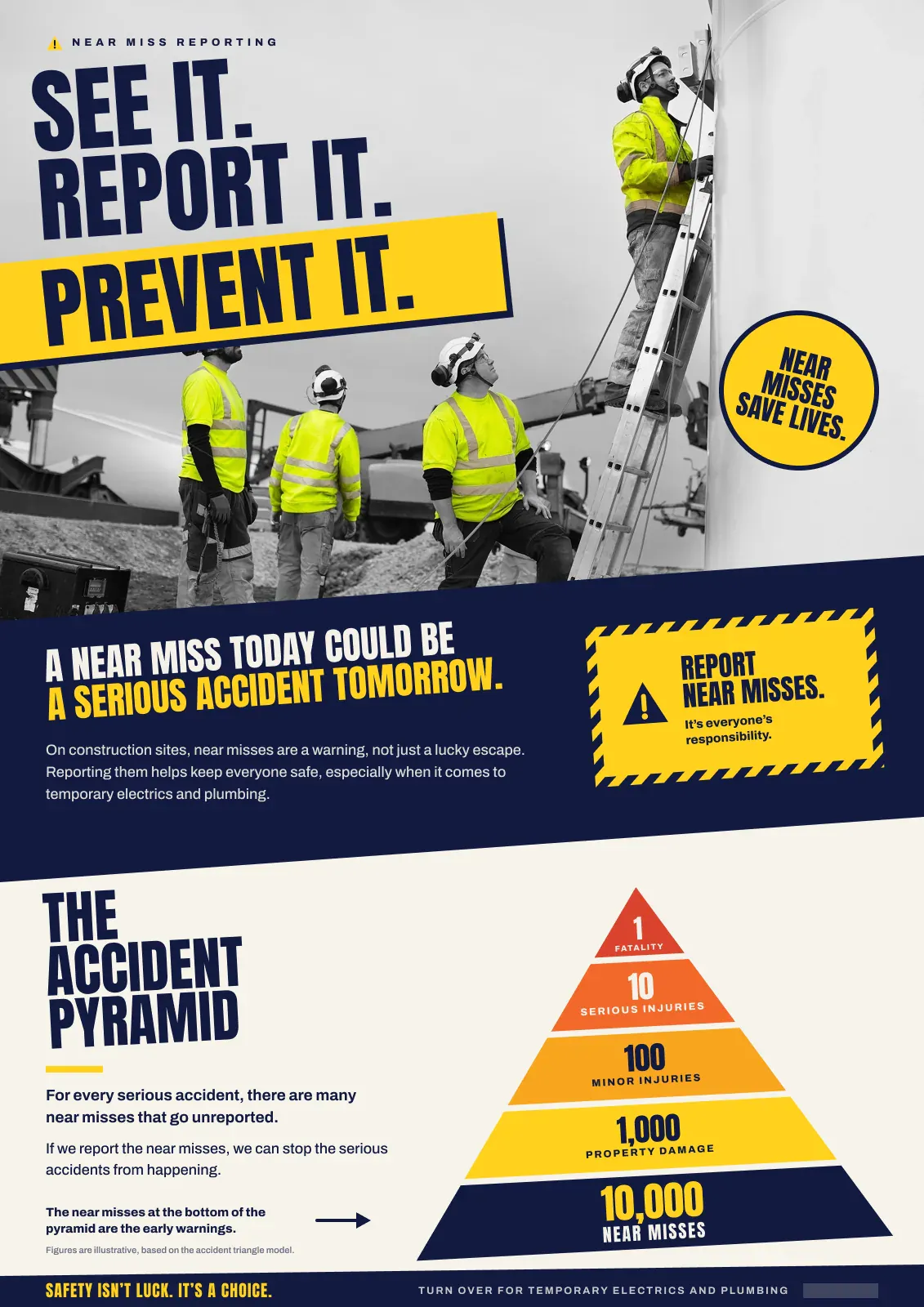
A near-miss reporting poster encouraging the team to speak up about hazards before someone gets hurt.

A reminder to stop and step aside before using your phone, then look up before walking on.
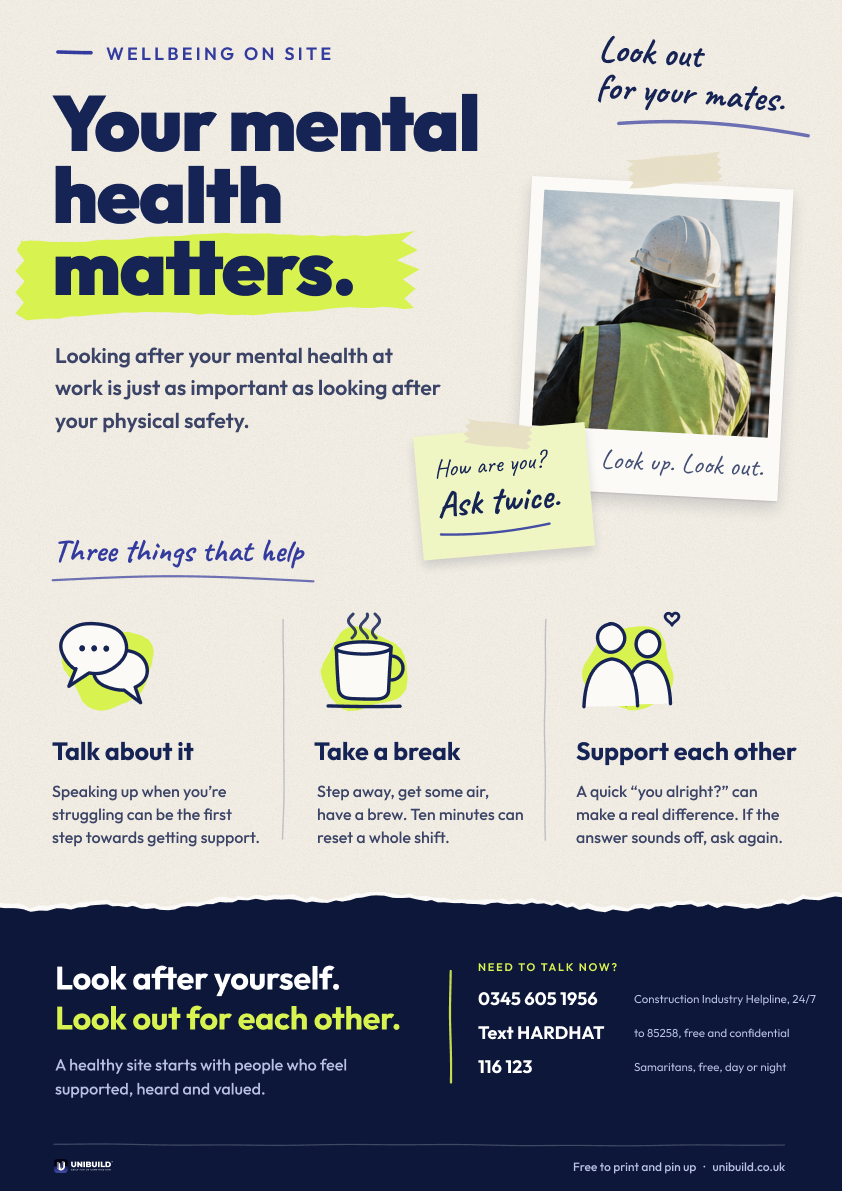
A wellbeing poster encouraging the team to talk, take a break and look out for each other, with support contacts.
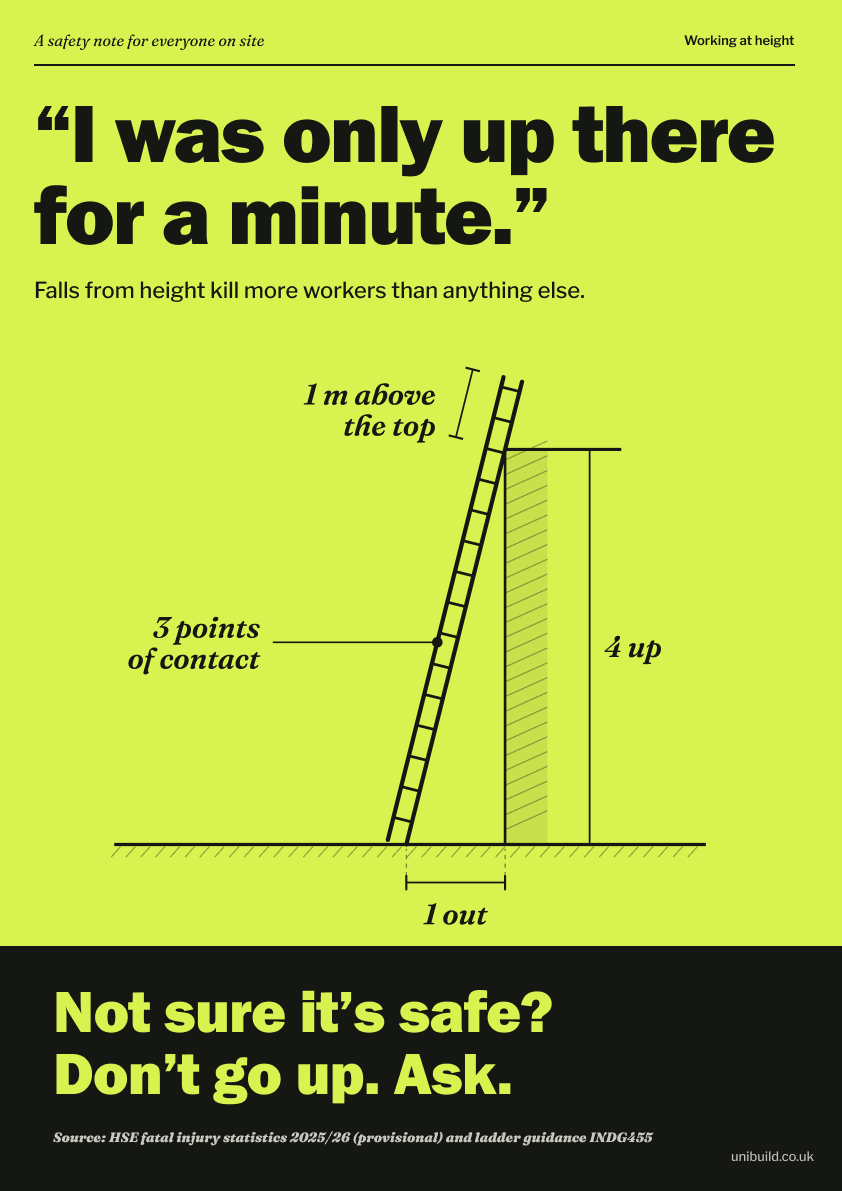
A ladder safety reminder for the site noticeboard, with illustrated points on setup and contact.
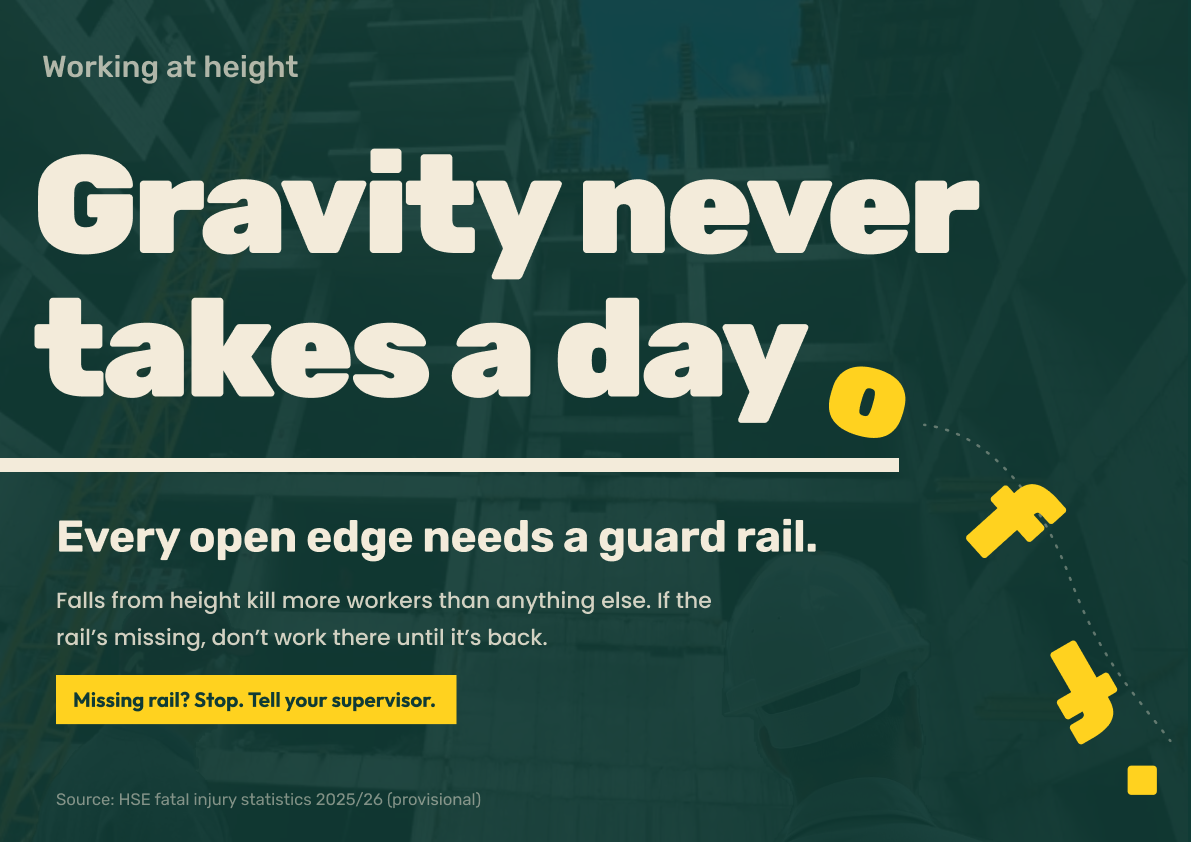
A working-at-height poster reminding the team to stop and tell their supervisor when a guard rail is missing.
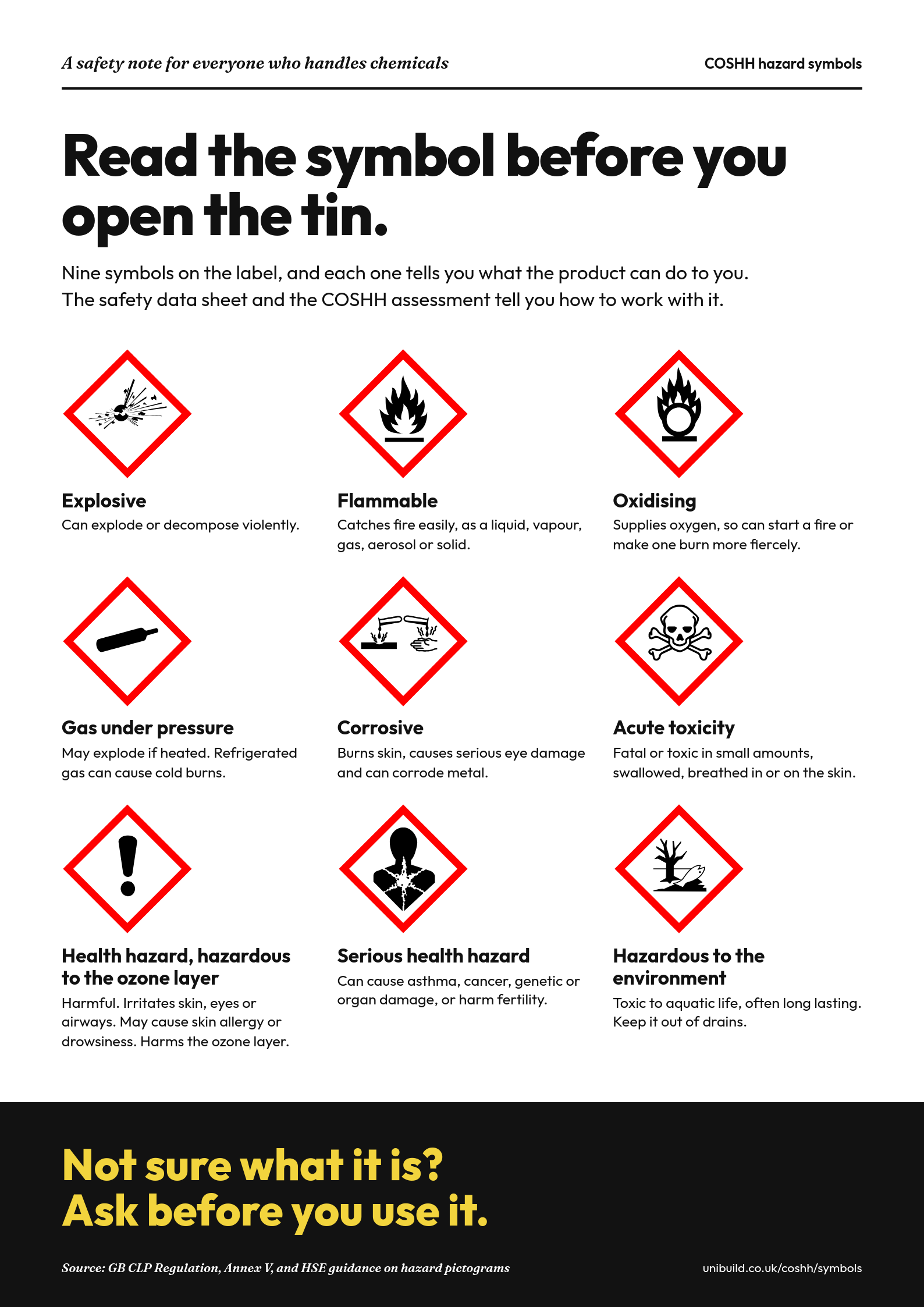
The nine hazard pictograms and what each one means, for the store, the van or the welfare cabin.
Every file on this page is free to download, print, use and reuse on any job, including paid work, with no sign-up and no credit needed. It is our contribution to safer, better-run sites across UK construction.
Each file is a starting point for your own review, not legal advice. Check it against the regulation it cites. The Unibuild name and logo are a registered UK trade mark and are not part of these terms.
Anything else, or a template you would like to see here: success@unibuild.co.uk.
On the platform these stop being sheets. The check, the person, the date, the photograph and the action that followed are recorded as the work runs and retrieved by site.
UK-built · CDM · CIS · MTD