
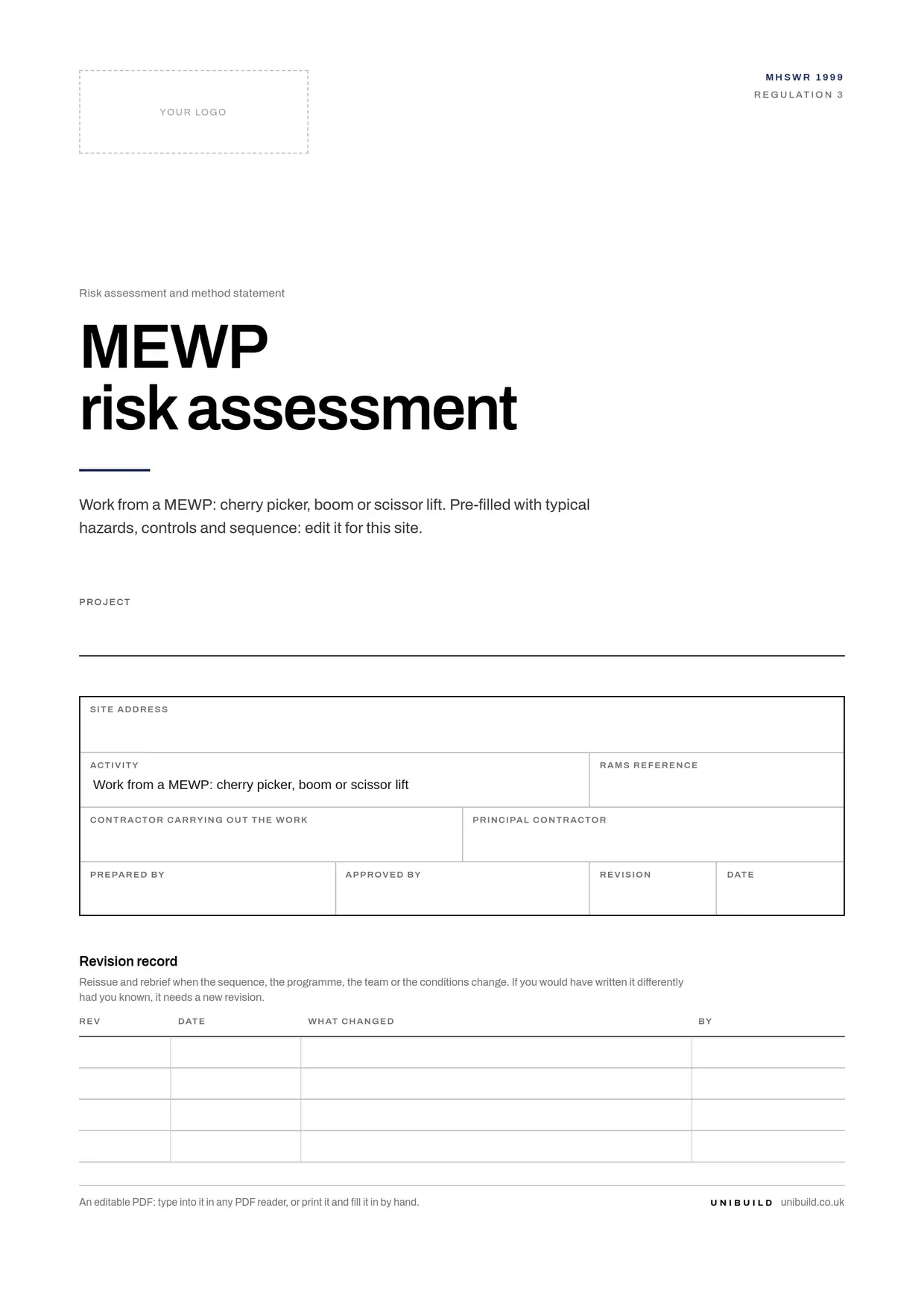
MEWP risk assessment template
A MEWP risk assessment, already filled in for cherry pickers, boom lifts and scissor lifts: ground, overhead hazards, trapping, harnesses and rescue, with a pre-use and rescue plan page. Edit it for your job, then brief it.
- Law
- Work at Height Regulations 2005
- Thorough examination
- At least every 6 months
- Format
- Editable PDF and Word
- Cost
- Free, always
What does a MEWP risk assessment cover?
A MEWP risk assessment covers work from a cherry picker, boom lift, scissor lift or other mobile elevating work platform. It looks at the ground, what is overhead, who is below and how the operator would be brought down. The Work at Height Regulations 2005 require the work to be planned, with rescue included.
A MEWP is equipment that prevents a fall, so it sits high in the order the law sets. HSE information sheet GEIS6 lists the risks that remain: overturning on poor ground, being thrown from a boom basket, trapping against overhead structures, falling objects, power lines and passing traffic.
Booms and scissors are treated differently. In a boom-type MEWP, HSE and IPAF guidance is that occupants wear a full body harness on a short restraint lanyard clipped to the basket anchor. In a scissor lift the guard-rails are the fall protection; IPAF says a harness is not normally needed, other than where the risk assessment or the manual requires one.
Checked against legislation.gov.uk and HSE guidance on .
MEWP hazards and controls
16 hazards, rated before and after controlsA worked example of the significant hazards when working from cherry pickers, boom lifts and scissor lifts, with the controls a reviewer expects to see. Delete what does not apply and add what your job has.
Overturning on poor ground
Occupants and people nearby, from soft ground, voids, covers, backfill, kerbs or slopes.
- Ground bearing capacity and any slab loading limit obtained from the person in control of the site before the machine arrives.
- Route and work position walked for covers, trenches, cellars and soft spots; outriggers on spreader plates sized for the point load.
- Machine kept within the gradient and level limits in its manual; ground re-checked after rain or frost.
BeforeHigh 15AfterMedium 5
Thrown from a boom basket
Occupants of boom-type MEWPs when the boom jolts on rough ground, snags or is struck.
- Full body harness on a short work restraint lanyard, clipped to the basket anchor point before the platform is raised or driven.
- Route cleared of debris and cables; travel slow over uneven ground, with the platform positioned as the manual sets for travel.
- Work area barriered so vehicles and plant cannot strike the machine.
BeforeHigh 15AfterMedium 5
Falls from a scissor lift platform
Occupants who lean over or climb on the guard-rails, or work with the entry gate open.
- Guard-rails complete and the entry gate closed before the platform is raised; feet stay on the platform floor.
- No ladders, steps or materials used on the platform to gain height.
- Machine repositioned rather than overreaching; a harness only where the manual or the assessment requires one, on the marked anchor.
BeforeHigh 15AfterMedium 5
Trapping against overhead structures
Operators working under beams, ducts, soffits and pipework, or manoeuvring up through steelwork.
- Approach and work position checked for overhead and adjacent structures; a MEWP with a secondary guarding device chosen where trapping is possible.
- Slow, smooth control movements near obstructions, allowing for run-on; never crouched over the control panel to dodge an obstruction.
- Extra entrapment training for operators working in congested areas; rescue plan practised.
BeforeHigh 15AfterMedium 5
People trapped or struck at ground level
Workers and the public near the base, during slewing, travel and reversing.
- Work area barriered and signed to the full outreach of the platform, not only the base footprint.
- Banksman to guide travel where the operator's view is limited, especially when reversing.
- Nobody stands between the counterweight and a structure while the machine slews.
BeforeMedium 12AfterLow 4
Contact with overhead power lines
Occupants and ground staff when the boom or platform nears an overhead line.
- Lines identified at the survey; work within 10 m, measured horizontally at ground level from below the nearest wire, planned, and the line owner consulted.
- Line made dead or diverted where the platform could reach it; otherwise a different method or position.
- Where the machine passes under a line, a fenced passageway with goalposts and the clearance height signed.
BeforeMedium 10AfterMedium 5
Overloading the platform
Occupants, from people, tools and materials over the rated load, or loads on the rails.
- Safe working load counted with people, tools, materials and any handling device; the overload system is never disabled.
- Nothing balanced on the guard-rails; long or heavy items placed by crane, telehandler or a fitted material handling attachment.
- If the overload alarm sounds, the overload is removed before the platform is moved.
BeforeMedium 10AfterMedium 5
Wind and weather
Occupants of MEWPs used outdoors, at full height, or between buildings where wind funnels.
- Wind speed checked with an anemometer at platform height against the manufacturer's maximum; work stops above it.
- Indoor-only machines kept indoors and out of draughts from open doors or part-clad buildings.
- Rain, ice and wind chill considered; cold and wet weather clothing issued.
BeforeHigh 15AfterMedium 5
Falling tools and materials
People below the platform, including other trades and the public.
- Area below the platform and its outreach barriered and signed, and kept clear of people.
- Tools on lanyards where people could be below; materials kept inside the basket.
- Nothing thrown or dropped from the platform.
BeforeMedium 12AfterLow 4
Struck by vehicles and site plant
The MEWP and its occupants when working beside live site routes or the public highway.
- Work area coned and barriered; the platform never booms out over live traffic.
- Site traffic diverted or stopped while the MEWP works beside a route; signing and traffic management agreed for highway work.
- Other lifting plant in the area identified and its movements co-ordinated.
BeforeHigh 15AfterMedium 5
Delivery and unloading
Drivers, ground staff and the public while the MEWP is offloaded, often on the highway.
- Delivery time, offload point and the person who meets the driver agreed with the hire company.
- Offload area segregated from pedestrians and traffic, including on the public highway; ground checked for covers and capacity.
- Banksman for any reversing on or off the vehicle.
BeforeMedium 12AfterMedium 8
Machine faults and defects
Occupants stranded or injured by a defective machine, and anyone below.
- Daily pre-use function check by the trained operator, recorded, including the ground controls and emergency lowering.
- Thorough examination report seen and in date before the machine is used on site.
- Any fault: controls isolated, machine tagged and the defect reported to the person in control.
BeforeMedium 12AfterLow 4
Operator taken ill or trapped at height
An operator who cannot lower the platform, and anyone else in it.
- Nominated people on site, familiarised on the ground controls and emergency descent of this machine and given regular practice.
- Ground control key left in the base during work, or a second key held by the rescuer where that is not safe.
- If a trapped operator does not respond, the emergency services are called at once while the rescue starts.
BeforeMedium 10AfterMedium 5
Leaving the platform at height
Occupants stepping off onto a roof, structure or another level.
- MEWPs are not used to transfer people between levels; occupants stay inside the platform.
- Exit at height only where a rigorous assessment at planning shows it is the safest way, with a written safe system of work.
BeforeMedium 10AfterMedium 5
Working over or beside water
Occupants of a MEWP working over or next to water, where the machine or a person could go in.
- Assessed at planning: whether falling from the basket or drowning if the machine goes into the water is the greater risk.
- Where drowning is the greater risk, life jackets are worn and harnesses are not, as HSE GEIS6 advises.
- Edges of quays, banks and slabs set out and barriered so the machine cannot run off them; rescue plan covers recovery from water.
BeforeMedium 10AfterMedium 5
Unauthorised use
Untrained workers or members of the public using a parked machine.
- Parked in a secure compound or agreed area, platform lowered, power off and brakes on; wheels chocked on a gradient.
- Machine isolated at the end of each shift by the method agreed with the hire company.
BeforeMedium 8AfterLow 4
Scores are likelihood times severity on the five by five matrix in the template. They are typical ratings for this work, a starting point for your own assessment of your site.
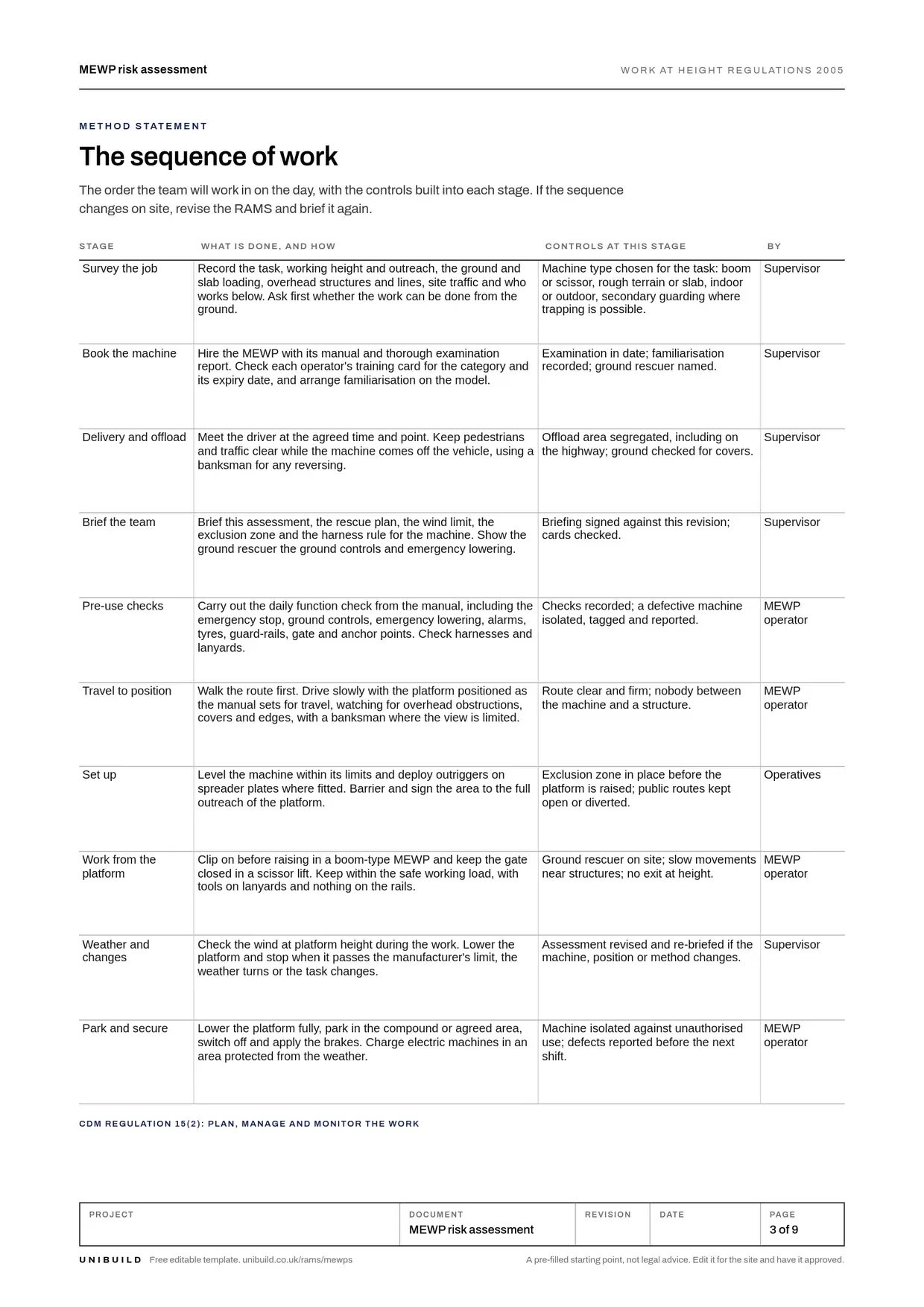
MEWP method statement: the sequence of work
The order of work, with the controls at each stageThe order the work runs in, from the survey to parking the machine, with the controls at each stage. If the machine, the operator or the work position changes, revise the assessment and brief it again.
Survey the job
Record the task, working height and outreach, the ground and slab loading, overhead structures and lines, site traffic and who works below. Ask first whether the work can be done from the ground.
ControlsMachine type chosen for the task: boom or scissor, rough terrain or slab, indoor or outdoor, secondary guarding where trapping is possible.
Book the machine
Hire the MEWP with its manual and thorough examination report. Check each operator's training card for the category and its expiry date, and arrange familiarisation on the model.
ControlsExamination in date; familiarisation recorded; ground rescuer named.
Delivery and offload
Meet the driver at the agreed time and point. Keep pedestrians and traffic clear while the machine comes off the vehicle, using a banksman for any reversing.
ControlsOffload area segregated, including on the highway; ground checked for covers.
Brief the team
Brief this assessment, the rescue plan, the wind limit, the exclusion zone and the harness rule for the machine. Show the ground rescuer the ground controls and emergency lowering.
ControlsBriefing signed against this revision; cards checked.
Pre-use checks
Carry out the daily function check from the manual, including the emergency stop, ground controls, emergency lowering, alarms, tyres, guard-rails, gate and anchor points. Check harnesses and lanyards.
ControlsChecks recorded; a defective machine isolated, tagged and reported.
Travel to position
Walk the route first. Drive slowly with the platform positioned as the manual sets for travel, watching for overhead obstructions, covers and edges, with a banksman where the view is limited.
ControlsRoute clear and firm; nobody between the machine and a structure.
Set up
Level the machine within its limits and deploy outriggers on spreader plates where fitted. Barrier and sign the area to the full outreach of the platform.
ControlsExclusion zone in place before the platform is raised; public routes kept open or diverted.
Work from the platform
Clip on before raising in a boom-type MEWP and keep the gate closed in a scissor lift. Keep within the safe working load, with tools on lanyards and nothing on the rails.
ControlsGround rescuer on site; slow movements near structures; no exit at height.
Weather and changes
Check the wind at platform height during the work. Lower the platform and stop when it passes the manufacturer's limit, the weather turns or the task changes.
ControlsAssessment revised and re-briefed if the machine, position or method changes.
Park and secure
Lower the platform fully, park in the compound or agreed area, switch off and apply the brakes. Charge electric machines in an area protected from the weather.
ControlsMachine isolated against unauthorised use; defects reported before the next shift.
What the law asks for MEWPs
Checked against the sourcePlan, supervise and include rescue
Work at height must be properly planned, appropriately supervised and carried out as safely as reasonably practicable. The planning includes emergencies and rescue, and the work goes ahead only in weather that does not put people at risk.
Work at Height Regulations 2005, regulation 4Choosing the machine
Collective protection, such as a guard-railed platform, takes priority over personal protection. The choice accounts for the working conditions, the distance and consequences of a fall, how long the work lasts, and the need for easy and timely rescue.
Work at Height Regulations 2005, regulation 7Lifting people
Equipment that lifts people must prevent them being crushed, trapped, struck or falling from the carrier, so far as is reasonably practicable. A person trapped in the carrier must not be endangered and must be able to be freed.
LOLER 1998, regulation 5Thorough examination
Lifting equipment for lifting persons that is exposed to conditions causing deterioration, as a MEWP on site is, is thoroughly examined at least every 6 months, or under an examination scheme, and after exceptional circumstances. Hired equipment comes with evidence of its last examination.
LOLER 1998, regulation 9(3) and (4)Training
Everyone who uses work equipment, and anyone who supervises or manages its use, has adequate training in the methods of use, the risks and the precautions. The law names no course; recognised schemes give a card listing the MEWP categories covered.
PUWER 1998, regulation 9Risk assessment and records
Employers make a suitable and sufficient assessment of the risks, review it when it may no longer be valid or the work has changed significantly, and record the significant findings where they have five or more employees.
Management of Health and Safety at Work Regulations 1999, regulation 3Competence, equipment and PPE
Competence and cards
- Planner Competent to plan the MEWP work and choose the machine, as LOLER regulation 8 requires for lifting operations; recognised MEWP manager training is available.
- MEWP operators Training card listing the category, such as IPAF 3a for scissor lifts, 3b for mobile booms or 1b for static booms, checked for expiry, plus recorded familiarisation on the model.
- Operators in congested areas Extra entrapment training where adjacent or overhead structures raise the risk of trapping.
- Ground rescuers Nominated, familiarised on the ground controls and emergency descent of each machine, and given regular practice.
- Occupants Instructed in fitting and using the harness and lanyard, and in the rescue plan.
- Banksman Trained and authorised to guide the MEWP when it travels or reverses where the view is limited.
Plant and equipment
- Boom-type MEWP (cherry picker) Daily function check; thorough examination at least every 6 months.
- Scissor lift Daily function check, including gate and guard-rails; examination in date.
- Harness and restraint lanyard Pre-use check by the user; detailed inspections recorded.
- Spreader plates and outrigger pads Sized for the point load and the ground; checked for damage.
- Anemometer Working, and read at platform height before and during the work.
- Barriers, cones and signs Set to the full outreach of the platform before work starts.
PPE
- Safety helmet with a chin strap so it stays on at height.
- Full body harness on a short restraint lanyard in a boom-type MEWP, clipped to the basket anchor.
- High-visibility clothing to the site standard, for occupants and ground staff.
- Cold and wet weather clothing for outdoor work, since wind chill affects grip and concentration.
- Safety boots with toe protection and a grip sole.
Permits and plans
A permit to work where the principal contractor's rules require one, for example near live services or in occupied areas. A lift plan if the MEWP itself is lifted into position by crane. Consultation with the line owner where the platform could reach or approach an overhead line, and highway authority approval where the machine stands or is offloaded on the highway.
Emergency and rescue
The rescue plan names the people on site trained to lower the platform from the ground, where the operator's manual is kept, and the hire company's call-out number. If a trapped operator does not respond, call the emergency services at once and start the rescue. First aider on site and the nearest accident and emergency department named on the briefing.
Toolbox talk: MEWPs
Read this to the team before work starts, tick each point as it is covered, and record who attended.
- Walk the route and the work position before you drive. Look for covers, trenches, soft ground and anything overhead.
- In a boom you clip on to the basket anchor with a short lanyard before the platform moves, every time.
- Never stand on the rails, rest materials on them or climb out at height. Move the machine instead of stretching.
- Near beams and ducts, move slowly and keep your body clear of the controls. The platform can run on after you let go.
- Check the wind at height against the limit on the machine. Indoor-only machines stay indoors.
- The platform does not go up until the person who can bring you down from the ground is on site.
Ask the team
- Who is our ground rescuer today, and where are the ground controls and emergency lowering?
- What is overhead on the route and at the work position?
- What is the wind limit for this machine, and how are we checking it?
What is in the MEWP risk assessment template
9 pages, pre-filled and editableThe work, pre-filled
Scope, location and access, interfaces with other trades, the documents the assessment relies on, and the team with their training cards.
The sequence of work
Ten stages from the survey to parking up, with the controls and the person responsible at each one.
Hazards and controls
Sixteen MEWP hazards rated before and after controls on a five by five matrix, with room for your own.
Plant, PPE and permits
The machine, harness, spreader plates and anemometer with their checks, PPE by type, and permits and agreements.
Pre-use and rescue plan
A page completed before the platform goes up: paperwork, operator, checks, ground, overhead, wind, exclusion zone, harness and rescue.
Briefing record
Twenty signatures against the revision, taken on the day before the work starts.
Brief it, and get it signed on the phone
On Unibuild a RAMS is written from a template, approved, then read by each operative on their phone in their own language and signed. Subcontract and agency workers sign through a link, with no app to install.
Every signature carries its date and time and prints as the last page of the RAMS PDF. Change the RAMS and it has to be signed again.
How RAMS work on UnibuildMEWP risk assessment questions
Is this MEWP risk assessment template free?
Do you need to wear a harness in a cherry picker or a scissor lift?
What IPAF card do I need for a scissor lift or a cherry picker?
Do you need a method statement for a cherry picker?
How often does a MEWP need a thorough examination?
Who can lower a MEWP in an emergency?
What wind speed is too high for a MEWP?
Is a cherry picker a MEWP?
RAMS templates for other trades and hazards
All free, pre-filled and editableBy trade
- Air conditioning and HVAC RAMS
- Bricklaying RAMS
- Carpentry and joinery RAMS
- CCTV installation RAMS
- Cleaning risk assessment
- Concrete works RAMS
- Demolition RAMS
- Drylining RAMS
- Electrical RAMS
- Facilities maintenance RAMS
- Fire alarm installation RAMS
- Glazing and window RAMS
- Groundworks RAMS
- Hot works and welding RAMS
- Insulation RAMS
- Landscaping and fencing RAMS
- Painting and decorating RAMS
- Pest control risk assessment
- Plastering and rendering RAMS
- Plumbing and heating RAMS
- Rail RAMS
- Refurbishment RAMS
- Roofing RAMS
- Rope access risk assessment
- Scaffolding RAMS
- Solar PV installation RAMS
- Steel erection RAMS
- Temporary works RAMS
- Tiling and flooring RAMS
- Tree surgery RAMS
By hazard
- Asbestos risk assessment
- Confined space risk assessment
- COSHH risk assessment
- Dust risk assessment
- Forklift and telehandler risk assessment
- Housekeeping risk assessment
- Lifting operations risk assessment
- Lone working risk assessment
- Manual handling risk assessment
- MEWP risk assessment
- Noise and vibration risk assessment
- Plant and excavator risk assessment
- Power tools risk assessment
- Traffic management risk assessment
- Working at height risk assessment
The blank RAMS template, the RAMS review checklist and every other free form are on Free downloads.
The RAMS, read and signed
before the work starts.
Unibuild keeps every RAMS with its versions, its approvals and each operative’s signature against the revision they read, for seven years, ready for the principal contractor or an auditor.