
Mental health: the talk
Read it as written or in your own words. Tick each point as you make it. Stop for the questions, and leave the numbers on the board.
Why it matters
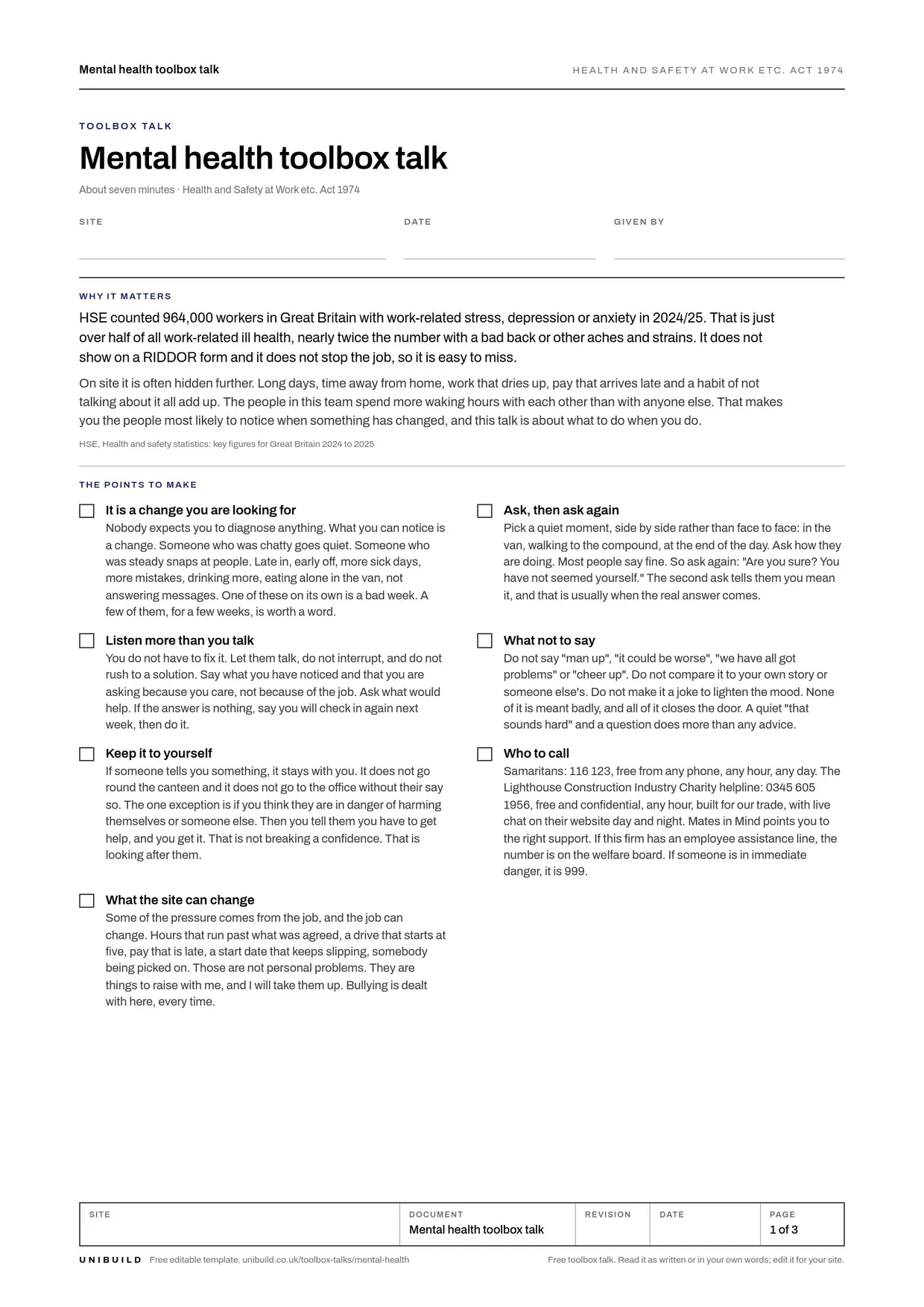
HSE counted 964,000 workers in Great Britain with work-related stress, depression or anxiety in 2024/25. That is just over half of all work-related ill health, nearly twice the number with a bad back or other aches and strains. It does not show on a RIDDOR form and it does not stop the job, so it is easy to miss.
On site it is often hidden further. Long days, time away from home, work that dries up, pay that arrives late and a habit of not talking about it all add up. The people in this team spend more waking hours with each other than with anyone else. That makes you the people most likely to notice when something has changed, and this talk is about what to do when you do.
HSE, Health and safety statistics: key figures for Great Britain 2024 to 2025The points to make
It is a change you are looking for
Nobody expects you to diagnose anything. What you can notice is a change. Someone who was chatty goes quiet. Someone who was steady snaps at people. Late in, early off, more sick days, more mistakes, drinking more, eating alone in the van, not answering messages. One of these on its own is a bad week. A few of them, for a few weeks, is worth a word.
Ask, then ask again
Pick a quiet moment, side by side rather than face to face: in the van, walking to the compound, at the end of the day. Ask how they are doing. Most people say fine. So ask again: "Are you sure? You have not seemed yourself." The second ask tells them you mean it, and that is usually when the real answer comes.
Listen more than you talk
You do not have to fix it. Let them talk, do not interrupt, and do not rush to a solution. Say what you have noticed and that you are asking because you care, not because of the job. Ask what would help. If the answer is nothing, say you will check in again next week, then do it.
What not to say
Do not say "man up", "it could be worse", "we have all got problems" or "cheer up". Do not compare it to your own story or someone else's. Do not make it a joke to lighten the mood. None of it is meant badly, and all of it closes the door. A quiet "that sounds hard" and a question does more than any advice.
Keep it to yourself
If someone tells you something, it stays with you. It does not go round the canteen and it does not go to the office without their say so. The one exception is if you think they are in danger of harming themselves or someone else. Then you tell them you have to get help, and you get it. That is not breaking a confidence. That is looking after them.
Who to call
Samaritans: 116 123, free from any phone, any hour, any day. The Lighthouse Construction Industry Charity helpline: 0345 605 1956, free and confidential, any hour, built for our trade, with live chat on their website day and night. Mates in Mind points you to the right support. If this firm has an employee assistance line, the number is on the welfare board. If someone is in immediate danger, it is 999.
What the site can change
Some of the pressure comes from the job, and the job can change. Hours that run past what was agreed, a drive that starts at five, pay that is late, a start date that keeps slipping, somebody being picked on. Those are not personal problems. They are things to raise with me, and I will take them up. Bullying is dealt with here, every time.
Do
- Ask how someone is doing, and ask twice when the first answer is "fine".
- Pick a quiet moment and a side by side setting, not the middle of the canteen.
- Listen, say what you noticed, and ask what would help.
- Keep what you are told private, unless someone is in danger.
- Keep the helpline numbers in your phone: Samaritans 116 123, Lighthouse 0345 605 1956.
- Tell me about hours, travel, pay or treatment that is wearing people down.
- Check back in a week, even if they said they were fine.
Do not
- Do not say "man up", "it could be worse" or "cheer up".
- Do not turn it into a joke, or into a story about yourself.
- Do not try to diagnose anyone or tell them what is wrong with them.
- Do not repeat what someone told you, in person or in the group chat.
- Do not leave someone on their own if you think they might hurt themselves.
- Do not wait for a crisis before saying something. A word early costs nothing.
Ask the team
- Who on this site would you notice had changed, and who would notice you?
- When did someone last ask how you were and wait for the answer?
- What is the hardest part of this job that nobody talks about?
- What on this site, in the hours, the travel or the pay, is wearing people down right now?
- Where are the helpline numbers kept, and has everyone got them in their phone?
To close
Nobody chooses to struggle, and nobody gets through it on their own. You do not need the right words, you need to ask the question and stay long enough to hear the answer. If it is one of you, say so to someone, or ring 116 123 or 0345 605 1956. If it is a workmate, ask twice. If it is the job, tell me and I will change what I can. Look after each other out there.
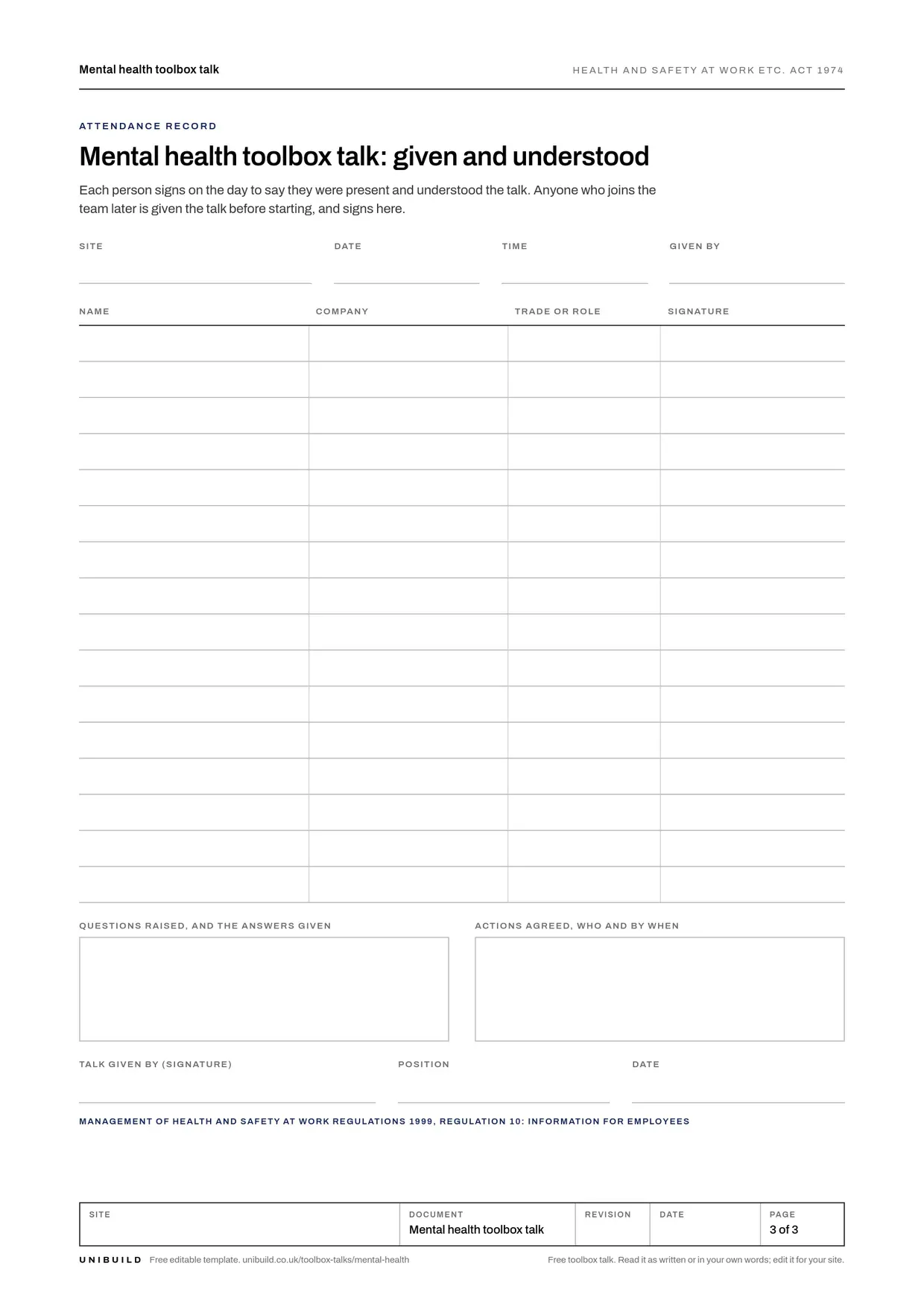
Record it. Who gave the talk, where, when, who was there and what was raised. The last page of the sheet is the record.