Free toolbox talk · Fire extinguishers

Fire extinguishers toolbox talk

A toolbox talk on fire extinguishers on site, written to be read aloud in about six minutes: raising the alarm first, which extinguisher for which fire, the colour bands, how to use one, when not to fight a fire, the fire points and checking the extinguishers. The last page is the attendance record.

PDF · 3 pages · 209 KB · Word 41 KB · Free to use and reuse · Terms

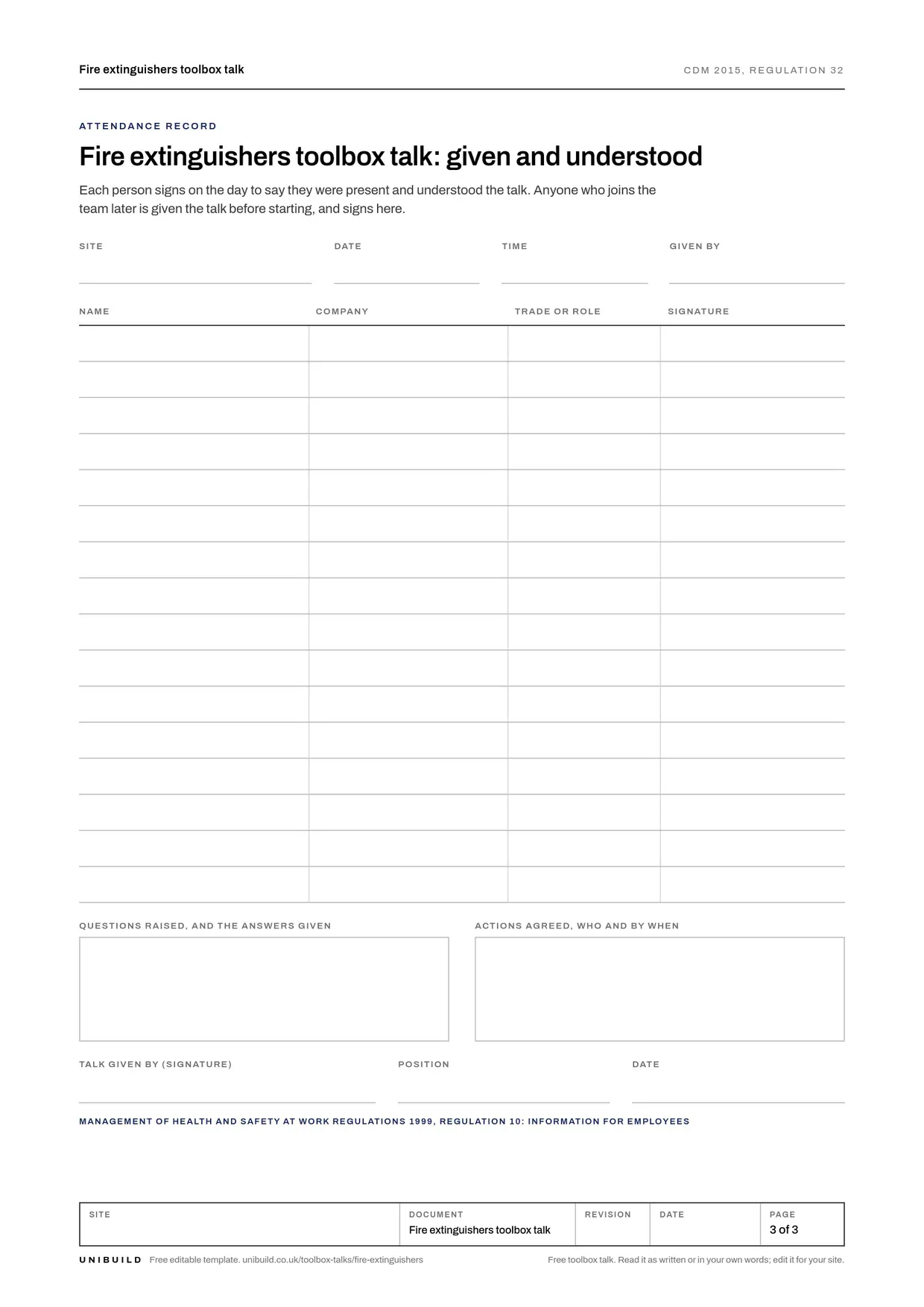
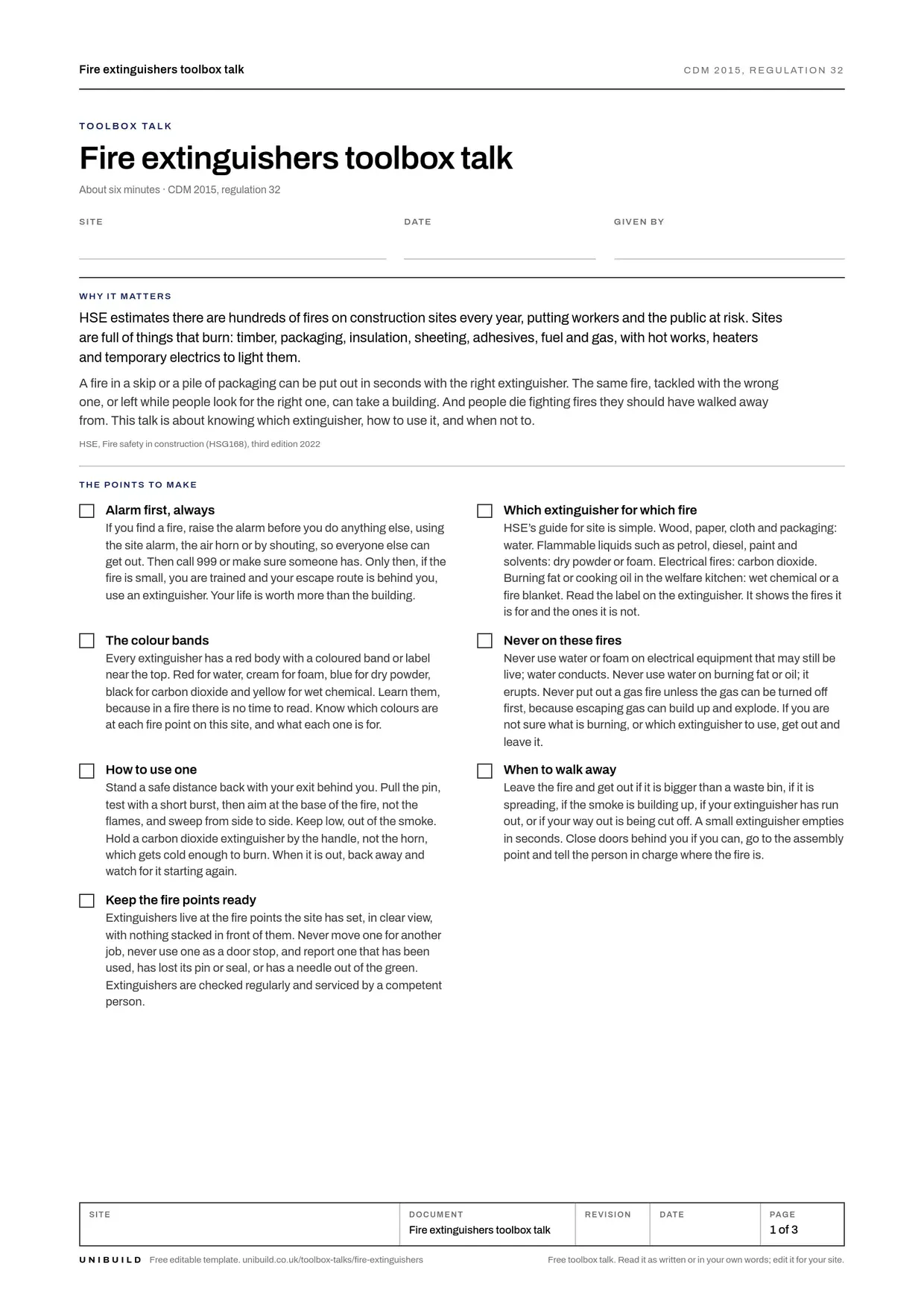
Attendance record page of the free fire extinguishers toolbox talk from Unibuild, where each person signs to say they were given the talk and understood itFront page of the free fire extinguishers toolbox talk from Unibuild
Law
CDM 2015, regulation 32
Time to deliver
About six minutes
Format
PDF and Word, with a sign-off sheet
Cost
Free, always

What this toolbox talk covers

This talk is for everyone on site, and especially the people nominated to use fire fighting equipment. It takes about six minutes to give and covers raising the alarm before anything else, the types of extinguisher and the fires each one is for, the colour bands, how to use one, the fires you should never tackle, where the fire points are and keeping the extinguishers ready.

It is written to be read aloud, with the points in the order a supervisor makes them, short lists of do and do not, and questions about the fire points on this site. The last page is the record: who gave it, who heard it and what was raised.

Preventing fire comes first. The fire safety toolbox talk covers fuel, ignition and escape, and the hot works toolbox talk covers the work most likely to start one.

Checked against HSE guidance and legislation.gov.uk on .

Toolbox talk · About six minutes

Fire extinguishers: the talk

Read it as written or in your own words. Tick each point as you make it. Stop for the questions.

Why it matters

HSE estimates there are hundreds of fires on construction sites every year, putting workers and the public at risk. Sites are full of things that burn: timber, packaging, insulation, sheeting, adhesives, fuel and gas, with hot works, heaters and temporary electrics to light them.

A fire in a skip or a pile of packaging can be put out in seconds with the right extinguisher. The same fire, tackled with the wrong one, or left while people look for the right one, can take a building. And people die fighting fires they should have walked away from. This talk is about knowing which extinguisher, how to use it, and when not to.

HSE, Fire safety in construction (HSG168), third edition 2022

The points to make

Alarm first, always

If you find a fire, raise the alarm before you do anything else, using the site alarm, the air horn or by shouting, so everyone else can get out. Then call 999 or make sure someone has. Only then, if the fire is small, you are trained and your escape route is behind you, use an extinguisher. Your life is worth more than the building.

Which extinguisher for which fire

HSE’s guide for site is simple. Wood, paper, cloth and packaging: water. Flammable liquids such as petrol, diesel, paint and solvents: dry powder or foam. Electrical fires: carbon dioxide. Burning fat or cooking oil in the welfare kitchen: wet chemical or a fire blanket. Read the label on the extinguisher. It shows the fires it is for and the ones it is not.

The colour bands

Every extinguisher has a red body with a coloured band or label near the top. Red for water, cream for foam, blue for dry powder, black for carbon dioxide and yellow for wet chemical. Learn them, because in a fire there is no time to read. Know which colours are at each fire point on this site, and what each one is for.

Never on these fires

Never use water or foam on electrical equipment that may still be live; water conducts. Never use water on burning fat or oil; it erupts. Never put out a gas fire unless the gas can be turned off first, because escaping gas can build up and explode. If you are not sure what is burning, or which extinguisher to use, get out and leave it.

How to use one

Stand a safe distance back with your exit behind you. Pull the pin, test with a short burst, then aim at the base of the fire, not the flames, and sweep from side to side. Keep low, out of the smoke. Hold a carbon dioxide extinguisher by the handle, not the horn, which gets cold enough to burn. When it is out, back away and watch for it starting again.

When to walk away

Leave the fire and get out if it is bigger than a waste bin, if it is spreading, if the smoke is building up, if your extinguisher has run out, or if your way out is being cut off. A small extinguisher empties in seconds. Close doors behind you if you can, go to the assembly point and tell the person in charge where the fire is.

Keep the fire points ready

Extinguishers live at the fire points the site has set, in clear view, with nothing stacked in front of them. Never move one for another job, never use one as a door stop, and report one that has been used, has lost its pin or seal, or has a needle out of the green. Extinguishers are checked regularly and serviced by a competent person.

Do

  • Raise the alarm and call 999 before tackling any fire.
  • Know where the fire points are and which extinguishers each one has.
  • Check the label and use the right extinguisher for what is burning.
  • Aim at the base of the fire and keep your escape route behind you.
  • Keep fire points clear and report any used or damaged extinguisher.
  • Get out if the fire grows, spreads, or the smoke builds up.

Do not

  • Do not fight a fire unless you are trained and it is small.
  • Do not use water or foam on electrics that may be live.
  • Do not fight a gas fire unless the gas supply has been turned off.
  • Do not hold a carbon dioxide extinguisher by its horn.
  • Do not move extinguishers from the fire points or block them.
  • Do not go back in for tools, phones or belongings.

Ask the team

  • Where are the fire points on this site, and what is at each one?
  • Which extinguisher would you use on a burning skip, a burning generator and a diesel spill fire?
  • Who here is nominated and trained to use fire fighting equipment?
  • What does the fire alarm sound like on this site, and where is the assembly point?
  • When were the extinguishers last checked, and who checks them?

To close

An extinguisher in the right hands, on the right fire, in the first minute, can stop a small fire becoming a disaster. In the wrong hands, on the wrong fire, or too late, it puts someone in danger. So raise the alarm first. Know your colours and which fire each one is for. Use it only if the fire is small, you are trained and your way out is clear. And if in doubt, get out, close the door and leave it to the fire service.

Record it. Who gave the talk, where, when, who was there and what was raised. The last page of the sheet is the record.

In Unibuild a talk is read in each operative’s own language and signed on the phone. How toolbox talks work

The law behind this talk

Checked against the source

Fire fighting equipment and alarms

Where necessary in the interests of health or safety, suitable and sufficient fire fighting equipment and fire detection and alarm systems are provided and located in suitable places, examined and tested at suitable intervals and properly maintained. Non-automatic equipment is easily accessible and indicated by suitable signs.

CDM 2015, regulation 32(1), (3), (4) and (7)

Instruction in using it

Each person at work on a construction site is, so far as is reasonably practicable, instructed in the correct use of any fire fighting equipment it may be necessary for them to use. Where a work activity may give rise to a particular risk of fire, a person does not carry it out unless suitably instructed.

CDM 2015, regulation 32(5) and (6)

Preventing fire

Suitable and sufficient steps are taken to prevent, so far as is reasonably practicable, the risk of injury from fire or explosion during construction work, and suitable arrangements for foreseeable emergencies, including evacuation, are made and tested.

CDM 2015, regulations 29 and 30

Occupied premises

In premises covered by the Fire Safety Order, such as an occupied building where work is going on, the responsible person makes sure the premises have appropriate fire fighting equipment, easily accessible, simple to use and signed, and nominates competent people to implement the fire fighting measures.

Regulatory Reform (Fire Safety) Order 2005, article 13

What is on the sheet

3 pages, the talk and the record

The talk, over two pages

Why it matters, the points to make, do and do not, and the questions to ask, laid out to read from in the cabin or at the workface. Space at the top for the site, the date and who is giving it.

The last page, the record

The attendance record: each person's name, company and signature, the questions raised and any actions, signed off by the person who gave the talk. Type into it or print it and pass it round.

The Word version

The same talk as a Word document, so you can put your own letterhead on it, add a site photograph or change a point to match how your job is set up.

Download the talk as PDF Word versionPDF · 3 pages · 209 KB
After it is given

Delivered on the phone, signed in the room

On Unibuild a toolbox talk is picked from the library, read by each operative on their own phone in their own language and signed there and then. The record is filed against the operative, the site and the date.

A site manager sees who has had which talk, and who has not, without a sheet going round on Thursday.

How toolbox talks work on Unibuild
How long should a fire extinguisher toolbox talk be?
About five to ten minutes. This one reads in about six if you make every point and stop for the questions. It is a briefing, not fire extinguisher training, which includes hands-on use and is recorded in the training matrix for the people nominated to fight fires.
Which fire extinguisher is used for which fire?
HSE’s guidance for construction sites is water for wood, paper and cloth, dry powder or foam for flammable liquids, and carbon dioxide for electrical fires. Wet chemical is for cooking oil and fat. The label on each extinguisher shows which classes of fire it is for.
What do the fire extinguisher colours mean?
In the UK every extinguisher has a red body with a coloured band or panel: red for water, cream for foam, blue for dry powder, black for carbon dioxide and yellow for wet chemical.
Can you use a water extinguisher on an electrical fire?
No. Water conducts electricity, so water and most foam extinguishers are not used on electrical equipment that may be live. Use carbon dioxide, and isolate the power if it is safe to do so.
Should everyone on site use fire extinguishers?
CDM 2015 requires everyone to be instructed, so far as is reasonably practicable, in the correct use of fire fighting equipment they may need to use. HSE says nominated people should be trained. Everyone else raises the alarm and gets out.
How many fire extinguishers does a construction site need?
The fire risk assessment decides, based on the size of the site, the work and the materials. HSE says extinguishers are placed at identified fire points around the site, appropriate to the fires that could happen there. Hot works usually need extinguishers at the point of work too.
How often should fire extinguishers be checked?
CDM requires fire fighting equipment to be examined and tested at suitable intervals and properly maintained. In practice that means regular visual checks on site that each one is in place, sealed and charged, and a service by a competent person, usually once a year.
Do we have to keep a record of the talk?
There is no regulation that names toolbox talk records, but CDM requires instruction in using fire fighting equipment, and most principal contractors and auditors ask for the evidence. A signed attendance record with the date and the topic is that evidence. The last page of the sheet is the record.
Is this fire extinguisher toolbox talk free?
Yes. Download it, print it, give it, edit it and put your own name on it, including on paid work and for clients, with no sign-up and no email address.
Next step

The talk given, understood
and on record.

Unibuild keeps every toolbox talk against the operative who signed it, the site and the date, for seven years, ready for the principal contractor or an auditor.

Get a quote
One figure per firm · For UK firms

Right, let’s talk numbers.

Five things about your business. We work your fee out properly and put it in writing the same working day.

What we build for you

  • Your own portalIn the browser, built around your firm
  • Your own appiOS and Android, under your name
  • Everyday AI includedHeavier AI at cost, nothing added
  • One platformEverything in one place, set up by us

Would you rather see it running first? Book a 30-minute demo

Quotation request