
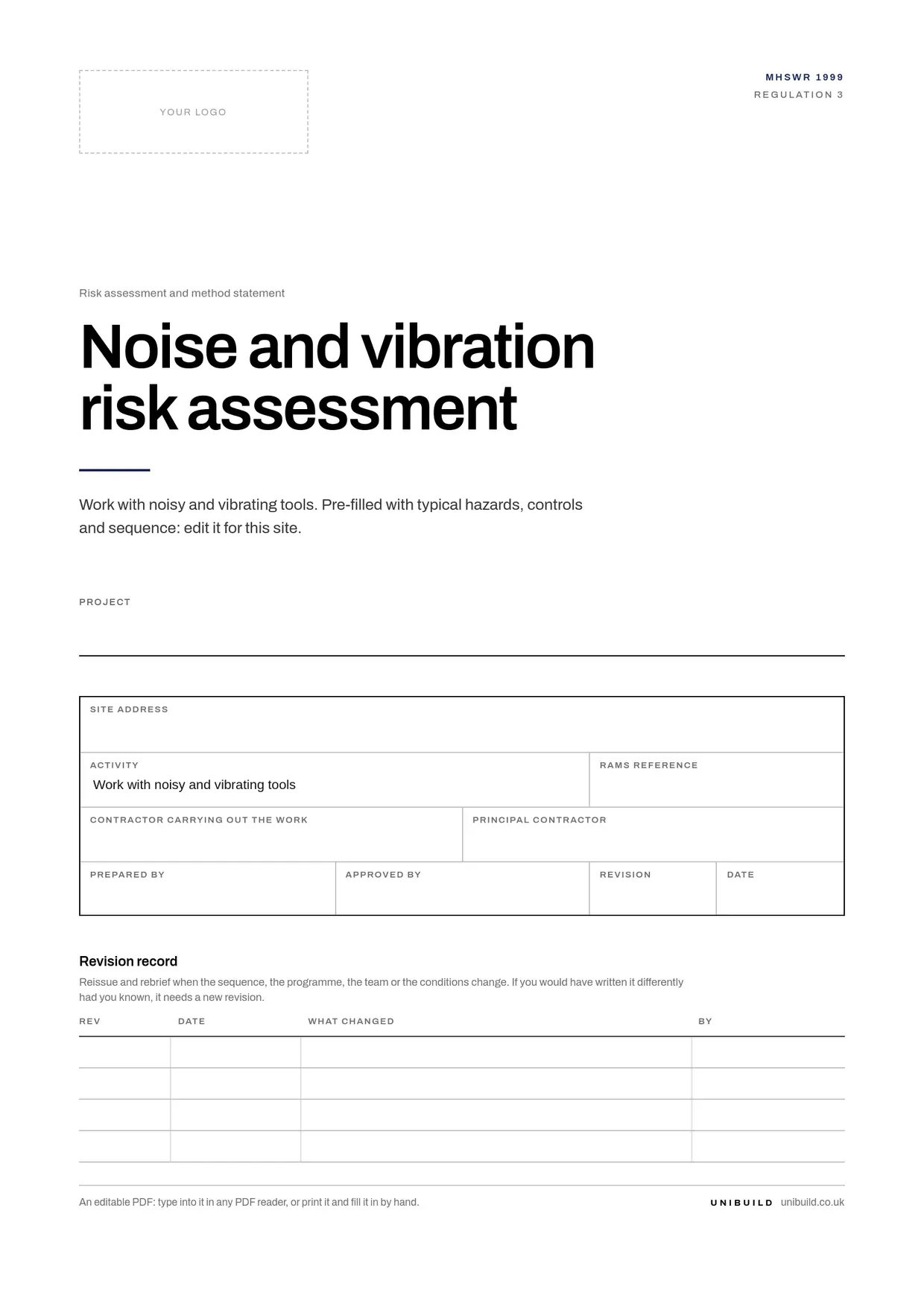
Noise and vibration risk assessment template
A noise and hand-arm vibration risk assessment, already filled in for breakers, drills, grinders, saws and plant, with an exposure calculator page. Edit it for your tools, then brief it.
- Law
- Control of Noise at Work and Vibration at Work Regulations 2005
- HAV action value
- 2.5 m/s² A(8), 100 points
- Format
- Editable PDF and Word
- Cost
- Free, always
What is a noise and vibration risk assessment?
A noise and vibration risk assessment works out how much noise and hand-arm vibration each person gets from their tools in a day. It compares that with the legal action and limit values, then sets the controls that bring exposure down.
Two sets of regulations apply. The Control of Noise at Work Regulations 2005 require an assessment where anyone is liable to be exposed at or above 80 dB(A). The Control of Vibration at Work Regulations 2005 require one wherever work is liable to expose people to risk from vibration. On site that means breakers, hammer drills, grinders, saws and compactors.
The figure that matters is the daily dose, not the tool alone. A grinder used for ten minutes and the same grinder used for three hours are different assessments. HSE's exposure points system turns vibration magnitude and trigger time into points that add up across the day.
Hand arm vibration and noise hazards and controls
14 hazards, rated before and after controlsThe noise and vibration hazards on a typical job with power tools and plant, with the controls a reviewer expects to see. Delete what does not apply and add the tools your team uses.
Vibration from breakers and hammers
Operatives using breakers, demolition hammers, rotary hammers and scabblers.
- Method changed where possible, for example bursting, core drilling or a remote-controlled machine in place of hand breaking.
- Low-vibration tools chosen, judged on the vibration figure for real use, not just the declared value.
- Trigger time limited and tasks rotated so each person stays under the action value where reasonably practicable.
BeforeHigh 16AfterMedium 8
Vibration from grinders, drills and saws
Operatives using angle grinders, hammer drills, cut-off saws, reciprocating saws and sanders.
- Exposure points worked out for each person each day, from the tool magnitude and trigger time.
- Discs, bits and blades kept sharp and of the right type, and tools serviced to the maker's schedule.
- Anti-vibration handles and mounts kept in good repair.
BeforeHigh 16AfterMedium 8
Vibration from compactors and rammers
Groundworkers using plate compactors, trench rammers and pedestrian rollers.
- Vibration-reduced compactors chosen: HSE typical figures are 2 to 7 m/s², against 9 to 22 m/s² for older types.
- Use time controlled through the daily points total, with tasks rotated on long runs.
BeforeHigh 16AfterMedium 8
Combined exposure from several tools
Operatives who use more than one noisy or vibrating tool in a day.
- Points from every tool added together for the day, for vibration and for noise.
- Work planned so the daily total stays under the action values, by rotating tasks or spreading heavy work across days.
BeforeMedium 12AfterMedium 8
Cold and wet hands
Operatives using vibrating tools outdoors in cold or wet weather.
- Warm, dry gloves and clothing provided, as the vibration regulations require protection from cold and damp to be considered.
- Warm welfare for breaks, and hands warmed before starting work.
BeforeMedium 12AfterMedium 8
Early HAVS symptoms missed
Operatives likely to be exposed at or above the vibration action value.
- Health surveillance for everyone likely to be exposed at or above the action value, by a competent occupational health provider.
- Operatives briefed to report tingling, numbness or fingers going white straight away.
- Any diagnosed HAVS or carpal tunnel syndrome reported under RIDDOR, and the person's work reviewed.
BeforeMedium 12AfterLow 4
Noise from breakers, saws and grinders
Operatives using noisy tools and anyone working nearby.
- Quieter methods and tools chosen first, such as bursting or diamond drilling in place of breaking.
- Noisy work screened or sited away from others, and timed for when others are clear.
- Hearing protection that brings the level at the ear below 85 dB(A) but not under 70 dB(A), worn the whole time in the noise.
BeforeHigh 16AfterMedium 8
Noise from generators and compressors
Operatives and others working near site plant.
- Plant sited away from work areas, with acoustic covers closed and silencers fitted.
- Plant maintained so it runs no louder than it should, and switched off when idle.
BeforeMedium 12AfterMedium 8
Peak noise from impact work
Operatives using cartridge tools and nail guns, or hammering steel.
- Peak noise assessed as well as the daily dose: action values of 135 and 137 dB(C), limit 140 dB(C).
- Hearing protection chosen for impact noise, and others kept away from the work.
BeforeMedium 12AfterMedium 8
Hearing protection that does not protect
Wearers with poorly fitted plugs, worn seals, or protection taken off in the noise.
- Protection chosen with the wearers, matched to the noise and compatible with helmets and eyewear.
- Wearers shown how to fit it, and checked; disposable plugs not reused.
- Seals and headbands inspected, and damaged protectors replaced.
BeforeMedium 12AfterMedium 8
Hearing protection zones not marked
Anyone entering an area where exposure could reach 85 dB(A).
- Zone marked with the mandatory ear protection sign, and entry restricted where practicable.
- Only people wearing hearing protection go into the zone.
BeforeMedium 12AfterLow 4
Hearing damage not picked up
Operatives regularly exposed above the upper action value.
- Hearing checks where the assessment shows a risk to hearing, with health records kept.
- If damage is found, the person is told, the assessment reviewed and quieter work considered.
BeforeMedium 12AfterMedium 8
Alarms and shouts not heard in the noise
Operatives wearing hearing protection near moving plant and vehicles.
- Banksman and visual signals for vehicle movements in noisy areas.
- Protection chosen to avoid over-protection, so reversing alarms and shouts can still be heard.
BeforeHigh 15AfterMedium 5
Whole-body vibration from plant
Drivers of dumpers, excavators and rollers, especially on rough ground.
- Haul routes kept level and maintained, with speed suited to the ground.
- Seats adjusted to the driver and in good repair, and suspension maintained.
- Exposure kept under the action value of 0.5 m/s² A(8), with breaks and rotation on long shifts.
BeforeMedium 9AfterMedium 6
Scores are likelihood times severity on the five by five matrix in the template. They are typical ratings for this work, a starting point for your own assessment of your site.
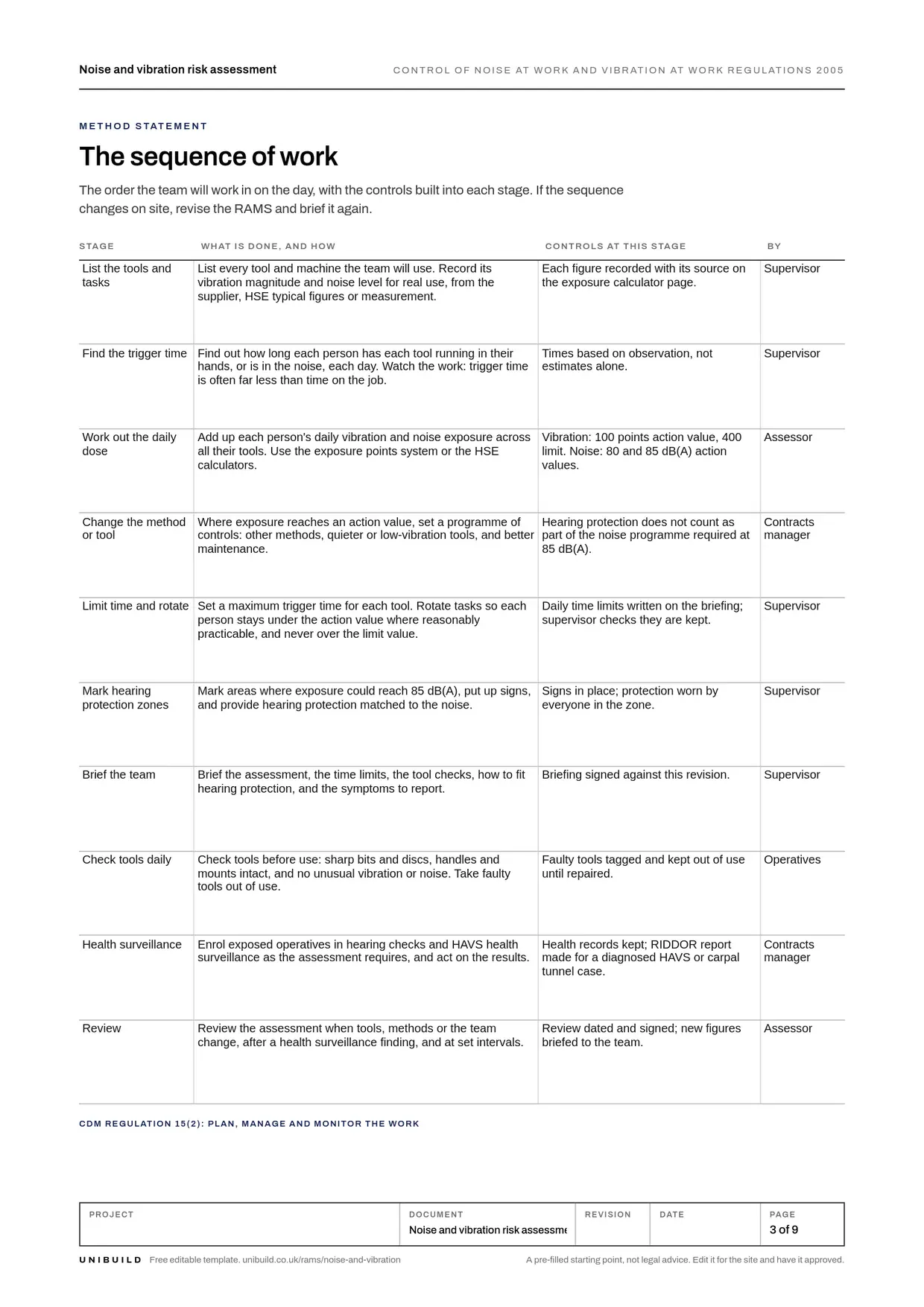
Noise and vibration assessment: the sequence of work
The order of work, with the controls at each stageHow the assessment is made and put to work on the job, with the controls built into each stage. If tools or methods change, recalculate the exposure and brief it again.
List the tools and tasks
List every tool and machine the team will use. Record its vibration magnitude and noise level for real use, from the supplier, HSE typical figures or measurement.
ControlsEach figure recorded with its source on the exposure calculator page.
Find the trigger time
Find out how long each person has each tool running in their hands, or is in the noise, each day. Watch the work: trigger time is often far less than time on the job.
ControlsTimes based on observation, not estimates alone.
Work out the daily dose
Add up each person's daily vibration and noise exposure across all their tools. Use the exposure points system or the HSE calculators.
ControlsVibration: 100 points action value, 400 limit. Noise: 80 and 85 dB(A) action values.
Change the method or tool
Where exposure reaches an action value, set a programme of controls: other methods, quieter or low-vibration tools, and better maintenance.
ControlsHearing protection does not count as part of the noise programme required at 85 dB(A).
Limit time and rotate
Set a maximum trigger time for each tool. Rotate tasks so each person stays under the action value where reasonably practicable, and never over the limit value.
ControlsDaily time limits written on the briefing; supervisor checks they are kept.
Mark hearing protection zones
Mark areas where exposure could reach 85 dB(A), put up signs, and provide hearing protection matched to the noise.
ControlsSigns in place; protection worn by everyone in the zone.
Brief the team
Brief the assessment, the time limits, the tool checks, how to fit hearing protection, and the symptoms to report.
ControlsBriefing signed against this revision.
Check tools daily
Check tools before use: sharp bits and discs, handles and mounts intact, and no unusual vibration or noise. Take faulty tools out of use.
ControlsFaulty tools tagged and kept out of use until repaired.
Health surveillance
Enrol exposed operatives in hearing checks and HAVS health surveillance as the assessment requires, and act on the results.
ControlsHealth records kept; RIDDOR report made for a diagnosed HAVS or carpal tunnel case.
Review
Review the assessment when tools, methods or the team change, after a health surveillance finding, and at set intervals.
ControlsReview dated and signed; new figures briefed to the team.
What the law asks for noise and vibration
Checked against the sourceNoise action and limit values
Lower action values are 80 dB(A) daily or weekly and 135 dB(C) peak. Upper action values are 85 dB(A) and 137 dB(C). The limit values of 87 dB(A) and 140 dB(C) take account of hearing protection.
Control of Noise at Work Regulations 2005, regulation 4Reduce noise, then protect hearing
Noise risk is eliminated or reduced as low as reasonably practicable. At the upper action value a programme of measures other than hearing protection is needed. Protection is available on request from 80 dB(A), and zones are marked at 85 dB(A).
Control of Noise at Work Regulations 2005, regulations 6 and 7Vibration action and limit values
Hand-arm vibration has a daily action value of 2.5 m/s² A(8) and a limit value of 5 m/s² A(8). For whole-body vibration the values are 0.5 and 1.15 m/s² A(8).
Control of Vibration at Work Regulations 2005, regulation 4Assess and control vibration
Where work is liable to expose employees to risk from vibration, the employer assesses it and records the significant findings. At the action value a programme of organisational and technical measures follows. The limit value must not be exceeded.
Control of Vibration at Work Regulations 2005, regulations 5 and 6Health surveillance
For vibration, health surveillance is needed where the assessment shows a risk or exposure is likely at or above the action value. For noise, it is needed where the assessment shows a risk, and includes hearing tests.
Vibration Regulations, regulation 7; Noise Regulations, regulation 9Reporting HAVS
Hand-arm vibration syndrome and carpal tunnel syndrome are reportable when diagnosed in a worker whose job involves regular use of percussive or vibrating tools.
RIDDOR 2013, regulation 8Competence, equipment and PPE
Competence and cards
- Assessor Understands the action values, the points system and the tools in use, and uses the HSE calculators.
- Supervisor Plans trigger times and rotation, and checks they are kept on the day.
- Operatives Trained to use and check their tools, fit hearing protection and report symptoms.
- Occupational health A competent provider for hearing checks and HAVS health surveillance.
- Plant drivers Trained for the plant they drive, and briefed on seat adjustment and haul routes.
Plant and equipment
- Breakers and hammers Vibration-reduced type; handles and mounts checked; bits sharp.
- Grinders and cut-off saws Right disc, sharp and undamaged; guard in place.
- Plate compactors Vibration-reduced type; handle mounts checked before use.
- Generators and compressors Acoustic covers closed; silencers fitted; serviced.
- Dumpers and rollers Seat, suspension and tyres checked daily.
PPE
- Hearing protection matched to the noise, fitted correctly and worn the whole time in the zone.
- Gloves warm and dry, for grip and warmth; not relied on to cut vibration.
- Warm clothing for outdoor work in cold, wet weather.
- Eye protection for breaking, grinding and cutting.
- Safety footwear with protective toecaps, for breaking and compacting work.
Permits and plans
A permit to work where the principal contractor requires one for noisy work in occupied areas or out of hours. A permit to dig or break ground before breaking out near buried services. Noisy work kept to the hours agreed with the client or local authority.
Emergency and rescue
First aid and the site emergency procedure for any injury. Operatives report tingling, numbness, fingers going white or sudden changes in hearing to the supervisor. The supervisor reviews their exposure and refers them to occupational health. A diagnosed HAVS or carpal tunnel case is reported under RIDDOR.
Toolbox talk: noise and vibration
Read this to the team before work starts, tick each point as it is covered, and record who attended.
- HAVS and noise damage are permanent. Tingling, numb or white fingers and ringing ears are the first signs, so report them.
- Your trigger time for each tool is on the briefing. When you reach it, swap to other work.
- Let the tool do the work. Gripping and pushing harder puts more vibration into your hands.
- Blunt bits and worn discs vibrate more. Change them, and report any tool that shakes more than it should.
- In a hearing protection zone, protection goes in before you enter and stays in until you leave.
- Keep your hands warm and dry. Use the gloves provided and warm up on your breaks.
Ask the team
- Which tool on this job gives the most vibration, and what is its time limit?
- Where are the hearing protection zones today?
- Which symptoms should you report, and to whom?
What is in the noise and vibration risk assessment template
9 pages, pre-filled and editableThe work, pre-filled
Scope, location and access, interfaces with other trades and occupants, and the documents the assessment relies on.
The sequence of work
Ten stages from listing the tools to review, with the controls and the person responsible at each one.
Hazards and controls
Fourteen noise and vibration hazards rated before and after controls on a five by five matrix, with room for your own.
Exposure calculator
A page for each tool: magnitude in m/s² or dB(A), time per day, points and the action needed, with four worked example rows.
Equipment, PPE and permits
Tools and plant with their checks, PPE by type, and the permits the job needs.
Briefing record
Twenty signatures against the revision, taken on the day before the work starts.
Brief it, and get it signed on the phone
On Unibuild a RAMS is written from a template, approved, then read by each operative on their phone in their own language and signed. Subcontract and agency workers sign through a link, with no app to install.
Every signature carries its date and time and prints as the last page of the RAMS PDF. Change the RAMS and it has to be signed again.
How RAMS work on UnibuildNoise and HAVS risk assessment questions
Is this noise and vibration risk assessment template free?
Do I need a hand arm vibration risk assessment?
What are the HAVS exposure action and limit values?
How do HAVS exposure points work?
At what noise level is hearing protection required?
Is HAVS reportable under RIDDOR?
Can I use the manufacturer's vibration figure?
When is health surveillance needed for noise and vibration?
RAMS templates for other trades and hazards
All free, pre-filled and editableBy trade
- Electrical RAMSSafe isolation, live work, testing and inspection, and working near other trades.
- Scaffolding RAMSErecting, altering and dismantling tube and fitting and system scaffold, with handover and inspection.
- Roofing RAMSPitched and flat roofs, fragile surfaces, edge protection, hot work and getting materials up safely.
- Groundworks RAMSExcavations, buried services, plant, trench support and inspections at the start of each shift.
- Plumbing and heating RAMSSoldering and brazing, gas work, unvented systems, lofts and occupied homes.
- Painting and decorating RAMSAccess equipment, solvents and spray, old lead paint, dust from preparation and occupied buildings.
- Hot works and welding RAMSWelding, cutting, grinding and torch-on work: permits, fire watch, fume and gas cylinders.
By hazard
- COSHH risk assessmentHazardous substances on site: dusts, solvents, cement, resins and fume, assessed and controlled.
- Manual handling risk assessmentLifting, carrying, pushing and pulling, assessed by task, individual, load and environment.
- Working at height risk assessmentLadders, towers, MEWPs, scaffolds and roofs, chosen and controlled in the order the law sets.
- Lone working risk assessmentPeople working alone on site, in empty buildings and out of hours, with check-ins and a plan if they go quiet.
- Noise and vibration risk assessmentNoise exposure and hand-arm vibration from tools, measured against the action and limit values.
- Asbestos risk assessmentFinding asbestos before work starts, deciding whether work is licensed, and controlling non-licensed work.
- Confined space risk assessmentManholes, tanks, voids and chambers: avoiding entry, a safe system of work, gas testing and rescue.
The blank RAMS template, the RAMS review checklist and every other free form are on Free downloads.
The RAMS, read and signed
before the work starts.
Unibuild keeps every RAMS with its versions, its approvals and each operative’s signature against the revision they read, for seven years, ready for the principal contractor or an auditor.