Free toolbox talk · Confined spaces

Confined spaces toolbox talk

A toolbox talk on confined spaces, written to be read aloud in about six minutes: what makes a space confined, why bad air gives no warning, avoiding entry, the safe system and permit, testing the air, the person outside, and why rescuers must never just go in. The last page is the attendance record.

PDF · 3 pages · 208 KB · Word 41 KB · Free to use and reuse · Terms

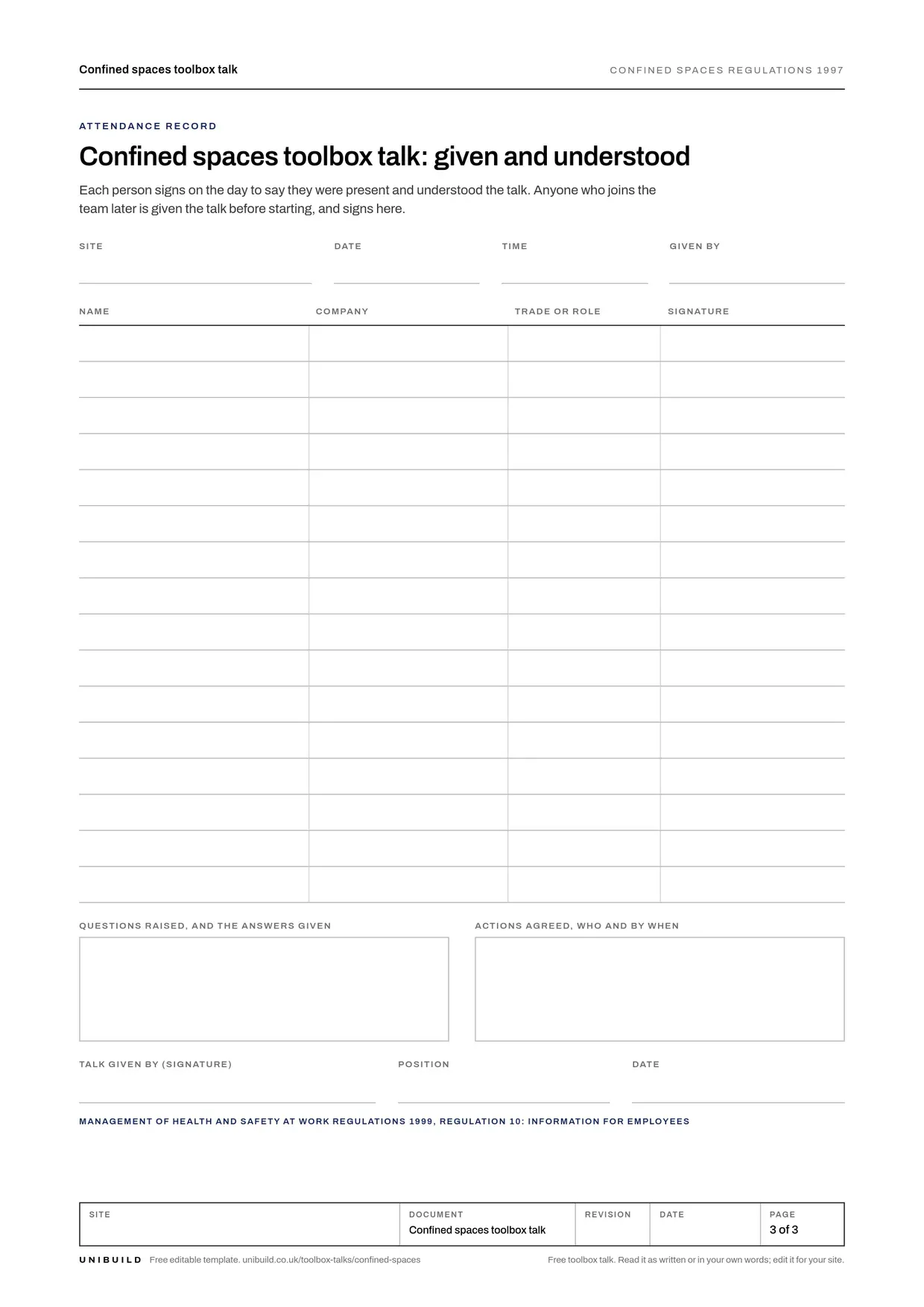
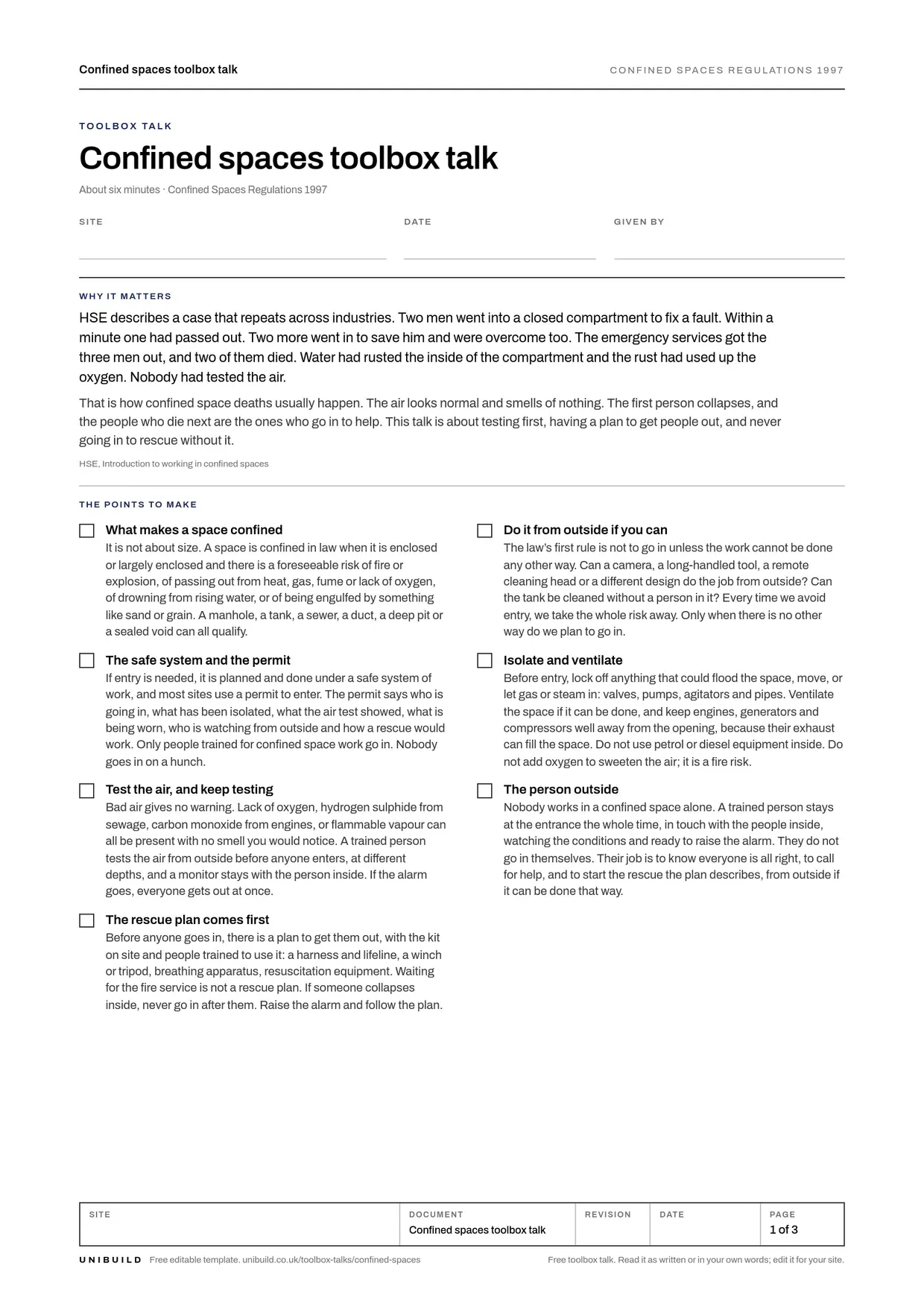
Attendance record page of the free confined spaces toolbox talk from Unibuild, where each person signs to say they were given the talk and understood itFront page of the free confined spaces toolbox talk from Unibuild
Law
Confined Spaces Regulations 1997
Time to deliver
About six minutes
Format
PDF and Word, with a sign-off sheet
Cost
Free, always

What this toolbox talk covers

This talk is for anyone who might go into, or work at the opening of, a confined space: manholes, inspection chambers, sewers, tanks, pits, ducts, culverts, boilers, deep trenches and sealed voids. It takes about six minutes to give and covers what makes a space confined in law, why bad air gives no warning, doing the job from outside where possible, the safe system and the permit, testing the air, the person outside and the rescue plan.

It is written to be read aloud, with the points in the order a supervisor makes them, short lists of do and do not, and questions about the spaces on this job. The last page is the record: who gave it, who heard it and what was raised.

The confined spaces risk assessment holds the full hazards and controls, and the excavations toolbox talk covers trenches and pits.

Checked against HSE guidance and legislation.gov.uk on .

Toolbox talk · About six minutes

Confined spaces: the talk

Read it as written or in your own words. Tick each point as you make it. Stop for the questions.

Why it matters

HSE describes a case that repeats across industries. Two men went into a closed compartment to fix a fault. Within a minute one had passed out. Two more went in to save him and were overcome too. The emergency services got the three men out, and two of them died. Water had rusted the inside of the compartment and the rust had used up the oxygen. Nobody had tested the air.

That is how confined space deaths usually happen. The air looks normal and smells of nothing. The first person collapses, and the people who die next are the ones who go in to help. This talk is about testing first, having a plan to get people out, and never going in to rescue without it.

HSE, Introduction to working in confined spaces

The points to make

What makes a space confined

It is not about size. A space is confined in law when it is enclosed or largely enclosed and there is a foreseeable risk of fire or explosion, of passing out from heat, gas, fume or lack of oxygen, of drowning from rising water, or of being engulfed by something like sand or grain. A manhole, a tank, a sewer, a duct, a deep pit or a sealed void can all qualify.

Do it from outside if you can

The law’s first rule is not to go in unless the work cannot be done any other way. Can a camera, a long-handled tool, a remote cleaning head or a different design do the job from outside? Can the tank be cleaned without a person in it? Every time we avoid entry, we take the whole risk away. Only when there is no other way do we plan to go in.

The safe system and the permit

If entry is needed, it is planned and done under a safe system of work, and most sites use a permit to enter. The permit says who is going in, what has been isolated, what the air test showed, what is being worn, who is watching from outside and how a rescue would work. Only people trained for confined space work go in. Nobody goes in on a hunch.

Isolate and ventilate

Before entry, lock off anything that could flood the space, move, or let gas or steam in: valves, pumps, agitators and pipes. Ventilate the space if it can be done, and keep engines, generators and compressors well away from the opening, because their exhaust can fill the space. Do not use petrol or diesel equipment inside. Do not add oxygen to sweeten the air; it is a fire risk.

Test the air, and keep testing

Bad air gives no warning. Lack of oxygen, hydrogen sulphide from sewage, carbon monoxide from engines, or flammable vapour can all be present with no smell you would notice. A trained person tests the air from outside before anyone enters, at different depths, and a monitor stays with the person inside. If the alarm goes, everyone gets out at once.

The person outside

Nobody works in a confined space alone. A trained person stays at the entrance the whole time, in touch with the people inside, watching the conditions and ready to raise the alarm. They do not go in themselves. Their job is to know everyone is all right, to call for help, and to start the rescue the plan describes, from outside if it can be done that way.

The rescue plan comes first

Before anyone goes in, there is a plan to get them out, with the kit on site and people trained to use it: a harness and lifeline, a winch or tripod, breathing apparatus, resuscitation equipment. Waiting for the fire service is not a rescue plan. If someone collapses inside, never go in after them. Raise the alarm and follow the plan.

Do

  • Ask whether the job can be done without anyone going in.
  • Check there is a permit and a rescue plan before entering.
  • Make sure the air has been tested and keep the monitor with you inside.
  • Keep someone at the entrance for the whole time anyone is inside.
  • Get out straight away if the monitor alarms, you feel unwell or conditions change.
  • Keep engines and generators well away from the opening.

Do not

  • Do not enter a confined space you have not been trained and authorised to enter.
  • Do not trust your nose. Many dangerous gases have no smell you would notice.
  • Do not go in after someone who has collapsed. Raise the alarm and follow the rescue plan.
  • Do not use oxygen to freshen the air in a space.
  • Do not assume a space is safe today because it was safe yesterday.

Ask the team

  • Which spaces on this job could count as confined, and does anyone go into them?
  • Could we do that work from outside instead?
  • Who is trained to test the air, and where is the gas monitor kept?
  • If someone collapsed in that chamber now, what would we do, step by step?
  • Who is trained in the rescue kit, and when was it last checked?

To close

Confined spaces kill people who were sure they would be fine, and then they kill the people who go in to help. The air looks normal and smells of nothing. So we do it from outside if we can. If we cannot, we isolate, ventilate, test, keep testing, keep someone at the top, and have the rescue ready before anyone goes in. And if someone goes down inside, you do not follow them. You raise the alarm and follow the plan. That is how two deaths do not become four.

Record it. Who gave the talk, where, when, who was there and what was raised. The last page of the sheet is the record.

In Unibuild a talk is read in each operative’s own language and signed on the phone. How toolbox talks work

The law behind this talk

Checked against the source

What a confined space is

A confined space is any place, including a chamber, tank, vat, silo, pit, trench, pipe, sewer, flue, well or similar space, in which, because it is enclosed, there is a reasonably foreseeable specified risk: serious injury from fire or explosion, loss of consciousness from a rise in body temperature, loss of consciousness or asphyxiation from gas, fume, vapour or lack of oxygen, drowning from a rise in liquid, or asphyxiation from a free flowing solid.

Confined Spaces Regulations 1997, regulation 1(2)

Avoid entry, then a safe system of work

No person at work enters a confined space to carry out work unless it is not reasonably practicable to do the work without entry. So far as is reasonably practicable, nobody enters, works in or leaves a confined space except under a system of work which, for the specified risks, makes the work safe and without risks to health.

Confined Spaces Regulations 1997, regulation 4

Emergency arrangements

Nobody enters or works in a confined space unless suitable and sufficient arrangements for rescue in an emergency have been prepared. The arrangements reduce the risk to the rescuers so far as is reasonably practicable, include resuscitation equipment where resuscitation is a likely need, and are put into operation immediately when needed.

Confined Spaces Regulations 1997, regulation 5

What is on the sheet

3 pages, the talk and the record

The talk, over two pages

Why it matters, the points to make, do and do not, and the questions to ask, laid out to read from in the cabin or at the workface. Space at the top for the site, the date and who is giving it.

The last page, the record

The attendance record: each person's name, company and signature, the questions raised and any actions, signed off by the person who gave the talk. Type into it or print it and pass it round.

The Word version

The same talk as a Word document, so you can put your own letterhead on it, add a site photograph or change a point to match how your job is set up.

Download the talk as PDF Word versionPDF · 3 pages · 208 KB
After it is given

Delivered on the phone, signed in the room

On Unibuild a toolbox talk is picked from the library, read by each operative on their own phone in their own language and signed there and then. The record is filed against the operative, the site and the date.

A site manager sees who has had which talk, and who has not, without a sheet going round on Thursday.

How toolbox talks work on Unibuild
How long should a confined spaces toolbox talk be?
About five to ten minutes. This one reads in about six if you make every point and stop for the questions. A toolbox talk is not confined space training. Anyone who enters, tests the air, stands at the entrance or carries out a rescue needs training for that work, recorded in the training matrix.
Is a manhole a confined space?
It is if there is a foreseeable specified risk, such as lack of oxygen, gas from sewage, flooding or fire, and on most sites a manhole, inspection chamber or sewer is treated as one. The test in law is the risk, not the size or the depth.
Is a trench a confined space?
It can be. Trench is in the legal list of places that can be confined spaces. A trench becomes one when there is a foreseeable risk such as gas collecting in it, heavier-than-air fumes from nearby plant, or flooding. Collapse alone is covered by the excavation rules.
Do you need a permit to work in a confined space?
The law requires a safe system of work and rescue arrangements rather than naming a permit. HSE’s Approved Code of Practice L101 explains how a permit to work fits in, and most principal contractors require one, because it is the clearest way to show isolation, testing, the watcher and the rescue plan are in place.
What gases should be tested for?
The risk assessment decides, but the usual checks are oxygen level, flammable gas, and toxic gases such as hydrogen sulphide and carbon monoxide. The air is tested by a trained person from outside before entry, at different levels, and monitored while people are inside.
Can the fire brigade be the rescue plan?
No. HSE says it is not enough to rely on the emergency services. The rescue arrangements, with the equipment and trained people, are on site before work starts, and the emergency services are called as well.
Who can work in a confined space?
Only people trained for the type of confined space work, and fit to do it, under a safe system of work. The person at the entrance and anyone who would carry out a rescue are trained for their part too.
Do we have to keep a record of the talk?
There is no regulation that names toolbox talk records, but employers must give information, instruction and training, and most principal contractors and auditors ask for the evidence. A signed attendance record with the date and the topic is that evidence. The last page of the sheet is the record.
Is this confined spaces toolbox talk free?
Yes. Download it, print it, give it, edit it and put your own name on it, including on paid work and for clients, with no sign-up and no email address.
Next step

The talk given, understood
and on record.

Unibuild keeps every toolbox talk against the operative who signed it, the site and the date, for seven years, ready for the principal contractor or an auditor.

Get a quote
One figure per firm · For UK firms

Right, let’s talk numbers.

Five things about your business. We work your fee out properly and put it in writing the same working day.

What we build for you

  • Your own portalIn the browser, built around your firm
  • Your own appiOS and Android, under your name
  • Everyday AI includedHeavier AI at cost, nothing added
  • One platformEverything in one place, set up by us

Would you rather see it running first? Book a 30-minute demo

Quotation request