
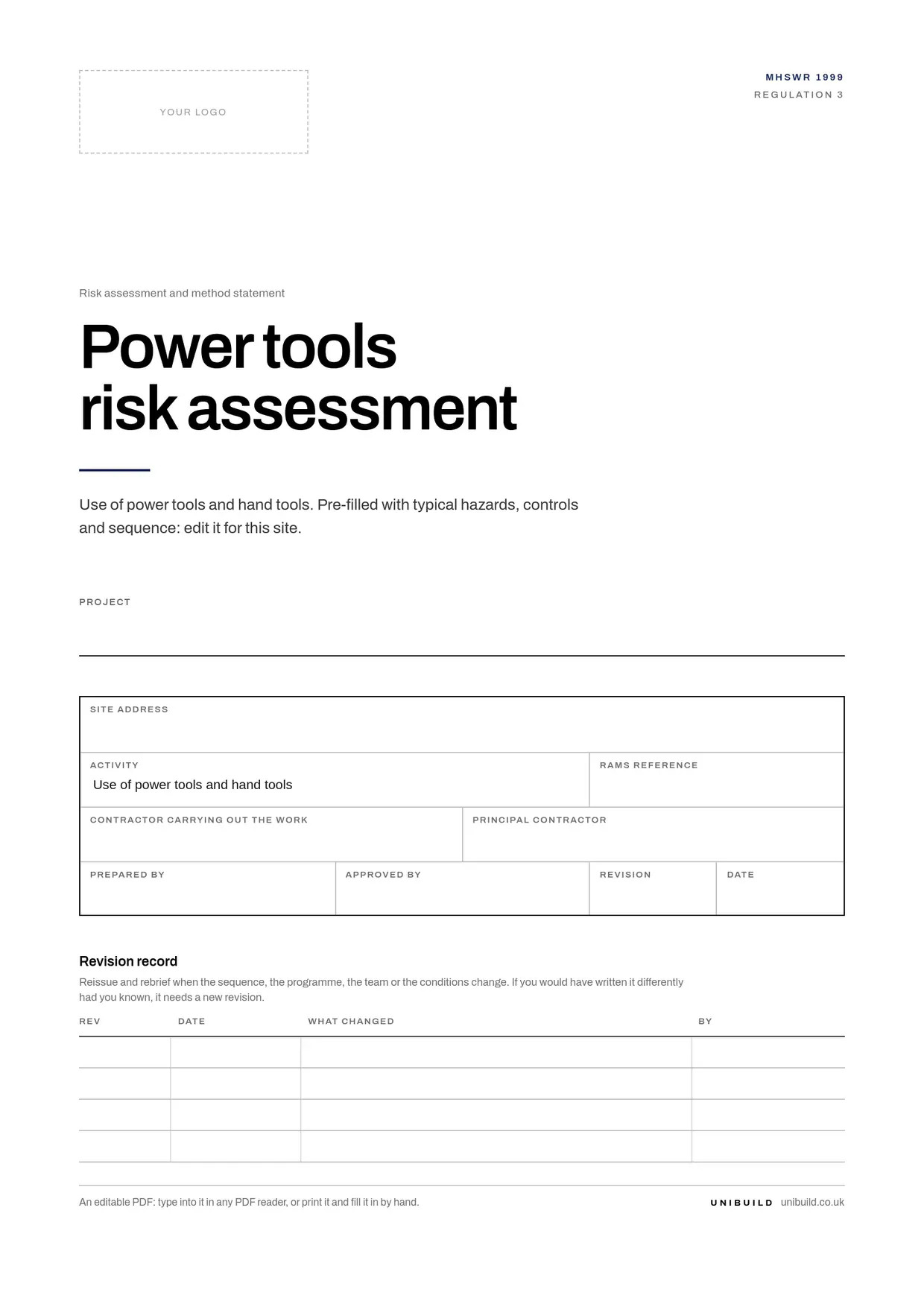
Power tools and hand tools risk assessment template
A power tools risk assessment already filled in for circular saws, grinders, cut-off saws, drills, cartridge tools, nail guns and hand tools, with a tool by tool check page. Edit it for your job, then brief it.
- Law
- PUWER 1998
- 110V site tools
- HSE suggests a test every 3 months
- Format
- Editable PDF and Word
- Cost
- Free, always
What is a power tools risk assessment?
A power tools risk assessment looks at each tool the team will use, from circular saws, grinders and drills to cartridge tools, nail guns and hand tools. It sets out how each one is chosen, powered, checked, guarded and used. The Management Regulations 1999 require the risk assessment, and PUWER 1998 sets the duties for the tools themselves.
The serious injuries to plan for come from a short list: contact with the blade or disc, circular saw kickback, a disc bursting, electric shock from a damaged lead, and fixings fired through the material. The same tools also make dust, noise and vibration, which build up into ill health over years and need their own assessment.
A hand tools risk assessment follows the same law. HSE counts any tool for use at work as work equipment, including tools workers provide for their own use. Hammers with split handles, mushroomed chisels and open-bladed knives are common causes of cuts and eye injuries.
Checked against legislation.gov.uk and HSE guidance on .
Power tool and hand tool hazards and controls
18 hazards, rated before and after controlsThe hazards from saws, grinders, drills, fixing tools and hand tools on a typical job, with the controls a reviewer expects to see. Delete what does not apply and add the tools your team uses.
Contact with blades, discs and bits
Operatives using saws, grinders, routers and planers, and anyone reaching in near a running tool.
- Guards fitted, adjusted and working on every tool; a tool with a missing or wedged guard taken out of use.
- Work clamped or supported so both hands stay on the tool where it is designed for two hands.
- Tool allowed to stop running before it is put down, and never carried with a finger on the trigger.
BeforeHigh 16AfterMedium 8
Circular saw kickback
Carpenters, joiners and fixers ripping and crosscutting timber and sheet with hand-held circular saws.
- Lower guard checked to return freely before each use; riving knife fitted where the saw is designed for one.
- Blade sharp and suited to the material, with the cutting depth set to just clear the work.
- Work supported on both sides so the cut does not close and pinch the blade; operator stands to one side of the cut line.
BeforeHigh 16AfterMedium 8
Grinder discs bursting
Grinder users and people nearby, struck by fragments when a disc breaks at speed.
- Disc speed marked on the wheel at least the speed of the grinder; disc type and marked restrictions matched to the task.
- Discs mounted by a trained person with the correct flanges, inside their use-by date and checked for damage.
- Guard set between disc and operator; a new disc run free for a short time with everyone clear.
BeforeHigh 15AfterMedium 5
Petrol cut-off saws
Operatives cutting concrete, kerbs, pipe and steel with disc cutters, and people working close by.
- Blade or disc rated for the saw and the material; guard set as the maker directs.
- Saw started on firm ground and held with both hands; no cutting with the upper front of the blade, where it kicks back.
- Cutting zone kept clear; refuelled with the engine stopped, away from sparks; water suppression for dust.
BeforeHigh 20AfterMedium 10
Electric shock from tools and leads
Anyone using mains-powered tools, especially outdoors, in wet conditions or with damaged leads.
- Battery tools first; 110V centre-tapped earth tools elsewhere; no domestic reels or 13 A sockets unless of a site type and RCD protected.
- 230V tools only where nothing else will do, through an RCD tested with its test button every day.
- RCDs never bypassed; damaged leads, plugs and casings taken out of use, not taped.
BeforeHigh 15AfterMedium 5
Tools not inspected or tested
Users of tools that have deteriorated in site conditions without anyone checking.
- Every tool and lead on a register with its inspection and test dates, including hired and own tools.
- Intervals set from HSE HSG107: 110V tools user-checked weekly, inspected monthly, tested before first use on site then every 3 months.
- Shorter intervals where faults keep being found.
BeforeMedium 12AfterMedium 8
Trailing leads and extension reels
Everyone moving around the work, and users whose leads are cut, crushed or wet.
- Leads routed along walls or overhead, away from walkways, doors and plant routes.
- Site-grade leads only: no twin and earth cable used as an extension.
- Leads kept short, out of water, and protected where they cross a route.
BeforeMedium 12AfterMedium 6
Drills and core drills snatching
Operatives drilling and coring, whose wrist or arm is twisted when a bit jams.
- Side handle fitted and used, with the clutch or torque setting the maker provides.
- Larger core drills mounted on a rig and fixed as the maker directs, not hand-held.
- Wet coring on 110V or battery supply, with water kept away from the motor and leads.
BeforeMedium 9AfterMedium 6
Hidden cables and pipes
Operatives drilling, chasing or cutting into walls, floors and ceilings.
- Drawings and services information checked before work, and the area scanned with a cable and pipe detector.
- Services isolated where practicable, and no drilling in zones where cables are likely to run.
BeforeHigh 15AfterMedium 10
Cartridge-operated fixing tools
Users and anyone behind or beside the material, from a fixing or fragment passing through.
- Treated as a specific risk under PUWER regulation 7: use restricted to the people given the task and trained on that tool.
- Material checked as suitable; the lowest cartridge strength that sets the fixing; nobody behind the work.
- Tool unloaded when not in use; cartridges kept locked away and counted back in.
BeforeHigh 15AfterMedium 5
Nail guns
Carpenters and roofers using air, gas or battery nailers, and people working close by.
- Trigger mode set as the maker recommends for the task; nailer never pointed at anyone or carried with a finger on the trigger.
- Air hose, battery or gas cell disconnected before clearing a jam or leaving the tool.
- Hands kept well clear of the nose; eye protection for user and others nearby.
BeforeMedium 12AfterMedium 8
Sparks and hot work from grinding
Users and others near grinding and cutting, where sparks can start a fire.
- Combustibles cleared or covered and a fire extinguisher at the work; a hot work permit where required.
- Sparks directed away from people, gas cylinders and openings; screens for others nearby.
- Area checked for smouldering after the work.
BeforeMedium 12AfterLow 4
Flying chips and particles in the eyes
Users of grinders, saws, drills, chisels and hammers, and people passing.
- Eye protection worn for all grinding and cutting, and for striking tools.
- Screens or barriers to protect others, with the work area kept clear.
BeforeMedium 12AfterMedium 6
Dust from cutting, chasing and drilling
Users and others breathing silica or wood dust from power tools.
- Water suppression or on-tool extraction to an H or M class unit, as set out in the dust risk assessment.
- RPE with an APF of 20, face-fit tested, where the task needs it.
BeforeHigh 20AfterMedium 10
Noise and hand-arm vibration
Users of grinders, breakers, hammer drills, saws and cartridge tools.
- Daily trigger time for each tool set from the noise and vibration assessment.
- Low-vibration, quieter tools chosen, and discs and bits kept sharp.
- Hearing protection in marked zones; tingling or numb fingers reported.
BeforeHigh 16AfterMedium 8
Hand tools in poor condition
Anyone using hammers, chisels, knives, hand saws and spanners.
- Right tool for the job; tools with split handles, loose heads or mushroomed striking ends repaired or replaced.
- Retractable or safety knives, cutting away from the body, with cut-resistant gloves.
- Tools carried in a bag or holder, and not left where they can fall from height.
BeforeMedium 8AfterLow 4
Entanglement and changing accessories
Users of drills, sanders and grinders with loose clothing, or changing a bit or blade.
- No loose cuffs, ties or jewellery near rotating parts; long hair tied back; gloves that cannot catch on the bit.
- Battery removed or plug pulled before changing a blade, disc or bit, or clearing a jam.
- Chuck keys and spanners removed before the tool is switched on.
BeforeMedium 9AfterLow 3
Untrained users and unsuitable tools
New starters, young workers and anyone using a tool they have not been trained on.
- Training on each tool type, with records, before unsupervised use; supervisors trained too.
- Tools chosen for the task and the conditions, used only within the maker's instructions.
- Young and new workers supervised until they are competent.
BeforeMedium 12AfterMedium 8
Scores are likelihood times severity on the five by five matrix in the template. They are typical ratings for this work, a starting point for your own assessment of your site.
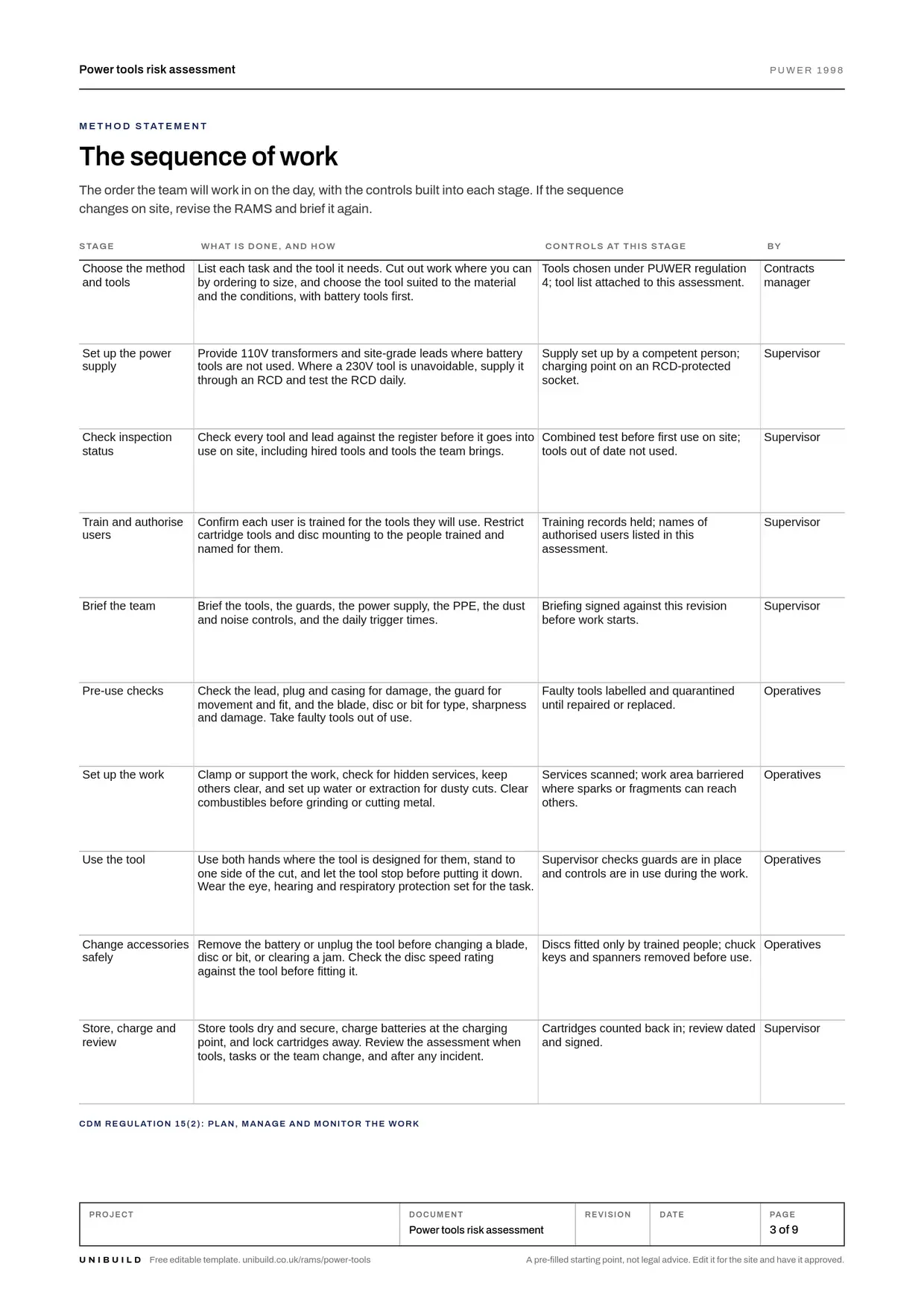
Power tools method statement: the sequence of work
The order of work, with the controls at each stageHow tools are chosen, checked and used on the job, with the controls at each stage. If a tool or method changes, revise the assessment and brief it again.
Choose the method and tools
List each task and the tool it needs. Cut out work where you can by ordering to size, and choose the tool suited to the material and the conditions, with battery tools first.
ControlsTools chosen under PUWER regulation 4; tool list attached to this assessment.
Set up the power supply
Provide 110V transformers and site-grade leads where battery tools are not used. Where a 230V tool is unavoidable, supply it through an RCD and test the RCD daily.
ControlsSupply set up by a competent person; charging point on an RCD-protected socket.
Check inspection status
Check every tool and lead against the register before it goes into use on site, including hired tools and tools the team brings.
ControlsCombined test before first use on site; tools out of date not used.
Train and authorise users
Confirm each user is trained for the tools they will use. Restrict cartridge tools and disc mounting to the people trained and named for them.
ControlsTraining records held; names of authorised users listed in this assessment.
Brief the team
Brief the tools, the guards, the power supply, the PPE, the dust and noise controls, and the daily trigger times.
ControlsBriefing signed against this revision before work starts.
Pre-use checks
Check the lead, plug and casing for damage, the guard for movement and fit, and the blade, disc or bit for type, sharpness and damage. Take faulty tools out of use.
ControlsFaulty tools labelled and quarantined until repaired or replaced.
Set up the work
Clamp or support the work, check for hidden services, keep others clear, and set up water or extraction for dusty cuts. Clear combustibles before grinding or cutting metal.
ControlsServices scanned; work area barriered where sparks or fragments can reach others.
Use the tool
Use both hands where the tool is designed for them, stand to one side of the cut, and let the tool stop before putting it down. Wear the eye, hearing and respiratory protection set for the task.
ControlsSupervisor checks guards are in place and controls are in use during the work.
Change accessories safely
Remove the battery or unplug the tool before changing a blade, disc or bit, or clearing a jam. Check the disc speed rating against the tool before fitting it.
ControlsDiscs fitted only by trained people; chuck keys and spanners removed before use.
Store, charge and review
Store tools dry and secure, charge batteries at the charging point, and lock cartridges away. Review the assessment when tools, tasks or the team change, and after any incident.
ControlsCartridges counted back in; review dated and signed.
What the law asks for power tools
Checked against the sourceSuitable for the job
Work equipment is suitable for the purpose it is used for, chosen with regard to the working conditions and the risks, and used only for operations and in conditions for which it is suitable.
PUWER 1998, regulation 4Maintained and inspected
Work equipment is kept in efficient working order and good repair. Equipment exposed to conditions that cause dangerous deterioration is inspected at suitable intervals, and the result recorded and kept until the next inspection.
PUWER 1998, regulations 5 and 6Information and training
Everyone who uses work equipment, and anyone who supervises its use, has adequate information and training in the methods of use, the risks and the precautions. Where a tool carries a specific risk, its use is restricted to those given the task.
PUWER 1998, regulations 7, 8 and 9Dangerous parts guarded
Access to dangerous parts of machinery is prevented. Fixed guards come first, then other guards or protection devices, then jigs, holders and push-sticks, with information, instruction, training and supervision.
PUWER 1998, regulation 11Ejected parts and bursting
Exposure is prevented or adequately controlled where articles may be ejected from equipment, parts may rupture or disintegrate, or equipment may catch fire or overheat. On site that includes a disc bursting and a fixing fired through the material.
PUWER 1998, regulation 12Electrical equipment maintained
Electrical systems are maintained so as to prevent danger, so far as is reasonably practicable. The law does not name PAT testing or set an interval; HSE guidance HSG107 gives suggested starting intervals.
Electricity at Work Regulations 1989, regulation 4(2)Competence, equipment and PPE
Competence and cards
- Assessor Knows the tools, the tasks and the site conditions, and reads the maker's instructions for each tool.
- Supervisor Trained in the tools the team uses; checks guards, supplies and inspection dates, and stops unsafe use.
- Operatives Trained on each tool type they use, with records, including how to check it before use.
- Abrasive wheel mounter Trained in selecting, checking and mounting discs, as HSE HSG17 describes, with a record of the training.
- Cartridge tool users Trained on the make and model they use, and named in this assessment as authorised.
- Tester Competent to carry out formal visual inspections and combined inspection and testing of portable tools.
Plant and equipment
- Hand-held circular saw Lower guard returns freely; riving knife fitted; blade sharp.
- Angle grinder Disc rated at least the tool speed; guard set; side handle on.
- Petrol cut-off saw Guard, blade and water feed checked; no fuel leaks.
- Drills and core drills Side handle fitted; clutch working; core rig fixed.
- Cartridge tool Checked by the user each day; serviced as the maker directs.
- 110V transformers and leads Casing and leads undamaged; inspection and test in date.
PPE
- Eye protection for grinding, cutting, drilling, nailing and striking tools.
- Hearing protection in marked zones and for cartridge tools, matched to the noise.
- Respiratory protection APF 20, face-fit tested, where cutting or drilling makes dust.
- Gloves cut-resistant for blades and sheet, but not where they can catch on a rotating bit.
- Safety footwear with protective toecaps, for all tool work on site.
Permits and plans
A hot work permit where the principal contractor requires one for grinding and disc cutting. A permit to work for drilling or cutting into live services or plant. A permit to dig or break ground before breaking out or cutting near buried services.
Emergency and rescue
First aider and first aid kit on site, with eyewash for particles in the eye. For a deep cut or amputation, call 999, control the bleeding and keep any severed part. For electric shock, isolate the supply before touching the person. Serious injuries are reported under RIDDOR, and the tool is quarantined for investigation.
Toolbox talk: power tools and hand tools
Read this to the team before work starts, tick each point as it is covered, and record who attended.
- Check the tool before you use it: lead, plug, casing, guard and blade. If anything is damaged, tag it and hand it in.
- Guards stay on and working. Never wedge back the lower guard on a circular saw.
- Battery or 110V on site. A 230V tool goes through an RCD, and you press the test button every day.
- Check the speed on a disc before you fit it. If you have not been trained to change discs, do not.
- Battery out or plug pulled before you change a blade, disc or bit, or clear a jam.
- Eye protection for every cut, grind and strike. Know your trigger time for each tool, and use the dust controls.
Ask the team
- Which tool on this job could hurt you fastest, and what stops it?
- Where do you hand in a faulty tool?
- Who is authorised to use the cartridge tool and change grinder discs?
What is in the power tools risk assessment template
9 pages, pre-filled and editableThe work, pre-filled
Scope, location and access, interfaces with other trades, the documents the assessment relies on, and the tools in use.
The sequence of work
Ten stages from choosing the tools to storage and review, with the controls and the person responsible at each one.
Hazards and controls
Eighteen power tool and hand tool hazards rated before and after controls on a five by five matrix, with room for your own.
Tool by tool checks
A page for each tool: checks before use, guards and safety devices, power and inspection, and who may use it, with eight worked examples.
Equipment, PPE and permits
Tools with their checks and the competence to use them, PPE by type, and the permits the job needs.
Briefing record
Twenty signatures against the revision, taken on the day before the work starts.
Brief it, and get it signed on the phone
On Unibuild a RAMS is written from a template, approved, then read by each operative on their phone in their own language and signed. Subcontract and agency workers sign through a link, with no app to install.
Every signature carries its date and time and prints as the last page of the RAMS PDF. Change the RAMS and it has to be signed again.
How RAMS work on UnibuildPower tools risk assessment questions
Is this power tools risk assessment template free?
Do I need a risk assessment for power tools and hand tools?
What should a circular saw risk assessment cover?
How often should power tools be PAT tested on site?
Is abrasive wheel training a legal requirement?
Why are 110V tools used on building sites?
What goes in a core drilling risk assessment?
Who can use a cartridge fixing tool?
RAMS templates for other trades and hazards
All free, pre-filled and editableBy trade
- Air conditioning and HVAC RAMS
- Bricklaying RAMS
- Carpentry and joinery RAMS
- CCTV installation RAMS
- Cleaning risk assessment
- Concrete works RAMS
- Demolition RAMS
- Drylining RAMS
- Electrical RAMS
- Facilities maintenance RAMS
- Fire alarm installation RAMS
- Glazing and window RAMS
- Groundworks RAMS
- Hot works and welding RAMS
- Insulation RAMS
- Landscaping and fencing RAMS
- Painting and decorating RAMS
- Pest control risk assessment
- Plastering and rendering RAMS
- Plumbing and heating RAMS
- Rail RAMS
- Refurbishment RAMS
- Roofing RAMS
- Rope access risk assessment
- Scaffolding RAMS
- Solar PV installation RAMS
- Steel erection RAMS
- Temporary works RAMS
- Tiling and flooring RAMS
- Tree surgery RAMS
By hazard
- Asbestos risk assessment
- Confined space risk assessment
- COSHH risk assessment
- Dust risk assessment
- Forklift and telehandler risk assessment
- Housekeeping risk assessment
- Lifting operations risk assessment
- Lone working risk assessment
- Manual handling risk assessment
- MEWP risk assessment
- Noise and vibration risk assessment
- Plant and excavator risk assessment
- Power tools risk assessment
- Traffic management risk assessment
- Working at height risk assessment
The blank RAMS template, the RAMS review checklist and every other free form are on Free downloads.
The RAMS, read and signed
before the work starts.
Unibuild keeps every RAMS with its versions, its approvals and each operative’s signature against the revision they read, for seven years, ready for the principal contractor or an auditor.