Free toolbox talk · Noise

Noise toolbox talk

A toolbox talk on noise at work, written to be read aloud in about six minutes: why hearing loss is permanent, the two-metre test, the action values, quieter ways of working, hearing protection that fits and hearing checks. The last page is the attendance record.

PDF · 3 pages · 212 KB · Word 41 KB · Free to use and reuse · Terms

Law
Control of Noise at Work Regulations 2005
Time to deliver
About six minutes
Format
PDF and Word, with a sign-off sheet
Cost
Free, always

What this toolbox talk covers

This talk is for anyone who uses or works near noisy kit: breakers, disc cutters, grinders, nail guns, mixers, compressors, generators, piling rigs and plant. It takes about six minutes to give and covers why hearing damage is permanent and creeps up unnoticed, the simple test for whether noise on your job is a problem, the levels the law works to, and the order of controls from quieter methods down to ear protection.

It is written to be read aloud, with the points a supervisor makes in the order they make them, two short lists of do and do not, and questions to put to the team so the talk is a conversation rather than a reading. The last page is the record: who gave it, who heard it and what was raised.

Noise and vibration usually arrive together on the same tools, and the noise and vibration risk assessment holds the full hazards and controls for both. This talk sticks to noise. A separate talk covers the kit people wear, including ear defenders and plugs.

Checked against HSE guidance and legislation.gov.uk on .

Toolbox talk · About six minutes

Noise: the talk

Read it as written or in your own words. Tick each point as you make it. Stop for the questions.

Why it matters

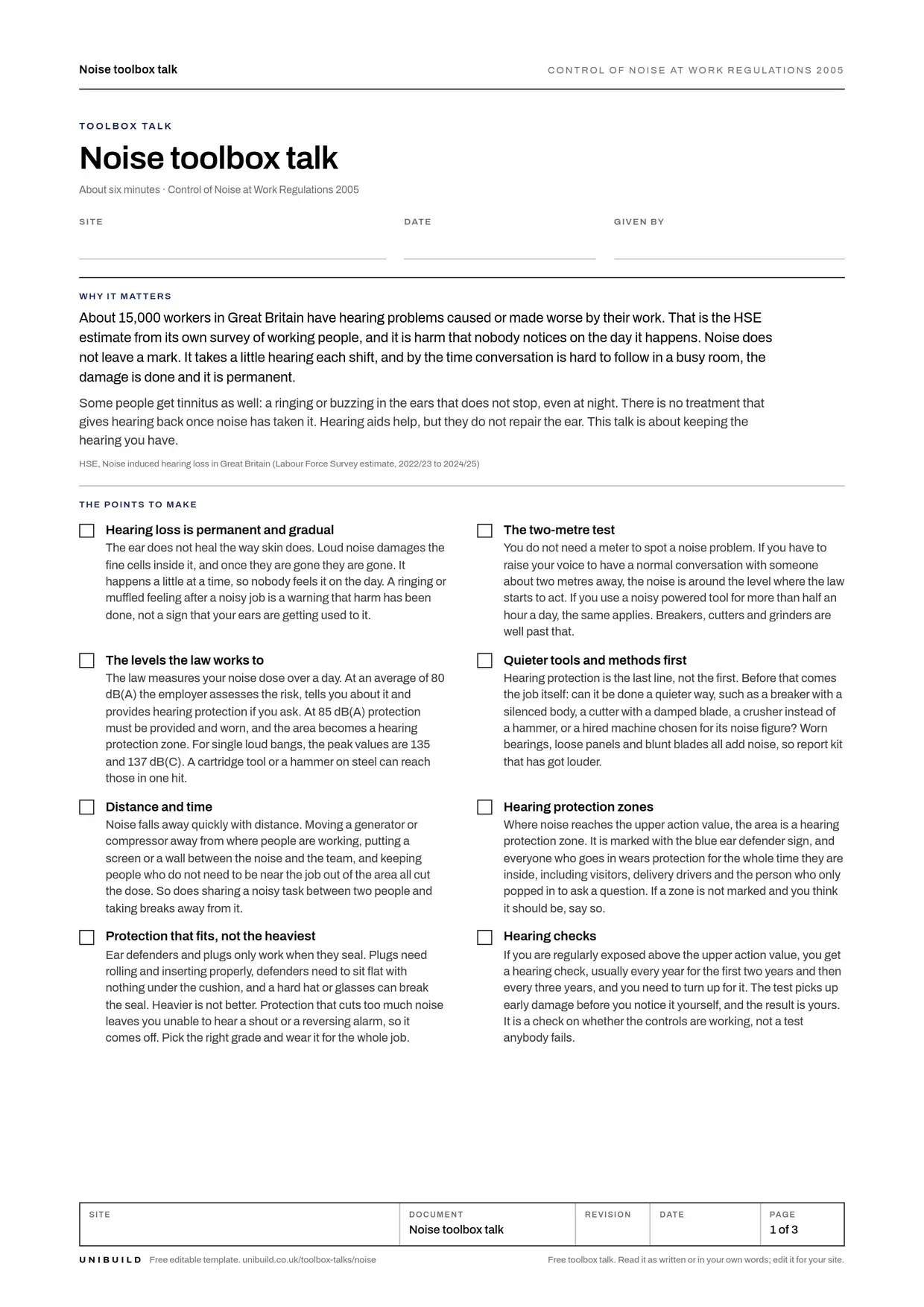
About 15,000 workers in Great Britain have hearing problems caused or made worse by their work. That is the HSE estimate from its own survey of working people, and it is harm that nobody notices on the day it happens. Noise does not leave a mark. It takes a little hearing each shift, and by the time conversation is hard to follow in a busy room, the damage is done and it is permanent.

Some people get tinnitus as well: a ringing or buzzing in the ears that does not stop, even at night. There is no treatment that gives hearing back once noise has taken it. Hearing aids help, but they do not repair the ear. This talk is about keeping the hearing you have.

HSE, Noise induced hearing loss in Great Britain (Labour Force Survey estimate, 2022/23 to 2024/25)

The points to make

Hearing loss is permanent and gradual

The ear does not heal the way skin does. Loud noise damages the fine cells inside it, and once they are gone they are gone. It happens a little at a time, so nobody feels it on the day. A ringing or muffled feeling after a noisy job is a warning that harm has been done, not a sign that your ears are getting used to it.

The two-metre test

You do not need a meter to spot a noise problem. If you have to raise your voice to have a normal conversation with someone about two metres away, the noise is around the level where the law starts to act. If you use a noisy powered tool for more than half an hour a day, the same applies. Breakers, cutters and grinders are well past that.

The levels the law works to

The law measures your noise dose over a day. At an average of 80 dB(A) the employer assesses the risk, tells you about it and provides hearing protection if you ask. At 85 dB(A) protection must be provided and worn, and the area becomes a hearing protection zone. For single loud bangs, the peak values are 135 and 137 dB(C). A cartridge tool or a hammer on steel can reach those in one hit.

Quieter tools and methods first

Hearing protection is the last line, not the first. Before that comes the job itself: can it be done a quieter way, such as a breaker with a silenced body, a cutter with a damped blade, a crusher instead of a hammer, or a hired machine chosen for its noise figure? Worn bearings, loose panels and blunt blades all add noise, so report kit that has got louder.

Distance and time

Noise falls away quickly with distance. Moving a generator or compressor away from where people are working, putting a screen or a wall between the noise and the team, and keeping people who do not need to be near the job out of the area all cut the dose. So does sharing a noisy task between two people and taking breaks away from it.

Hearing protection zones

Where noise reaches the upper action value, the area is a hearing protection zone. It is marked with the blue ear defender sign, and everyone who goes in wears protection for the whole time they are inside, including visitors, delivery drivers and the person who only popped in to ask a question. If a zone is not marked and you think it should be, say so.

Protection that fits, not the heaviest

Ear defenders and plugs only work when they seal. Plugs need rolling and inserting properly, defenders need to sit flat with nothing under the cushion, and a hard hat or glasses can break the seal. Heavier is not better. Protection that cuts too much noise leaves you unable to hear a shout or a reversing alarm, so it comes off. Pick the right grade and wear it for the whole job.

Hearing checks

If you are regularly exposed above the upper action value, you get a hearing check, usually every year for the first two years and then every three years, and you need to turn up for it. The test picks up early damage before you notice it yourself, and the result is yours. It is a check on whether the controls are working, not a test anybody fails.

Do

  • Use the quietest tool and method that will do the job, and report kit that has got louder.
  • Keep generators, compressors and cutting stations away from where people are working.
  • Wear hearing protection for the whole of a noisy task, in every marked zone, every time.
  • Fit plugs and defenders properly and check the seal, especially with a hard hat and glasses.
  • Share noisy tasks and take breaks away from the noise.
  • Go to your hearing check when it is booked, and tell us if your ears ring after work.

Do not

  • Do not treat ringing or muffled hearing after a shift as normal. It is damage.
  • Do not take protection off for a quick word inside a hearing protection zone. Step outside instead.
  • Do not run a noisy tool next to someone who is not wearing protection.
  • Do not use ear defenders that are cracked, have hard cushions or no longer sit flat.
  • Do not choose protection so heavy that you cannot hear alarms, horns or a shout.
  • Do not wear music earphones as hearing protection. They add noise rather than cutting it.

Ask the team

  • Where on this site today would you have to raise your voice to be heard two metres away?
  • Which tools and plant on this job are the loudest, and is there a quieter way to do that task?
  • Where are the hearing protection zones, and how do we know where they start?
  • Does your protection seal with your hard hat and glasses on? Show me.
  • When was your last hearing test, and do you know what it showed?

To close

Nobody chooses to lose their hearing. It goes a little at a time, on jobs that felt normal, with protection that was in a pocket or did not quite seal. Your hearing has to last you long after this job is finished. If the noise is loud enough that you are raising your voice, it is loud enough to do harm. Choose the quieter way, keep your distance, wear protection that fits for the whole job, and tell us when something gets louder. We will sort it.

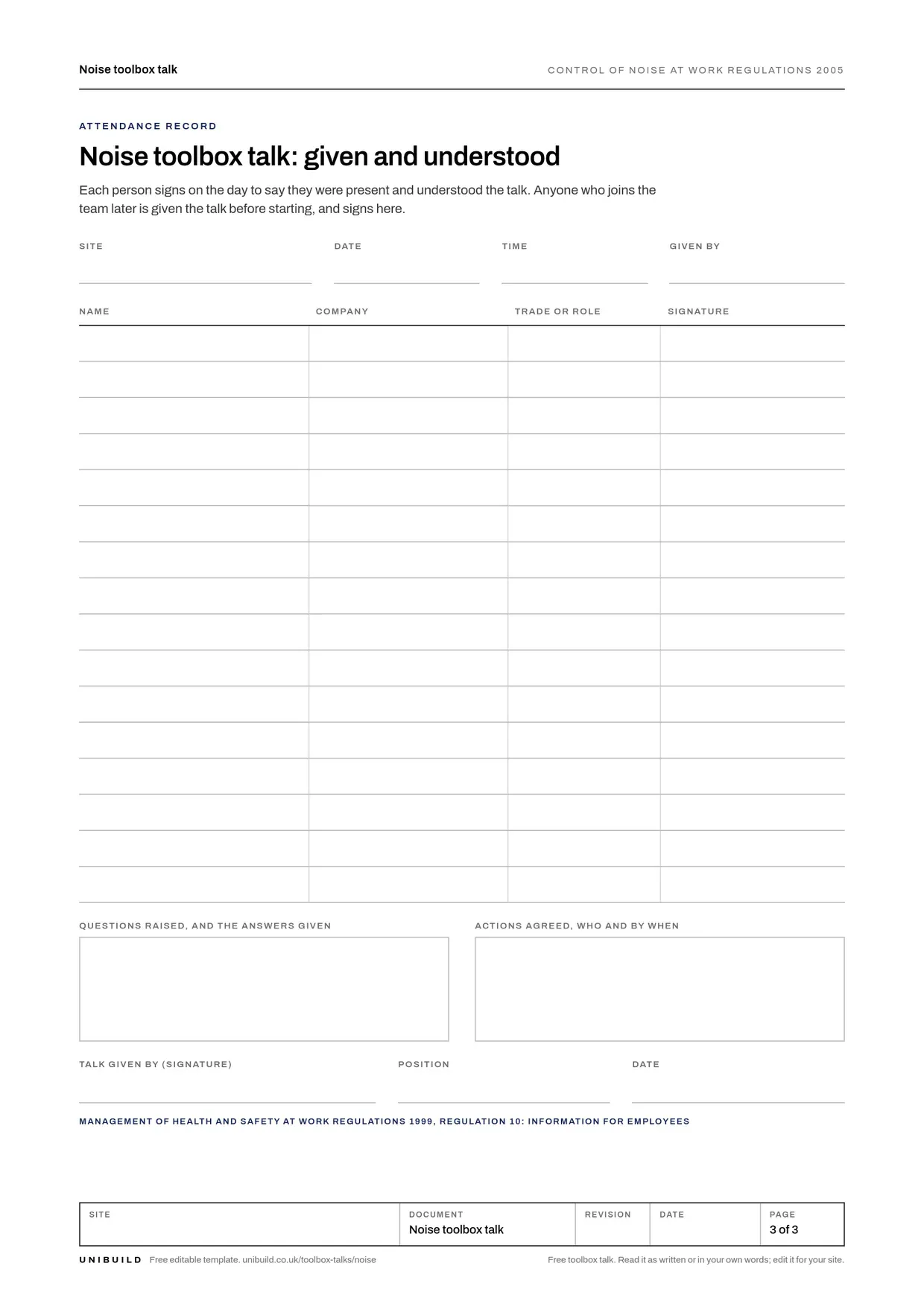
Record it. Who gave the talk, where, when, who was there and what was raised. The last page of the sheet is the record.

In Unibuild a talk is read in each operative’s own language and signed on the phone. How toolbox talks work

The law behind this talk

Checked against the source

Action values and limit values

The lower exposure action values are a daily or weekly personal noise exposure of 80 dB(A) and a peak sound pressure of 135 dB(C). The upper exposure action values are 85 dB(A) and 137 dB(C). The exposure limit values are 87 dB(A) and 140 dB(C), and only the limit values take account of the reduction given by hearing protection.

Control of Noise at Work Regulations 2005, regulation 4

Assess the risk, then eliminate or reduce it at source

An employer whose work is liable to expose employees to noise at or above a lower exposure action value makes a suitable and sufficient assessment of the risk. The risk from exposure is eliminated at source or, where that is not reasonably practicable, reduced to as low a level as is reasonably practicable. Where exposure reaches an upper exposure action value, the employer puts in place a programme of organisational and technical measures, excluding hearing protectors, covering other working methods, quieter equipment, workplace design, maintenance, limiting duration and training.

Control of Noise at Work Regulations 2005, regulations 5 and 6

Hearing protection and hearing protection zones

At or above a lower exposure action value, personal hearing protectors are made available on request. Where exposure cannot be reduced below an upper exposure action value by other means, hearing protectors are provided to everyone so exposed. Areas where exposure is likely to reach an upper exposure action value are designated hearing protection zones, marked with the ear protection sign, with access restricted where practicable, and no employee enters without wearing hearing protectors. Regulation 3 extends the duties to other people at the workplace so far as is reasonably practicable.

Control of Noise at Work Regulations 2005, regulations 3 and 7

Health surveillance

Where the risk assessment indicates a risk to the health of employees who are, or are liable to be, exposed to noise, the employer places them under suitable health surveillance, which includes testing of their hearing. A health record is kept for each employee under surveillance, and the employee may see their own record on reasonable notice. HSE guidance expects regular hearing checks for everyone likely to be regularly exposed above the upper exposure action values.

Control of Noise at Work Regulations 2005, regulation 9

What is on the sheet

3 pages, the talk and the record

The talk, over two pages

Why it matters, the points to make, do and do not, and the questions to ask, laid out to read from in the cabin or at the workface. Space at the top for the site, the date and who is giving it.

The last page, the record

The attendance record: each person's name, company and signature, the questions raised and any actions, signed off by the person who gave the talk. Type into it or print it and pass it round.

The Word version

The same talk as a Word document, so you can put your own letterhead on it, add a site photograph or change a point to match how your job is set up.

Download the talk as PDF Word versionPDF · 3 pages · 212 KB
After it is given

Delivered on the phone, signed in the room

On Unibuild a toolbox talk is picked from the library, read by each operative on their own phone in their own language and signed there and then. The record is filed against the operative, the site and the date.

A site manager sees who has had which talk, and who has not, without a sheet going round on Thursday.

How toolbox talks work on Unibuild
How long should a noise toolbox talk be?
About five to ten minutes. This one reads in about six if you make every point and stop for the questions. A toolbox talk is a short, focused briefing, not a training course. The information, instruction and training the Noise Regulations require is wider than one talk and is recorded in the training matrix.
How do we know if noise on our site is a problem?
HSE gives three signs. The noise is intrusive, like a busy road or a vacuum cleaner, for most of the day. People have to raise their voices to talk at about two metres apart. Or people use noisy powered tools for more than half an hour a day. On most sites with breakers, cutters or plant, at least one applies, and a noise assessment follows.
What are the noise action values?
The lower exposure action value is a daily or weekly exposure of 80 dB(A) with a peak of 135 dB(C). The upper exposure action value is 85 dB(A) with a peak of 137 dB(C). The exposure limit value, which nobody may be exposed above, is 87 dB(A) and 140 dB(C), and that one takes account of hearing protection.
Does everyone have to wear ear defenders all the time?
No. Hearing protection is compulsory in marked hearing protection zones and wherever exposure reaches the upper action value. Between the lower and upper values it is made available to anyone who asks. HSE advises against making it compulsory where the law does not require it, because protection worn where it is not needed cuts off warnings and conversation.
Is heavier hearing protection safer?
Not usually. HSE advises aiming to get below 85 dB at the ear, and avoiding protection that takes the level below 70 dB, because people then cannot hear speech, alarms or plant and tend to take it off. Choose the grade to match the measured noise, check it fits with hard hats and glasses, and wear it for the whole task.
Who needs a hearing test?
Anyone likely to be regularly exposed above the upper exposure action values, or at particular risk for another reason. HSE expects a test every year for the first two years of exposure and every three years after that, more often if a problem shows. The results go to the person tested, and the employer keeps a health record.
How often should we give this talk?
The law does not set an interval. Give it when a team starts noisy work on a job, when new plant or tools arrive, after a hearing test picks something up, and as part of a rolling programme so no topic goes more than a few months without a refresh. Record each delivery.
Who can deliver a toolbox talk on noise?
A supervisor, site manager or a competent member of the team who knows the job and the controls. The person delivering it should be able to say where the hearing protection zones are on this site and which tools took it over the upper action value. If they cannot, they bring someone who can.
Do we have to keep a record of the talk?
There is no regulation that names toolbox talk records, but the Noise Regulations require information, instruction and training, and most principal contractors and auditors ask for the evidence. A signed attendance record, with the date and the topic, is the evidence. The last page of the sheet is that record.
Is this noise toolbox talk free?
Yes. Download it, print it, give it, edit it and put your own name on it, including on paid work and for clients, with no sign-up and no email address.
Next step

The talk given, understood
and on record.

Unibuild keeps every toolbox talk against the operative who signed it, the site and the date, for seven years, ready for the principal contractor or an auditor.