
Tiling and flooring risk assessment and method statement
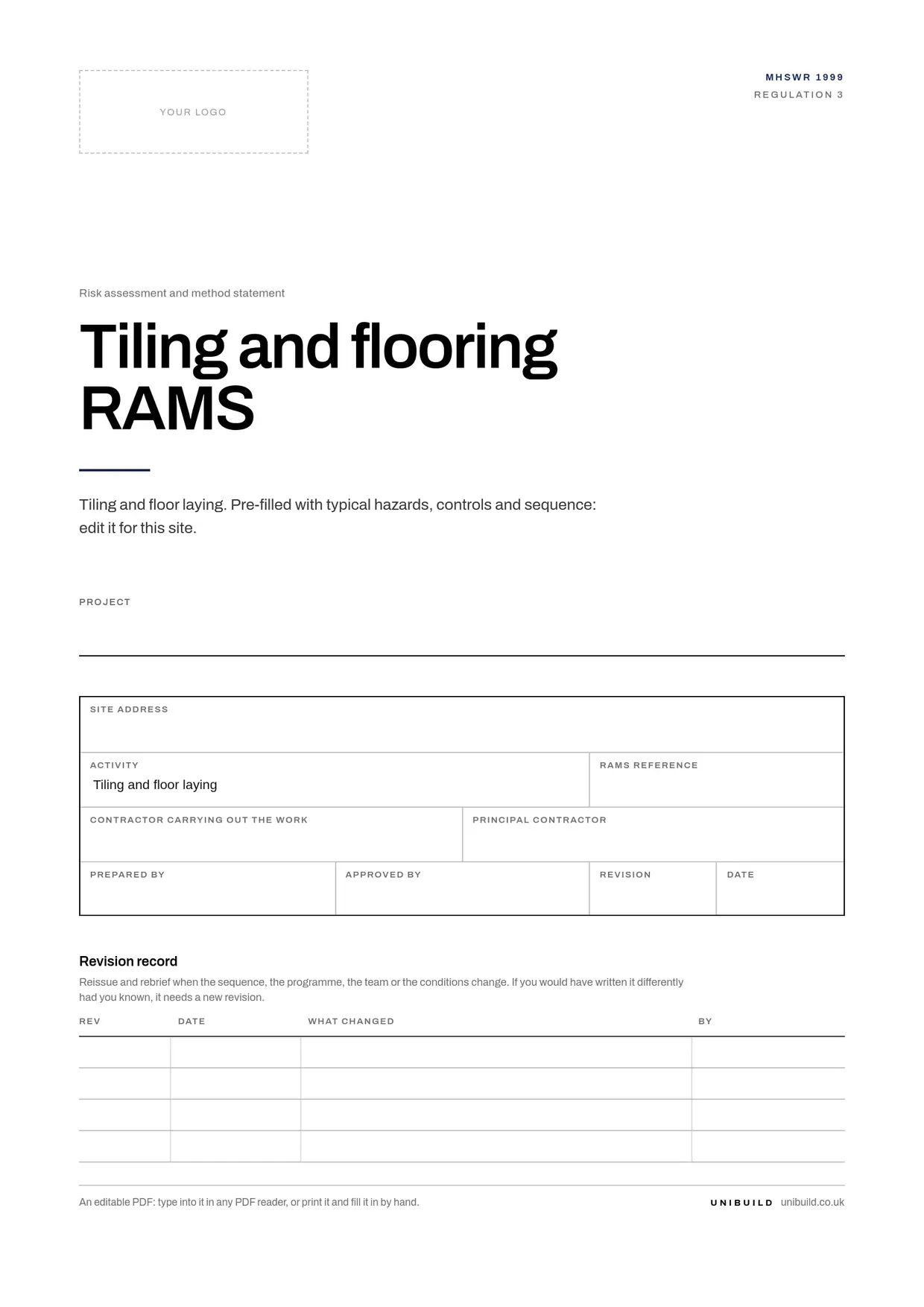
A tiling and flooring risk assessment and method statement, already filled in for cutting tile and stone, adhesives and screeds, kneeling, heavy rolls and floors others walk on. Edit it for your job, then brief it.
- Law
- COSHH Regulations 2002
- Cutting dust
- Water or extraction, plus APF 20 RPE
- Format
- Editable PDF and Word
- Cost
- Free, always
Do you need a risk assessment for tiling and flooring?
Yes. A risk assessment for tiling is a legal duty for every employer, and a tiling method statement is what a principal contractor or client asks for before the first tile is cut. Flooring work is the same, whether it is tile, stone, vinyl, carpet, timber or resin.
The general duty is regulation 3 of the Management of Health and Safety at Work Regulations 1999, recorded if you employ five or more people. COSHH adds an assessment for the adhesives, grouts, screeds and the dust from cutting, and the Manual Handling Regulations cover rolls, boards, bags and large tiles.
A flooring risk assessment should describe the job in front of you: what the old floor is and whether it may contain asbestos, what is cut and where, which products are used, and who will walk across the floor before it is ready.
Checked against legislation.gov.uk and HSE guidance on .
Tiling and flooring hazards and controls
18 hazards, rated before and after controlsThe significant hazards on a typical tiling or floor laying job, from strip out to hand back, with the controls a reviewer expects to see. Delete what does not apply and add what your job has.
Silica dust from cutting tile and stone
Tilers cutting porcelain, ceramic, stone and screed, and anyone nearby, from silicosis and lung cancer.
- Score and snap or manual cutters where they do the job; cuts planned to keep power cutting down.
- Power cutting wet for the whole cut, or with on-tool extraction to an H or M class unit.
- RPE with an APF of 20, face fit tested; cutting area away from others, cleaned by vacuum, never swept dry.
BeforeHigh 20AfterMedium 10
Dust from mixing adhesive, grout and screed
Tilers and floor layers emptying bags and mixing powders.
- Bags opened and poured low into the bucket; paddle started slowly and kept below the surface.
- Mixing done in a ventilated area away from others; FFP3 RPE where the data sheet or dust calls for it.
BeforeMedium 9AfterMedium 6
Cement burns and dermatitis
Tilers and screeders whose skin, knees or eyes touch wet cement-based products.
- Waterproof gloves suitable for alkalis; long sleeves; waterproof knee pads or kneeling boards when screeding.
- Cement washed off the skin at once; hands washed at breaks; skin care cream provided.
- Eyewash on hand; skin checks by a responsible person where dermatitis is reasonably likely.
BeforeMedium 9AfterLow 3
Epoxy grouts and resin floors
Floor layers and tilers mixing and applying epoxy, from skin sensitisation.
- Cement-based or other products used where they do the job.
- Gloves chosen from the safety data sheet and changed when contaminated; no skin cleaned with solvents.
- Resin mixed and applied with tools, not hands; skin checks for anyone using epoxy regularly.
BeforeMedium 9AfterLow 3
Solvent adhesives and primers
Floor layers and occupants, from vapour and from fire where vapour meets an ignition source.
- Solvent-free adhesives and primers used wherever they do the job.
- Rooms ventilated; no smoking, flames or sparking tools near; minimum quantities in the room.
- Lids on; rags in a sealed metal container; vapour filter RPE where the COSHH assessment calls for it.
BeforeMedium 8AfterLow 4
Kneeling and knee injury
Tilers, carpet fitters and floor layers working on their knees for most of the day.
- Knee pads or kneeling boards worn for all floor work; tasks rotated with standing work.
- Power stretchers used in place of knee kickers on larger rooms; long-handled tools for scraping and spreading.
- Knee pain or swelling reported early.
BeforeMedium 12AfterMedium 6
Heavy rolls, boards, bags and large tiles
Floor layers carrying carpet and vinyl rolls, boards, adhesive bags and large format tiles up stairs.
- Deliveries placed close to the work; roll trolleys, sack barrows and lifts used where available.
- Two-person lifts for rolls and large format tiles, with carrying frames or suction lifters for big slabs.
- Team briefed on weights and the route before carrying.
BeforeMedium 12AfterMedium 6
Floor preparation: grinders and scabblers
Operators preparing concrete and screed, from dust, noise and hand-arm vibration.
- Grinders with on-tool extraction to an H or M class unit; RPE with an APF of 20.
- Hearing protection zone where levels may reach 85 dB(A); hearing protection worn.
- Trigger time planned from the manufacturer's data to keep exposure below the 2.5 m/s² A(8) action value where practicable.
BeforeHigh 20AfterMedium 10
Wet saws, grinders and power tools
Tilers cutting with wet saws and angle grinders, from blade contact, kickback and shock.
- Users trained on the tool; guards fitted; disc or blade suited to the material and the tool speed.
- Wet saws on an RCD-protected or 110V supply, with leads kept out of the water.
- Workpiece held on the bed or clamped; tool allowed to stop before it is put down.
BeforeMedium 12AfterLow 4
Knives, gripper and sharp edges
Carpet and vinyl fitters using knives, and anyone handling gripper strip or cut tile edges.
- Knives with retractable or guarded blades; blades changed often and disposed of in a sharps box.
- Cut-resistant gloves for handling tile edges and gripper; gripper fixed with care and offcuts cleared.
BeforeMedium 8AfterLow 4
Asbestos in old floors
Floor layers lifting old vinyl and thermoplastic tiles, sheet flooring and bitumen adhesive.
- Asbestos survey checked before any old floor is lifted in buildings built or refurbished before 2000.
- Suspect tiles, backing paper or adhesive left in place and reported; no grinding or sanding.
- Overlay where possible; removal only by trained workers to HSE Asbestos Essentials sheet A23, notified where tiles are paper-backed.
BeforeHigh 15AfterMedium 5
Floors others walk on
Occupants, the public and other trades crossing wet adhesive, fresh grout, uncured screed or loose edges.
- Work areas barriered and signed, with a safe route kept open or a diversion agreed.
- Floors kept closed until the product can take foot traffic, from the data sheet; protection laid before reopening.
- Edges, thresholds and changes of level fixed or ramped before handing back.
BeforeMedium 9AfterLow 3
Slips and trips in the work area
Tilers and floor layers, on slurry, offcuts, packaging and trailing leads.
- Spills and slurry cleaned up straight away; offcuts and packaging cleared as work goes on.
- Leads run along walls; materials stacked out of walkways.
BeforeMedium 6AfterLow 4
Wall tiling from steps and hop-ups
Tilers fixing high wall tiles, splashbacks and cladding.
- Podium steps or a low platform with guard-rails for longer work; stepladders only for light, short tasks.
- Steps on a clean, level floor, not on wet adhesive or loose boards; no overreaching.
- Pre-use check each day; faulty equipment taken out of use.
BeforeMedium 9AfterLow 3
Hot air welding of vinyl seams
Floor layers welding seams and coving, from burns and from fire.
- Welding gun stood on its stand when not in use and left to cool away from flammable materials.
- Hot work permit where the site requires one; area checked before leaving.
BeforeMedium 6AfterLow 3
Hidden pipes and cables in floors
Floor layers fixing boards, gripper and thresholds, or lifting old floors.
- Detector used before nailing or screwing into floors; drawings checked for underfloor heating and service routes.
- Any service hit is reported and made safe by a competent person before work goes on.
BeforeMedium 8AfterLow 4
Wood dust from sanding and cutting floors
Floor layers sanding timber floors and cutting boards and MDF.
- Sanders and saws with extraction at the tool; FFP3 RPE, face fit tested.
- Clean up with an M class vacuum, never by dry sweeping.
BeforeMedium 12AfterMedium 8
Occupied homes and buildings
Residents, staff and visitors, from dust, noise, moved furniture and unfinished floors.
- Times for noisy and dusty work agreed with the occupier or building manager.
- Dust kept in the work area by extraction and sheeting; furniture moved by two people with trolleys.
- Children and vulnerable people kept out of the work area.
BeforeMedium 9AfterLow 3
Scores are likelihood times severity on the five by five matrix in the template. They are typical ratings for this work, a starting point for your own assessment of your site.
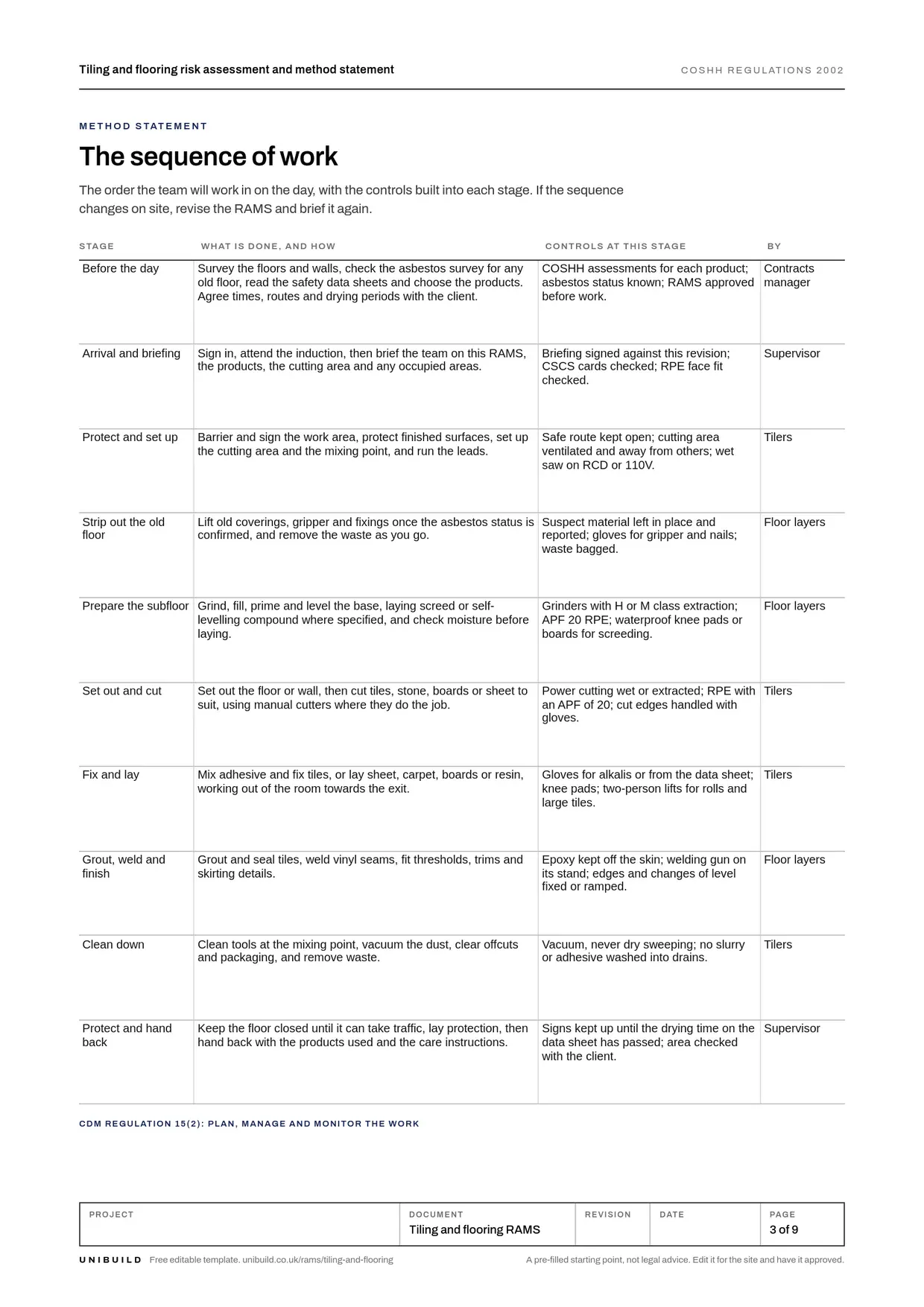
Tiling method statement: the sequence of work
The order of work, with the controls at each stageThe order the team works in, from strip out to hand back, with the controls built into each stage. If the sequence changes on site, revise the RAMS and brief it again.
Before the day
Survey the floors and walls, check the asbestos survey for any old floor, read the safety data sheets and choose the products. Agree times, routes and drying periods with the client.
ControlsCOSHH assessments for each product; asbestos status known; RAMS approved before work.
Arrival and briefing
Sign in, attend the induction, then brief the team on this RAMS, the products, the cutting area and any occupied areas.
ControlsBriefing signed against this revision; CSCS cards checked; RPE face fit checked.
Protect and set up
Barrier and sign the work area, protect finished surfaces, set up the cutting area and the mixing point, and run the leads.
ControlsSafe route kept open; cutting area ventilated and away from others; wet saw on RCD or 110V.
Strip out the old floor
Lift old coverings, gripper and fixings once the asbestos status is confirmed, and remove the waste as you go.
ControlsSuspect material left in place and reported; gloves for gripper and nails; waste bagged.
Prepare the subfloor
Grind, fill, prime and level the base, laying screed or self-levelling compound where specified, and check moisture before laying.
ControlsGrinders with H or M class extraction; APF 20 RPE; waterproof knee pads or boards for screeding.
Set out and cut
Set out the floor or wall, then cut tiles, stone, boards or sheet to suit, using manual cutters where they do the job.
ControlsPower cutting wet or extracted; RPE with an APF of 20; cut edges handled with gloves.
Fix and lay
Mix adhesive and fix tiles, or lay sheet, carpet, boards or resin, working out of the room towards the exit.
ControlsGloves for alkalis or from the data sheet; knee pads; two-person lifts for rolls and large tiles.
Grout, weld and finish
Grout and seal tiles, weld vinyl seams, fit thresholds, trims and skirting details.
ControlsEpoxy kept off the skin; welding gun on its stand; edges and changes of level fixed or ramped.
Clean down
Clean tools at the mixing point, vacuum the dust, clear offcuts and packaging, and remove waste.
ControlsVacuum, never dry sweeping; no slurry or adhesive washed into drains.
Protect and hand back
Keep the floor closed until it can take traffic, lay protection, then hand back with the products used and the care instructions.
ControlsSigns kept up until the drying time on the data sheet has passed; area checked with the client.
What the law asks for tiling and flooring
Checked against the sourceCOSHH assessment
No work that could expose people to a hazardous substance starts until its risk has been assessed. For tiling and flooring that means adhesives, grouts, screeds, primers and resins, and the dust from cutting and preparation.
COSHH Regulations 2002, regulation 6Prevent, then control
Exposure is prevented first, by a safer product or process where reasonably practicable. Otherwise it is controlled at source, such as wet cutting or extraction, with RPE and PPE last. Respirable crystalline silica has a workplace exposure limit of 0.1 mg/m³ over 8 hours.
COSHH Regulations 2002, regulation 7; HSE EH40/2005Health surveillance
Health surveillance is needed where a disease such as dermatitis or asthma is reasonably likely from the work and can be detected. For tilers and floor layers using cement, epoxy or other sensitisers, that can mean regular skin checks by a responsible person.
COSHH Regulations 2002, regulation 11Manual handling
Handling that risks injury is avoided so far as is reasonably practicable. What cannot be avoided is assessed, and the risk reduced to the lowest level reasonably practicable, with information on load weights where practicable.
Manual Handling Operations Regulations 1992, regulation 4People who are not your employees
Every employer, and every self-employed person doing construction work, must run the work so that people not in their employment are not exposed to risk, so far as is reasonably practicable. That includes anyone who walks across the floor.
Health and Safety at Work etc. Act 1974, section 3Asbestos before strip out
No work that could disturb asbestos starts until the employer has assessed whether it is present, what type, in what material and in what condition. Where there is doubt, asbestos is assumed to be present.
Control of Asbestos Regulations 2012, regulation 5Competence, equipment and PPE
Competence and cards
- Tilers and floor layers CSCS card for the trade, with apprentices supervised.
- Supervisor Experienced tiler or floor layer with site supervision training.
- Cutting tool users Trained on the wet saws, grinders and floor preparation machines they use.
- Strip out Asbestos awareness for anyone who lifts old floors; non-licensed asbestos task training before anyone removes asbestos tiles.
- Resin and epoxy users Trained on the product and its data sheet before first use.
- RPE wearers Face fit tested for tight-fitting masks, and clean shaven where the mask seals.
Plant and equipment
- Wet tile saw Guard and water supply checked; RCD-protected or 110V supply.
- Angle grinder Guard fitted; disc suited to the material and rated for the speed.
- Floor grinder and extraction H or M class unit; hoses and filters checked; examined every 14 months.
- Mixing paddle and drill Paddle secure; lead and casing checked before use.
- Carpet power stretcher Head, poles and teeth checked before use.
- Podium steps and stepladders Pre-use check each day; detailed inspection on a set schedule.
PPE
- Knee pads or kneeling boards for all floor work, waterproof for screeding and wet adhesive.
- Gloves waterproof and suitable for alkalis for cement products, from the data sheet for epoxy.
- Respiratory protection APF 20, such as FFP3 face fit tested, for cutting, grinding and sanding.
- Eye protection for cutting, grinding, mixing and overhead wall tiling.
- Hearing protection for grinders, saws and other loud tools.
- Safety footwear to the site standard, with a grip sole.
Permits and plans
A hot work permit for hot air welding where the site requires one. A permit to work for controlled or occupied areas where the client's rules require one. An asbestos check before any old floor is lifted, and the client's agreement on times, routes and when each floor can reopen.
Emergency and rescue
First aider and first aid kit on site, with eyewash for cement and adhesive splashes. Cement on the skin or in the eyes is washed off at once with plenty of clean water, and medical advice sought for burns. Fire procedure and extinguisher known before solvents are used. Nearest accident and emergency department named on the briefing.
Toolbox talk: tiling and flooring safety
Read this to the team before work starts, tick each point as it is covered, and record who attended.
- Cut wet or with the extractor, every cut. Wetting the tile first and then cutting dry does not work. Mask on.
- Wet adhesive and grout burn. Gloves on, knee pads on, and wash it off your skin straight away.
- Do not lift an old floor until we know it is free of asbestos. If in doubt, stop and ask.
- Knee pads for every floor job. Use the power stretcher, not your knee, on big rooms.
- Two people for rolls and large tiles. Ask for help on stairs.
- Keep the barrier and signs up until the floor is ready to walk on, and keep a safe route open.
Ask the team
- Where is the cutting area, and how is the dust controlled there?
- What is the old floor made of, and has it been checked for asbestos?
- When can people walk on this floor, and who needs to know?
What is in the tiling and flooring RAMS template
9 pages, pre-filled and editableThe work, pre-filled
Scope, location and access, interfaces with the client and other trades, the documents the RAMS relies on, and the team.
The sequence of work
Ten stages from survey to hand back, with the controls and the person responsible at each one.
Hazards and controls
Eighteen tiling and flooring hazards rated before and after controls on a five by five matrix, with room for your own.
Equipment, PPE and substances
Saws, grinders and extraction with their checks, PPE by type, and the products with their COSHH references.
Products register
A page listing each adhesive, grout, screed, primer and resin with its hazards, how it is used, its controls and RPE.
Emergency and briefing record
First aid for cement and adhesive splashes, fire arrangements, then twenty signatures against the revision.
Brief it, and get it signed on the phone
On Unibuild a RAMS is written from a template, approved, then read by each operative on their phone in their own language and signed. Subcontract and agency workers sign through a link, with no app to install.
Every signature carries its date and time and prints as the last page of the RAMS PDF. Change the RAMS and it has to be signed again.
How RAMS work on UnibuildTiling and flooring RAMS questions
Is this tiling and flooring RAMS template free?
What should a tiling risk assessment include?
What goes in a tiling method statement?
Do I need a COSHH assessment for tile adhesive and grout?
How do I control dust when cutting tiles?
Does a flooring risk assessment cover carpet and vinyl?
Can I lift old vinyl floor tiles myself?
Does a self-employed tiler need a risk assessment?
RAMS templates for other trades and hazards
All free, pre-filled and editableBy trade
- Air conditioning and HVAC RAMS
- Bricklaying RAMS
- Carpentry and joinery RAMS
- CCTV installation RAMS
- Cleaning risk assessment
- Concrete works RAMS
- Demolition RAMS
- Drylining RAMS
- Electrical RAMS
- Facilities maintenance RAMS
- Fire alarm installation RAMS
- Glazing and window RAMS
- Groundworks RAMS
- Hot works and welding RAMS
- Insulation RAMS
- Landscaping and fencing RAMS
- Painting and decorating RAMS
- Pest control risk assessment
- Plastering and rendering RAMS
- Plumbing and heating RAMS
- Rail RAMS
- Refurbishment RAMS
- Roofing RAMS
- Rope access risk assessment
- Scaffolding RAMS
- Solar PV installation RAMS
- Steel erection RAMS
- Temporary works RAMS
- Tiling and flooring RAMS
- Tree surgery RAMS
By hazard
- Asbestos risk assessment
- Confined space risk assessment
- COSHH risk assessment
- Dust risk assessment
- Forklift and telehandler risk assessment
- Housekeeping risk assessment
- Lifting operations risk assessment
- Lone working risk assessment
- Manual handling risk assessment
- MEWP risk assessment
- Noise and vibration risk assessment
- Plant and excavator risk assessment
- Power tools risk assessment
- Traffic management risk assessment
- Working at height risk assessment
The blank RAMS template, the RAMS review checklist and every other free form are on Free downloads.
The RAMS, read and signed
before the work starts.
Unibuild keeps every RAMS with its versions, its approvals and each operative’s signature against the revision they read, for seven years, ready for the principal contractor or an auditor.