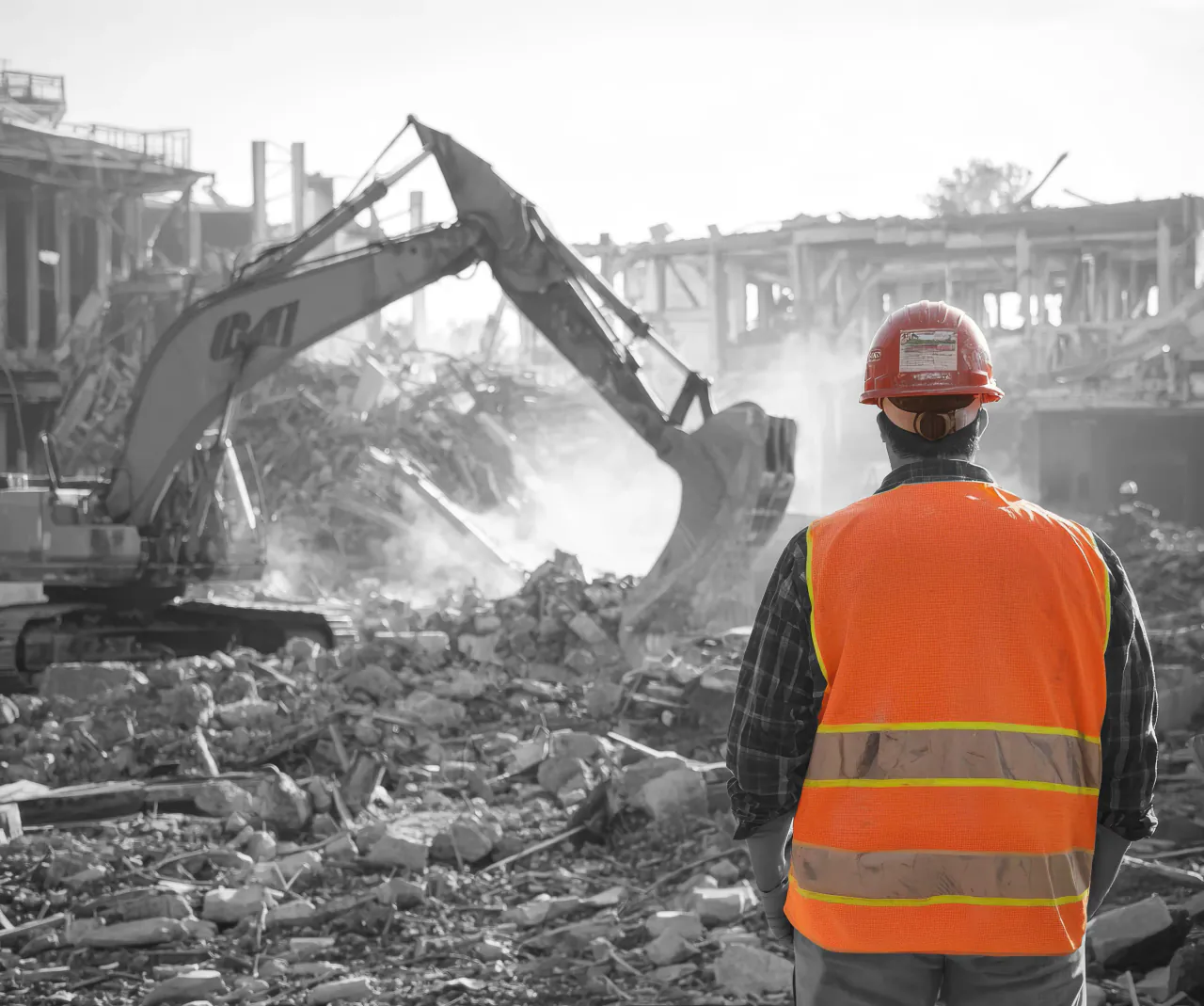
Attachments booked to the machine they are on rather than to the yard. Every load weighed and ticketed to the job, scrap included. The refurbishment and demolition survey held against the structure it describes, with the method statement revision that is actually live. Cards, face fit records and plant examinations in date at the gate. Around thirty modules on one account, and a demolition firm turns on the handful it needs.
Soft strip, top down, high reach or explosive: the method differs, the office side does not.
Taking the building down is the part a demolition firm already has right. It is the paperwork wrapped around it that decides whether the job is profitable and defensible: what the survey said was in there, which attachment was on which machine, what left the site and what it weighed, and whether the method statement in the cab is the one the engineer signed.
Unibuild is construction management software for UK contractors, built inside a contracting business rather than sold into one. One account carries the labour run, plant and equipment registers, materials and stock, certification and training records, documents, day works, variations and applications for payment.
Built for demolition
What demolition requires, and what Unibuild provides.
A fit-out job and a demolition job look alike in a database. They stop looking alike at the weighbridge, in front of an asbestos survey, and when the structure stops behaving as drawn. Each requirement below is followed by what the platform does about it.
The tradeThe platform
Read before anything moves
The survey governs the whole job
A refurbishment and demolition survey is the document the job is priced, planned and defended from. What it found, where, and what was inspected but not accessed all change the sequence, the licensed work and the waste routes.
Licensed, notifiable non-licensed and non-licensed work each carry different duties
Areas recorded as not accessed become the ones that stop the job
The survey is referenced for years afterwards, by people who were not there
A missed presumption is a stop notice, not a snag
The survey held against the structure
The survey, the register and the clearance certificates sit against the building and the zone they describe, with the version that was issued and who accepted it. When a supervisor needs to know what was found in a riser, it is retrieved by the structure rather than searched for in a mailbox.

A muncher, shear, pulveriser or grapple can be worth more than the excavator carrying it, and it moves between machines and sites in a way the machine never does. It is also the item most likely to leave a job and not come back.
A high reach attachment runs well into five figures
Attachments swap between carriers by shift, not by contract
Wear parts, teeth and jaws are consumed and replaced continually
The insurer asks for a serialised schedule, not a total
Every attachment booked to a carrier
Attachments are held individually by serial number with a QR label, a current holder and a full service history, and booking one onto a machine is a movement rather than a memory. Scanning the label returns where it has been and who had it.
Demolition is one of the few trades where the material going out is worth money. Scrap steel, hardcore and recovered brick all carry a value, and everything else carries a duty of care and a transfer note.
Waste transfer and consignment notes have to be kept and produced
Scrap is a receipt rather than a cost, and it is easily untracked
Crushed arisings reused on site change the whole waste calculation
A weighbridge ticket in a cab is not a record
Every load ticketed to the job
Loads out are booked as movements against the job as the wagon leaves, so tickets, tonnages and transfer notes attach to the contract rather than living in a cab. The volume that gets invoiced is the volume that can be evidenced.
A demolition method statement is written against a structure that is being altered by the hour. Propping goes in, a floor comes out, and the sequence the engineer signed is not the sequence in front of the operator.
Temporary works and propping designs are revised on site
A structural engineer signs the sequence, and owns it
The document in the cab is the one that matters after an event
Verbal changes on site are the ones nobody can evidence
The live revision, briefed and signed
The method statement and the temporary works design are delivered to the phone frozen at the issued version, and acceptance captures who was briefed and when. A revision issued at eleven replaces the one from nine everywhere at once.
CCDO cards carry the role as well as the person, and respiratory protection only works if the mask has been face fit tested to that individual. Both are checked, and both expire quietly.
Cards carry supervisor, topman and operative levels
Face fit is per person and per mask model, not per firm
Plant operator tickets sit alongside the demolition card
Health surveillance runs on its own cycle
Cards, tickets and face fit on one grid
Every card, ticket, face fit record and health assessment sits against the person on one matrix and turns amber before it lapses. What the principal contractor asks for at the gate is produced from one page rather than four folders.
Once the site is cleared there is nothing left to inspect, so the record is the only account of how the work was done. Clearance certificates, air tests and photographs are what answer a question in year six.
Clearance certificates and air test results are kept indefinitely
Photographs before, during and after are the only remaining evidence
The client, the insurer and the enforcing authority may all ask
The people who did the work will have moved on
Photographed and filed against the job
Dated photographs, clearance certificates and air test results attach to the job and the zone on the phone as the work happens. The account of a cleared site is retrieved by the contract rather than reassembled from drives.
Counted in the deployment Unibuild was built on, July 2026: one expiry page carrying 376 assets, 141 subcontractor certificates, 84 accreditations, 80 health assessments, 55 instruments and 9 vehicles.
Structure and arisings
Attachments
Crushed and recycled
Propping and temporary works
Scrap metal
High reach plant
Dust suppression
Surveys and certificates
The week
An ordinary week, and the record it leaves.
Six entries from a demolition contractor's day book. Nothing here asks anybody to remember something at five o'clock on a Friday.
Monday, the survey
The refurbishment and demolition survey sits against the structure with the zones it covers, so the supervisor checks the riser before the strip out gang goes near it.
Read before it is opened
In the yard
The shear comes off the twenty tonne and onto the high reach as a movement, so the schedule the insurer asks for is current rather than annual.
Booked to a carrier
The weighbridge
Eleven loads go out and eleven movements are booked to the contract, with the transfer notes attached as they are issued.
Ticketed to the job
Wednesday
The engineer revises the propping sequence at eleven. The new version reaches every phone at once and the gang accepts it by name before work restarts.
Briefed on the revision
At the gate
The principal contractor asks for CCDO cards, plant tickets and face fit records for six operatives. All of it comes off one page, in date.
Gang goes on
Year six
An insurer asks how a party wall was taken down. The photographs, the method statement revision and the clearance certificate are all on the contract.
Answered from the record
What it must do
Eight requirements, and an honest answer to each.
Dusty, gloved, in a cab or behind a hoarding, in two taps rather than ten. A system that cannot meet these eight gets abandoned inside a month, and that is a failure of design rather than of discipline. Unibuild is around thirty modules on one account, and a demolition firm turns on a handful.
Gloved, dusty, with no signal
The field app carries 24 modules on the phone, granted per person, so an operative sees the three things they need and nothing else. Clock in is a QR scan at the hoarding. The design constraint throughout was a cold morning and a gloved hand, because a system that takes a minute in a cab does not get used twice.
Attachments held individually, not as a total
Plant, attachments and small tools are one record per physical item in assets and inventory, each with a serial, a QR label, a purchase price, a current holder and a full service history. After a compound break in, the schedule the insurer asks for already exists.
Loads out recorded as they leave
Waste and scrap movements are booked against the contract as the wagon goes, so tonnages and transfer notes sit with the job in cost control rather than in a cab. On a job where the scrap is the margin, that is the difference between a figure and a guess.
The live revision, everywhere at once
RAMS, method statements and temporary works designs are delivered to the phone against a frozen version, and acceptance captures the name, the printed name and the timestamp. A document completed after the work says so on its face.
Expiry dates watched instead of remembered
Reminders and expiry watches twelve registers on one page, and the training matrix turns a card red before it lapses rather than after. Face fit records, health surveillance and plant examinations sit on the item or the person they belong to.
The survey and the certificates against the structure
Documents and certificates holds the survey, the register, clearance certificates and air test results against the job and the zone, with an audit trail on the document itself. It issues 58 document types on your own letterhead.
Photographs that survive the building
Project and site management holds the site diary, drawings, day works and dated photographs against the contract. Once the site is cleared these are the only remaining evidence of how the work was done, which is why they belong on the job rather than on a phone.
Priced per business, not per operative
Users are unlimited on every plan. Operatives, topmen, the plant manager and the directors all sit on the same price, so taking on eight people for a big strip out does not change the bill. Pricing is set against the size and shape of the business rather than published as a rate card, and the pricing page explains how that is worked out.
Governing clauseIf it takes longer than a marker pen and a good memory, it will lose to the marker pen.
Site noticeWhere it stops
Four things Unibuild does not do today.
Every one of these has been asked for by a demolition firm on a demonstration. They are published here rather than discovered in week three.
A waste carrier and consignment note integration
Waste and scrap movements are recorded against the job and transfer notes are held as documents, but the platform does not produce statutory consignment notes, talk to the environmental regulator, or connect to a weighbridge. The tickets are entered or attached by you.
Structural or temporary works design
Propping designs and demolition sequences are held, briefed and version controlled here. They are not produced here, and nothing in the platform checks a sequence or a design. That stays with your engineer, as it should.
Asbestos air monitoring and analysis
Clearance certificates and air test results are stored against the zone they belong to. The platform does not perform, schedule or interpret monitoring, and it is not a substitute for an accredited analyst.
Live plant telematics
Machines are held with their service history, examinations and current location as a record. There is no live feed from machine telematics and no automatic hours capture from the ECU, so utilisation is entered rather than measured.
Why this is hereHiding the gaps wastes both our afternoons. Ask about all four.
The yard
Materials schedule
The yard and the site, and the quirk in each line that breaks ordinary inventory software. Written for the trade rather than for any one firm. Most demolition contractors will recognise seven or eight of these lines and ignore the rest.
What a UK demolition contractor holds, and the tracking quirk in each line
Key
Category
Typical items
The tracking quirk
High reach and excavators
High reach machines, tracked excavators across weight classes, loading shovels, telehandlers
Serialised and worth six figures. Thorough examination, maintenance history and the operator ticket all have to travel with the machine
Hired as often as owned, and the off hire reference rather than the phone call is what stops the charge
Dust and environmental control
Water bowsers, misting cannons, sprinklers, sheeting, monitoring equipment
Hired on long periods and easily forgotten on a job that has moved to another phase
Asbestos and enclosures
Enclosure materials, negative pressure units, transit and waste sacks, decontamination units
Consumables against licensed work, ordered per enclosure rather than stocked, with their own disposal route
Respiratory and PPE
Half masks, full face masks, powered respirators, filters, coveralls, gloves, eye protection
Face fit is per person and per mask model. A mask issued to the wrong person is not protection, and the record has to name both
Small plant and tools
Breakers, saws, generators, lighting, compressors, hand tools
Portable appliance testing, high theft risk from an open site, and a serial number on anything worth taking
Surveys and certificates
Refurbishment and demolition surveys, registers, clearance certificates, air tests, method statements
Not stock, but the documents the job is defended with. Each carries a version and a person who accepted it
Regulations
The regimes you work under
Demolition carries one of the heaviest compliance loads in construction, and almost none of it is about how well you take the building down. Nearly all of it is about what was in the building, what left the site, and who was competent to be there. This is the reference version, kept factual.
What each regime asks of a demolition contractor
Regime
What it requires
Control of Asbestos Regulations 2012
A refurbishment and demolition survey is required before work that will disturb the fabric, and the results drive everything after it. Licensed work needs a licensed contractor, fourteen days notification and medical surveillance. Notifiable non-licensed work carries its own record keeping and health surveillance duties.
BS 6187 and the demolition method statement
The code of practice for full and partial demolition expects a documented sequence produced from a structural appraisal, with temporary works designed where stability is affected. The sequence is signed by a competent engineer and revised as the structure changes.
CDM 2015
A demolition contractor is a contractor and frequently the principal contractor, with duties around planning, the construction phase plan and cooperation. Demolition or dismantling that could endanger anyone requires arrangements recorded in writing before the work begins.
Environmental Protection Act 1990 and the duty of care
Waste leaving the site must go to an authorised person with a transfer note describing it, and hazardous waste carries a consignment note. The duty follows the waste rather than ending at the gate, and the paperwork has to be kept and produced on request.
LOLER 1998 and PUWER 1998
High reach machines, telehandlers and quick hitches are work equipment, and lifting equipment carries a thorough examination at least every six months where people are lifted and twelve where they are not. The record has to identify the individual item, which is why a quantity on a line is not enough.
Control of Noise at Work 2005 and vibration
Breaking, crushing and cutting put operatives over exposure action values routinely. Exposure has to be assessed, controlled and, where the limits require it, monitored, with hearing protection zones and health surveillance following from that.
RIDDOR 2013
A structural collapse, a specified injury or an over seven day injury are all reportable. On demolition the dangerous occurrence categories around unintentional collapse are the ones most often engaged, and the report is assessed against the method statement that was live on the day.
CCDO and operative competence
The Certificate of Competence of Demolition Operatives is the card scheme the industry works to, carrying operative, topman and supervisor levels, and it sits alongside plant operator tickets and face fit testing for respiratory protection. Principal contractors check all three at the gate.
Questions
Requests for information
The questions demolition firms actually raise on a demonstration, answered on the record. Open one to read the response.
The marketWhat software do UK demolition contractors use?+
Most run a combination rather than a system: a spreadsheet for plant, a folder for surveys and certificates, WhatsApp for the day to day, and an accounts package behind it. Plant tracking apps handle machines but not documents. Document systems handle paperwork but not the yard. Unibuild sits across both, with modules turned on as you need them rather than all at once.
AttachmentsCan it track attachments separately from machines?+
Yes, and it is one of the strongest fits for this trade. Every attachment is its own record with a serial number, a QR label, a purchase price, a service history and a current holder, and putting one on a carrier is a booked movement. Scanning the label on a shear returns where it has been and who had it.
WasteDoes it handle waste transfer and consignment notes?+
Partly, and honestly the mechanism is recording rather than production. Loads out are booked as movements against the contract with their tonnage, and the transfer or consignment note is attached as a document. The platform does not generate statutory notes or talk to the regulator, which is set out in the site notice above.
ScrapCan it show what the scrap is actually worth to a job?+
Yes, and on many jobs that is the number that decides the outcome. Loads out are booked against the contract, so recovered steel appears in job costing as a receipt rather than as an absence. What it will not do is price it for you against a moving market.
AdoptionWill operatives and machine drivers actually use it?+
Only if what you ask of them is small. The realistic answer is to grant each person three things on the phone, clock in, method statement acceptance and booking a load out, and leave everything else to the office. Permissions are granted per person, so that is a configuration rather than a compromise.
SurveysWhere do the asbestos survey and clearance certificates live?+
Against the structure and the zone they describe, with the version that was issued and an audit trail on the document. That matters most in year six, when the site is a car park and the record is the only thing left to answer with.
Method statementsHow do we know the gang is working to the current revision?+
The method statement is delivered to the phone at the point the work starts, frozen at the version that was issued, and acceptance captures the name and the moment. A revision issued at eleven replaces the nine o'clock one on every phone at once, and a briefing completed afterwards says so on its face.
PricingHow is it priced, and do you charge per operative?+
Users are unlimited and the price does not change when you take people on, which matters on a trade that gangs up and down between contracts. There is no published rate card, because a fifteen person firm running three modules and an eighty person firm running twenty are not the same product. Pricing is worked out on the demonstration.
SignalWhat happens when there is no signal behind the hoarding?+
The field app is built for patchy coverage, which inside a basement or behind a steel frame is the normal condition rather than an edge case. Test it on your worst site rather than your best one, because that is the site that decides whether the data is trustworthy six months later.
RolloutDo we have to move everything across at once?+
No, and it is usually a poor idea. Most demolition firms start with plant and attachments, because that is where the money walks, and add documents and competence once the first is habit. Cataloguing every item you own before anyone uses the system is the most reliable way to kill the project.
Return slip
Come and try it on your own site.
Half an hour, on your own contracts and your own plant list. Bring a live job and we will set it up in front of you. Unlimited users, never per seat, and fourteen days to try it without a card.