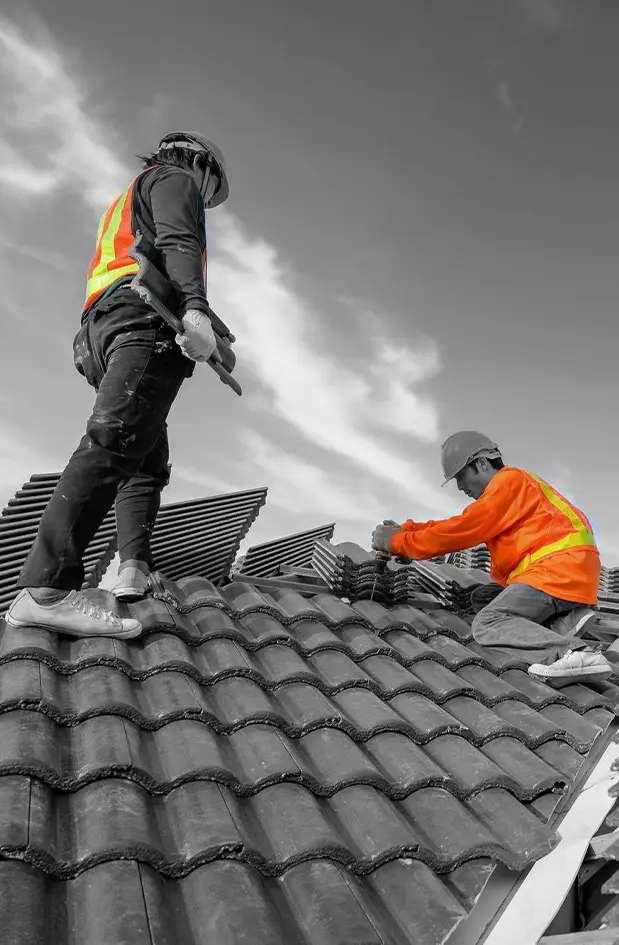
Crews and the weather move together on one labour run. Materials go out against a job. The welder is booked to a van and a person. Harness and LOLER dates turn amber before they lapse, and the photographs taken before the lap was covered are still on the job in year eleven. 30+ modules on one account, and a roofing firm turns on the handful it needs.
From the scaffold going up to the certificate going out.
Single ply, torch-on, slate, lead or liquid: the systems differ, the office side does not.
The roof is the part a roofing firm already has right. It is what the job leaves behind that spreads out across the business: which batch went on, who laid it, when the harness was last inspected, what the day works were worth, and where all of that will be in eleven years when somebody asks.
Unibuild is bespoke business software for UK trades and specialist contractors, built inside a contracting business rather than sold into one. One account carries the labour run, plant and equipment registers, materials and stock, certification and training records, documents, day works, variations and applications for payment.
Built for roofing
What roofing requires, and what Unibuild provides.
A plumbing job and a roofing job look alike in a database. They stop looking alike in the yard, at the gate, and in year eleven of a guarantee. Each requirement below is followed by what the platform does about it.
The tradeThe platform
Regulation 12, every day
Height is the condition, not an activity
For most trades, working at height is one line on a risk assessment. For yours it describes every hour worked, and Unibuild keeps the inspection load that comes with it on a single expiry grid.
Harnesses, lanyards and anchors inspected at least every six months
Ladders, steps and towers tagged and checked
Any main contractor can ask for the evidence at the gate
Falls from height remain the largest single cause of death in the industry
One expiry grid
Every harness, lanyard, ladder and tower is its own record with a next due date, and one page watches the registers together. What a main contractor asks for at the gate comes off the QR label on the item itself.
Single ply and built-up systems from Bauder, Sika, IKO and Langley carry guarantees running fifteen to thirty years, and a claim asks what went on and who fitted it.
Batch numbers tied to a specific roof, not a specific delivery
Evidence that an approved and trained operative laid it
Photographs of details, laps and terminations before they were covered
The record stays with the job when the person moves on
Answered from the job
The site diary, drawings, day works and dated photographs sit against the roof they belong to. A detail shot taken before a lap was covered is still attached to that job in year eleven, when the person who took it has moved on.
Few trades lose a whole week to a forecast. Roofing does, repeatedly, so the replan belongs somewhere everyone can see rather than in one person's head on a Monday morning.
Wet work stops and dry work has to be found for the same crews
Scaffold and hire keep running whether anyone is on the roof or not
The labour run shows everyone where they are going
Hours land on the job they were actually worked on
Now on the labour run
The labour run planner puts every person against every site, weeks ahead and coloured by project. A forecast change is one view rather than eleven phone calls, and the hours land on the job that was actually worked.
Torch-on and propane bring insurer conditions that sit outside the ordinary safety paperwork, and they are the conditions that get tested after a fire.
A hot works permit issued for the day, not filed once a year
A fire watch held after the torches go off, usually for an hour
Rented cylinders carrying deposits, scattered across vans and sites
Hoses, regulators and gauges with their own check dates
Permit raised on site
The permit is raised on the phone before the torches go on, with the fire watch recorded against it and the rented cylinder held to the job. COSHH assessments and near miss reporting sit beside it rather than in another system.
Manufacturer approval, NFRC membership and Constructionline or SMAS accreditation are what put you on tender lists. All of them rest on evidence you have to produce on demand.
Trained operatives, with cards that expire quietly
Inspection and maintenance records for the equipment you issue
Accident and near miss records, kept and reportable
The evidence behind it sits in one place, ready to produce
Evidence ready on demand
Training, cards, insurances and equipment inspections sit on one matrix that turns amber before a date lapses. The documents module issues the evidence pack on your own letterhead, so an audit is a retrieval rather than a hunt.
Counted in the deployment Unibuild was built on, July 2026: one expiry page carrying 376 assets, 141 subcontractor certificates, 84 accreditations, 80 health assessments, 55 instruments and 9 vehicles.
Single ply membrane
Torch-on felt
Tapered insulation
Slate and tile
Leadwork, Codes 3 to 8
Zinc and standing seam
Green and sedum roofs
Liquid systems
The week
An ordinary week in a roofing firm, and the record it leaves.
Six entries from a roofing firm's day book. The first is a Monday morning and the last is eleven years later, and they sit in the same place, on the same job, because a diary does not stop at the end of the week.
Monday, 6am
The forecast turns. Two crews and a booked scaffold come off the wet flat roof and onto dry work, and the labour run shows everyone where they are going before they set off.
Replanned by seven
In the unit
The tapered insulation left over from the last job is on the stock list with a quantity and a location, so it goes on this roof instead of being ordered again.
Bought once
Mid morning
Van stock runs low. The top-up is raised against the job on the phone at the merchant counter, so the ticket lands on the right job rather than in a door pocket.
Costed to the job
At the gate
A main contractor asks for harness inspection dates and card numbers before anyone goes up. They come off the phone at the gate, in date.
Crew goes up
A fortnight later
The hot air welder is booked out to a van and a person, with its serial number and service date on the record, so the site that finished hands it back.
Serial, holder, date
Eleven years on
A seam lifts. The photographs taken before that lap was covered, the site diary and the operatives clocked in that day are all still sitting on the job.
Answered from the job
The test
Eight things roofing software has to do.
Gloves on, in the rain, on a site with no signal, in two taps rather than ten. A system that cannot meet these eight gets abandoned inside a month, and that is a failure of design rather than of discipline. Unibuild is 30+ modules on one account, and a roofing firm turns on a handful.
Gloves on, in the rain, with no signal
The field app carries 25+ modules on the phone, granted per person, so a roofer sees the three things they need and nothing else. Clock in is a QR scan at the gate, and the construction timesheet is built from those scans rather than from memory on a Friday. The design constraint throughout was a cold morning and a gloved hand, because a system that takes a minute on a roof does not get used twice.
Materials booked to the job as they leave
Assets and inventory holds stock against bin locations with a continuous, append only ledger, and picking posts the movement rather than leaving a second job for somebody to forget. The value of that is not the count. It is that cost control and job costing finally see the materials, which on fixed price commercial work is where the margin was going.
Every welder, torch and harness held individually
Plant, power tools and access equipment are one record per physical item, each with a serial, a QR label, a purchase price, a current holder and a full service history. Scanning the label on a hot air welder returns where it has been and who had it. After a van break-in, the schedule the insurer asks for already exists.
Expiry dates watched instead of remembered
Reminders and expiry watches twelve registers on one page, and the training matrix turns a card red before it lapses rather than after. Harness and ladder inspections, PAT results and calibration dates sit on the item itself in compliance and certification, so the equipment and its evidence are the same object.
Monday morning, replanned in colour
The labour run planner puts every person against every site, weeks ahead, colour coded by project. When the forecast turns, the week is moved in one view instead of eleven phone calls, and the office can see the answer without asking. Where is everybody then shows who has actually scanned in, on a live map.
Evidence produced at the gate
RAMS are signed on the phone at the gate against a frozen version, by the operative doing the work, and toolbox talks are signed in the room by the people who were in it. Health and safety carries permits, COSHH and near miss reporting, and documents and certificates issues 58 document types on your own letterhead.
The photographs that settle a guarantee query
Project and site management holds the site diary, drawings, day works and dated photographs against the job. Detail shots taken before a lap was covered stay attached to that roof, which is the part of a guarantee conversation that is otherwise somebody's memory.
Priced per business, not per roofer
Users are unlimited on every plan. One monthly figure covers everything, sized to the business when it is quoted and fixed for three years. Taking on four people for a busy summer never changes the fee, and the pricing page explains how it is worked out.
Governing clauseIf it takes longer than a Sharpie and a good memory, it will lose to the Sharpie.
The stockroom
What a roofing firm holds
The stockroom, and the quirk in each line that breaks ordinary inventory software. Written for the trade rather than for any one firm. Most roofing contractors will recognise six or seven of these lines and ignore the rest.
What a UK roofing contractor holds, and the tracking quirk in each line
Key
Category
Typical items
The tracking quirk
Single ply
Membrane rolls in several widths, PIR flat and tapered insulation, vapour control layers, adhesives, detail membrane, preformed corners, termination bars, fasteners
Rolls are part used, so the honest unit is the linear metre. Batch numbers matter because the guarantee runs for decades
Torch-on felt
Cap sheets, underlays, primers, propane cylinders
Cylinders are rented and carry deposits. Hoses and regulators need their own check dates
Liquid waterproofing
Resin systems, catalysts, reinforcement fleece
Strict shelf life and storage temperature. Part tins are common and usually wasted
Pitched roofing
Slates, concrete and clay tiles across many profiles and colours, ridge and valley units, dry fix kits, battens, underlay, clips and hooks
Pallets arrive and tiles break. Part packs of a colour are worth keeping for repairs, and colour variants multiply item lines quickly
Leadwork
Rolled lead in Codes 3 to 8, patination oil, fixings
Priced by weight, high scrap value, the first thing taken off a site. Offcuts should be weighed back in
Metal and zinc
Zinc coil and sheet in named finishes, clips, structured underlays, solder
Finishes cannot be mixed on one elevation, so provenance matters more than quantity
Formal inspection at least every six months, and failed kit has to be quarantined rather than noted
Powered access and plant
Mobile elevating work platforms, generators, transformers, lighting, power tools
Six monthly thorough examination for anything that lifts people, PAT for the rest, and a named current holder for all of it
Regulations
The regimes a roofing firm works under
Roofing carries a heavier inspection load than almost any other trade. Not because roofers are trusted less, but because the consequence of a failure at height is not a snag. This is the reference version, kept factual.
What each regime asks of a roofing contractor
Regime
What it requires
Work at Height Regulations 2005
The defining regime for the trade. Regulation 12 requires that work equipment for work at height is inspected, and that the result is recorded. In practice that means harnesses, lanyards, anchor points and edge protection inspected by a competent person at intervals of no more than six months, with ladders and towers checked and tagged. Failed equipment has to be taken out of use, not noted and left on the rack.
LOLER 1998
Where a firm owns or operates a mobile elevating work platform, it needs a thorough examination at least every six months because it lifts people. Lifting accessories such as slings and chain blocks fall under the same regime. The examination is carried out by a competent person and the report is kept.
PUWER 1998 and the Electricity at Work Regulations 1989
Work equipment must be suitable, maintained in good repair and inspected where safety depends on its condition. For a roofing firm that covers welders, grinders, breakers, generators and transformers, and it is the basis of portable appliance testing. The record has to identify the individual item, which is why a quantity on a line is not enough.
Hot works, DSEAR and insurer conditions
Torch-on felt and gas equipment bring a permit regime that most insurers impose as a policy condition rather than a recommendation: a permit issued for the day, a fire watch maintained after the torches are off, and gas equipment with in-date hoses and regulators. A fire claim is assessed against whether that paperwork existed on the day.
COSHH 2002
Adhesives, primers, resin systems, catalysts and solvents all carry assessments and storage conditions, and several carry a shelf life that quietly makes stock worthless. Sedum for a green roof is ordered against a fitting date rather than stocked at all.
CDM 2015 and RIDDOR 2013
On most commercial work a roofing firm is a contractor under CDM, with duties around planning, construction phase plans and cooperation with the principal contractor. A fall from height, a dangerous occurrence involving a scaffold collapse, or an over seven day injury are all reportable. See the CDM 2015 guide for the duty holder detail.
Asbestos: the Control of Asbestos Regulations 2012
Refurbishment and strip work on roofs built before 2000 raises the realistic prospect of asbestos cement sheeting, bitumen products and insulating board. The duty to survey sits with the building owner, but the crew going up is the one exposed, and the refurbishment and demolition survey is the document to have seen before anyone starts.
Accreditation and manufacturer approval
Constructionline, SMAS, CHAS and SafeContractor all audit the same underlying evidence: policies, competence records, equipment inspection and accident reporting. NFRC membership sits alongside them. So does the NFRC Competent Person Scheme, the roofing specific self certification route branded CompetentRoofer until 2022, which now carries RoofCERT with it. Manufacturer approval from a system supplier is usually the most commercially valuable of the set, and the one that depends most directly on named, trained operatives.
On the record
Questions roofing firms ask
The questions roofing firms actually raise on a demonstration, answered on the record. Open one to read the response.
InspectionsHow does it handle harness and ladder inspections?+
Each harness, lanyard, ladder and tower is a record of its own with a service date, a next due date and a service history with attachments. One page watches the registers together, so what is due or overdue is a list rather than a hunt. The inspection sits on the item, and the item carries a QR label, so scanning it produces the evidence.
GuaranteesCan we answer a guarantee query in year eleven?+
Yes, from the job record: dated photographs of details and laps before they were covered, the site diary, and which operatives were clocked in on the day. Stock is held by item, bin location and serial number. The whole record stays with the roof for the life of the guarantee, after the person who took the photographs has moved on.
At the gateWhat can we show a main contractor at the gate?+
Harness inspection dates and card numbers come off the phone at the gate, in date. RAMS are signed on the phone by the operative doing the work, against a frozen version, and toolbox talks are signed by the people who were in the room. The same matrix carries the training, cards, insurances and inspections that a Constructionline or SMAS audit asks for.
Hot worksCan hot works permits be raised on the roof?+
Yes. The permit is raised on the phone before the torches go on, with the fire watch recorded against it and the rented cylinder held to the job. COSHH assessments and near miss reporting sit beside it in the health and safety module, so the paperwork an insurer tests after a fire exists for that day.
WeatherWhen the forecast turns, how quickly can we replan the crews?+
In one view. The labour run puts every person against every site, weeks ahead and coloured by project. Crews come off the wet flat roof and onto dry work before they set off, and the hours land on the job that was actually worked.
MaterialsHow are part rolls of membrane and lead held?+
Remnants are held as their own item lines with a quantity and a bin location, so a part roll keeps its value and goes on the next roof. Van top-ups are raised against the job on the phone at the merchant counter. Plant and tools, from the hot air welder to the torch, are held individually by serial number with a named holder.
HireDoes it stop scaffold and hire running on past the programme?+
Yes, by making it visible. Hired items are held with the job they sit on, and there is a standing view of jobs that are finishing with equipment still allocated to them. That list catches kit nobody has thought about before the invoice arrives.
Contract typesWe do commercial and domestic work. Does it handle both?+
Yes. Commercial contracts run through estimating, applications for payment, retention and variations. Domestic and reactive work runs through quotations and on site variations, priced where the work happens. Both post to the same job costing, so the mix shows which half of the business makes the money.
SignalWhat happens when there is no signal on site?+
It keeps working. Clock-ins are stored on the phone and synced with the office the moment it is back in signal, so nothing is lost and nothing is entered twice. The field app is built for patchy coverage, which is the normal condition on rural and roof level work.
AdoptionWill roofers actually use it?+
Yes, when what you ask of them is small. Each roofer is granted three things on the phone: clock in, RAMS signature and booking materials to a job, and the office carries the rest. Permissions are granted per person, so that is a setting rather than a compromise.
The marketWhat software do UK roofing contractors use?+
Most run a combination: a spreadsheet for stock, WhatsApp for the day to day, a paper file for certificates and an accounts package behind it. Unibuild holds the labour, the inspections, the materials and the money on one account, with unlimited users and modules turned on as you need them. Comparisons with other systems are set out at compare.
PricingHow is it priced, and do you charge per roofer?+
One monthly figure covers everything, with unlimited users and no charge per roofer. It is sized to the firm when it is quoted and fixed for three years. Taking on more people never changes the fee, which matters in a trade that flexes with the season. How pricing works.
RolloutDo we have to move everything across at once?+
No. Most roofing firms start with the one thing costing them most, commonly equipment and inspections or materials booked to jobs, and add modules once the first is habit. Migration of your existing lists is done for you, and the 14-day trial is the full platform with no card needed.
Half an hour, on your own jobs and your own kit list. Bring a live roof and we will set it up in front of you. Unlimited users, never per seat, and fourteen days to try it without a card.