
Drugs and alcohol: the talk
Read it as written or in your own words. Keep it a conversation. Tick each point as you make it.
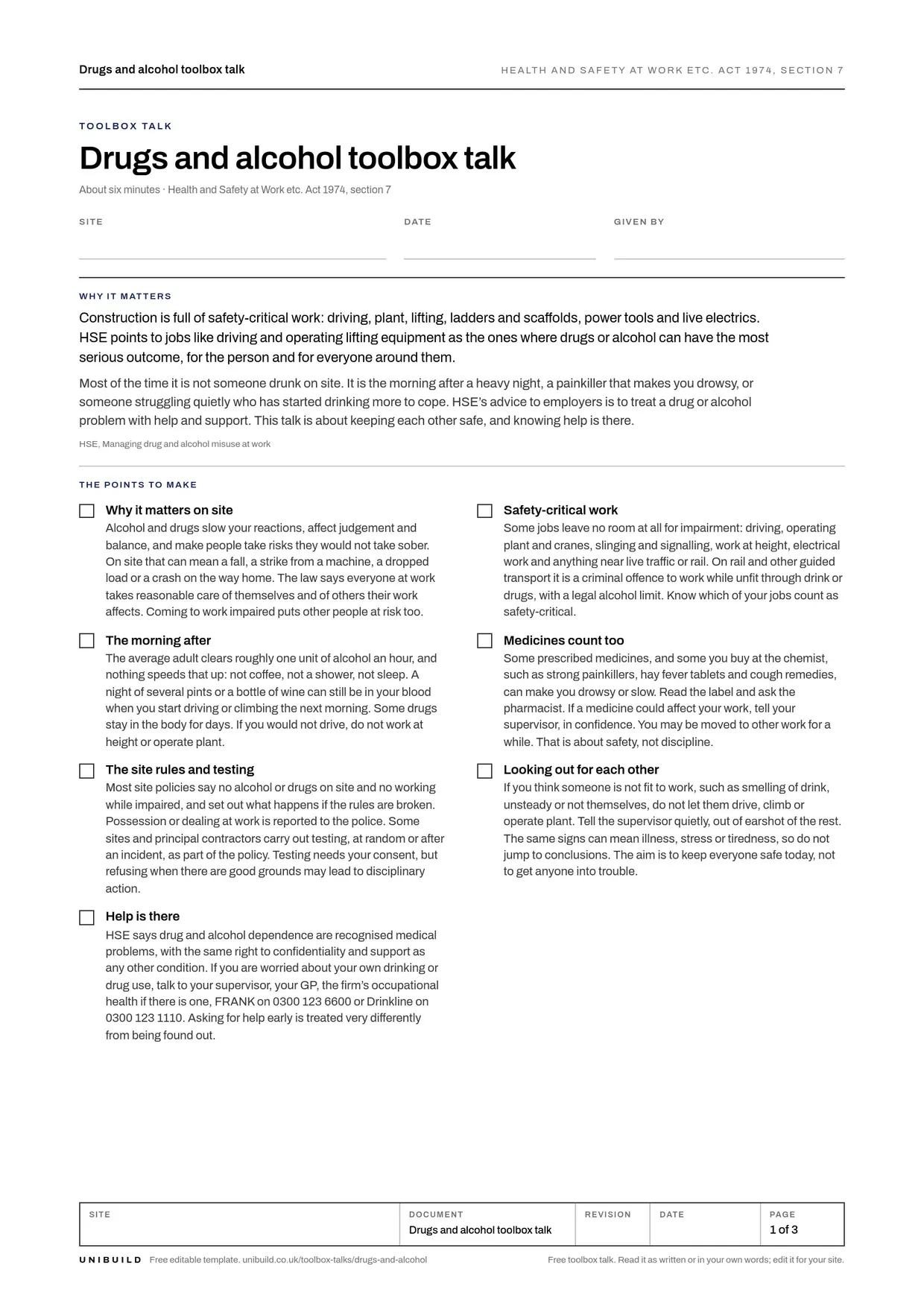
Why it matters
Construction is full of safety-critical work: driving, plant, lifting, ladders and scaffolds, power tools and live electrics. HSE points to jobs like driving and operating lifting equipment as the ones where drugs or alcohol can have the most serious outcome, for the person and for everyone around them.
Most of the time it is not someone drunk on site. It is the morning after a heavy night, a painkiller that makes you drowsy, or someone struggling quietly who has started drinking more to cope. HSE’s advice to employers is to treat a drug or alcohol problem with help and support. This talk is about keeping each other safe, and knowing help is there.
HSE, Managing drug and alcohol misuse at workThe points to make
Why it matters on site
Alcohol and drugs slow your reactions, affect judgement and balance, and make people take risks they would not take sober. On site that can mean a fall, a strike from a machine, a dropped load or a crash on the way home. The law says everyone at work takes reasonable care of themselves and of others their work affects. Coming to work impaired puts other people at risk too.
Safety-critical work
Some jobs leave no room at all for impairment: driving, operating plant and cranes, slinging and signalling, work at height, electrical work and anything near live traffic or rail. On rail and other guided transport it is a criminal offence to work while unfit through drink or drugs, with a legal alcohol limit. Know which of your jobs count as safety-critical.
The morning after
The average adult clears roughly one unit of alcohol an hour, and nothing speeds that up: not coffee, not a shower, not sleep. A night of several pints or a bottle of wine can still be in your blood when you start driving or climbing the next morning. Some drugs stay in the body for days. If you would not drive, do not work at height or operate plant.
Medicines count too
Some prescribed medicines, and some you buy at the chemist, such as strong painkillers, hay fever tablets and cough remedies, can make you drowsy or slow. Read the label and ask the pharmacist. If a medicine could affect your work, tell your supervisor, in confidence. You may be moved to other work for a while. That is about safety, not discipline.
The site rules and testing
Most site policies say no alcohol or drugs on site and no working while impaired, and set out what happens if the rules are broken. Possession or dealing at work is reported to the police. Some sites and principal contractors carry out testing, at random or after an incident, as part of the policy. Testing needs your consent, but refusing when there are good grounds may lead to disciplinary action.
Looking out for each other
If you think someone is not fit to work, such as smelling of drink, unsteady or not themselves, do not let them drive, climb or operate plant. Tell the supervisor quietly, out of earshot of the rest. The same signs can mean illness, stress or tiredness, so do not jump to conclusions. The aim is to keep everyone safe today, not to get anyone into trouble.
Help is there
HSE says drug and alcohol dependence are recognised medical problems, with the same right to confidentiality and support as any other condition. If you are worried about your own drinking or drug use, talk to your supervisor, your GP, the firm’s occupational health if there is one, FRANK on 0300 123 6600 or Drinkline on 0300 123 1110. Asking for help early is treated very differently from being found out.
Do
- Come to work fit to work, and know your own limits the night before.
- Read the label on medicines and tell your supervisor if they could make you drowsy.
- Tell a supervisor quietly if you think someone is not fit for safety-critical work.
- Stop anyone who may be impaired from driving, climbing or operating plant.
- Know the site policy, including any testing.
- Ask for help early if you are worried about your drinking or drug use.
Do not
- Do not bring alcohol or drugs onto site, or work under their influence.
- Do not drive, operate plant or work at height the morning after heavy drinking.
- Do not assume someone who seems unwell is drunk. It could be illness or stress.
- Do not cover for a workmate who is not fit to work. Tell someone, quietly.
- Do not stop taking prescribed medicine without talking to your doctor.
Ask the team
- Which jobs on this site would be most dangerous if someone was not fully fit?
- How long do you think it takes to clear a heavy night out of your blood?
- What would you do if a workmate turned up smelling of drink and was about to drive?
- Does anyone take medicine that says it may cause drowsiness? Have you told someone?
- Who could you talk to on this job if you were worried about your own drinking?
To close
Nobody comes to work planning to hurt themselves or anyone else. Drink and drugs make that more likely, even the morning after, even from a packet off the chemist’s shelf. So come in fit, be honest about medicines, and look out for each other quietly and fairly. If you think someone is not fit, keep them off safety-critical work and tell a supervisor. And if you are struggling yourself, ask for help early. It will be treated in confidence, and as a health problem.
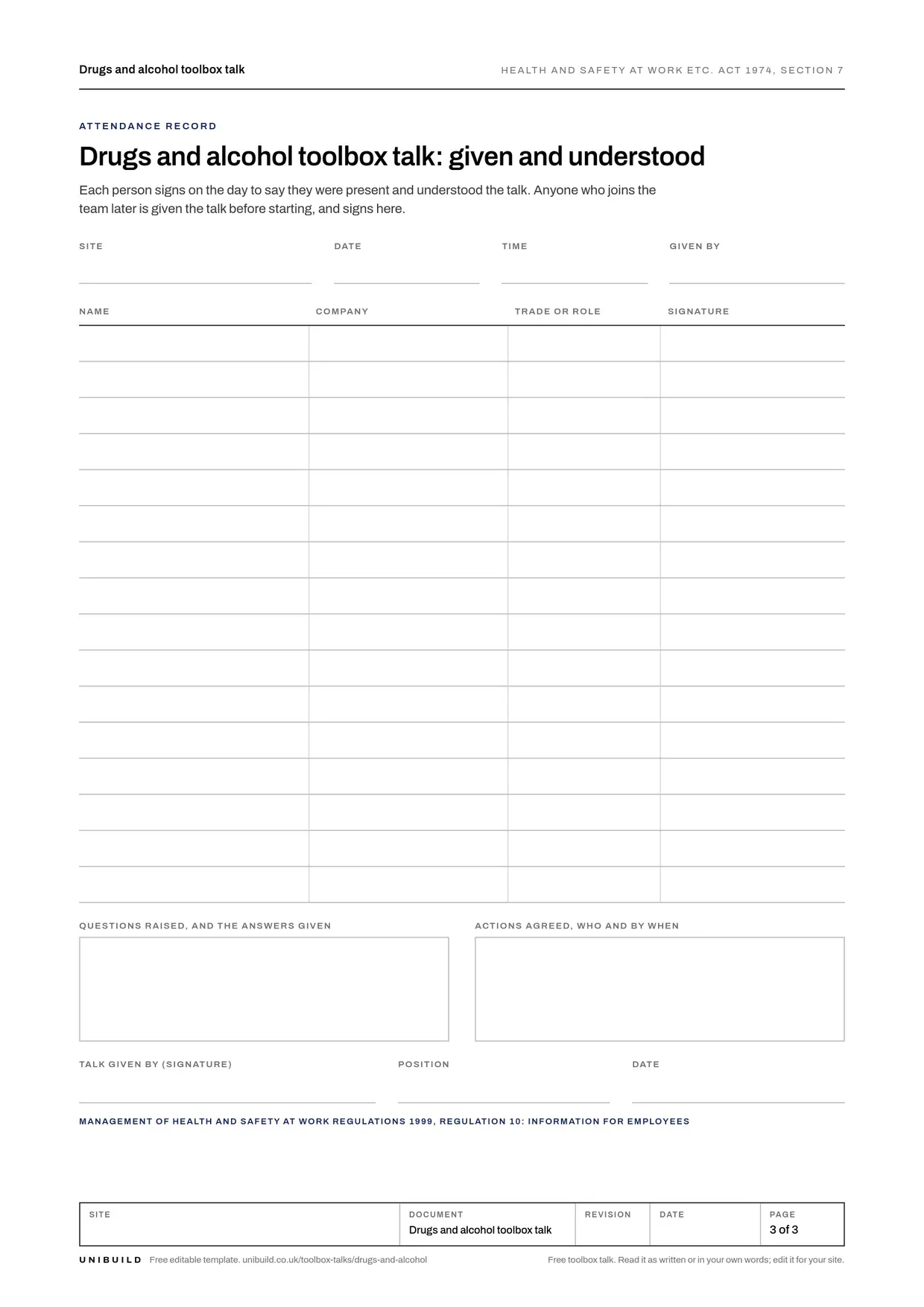
Record it. Who gave the talk, where, when, who was there and what was raised. The last page of the sheet is the record.