
Driving for work: the talk
Read it as written or in your own words. Tick each point as you make it. Stop for the questions.
Why it matters
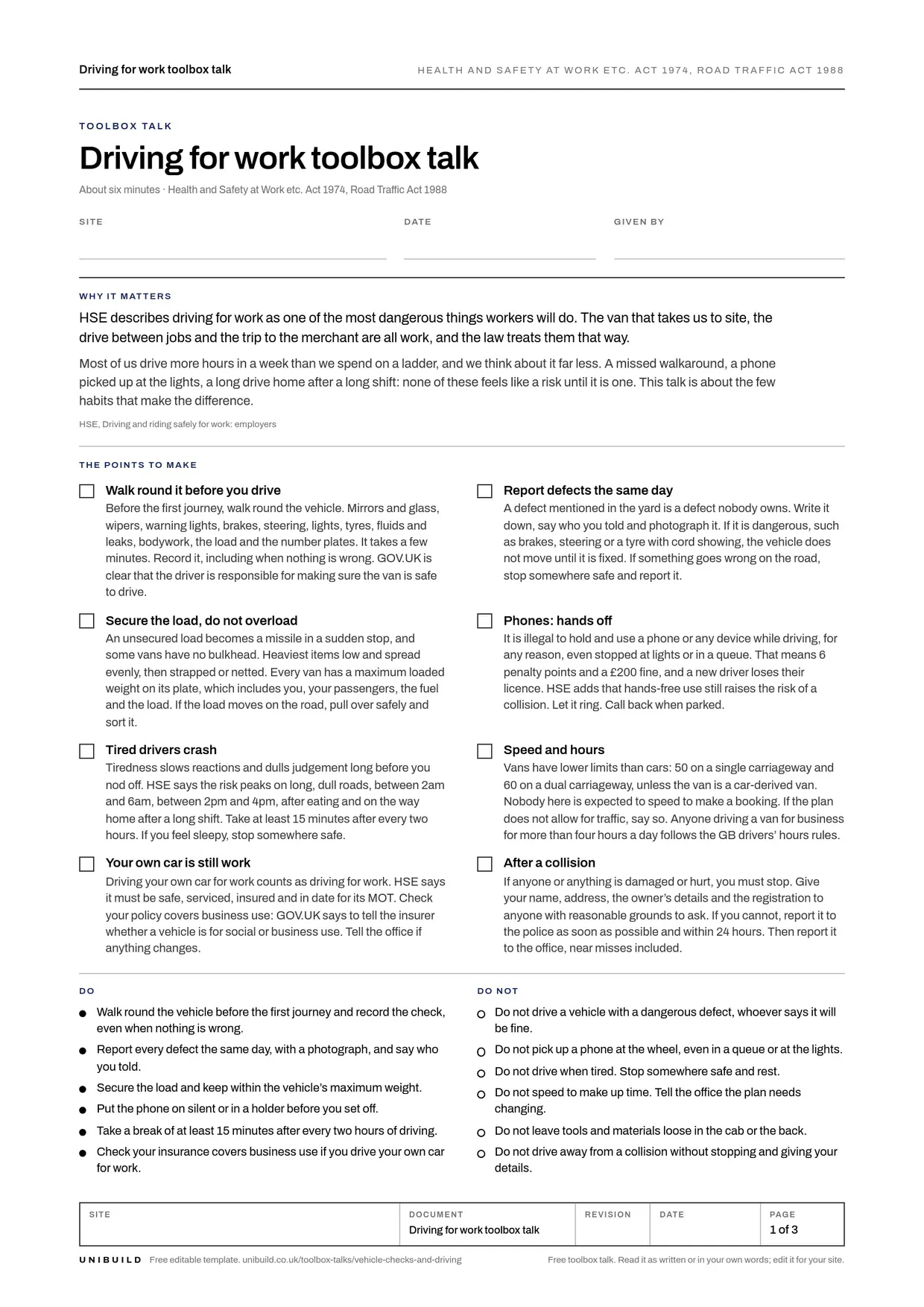
HSE describes driving for work as one of the most dangerous things workers will do. The van that takes us to site, the drive between jobs and the trip to the merchant are all work, and the law treats them that way.
Most of us drive more hours in a week than we spend on a ladder, and we think about it far less. A missed walkaround, a phone picked up at the lights, a long drive home after a long shift: none of these feels like a risk until it is one. This talk is about the few habits that make the difference.
HSE, Driving and riding safely for work: employersThe points to make
Walk round it before you drive
Before the first journey, walk round the vehicle. Mirrors and glass, wipers, warning lights, brakes, steering, lights, tyres, fluids and leaks, bodywork, the load and the number plates. It takes a few minutes. Record it, including when nothing is wrong. GOV.UK is clear that the driver is responsible for making sure the van is safe to drive.
Report defects the same day
A defect mentioned in the yard is a defect nobody owns. Write it down, say who you told and photograph it. If it is dangerous, such as brakes, steering or a tyre with cord showing, the vehicle does not move until it is fixed. If something goes wrong on the road, stop somewhere safe and report it.
Secure the load, do not overload
An unsecured load becomes a missile in a sudden stop, and some vans have no bulkhead. Heaviest items low and spread evenly, then strapped or netted. Every van has a maximum loaded weight on its plate, which includes you, your passengers, the fuel and the load. If the load moves on the road, pull over safely and sort it.
Phones: hands off
It is illegal to hold and use a phone or any device while driving, for any reason, even stopped at lights or in a queue. That means 6 penalty points and a £200 fine, and a new driver loses their licence. HSE adds that hands-free use still raises the risk of a collision. Let it ring. Call back when parked.
Tired drivers crash
Tiredness slows reactions and dulls judgement long before you nod off. HSE says the risk peaks on long, dull roads, between 2am and 6am, between 2pm and 4pm, after eating and on the way home after a long shift. Take at least 15 minutes after every two hours. If you feel sleepy, stop somewhere safe.
Speed and hours
Vans have lower limits than cars: 50 on a single carriageway and 60 on a dual carriageway, unless the van is a car-derived van. Nobody here is expected to speed to make a booking. If the plan does not allow for traffic, say so. Anyone driving a van for business for more than four hours a day follows the GB drivers’ hours rules.
Your own car is still work
Driving your own car for work counts as driving for work. HSE says it must be safe, serviced, insured and in date for its MOT. Check your policy covers business use: GOV.UK says to tell the insurer whether a vehicle is for social or business use. Tell the office if anything changes.
After a collision
If anyone or anything is damaged or hurt, you must stop. Give your name, address, the owner’s details and the registration to anyone with reasonable grounds to ask. If you cannot, report it to the police as soon as possible and within 24 hours. Then report it to the office, near misses included.
Do
- Walk round the vehicle before the first journey and record the check, even when nothing is wrong.
- Report every defect the same day, with a photograph, and say who you told.
- Secure the load and keep within the vehicle’s maximum weight.
- Put the phone on silent or in a holder before you set off.
- Take a break of at least 15 minutes after every two hours of driving.
- Check your insurance covers business use if you drive your own car for work.
Do not
- Do not drive a vehicle with a dangerous defect, whoever says it will be fine.
- Do not pick up a phone at the wheel, even in a queue or at the lights.
- Do not drive when tired. Stop somewhere safe and rest.
- Do not speed to make up time. Tell the office the plan needs changing.
- Do not leave tools and materials loose in the cab or the back.
- Do not drive away from a collision without stopping and giving your details.
Ask the team
- When did you last walk round your vehicle before driving it, and what did you find?
- Who do you tell about a defect, and how quickly does it get fixed?
- Where is your phone while you drive, and does anyone ring you knowing you are driving?
- Who drives their own car for work, and is it insured for business use?
- What would you do in the first five minutes after a collision?
To close
The drive is part of the job, and it is the part most likely to hurt us. A few minutes walking round the vehicle, the phone out of reach, a break every two hours and a load that cannot move. If a vehicle is not safe, it does not go, and nobody here will argue with you for saying so.
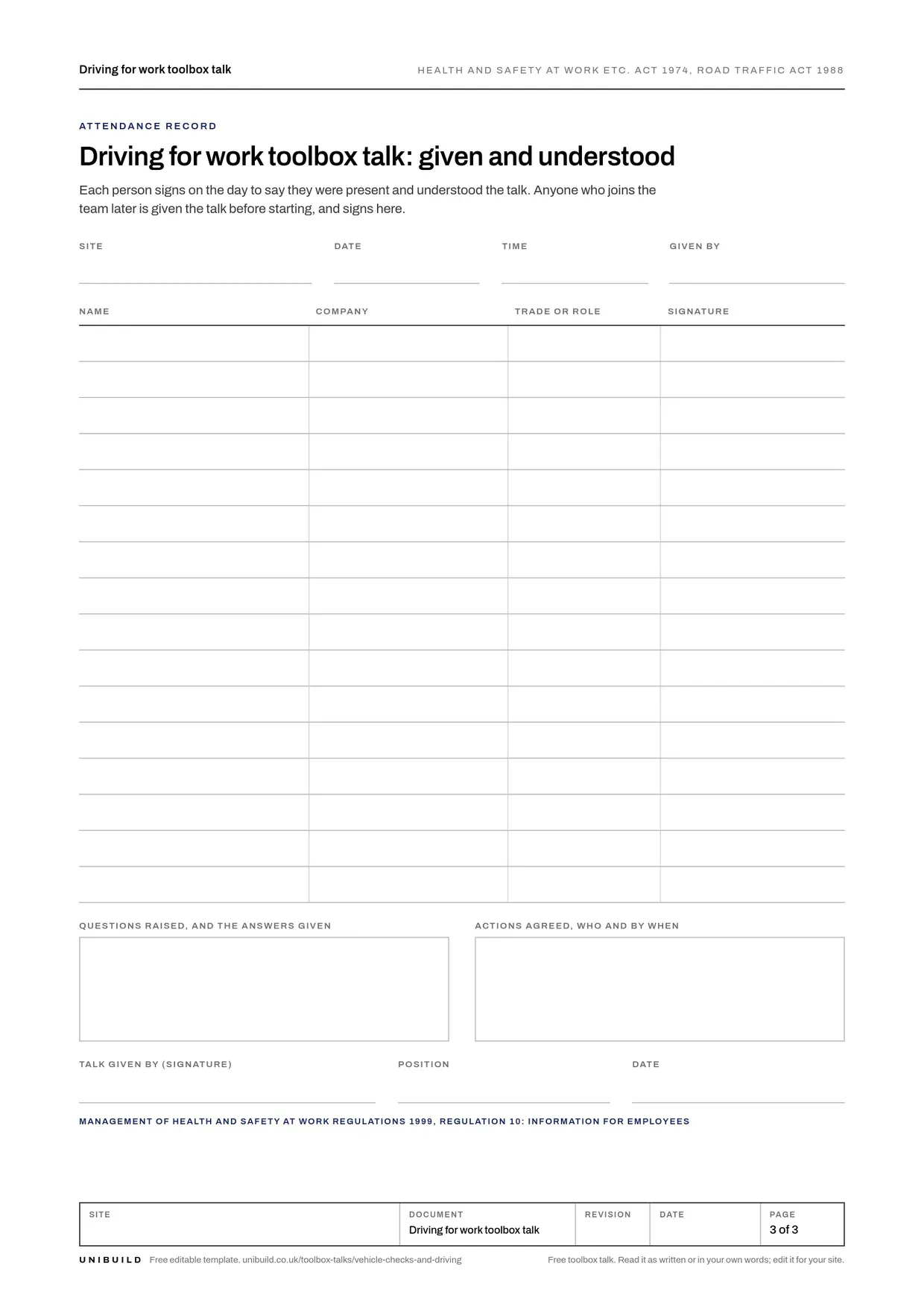
Record it. Who gave the talk, where, when, who was there and what was raised. The last page of the sheet is the record.