
Demolition method statement and risk assessment
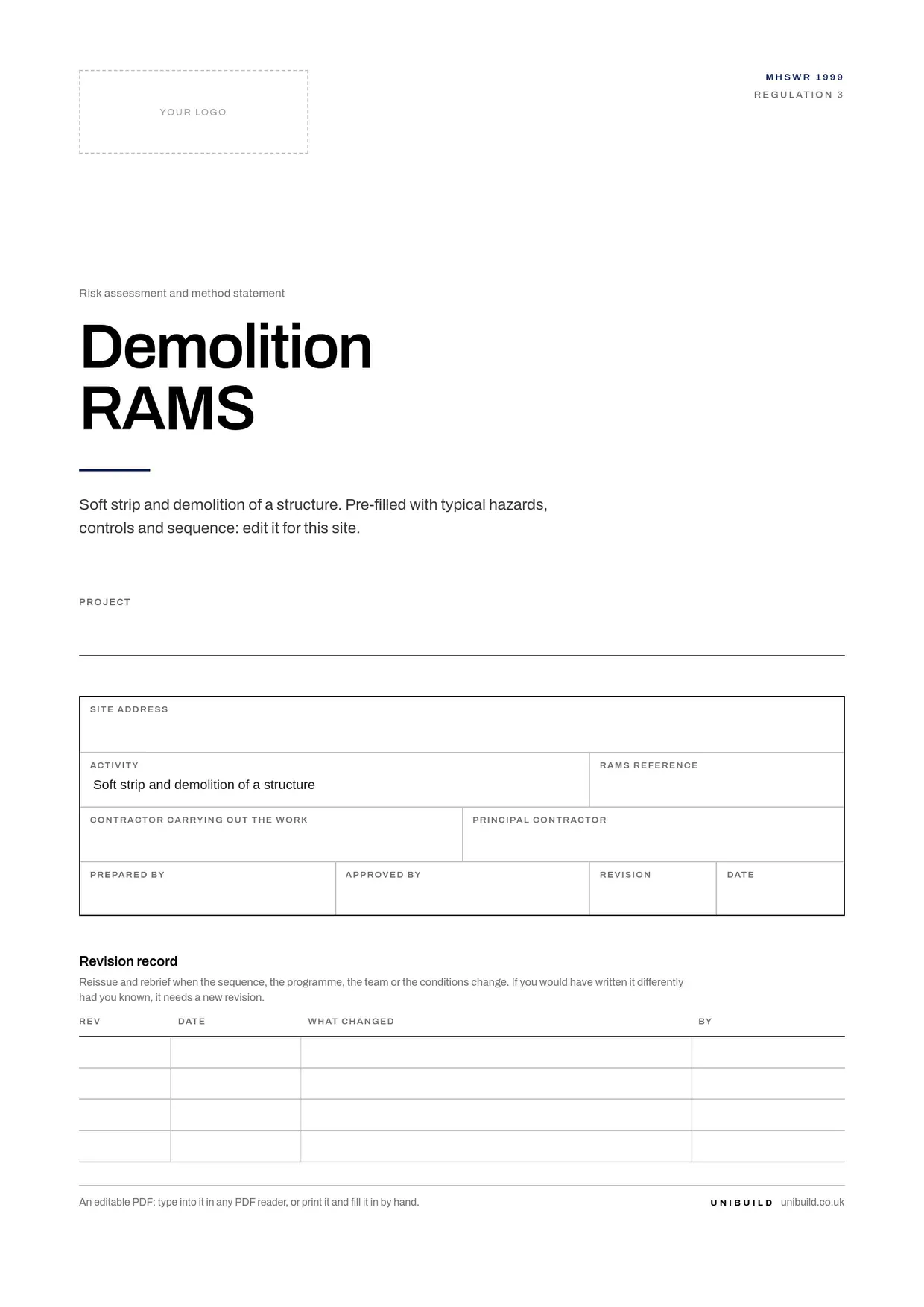
A demolition method statement and risk assessment, already filled in for surveys and isolations, soft strip, structural demolition and the exclusion zones. Edit it for your structure, then brief it.
- Law
- CDM 2015, regulation 20
- Written plan
- Recorded before demolition begins
- Format
- Editable PDF and Word
- Cost
- Free, always
Do you need a method statement for demolition?
Yes. CDM 2015 regulation 20 requires the arrangements for demolition or dismantling to be recorded in writing before the work begins, and a demolition method statement is the usual way to record them. A principal contractor will expect to review the RAMS before anything comes down.
The risk assessment is the legal duty under regulation 3 of the Management of Health and Safety at Work Regulations 1999. The method statement is the written plan: what the surveys found, how services are isolated, the order the structure comes down in, how it stays stable, and where the exclusion and debris zones sit.
A demolition method statement has to fit the structure in front of you. Its form and load paths, the asbestos survey, the neighbours, the services and the space for debris decide the method. HSE expects it to be written by a competent person, and BS 6187:2011 is the code of practice for full and partial demolition.
Checked against legislation.gov.uk and HSE guidance on .
Demolition hazards and controls
18 hazards, rated before and after controlsThe significant hazards on a typical soft strip and structural demolition, with the controls a reviewer expects to see. Delete what does not apply and add what your structure has.
Premature or uncontrolled collapse
Operatives, plant operators, neighbours and the public, if the structure falls before or beyond the plan.
- Structural survey of the form, load paths, floors, shear walls, stairs and lift shafts before the method is written, with a demolition engineer where needed.
- Demolition sequence keeps the remaining structure stable at every stage, with temporary propping or restraint to a temporary works design.
- Any change from the planned sequence agreed with the engineer and the RAMS revised before work carries on.
BeforeHigh 15AfterMedium 5
Falls from edges, floors and roofs
Operatives working at open edges, on upper floors and on roofs during strip out and demolition.
- Machine demolition from the ground, or remote controlled machines, in place of people working at height wherever practicable.
- Edge protection at open edges, with a top guard-rail at least 950mm high and no gap over 470mm, or MEWPs for work at height.
- Harness and lanyard only where collective protection cannot be provided, with a rescue plan.
BeforeHigh 20AfterMedium 5
Falls through floors, roofs and openings
Operatives on fragile roofs, rotten or weakened floors, and near stair and lift openings.
- Fragile roofs, rooflights and weakened floors identified in the survey and marked before anyone goes near them.
- Openings covered with fixed, marked covers or guarded; nobody walks on a roof or floor not confirmed safe.
- Debris kept off upper floors so it does not overload them.
BeforeHigh 15AfterMedium 5
Asbestos found or disturbed
Operatives, other trades and neighbours, from fibres released during strip out or demolition.
- Refurbishment and demolition survey to HSG264 for the whole building before work, read and briefed.
- Asbestos removed by a licensed contractor where the work is licensable, with a clearance certificate, before other major works start.
- Suspect material found later means stop work, keep people out and report it; work restarts only once it is sampled and dealt with.
BeforeHigh 20AfterMedium 5
Live services in the structure
Operatives and plant operators, from electric shock, gas escape, fire or flooding.
- Electricity, gas, water and telecoms disconnected by the owners, with written confirmation, before demolition starts.
- Cables and pipes treated as live until proven dead; temporary supplies for the work run separately and marked.
- Buried services under slabs and in the ground located before breaking out below ground level.
BeforeHigh 15AfterMedium 5
Overhead power lines
High reach and excavator operators, and anyone near plant or a structure that falls towards a line.
- Lines identified before work and the network operator asked to divert or switch them off where plant or debris could reach them.
- Where lines stay live, barriers and goal posts keep plant out of reach, and the sequence drops debris away from the line.
BeforeMedium 10AfterMedium 5
Falling debris and materials
Operatives, other trades and the public below and around the work.
- Exclusion and debris zones set out and barriered, sized for the method and the height, with nobody inside them while demolition is live.
- Debris lowered by chute, skip or machine, never thrown; chutes enclosed and the base area fenced.
- Scaffold and netting used to contain debris only where designed for that load by a competent person.
BeforeHigh 20AfterMedium 5
Demolition plant: overturning and struck by
Plant operators, banksmen and operatives near high reach machines and excavators.
- Machine chosen for the reach and the work, with a cab guard against falling material, and set up on firm, level ground or a prepared platform.
- Exclusion zone around each machine; nobody approaches until the operator has seen them and stopped.
- Operators hold a CPCS or NPORS card for the machine, and are trained on the attachments fitted.
BeforeHigh 15AfterMedium 5
Vehicles and people on site
Operatives, drivers and visitors near muck-away lorries, loading shovels and dumpers.
- Vehicle and pedestrian routes planned and kept apart by barriers, with a one-way system where space allows.
- Trained banksman for every reversing movement and at the site gate.
BeforeHigh 20AfterMedium 5
Adjoining buildings and party walls
Neighbours and occupants of attached buildings, and operatives near a shared wall.
- Condition of adjoining buildings recorded before work, and party walls and shared structure assessed by the engineer.
- Shared walls propped or restrained to the temporary works design before the structure tying them in is removed.
- Weather protection for exposed party walls agreed with the neighbours before work starts.
BeforeMedium 12AfterLow 4
The public and neighbours
Passers-by, neighbours and children who could enter the site or the debris zone.
- Site enclosed by hoarding or fencing that keeps the public out of the debris zone, secured at the end of each day.
- Footpaths diverted or protected where the debris zone reaches them, with any licence the highway authority requires.
BeforeHigh 15AfterMedium 5
Silica and demolition dust
Operatives breaking, crushing and cutting concrete and masonry, and neighbours downwind.
- Water suppression at the point of demolition and on crushers and processing.
- Machines with filtered, sealed cabs; on-tool extraction with an H or M class unit for hand-held cutting.
- RPE with an assigned protection factor of 20, face fit tested, for anyone working in dust outside a cab.
BeforeMedium 12AfterMedium 6
Noise and hand-arm vibration
Operatives using breakers, saws and hand tools, and anyone near crushers and machine breakers.
- Machine-mounted or remote controlled breakers in place of hand-held ones wherever practicable.
- Vibration exposure planned per tool and per person against the action value of 2.5 m/s² A(8).
- Hearing protection worn wherever exposure can reach 85 dB(A), the upper exposure action value.
BeforeMedium 12AfterMedium 6
Hot cutting, fire and fume
Operatives cutting steelwork, and anyone near combustible materials, painted steel or fuel.
- Hot work permit, combustibles cleared, extinguishers at hand and a fire watch during and after cutting.
- Old paint on steelwork checked for lead before burning, with cold cutting or shears used where it is.
- Gas cylinders stored upright, secured and away from the demolition, with flashback arrestors fitted.
BeforeMedium 12AfterLow 4
Hazards in derelict buildings
Operatives in the soft strip meeting needles, droppings, chemicals, rot or vermin.
- Pre-start walk round to find sharps, bird droppings, chemicals, fuel and stored waste, with specialists for any of them.
- Sharps picked up with tools into a sharps bin, never by hand; droppings damped down and removed with RPE.
- Welfare with hot water for washing before eating; cuts covered and any needle injury reported at once.
BeforeMedium 9AfterLow 3
Manual handling and sharp materials
Operatives stripping out glass, timber, plasterboard, ceilings and fixtures.
- Strip out arisings moved by skip, chute or machine rather than carried, with short carrying routes.
- Glass removed early and handled with cut-resistant gloves and sleeves; nails knocked down or removed.
BeforeMedium 8AfterLow 4
Basements, voids and below-ground work
Operatives and plant near cellars, voids, tanks and open excavations left by the demolition.
- Basements, voids, tanks and old shafts identified in the survey and fenced, covered or filled as the work reaches them.
- Basement walls propped to the design where they hold up the ground or a road behind them.
- Plant kept back from the edge of voids and excavations.
BeforeHigh 15AfterMedium 5
Unauthorised entry out of hours
Trespassers and children entering a part-demolished structure at night or at weekends.
- Hoarding secured, ladders removed, and plant immobilised at the end of each day.
- Structure left stable at the end of every shift, with no part-cut members or free-standing walls left unsupported.
BeforeHigh 15AfterMedium 5
Scores are likelihood times severity on the five by five matrix in the template. They are typical ratings for this work, a starting point for your own assessment of your site.
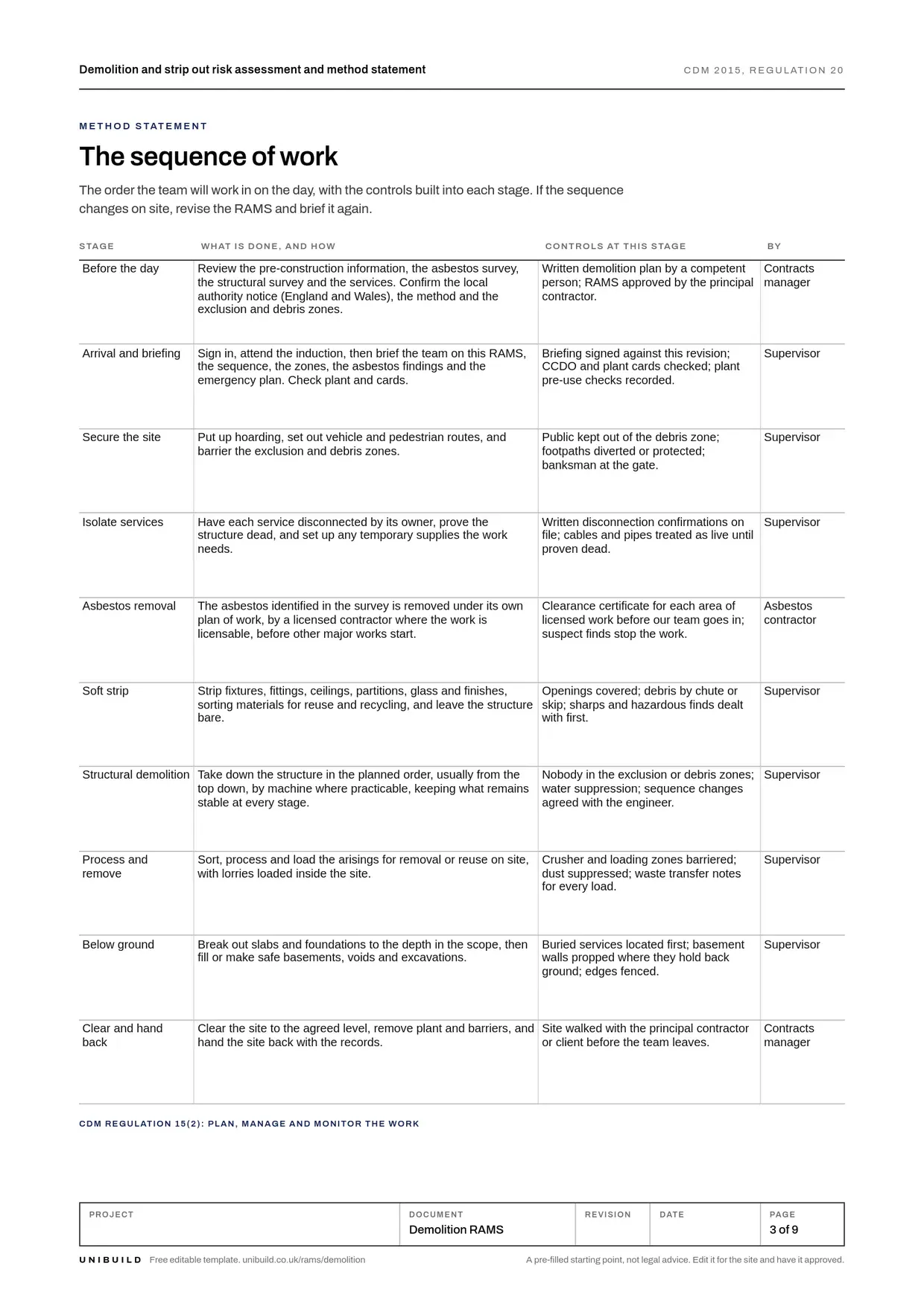
Demolition method statement: the sequence of work
The order of work, with the controls at each stageThe order the team works in, from surveys to handing back the site, with the controls built into each stage. If the sequence changes on site, revise the RAMS and brief it again.
Before the day
Review the pre-construction information, the asbestos survey, the structural survey and the services. Confirm the local authority notice (England and Wales), the method and the exclusion and debris zones.
ControlsWritten demolition plan by a competent person; RAMS approved by the principal contractor.
Arrival and briefing
Sign in, attend the induction, then brief the team on this RAMS, the sequence, the zones, the asbestos findings and the emergency plan. Check plant and cards.
ControlsBriefing signed against this revision; CCDO and plant cards checked; plant pre-use checks recorded.
Secure the site
Put up hoarding, set out vehicle and pedestrian routes, and barrier the exclusion and debris zones.
ControlsPublic kept out of the debris zone; footpaths diverted or protected; banksman at the gate.
Isolate services
Have each service disconnected by its owner, prove the structure dead, and set up any temporary supplies the work needs.
ControlsWritten disconnection confirmations on file; cables and pipes treated as live until proven dead.
Asbestos removal
The asbestos identified in the survey is removed under its own plan of work, by a licensed contractor where the work is licensable, before other major works start.
ControlsClearance certificate for each area of licensed work before our team goes in; suspect finds stop the work.
Soft strip
Strip fixtures, fittings, ceilings, partitions, glass and finishes, sorting materials for reuse and recycling, and leave the structure bare.
ControlsOpenings covered; debris by chute or skip; sharps and hazardous finds dealt with first.
Structural demolition
Take down the structure in the planned order, usually from the top down, by machine where practicable, keeping what remains stable at every stage.
ControlsNobody in the exclusion or debris zones; water suppression; sequence changes agreed with the engineer.
Process and remove
Sort, process and load the arisings for removal or reuse on site, with lorries loaded inside the site.
ControlsCrusher and loading zones barriered; dust suppressed; waste transfer notes for every load.
Below ground
Break out slabs and foundations to the depth in the scope, then fill or make safe basements, voids and excavations.
ControlsBuried services located first; basement walls propped where they hold back ground; edges fenced.
Clear and hand back
Clear the site to the agreed level, remove plant and barriers, and hand the site back with the records.
ControlsSite walked with the principal contractor or client before the team leaves.
What the law asks for demolition
Checked against the sourcePlan it and write it down
Demolition or dismantling of a structure is planned and carried out so as to prevent danger or, where that is not practicable, reduce it as low as reasonably practicable. The arrangements are recorded in writing before the work begins.
CDM 2015, regulation 20Keep the structure stable
All practicable steps are taken, where necessary to prevent danger, so that a structure made unstable, or left in a temporary state of weakness, by the work does not collapse. Temporary supports are designed, installed and maintained for the foreseeable loads.
CDM 2015, regulation 19Find the asbestos first
Work that could expose people to asbestos does not start until a suitable and sufficient assessment shows whether asbestos is present, what type, in what material and in what condition. If in doubt, it is presumed present. HSE guidance HSG264 sets out the survey.
Control of Asbestos Regulations 2012, regulation 5Remove asbestos before demolition
For final demolition or major refurbishment, the plan of work specifies, so far as is reasonably practicable, that asbestos is removed before any other major works begin, unless removal would cause a greater risk to employees than leaving it in place.
Control of Asbestos Regulations 2012, regulation 7Notice to the local authority
England and Wales only. Most demolition of the whole or part of a building needs notice to the local authority, copied to adjacent occupiers and the gas and electricity suppliers. Work waits for the council's section 81 notice or for 6 weeks to pass.
Building Act 1984, sections 80 and 81Risk assessment
Every employer must make a suitable and sufficient assessment of the risks, and record the significant findings if they employ five or more people.
Management of Health and Safety at Work Regulations 1999, regulation 3Competence, equipment and PPE
Competence and cards
- Demolition operatives CCDO card for the role, from the NFDC scheme administered by the NDTG.
- Supervisor CCDO Supervisor card, on site throughout.
- Method statement author A competent person, with a demolition engineer for complex structures.
- Plant operators CPCS or NPORS card for the high reach, excavator or loading shovel and its attachment.
- Asbestos removal A contractor holding an HSE licence for licensable work.
- Hot cutting Trained in the use of oxy-fuel equipment and the hot work permit.
Plant and equipment
- High reach or demolition excavator Daily check; cab guard fitted; attachment change checked.
- Remote controlled demolition machine Daily check; controls and emergency stop tested.
- Breakers, saws and hand tools Checked before use; vibration data known for planning.
- Crusher and screen Daily check; guards and emergency stops working.
- Oxy-fuel cutting set Hoses, regulators and flashback arrestors checked before use.
- Dust suppression Water supply and spray units working before demolition starts.
PPE
- Safety helmet worn at all times on site.
- Safety boots with midsole protection against nails and debris.
- High-visibility clothing to the site standard, worn near plant.
- Gloves cut-resistant for glass and sharp materials, grip gloves for handling.
- Eye and hearing protection for breaking, cutting and working near machines.
- Respiratory protection FFP3, face fit tested, for dust outside a cab.
Permits and plans
A permit to work for the isolation and disconnection of services. A hot work permit for every hot cutting task. A permit to dig or break ground before slabs and foundations are broken out. A lift plan for any crane lift, and a temporary works design for propping and restraint.
Emergency and rescue
If the structure moves or cracks unexpectedly, stop work, clear the exclusion zone and call the engineer. For a service strike or gas smell, stop, move everyone clear and call the owner and the emergency services. First aider and kit on site, and the nearest accident and emergency department named on the briefing.
Toolbox talk: demolition safety
Read this to the team before work starts, tick each point as it is covered, and record who attended.
- We work to the sequence in the method statement. If something is not as planned, stop and tell the supervisor before going on.
- Nobody enters the exclusion or debris zone while demolition is live. If someone walks in, the machine stops.
- Treat every cable and pipe as live until we are told it is proven dead.
- If you find anything that could be asbestos, stop, keep people away and report it. Do not break it up to look.
- Keep the dust down. Water on the work, cab doors shut, and your mask on and fitted outside a cab.
- Never approach a working machine until the operator has seen you and stopped.
Ask the team
- Where are the exclusion and debris zones today?
- What has the asbestos survey found, and where?
- What would make us stop work and call the engineer?
What is in the demolition RAMS template
9 pages, pre-filled and editableThe work, pre-filled
Scope, location and access, interfaces with other trades, the documents the RAMS relies on, and the team with their cards.
The sequence of work
Ten stages from surveys to handing back the site, with the controls and the person responsible at each one.
Hazards and controls
Eighteen demolition hazards rated before and after controls on a five by five matrix, with room for your own.
Plant, PPE and permits
The demolition plant and its checks, PPE by type, dust, lead and asbestos, and the permits the job needs.
Pre-demolition check
A page to record the surveys, notices, isolations and zones before the structure is touched.
Emergency and briefing record
Collapse and service strike arrangements, then twenty signatures against the revision.
Brief it, and get it signed on the phone
On Unibuild a RAMS is written from a template, approved, then read by each operative on their phone in their own language and signed. Subcontract and agency workers sign through a link, with no app to install.
Every signature carries its date and time and prints as the last page of the RAMS PDF. Change the RAMS and it has to be signed again.
How RAMS work on UnibuildDemolition method statement questions
Is this demolition method statement template free?
What should a demolition method statement include?
Is a demolition method statement a legal requirement?
Do I need an asbestos survey before demolition?
Do I need to tell the council before demolishing a building?
Does a demolition RAMS cover soft strip?
Who can write a demolition method statement?
What cards do demolition operatives need?
RAMS templates for other trades and hazards
All free, pre-filled and editableBy trade
- Air conditioning and HVAC RAMS
- Bricklaying RAMS
- Carpentry and joinery RAMS
- CCTV installation RAMS
- Cleaning risk assessment
- Concrete works RAMS
- Demolition RAMS
- Drylining RAMS
- Electrical RAMS
- Facilities maintenance RAMS
- Fire alarm installation RAMS
- Glazing and window RAMS
- Groundworks RAMS
- Hot works and welding RAMS
- Insulation RAMS
- Landscaping and fencing RAMS
- Painting and decorating RAMS
- Pest control risk assessment
- Plastering and rendering RAMS
- Plumbing and heating RAMS
- Rail RAMS
- Refurbishment RAMS
- Roofing RAMS
- Rope access risk assessment
- Scaffolding RAMS
- Solar PV installation RAMS
- Steel erection RAMS
- Temporary works RAMS
- Tiling and flooring RAMS
- Tree surgery RAMS
By hazard
- Asbestos risk assessment
- Confined space risk assessment
- COSHH risk assessment
- Dust risk assessment
- Forklift and telehandler risk assessment
- Housekeeping risk assessment
- Lifting operations risk assessment
- Lone working risk assessment
- Manual handling risk assessment
- MEWP risk assessment
- Noise and vibration risk assessment
- Plant and excavator risk assessment
- Power tools risk assessment
- Traffic management risk assessment
- Working at height risk assessment
The blank RAMS template, the RAMS review checklist and every other free form are on Free downloads.
The RAMS, read and signed
before the work starts.
Unibuild keeps every RAMS with its versions, its approvals and each operative’s signature against the revision they read, for seven years, ready for the principal contractor or an auditor.