
Hoarding risk assessment and temporary works method statement
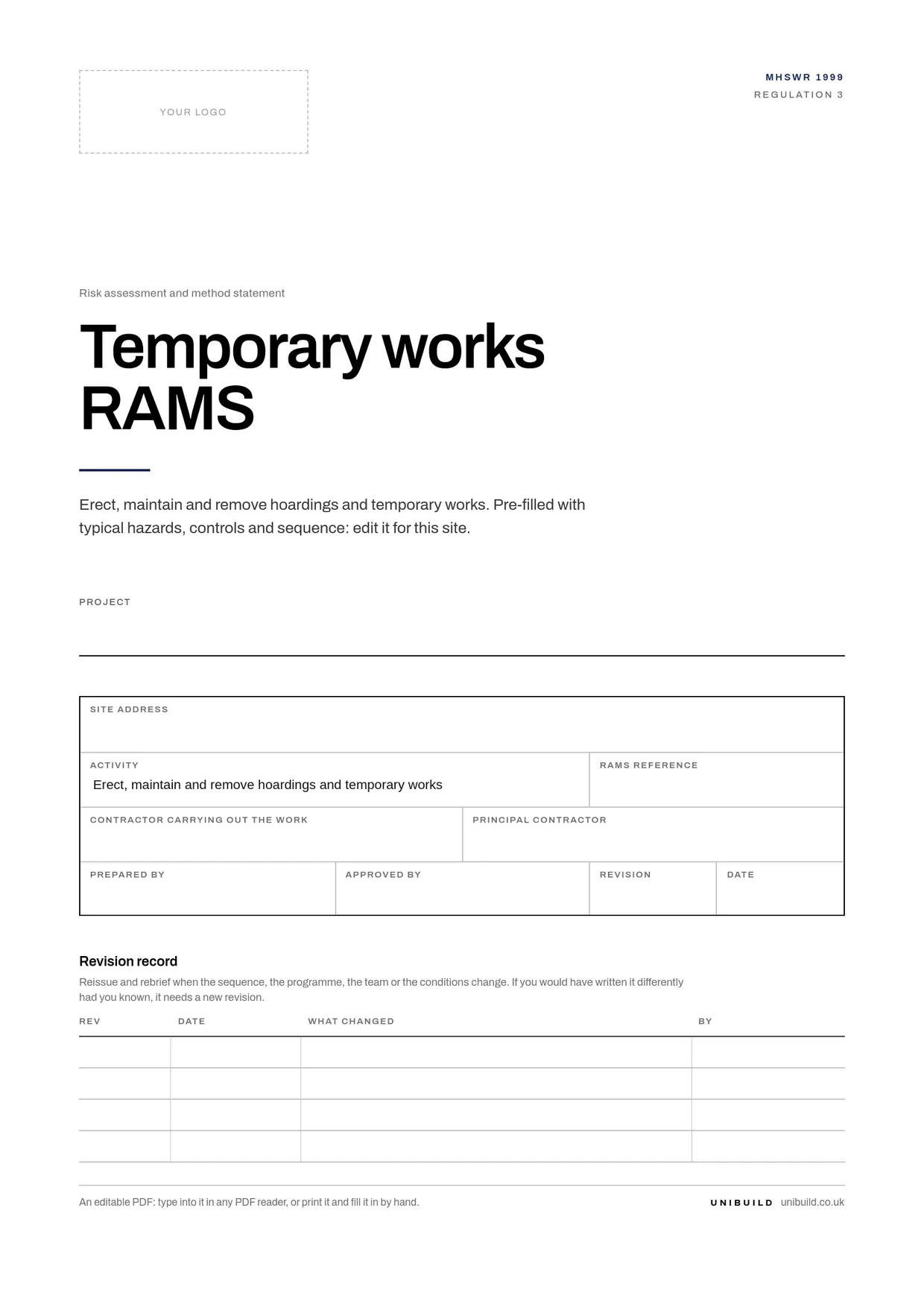
A hoarding risk assessment and temporary works method statement, already filled in for site hoardings, props and supports, from design and check to the permit to load and dismantling. Edit it for your site, then brief it.
- Law
- CDM 2015, regulation 19
- Code of practice
- BS 5975-1:2024
- Format
- Editable PDF and Word
- Cost
- Free, always
Do you need a risk assessment for a site hoarding?
Yes. A hoarding risk assessment is needed before the first post goes in, because a hoarding is temporary works: it carries wind load and stands beside the public. CDM 2015 requires any temporary structure to be designed, installed and maintained for the loads on it, and a principal contractor will expect to review the RAMS first.
The risk assessment is the legal duty, under regulation 3 of the Management of Health and Safety at Work Regulations 1999. The temporary works method statement sets out the plan: the design and its check, how the hoarding or support goes up, who issues the permit to load, how it is inspected while it stands, and who allows it to come down.
BS 5975-1:2024 is the code of practice for managing temporary works. HSE says the law does not fix how temporary works are managed, but recommends a formally appointed temporary works coordinator. The same RAMS serves as a site set-up method statement for hoardings, props and supports; scaffolds and deep excavations have their own guides.
Checked against legislation.gov.uk and HSE guidance on .
Hoarding and temporary works hazards and controls
16 hazards, rated before and after controlsThe significant hazards when erecting and maintaining a site hoarding and installing props and temporary supports, with the controls a reviewer expects to see. Delete what does not apply and add what your site has.
Hoarding blown over by wind
The public, site staff and neighbours beside the hoarding when it fails in a gust.
- Hoarding built to a temporary works design for the site's wind exposure, or to a proprietary system used within its published limits.
- No sheeting, banners or solid graphics added to fencing or hoarding unless the design allows for the extra wind load.
- Forecast checked in windy spells; hoarding inspected after high winds before the public route reopens.
BeforeHigh 15AfterMedium 5
Temporary works loaded before they are ready
Operatives on or under props, falsework, formwork or supports that fail under load.
- Every item designed and the design checked to the category the temporary works coordinator sets, before it is built.
- Built to the drawing, then checked against it by the coordinator or supervisor.
- Nothing loaded until the permit to load is signed and recorded on the temporary works register.
BeforeHigh 15AfterMedium 5
Props or supports removed too early
Operatives below and beside a structure that drops when its support is taken away.
- Nothing struck or dismantled until the permit to dismantle is signed by the temporary works coordinator.
- Dismantling follows the sequence in the design, with back-propping left where the design requires it.
- Nobody below the area being struck; props released in a controlled way, never knocked out.
BeforeHigh 15AfterMedium 5
Props on unsuitable ground or floors
Operatives near props that sink, slip or punch through the ground or the slab below.
- Bearing for every prop checked in the design: ground, sole plates, slab capacity and any back-propping below.
- Props plumb, pinned, on base plates and sole plates, at the spacing on the drawing.
- Ground kept dry around bases; soft spots, voids and drains found before the props go in.
BeforeHigh 15AfterMedium 5
Excavation support failing
Operatives in or beside an excavation if the sides or the support give way.
- Trench boxes, sheets and props or battering to the temporary works design; nobody enters an unsupported excavation.
- Excavation inspected by a competent person at the start of each shift, after any event affecting stability and after any fall of material.
- Spoil, plant and materials kept back from the edge, as the groundworks RAMS sets out.
BeforeHigh 15AfterMedium 5
Striking buried services
Operatives digging post holes, driving posts or fixing ground anchors, from shock, burns or gas.
- Service drawings obtained and the line of the hoarding scanned with a cable locator and signal generator before any dig.
- Services marked on the ground; post holes near them dug by hand or vacuum excavation.
- Hoarding line moved, or a surface-mounted foot used, where a post would land on a service.
BeforeHigh 15AfterMedium 5
The public during erection on the street
Pedestrians, wheelchair and pushchair users, and drivers beside the work.
- Highway licence or council agreement in place before work starts, and its conditions briefed.
- Safe pedestrian route kept open or diverted, with ramps, barriers and lighting as the licence requires.
- Panels moved and fixed inside a barriered work area, with a banksman for vehicle movements.
BeforeMedium 12AfterLow 4
Vehicles striking the hoarding or props
The public and site staff when a vehicle hits a hoarding, gate or prop and it falls.
- Hoarding set back from the carriageway as the licence requires, with corners and gates lit and marked.
- Site vehicle routes kept clear of props and braces; barriers or kerbs where they sit near traffic.
- Any strike reported at once, the area made safe, and the structure inspected before reuse.
BeforeMedium 12AfterLow 4
Trespassers and children getting in
Children and intruders entering the site through gaps, gates or damaged panels.
- Hoarding continuous, with no climbing aids on the outside and gates that lock.
- Gates closed and locked at the end of each day, and the line walked for damage.
- Damaged or missing panels made good the same day, or the gap guarded until they are.
BeforeMedium 12AfterLow 4
Unauthorised alteration of temporary works
Other trades removing braces, panels, props or ties to suit their work.
- Site rule briefed at induction: only the temporary works team alters a hoarding, prop or support.
- Items labelled with their register reference and a "Do not remove" notice.
- Inspections pick up changes; anything altered is made safe and re-checked before use.
BeforeHigh 16AfterMedium 8
Manual handling of panels, posts and props
Operatives carrying sheet panels, timber posts, steel props and fence feet.
- Panels and posts delivered close to the line and moved by telehandler or trolley where practicable.
- Two-person lifts for full sheets and long timbers, with no carrying in strong wind.
- Team briefed on lifting technique, and gloves with good grip worn.
BeforeMedium 8AfterLow 4
Lifting heavy sections with plant
Operatives guiding hoarding sections, blocks, props or trench support into place.
- Lift planned by a competent person, with a lift plan for any lift the site requires one for.
- Lifting equipment with a LOLER thorough examination in date, and accessories marked with their safe working load.
- Nobody under the load; tag lines used to steer it.
BeforeMedium 12AfterLow 4
Overhead power lines
Operatives handling long posts or props, and plant lifting near overhead lines.
- Lines identified before work, and the network operator asked to divert or switch them off where posts or plant could reach them.
- Where lines stay live, barriers and goal posts keep plant out of reach, and long items are carried horizontally.
BeforeMedium 10AfterMedium 5
Saws, drills and post drivers
Operatives cutting sheet and timber, fixing panels and driving posts.
- Saws and drills guarded and checked before use; dust from cutting controlled at source.
- Post driver and auger vibration exposure planned per person against the exposure action value.
- Eye protection for cutting and drilling, and hearing protection for post driving.
BeforeMedium 9AfterMedium 6
Working at height on tall hoardings
Operatives fixing panels, lights and signs at the top of a hoarding.
- Work done from a podium, mobile tower or MEWP; stepladders only for short, light tasks.
- Panels fixed from inside the site where possible, so the public route stays clear below.
BeforeMedium 12AfterLow 4
Slips and trips on the public route
Pedestrians on a diverted footway, and operatives on uneven ground along the line.
- Diverted footway kept level, firm and lit, with ramps at kerbs and no trailing cables.
- Offcuts, fixings and packaging cleared from the line as the work goes.
BeforeMedium 9AfterLow 3
Scores are likelihood times severity on the five by five matrix in the template. They are typical ratings for this work, a starting point for your own assessment of your site.
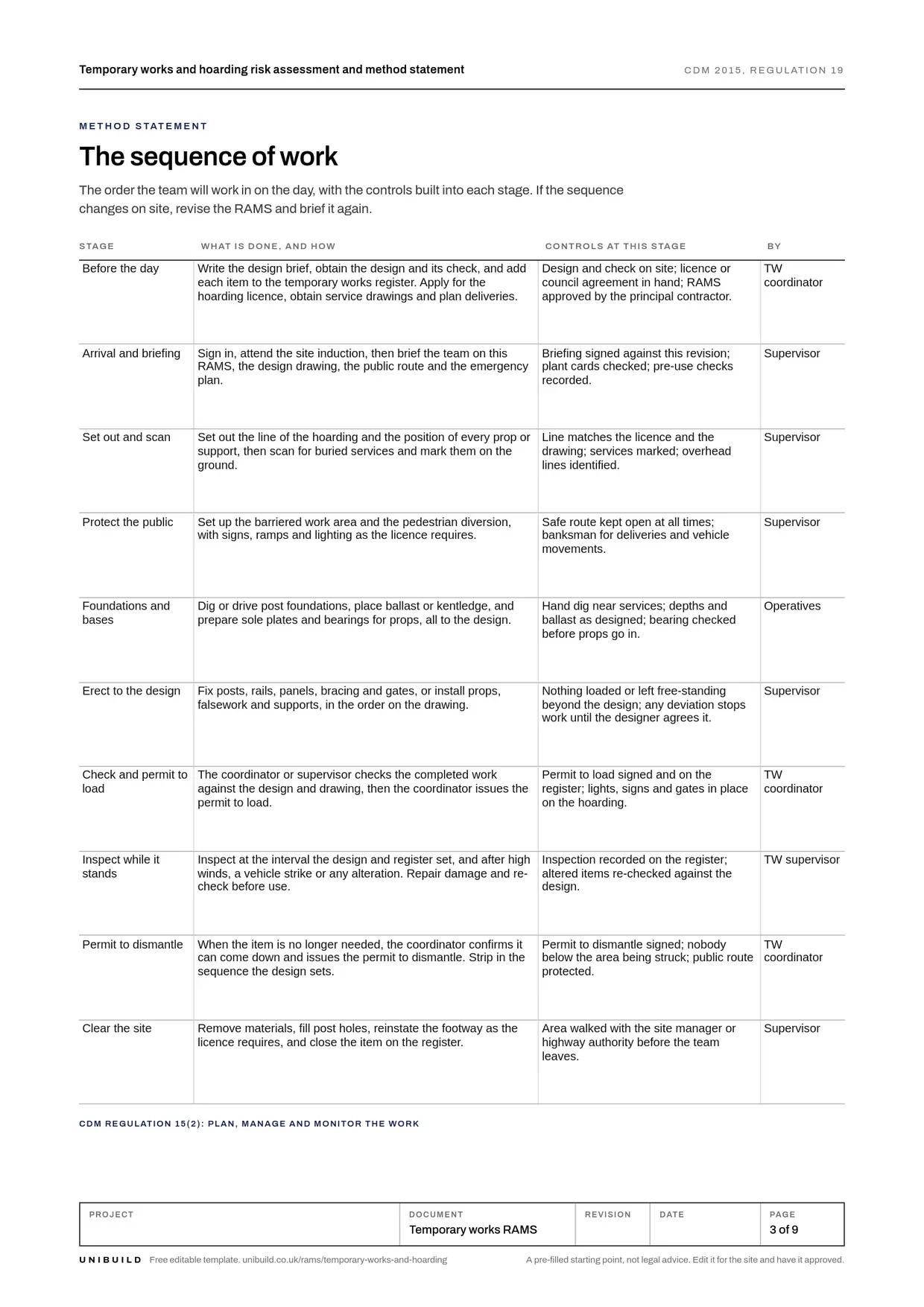
Temporary works method statement: the sequence of work
The order of work, with the controls at each stageThe order the team works in, from the design brief to clearing the site, with the controls built into each stage. If the sequence changes on site, revise the RAMS and brief it again.
Before the day
Write the design brief, obtain the design and its check, and add each item to the temporary works register. Apply for the hoarding licence, obtain service drawings and plan deliveries.
ControlsDesign and check on site; licence or council agreement in hand; RAMS approved by the principal contractor.
Arrival and briefing
Sign in, attend the site induction, then brief the team on this RAMS, the design drawing, the public route and the emergency plan.
ControlsBriefing signed against this revision; plant cards checked; pre-use checks recorded.
Set out and scan
Set out the line of the hoarding and the position of every prop or support, then scan for buried services and mark them on the ground.
ControlsLine matches the licence and the drawing; services marked; overhead lines identified.
Protect the public
Set up the barriered work area and the pedestrian diversion, with signs, ramps and lighting as the licence requires.
ControlsSafe route kept open at all times; banksman for deliveries and vehicle movements.
Foundations and bases
Dig or drive post foundations, place ballast or kentledge, and prepare sole plates and bearings for props, all to the design.
ControlsHand dig near services; depths and ballast as designed; bearing checked before props go in.
Erect to the design
Fix posts, rails, panels, bracing and gates, or install props, falsework and supports, in the order on the drawing.
ControlsNothing loaded or left free-standing beyond the design; any deviation stops work until the designer agrees it.
Check and permit to load
The coordinator or supervisor checks the completed work against the design and drawing, then the coordinator issues the permit to load.
ControlsPermit to load signed and on the register; lights, signs and gates in place on the hoarding.
Inspect while it stands
Inspect at the interval the design and register set, and after high winds, a vehicle strike or any alteration. Repair damage and re-check before use.
ControlsInspection recorded on the register; altered items re-checked against the design.
Permit to dismantle
When the item is no longer needed, the coordinator confirms it can come down and issues the permit to dismantle. Strip in the sequence the design sets.
ControlsPermit to dismantle signed; nobody below the area being struck; public route protected.
Clear the site
Remove materials, fill post holes, reinstate the footway as the licence requires, and close the item on the register.
ControlsArea walked with the site manager or highway authority before the team leaves.
What the law asks for temporary works and hoardings
Checked against the sourceTemporary works carry the load
Any buttress, temporary support or temporary structure is designed, installed and maintained to withstand any foreseeable loads, and used only for the purposes it was designed for. No structure may be so loaded as to make it unsafe.
CDM 2015, regulation 19(2) and 19(3)Keep structures stable
Where construction work may make a new or existing structure unstable, or leave it in a temporary state of weakness, all practicable steps are taken, where necessary to prevent danger, so that it does not collapse.
CDM 2015, regulation 19(1)Excavation support
All practicable steps, including supports or battering where necessary, prevent an excavation collapsing. Where they are provided, no work is done in it until a competent person has inspected it at the start of the shift, after any event affecting its stability and after any fall of material.
CDM 2015, regulation 22Hoardings beside a street
England and Wales only. Before putting up or taking down a building in a street, or altering or repairing its outside, a close boarded hoarding or fence goes up to the council's satisfaction, unless it agrees otherwise. It may also require a covered footway and lighting.
Highways Act 1980, section 172Structures on the highway
England and Wales only. Scaffolding or any other structure that obstructs a highway, put up in connection with building work, needs a written licence from the highway authority, and the licence conditions are kept.
Highways Act 1980, section 169Keep the public out
The principal contractor ensures the necessary steps are taken to prevent access by unauthorised persons to the construction site. A secure hoarding is the usual way. Every employer also assesses the risks, and records the findings if they employ five or more people.
CDM 2015, regulation 13(4)(b); MHSWR 1999, regulation 3Competence, equipment and PPE
Competence and cards
- Temporary works coordinator Formally appointed, with the authority to stop work, and issues the permits to load and dismantle.
- Temporary works supervisor Where appointed, checks the work on site day to day for the coordinator.
- Designer and checker A competent temporary works designer, with the check done to the category set for the item.
- Hoarding erectors Trained in the hoarding or fencing system and able to read the design drawing.
- Plant operators CPCS or NPORS card for the telehandler or excavator in use.
- Service location Trained in the cable locator and signal generator, and in safe digging near services.
Plant and equipment
- Cable locator and signal generator Calibration in date; function checked before each use.
- Post auger or post driver Guards, controls and hoses checked; vibration data known for planning.
- Telehandler or excavator for lifting Daily check; LOLER thorough examination in date.
- Adjustable steel props Checked for bent tubes, missing pins and damaged plates before use.
- Saws and drills Checked before use; guards fitted and dust control working.
- Podium steps or mobile tower Pre-use check; tower built to the manufacturer's instructions.
PPE
- Safety helmet worn at all times on site and near lifts.
- Safety boots with toe and midsole protection.
- High-visibility clothing to the site standard, and when working beside the highway.
- Gloves with good grip, for panels, posts and props.
- Eye protection for cutting, drilling and driving posts.
- Hearing protection for post drivers and saws.
Permits and plans
A temporary works design and check for each item, a permit to load before it is used and a permit to dismantle before it comes down. A permit to dig before post holes or anchors. A highway licence or council agreement for a hoarding on or beside a street. A lift plan for any lift the site requires one for.
Emergency and rescue
If a hoarding, prop or support moves, cracks or is struck, clear the area below and around it, keep the public away and call the temporary works coordinator. For a service strike, stop, move everyone clear and call the owner and the emergency services. First aider and kit on site, and the nearest accident and emergency department named.
Toolbox talk: hoardings and temporary works
Read this to the team before work starts, tick each point as it is covered, and record who attended.
- We build to the drawing. If something does not fit, stop and ask the supervisor. Nobody changes the design on site.
- Nothing is loaded until the permit to load is signed, and nothing comes down until the permit to dismantle is signed.
- Nobody removes a brace, panel, prop or tie to suit their work. If one is in the way, ask the temporary works coordinator.
- Scan before you dig. Every post hole near a marked service is dug by hand.
- No banners, sheeting or signs go on the hoarding or fencing unless the design allows for them.
- If the hoarding is damaged, struck or moving in the wind, keep people clear and report it straight away.
Ask the team
- Who is the temporary works coordinator, and how do we reach them?
- Where are the buried and overhead services on this line?
- What would make us stop and clear the footway today?
What is in the hoarding and temporary works RAMS template
9 pages, pre-filled and editableThe work, pre-filled
Scope, location and access, interfaces with other trades and the public, the documents the RAMS relies on, and the team.
The sequence of work
Ten stages from the design brief to clearing the site, with the controls and the person responsible at each one.
Hazards and controls
Sixteen hoarding and temporary works hazards rated before and after controls on a five by five matrix, with room for your own.
Plant, PPE and permits
The plant and its checks, PPE by type, and the designs, permits and licences the job needs.
Pre-load check
A page to record the design, licence, services, foundations and fixings before the permit to load is signed.
Emergency and briefing record
Collapse, vehicle strike and service strike arrangements, then twenty signatures against the revision.
Brief it, and get it signed on the phone
On Unibuild a RAMS is written from a template, approved, then read by each operative on their phone in their own language and signed. Subcontract and agency workers sign through a link, with no app to install.
Every signature carries its date and time and prints as the last page of the RAMS PDF. Change the RAMS and it has to be signed again.
How RAMS work on UnibuildHoarding and temporary works RAMS questions
Is this hoarding risk assessment template free?
What should a hoarding risk assessment include?
Do you need a licence for a site hoarding?
Does a site hoarding need a temporary works design?
What is a temporary works method statement?
Is a temporary works coordinator a legal requirement?
What is a permit to load?
How often should a site hoarding be inspected?
RAMS templates for other trades and hazards
All free, pre-filled and editableBy trade
- Air conditioning and HVAC RAMS
- Bricklaying RAMS
- Carpentry and joinery RAMS
- CCTV installation RAMS
- Cleaning risk assessment
- Concrete works RAMS
- Demolition RAMS
- Drylining RAMS
- Electrical RAMS
- Facilities maintenance RAMS
- Fire alarm installation RAMS
- Glazing and window RAMS
- Groundworks RAMS
- Hot works and welding RAMS
- Insulation RAMS
- Landscaping and fencing RAMS
- Painting and decorating RAMS
- Pest control risk assessment
- Plastering and rendering RAMS
- Plumbing and heating RAMS
- Rail RAMS
- Refurbishment RAMS
- Roofing RAMS
- Rope access risk assessment
- Scaffolding RAMS
- Solar PV installation RAMS
- Steel erection RAMS
- Temporary works RAMS
- Tiling and flooring RAMS
- Tree surgery RAMS
By hazard
- Asbestos risk assessment
- Confined space risk assessment
- COSHH risk assessment
- Dust risk assessment
- Forklift and telehandler risk assessment
- Housekeeping risk assessment
- Lifting operations risk assessment
- Lone working risk assessment
- Manual handling risk assessment
- MEWP risk assessment
- Noise and vibration risk assessment
- Plant and excavator risk assessment
- Power tools risk assessment
- Traffic management risk assessment
- Working at height risk assessment
The blank RAMS template, the RAMS review checklist and every other free form are on Free downloads.
The RAMS, read and signed
before the work starts.
Unibuild keeps every RAMS with its versions, its approvals and each operative’s signature against the revision they read, for seven years, ready for the principal contractor or an auditor.