
Abrasive wheels: the talk
Read it as written or in your own words. Tick each point as you make it. Stop for the questions.
Why it matters
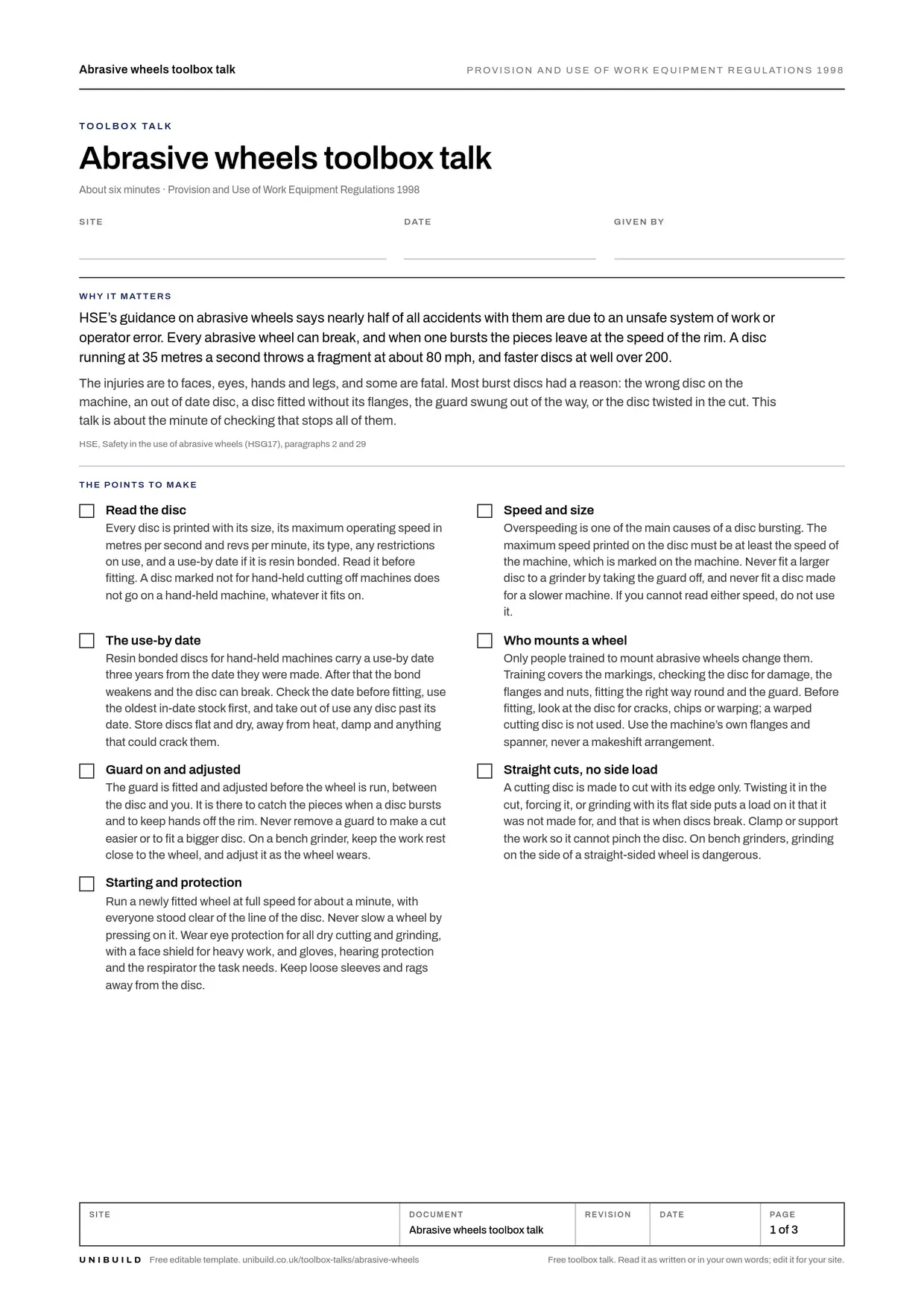
HSE’s guidance on abrasive wheels says nearly half of all accidents with them are due to an unsafe system of work or operator error. Every abrasive wheel can break, and when one bursts the pieces leave at the speed of the rim. A disc running at 35 metres a second throws a fragment at about 80 mph, and faster discs at well over 200.
The injuries are to faces, eyes, hands and legs, and some are fatal. Most burst discs had a reason: the wrong disc on the machine, an out of date disc, a disc fitted without its flanges, the guard swung out of the way, or the disc twisted in the cut. This talk is about the minute of checking that stops all of them.
HSE, Safety in the use of abrasive wheels (HSG17), paragraphs 2 and 29The points to make
Read the disc
Every disc is printed with its size, its maximum operating speed in metres per second and revs per minute, its type, any restrictions on use, and a use-by date if it is resin bonded. Read it before fitting. A disc marked not for hand-held cutting off machines does not go on a hand-held machine, whatever it fits on.
Speed and size
Overspeeding is one of the main causes of a disc bursting. The maximum speed printed on the disc must be at least the speed of the machine, which is marked on the machine. Never fit a larger disc to a grinder by taking the guard off, and never fit a disc made for a slower machine. If you cannot read either speed, do not use it.
The use-by date
Resin bonded discs for hand-held machines carry a use-by date three years from the date they were made. After that the bond weakens and the disc can break. Check the date before fitting, use the oldest in-date stock first, and take out of use any disc past its date. Store discs flat and dry, away from heat, damp and anything that could crack them.
Who mounts a wheel
Only people trained to mount abrasive wheels change them. Training covers the markings, checking the disc for damage, the flanges and nuts, fitting the right way round and the guard. Before fitting, look at the disc for cracks, chips or warping; a warped cutting disc is not used. Use the machine’s own flanges and spanner, never a makeshift arrangement.
Guard on and adjusted
The guard is fitted and adjusted before the wheel is run, between the disc and you. It is there to catch the pieces when a disc bursts and to keep hands off the rim. Never remove a guard to make a cut easier or to fit a bigger disc. On a bench grinder, keep the work rest close to the wheel, and adjust it as the wheel wears.
Straight cuts, no side load
A cutting disc is made to cut with its edge only. Twisting it in the cut, forcing it, or grinding with its flat side puts a load on it that it was not made for, and that is when discs break. Clamp or support the work so it cannot pinch the disc. On bench grinders, grinding on the side of a straight-sided wheel is dangerous.
Starting and protection
Run a newly fitted wheel at full speed for about a minute, with everyone stood clear of the line of the disc. Never slow a wheel by pressing on it. Wear eye protection for all dry cutting and grinding, with a face shield for heavy work, and gloves, hearing protection and the respirator the task needs. Keep loose sleeves and rags away from the disc.
Do
- Read the disc: size, maximum speed, restrictions and use-by date.
- Check the disc’s speed is at least the machine’s marked speed.
- Leave mounting to people trained to mount abrasive wheels.
- Fit and adjust the guard before running the wheel.
- Run a new wheel for about a minute with everyone clear of its line.
- Use water or extraction for the dust, and wear eye protection every time.
Do not
- Do not use a disc that is cracked, chipped, warped or past its use-by date.
- Do not take a guard off, or fit a larger disc than the guard was made for.
- Do not twist a cutting disc in the cut or grind with its flat side.
- Do not slow a spinning wheel by pressing on its face or rim.
- Do not use a disc marked not for hand-held machines on a hand-held tool.
Ask the team
- Where are our discs stored, and how would we find the use-by dates?
- Who here is trained to mount abrasive wheels?
- Which machines on this job have guards that have been moved or damaged?
- What would you do if a disc started to wobble or the cut started to pinch?
- How are we controlling the dust from cutting on this job?
To close
A disc spinning at full speed is stored energy, and when it lets go it throws pieces faster than a car on a motorway. Nearly half of these accidents come from how the job was done. So read the disc before fitting it, match it to the machine, check the date, leave fitting to trained people, keep the guard on, cut straight, and let a new wheel run before you put it to work. If a disc does not look or sound right, it is not used.
Record it. Who gave the talk, where, when, who was there and what was raised. The last page of the sheet is the record.