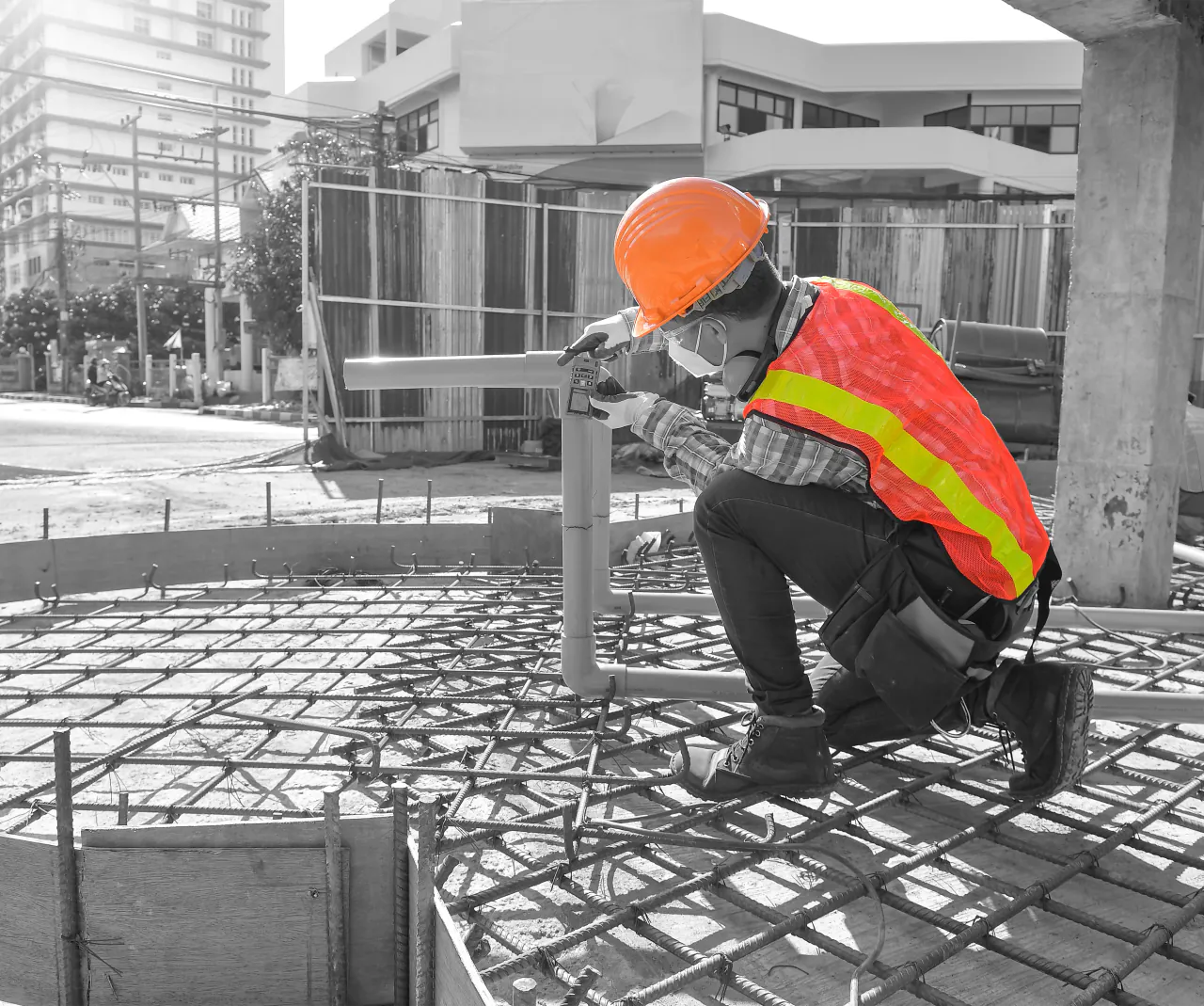
Every pile carries its own record, made as it is bored rather than typed up on Friday. Rigs and lifting accessories with their thorough examinations in date. Cages and concrete booked to the pile they went into. The working platform certificate held with the job it belongs to. 30+ modules on one account, and a piling firm turns on the handful it needs.
CFA, rotary bored, driven, sheet or mini piling: the rig differs, the office side does not.
Getting the pile in the ground is the part a piling contractor already has right. It is the record that decides whether it is ever questioned: what the ground actually did, what depth was reached, how much concrete went in against how much should have, which cage went down and who signed for the lot. All of it becomes unverifiable the moment the pile is complete.
Unibuild is bespoke business software for UK trades and specialist contractors, built inside a contracting business rather than sold into one. One account carries the labour run, plant and equipment registers, materials and stock, certification and training records, documents, day works, variations and applications for payment.
Built for piling
What piling requires, and what Unibuild provides.
A fit-out job and a piling job look alike in a database. They stop looking alike at the rig, at the concrete wagon, and when a pile is questioned six months after it was cast. Each requirement below is followed by what the platform does about it.
The tradeThe platform
Unverifiable in an hour
The pile record is the product
Once concrete is placed, the only account of what happened is what somebody wrote down at the rig. Depth, torque, penetration rate, concrete volume and over-break are the evidence the pile was built as designed.
Concrete volume against theoretical volume is the first check anybody makes
Depth, time and rate come off the rig and mean nothing if they stay there
Piles are numbered against a setting out drawing that gets revised
A missing record is a pile that has to be tested or replaced
The record made at the rig
Each pile is a record of its own against the setting out drawing, completed on the phone at the rig with depths, volumes, times and photographs attached. It is finished the moment it is saved rather than transcribed from a sheet in a cab on Friday afternoon.
A piling rig lifts casings, cages and augers, so it carries a thorough examination regime as well as maintenance. Ancillary lifting accessories, shackles, chains and lifting beams are examined in their own right and are the items most often missed.
Thorough examination at least every twelve months, or six where people are lifted
Every shackle, chain and lifting beam has its own certificate
Rig assembly and dismantling are temporary works in themselves
A missing certificate stops the rig, not just the lift
One record per rig and accessory
Rigs, augers, casings and every lifting accessory are held individually by serial number with examination dates, service history and attachments, on one reminder page. Scanning the item returns what is due on it before it goes on a lorry.
A piling rig overturning is the accident this trade is judged by, and the control is a designed, constructed and certified working platform. The certificate is issued by the principal contractor and it is the document that decides who carries the risk.
The platform is designed for the rig that will stand on it
The certificate names the rig, the loading and the maintenance regime
Ground conditions change the platform after rain, not just after use
The certificate is asked for by the rig operator and by the insurer
The certificate held with the job
The working platform certificate, the design it references and the reinspections after it sit against the site rather than in an email. When the rig operator asks whether the platform is signed off, the answer is on the job in front of them.
Reinforcement cages are fabricated to a schedule for specific piles, and concrete is ordered by the cubic metre against a theoretical volume that the ground then disagrees with. Both are consumed the moment they arrive.
Cages are scheduled per pile diameter and length, not by the tonne
Concrete has a workability window measured in tens of minutes
Cube samples are taken and tested against the pour they came from
Over-break turns a priced volume into a variation
Materials booked to the pile
Cages, concrete and consumables are booked as movements against the pile and the job as they are used, so consumption sits in job costing rather than in a delivery note. Over-break shows up as a priced variation while the wagon is still on site.
Low strain integrity testing and load testing happen after the pile exists, and what they find is compared against the record made on the day. A pile with a good record and an odd trace is a conversation. A pile with no record is a problem.
Testing is programmed against a percentage of the piles
Results are read alongside the pile record, not instead of it
A questioned pile can mean a replacement pile and a delayed programme
The engineer asks for the record before asking for a retest
The record ready when the trace is not
The pile record, the concrete tickets, the cube results and the photographs sit against the pile, so a query is answered from the job rather than from a foreman's memory of a Tuesday in March.
Rig operators, banksmen and slingers all carry tickets, and the categories are specific. Alongside them sit health surveillance for vibration and noise, and the audits that keep you on the framework.
Operator tickets are per rig category rather than general
Slinging and banksman duties carry their own competence
Hand arm vibration surveillance runs on its own cycle
Client audits sample the records rather than accept assurances
Tickets and surveillance on one grid
Tickets, categories, health surveillance and accreditations sit against the person on one matrix and turn amber before they lapse. A subcontract crew whose insurance or certificate has lapsed drops out of approved status overnight and off the order forms with it.
Counted in the deployment Unibuild was built on, July 2026: one expiry page carrying 376 assets, 141 subcontractor certificates, 84 accreditations, 80 health assessments, 55 instruments and 9 vehicles.
Bored piles
Driven and sheet piles
Concrete and grout
Reinforcement cages
Casings and augers
Rigs and cranes
Bentonite and polymer
Pile records and tests
The week
An ordinary week in a piling firm, and the record it leaves.
Six entries from a piling contractor's day book. Nothing here asks anybody to remember something at five o'clock on a Friday.
Monday, mobilisation
The working platform certificate, the design it references and the rig examination all sit on the job, so the rig tracks on against a signed platform rather than an assurance.
Signed before it tracks on
At the rig
Pile forty two is recorded where it is bored: depth, time, torque, concrete volume against theoretical, and a photograph of the cage before it went down.
Recorded as it is built
The wagon
Concrete is booked to the pile as it is placed, so over-break appears as a priced variation while the wagon is still on site rather than in a valuation.
Priced on the day
Wednesday
A cage is fabricated to the schedule for three piles and booked out against them, so the reinforcement in job costing is the reinforcement in the ground.
Booked to the pile
At the gate
The principal contractor asks for operator tickets, the lifting accessory certificates and the platform certificate. All three come off one page, in date.
Rig stays working
The test
Integrity testing flags an odd trace on one pile. The record, the concrete ticket and the cube result are all on the pile.
Answered from the record
The test
Eight things piling software has to do.
Muddy, gloved, at a rig with a wagon waiting, in two taps rather than ten. A system that cannot meet these eight gets abandoned inside a month, and that is a failure of design rather than of discipline. Unibuild is 30+ modules on one account, and a piling firm turns on a handful.
Gloved, at the rig, with a wagon waiting
The field app carries 25+ modules on the phone, granted per person, so an operative sees the three things they need and nothing else. Clock in is a QR scan at the compound. Time and attendance is stamped by the server rather than the handset, with a photograph on each clock-in. The design constraint throughout was a cold morning and a gloved hand, because a system that takes a minute at a rig with concrete going off does not get used twice.
A record per pile, not per day
Project and site management holds the site diary, drawings, day works and dated photographs against the job, so a pile record is an entry against a numbered pile on a setting out drawing rather than a line on a daily sheet.
Rigs and every lifting accessory held individually
Rigs, augers, casings, shackles, chains and lifting beams are one record per physical item in assets and inventory, each with a serial, a QR label and a full service history. Scanning the item returns its examination dates before it goes on a lorry.
Assets and inventory holds stock against locations with an append only ledger, and booking a cage or a load of concrete to a pile posts the movement rather than leaving a second job for somebody to forget. That is what makes over-break visible in cost control.
Certificates that are found by the job
Documents and certificates holds the platform certificate, examination reports, cube results and test reports against the site and the pile, with an audit trail on the document itself, and issues 58 document types on your own letterhead.
Variations priced while the ground is open
Variations and day works are raised on site against the job, with photographs and a signature, at the moment the ground stops matching the design. The valuation then argues with a dated record rather than a recollection.
Priced per business, not per operative
Users are unlimited on every plan. One monthly figure covers everything, sized to the business when it is quoted and fixed for three years. A second rig crew never changes the fee, and the pricing page explains how it is worked out.
The yard
What a piling firm holds
The yard and the site, and the quirk in each line that breaks ordinary inventory software. Written for the trade rather than for any one firm. Most piling contractors will recognise seven or eight of these lines and ignore the rest.
What a UK piling contractor holds, and the tracking quirk in each line
Key
Category
Typical items
The tracking quirk
Rigs
CFA rigs, rotary bored rigs, driven rigs, mini piling rigs, sheet pile hammers and leaders
Serialised, six figure assets with a thorough examination, a maintenance history and an assembly and dismantling procedure that is itself temporary works
Wear items on expensive assets. Diameters have to match the pile schedule, and a worn auger changes the volume relationship you rely on
Reinforcement cages
Cages fabricated to a schedule per diameter and length, spacers, lifting eyes, couplers
Made for specific piles rather than stocked. A cage for a pile that has moved on the setting out drawing is scrap, not stock
Concrete and grout
Structural concrete by design mix, grout for CFA and mini piles, admixtures, cube moulds
Ordered against a theoretical volume and consumed in tens of minutes. The gap between theoretical and actual is the commercial story of the job
Bentonite and polymer
Bentonite powder, polymer support fluid, mixing and desanding plant, testing equipment
Mixed on site to a specification and tested for density and sand content. Batch conditions matter and are rarely recorded well
Sheet piles and driven sections
Sheet pile sections, tubular and H sections, clutches, extraction gear
Often hired rather than owned, driven and later extracted, so the same asset is stock, plant and a recovery job in one
Cranes and lifting accessories
Service cranes, lifting beams, chains, shackles, slings, spreader bars
Every accessory carries its own certificate and examination date. This is the register most often incomplete when an audit asks
Small plant and tools
Welding sets, generators, pumps, lighting, compressors, hand tools
Portable appliance testing, calibration where readings matter, and a serial number on anything worth taking from a compound
Site setup and welfare
Welfare units, fencing, matting, working platform materials, wheel wash
Hired on long periods against a programme that moves. The off hire reference rather than the phone call is what stops the charge
Records and certificates
Pile records, platform certificates, examination reports, cube results, test reports
Not stock, but the only remaining evidence of a buried product. Each carries a pile number and a person who signed it
Regulations
The regimes a piling firm works under
Piling carries a heavier examination and temporary works load than almost any other groundworks discipline, because the equipment lifts, the platform it stands on is engineered, and the product is invisible within the hour. This is the reference version, kept factual.
What each regime asks of a piling contractor
Regime
What it requires
LOLER 1998
A piling rig lifts casings, cages and augers, so it is lifting equipment. Thorough examination is required at least every twelve months, or every six where people are lifted, and lifting accessories such as chains, shackles and beams are examined in their own right. The report is kept and produced on request.
PUWER 1998
Work equipment must be suitable, maintained in good repair and inspected where safety depends on its condition. For a piling contractor that covers rigs, augers, hammers, pumps and welding sets, and the record has to identify the individual item rather than a quantity on a line.
BS 5975 and temporary works
Working platforms, rig assembly and dismantling, and any temporary support are temporary works requiring design, a temporary works coordinator and a permit to proceed. The Federation of Piling Specialists working platform certificate is the document that records that a platform is fit for the rig standing on it.
CDM 2015
A piling contractor is a contractor and sometimes a principal contractor, with duties around planning, the construction phase plan and cooperation. Where the work is notifiable the client makes the notification, but the arrangements for managing it are the contractor's to record.
ICE Specification for Piling and Embedded Retaining Walls
The industry specification sets what a pile record must contain, the tolerances that apply, and the testing regime. The record made at the rig is the document that demonstrates compliance with it, and it is written into the contract rather than being good practice.
Control of Noise at Work 2005 and vibration
Driven piling and percussive work put operatives over exposure action values routinely, and hand arm vibration from breakers and grinders carries its own limits. Exposure is assessed and controlled, with health surveillance where the limits require it.
Control of Substances Hazardous to Health 2002
Bentonite, polymers, admixtures, grouts and fuels all carry assessments and storage conditions, and silica dust from coring and breaking is one of the most heavily enforced exposures in construction.
RIDDOR 2013
Specified injuries, over seven day injuries and dangerous occurrences are reportable. On this trade the overturning or collapse of lifting equipment is the category most often engaged, and it is assessed against the platform certificate and the examination records that were current on the day.
On the record
Questions piling firms ask
The questions piling firms actually raise on a demonstration, answered on the record. Open one to read the response.
Pile recordsCan every pile have its own record, made at the rig?+
Yes. Each pile is an entry against the job and the setting out drawing, completed on the phone at the rig with depths, volumes, times and photographs. Rig data is entered there or attached as the logger's own file, against the numbered pile. The record is finished the moment it is saved, before the rig moves to the next position.
ConcreteCan it show over-break against theoretical volume?+
Yes. It holds both figures against the pile, shows the difference, and turns it into a priced variation while the wagon is still on site. The theoretical volume comes from your engineer's design. Cages and concrete are booked to the pile as they are used, so the materials in job costing are the materials in the ground.
TestingWhen a pile is questioned months later, what can we show?+
The pile record, the concrete ticket, the cube results and the photographs, all held against that pile. An odd integrity trace is answered from the job rather than from a foreman's memory of a Tuesday in March. Unibuild keeps every record for seven years.
ExaminationsHow does it handle thorough examinations on rigs and accessories?+
Each rig, auger, casing, chain, shackle and lifting beam is a record of its own, with a next examination date and a service history with attachments. One page watches the registers together, so what is due or overdue is a list rather than a hunt. Scanning the item returns its examination dates before it goes on a lorry.
Platform certificateWhere does the working platform certificate live?+
Against the site it belongs to, with the design it references and any reinspection after rain or damage. An operator asks whether the platform is signed off before tracking a rig onto it. The answer is on the job in front of them, not in somebody's inbox.
CompetenceCan we produce operator tickets and certificates at the gate?+
Yes. Tickets, categories, health surveillance and accreditations sit against each person on one matrix and turn amber before they lapse. When the principal contractor asks for operator tickets, lifting accessory certificates and the platform certificate, all three come off one page, in date.
SubcontractorsWhat happens when a subcontract crew's insurance lapses?+
The crew drops out of approved status overnight, and off the order forms with it. Their certificates and insurances are held on the subcontractor portal, so the lapse is seen before the crew is booked rather than after.
SignalWhat happens when there is no signal on site?+
It keeps working. Clock-ins are stored on the phone and synced with the office the moment it is back in signal, so nothing is lost and nothing is entered twice. The field app is built for patchy coverage, which in a basement box or on a remote site is the normal condition.
AdoptionWill rig crews actually use it?+
Yes, when what you ask of them is small. Each operative is granted three things on the phone: clock in, the pile record and RAMS acceptance, and the office carries the rest. Permissions are granted per person, so that is a setting rather than a compromise.
The marketWhat software do UK piling contractors use?+
Most run a combination: rig instrumentation with its own output, a spreadsheet or a pad for pile records, a plant register kept by hand and an accounts package behind it. Unibuild holds the pile records, the plant register, the materials, the documents and the commercial position on one account, with modules turned on as you need them.
PricingHow is it priced, and do you charge per operative?+
One monthly figure covers everything, with unlimited users and no charge per operative. It is sized to the firm when it is quoted and fixed for three years. Taking on more people never changes the fee, which matters when a second rig means a second crew. How pricing works.
RolloutDo we have to move everything across at once?+
No. Most piling firms start with the plant and lifting register, because that is the one an audit tests first, and add pile records once the first is habit. Most firms go live in about two weeks, in phases, and the 14-day trial is the full platform with no card needed.
Free RAMS templates
RAMS for this work, already filled in.
Risk assessments and method statements pre-filled for the work this trade does, free in PDF and Word, each with the law and a toolbox talk.
Half an hour, on your own jobs and your own plant list. Bring a live setting out drawing and we will set it up in front of you. Unlimited users, never per seat, and fourteen days to try it without a card.