
Hot works risk assessment and RAMS template
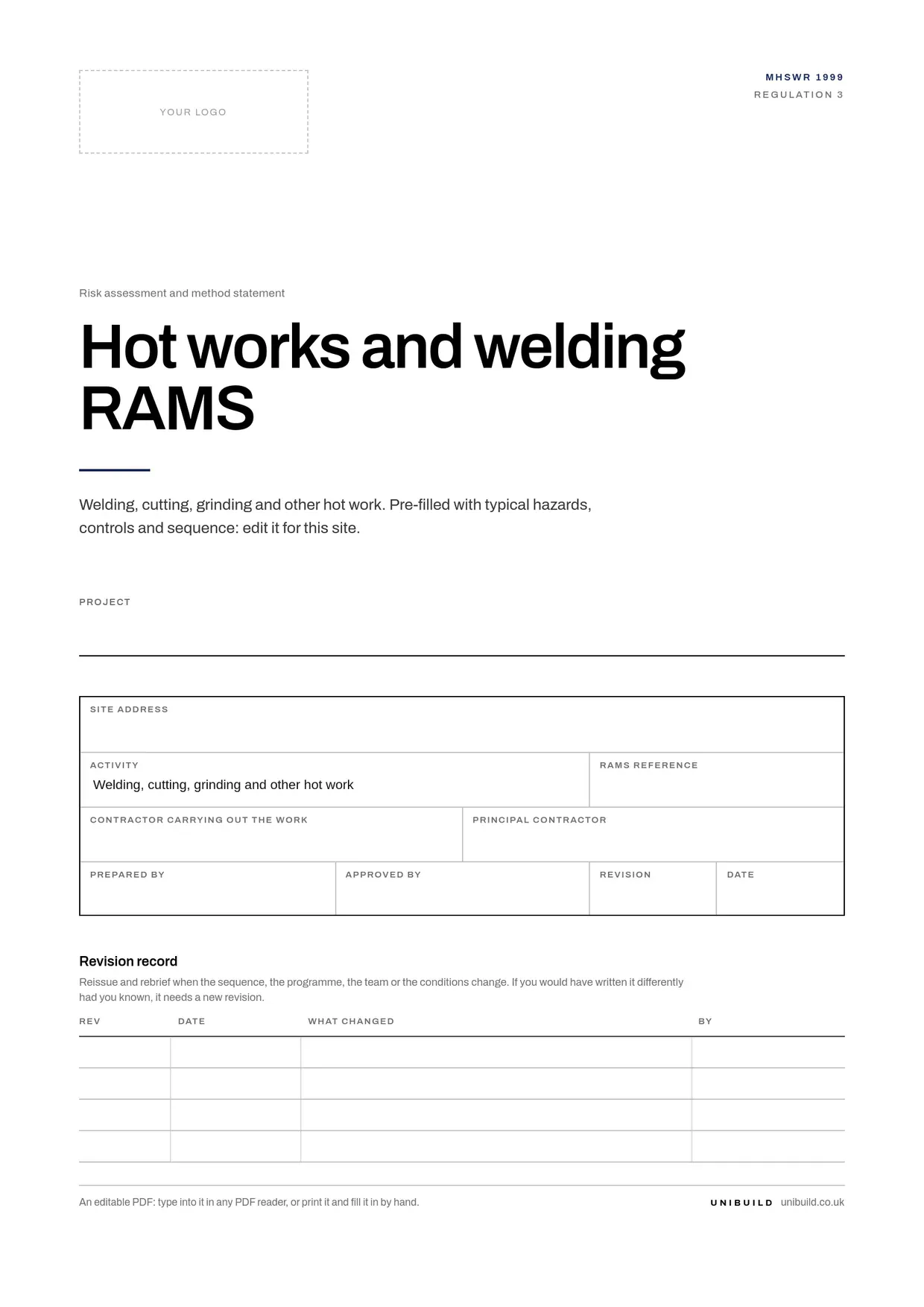
A hot works and welding risk assessment and method statement, already filled in with the hazards, controls and sequence for welding, cutting, grinding and torch work. Edit it for your site, then brief it.
- Law
- CDM 2015 regulation 29 and COSHH 2002
- Fire watch
- 1 hour after, check at 2 hours
- Format
- Editable PDF and Word
- Cost
- Free, always
Do you need a risk assessment for hot works?
Yes. Any work that makes flame, sparks or heat needs a risk assessment, and CDM 2015 requires suitable steps to prevent injury from fire or explosion during construction work. Most sites also run a hot work permit.
The risk assessment is the legal duty, under regulation 3 of the Management of Health and Safety at Work Regulations 1999. The method statement sets out the controls: clearing combustibles, the permit, the fire watch, fume extraction, and safe use of gas cylinders and welding sets.
Welding fume needs its own attention. HSE treats all welding fume, including mild steel fume, as able to cause lung cancer. Indoor welding needs extraction at source, with RPE where extraction is not enough.
Hot works and welding hazards and controls
15 hazards, rated before and after controlsThe significant hazards when welding, cutting, grinding or heating on site, with the controls a reviewer expects to see. Delete what does not apply and add what your site has.
Fire from sparks, slag and heat
Everyone on site and the building, from sparks reaching voids, gaps and combustible materials.
- Combustibles removed from the area, voids, openings, the floor below and beyond walls; what cannot move is covered with non-combustible board.
- Hot work permit issued for the job, location and time, after the issuer has checked the area.
- At least two suitable extinguishers within reach, and the team trained to use them.
BeforeHigh 20AfterMedium 5
Smouldering fire after work ends
The building and anyone in it after the team leaves, from material that smoulders before it ignites.
- Continuous fire watch for at least an hour after hot work ends, then a further check at two hours, as HSG168 advises.
- Hot work finished at least two hours before the end of the working day.
- Areas above, below and beside the work included in the watch, with a thermal imaging camera where available.
BeforeHigh 15AfterMedium 5
Welding fume
Welders and others nearby, from fume that can cause lung cancer and other lung disease.
- Cold methods or lower-fume processes chosen where practicable.
- Local exhaust ventilation capturing fume at source for all indoor welding; general ventilation alone is not enough.
- RPE where LEV is not enough and for all outdoor welding. HSE names powered air RPE with a protection factor of at least 20 as the best option for arc welders.
BeforeHigh 20AfterMedium 10
Fume from coated or contaminated metal
Welders and cutters working on painted, galvanised, plated or dirty metal.
- Coatings identified before work; lead paint and other coatings removed back from the cut where practicable.
- Extraction and RPE chosen for the coating, under a COSHH assessment.
BeforeMedium 12AfterLow 4
Gas cylinder leaks, fire and explosion
Users and everyone nearby, from leaking oxy-fuel or LPG cylinders, hoses and regulators.
- Only the cylinders needed on site; stored upright and secured, oxygen apart from fuel gases, and returned to the store after work.
- Hoses colour coded, kept short, and leak checked with a proprietary leak detection spray, never a flame.
- Cylinder valves closed at the end of the job and before cylinders are moved.
BeforeHigh 15AfterMedium 5
Flashback
The operator and anyone near the cylinders, from flame burning back through the hose to the regulator.
- Flashback arresters at the regulators on both oxygen and fuel gas, and non-return valves at the torch.
- Correct lighting-up procedure, with hoses purged and a spark igniter used.
- Equipment checked after any flashback; a heated acetylene cylinder is left alone and the fire service called.
BeforeMedium 10AfterMedium 5
Oxygen enrichment
Workers in enclosed areas, where leaking or misused oxygen makes clothing burn fiercely.
- Oxygen never used to blow dust off clothing or to freshen the air in a space.
- No oil or grease on oxygen valves, regulators or fittings.
- Hoses and torches taken out of enclosed spaces during breaks.
BeforeMedium 10AfterMedium 5
Flammable atmospheres, tanks and drums
Workers cutting or welding containers that held flammable materials, or working near flammable vapour.
- Hot work avoided where a flammable atmosphere may exist; where DSEAR applies, its assessment and the site permit are followed.
- Tanks and drums cleaned and certified free of gas and residues by a competent person before hot work.
- Gas detector used before and during work near possible flammable vapour.
BeforeMedium 10AfterMedium 5
Electric shock from welding sets
Arc welders, especially in damp conditions or in contact with steelwork.
- Welding sets to the appropriate standard, with leads, connectors and electrode holders checked for damage before use.
- Return lead clamped close to the work, not to handrails or pipes.
- Dry gloves and clothing, an insulating mat or dry platform in damp conditions, and a set with a no-load voltage limiting device.
BeforeHigh 15AfterMedium 5
UV radiation and arc eye
Welders and anyone nearby, from arc light that burns the eyes and skin.
- Welding helmet or face shield with a filter suited to the process and current.
- Welding screens around the work to protect others.
- Skin covered with flame-resistant clothing, including arms and neck.
BeforeMedium 12AfterLow 3
Burns from spatter and hot metal
Welders, cutters and helpers handling freshly cut or welded metal.
- Flame-resistant overalls, leather gauntlets, boots and spats.
- Hot metal marked, or left to cool in a safe place.
BeforeMedium 12AfterMedium 6
Abrasive wheel breakage and contact
Grinder users and people nearby, from a wheel bursting or a cutting disc shattering.
- Wheels mounted only by people trained to do it, as HSE guidance HSG17 advises.
- Speed marked on the wheel at least the speed of the machine, wheel inspected before fitting, and the guard in place.
- Grinder held with both hands, with nobody in line with the wheel.
BeforeMedium 12AfterLow 4
Noise and vibration from grinding
Grinder users and others working nearby.
- Noise and vibration exposure assessed, with time on the tool planned to stay within the action values.
- Hearing protection where the assessment requires it; low-vibration tools and well-maintained wheels.
BeforeMedium 12AfterMedium 6
Hot work in confined spaces
Welders in tanks, ducts, voids and chambers, where fume and gas build up and oxygen can fall.
- Entry avoided where the work can be done from outside.
- Where entry is needed, a safe system of work with gas monitoring, ventilation, cylinders kept outside, and a rescue plan.
BeforeMedium 10AfterMedium 5
Fire alarm isolated for the work
Everyone in the building, if detectors isolated for hot work are not switched back on.
- Detectors isolated only under the site procedure, by the person responsible for the alarm.
- Each isolation logged and reinstated when work stops for a break or the day, and before the permit is closed.
BeforeHigh 15AfterMedium 5
Scores are likelihood times severity on the five by five matrix in the template. They are typical ratings for this work, a starting point for your own assessment of your site.
Hot works method statement: the sequence of work
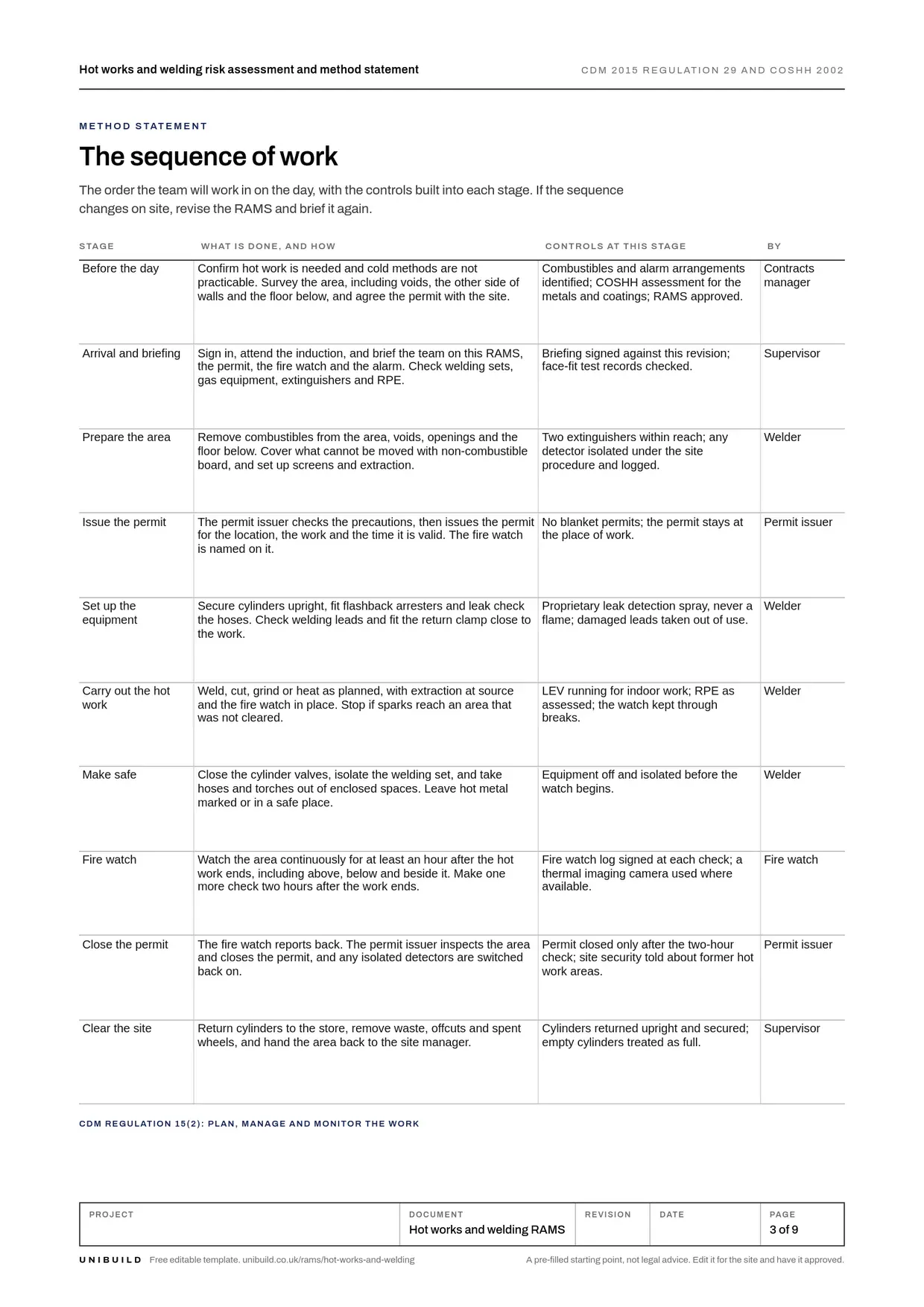
The order of work, with the controls at each stageThe order the team works in, with the controls built into each stage. If the sequence changes on site, revise the RAMS and brief it again.
Before the day
Confirm hot work is needed and cold methods are not practicable. Survey the area, including voids, the other side of walls and the floor below, and agree the permit with the site.
ControlsCombustibles and alarm arrangements identified; COSHH assessment for the metals and coatings; RAMS approved.
Arrival and briefing
Sign in, attend the induction, and brief the team on this RAMS, the permit, the fire watch and the alarm. Check welding sets, gas equipment, extinguishers and RPE.
ControlsBriefing signed against this revision; face-fit test records checked.
Prepare the area
Remove combustibles from the area, voids, openings and the floor below. Cover what cannot be moved with non-combustible board, and set up screens and extraction.
ControlsTwo extinguishers within reach; any detector isolated under the site procedure and logged.
Issue the permit
The permit issuer checks the precautions, then issues the permit for the location, the work and the time it is valid. The fire watch is named on it.
ControlsNo blanket permits; the permit stays at the place of work.
Set up the equipment
Secure cylinders upright, fit flashback arresters and leak check the hoses. Check welding leads and fit the return clamp close to the work.
ControlsProprietary leak detection spray, never a flame; damaged leads taken out of use.
Carry out the hot work
Weld, cut, grind or heat as planned, with extraction at source and the fire watch in place. Stop if sparks reach an area that was not cleared.
ControlsLEV running for indoor work; RPE as assessed; the watch kept through breaks.
Make safe
Close the cylinder valves, isolate the welding set, and take hoses and torches out of enclosed spaces. Leave hot metal marked or in a safe place.
ControlsEquipment off and isolated before the watch begins.
Fire watch
Watch the area continuously for at least an hour after the hot work ends, including above, below and beside it. Make one more check two hours after the work ends.
ControlsFire watch log signed at each check; a thermal imaging camera used where available.
Close the permit
The fire watch reports back. The permit issuer inspects the area and closes the permit, and any isolated detectors are switched back on.
ControlsPermit closed only after the two-hour check; site security told about former hot work areas.
Clear the site
Return cylinders to the store, remove waste, offcuts and spent wheels, and hand the area back to the site manager.
ControlsCylinders returned upright and secured; empty cylinders treated as full.
What the law asks for hot works and welding
Checked against the sourceFire and explosion
Suitable and sufficient steps must be taken to prevent, so far as is reasonably practicable, the risk of injury from fire or explosion during construction work.
Construction (Design and Management) Regulations 2015, regulation 29Instruction and fire equipment
Where an activity gives rise to a particular risk of fire, no one carries it out unless suitably instructed. Suitable fire-fighting equipment is provided, easily accessible, signed and maintained.
Construction (Design and Management) Regulations 2015, regulation 32Permit and fire watch
HSE guidance: use a permit-to-work where hot work cannot be avoided, and keep a fire watch through work and breaks. Watch continuously for at least an hour afterwards, then check again at two hours.
HSE HSG168 Fire safety in construction, paragraphs 122 to 129Welding fume
Exposure to hazardous substances is prevented or adequately controlled, and exposure to a carcinogen is kept as low as reasonably practicable. Since February 2019 HSE expects engineering controls, such as LEV, for all indoor welding.
COSHH Regulations 2002, regulation 7Flammable atmospheres
Where dangerous substances are present, the risk is eliminated or reduced so far as is reasonably practicable. Substitution comes first, then measures that include avoiding ignition sources.
Dangerous Substances and Explosive Atmospheres Regulations 2002, regulation 6Training for grinders and wheels
Everyone who uses work equipment, and anyone who supervises its use, must have adequate training in its use, the risks and the precautions. For abrasive wheels, HSE guidance HSG17 adds mounting.
Provision and Use of Work Equipment Regulations 1998, regulation 9Competence, equipment and PPE
Competence and cards
- Welders Trained and assessed for the process and position, working to the welding procedure for the job.
- Permit issuer Given clear authority by the principal contractor to issue and close hot work permits.
- Fire watch Briefed on the area, trained to use the extinguishers, and able to raise the alarm.
- Grinder users Trained in the safe use and mounting of abrasive wheels, with a record of the training kept.
- Gas equipment users Trained in oxy-fuel equipment, including lighting up, shutting down and what to do after a flashback.
- RPE wearers Face-fit tested for each tight-fitting mask they use, and trained to check it before use.
Plant and equipment
- Welding set and leads Leads, connectors and holder checked for damage before use.
- Oxy-fuel set, regulators and hoses Flashback arresters fitted; leak test before use.
- Angle grinder and wheels Wheel speed rating at least the machine speed; guard in place.
- LEV unit Checked before use; hood placed close to the arc.
- Fire extinguishers At least two, suitable for the materials, within reach.
- Gas detector In calibration and checked before use.
PPE
- Welding helmet or face shield with a filter suited to the process and current.
- Flame-resistant clothing covering arms and neck, with leather gauntlets and spats.
- RPE powered air RPE with a protection factor of at least 20 for arc welding, or as assessed.
- Eye protection impact rated, for grinding and chipping slag.
- Hearing protection for grinding, where the noise assessment requires it.
- Safety boots leather, with toe protection.
Permits and plans
A hot work permit for each job, location and time period, issued and closed by an authorised person. A confined space entry permit for welding in tanks or chambers. A permit to work where DSEAR applies or the site requires one.
Emergency and rescue
For fire, raise the alarm, stop work and close cylinder valves if it is safe. Use an extinguisher only if trained and safe to do so. Never move a heated acetylene cylinder: clear the area and tell the fire service where it is. First aider and kit on site, with the nearest accident and emergency department named on the briefing.
Toolbox talk: hot work and fire watch
Read this to the team before work starts, tick each point as it is covered, and record who attended.
- No permit, no hot work. The permit is for this job, this place and this time only.
- Clear it, cover it, check behind it. Sparks travel into voids and through gaps you cannot see.
- Two extinguishers within reach before anyone strikes an arc or lights a torch.
- The fire watch stays for at least an hour after the last spark, and comes back at two hours.
- Welding fume can cause cancer. Extraction on, at the arc, and RPE on when the assessment says so.
- Cylinders upright and secured, valves shut when you stop, and leaks checked with spray, never a flame.
Ask the team
- Who is the fire watch today, and where are the extinguishers?
- What is on the other side of this wall and below this floor?
- How do you raise the fire alarm from here?
What is in the hot works and welding RAMS template
9 pages, pre-filled and editableThe work, pre-filled
Scope, location and access, interfaces with other trades, the documents the RAMS relies on, and the team with their training.
The sequence of work
Ten stages from survey to clearing the site, with the controls and the person responsible at each one.
Hazards and controls
Fifteen hot works hazards rated before and after controls on a five by five matrix, with room for your own.
Plant, PPE and permits
The equipment and its checks, PPE by type, the fume and gas substances, and the permits the job needs.
Fire watch log
A page to sign each check, from the work itself through the hour after it ends to the final check at two hours.
Emergency and briefing
Fire and cylinder emergencies, the environment section, and twenty signatures against the revision.
Brief it, and get it signed on the phone
On Unibuild a RAMS is written from a template, approved, then read by each operative on their phone in their own language and signed. Subcontract and agency workers sign through a link, with no app to install.
Every signature carries its date and time and prints as the last page of the RAMS PDF. Change the RAMS and it has to be signed again.
How RAMS work on UnibuildHot works and welding RAMS questions
Is this hot works and welding RAMS template free?
What is a hot works risk assessment?
How long should a fire watch last after hot work?
Is a hot work permit a legal requirement?
Is welding fume a carcinogen?
What should a welding risk assessment include?
Does grinding count as hot work?
When should hot work stop for the day?
RAMS templates for other trades and hazards
All free, pre-filled and editableBy trade
- Electrical RAMSSafe isolation, live work, testing and inspection, and working near other trades.
- Scaffolding RAMSErecting, altering and dismantling tube and fitting and system scaffold, with handover and inspection.
- Roofing RAMSPitched and flat roofs, fragile surfaces, edge protection, hot work and getting materials up safely.
- Groundworks RAMSExcavations, buried services, plant, trench support and inspections at the start of each shift.
- Plumbing and heating RAMSSoldering and brazing, gas work, unvented systems, lofts and occupied homes.
- Painting and decorating RAMSAccess equipment, solvents and spray, old lead paint, dust from preparation and occupied buildings.
- Hot works and welding RAMSWelding, cutting, grinding and torch-on work: permits, fire watch, fume and gas cylinders.
By hazard
- COSHH risk assessmentHazardous substances on site: dusts, solvents, cement, resins and fume, assessed and controlled.
- Manual handling risk assessmentLifting, carrying, pushing and pulling, assessed by task, individual, load and environment.
- Working at height risk assessmentLadders, towers, MEWPs, scaffolds and roofs, chosen and controlled in the order the law sets.
- Lone working risk assessmentPeople working alone on site, in empty buildings and out of hours, with check-ins and a plan if they go quiet.
- Noise and vibration risk assessmentNoise exposure and hand-arm vibration from tools, measured against the action and limit values.
- Asbestos risk assessmentFinding asbestos before work starts, deciding whether work is licensed, and controlling non-licensed work.
- Confined space risk assessmentManholes, tanks, voids and chambers: avoiding entry, a safe system of work, gas testing and rescue.
The blank RAMS template, the RAMS review checklist and every other free form are on Free downloads.
The RAMS, read and signed
before the work starts.
Unibuild keeps every RAMS with its versions, its approvals and each operative’s signature against the revision they read, for seven years, ready for the principal contractor or an auditor.