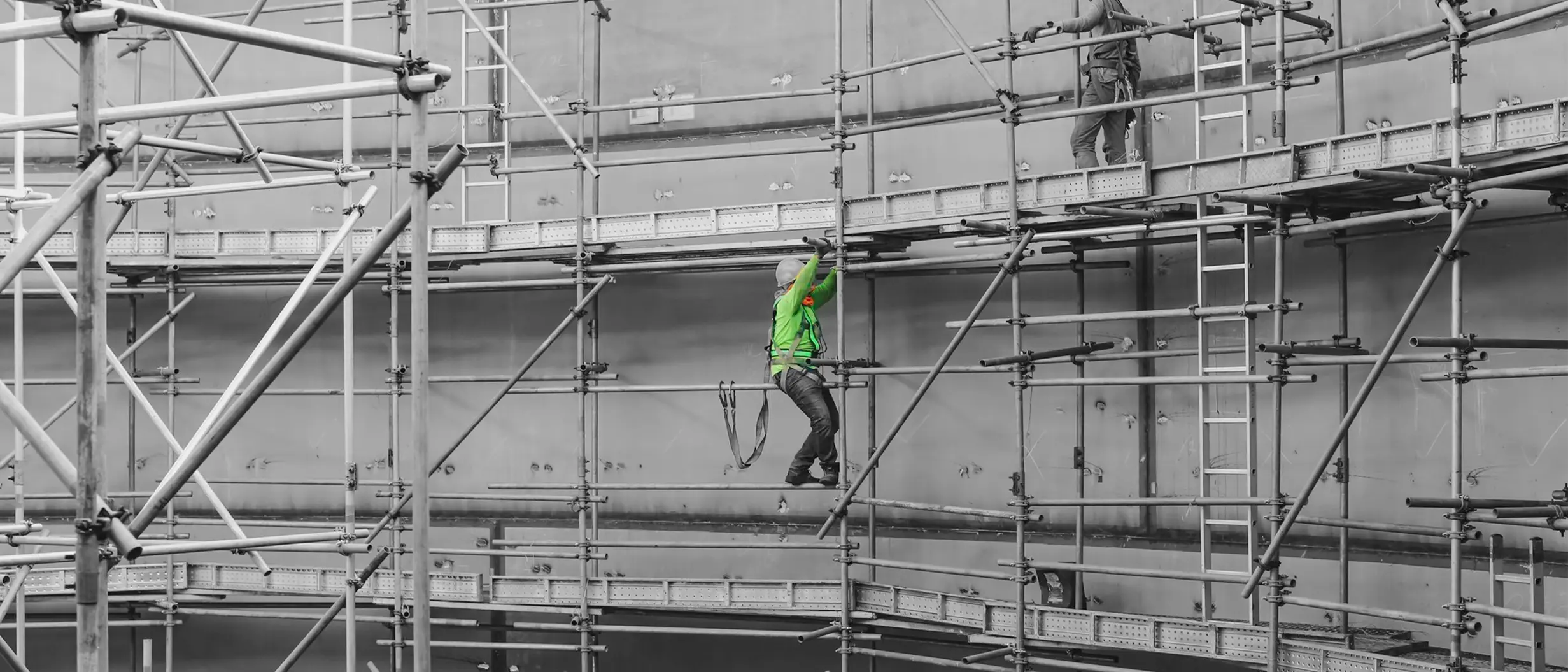
Your whole business is standing on somebody else's site.
Every bay you own is booked to the contract it stands on. The hire clock runs where the office can see it. Inspections on every standing scaffold sit on one page rather than a clipboard. Handover certificates, adaptations and CISRS cards are produced at the gate. Around thirty modules on one account, and a scaffolding firm turns on the handful it needs.
Tube and fitting, system, birdcage or temporary roof: the scaffold differs, the office side does not.
The scaffold is the part a scaffolding firm already has right. It is the register behind it that decides the year: what is standing, where, since when, who signed it, what came back off the wagon, and which adaptations somebody made without telling you.
Unibuild is construction management software for UK contractors, built inside a contracting business rather than sold into one. One account carries the labour run, plant and equipment registers, materials and stock, certification and training records, documents, day works, variations and applications for payment.
Built for scaffolding
What scaffolding requires, and what Unibuild provides.
A fit-out job and a scaffolding job look alike in a database. They stop looking alike in the yard, at the seven day inspection, and in the hire account. Each requirement below is followed by what the platform does about it.
The tradeThe platform
Bought once, lost a bay at a time
Your stock is your asset and it lives elsewhere
Everything of value you own is spread across other people's sites in quantities nobody can see, and it comes back short a little at a time.
Tube is roughly half your material value, boards and fittings the other half
Timber boards are written off over one to three years and often last eighteen months
Losses, repairs and replacement decide the margin, not the erect price
A yard count that is six months old is a guess with a number on it
Every bay booked to a contract
Tube, fittings, boards and beams are held as stock against the contract they went out on, and what comes back is booked in as a movement. The yard figure stops being a March count and a hopeful guess, and short returns show up against the job that lost them.

The erect and dismantle are priced. The weeks in between are the business, and they are the part most often left unbilled.
Some firms include four weeks in the price, others eight, then it is on hire
A scaffold left standing past its period is revenue or exposure, depending only on whether anyone billed it
A job that finishes early rarely triggers a strike instruction
Nobody in the yard finds out that a contract ended
The hire clock where the office can see it
Every standing scaffold carries the contract, the erection date and the hire period, and there is a standing view of scaffolds still up on jobs that have finished. That list is the one that catches six weeks of hire nobody was invoicing.
Your product is left unattended among other trades who need it out of the way, and the guidance on that is unusually blunt.
Only competent scaffolders you have authorised may alter a scaffold
A client authorising an alteration may invalidate their own insurance
Interference can be an offence under section 7 of the Act
The certificate still carries your name and your firm
Adaptations recorded when they happen
An adaptation is raised on the phone at the scaffold, with photographs and who asked for it, so an unauthorised alteration is a dated record rather than a conversation. The liability does not move; what changes is that you can show when it did.
It is not an administrative courtesy. It is the document that moves responsibility to the principal contractor, and until it exists no other trade should set foot on the lift.
Who erected it, when, and to which design
The safe working load and any conditions of use
Signed by somebody competent to inspect and certify it
A supervisor at minimum, advanced for the complex configurations
Handover signed on the phone
The handover certificate is produced on site, numbered and branded to your firm, against the scaffold it describes. It is handed over at the gate rather than after an office cycle, and it sits with the inspections that follow it.
The seven day inspection is not per site or per contract. It is per scaffold, it restarts after anything that could have affected stability, and each one needs a written record.
At least every seven days while it stands
Again after high wind, an impact or an alteration
A written record every time, held in the register
Thirty standing scaffolds is thirty separate clocks
Thirty one clocks on one page
Each standing scaffold has its own next inspection date, and one page bands them together, amber inside the window and red once passed. A person still has to go and inspect it. What changes is that nobody has to remember which ones are due.
A standard configuration can be justified from the guidance. Anything outside it needs a bespoke design, and knowing which of the two you are on is itself a record.
TG20:21 compliance sheets cover the standard configurations
Outside those parameters a bespoke design is mandatory
The sheet or the drawing belongs with that scaffold, not in a drive
Courts treat the industry guidance as the standard of care
Filed with the scaffold, not in a folder
The compliance sheet or the design drawing sits against the scaffold it belongs to, with the version that was issued and who accepted it. When an inspector or a principal contractor asks, it is retrieved by the scaffold rather than searched for across a drive.
Counted in the deployment Unibuild was built on, July 2026: one expiry page carrying 376 assets, 141 subcontractor certificates, 84 accreditations, 80 health assessments, 55 instruments and 9 vehicles.
Tube and fittings
System scaffold
Boards and battens
Beams and bridging
Ties and anchors
Loading and access
Sheeting and protection
Certificates and records
The week
An ordinary week, and the record it leaves.
Six entries from a scaffolding firm's day book. Nothing here asks anybody to remember something at five o'clock on a Friday.
Monday
The scaffold that came off hire six weeks ago is on the standing list with its contract and erection date, so the strike is booked before the hire runs on.
Struck on time
In the yard
Four thousand tube went out against contracts and what came back was booked in on the wagon, so a short return is attached to the job that lost it.
Counted as it moves
Wednesday
A bricklayer takes a ledger out to get a window in. The adaptation is raised at the scaffold with photographs and who asked for it, before anyone climbs on it again.
On the record
Day seven, everywhere
Inspections fall due across thirty one standing scaffolds. They band onto one page, amber inside the window and red once passed.
One page, not a clipboard
At the gate
The principal contractor wants the handover certificate, the compliance sheet and the card of whoever signed it. All three come off the phone.
Scaffold accepted
The valuation
Three adaptations were done in week three so another trade could work. Each was priced and signed where it happened.
Paid for
What it must do
Eight requirements, and an honest answer to each.
Written from what actually costs a scaffolding firm money or exposes it, rather than from a feature list. Unibuild is around thirty modules on one account, and a scaffolding firm turns on a handful of them.
What is in the yard, and what is out on jobs
Assets and inventory holds materials as quantities by item against bin locations, with an append only ledger, so tube, boards and fittings move on the record when they physically move rather than when somebody remembers. Loads out and loads back are movements against the job, which is what turns a six month old guess into a running figure. Related: knowing what plant you own.
What is still standing, and whether it is still being paid for
There is a standing view of jobs that are finishing with equipment still allocated to them, which for a scaffolding firm is the most valuable list on the system: it is every scaffold that is up on a contract that has ended. Whether that becomes an invoice or a strike instruction is your decision, but you get to make it. The mechanism is the same one described in off hire plant charges.
The seven day inspection, done and written down
Reminders and expiry watches twelve registers on one page and turns a due date red before it passes. Health and safety carries the inspection record itself, with photographs and a signature taken on the phone at the scaffold rather than typed up that evening. Read the limit on a scaffold specific register below before you plan around this.
The handover certificate, on your own letterhead
Documents and certificates issues 58 document types on your own branding, produced from the job record rather than retyped into a template. The design reference, the loading, the conditions and the signature come off the record that already exists, and the issued document stays attached to the job it belongs to.
CISRS cards in date, and at the right level
The training matrix holds every card and course per person and turns it red before it lapses. It holds the level rather than just the fact of a card, which matters here more than in most trades: the person signing a handover has to be competent to certify that scaffold, and a labourer, a scaffolder, a supervisor and an advanced scaffolder are four different answers to that question.
Adaptations priced at the moment somebody asks
Onsite quotes and variations price the extra work where it happens, from the phone, by the charge hand who was asked to move the lift. Rate valuations are measured on site, capped against the contract rates and signed, and they feed applications for payment. An adaptation becomes a priced line on the day rather than a favour that gets remembered too late.
The method signed by the gang that is climbing
RAMS are signed on the phone at the gate against a frozen version, by the operatives doing the work rather than by a supervisor on their behalf, and the record says which version. Toolbox talks are signed in the room by the people who were in it. For a trade working to a published safe system of work, the difference between a signature and an attendance list is the whole point.
Gangs across many short visits, not one long site
The labour run planner puts every person against every job, weeks ahead and colour coded, which suits a trade whose week is nine visits rather than one. Where is everybody shows who has actually scanned in, on a live map, and workforce and time puts the hours against the contract they were on rather than against the week.
Governing clauseEverything above is a record made at the scaffold, not typed up on friday.
Site noticeWhere it stops
Four things Unibuild does not do today.
Every one of these has been asked for by a scaffolding firm on a demonstration. They are published here rather than discovered in week three.
A scaffold register in the NASC sense
There is no per scaffold object holding the handover certificate, the compliance sheet and every seven day inspection as one structured record. Documents and inspections hang off the job, which works for a firm with a few contracts and strains for one with thirty standing scaffolds. This is the honest gap for this trade and the first thing to scope.
TG20 compliance sheets and design
Nothing here produces a compliance sheet or a bespoke design, and nothing checks a configuration against the guidance. The output of your design software is a document the platform will hold against the job. It is not a design tool and will not pretend to be one.
Tube and boards counted individually
Materials are held as quantities by item and location, which is the right shape for scaffold stock, but there is no serial level tracking of individual tube and no automatic yard to site reconciliation. What you get is a movement record, not a count that argues with itself.
Hire billed automatically by period
There is no recurring hire billing engine that raises a weekly charge while a scaffold stands. Invoicing runs from the job. The platform makes the standing scaffold visible so the charge gets raised; it does not raise it on a timer.
Why this is hereHiding the gaps wastes both our afternoons. Ask about all four.
The yard
Materials schedule
Written for the trade rather than for any one firm. Most scaffolding contractors will recognise eight or nine of these lines and ignore the rest.
What a UK scaffolding contractor holds, and the tracking quirk in each line
Key
Category
Typical items
The tracking quirk
Tube
Galvanised and black tube in standard lengths, aluminium tube
Roughly half the material value of the business, counted by the bundle and lost by the length
Boards
Timber scaffold boards, steel and aluminium battens, hop up brackets
Written off over one to three years and often last eighteen months, so the replacement rate is a real cost line
A hoist is lifting equipment and carries examinations the rest of the yard does not
Protection
Debris netting, monarflex sheeting, brick guards, toe boards, fans
Consumable in practice, and the sheeting on a scaffold changes its wind loading, which is a design input
Edge protection
Handrail posts, guard rails, temporary edge systems
Moves between jobs faster than anything else and rarely comes back to the yard in between
Transport
Flatbeds, hiabs, vans, trailers
A hiab is lifting equipment, and the load out is the only reliable moment to record what left
Small tools
Spanners, levels, tape, drills, podgers, gin wheels and ropes
Gin wheels and ropes are lifting accessories with their own examination interval
The paperwork
Handover certificates, compliance sheets, designs, inspection records
The only category with no physical existence and the one that decides liability, so it is the one worth systemising first
Regulations
The regimes you work under
It is about who was competent, who signed, when it was last looked at, and what was allowed to change. This is the reference version, kept factual.
What each regime asks of a scaffolding contractor
Regime
What it requires
Work at Height Regulations 2005, regulation 12
A scaffold is inspected before first use, then at intervals of no more than seven days while it remains in position, and again after any event likely to have affected its stability, which in practice means high wind, an impact or any alteration. Every one of those inspections needs a written record, and the records belong together in a register rather than in the van that happened to be there.
The handover certificate
Treated as the first inspection, and the document that transfers responsibility for the scaffold from the erecting contractor to the principal contractor or user. Until it exists, no other trade should be on it. It records who erected the scaffold, when, to what design, the safe working load and any restrictions on use, and it is signed by somebody competent to inspect and certify that configuration.
TG20:21 and bespoke design
The industry technical guidance covers tube and fitting scaffolds, with loading tables, tie patterns, foundations and standard configurations. A compliance sheet can justify a standard configuration without a bespoke design. Anything falling outside those parameters requires a design by a qualified designer, and the resulting sheet or drawing is part of that scaffold's record rather than a file somebody has a copy of.
NASC SG4 and the safe system of erection
The industry standard for preventing falls while scaffolds are erected, altered and dismantled, covering the sequence of work, advance guard rails and personal fall protection where a safe working platform is not yet in place. It is written as the method your operatives are trained to, which is why signing the method statement matters more here than a general site induction.
SG36:12, unauthorised modification
Blunt, and worth quoting to clients. Modification by anyone other than a competent scaffolder authorised by the scaffolding contractor is unacceptable in any circumstances and may lead to prosecution. A client or user authorising an alteration without your consent may invalidate their insurance and may be committing an offence under section 7 of the Health and Safety at Work Act. Your certificate does not stop applying because somebody else moved a ledger.
CISRS competence
The recognised card scheme for the trade, from trainee and labourer through scaffolder, advanced scaffolder, supervisor and inspection qualifications. The level matters operationally rather than administratively: the person signing a handover must be competent to inspect and certify that scaffold, which for standard configurations usually means a supervisor at minimum and for complex ones an advanced scaffolder.
CDM 2015 and temporary works
A scaffold is temporary works, and on most projects it sits on the principal contractor's temporary works register alongside excavation support and propping. Where things go wrong, both the principal contractor and the scaffolding contractor can be prosecuted, which is why the handover and inspection records are the documents that decide where responsibility actually sat. See the CDM 2015 guide and the temporary works register guide.
Public protection and the highway
Scaffolding erected on or over a public highway needs a licence from the highway authority, and the industry guidance on protecting the public covers fans, hoardings, netting, lighting and pedestrian routes. These are dated permissions with conditions attached, and they expire on their own timetable rather than with the contract, which is exactly the sort of date that goes unwatched.
Questions
Requests for information
The questions scaffolding firms actually raise on a demonstration, answered on the record. Open one to read the response.
The marketWhat software do UK scaffolding contractors use?+
The market splits into three. Scaffold specific packages handle design, estimating and sometimes the register, and are strong at exactly that. General stock systems handle the yard but know nothing about a handover certificate. Full contractor suites run the business but were not written for a trade whose product stays standing. Unibuild is in the third group, and the honest position is that it is strong on the yard, the people, the certificates and the money, and does not do scaffold design at all.
StockDoes it keep a scaffold register with the seven day inspections?+
Partly, and this is the one to be plain about. Inspections, photographs and signatures are recorded on the phone against the job, and due dates are watched on one page that turns red before a date passes. What does not exist is a per scaffold record that holds the handover certificate, the compliance sheet and every subsequent inspection as one structured object. For a firm with thirty standing scaffolds that gap is real. Scope it at the start rather than discovering it in month two.
HireCan it tell me what is still standing on a finished contract?+
Yes, and it is probably the single most valuable thing on the system for this trade. There is a standing list of jobs that are finishing or finished with equipment still allocated to them. For most contractors that catches a forgotten generator. For you it catches a scaffold that is still up, still your liability, and either unbilled or ready to strike. Nothing decides which of those it is. It just stops the situation being invisible.
InspectionsWill it produce our handover certificates?+
Yes, as a document issued from the job record on your own letterhead rather than a Word template somebody retypes. The design reference, the loading, the conditions and the signatory come from the record that already exists, and the issued certificate stays attached to that job. What it does not do is validate the configuration or check that the person signing holds the right card, so the competence question stays a management one.
AdoptionHow does it handle tube, boards and fittings in the yard?+
As quantities by item against bin locations, with an append only ledger, which is the right shape for scaffold stock: nobody wants to serialise a tube. Loads out and loads back are recorded as movements against the job, so the yard figure moves when material moves. There is no reconciliation engine that argues a site count against a yard count. What changes is that you have a running figure instead of a count from March.
AdaptationsDoes it do scaffold design or TG20 compliance sheets?+
No, and it will not pretend otherwise. Nothing here produces a compliance sheet, generates a bespoke design or checks a configuration against the guidance. Keep the design package you already run. The output of it is a document that lives against the job in Unibuild, so the drawing and the scaffold stop being in two different systems, but the engineering stays where it belongs.
HandoverCan it keep CISRS cards in date, including the level?+
Yes, and the level is held rather than just the fact of a card, which matters more in scaffolding than in most trades. Trainee, scaffolder, advanced, supervisor and inspection qualifications are different answers to the question of who may sign a handover. The grid turns a card red before it lapses rather than after, which is the difference between rescheduling a gang and sending one home from the gate.
PricingCan we charge for adaptations properly?+
You can price them at the moment somebody asks, from the phone, by the person who was asked. That is the whole problem with adaptations: they are agreed verbally on a lift, done in twenty minutes, and remembered by nobody when the valuation comes round. Pricing on the spot turns a favour into a line. Whether the client accepts it is still a commercial conversation, but it is one about a dated priced record rather than a recollection.
SignalWill scaffolders actually use it?+
Only if what you ask of them is small. The realistic approach is three things on the phone for a gang: clock in, the method statement signature, and the inspection or handover record with a photograph. Everything else stays with the office and the contracts manager. Permissions are granted per person, so that is a configuration rather than a compromise. Asking a gang to run the whole platform in month one is how these projects die.
RolloutHow is it priced, and do you charge per scaffolder?+
Users are unlimited and the price does not change when you take gangs on, which matters in a trade that flexes hard with the order book. There is no published rate card, because an eight person firm running two modules and a fifty person firm running twenty are not the same product. Pricing is worked out against the size and shape of the business on the demonstration. There is a 14 day free trial on your own data, and migration of your existing stock list and people records is done for you.
Half an hour, on your own contracts and your own yard. Bring what is standing today and we will set it up in front of you. Unlimited users, never per seat, and fourteen days to try it without a card.