
Tree surgery risk assessment and RAMS template
A tree surgery risk assessment and method statement, already filled in for climbing, aerial rescue, chainsaw work, felling, dismantling and chipping. Edit it for the tree in front of you, then brief it.
- Law
- Work at Height Regulations 2005
- Aerial work
- At least two people, one ready to rescue
- Format
- Editable PDF and Word
- Cost
- Free, always
Do you need a risk assessment for tree surgery?
Yes. A tree surgery risk assessment is a legal duty before any climbing, chainsaw or felling work starts, and clients and principal contractors will ask for it as part of a RAMS. A chainsaw risk assessment on its own is not enough once anyone leaves the ground.
The risk assessment is required by regulation 3 of the Management of Health and Safety at Work Regulations 1999. The Work at Height Regulations add that the work is properly planned, including for emergencies and rescue. The method statement sets out how the tree is climbed, cut, lowered and cleared, and who does the aerial rescue.
A tree surgery RAMS has to fit the tree in front of you. Its condition, the anchor points, the overhead lines, the drop zone, the public and the road beside it decide the controls, and they are what a reviewer checks first. A tree felling risk assessment adds the danger zone and escape routes.
Checked against legislation.gov.uk and HSE guidance on .
Tree surgery hazards and controls
18 hazards, rated before and after controlsThe significant hazards on a typical pruning, dismantling or felling job, with the controls a reviewer expects to see. Delete what does not apply and add what your site has.
Falls while climbing and working in the tree
Climbers ascending, moving through the crown and working from a rope and harness.
- Climbing system attached to two load-bearing anchor points where feasible, with a backup to stop or arrest a fall, as the HSE tree climbing guidance sets out.
- Climber trained and certificated for tree climbing and for the techniques in use.
- For rope access such as single rope technique, one rope only where the risk assessment shows a second line would be more dangerous.
BeforeHigh 20AfterMedium 5
Anchor or tree failure
Climbers relying on a weak, decayed or dead anchor, and ground staff below.
- Tree inspected from the ground before climbing for decay, cavities, deadwood, cracks and hung branches.
- Anchor chosen in sound wood with enough strength for the climber and any rigging load; tested before committing weight.
- MEWP or another method used where the tree is not safe to climb.
BeforeHigh 15AfterMedium 5
Climber injured or stuck in the tree
A climber cut, struck, taken ill or unable to descend.
- At least two people on site for aerial work; one of the ground team competent and equipped to do an aerial rescue without delay.
- Rescue kit at the base of the tree and the rescue plan briefed before the climb.
- Rescue practised, and the emergency services meeting point agreed.
BeforeHigh 15AfterMedium 10
Chainsaw cuts while working aloft
Climbers using a saw from a rope and harness.
- Top-handled saws used only off the ground, and only by trained, competent arborists.
- Saw on a lanyard, both hands on the saw wherever possible, and the chain brake on before restarting in the tree.
- Saw kept clear of the body and climbing kit, from the best cutting position; no holding and cutting a section.
BeforeHigh 15AfterMedium 5
Chainsaw cuts and kickback on the ground
Chainsaw operators crosscutting, snedding and felling, and people nearby.
- Operators trained and holding the certificate of competence for the work, or trainees under supervision.
- Daily checks of chain brake, chain catcher, throttle lockout and stop switch; low-kickback chain.
- Saw kept below chest height, the nose kept clear of obstructions, chain brake applied when not cutting.
- Chainsaw trousers, boots, gloves, helmet, visor and hearing protection worn.
BeforeHigh 20AfterMedium 10
Struck by a falling tree when felling
The feller, ground staff and anyone within twice the height of the tree.
- Tree checked for rot, lean, uneven crown, broken branches and wind before the cut is planned.
- Danger zone of twice the tree height kept clear; escape routes cleared before cutting.
- Wedges, breaking bar or winch on hand; hung-up trees brought down only by people trained to do it.
BeforeHigh 15AfterMedium 5
Rigging and lowering failures
Climbers and ground staff when sections are lowered on ropes, blocks and lowering devices.
- Each rigging operation planned by a competent person, supervised, and kept within the rated load of every component.
- Rigging kit thoroughly examined under LOLER and checked before use.
- Ground staff out of the drop zone until the section is down and the climber says so.
BeforeHigh 15AfterMedium 5
Falling branches, timber and tools
Ground staff, the public and property below the work.
- Drop zone barriered and kept clear, with signals between climber and ground agreed before work.
- Nobody enters the drop zone until the climber stops and confirms it.
- Helmets worn on the ground; tools and saws secured aloft.
BeforeHigh 16AfterMedium 8
Climbing equipment failure
Climbers relying on ropes, harnesses, karabiners and friction devices.
- Kit for lifting people thoroughly examined at least every 6 months under LOLER, with the reports kept.
- Daily pre-use check by the user, and a written weekly inspection record for ropes and high wear items.
- Damaged, contaminated or chainsaw-nicked kit taken out of use at once.
BeforeMedium 10AfterMedium 5
Overhead power lines
Climbers, MEWP operators and ground staff working near or felling towards lines.
- Work within 10 metres of an overhead line planned with the network operator before starting, as HSE advises.
- For felling, line owners contacted where the line is within twice the height of the tree.
- Work goes ahead only to the procedure the network operator sets, which may mean the line is made dead.
BeforeMedium 10AfterMedium 5
Wood chipper: drawn into the infeed
Operators feeding brash, and anyone helping at the chute.
- Operator trained in feeding the chipper; machine set level so the chute height suits the protection device.
- Close-fitting clothing, gloves with tucked-in cuffs, branches fed butt first and released once gripped.
- Short material pushed in with a long branch; rollers stopped before anyone reaches into the chute.
BeforeHigh 15AfterMedium 5
Stump grinders
Operators and people nearby, from flying debris and contact with the cutting wheel.
- Operated only by someone trained on the machine, with guards in place and the area cleared.
- Services checked before grinding below ground; others kept back from the debris zone.
BeforeMedium 12AfterLow 4
Working from a MEWP
Operators in the basket and people below the boom.
- Operator trained on the platform and in using a chainsaw from it.
- Platform set up on firm ground with outriggers or stabilisers deployed; harness and short lanyard worn in boom-type platforms.
- Cut sections kept clear of the boom and basket.
BeforeHigh 15AfterMedium 5
The public and road users
Passers-by, residents, drivers and anyone using a path or road near the work.
- Warning and prohibition signs on every foreseeable approach, with barriers in busy areas.
- Banksman at access points to stop or redirect the public, in contact with the operators.
- Work beside a road set out with the highway authority's permission and trained traffic management.
BeforeHigh 15AfterMedium 5
Noise and vibration from saws and chippers
Chainsaw operators, chipper operators and ground staff working nearby.
- Low-noise and low-vibration saws with anti-vibration mounts, maintained to the manufacturer's schedule.
- Hearing protection worn; trigger time planned against the hand-arm vibration exposure action value.
- Health surveillance where exposure cannot be reduced; tingling or numbness reported at once.
BeforeMedium 12AfterMedium 6
Manual handling of timber
Ground staff moving logs, rounds and brash.
- Timber cut into manageable pieces, then rolled, pivoted or slid rather than lifted.
- Aid tools such as log tongs, pulp hooks, cant hooks and winches provided and used; help for larger sections.
BeforeMedium 12AfterMedium 6
Fuel and fire
Operators refuelling saws and chippers, and anyone near the fuel.
- Fuel in labelled containers with secure caps and an auto-filler spout, spills wiped up.
- Fuel kept away from ignition sources, including the saw itself, at least 4 metres during starting and use as HSE recommends.
- No discarded engine oil used as chain lubricant.
BeforeMedium 8AfterLow 4
Severe bleeding and remote sites
Anyone cut by a saw, especially where help is far away or someone works alone.
- Each operator carries a personal first aid kit with haemostatic dressings and a tourniquet, as HSE tree work guidance sets out.
- Nobody works alone with a chainsaw where it can be avoided; otherwise regular contact and a check-in time.
- Site location, grid reference and access point for the emergency services known before work starts.
BeforeHigh 15AfterMedium 10
Scores are likelihood times severity on the five by five matrix in the template. They are typical ratings for this work, a starting point for your own assessment of your site.
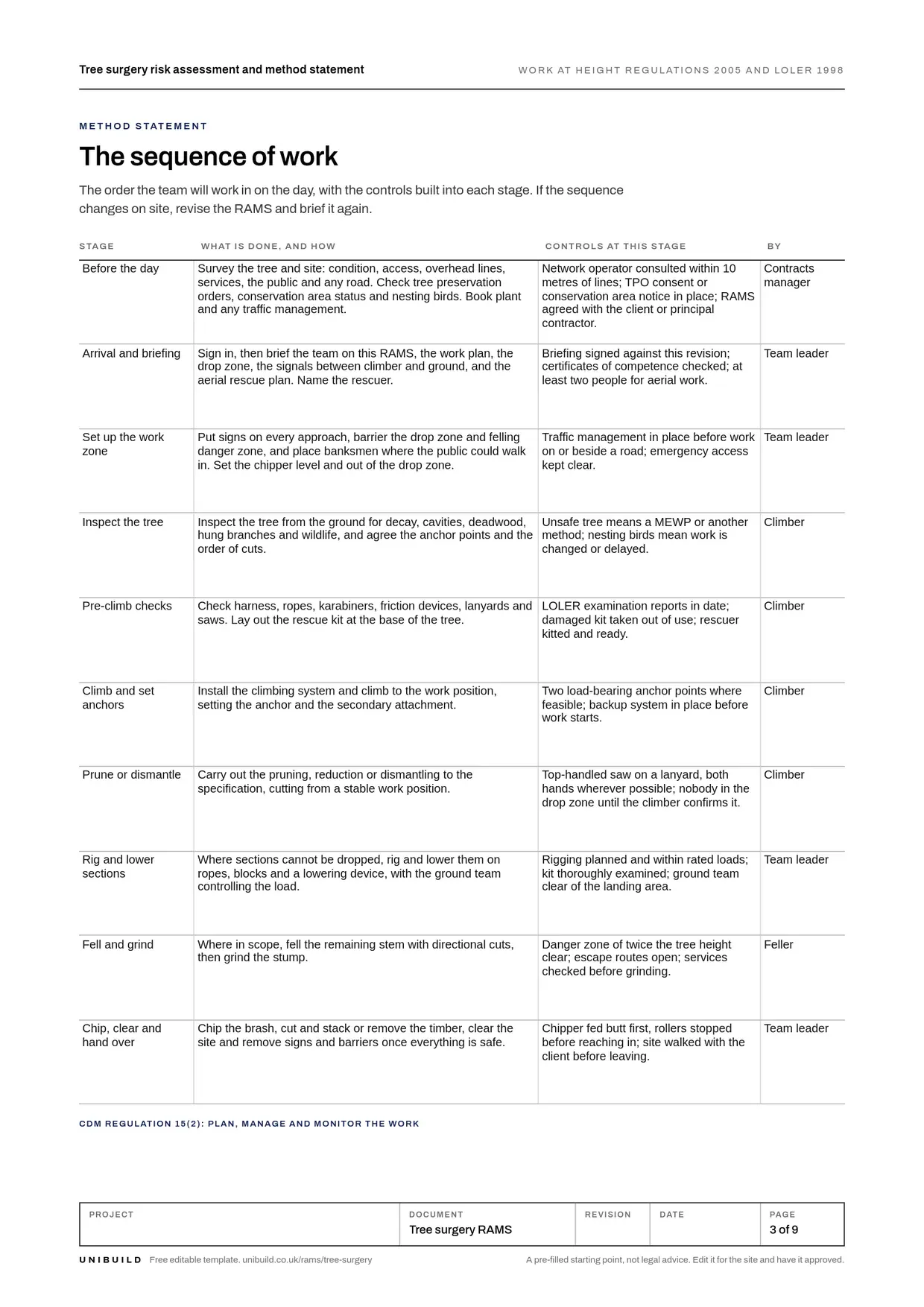
Tree surgery method statement: the sequence of work
The order of work, with the controls at each stageThe order the team works in on the day, with the controls built into each stage. If the sequence changes on site, revise the RAMS and brief it again.
Before the day
Survey the tree and site: condition, access, overhead lines, services, the public and any road. Check tree preservation orders, conservation area status and nesting birds. Book plant and any traffic management.
ControlsNetwork operator consulted within 10 metres of lines; TPO consent or conservation area notice in place; RAMS agreed with the client or principal contractor.
Arrival and briefing
Sign in, then brief the team on this RAMS, the work plan, the drop zone, the signals between climber and ground, and the aerial rescue plan. Name the rescuer.
ControlsBriefing signed against this revision; certificates of competence checked; at least two people for aerial work.
Set up the work zone
Put signs on every approach, barrier the drop zone and felling danger zone, and place banksmen where the public could walk in. Set the chipper level and out of the drop zone.
ControlsTraffic management in place before work on or beside a road; emergency access kept clear.
Inspect the tree
Inspect the tree from the ground for decay, cavities, deadwood, hung branches and wildlife, and agree the anchor points and the order of cuts.
ControlsUnsafe tree means a MEWP or another method; nesting birds mean work is changed or delayed.
Pre-climb checks
Check harness, ropes, karabiners, friction devices, lanyards and saws. Lay out the rescue kit at the base of the tree.
ControlsLOLER examination reports in date; damaged kit taken out of use; rescuer kitted and ready.
Climb and set anchors
Install the climbing system and climb to the work position, setting the anchor and the secondary attachment.
ControlsTwo load-bearing anchor points where feasible; backup system in place before work starts.
Prune or dismantle
Carry out the pruning, reduction or dismantling to the specification, cutting from a stable work position.
ControlsTop-handled saw on a lanyard, both hands wherever possible; nobody in the drop zone until the climber confirms it.
Rig and lower sections
Where sections cannot be dropped, rig and lower them on ropes, blocks and a lowering device, with the ground team controlling the load.
ControlsRigging planned and within rated loads; kit thoroughly examined; ground team clear of the landing area.
Fell and grind
Where in scope, fell the remaining stem with directional cuts, then grind the stump.
ControlsDanger zone of twice the tree height clear; escape routes open; services checked before grinding.
Chip, clear and hand over
Chip the brash, cut and stack or remove the timber, clear the site and remove signs and barriers once everything is safe.
ControlsChipper fed butt first, rollers stopped before reaching in; site walked with the client before leaving.
What the law asks for tree surgery
Checked against the sourcePlan for rescue
Work at height must be properly planned, appropriately supervised and carried out as safely as reasonably practicable. The planning includes emergencies and rescue, and work at height only goes ahead when the weather does not put people at risk.
Work at Height Regulations 2005, regulation 4Rope access and positioning
A rope technique uses at least two separately anchored lines, a working line and a safety line, with a suitable harness and fall protection. A single rope is allowed only where a risk assessment shows a second line would be more dangerous and other measures are taken.
Work at Height Regulations 2005, Schedule 5, Part 3Thorough examination
Lifting equipment for lifting people, and lifting accessories, exposed to conditions that cause deterioration are thoroughly examined at least every 6 months, or to an examination scheme. HSE counts ropes, harnesses, karabiners and rigging kit as lifting equipment in tree work.
LOLER 1998, regulation 9Planned lifting operations
Every lifting operation, including lowering a section of tree on a rigging system, is properly planned by a competent person, appropriately supervised and carried out safely.
LOLER 1998, regulation 8Chainsaw competence
Users of work equipment must have adequate training. The PUWER Approved Code of Practice adds that before using a chainsaw on or in a tree, a worker should hold a relevant certificate of competence or national qualification, unless training under adequate supervision.
PUWER 1998, regulation 9, and its Approved Code of Practice L22, paragraph 133Risk assessment
Every employer must make a suitable and sufficient assessment of the risks to employees and to others affected by the work, and record the significant findings if they employ five or more people.
Management of Health and Safety at Work Regulations 1999, regulation 3Competence, equipment and PPE
Competence and cards
- Climbers Certificates of competence for tree climbing, aerial rescue and chainsaw use from a rope and harness.
- Chainsaw operators Certificate of competence for the work, from an awarding body such as City and Guilds NPTC or Lantra.
- Aerial rescuer Trained and equipped to rescue the climber without delay, on site whenever anyone is climbing.
- Chipper operator Trained in the machine, its protection devices and safe feeding.
- MEWP operator Trained on the platform and in using a chainsaw from it.
- Team leader Experienced in the work, plans the job with the climber and controls the site.
Plant and equipment
- Chainsaws, rear and top-handled Daily check of chain brake, catcher, lockout and stop switch.
- Ropes, harnesses, karabiners Pre-use check daily; weekly written record; LOLER exam 6-monthly.
- Rigging kit and lowering device Pre-use check; rated loads known; LOLER exam in date.
- Wood chipper Protection device tested before use; machine level; knives sharp.
- Stump grinder Guards in place; cutting teeth checked; area cleared.
- MEWP Pre-use check; LOLER exam in date; ground checked for outriggers.
PPE
- Safety helmet with visor and ear defenders; a mountaineering style helmet for climbers.
- Chainsaw trousers with leg protection, worn whenever a saw is used.
- Chainsaw boots with chainsaw protection, or gaiters with safety boots for occasional use on even ground.
- Gloves suited to the saw and the task, chainsaw gloves where the risk assessment calls for them.
- Harness and lanyards for climbers and for MEWP work.
- High-visibility clothing for ground staff near roads and the public.
Permits and plans
Consent for trees under a tree preservation order, and six weeks notice to the local planning authority for trees in a conservation area. Highway authority permission for work on or beside a road. A permit to work or line owner procedure for work near overhead lines, and a lift plan for any crane lift.
Emergency and rescue
Aerial rescue plan with a named rescuer and kit at the base of the tree. Personal first aid kits with haemostatic dressings and a tourniquet, a first aider on site, and the site location, grid reference and nearest accident and emergency department on the briefing.
Toolbox talk: climbing, chainsaws and the drop zone
Read this to the team before work starts, tick each point as it is covered, and record who attended.
- Nobody climbs unless the named rescuer is on the ground, kitted up and watching.
- Climbers work on two anchor points wherever we can, with a backup to stop a fall.
- Nobody enters the drop zone until the climber has stopped and called it clear.
- Top-handled saws stay in the tree. On the ground we use rear-handled saws with both hands.
- At the chipper: butt first, let go once it grips, and never reach into the chute while the rollers turn.
- When felling, nobody is within twice the height of the tree, and the escape route is clear before the cut.
Ask the team
- Who is the rescuer today, and where is the rescue kit?
- What are the signals between the climber and the ground?
- Where are the overhead lines and the nearest public access points?
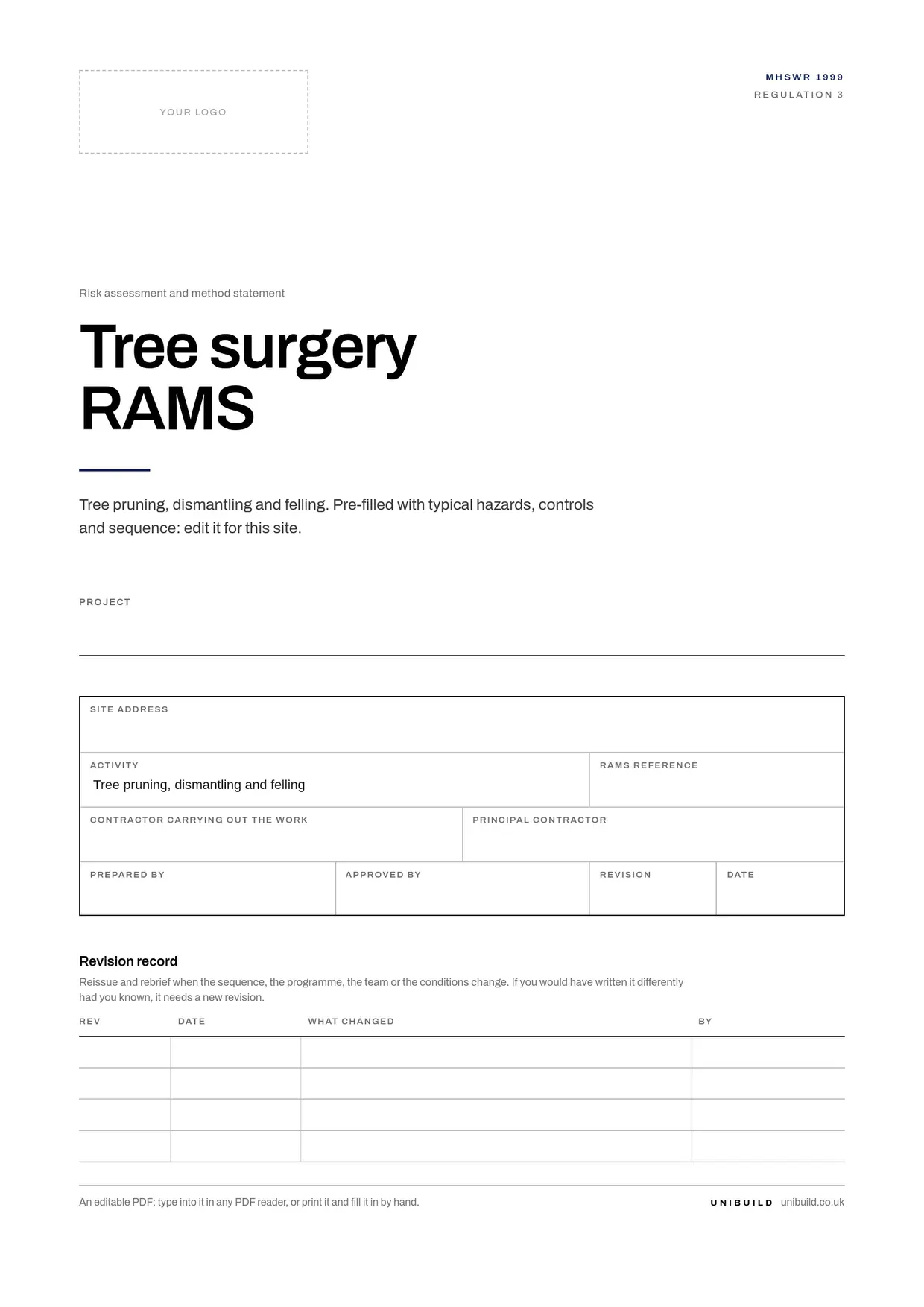
What is in the tree surgery RAMS template
9 pages, pre-filled and editableThe work, pre-filled
Scope, location and access, interfaces with the client and others, the documents the RAMS relies on, and the team with their certificates.
The sequence of work
Ten stages from survey to clearing the site, with the controls and the person responsible at each one.
Hazards and controls
Eighteen tree surgery hazards rated before and after controls on a five by five matrix, with room for your own.
Plant, PPE and permits
Saws, climbing and rigging kit, chipper and grinder with their checks, PPE by type, and the consents and permits.
Pre-climb and aerial rescue check
A page to record the tree inspection, kit checks, anchors, the named rescuer and the emergency details before anyone climbs.
Briefing record
Twenty signatures against the revision, taken on the day before the work starts.
Brief it, and get it signed on the phone
On Unibuild a RAMS is written from a template, approved, then read by each operative on their phone in their own language and signed. Subcontract and agency workers sign through a link, with no app to install.
Every signature carries its date and time and prints as the last page of the RAMS PDF. Change the RAMS and it has to be signed again.
How RAMS work on UnibuildTree surgery RAMS questions
Is this tree surgery risk assessment template free?
What should a tree surgery method statement include?
Do you need a certificate to use a chainsaw?
How many people are needed for tree climbing?
How often does tree climbing equipment need a LOLER inspection?
How far away should people be when a tree is felled?
Can you use a chainsaw from a ladder?
Do I need permission before tree work?
RAMS templates for other trades and hazards
All free, pre-filled and editableBy trade
- Air conditioning and HVAC RAMS
- Bricklaying RAMS
- Carpentry and joinery RAMS
- CCTV installation RAMS
- Cleaning risk assessment
- Concrete works RAMS
- Demolition RAMS
- Drylining RAMS
- Electrical RAMS
- Facilities maintenance RAMS
- Fire alarm installation RAMS
- Glazing and window RAMS
- Groundworks RAMS
- Hot works and welding RAMS
- Insulation RAMS
- Landscaping and fencing RAMS
- Painting and decorating RAMS
- Pest control risk assessment
- Plastering and rendering RAMS
- Plumbing and heating RAMS
- Rail RAMS
- Refurbishment RAMS
- Roofing RAMS
- Rope access risk assessment
- Scaffolding RAMS
- Solar PV installation RAMS
- Steel erection RAMS
- Temporary works RAMS
- Tiling and flooring RAMS
- Tree surgery RAMS
By hazard
- Asbestos risk assessment
- Confined space risk assessment
- COSHH risk assessment
- Dust risk assessment
- Forklift and telehandler risk assessment
- Housekeeping risk assessment
- Lifting operations risk assessment
- Lone working risk assessment
- Manual handling risk assessment
- MEWP risk assessment
- Noise and vibration risk assessment
- Plant and excavator risk assessment
- Power tools risk assessment
- Traffic management risk assessment
- Working at height risk assessment
The blank RAMS template, the RAMS review checklist and every other free form are on Free downloads.
The RAMS, read and signed
before the work starts.
Unibuild keeps every RAMS with its versions, its approvals and each operative’s signature against the revision they read, for seven years, ready for the principal contractor or an auditor.