
Plastering and rendering risk assessment and method statement
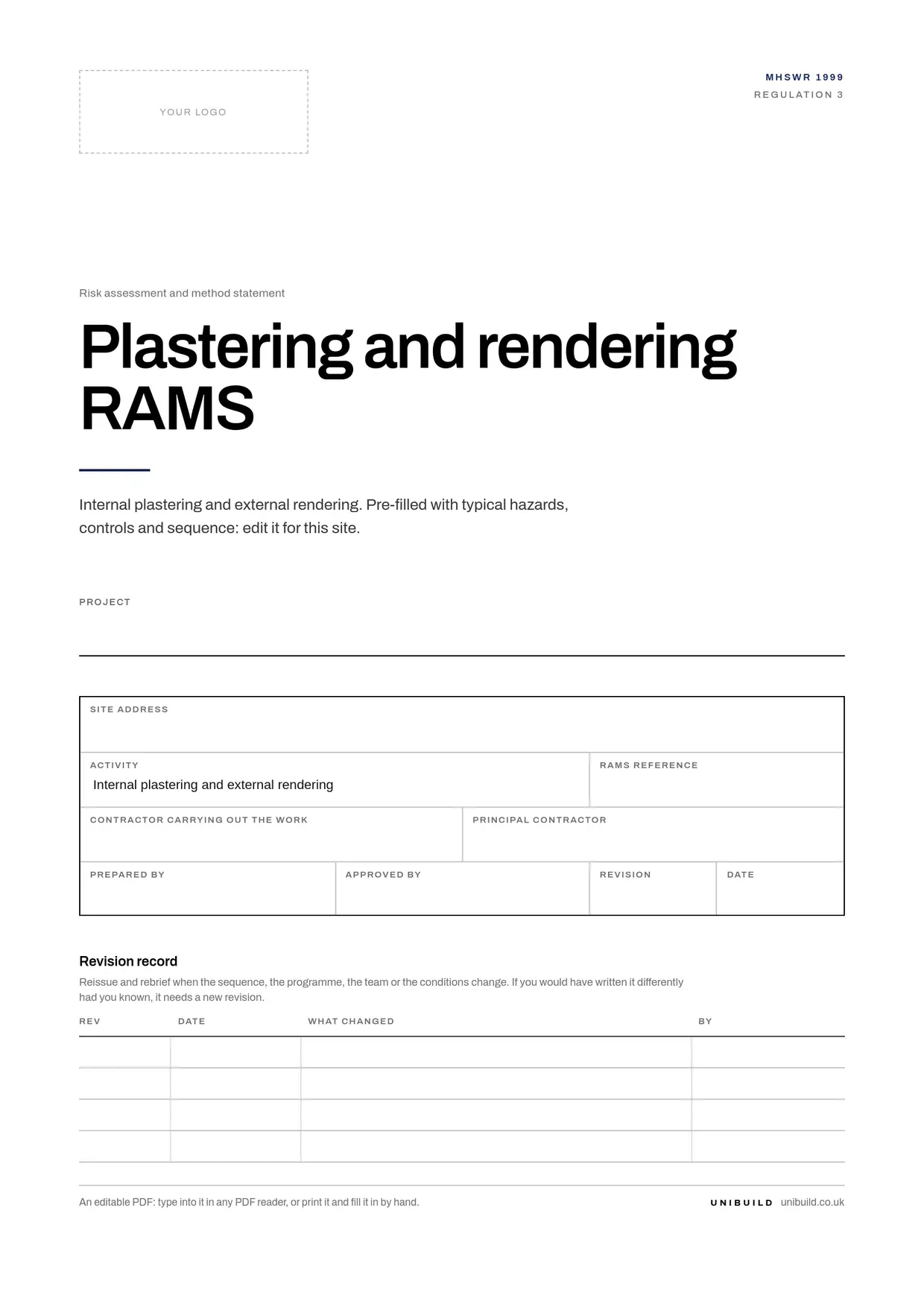
A plastering method statement and risk assessment, already filled in for hop-ups and platforms, mixing and spraying, lime and cement, preparation dust and render on scaffold. Edit it for your job, then brief it.
- Law
- COSHH 2002 and Work at Height 2005
- Cement and lime
- Alkaline: gloves and eye protection
- Format
- Editable PDF and Word
- Cost
- Free, always
Do you need a method statement for plastering?
Yes, in practice. A plastering risk assessment and a plastering method statement are expected before work starts, and rendering needs the same. The risk assessment is the legal duty; the method statement shows how the work is done safely, and a principal contractor will expect to review both as a RAMS.
The risk assessment is required by regulation 3 of the Management of Health and Safety at Work Regulations 1999, and recorded if you employ five or more people. COSHH adds an assessment for cement, lime, plaster and preparation dust, and the Work at Height Regulations cover hop-ups, platforms and scaffold.
A plastering and rendering RAMS should describe the job in front of you. The height of the walls and ceilings, the access chosen, whether render is sprayed or applied by hand, and the age of the surfaces being prepared decide the controls, and are what a reviewer checks first.
Checked against legislation.gov.uk and HSE guidance on .
Plastering and rendering hazards and controls
16 hazards, rated before and after controlsThe significant hazards on a typical internal plastering and external rendering package, with the controls a reviewer expects to see. Delete what does not apply and add what your job has.
Falls from hop-ups and podium steps
Plasterers skimming walls and ceilings, stepping on and off and reaching while trowelling.
- Hop-ups chosen only for low, short work; podium steps with gates closed, or a tower, for ceilings and longer runs.
- Platforms used to the manufacturer's instructions, fully opened, on a level floor cleared of droppings and offcuts.
- No standing on buckets, tubs or improvised trestles; platforms moved, not overreached from.
BeforeMedium 12AfterMedium 6
Falls from towers and trestle platforms
Plasterers working on high ceilings, stairwells and atriums.
- Towers erected to the manufacturer's instructions by PASMA-trained people, with guard-rails and toe boards and castors locked.
- Stairwells reached from a tower or platform made for stairs, never ladders on treads.
- Platforms inspected after assembly and before use; never moved with anyone on them.
BeforeHigh 15AfterMedium 5
Falls from scaffold when rendering
Renderers on working lifts, at the gap to the wall and at loading bays.
- Work only from scaffold with a handover certificate and an inspection within the last 7 days, with guard-rails and toe boards in place.
- Boards, ties and rails moved only by the scaffolder; inside boards kept to the design as the work proceeds.
- Sheeting fitted only where the scaffold is designed to carry the extra wind load.
BeforeHigh 15AfterMedium 5
Overloading the scaffold
Everyone on and below the scaffold, from stacked bags, tubs, mixers or spray machines on the lift.
- Load class agreed with the scaffolder and shown on the tag; mixers and spray machines kept on the ground unless the design allows them.
- Bags and tubs landed in small loads over the standards, never stacked against guard-rails.
BeforeHigh 15AfterMedium 5
Falling materials and hacked off render
Labourers, other trades and the public below the scaffold or work area.
- Exclusion zone below the work, barriered and signed; debris netting or brick guards on public elevations.
- Hacked off material bagged or sent down a chute, never thrown or tipped from height.
- Tools and hawks kept back from the platform edge.
BeforeHigh 16AfterMedium 8
Wet cement and lime on skin
Plasterers and labourers mixing and applying render, from cement burns, lime irritation and dermatitis.
- Waterproof gloves suitable for alkalis, such as EN 374 class K, long and close fitting at the wrist; long sleeves.
- Wet render or lime washed off skin straight away; warm water, soap and towels at the welfare unit, and skin care products.
- Cement bags used within their shelf date so the chromium VI reducer still works.
BeforeMedium 9AfterLow 3
Lime and cement in the eyes
Anyone mixing, spraying, applying overhead or tipping bags of lime, cement or render.
- Eye protection for mixing, spraying and overhead work; goggles where lime is handled.
- Eyewash at the mixing area and on the scaffold; anyone splashed rinses at once and gets medical advice.
BeforeMedium 12AfterLow 4
Dust from mixing bagged plaster and render
Labourers and plasterers tipping and mixing powders, and people nearby.
- Pre-mixed or ready-to-use products where they do the job.
- Bags opened low and tipped slowly into water; mixing outdoors or in a ventilated area away from others.
- FFP3 RPE, face fit tested, while tipping and mixing powders.
BeforeMedium 9AfterMedium 6
Silica dust from hacking off and chasing
Plasterers removing old sand and cement, chasing for beads or services, and others nearby.
- Hacking off kept to what the specification needs; surfaces damped or tools fitted with on-tool extraction to an M or H class unit.
- RPE of at least APF 20, such as FFP3, face fit tested, with users clean shaven where the mask seals.
- Clean up with an M class vacuum or damp methods, never by dry sweeping.
BeforeHigh 16AfterMedium 8
Asbestos in old coatings and boards
Plasterers hacking off, skimming over or drilling older textured ceilings, panels and boards.
- Asbestos survey checked before any preparation in buildings built or refurbished before 2000.
- No sanding, scraping or hacking off of suspect textured coatings or boards; work stopped if a suspect material is found.
- Removal only by trained workers under the asbestos plan, or by a licensed contractor where the work needs one.
BeforeHigh 15AfterMedium 5
Spray machines and pumps under pressure
Operators and helpers, from hoses whipping or couplings bursting open when blocked or disconnected.
- Machine set up and run to the manufacturer's instructions by a trained operator; hoses and couplings checked before each use.
- Pressure released by the manufacturer's procedure before opening a coupling or clearing a blockage.
- Eye protection, gloves and overalls when spraying; others kept clear of the hose line and nozzle.
BeforeMedium 12AfterLow 4
Paddle mixers and drum mixers
Labourers mixing plaster and render, from entanglement, wrist injuries and electric shock.
- Paddle mixers with two handles and a lock-off trigger, used in a stable tub held steady; 110V or battery supply.
- Drum mixers with guards over the drive, isolated before cleaning; hands and shovels kept out while turning.
BeforeMedium 9AfterLow 3
Manual handling of bags, boards and tubs
Plasterers and labourers carrying bagged plaster, render, boards and mixed tubs up stairs and scaffold.
- Materials landed close to the work by plant or hoist; trolleys for bags and boards; tubs kept half full.
- Boards moved by trolley or lifter where possible; a two person lift only where no aid can be used and lifting is infrequent.
- Bags stored on pallets at a workable height.
BeforeMedium 8AfterLow 4
Breakers and vibration when hacking off
Plasterers using breakers, SDS hammers and scabblers to remove old render and plaster.
- Low-vibration tools chosen, with trigger time planned and recorded so exposure stays as low as reasonably practicable.
- Tools maintained with sharp bits; hearing protection worn when breaking.
BeforeMedium 9AfterMedium 6
Hidden cables and electrical fittings
Plasterers hacking off, chasing, fixing beads and plastering round sockets and switches.
- Cable detector used before hacking off, chasing or fixing; services drawings checked.
- Faceplates removed and replaced only after the circuit has been isolated and proved dead by a competent person.
BeforeMedium 10AfterMedium 5
Slips and trips
Plasterers and others, on plaster droppings, wet floors, hoses and cables.
- Droppings cleared as work proceeds; floors protected and dried; hoses and cables run along walls.
- Work areas closed to other trades while wet, and cleared at the end of each day.
BeforeMedium 6AfterLow 4
Scores are likelihood times severity on the five by five matrix in the template. They are typical ratings for this work, a starting point for your own assessment of your site.
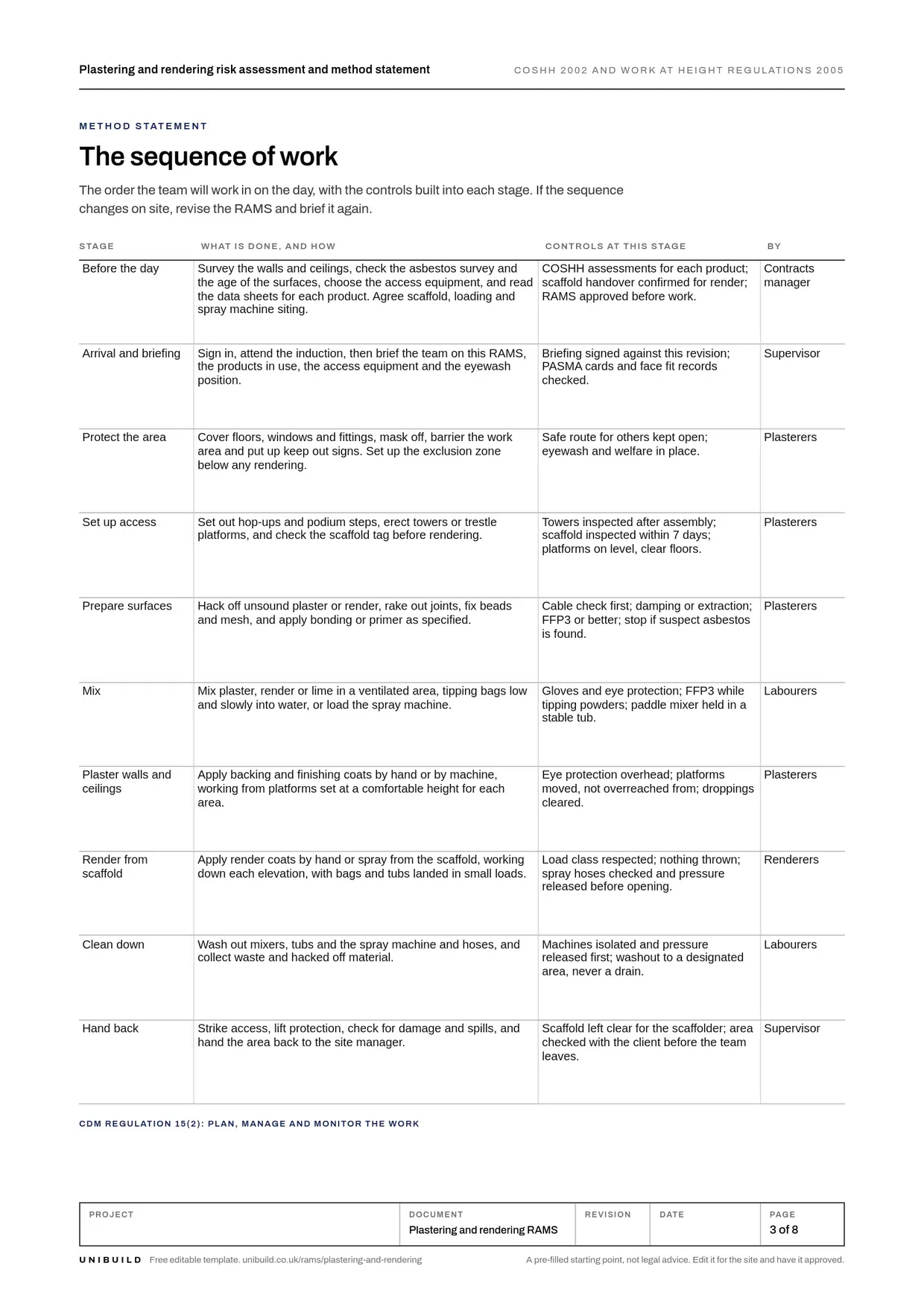
Plastering method statement: the sequence of work
The order of work, with the controls at each stageThe order the team works in, with the controls built into each stage. If the sequence changes on site, revise the RAMS and brief it again.
Before the day
Survey the walls and ceilings, check the asbestos survey and the age of the surfaces, choose the access equipment, and read the data sheets for each product. Agree scaffold, loading and spray machine siting.
ControlsCOSHH assessments for each product; scaffold handover confirmed for render; RAMS approved before work.
Arrival and briefing
Sign in, attend the induction, then brief the team on this RAMS, the products in use, the access equipment and the eyewash position.
ControlsBriefing signed against this revision; PASMA cards and face fit records checked.
Protect the area
Cover floors, windows and fittings, mask off, barrier the work area and put up keep out signs. Set up the exclusion zone below any rendering.
ControlsSafe route for others kept open; eyewash and welfare in place.
Set up access
Set out hop-ups and podium steps, erect towers or trestle platforms, and check the scaffold tag before rendering.
ControlsTowers inspected after assembly; scaffold inspected within 7 days; platforms on level, clear floors.
Prepare surfaces
Hack off unsound plaster or render, rake out joints, fix beads and mesh, and apply bonding or primer as specified.
ControlsCable check first; damping or extraction; FFP3 or better; stop if suspect asbestos is found.
Mix
Mix plaster, render or lime in a ventilated area, tipping bags low and slowly into water, or load the spray machine.
ControlsGloves and eye protection; FFP3 while tipping powders; paddle mixer held in a stable tub.
Plaster walls and ceilings
Apply backing and finishing coats by hand or by machine, working from platforms set at a comfortable height for each area.
ControlsEye protection overhead; platforms moved, not overreached from; droppings cleared.
Render from scaffold
Apply render coats by hand or spray from the scaffold, working down each elevation, with bags and tubs landed in small loads.
ControlsLoad class respected; nothing thrown; spray hoses checked and pressure released before opening.
Clean down
Wash out mixers, tubs and the spray machine and hoses, and collect waste and hacked off material.
ControlsMachines isolated and pressure released first; washout to a designated area, never a drain.
Hand back
Strike access, lift protection, check for damage and spills, and hand the area back to the site manager.
ControlsScaffold left clear for the scaffolder; area checked with the client before the team leaves.
What the law asks for plastering and rendering
Checked against the sourceRisk assessment
Every employer must make a suitable and sufficient assessment of the risks to their employees and others affected by the work, and record the significant findings if they employ five or more people.
Management of Health and Safety at Work Regulations 1999, regulation 3Avoid, prevent, then mitigate
Work at height is avoided where it can be done safely another way. Where it cannot, falls are prevented, using an existing safe place of work or suitable equipment, and only then are the distance and consequences of a fall reduced.
Work at Height Regulations 2005, regulation 6Scaffold and platform inspection
Equipment whose safety depends on how it is assembled is inspected in position before use. A working platform used for construction work, from which a person could fall 2 metres or more, is inspected in position within the previous 7 days.
Work at Height Regulations 2005, regulation 12Cement, lime and dust
Exposure to hazardous substances is prevented or, where that is not reasonably practicable, adequately controlled: safer products and processes first, then control at source, with RPE and gloves as the last measure.
COSHH Regulations 2002, regulation 7Mixers and machines
Access to dangerous parts of machinery is prevented by fixed guards where practicable, then other guards or protection devices, backed by information, instruction, training and supervision.
PUWER 1998, regulation 11Manual handling
Handling that risks injury is avoided so far as is reasonably practicable. What cannot be avoided is assessed and the risk reduced. HSE sets no safe weight, and treats a two person lift of plasterboard as a last resort.
Manual Handling Operations Regulations 1992, regulation 4Competence, equipment and PPE
Competence and cards
- Plasterers Blue Skilled Worker CSCS card (plastering NVQ level 2 or completed apprenticeship); apprentices on the Apprentice card, supervised.
- Supervisor Experienced plasterer with site supervision training.
- Tower users PASMA training for anyone erecting or moving an aluminium tower.
- Spray machine operators Trained on the machine, including pressure release and clearing blockages.
- RPE wearers Face fit tested for tight-fitting masks, and clean shaven where the mask seals.
Plant and equipment
- Hop-ups and podium steps Pre-use check; locks, gates and feet sound; level floor.
- Mobile tower Built to the instructions; inspected after assembly and before use.
- Paddle and drum mixers Handles, trigger, guards and leads checked; 110V or battery.
- Plaster or render spray machine Hoses, couplings and pressure gauge checked before use.
- Breakers and SDS hammers Vibration data known; extraction fitted; bits sharp.
- Extraction unit M or H class; filters and hoses checked.
PPE
- Gloves waterproof and suitable for alkalis, long and close fitting at the wrist.
- Eye protection for mixing, spraying, overhead work and hacking off; goggles for lime.
- Respiratory protection FFP3 or better for tipping powders and hacking off, face fit tested.
- Hearing protection for breakers and scabblers.
- Safety footwear to the site standard, with helmet and high visibility where the site requires them.
Permits and plans
A permit to work where the principal contractor's rules require one, for example for scaffold over an occupied area or work near live services. A temporary works design where the scaffold is sheeted beyond its compliance sheet. An asbestos check before any hacking off in older buildings.
Emergency and rescue
First aider and first aid kit on site, with eyewash at the mixing area and on the scaffold. Lime or cement in the eye is rinsed straight away and medical advice sought. Wet render on skin is washed off at once. Plan for getting someone down from a tower or scaffold. Nearest accident and emergency department named on the briefing.
Toolbox talk: plastering and rendering safety
Read this to the team before work starts, tick each point as it is covered, and record who attended.
- Hop-ups are for low, short work. For ceilings and long runs, use the podium or the tower, and never stand on a bucket.
- Wet cement burns skin and lime can seriously damage eyes. Gloves on, sleeves down, and goggles when you tip or mix lime.
- If it splashes in your eye, go straight to the eyewash and keep rinsing. Tell the supervisor.
- Hacking off makes silica dust. Damp it down or use the extractor, and keep your mask on.
- Never open a spray hose or clear a blockage until the pressure has been released the way the manufacturer says.
- Only the scaffolder moves boards or rails. Land bags in small loads and keep them off the guard-rails.
Ask the team
- Where is the eyewash on this job, and on the scaffold?
- Has the asbestos survey been checked for the walls we are hacking off?
- How do we release the pressure on the spray machine before clearing a blockage?
What is in the plastering and rendering RAMS template
8 pages, pre-filled and editableThe work, pre-filled
Scope, location and access, interfaces with the scaffolder, the building and other trades, the documents the RAMS relies on, and the team.
The sequence of work
Ten stages from survey to hand back, with the controls and the person responsible at each one.
Hazards and controls
Sixteen plastering and rendering hazards rated before and after controls on a five by five matrix, with room for your own.
Plant, PPE and substances
Access equipment, mixers and spray machines with their checks, PPE by type, and cement, lime, plaster and silica dust.
Permits and emergency
Permits and asbestos checks, then first aid, eyewash and getting someone down from height.
Briefing record
Twenty signatures against the revision, taken on the day before the work starts.
Brief it, and get it signed on the phone
On Unibuild a RAMS is written from a template, approved, then read by each operative on their phone in their own language and signed. Subcontract and agency workers sign through a link, with no app to install.
Every signature carries its date and time and prints as the last page of the RAMS PDF. Change the RAMS and it has to be signed again.
How RAMS work on UnibuildPlastering and rendering RAMS questions
Is this plastering method statement template free?
What should a plastering risk assessment include?
Do I need a separate method statement for rendering?
Are hop-ups safe for plastering?
Do plasterers need a COSHH assessment?
What PPE do plasterers and renderers need?
Who checks the scaffold before rendering?
Does a self-employed plasterer need a risk assessment?
RAMS templates for other trades and hazards
All free, pre-filled and editableBy trade
- Air conditioning and HVAC RAMS
- Bricklaying RAMS
- Carpentry and joinery RAMS
- CCTV installation RAMS
- Cleaning risk assessment
- Concrete works RAMS
- Demolition RAMS
- Drylining RAMS
- Electrical RAMS
- Facilities maintenance RAMS
- Fire alarm installation RAMS
- Glazing and window RAMS
- Groundworks RAMS
- Hot works and welding RAMS
- Insulation RAMS
- Landscaping and fencing RAMS
- Painting and decorating RAMS
- Pest control risk assessment
- Plastering and rendering RAMS
- Plumbing and heating RAMS
- Rail RAMS
- Refurbishment RAMS
- Roofing RAMS
- Rope access risk assessment
- Scaffolding RAMS
- Solar PV installation RAMS
- Steel erection RAMS
- Temporary works RAMS
- Tiling and flooring RAMS
- Tree surgery RAMS
By hazard
- Asbestos risk assessment
- Confined space risk assessment
- COSHH risk assessment
- Dust risk assessment
- Forklift and telehandler risk assessment
- Housekeeping risk assessment
- Lifting operations risk assessment
- Lone working risk assessment
- Manual handling risk assessment
- MEWP risk assessment
- Noise and vibration risk assessment
- Plant and excavator risk assessment
- Power tools risk assessment
- Traffic management risk assessment
- Working at height risk assessment
The blank RAMS template, the RAMS review checklist and every other free form are on Free downloads.
The RAMS, read and signed
before the work starts.
Unibuild keeps every RAMS with its versions, its approvals and each operative’s signature against the revision they read, for seven years, ready for the principal contractor or an auditor.