
Fencing and landscaping risk assessment and RAMS template
A fencing and landscaping risk assessment and method statement, already filled in for post holes, buried services, hard landscaping, mowing and herbicides. Edit it for your site, then brief it.
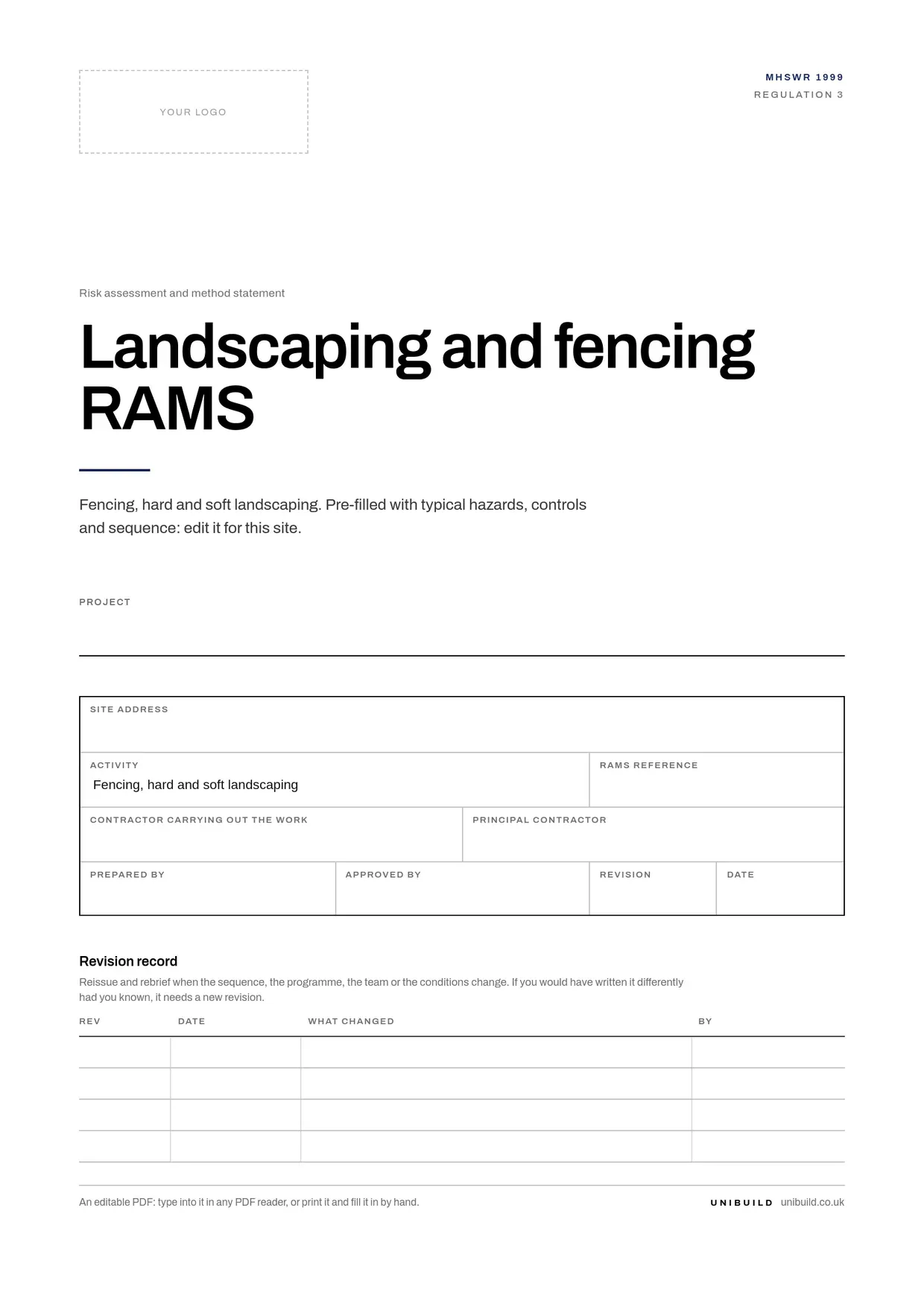
- Law
- PUWER 1998 and COSHH 2002
- Herbicides
- Certificate holder, or supervised trainee
- Format
- Editable PDF and Word
- Cost
- Free, always
Do you need a risk assessment for fencing and landscaping?
Yes. A fencing risk assessment, or a landscaping risk assessment, is a legal duty before the work starts, and on a construction site the principal contractor will expect it as part of a RAMS. Post holes, powered tools, plant and chemicals are where most of the risk sits.
The risk assessment is required by regulation 3 of the Management of Health and Safety at Work Regulations 1999, and written down if you employ five or more people. The method statement sets out the order of work: how services are found before a post goes in, how slabs are cut and moved, and how mowers, saws and sprayers are used.
A fencing method statement or landscaping RAMS has to fit the ground in front of you. The services under it, the overhead lines above it, the slopes, the public nearby and the chemicals in the van decide the controls, and they are what a reviewer checks first.
Checked against legislation.gov.uk and HSE guidance on .
Fencing and landscaping hazards and controls
18 hazards, rated before and after controlsThe significant hazards on a typical fencing, hard landscaping or grounds maintenance job, with the controls a reviewer expects to see. Delete what does not apply and add what your site has.
Striking buried services with posts
Fencers digging, augering or driving posts, and anyone nearby, from shock, burns, gas escape or flooding.
- Service plans checked, the fence line scanned with a cable locator and signal generator, and services marked before any post goes in.
- Trial holes dug by hand to confirm position and depth where the line crosses or runs near a service.
- No post driven, augered or pinned over a marked line; marks in paint or wooden pegs, never steel pins.
BeforeHigh 20AfterMedium 5
Overhead power lines
Operators of post drivers, augers, tippers and telehandlers, and anyone carrying long rails or poles.
- Lines identified at the survey; work within 10 metres, measured at ground level from below the nearest wire, planned first and the line owner consulted, as HSE GS6 advises.
- Where lines stay live, ground barriers at least 6 metres either side keep plant away, with goal posts at any crossing.
- Long rails, posts and poles carried horizontally and close to the ground near lines.
BeforeMedium 10AfterMedium 5
Machine-mounted post drivers
The operator and the person setting the post, from crushing, flying splinters and the post kicking out.
- Operated only by someone trained on that driver, with guards and controls checked before use.
- Post set in a pilot hole or held in the driver's post holder; nobody steadies a post by hand under the rammer.
- Everyone else kept clear of the driver while it works; eye and hearing protection worn.
BeforeMedium 12AfterLow 4
Powered augers: torque and entanglement
Operators of hand-held and machine-mounted augers when the bit jams on roots or stone.
- Two-person or frame-mounted augers for larger holes, with a torque reaction bar where the auger has one.
- Close-fitting clothing, no loose cuffs or cords; engine stopped before freeing a jammed bit.
- Ground checked for roots, stone and services before boring.
BeforeMedium 9AfterMedium 6
Hand-arm vibration
Operatives using hand-held post drivers, breakers, strimmers, hedge trimmers and plate compactors.
- Machine-mounted drivers or lower vibration tools chosen where practicable, and tools maintained to the manufacturer's schedule.
- Trigger time planned per tool and per person against the exposure action value of 2.5 m/s2 A(8).
- Health surveillance where the assessment shows a risk; tingling or numbness reported at once.
BeforeMedium 12AfterMedium 6
Noise from saws, drivers and mowers
Operatives using cut-off saws, post drivers, mowers, strimmers and blowers, and people working beside them.
- Quieter equipment and methods chosen where practicable, and exhausts and silencers kept in good order.
- Hearing protection worn at or above 85 dB(A), the upper exposure action value, and available on request from 80 dB(A).
- Others kept back from noisy work where they can be.
BeforeMedium 12AfterMedium 6
Cut-off saws: contact and kickback
Operatives cutting slabs, blocks, kerbs and setts, and anyone close to the cut.
- Operated only by people trained on the saw and in fitting discs; disc rated for the saw speed and the material.
- Guard set correctly, both hands on the saw, no cutting above shoulder height, and the work held firm on a stand or block.
- Saw stopped before being put down; others kept clear of the cutting line.
BeforeHigh 15AfterMedium 5
Silica dust from cutting paving
Operatives cutting concrete or stone slabs, blocks, kerbs and setts, and people working nearby.
- Cuts reduced at the layout stage, a block splitter used where it will do, or units cut off site.
- Water suppression on every cut-off saw cut, with the water supply checked before starting.
- RPE with an assigned protection factor of 20, such as an FFP3 mask, face fit tested and worn with water suppression.
BeforeHigh 16AfterMedium 8
Manual handling of slabs, kerbs and posts
Operatives moving paving slabs, kerbs, posts, panels, rolls of turf and bags of aggregate.
- Slab and kerb lifters, vacuum lifters or plant used for heavy units rather than lifting by hand.
- Deliveries placed close to where they are laid, so carrying distances stay short.
- Heavy posts and panels handled by two people; knee pads for laying work.
BeforeMedium 12AfterMedium 6
Ride-on mowers overturning
Ride-on mower operators on slopes, banks and the edges of ditches, ponds and retaining walls.
- Slopes assessed before mowing and kept within the manufacturer's limits; steeper banks cut by pedestrian or remote mower.
- Roll-over protection kept up and the seat belt worn where the mower has them.
- Edges of drops and water marked or cut by hand from a safe distance.
BeforeHigh 15AfterMedium 5
Mower blades and blockages
Operators clearing grass from decks and chutes, and people near the mower.
- Blades stopped, engine off and key removed before clearing a blockage or reaching under the deck.
- Guards and collection boxes kept in place; no mowing with a damaged guard.
BeforeMedium 12AfterLow 4
Thrown stones from strimmers and mowers
Operators, colleagues and the public near strimmers, brushcutters and mowers.
- Area walked first and stones, glass and wire removed.
- Visor or eye protection worn, guards fitted, and cutting stopped when anyone comes close.
- Work near roads, windows and parked cars planned so debris is thrown away from them.
BeforeMedium 9AfterMedium 6
Herbicides and pesticides
Operators mixing and spraying, the public, pets and nearby watercourses.
- COSHH assessment and the label read before use; only professional products the operator is certificated for, or used under direct supervision while training.
- Label PPE worn; mixing and filling away from drains and water, with a spill kit.
- Use kept as low as reasonably practicable in public areas, school grounds and parks; no spraying in wind that causes drift.
BeforeMedium 12AfterLow 4
Wet cement and postcrete
Operatives setting posts and laying bedding mortar and concrete.
- Waterproof gloves suitable for alkalis, and cement washed off the skin straight away.
- Eye protection when mixing or pouring dry mix; eyewash in the van.
BeforeMedium 9AfterLow 3
Petrol, fuelling and fire
Operators refuelling mowers, saws, augers and drivers, and anyone near the fuel store.
- Fuel kept in approved, labelled containers, away from ignition sources and secured in the van.
- Refuelling with the engine stopped and cool, on open ground, with spills wiped up before starting.
BeforeMedium 8AfterLow 4
Plant, vehicles and the public
Operatives, other trades, the public and road users near plant, deliveries and work on the highway edge.
- Work area barriered and signed, with pedestrian routes kept open or diverted.
- Banksman for reversing and for plant near people; dumpers with roll-over protection and seat belts worn.
- Work on or beside a road set out under a traffic management plan agreed with the highway authority.
BeforeHigh 15AfterMedium 5
Open post holes, slopes and uneven ground
Operatives, other trades and the public walking near the fence line or the landscaping area.
- Post holes filled the same day or covered and marked; nothing left open at the end of the shift.
- Tools, offcuts and materials kept off walkways; steep or wet ground walked before plant goes on it.
BeforeMedium 9AfterLow 3
Needles, ticks and rat urine
Operatives clearing litter, scrub and long grass in parks, verges and ground near water.
- Area walked first; needles picked up only with a litter picker into a sharps box, never by hand.
- Gloves worn, cuts covered, and hands washed before eating, drinking or smoking, especially near water or rats.
- Long sleeves and trousers in long grass and scrub, with a check for ticks after work.
BeforeMedium 9AfterLow 3
Scores are likelihood times severity on the five by five matrix in the template. They are typical ratings for this work, a starting point for your own assessment of your site.
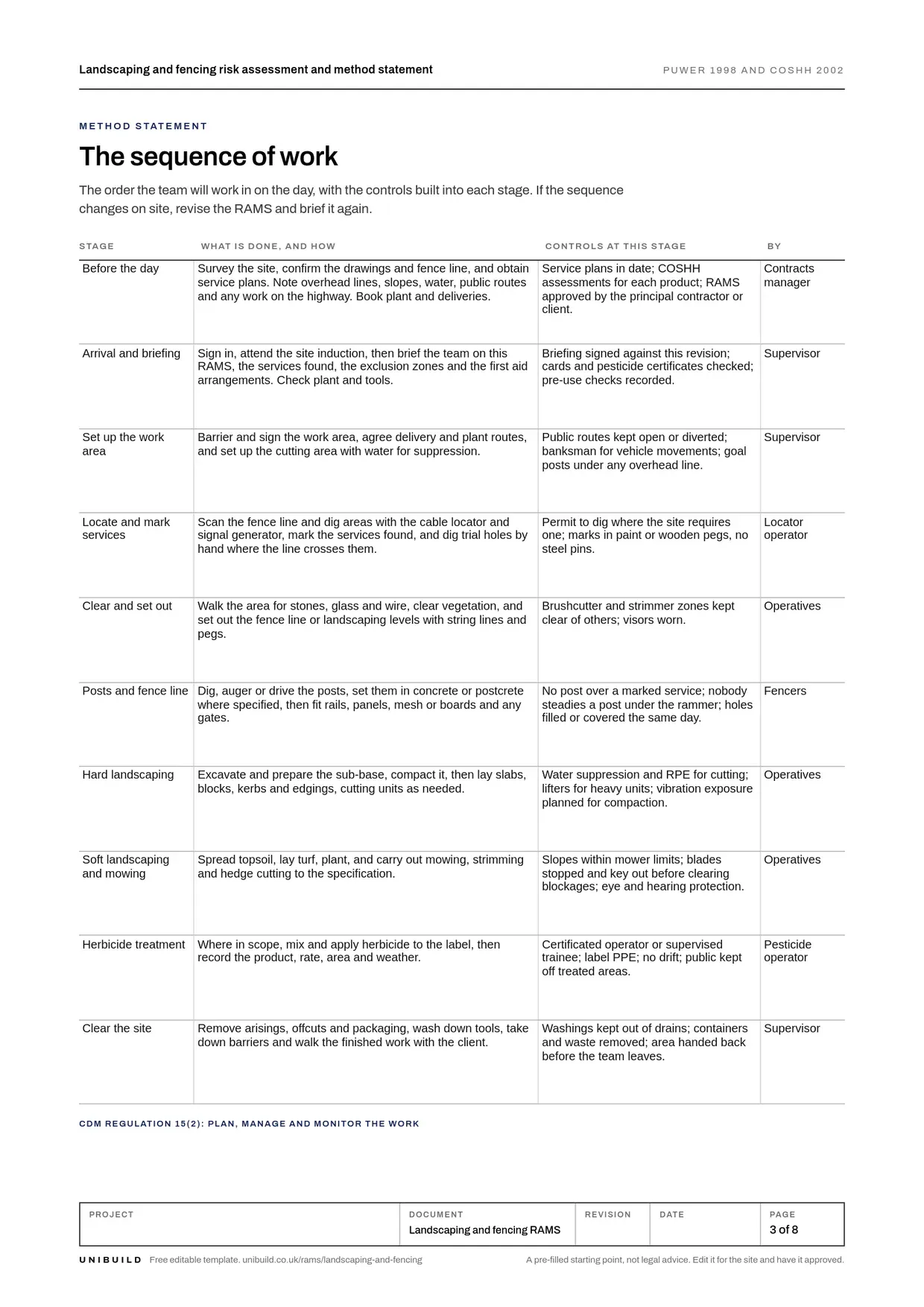
Fencing and landscaping method statement: the sequence of work
The order of work, with the controls at each stageThe order the team works in on the day, with the controls built into each stage. If the sequence changes on site, revise the RAMS and brief it again.
Before the day
Survey the site, confirm the drawings and fence line, and obtain service plans. Note overhead lines, slopes, water, public routes and any work on the highway. Book plant and deliveries.
ControlsService plans in date; COSHH assessments for each product; RAMS approved by the principal contractor or client.
Arrival and briefing
Sign in, attend the site induction, then brief the team on this RAMS, the services found, the exclusion zones and the first aid arrangements. Check plant and tools.
ControlsBriefing signed against this revision; cards and pesticide certificates checked; pre-use checks recorded.
Set up the work area
Barrier and sign the work area, agree delivery and plant routes, and set up the cutting area with water for suppression.
ControlsPublic routes kept open or diverted; banksman for vehicle movements; goal posts under any overhead line.
Locate and mark services
Scan the fence line and dig areas with the cable locator and signal generator, mark the services found, and dig trial holes by hand where the line crosses them.
ControlsPermit to dig where the site requires one; marks in paint or wooden pegs, no steel pins.
Clear and set out
Walk the area for stones, glass and wire, clear vegetation, and set out the fence line or landscaping levels with string lines and pegs.
ControlsBrushcutter and strimmer zones kept clear of others; visors worn.
Posts and fence line
Dig, auger or drive the posts, set them in concrete or postcrete where specified, then fit rails, panels, mesh or boards and any gates.
ControlsNo post over a marked service; nobody steadies a post under the rammer; holes filled or covered the same day.
Hard landscaping
Excavate and prepare the sub-base, compact it, then lay slabs, blocks, kerbs and edgings, cutting units as needed.
ControlsWater suppression and RPE for cutting; lifters for heavy units; vibration exposure planned for compaction.
Soft landscaping and mowing
Spread topsoil, lay turf, plant, and carry out mowing, strimming and hedge cutting to the specification.
ControlsSlopes within mower limits; blades stopped and key out before clearing blockages; eye and hearing protection.
Herbicide treatment
Where in scope, mix and apply herbicide to the label, then record the product, rate, area and weather.
ControlsCertificated operator or supervised trainee; label PPE; no drift; public kept off treated areas.
Clear the site
Remove arisings, offcuts and packaging, wash down tools, take down barriers and walk the finished work with the client.
ControlsWashings kept out of drains; containers and waste removed; area handed back before the team leaves.
What the law asks for fencing and landscaping
Checked against the sourceRisk assessment
Every employer must make a suitable and sufficient assessment of the risks to employees and to others affected by the work, and record the significant findings if they employ five or more people.
Management of Health and Safety at Work Regulations 1999, regulation 3Training and guarding for equipment
Everyone who uses work equipment, and everyone who supervises its use, must have adequate training in how to use it, the risks and the precautions. Dangerous parts of machinery are guarded, or the movement stopped before anyone reaches them.
PUWER 1998, regulations 9 and 11Herbicides and pesticides
A product authorised for professional use may only be used by a holder of a specified certificate, or by someone training under the direct and personal supervision of one. In public areas and similar places, the amount and frequency of use are kept as low as reasonably practicable.
Plant Protection Products (Sustainable Use) Regulations 2012, regulations 8 and 10Substances, dust and cement
Before work that could expose people to a hazardous substance, the employer assesses the risk and puts the controls in place. Exposure is prevented, or where that is not reasonably practicable, adequately controlled, with substitution preferred.
COSHH 2002, regulations 6 and 7Noise and vibration
For hand-arm vibration the daily exposure action value is 2.5 m/s2 A(8) and the limit value is 5 m/s2 A(8). For noise the lower and upper exposure action values are 80 and 85 dB(A), with a limit value of 87 dB(A).
Control of Vibration at Work Regulations 2005 and Control of Noise at Work Regulations 2005, regulation 4Underground services
Construction work that could create a risk from an underground service, or from damaging it, does not go ahead until suitable and sufficient steps have been taken to prevent the risk, so far as is reasonably practicable. HSE guidance HSG47 sets out how to find and mark services.
CDM 2015, regulation 25(4), with HSE HSG47Competence, equipment and PPE
Competence and cards
- Operatives Trained on each machine they use, including mowers, strimmers, augers and post drivers.
- Cut-off saw users Trained on the saw and in selecting and fitting discs.
- Pesticide users A specified certificate for the method of application, or under direct supervision while training.
- Plant operators CPCS or NPORS card, or equivalent training, for dumpers, excavators and telehandlers on site.
- Locator operator Trained in the cable locator and signal generator and their limits.
- Supervisor Experienced in the work, on site or in regular contact throughout.
Plant and equipment
- Post driver, hand-held or mounted Pre-use check; guards and controls working; vibration data known.
- Powered auger Pre-use check; bit secure; torque bar fitted where provided.
- Cut-off saw Disc rated and undamaged; guard set; water supply working.
- Ride-on and pedestrian mowers Daily check; guards, blade brake and seat switch working.
- Strimmers, brushcutters, hedge trimmers Guards fitted; line or blade sound; harness adjusted.
- Knapsack or pedestrian sprayer Checked for leaks; nozzles and calibration suit the label.
- Cable locator and signal generator Calibration or self-test in date; checked before use.
PPE
- Safety boots with toe protection and a grip sole, suited to wet ground.
- Eye protection visor or glasses for strimming, cutting, driving posts and mixing.
- Hearing protection for saws, drivers, mowers, strimmers and blowers.
- Gloves grip gloves for handling, waterproof gloves for cement, chemical gloves as the label says.
- Respiratory protection FFP3, face fit tested, for cutting slabs, blocks and kerbs.
- High-visibility clothing near plant, vehicles and the highway.
Permits and plans
A permit to dig before posts or excavation where the principal contractor or client requires one. A permit to work for work near live services or in a restricted area. Traffic management agreed with the highway authority for work on or beside a road.
Emergency and rescue
First aider and first aid kit on site or in the van, with eyewash for cement and chemicals and the nearest accident and emergency department named on the briefing. For a service strike: stop, move everyone clear, call the service owner and the emergency services, and do not touch damaged cables or pipes.
Toolbox talk: post holes, services and powered tools
Read this to the team before work starts, tick each point as it is covered, and record who attended.
- Assume there are services under the fence line. We scan and mark first, and no post goes in over a marked line.
- Nobody holds a post under the driver. Set it in a pilot hole or the holder, and stand clear while it is driven.
- Cut-off saws are used wet, with the mask on. If the water stops, the cutting stops.
- Before you clear a mower or reach near a blade, stop the engine and take the key out.
- Visor on for strimming, and stop when anyone comes within range.
- Only certificated people mix or spray herbicide. If it is windy enough to drift, we do not spray.
Ask the team
- What services are marked along our fence line today?
- Where are the overhead lines, and which plant could reach them?
- Which slopes on this site are too steep for the ride-on?
What is in the landscaping and fencing RAMS template
8 pages, pre-filled and editableThe work, pre-filled
Scope, location and access, interfaces with other trades, the documents the RAMS relies on, and the team with their cards and certificates.
The sequence of work
Ten stages from survey to clearing the site, with the controls and the person responsible at each one.
Hazards and controls
Eighteen fencing and landscaping hazards rated before and after controls on a five by five matrix, with room for your own.
Plant, PPE and permits
The equipment and its checks, PPE by type, and the permits and plans the job needs.
Substances
Herbicides, cement and postcrete, silica dust and fuel, with the controls for each.
Emergency and briefing record
First aid and service strike arrangements, then twenty signatures against the revision.
Brief it, and get it signed on the phone
On Unibuild a RAMS is written from a template, approved, then read by each operative on their phone in their own language and signed. Subcontract and agency workers sign through a link, with no app to install.
Every signature carries its date and time and prints as the last page of the RAMS PDF. Change the RAMS and it has to be signed again.
How RAMS work on UnibuildFencing and landscaping RAMS questions
Is this fencing risk assessment template free?
What should a fencing risk assessment and method statement include?
Is a landscaping risk assessment a legal requirement?
Do I need to check for underground services before putting in fence posts?
Do I need a certificate to spray weedkiller at work?
Do I need a risk assessment for grass cutting and strimming?
Does this cover a Heras fencing method statement?
How do I control dust when cutting paving slabs?
RAMS templates for other trades and hazards
All free, pre-filled and editableBy trade
- Air conditioning and HVAC RAMS
- Bricklaying RAMS
- Carpentry and joinery RAMS
- CCTV installation RAMS
- Cleaning risk assessment
- Concrete works RAMS
- Demolition RAMS
- Drylining RAMS
- Electrical RAMS
- Facilities maintenance RAMS
- Fire alarm installation RAMS
- Glazing and window RAMS
- Groundworks RAMS
- Hot works and welding RAMS
- Insulation RAMS
- Landscaping and fencing RAMS
- Painting and decorating RAMS
- Pest control risk assessment
- Plastering and rendering RAMS
- Plumbing and heating RAMS
- Rail RAMS
- Refurbishment RAMS
- Roofing RAMS
- Rope access risk assessment
- Scaffolding RAMS
- Solar PV installation RAMS
- Steel erection RAMS
- Temporary works RAMS
- Tiling and flooring RAMS
- Tree surgery RAMS
By hazard
- Asbestos risk assessment
- Confined space risk assessment
- COSHH risk assessment
- Dust risk assessment
- Forklift and telehandler risk assessment
- Housekeeping risk assessment
- Lifting operations risk assessment
- Lone working risk assessment
- Manual handling risk assessment
- MEWP risk assessment
- Noise and vibration risk assessment
- Plant and excavator risk assessment
- Power tools risk assessment
- Traffic management risk assessment
- Working at height risk assessment
The blank RAMS template, the RAMS review checklist and every other free form are on Free downloads.
The RAMS, read and signed
before the work starts.
Unibuild keeps every RAMS with its versions, its approvals and each operative’s signature against the revision they read, for seven years, ready for the principal contractor or an auditor.