
Building maintenance risk assessment and RAMS template
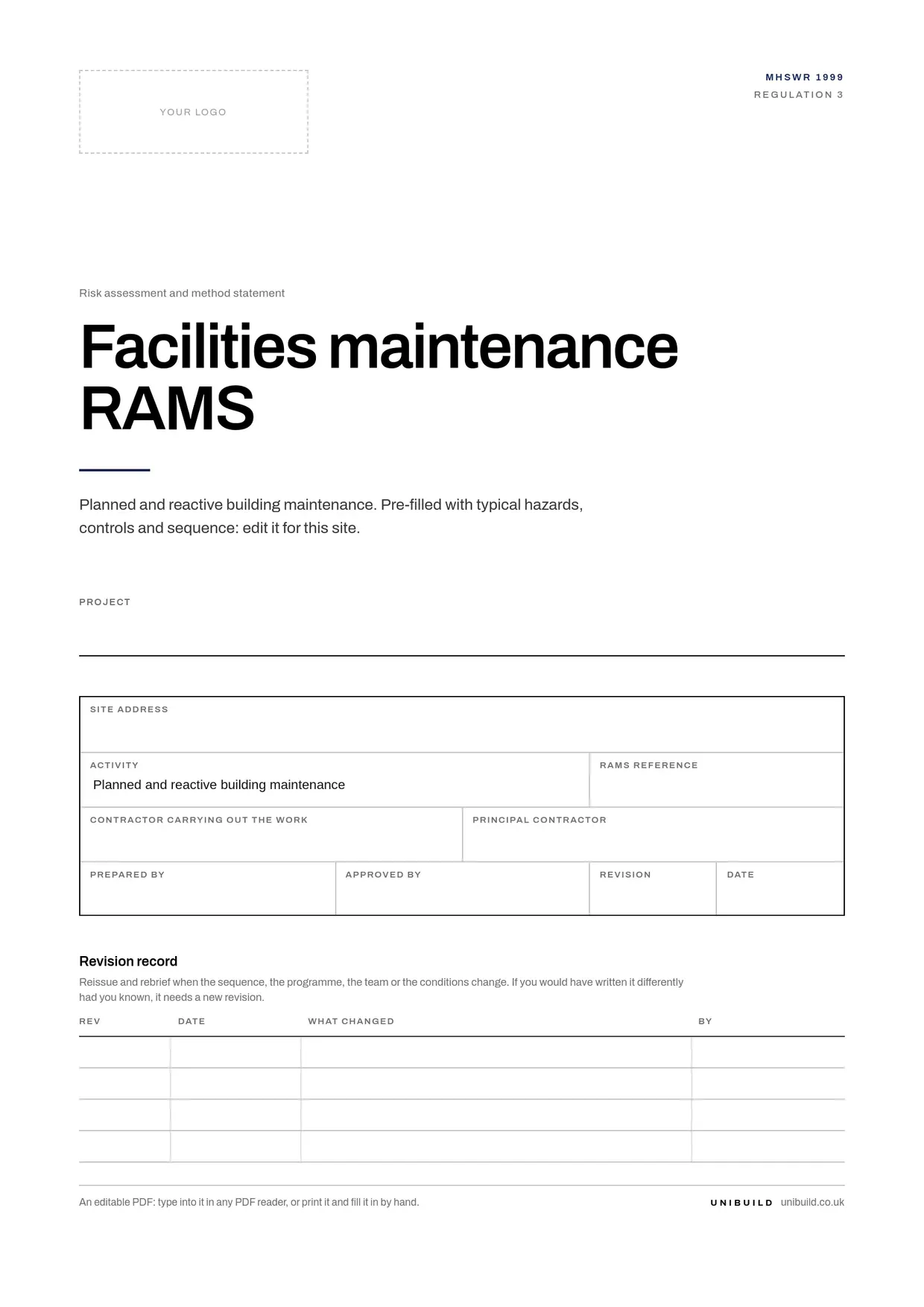
A building maintenance risk assessment and method statement, already filled in with the hazards, controls and sequence for planned and reactive work in occupied buildings. Edit it for the building, then brief it.
- Law
- MHSWR 1999, regulation 3
- Isolations
- Locked off and proved safe
- Format
- Editable PDF and Word
- Cost
- Free, always
Do you need a risk assessment for maintenance work?
Yes, in practice every maintenance job in a commercial building needs a maintenance risk assessment and method statement before work starts. The law requires a risk assessment, and much repair and upkeep of a building or its fixed services is construction work under CDM 2015. Clients and facilities managers will usually ask for a RAMS before they issue a permit or a key.
The risk assessment is the legal duty, under regulation 3 of the Management of Health and Safety at Work Regulations 1999. The method statement sets out how the job is done in a building that stays open: signing in, the asbestos information, permits and isolations, keeping occupants clear, and handing the building back with every system restored.
The same template works as a facilities management risk assessment for planned preventive maintenance and reactive call-outs, across M&E, building fabric, plant rooms and roofs. Write it for the building in front of you. The occupants, the asbestos register, the permit rules and who else is working there are what make it suitable.
Checked against legislation.gov.uk and HSE guidance on .
Building maintenance hazards and controls
18 hazards, rated before and after controlsThe significant hazards on planned and reactive maintenance in an occupied commercial building, with the controls a reviewer expects to see. Delete what does not apply and add what your building has.
Plant starting up or moving during work
Engineers working on pumps, fans, air handling units, doors, shutters and other powered plant.
- Plant stopped, isolated at every energy source and locked off with the engineer's own lock and tag, as HSE guidance on maintenance sets out.
- Stored energy released first: springs, compressed air, hydraulic pressure and parts that could fall supported or blocked.
- Isolation proved by trying to start the plant from its local controls before work begins.
BeforeHigh 15AfterMedium 5
Electric shock from building services
Engineers working on boards, lighting, controls and plant supplies thought to be dead.
- Supply isolated at a lockable point, locked off, and proved dead with an approved voltage indicator checked on a known source before and after.
- Precautions kept in place so the equipment cannot be made live again during the work, as EAWR regulation 13 requires.
- Electrical work only by competent electricians; the electrical RAMS covers live work and testing.
BeforeHigh 15AfterMedium 5
Hot and pressurised systems in plant rooms
Engineers working on boilers, heating and hot water circuits, calorifiers and pressure vessels.
- Section isolated on both sides with valves locked or tagged, then drained down and the pressure released before any joint is broken.
- Hot parts left to cool, with the temperature checked before work.
- Pressure systems worked on only by engineers trained on that plant, to the building's procedures.
BeforeMedium 12AfterLow 4
Gas appliances and supplies
Engineers and occupants where boilers, water heaters or catering appliances are serviced or repaired.
- Work on gas fittings only by a Gas Safe registered engineer qualified for the appliance type, as HSE guidance sets out for workplaces.
- Gas isolated and the appliance left safe, labelled and reported if it is found unsafe.
BeforeMedium 10AfterMedium 5
Asbestos in older buildings
Engineers drilling, lifting ceiling tiles, opening risers or removing old plant, and occupants nearby.
- Asbestos register checked for the exact area before work; anything it does not cover is presumed to contain asbestos until sampled.
- Work stops and the area is closed off if suspect material is found or disturbed, and the building contact is told at once.
- Asbestos awareness training for every engineer liable to disturb it.
BeforeHigh 15AfterMedium 5
Falls from ladders and stepladders
Engineers changing lamps, lifting ceiling tiles and reaching high-level equipment.
- Podium steps or a mobile tower chosen ahead of a ladder, with PASMA training for towers.
- Ladders and stepladders only for short, light, low-risk tasks, checked before use and set on firm, level ground.
- The working at height RAMS used for anything higher or longer.
BeforeMedium 12AfterMedium 8
Roofs, roof plant and fragile rooflights
Engineers reaching roof plant, gutters, outlets and fans, near edges, rooflights and fragile sheets.
- Roof access under the building's roof permit or access procedure, by a fixed or secured route.
- Fragile surfaces avoided wherever reasonably practicable, as WAHR regulation 9 requires, with covers or guard-rails where they cannot be.
- Edge protection or a fixed walkway to the plant; work restraint where neither is in place; work stopped in high wind or ice.
BeforeHigh 15AfterMedium 5
Fire systems taken out of service
Occupants, if a fire alarm zone, detector, door closer or sprinkler valve is left disabled.
- Fire alarm zones isolated only through the building's fire alarm procedure, with the building contact told and the time logged.
- Fire doors never wedged open; covers on detectors removed when the dusty work stops.
- Every isolated fire system restored and tested before the engineer leaves.
BeforeHigh 15AfterMedium 5
Hot work in an occupied building
Engineers soldering, brazing, cutting or grinding, and the building and its occupants.
- Cold methods such as press-fit, compression or mechanical cutting used where they will do the job.
- Hot work permit where the building requires one, with combustibles moved, detectors managed under the permit and an extinguisher at hand.
- Fire watch during and after the work, as the permit sets; the hot works RAMS covers the detail.
BeforeHigh 15AfterMedium 5
Occupants and the public near the work
Staff, visitors, tenants and the public in corridors, offices, toilets and car parks.
- Work area barriered and signed, with tools, leads and materials kept off walkways and doors not blocked.
- Noisy, dusty and disruptive work timed with the building contact, and service shutdowns agreed in advance.
- Nothing left open, isolated or unguarded when the engineer steps away, even briefly.
BeforeMedium 9AfterLow 3
Hidden services in ceilings and risers
Engineers drilling, cutting or fixing near cables, pipes, gas and sprinkler mains.
- Drawings and the building's records checked, and a cable and pipe detector used before drilling.
- Ceiling voids and risers looked into with a torch before hands go in; sharp edges and loose debris noted.
BeforeMedium 12AfterMedium 8
Water systems and legionella
Engineers and occupants, from work on tanks, showers, calorifiers, cooling towers and little-used outlets.
- Work on water systems follows the building's legionella risk assessment and any written control scheme, held by the person in control of the premises.
- Spray and aerosol kept to a minimum when opening, flushing or draining systems, with the area ventilated.
- Dead legs or redundant pipework left by the work reported to the building contact.
BeforeMedium 8AfterLow 4
Tanks, pits, sumps and ducts
Engineers entering water tanks, drainage pits, sumps, ducts or other enclosed spaces.
- Entry avoided where the work can be done from outside.
- Where entry is needed, a confined space entry permit, gas testing, a standby person and a rescue plan, as the confined spaces RAMS sets out.
BeforeMedium 10AfterMedium 5
Working alone and out of hours
Engineers on night, weekend and call-out work in empty buildings, plant rooms and basements.
- Lone working only for tasks assessed as safe for one person; confined space entry and work near exposed live conductors have a second person present, as HSE advises.
- Check-in at agreed times with someone who acts if a call is missed, and phone signal or another means of raising the alarm confirmed.
- Out-of-hours access, alarms and keys agreed with the building before the visit.
BeforeMedium 12AfterMedium 8
Moving parts on fans, belts and drives
Engineers servicing air handling units, extract fans, pumps and belt-driven plant.
- Plant isolated and left to run down before guards or panels are removed; fans can freewheel in a draught.
- Guards and panels refitted before the plant is restarted, and loose clothing kept clear.
BeforeMedium 8AfterLow 4
Manual handling of plant and parts
Engineers carrying motors, pumps, filters, tools and spares up stairs, through risers and onto roofs.
- Heavy items moved by trolley, lift or lifting aid, with two people for awkward loads.
- Route checked and cleared before the lift, including stairs and doors.
- Spares and tools taken up in loads one person can carry safely.
BeforeMedium 9AfterMedium 6
Chemicals for water treatment and cleaning
Engineers dosing water systems, descaling, or using solvents, sealants and lubricants.
- COSHH assessment and safety data sheet read for each product before use.
- Gloves and eye protection when decanting or dosing; products never mixed.
- Products stored and carried in labelled containers, and spills cleaned up at once.
BeforeMedium 9AfterLow 3
Other contractors in the same area
Engineers and other trades whose work, isolations or permits affect each other.
- Work co-ordinated through the building's permit system or contractor log, as MHSWR regulation 11 requires where employers share a workplace.
- Isolations and permits checked for conflicts before work starts, and each person keeps their own lock on a shared isolation.
BeforeMedium 12AfterLow 4
Scores are likelihood times severity on the five by five matrix in the template. They are typical ratings for this work, a starting point for your own assessment of your site.
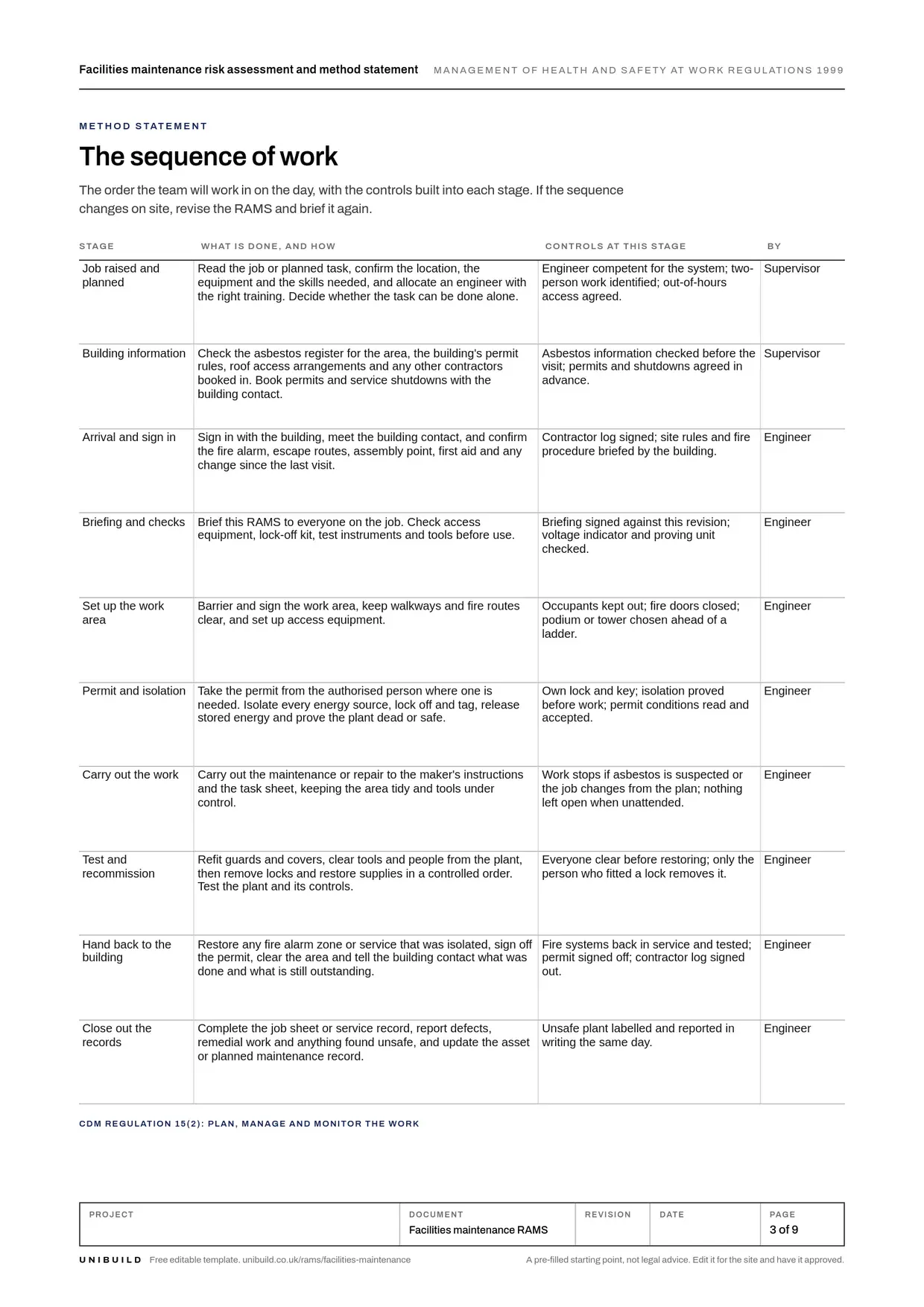
Maintenance method statement: the sequence of work
The order of work, with the controls at each stageThe order an engineer works in on a planned or reactive visit, with the controls built into each stage. If the job changes on site, stop, revise the RAMS and brief it again.
Job raised and planned
Read the job or planned task, confirm the location, the equipment and the skills needed, and allocate an engineer with the right training. Decide whether the task can be done alone.
ControlsEngineer competent for the system; two-person work identified; out-of-hours access agreed.
Building information
Check the asbestos register for the area, the building's permit rules, roof access arrangements and any other contractors booked in. Book permits and service shutdowns with the building contact.
ControlsAsbestos information checked before the visit; permits and shutdowns agreed in advance.
Arrival and sign in
Sign in with the building, meet the building contact, and confirm the fire alarm, escape routes, assembly point, first aid and any change since the last visit.
ControlsContractor log signed; site rules and fire procedure briefed by the building.
Briefing and checks
Brief this RAMS to everyone on the job. Check access equipment, lock-off kit, test instruments and tools before use.
ControlsBriefing signed against this revision; voltage indicator and proving unit checked.
Set up the work area
Barrier and sign the work area, keep walkways and fire routes clear, and set up access equipment.
ControlsOccupants kept out; fire doors closed; podium or tower chosen ahead of a ladder.
Permit and isolation
Take the permit from the authorised person where one is needed. Isolate every energy source, lock off and tag, release stored energy and prove the plant dead or safe.
ControlsOwn lock and key; isolation proved before work; permit conditions read and accepted.
Carry out the work
Carry out the maintenance or repair to the maker's instructions and the task sheet, keeping the area tidy and tools under control.
ControlsWork stops if asbestos is suspected or the job changes from the plan; nothing left open when unattended.
Test and recommission
Refit guards and covers, clear tools and people from the plant, then remove locks and restore supplies in a controlled order. Test the plant and its controls.
ControlsEveryone clear before restoring; only the person who fitted a lock removes it.
Hand back to the building
Restore any fire alarm zone or service that was isolated, sign off the permit, clear the area and tell the building contact what was done and what is still outstanding.
ControlsFire systems back in service and tested; permit signed off; contractor log signed out.
Close out the records
Complete the job sheet or service record, report defects, remedial work and anything found unsafe, and update the asset or planned maintenance record.
ControlsUnsafe plant labelled and reported in writing the same day.
What the law asks for building maintenance
Checked against the sourceRisk assessment
Every employer must make a suitable and sufficient assessment of the risks to employees and to others affected by the work, and record the significant findings if they employ five or more people.
Management of Health and Safety at Work Regulations 1999, regulation 3Shared buildings
Where two or more employers share a workplace, each co-operates with the others, takes reasonable steps to co-ordinate the measures they take, and tells the others about the risks its work creates for their employees.
Management of Health and Safety at Work Regulations 1999, regulation 11Information for visiting workers
An employer whose undertaking outside workers come into gives their employer comprehensible information on the risks and the measures taken, and enough information to identify the people nominated to run an evacuation.
Management of Health and Safety at Work Regulations 1999, regulation 12Maintenance and CDM 2015
Construction work includes repair, upkeep or maintenance of a structure and of its fixed mechanical, electrical and gas services, though HSE says not all maintenance is caught. Contractors plan, manage and monitor that work so it is done safely, so far as is reasonably practicable.
Construction (Design and Management) Regulations 2015, regulations 2 and 15Asbestos before work
Maintenance work liable to expose employees to asbestos does not start until the employer has assessed whether asbestos is present, or presumes it is. The dutyholder for non-domestic premises gives information on its location and condition to anyone liable to disturb it.
Control of Asbestos Regulations 2012, regulations 4 and 5Gas work
Nobody carries out work on a gas fitting unless competent to do so. HSE guidance is that in workplaces such as shops, restaurants, schools and hospitals, work on gas fittings is done by a Gas Safe registered engineer qualified for it.
Gas Safety (Installation and Use) Regulations 1998, regulation 3Competence, equipment and PPE
Competence and cards
- Maintenance engineers Trained and experienced on the systems they maintain, with the maker's training for specialist plant.
- Electrical work A competent electrician working to BS 7671.
- Gas work A Gas Safe registered engineer qualified for the appliance type.
- Permits Issued by the person the building's permit system names as authorised to issue them.
- Asbestos Asbestos awareness training for every engineer liable to disturb it.
- Access equipment PASMA training for mobile towers and IPAF for MEWPs.
Plant and equipment
- Ladders, stepladders and podium steps Pre-use check each time; regular detailed inspection recorded.
- Lock-off kit, padlocks and tags One personal lock per engineer; kit checked complete before the visit.
- Voltage indicator and proving unit Proved on a known source before and after each test for dead.
- Mobile tower Built and checked to the maker's instructions before use.
- Drills and power tools Visual check before use; dust extraction fitted for drilling.
PPE
- Safety boots with toe protection.
- Gloves suited to the task: cut-resistant for sheet metal, chemical-resistant for dosing and descaling.
- Eye protection for drilling, overhead work and handling chemicals.
- Hearing protection in plant rooms and wherever the noise assessment calls for it.
- RPE FFP3 mask, face-fit tested, for drilling dust and dusty ceiling voids.
- Safety helmet and high-visibility clothing on roofs, in risers and where the building rules require them.
Permits and plans
A permit to work where the building requires one, for example for isolations, roof access or plant rooms. A hot work permit for soldering, brazing, cutting or grinding. A confined space entry permit for tanks, pits and sumps. A fire alarm isolation recorded through the building's procedure.
Emergency and rescue
Follow the building's fire and evacuation procedure, briefed by the building contact on arrival. For an electric shock, isolate the supply before touching the casualty. Lone workers check in at agreed times and the contact acts on a missed call. First aider and kit on site or in the van, and the nearest accident and emergency department named on the briefing.
Toolbox talk: building maintenance safety
Read this to the team before work starts, tick each point as it is covered, and record who attended.
- Sign in, meet the building contact and know the fire alarm and the way out before you touch anything.
- Check the asbestos register for the area before drilling, lifting a ceiling tile or opening a riser. If it is not covered, treat it as asbestos and ask.
- Nothing is worked on until it is isolated, locked off and proved dead or safe. Your lock, your key.
- If the job needs a permit, no permit means no start. Work only to what the permit says.
- Keep occupants out of the work area. Barriers up, leads off the floor, and nothing left open when you step away.
- Before you leave, every system you touched is back on and tested, the fire alarm is back in service, and the building contact knows.
Ask the team
- Where is the asbestos information for the area we are working in today?
- Which jobs on today's list need a permit or an isolation, and who issues them?
- Who is working alone or out of hours, and when do they check in?
What is in the facilities maintenance RAMS template
9 pages, pre-filled and editableThe work, pre-filled
Scope, the building and its access, interfaces with occupants and other contractors, the documents the RAMS relies on, and the team.
The sequence of work
Ten stages from the job being raised to closing out the records, with the controls and the person responsible at each one.
Hazards and controls
Eighteen building maintenance hazards rated before and after controls on a five by five matrix, with room for your own.
Plant, PPE and permits
The equipment and its checks, PPE by type, the substances used, and the permits the building needs.
Visit and permit log
A page to log each task on the visit: the asbestos check, the permit and isolation, and the systems restored on hand-back.
Emergency and briefing
The building's fire procedure, lone working check-ins, first aid, the environment section and twenty signatures against the revision.
Brief it, and get it signed on the phone
On Unibuild a RAMS is written from a template, approved, then read by each operative on their phone in their own language and signed. Subcontract and agency workers sign through a link, with no app to install.
Every signature carries its date and time and prints as the last page of the RAMS PDF. Change the RAMS and it has to be signed again.
How RAMS work on UnibuildMaintenance RAMS questions
Is this maintenance risk assessment template free?
What should a building maintenance RAMS include?
Is a maintenance risk assessment a legal requirement?
Do I need a new RAMS for every maintenance job?
Does CDM 2015 apply to maintenance work?
Who provides the asbestos information for maintenance work?
When does maintenance work need a permit to work?
Does a handyman need a RAMS?
RAMS templates for other trades and hazards
All free, pre-filled and editableBy trade
- Air conditioning and HVAC RAMS
- Bricklaying RAMS
- Carpentry and joinery RAMS
- CCTV installation RAMS
- Cleaning risk assessment
- Concrete works RAMS
- Demolition RAMS
- Drylining RAMS
- Electrical RAMS
- Facilities maintenance RAMS
- Fire alarm installation RAMS
- Glazing and window RAMS
- Groundworks RAMS
- Hot works and welding RAMS
- Insulation RAMS
- Landscaping and fencing RAMS
- Painting and decorating RAMS
- Pest control risk assessment
- Plastering and rendering RAMS
- Plumbing and heating RAMS
- Rail RAMS
- Refurbishment RAMS
- Roofing RAMS
- Rope access risk assessment
- Scaffolding RAMS
- Solar PV installation RAMS
- Steel erection RAMS
- Temporary works RAMS
- Tiling and flooring RAMS
- Tree surgery RAMS
By hazard
- Asbestos risk assessment
- Confined space risk assessment
- COSHH risk assessment
- Dust risk assessment
- Forklift and telehandler risk assessment
- Housekeeping risk assessment
- Lifting operations risk assessment
- Lone working risk assessment
- Manual handling risk assessment
- MEWP risk assessment
- Noise and vibration risk assessment
- Plant and excavator risk assessment
- Power tools risk assessment
- Traffic management risk assessment
- Working at height risk assessment
The blank RAMS template, the RAMS review checklist and every other free form are on Free downloads.
The RAMS, read and signed
before the work starts.
Unibuild keeps every RAMS with its versions, its approvals and each operative’s signature against the revision they read, for seven years, ready for the principal contractor or an auditor.