
Awaab’s Law: the talk
Read it as written or in your own words. Tick each point as you make it. Stop for the questions.
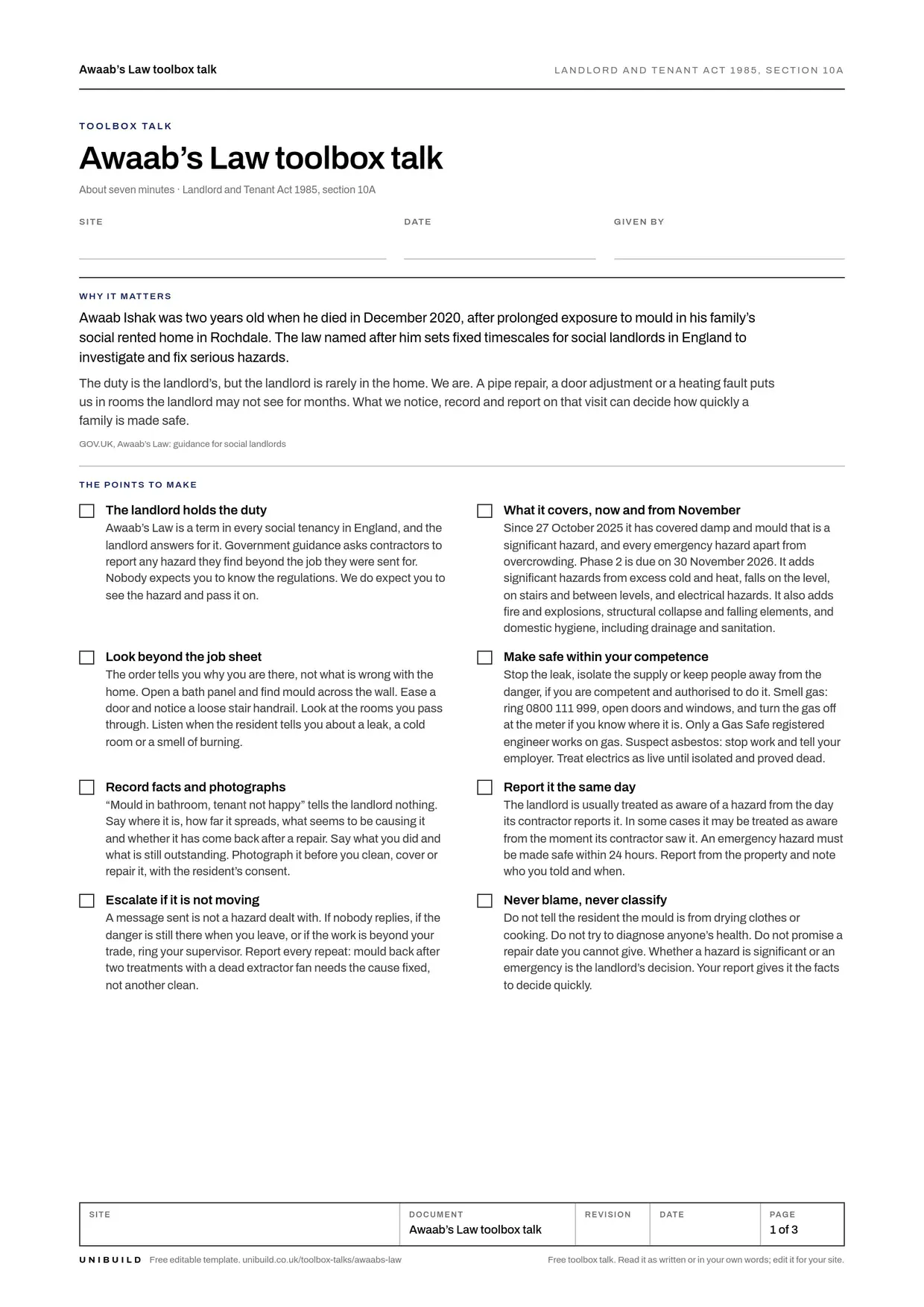
Why it matters
Awaab Ishak was two years old when he died in December 2020, after prolonged exposure to mould in his family’s social rented home in Rochdale. The law named after him sets fixed timescales for social landlords in England to investigate and fix serious hazards.
The duty is the landlord’s, but the landlord is rarely in the home. We are. A pipe repair, a door adjustment or a heating fault puts us in rooms the landlord may not see for months. What we notice, record and report on that visit can decide how quickly a family is made safe.
GOV.UK, Awaab’s Law: guidance for social landlordsThe points to make
The landlord holds the duty
Awaab’s Law is a term in every social tenancy in England, and the landlord answers for it. Government guidance asks contractors to report any hazard they find beyond the job they were sent for. Nobody expects you to know the regulations. We do expect you to see the hazard and pass it on.
What it covers, now and from November
Since 27 October 2025 it has covered damp and mould that is a significant hazard, and every emergency hazard apart from overcrowding. Phase 2 is due on 30 November 2026. It adds significant hazards from excess cold and heat, falls on the level, on stairs and between levels, and electrical hazards. It also adds fire and explosions, structural collapse and falling elements, and domestic hygiene, including drainage and sanitation.
Look beyond the job sheet
The order tells you why you are there, not what is wrong with the home. Open a bath panel and find mould across the wall. Ease a door and notice a loose stair handrail. Look at the rooms you pass through. Listen when the resident tells you about a leak, a cold room or a smell of burning.
Make safe within your competence
Stop the leak, isolate the supply or keep people away from the danger, if you are competent and authorised to do it. Smell gas: ring 0800 111 999, open doors and windows, and turn the gas off at the meter if you know where it is. Only a Gas Safe registered engineer works on gas. Suspect asbestos: stop work and tell your employer. Treat electrics as live until isolated and proved dead.
Record facts and photographs
“Mould in bathroom, tenant not happy” tells the landlord nothing. Say where it is, how far it spreads, what seems to be causing it and whether it has come back after a repair. Say what you did and what is still outstanding. Photograph it before you clean, cover or repair it, with the resident’s consent.
Report it the same day
The landlord is usually treated as aware of a hazard from the day its contractor reports it. In some cases it may be treated as aware from the moment its contractor saw it. An emergency hazard must be made safe within 24 hours. Report from the property and note who you told and when.
Escalate if it is not moving
A message sent is not a hazard dealt with. If nobody replies, if the danger is still there when you leave, or if the work is beyond your trade, ring your supervisor. Report every repeat: mould back after two treatments with a dead extractor fan needs the cause fixed, not another clean.
Never blame, never classify
Do not tell the resident the mould is from drying clothes or cooking. Do not try to diagnose anyone’s health. Do not promise a repair date you cannot give. Whether a hazard is significant or an emergency is the landlord’s decision. Your report gives it the facts to decide quickly.
Do
- Look at every room you pass through, not only the one on the order.
- Make safe only within your competence and your authority.
- Photograph the hazard, with the resident’s consent, before you clean, cover or repair it.
- Report the same day, from the property, and note who you told and when.
- Say plainly when you think a hazard could be an emergency.
- Ring your supervisor if you hear nothing back or the hazard is still there.
Do not
- Do not walk past a hazard because it is not on the order.
- Do not blame the resident for damp, mould or anything else.
- Do not decide whether a hazard is significant or an emergency. Report the facts.
- Do not wipe away mould and close the job while the cause is still there.
- Do not work on gas unless Gas Safe registered, or on electrics until they are isolated and proved dead.
- Do not carry on if you suspect asbestos. Stop work and report it.
- Do not promise the resident a repair date.
Ask the team
- You open a bath panel to fix a leaking pipe and find mould across the wall behind it. What do you do before you leave?
- You are there to adjust a door and notice a loose stair handrail. Who reports it, and when?
- You find a scorched socket on a call for a dripping tap. What do you do first?
- The heating has failed in January and the resident says the home has been cold for days. What goes in your report?
- Sewage is backing up into the bathroom and the resident has no working toilet. Who do you ring?
- This is the third mould treatment and the bathroom fan does not work. What do you write?
To close
Awaab’s Law is the landlord’s duty, but it works only if the people in the home speak up. Look past the job sheet. Make safe what you safely can. Photograph it, write down the facts and report it before you leave the street. If nothing happens, say so again, louder. Reporting a hazard that turns out to be minor is never a mistake.
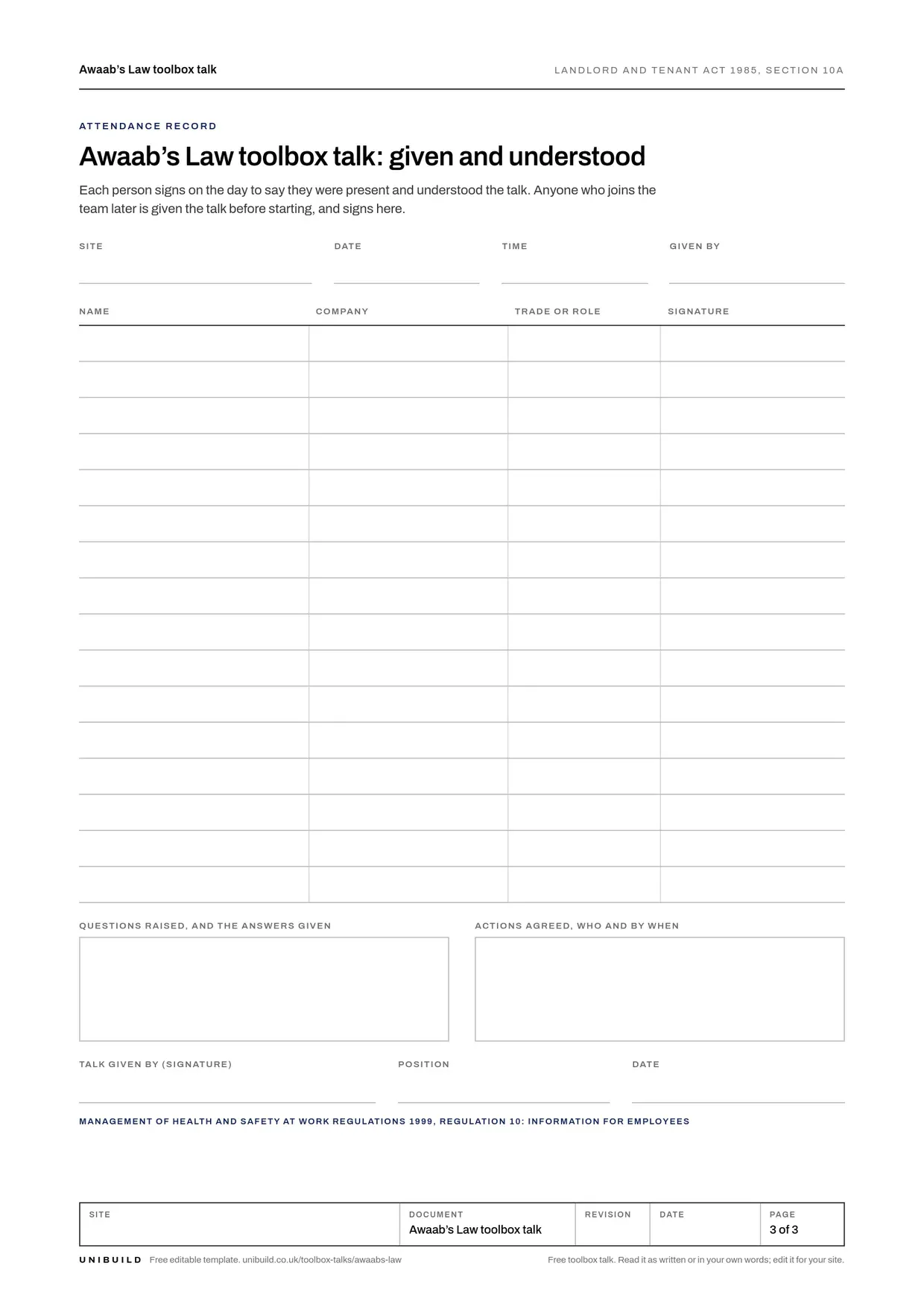
Record it. Who gave the talk, where, when, who was there and what was raised. The last page of the sheet is the record.