Free toolbox talk · Electrical safety

Electrical safety toolbox talk

A toolbox talk on electrical safety for every trade on site, written to be read aloud in about six minutes: the 110 volt supply, leads and tools, damaged kit, buried and overhead cables, never working live, and what to do if someone gets a shock. The last page is the attendance record.

PDF · 3 pages · 215 KB · Word 42 KB · Free to use and reuse · Terms

Law
Electricity at Work Regulations 1989
Time to deliver
About six minutes
Format
PDF and Word, with a sign-off sheet
Cost
Free, always

What this toolbox talk covers

This talk is for everyone on site who plugs in a tool, runs a lead, breaks ground or works near a cable, not only the electricians. It takes about six minutes to give and covers why the 110 volt site supply exists, the check to make on every lead and tool before it is used, what happens to damaged kit, buried and overhead cables, why nobody works on anything live, and what to do if someone gets a shock.

It is written to be read aloud, with the points a supervisor makes in the order they make them, two short lists of do and do not, and questions to put to the team so the talk is a conversation rather than a reading. The last page is the record: who gave it, who heard it and what was raised.

Electricity is unusual among site hazards because you cannot see it, hear it or smell it before it hurts you. Normal mains voltage, 230 volts, can kill. The electrical risk assessment holds the full hazards and controls this talk briefs, and the power tools RAMS covers the kit itself.

Checked against HSE guidance and legislation.gov.uk on .

Toolbox talk · About six minutes

Electrical safety: the talk

Read it as written or in your own words. Tick each point as you make it. Stop for the questions.

Why it matters

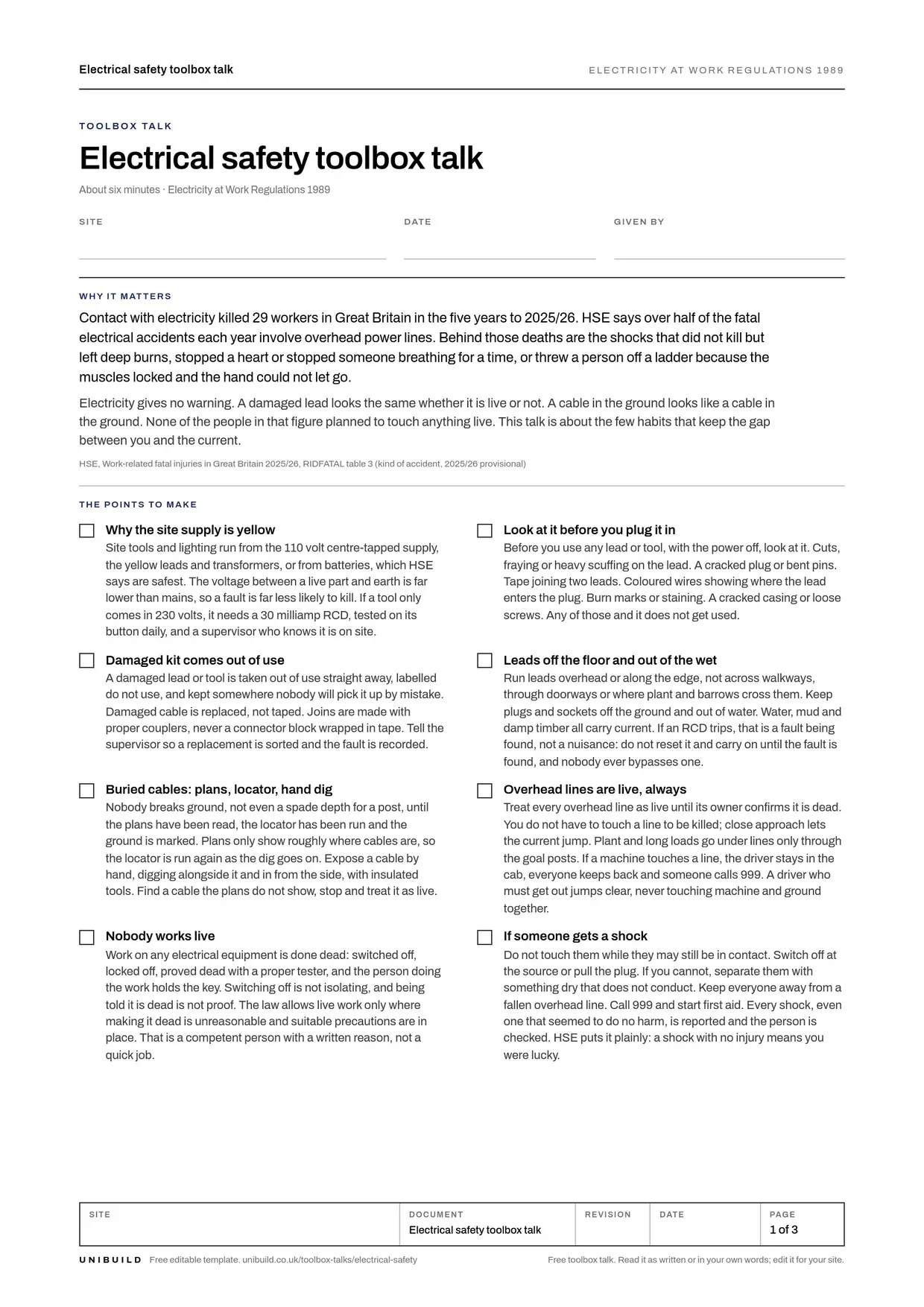
Contact with electricity killed 29 workers in Great Britain in the five years to 2025/26. HSE says over half of the fatal electrical accidents each year involve overhead power lines. Behind those deaths are the shocks that did not kill but left deep burns, stopped a heart or stopped someone breathing for a time, or threw a person off a ladder because the muscles locked and the hand could not let go.

Electricity gives no warning. A damaged lead looks the same whether it is live or not. A cable in the ground looks like a cable in the ground. None of the people in that figure planned to touch anything live. This talk is about the few habits that keep the gap between you and the current.

HSE, Work-related fatal injuries in Great Britain 2025/26, RIDFATAL table 3 (kind of accident, 2025/26 provisional)

The points to make

Why the site supply is yellow

Site tools and lighting run from the 110 volt centre-tapped supply, the yellow leads and transformers, or from batteries, which HSE says are safest. The voltage between a live part and earth is far lower than mains, so a fault is far less likely to kill. If a tool only comes in 230 volts, it needs a 30 milliamp RCD, tested on its button daily, and a supervisor who knows it is on site.

Look at it before you plug it in

Before you use any lead or tool, with the power off, look at it. Cuts, fraying or heavy scuffing on the lead. A cracked plug or bent pins. Tape joining two leads. Coloured wires showing where the lead enters the plug. Burn marks or staining. A cracked casing or loose screws. Any of those and it does not get used.

Damaged kit comes out of use

A damaged lead or tool is taken out of use straight away, labelled do not use, and kept somewhere nobody will pick it up by mistake. Damaged cable is replaced, not taped. Joins are made with proper couplers, never a connector block wrapped in tape. Tell the supervisor so a replacement is sorted and the fault is recorded.

Leads off the floor and out of the wet

Run leads overhead or along the edge, not across walkways, through doorways or where plant and barrows cross them. Keep plugs and sockets off the ground and out of water. Water, mud and damp timber all carry current. If an RCD trips, that is a fault being found, not a nuisance: do not reset it and carry on until the fault is found, and nobody ever bypasses one.

Buried cables: plans, locator, hand dig

Nobody breaks ground, not even a spade depth for a post, until the plans have been read, the locator has been run and the ground is marked. Plans only show roughly where cables are, so the locator is run again as the dig goes on. Expose a cable by hand, digging alongside it and in from the side, with insulated tools. Find a cable the plans do not show, stop and treat it as live.

Overhead lines are live, always

Treat every overhead line as live until its owner confirms it is dead. You do not have to touch a line to be killed; close approach lets the current jump. Plant and long loads go under lines only through the goal posts. If a machine touches a line, the driver stays in the cab, everyone keeps back and someone calls 999. A driver who must get out jumps clear, never touching machine and ground together.

Nobody works live

Work on any electrical equipment is done dead: switched off, locked off, proved dead with a proper tester, and the person doing the work holds the key. Switching off is not isolating, and being told it is dead is not proof. The law allows live work only where making it dead is unreasonable and suitable precautions are in place. That is a competent person with a written reason, not a quick job.

If someone gets a shock

Do not touch them while they may still be in contact. Switch off at the source or pull the plug. If you cannot, separate them with something dry that does not conduct. Keep everyone away from a fallen overhead line. Call 999 and start first aid. Every shock, even one that seemed to do no harm, is reported and the person is checked. HSE puts it plainly: a shock with no injury means you were lucky.

Do

  • Use 110 volt or battery tools on site, and ask before any 230 volt kit comes through the gate.
  • Look at every lead, plug and tool before you use it, with the power off.
  • Take damaged kit out of use at once, label it and report it.
  • Run leads overhead or along edges, and keep plugs and sockets off wet ground.
  • Read the plans, run the locator and mark the ground before anyone breaks it.
  • Treat every overhead and buried cable as live until its owner confirms otherwise.
  • Report every shock, however small, and get the person checked.

Do not

  • Do not use a lead or tool with a cut, a taped join, exposed wires, a cracked plug or burn marks.
  • Do not reset a tripped RCD and carry on without finding out why it tripped.
  • Do not dig, drive a pin or auger a hole where the ground has not been scanned and marked.
  • Do not take plant, ladders, scaffold tubes or long loads under overhead lines outside the marked route.
  • Do not open, repair or alter anything electrical unless that is your trade and the supply is locked off.
  • Do not touch someone who is still in contact with electricity. Switch it off first.

Ask the team

  • Where is the 230 volt kit on this site today, and what protects the person using it?
  • What did the last lead you picked up look like, and did you check it before plugging in?
  • Where are the buried services on this job, and where are the markings?
  • Which overhead lines are near our access route, and what is in place under them?
  • If the person next to you got a shock right now, what is the first thing you would do?

To close

Nobody reaches for a live cable on purpose. People get hurt because the lead was handy, the plans looked clear, the line looked far enough away, or the job was only going to take a minute. Electricity does not give second chances the way a trip or a slip sometimes does. If you are not sure a lead, a cable or a circuit is dead, treat it as live. Stop, ask, and we will sort it.

Record it. Who gave the talk, where, when, who was there and what was raised. The last page of the sheet is the record.

In Unibuild a talk is read in each operative’s own language and signed on the phone. How toolbox talks work

The law behind this talk

Checked against the source

Systems, work and protective equipment

All electrical systems are constructed and maintained so as to prevent danger, so far as is reasonably practicable. Every work activity on or near a system is carried out in a manner that does not give rise to danger. Protective equipment provided for work on or near electrical equipment is suitable, maintained and properly used. On site that covers the temporary supply, the transformers, every lead and every tool.

Electricity at Work Regulations 1989, regulation 4

Dead means staying dead

Where equipment has been made dead so that work can be done on or near it, adequate precautions are taken to prevent it becoming electrically charged during that work. In practice that is isolation, locking off, proving dead and keeping the key with the person doing the work.

Electricity at Work Regulations 1989, regulation 13

Work on or near live conductors

No person works on or so near any live conductor that danger may arise unless it is unreasonable in all the circumstances for it to be dead, it is reasonable for the person to be at work on or near it while live, and suitable precautions, including protective equipment where necessary, are taken to prevent injury. All three tests have to be met. Convenience does not meet them.

Electricity at Work Regulations 1989, regulation 14

Competent people

No person is engaged in any work activity where technical knowledge or experience is necessary to prevent danger or injury unless they possess that knowledge or experience, or are under an appropriate degree of supervision. Checking a lead is for everyone. Opening, repairing or altering electrical equipment is for a competent person.

Electricity at Work Regulations 1989, regulation 16

What is on the sheet

3 pages, the talk and the record

The talk, over two pages

Why it matters, the points to make, do and do not, and the questions to ask, laid out to read from in the cabin or at the workface. Space at the top for the site, the date and who is giving it.

The last page, the record

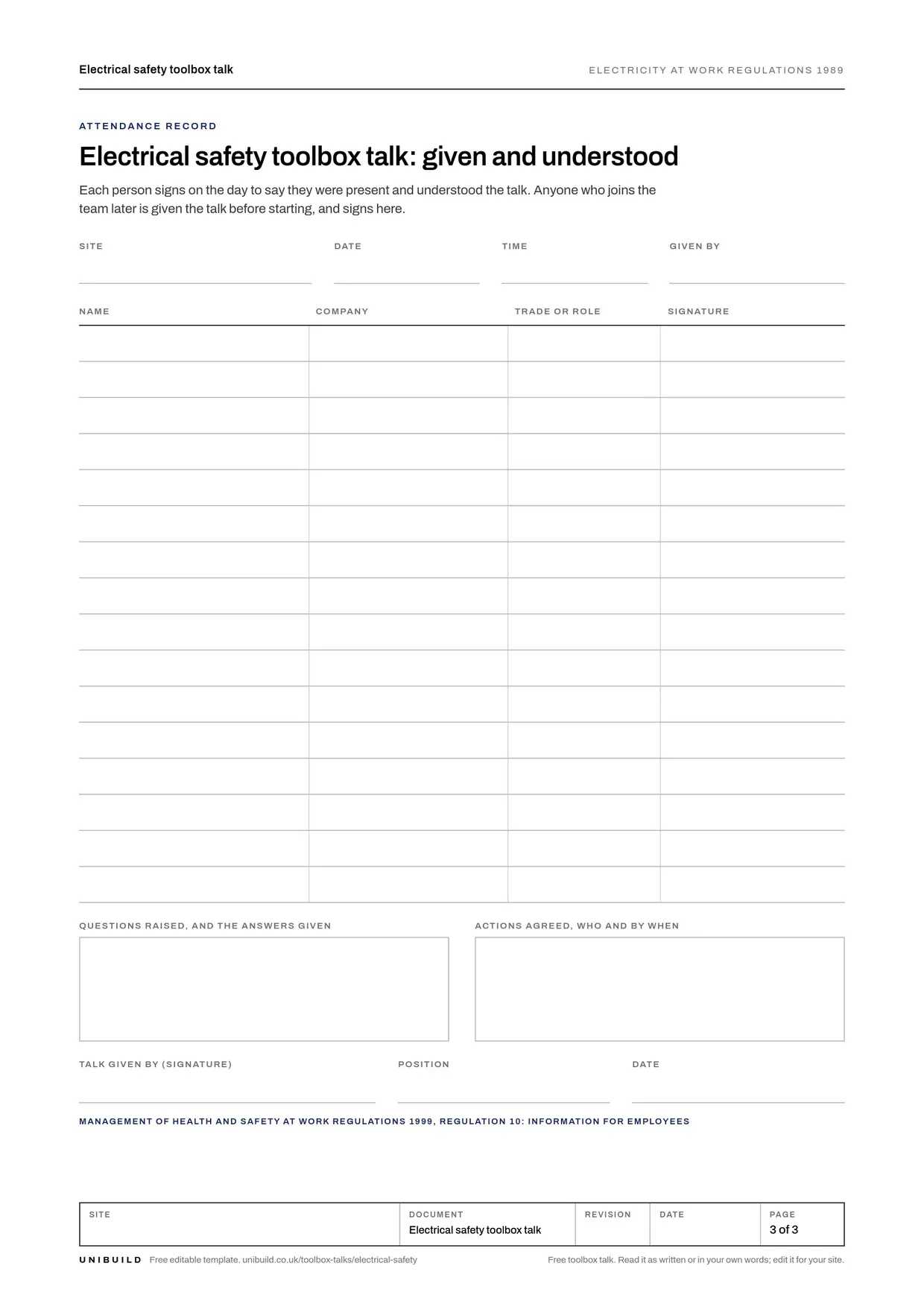
The attendance record: each person's name, company and signature, the questions raised and any actions, signed off by the person who gave the talk. Type into it or print it and pass it round.

The Word version

The same talk as a Word document, so you can put your own letterhead on it, add a site photograph or change a point to match how your job is set up.

Download the talk as PDF Word versionPDF · 3 pages · 215 KB
After it is given

Delivered on the phone, signed in the room

On Unibuild a toolbox talk is picked from the library, read by each operative on their own phone in their own language and signed there and then. The record is filed against the operative, the site and the date.

A site manager sees who has had which talk, and who has not, without a sheet going round on Thursday.

How toolbox talks work on Unibuild
How long should an electrical safety toolbox talk be?
About five to ten minutes. This one reads in about six if you make every point and stop for the questions. It is a briefing, not electrical training. Anyone who works on electrical systems needs proper training, recorded in the training matrix, and this talk does not replace it.
Is this talk only for electricians?
No. It is written for every trade. Anyone who plugs in a tool, runs a lead, drills into a wall, digs a hole or drives plant near overhead lines is exposed to electricity. Electricians need this talk too, but the people HSE records being killed by electricity are often not electricians.
Why do sites use 110 volts?
HSE guidance for construction is that portable tools and temporary lighting run from a 110 volt centre-tapped-to-earth supply, or from batteries, which HSE calls the safest option. The voltage between a live part and earth is far lower than mains, so a shock from a fault is far less likely to kill. Where 230 volt equipment has to be used, an RCD rated at no more than 30 milliamps, tested daily, gives additional protection.
Do we need to PAT test every tool on site?
The law requires equipment to be maintained so it does not cause danger; it does not name PAT testing or set an interval. HSE describes three layers: user checks before use, a formal visual inspection by someone who knows what to look for, and combined inspection and testing where the risk justifies it. On a construction site, leads and tools get used hard, so the intervals are short. Your risk assessment sets them.
How often should we give this talk?
The law does not set an interval. Give it when a team starts on a job, when the temporary supply changes, before any excavation or work near overhead lines, after a shock, a cable strike or a near miss anywhere on site, and as part of a rolling programme. Record each delivery.
Who can deliver an electrical safety toolbox talk?
A supervisor, site manager or a competent member of the team who knows the job and the site. They do not need to be an electrician to give this talk, but they should know where the supply, the buried services and the overhead lines are on this site. If a question goes beyond them, they bring in someone who can answer it.
What do we do if someone gets an electric shock?
Do not touch them until the supply is off. Switch off at the source or pull the plug; if you cannot, separate them with something dry that does not conduct. Keep everyone away from a fallen overhead line. Call 999 and start first aid. Report every shock, even one with no visible injury, and get the person checked. HSE says a shock that left no injury means you were lucky, not safe.
Do we have to keep a record of the talk?
There is no regulation that names toolbox talk records, but the Management Regulations require information and training to be provided and most principal contractors and auditors ask for the evidence. A signed attendance record, with the date and the topic, is the evidence. The last page of the sheet is that record.
Is this electrical safety toolbox talk free?
Yes. Download it, print it, give it, edit it and put your own name on it, including on paid work and for clients, with no sign-up and no email address.
Next step

The talk given, understood
and on record.

Unibuild keeps every toolbox talk against the operative who signed it, the site and the date, for seven years, ready for the principal contractor or an auditor.