
Lifting operations: the talk
Read it as written or in your own words. Tick each point as you make it. Stop for the questions.
Why it matters
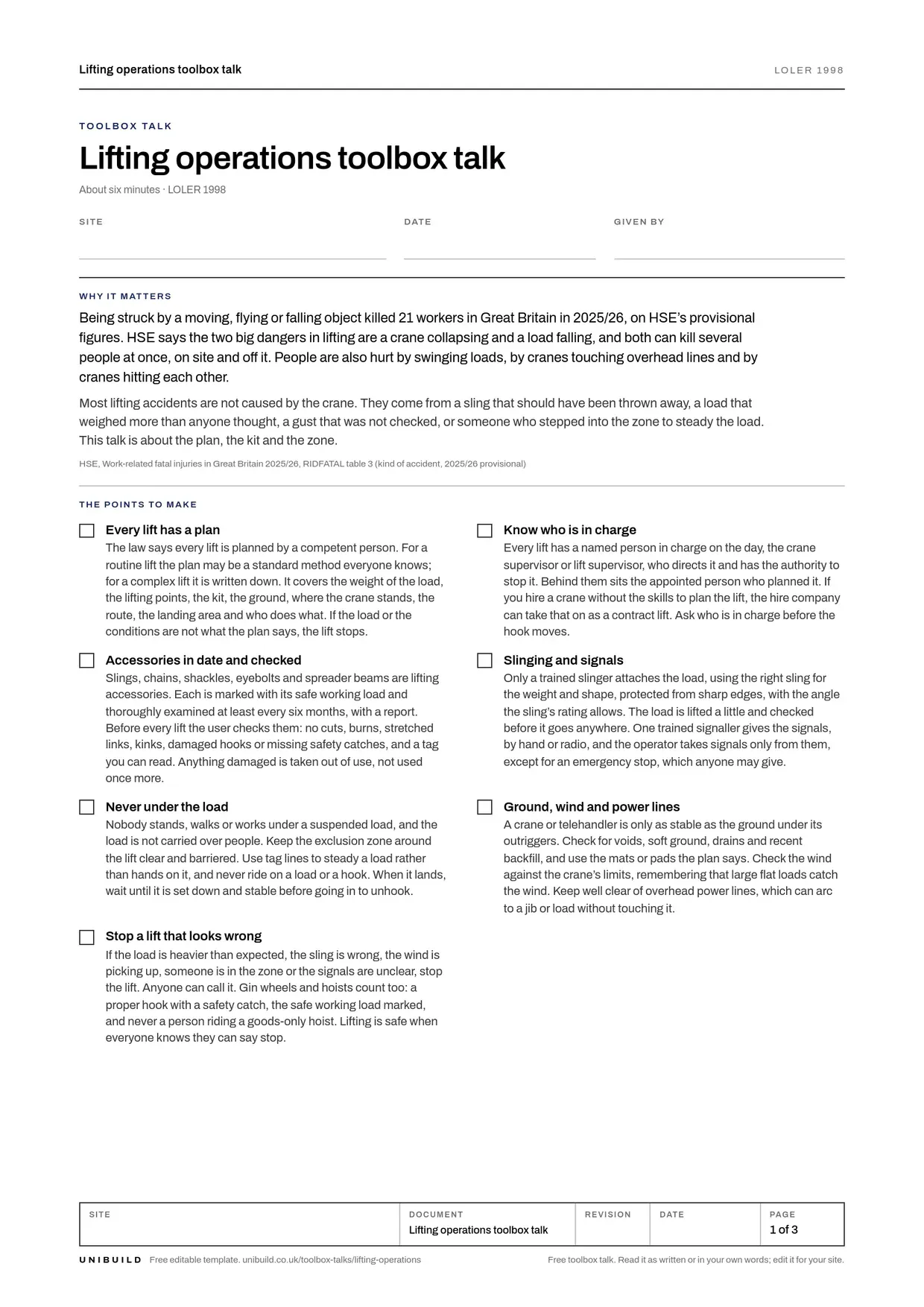
Being struck by a moving, flying or falling object killed 21 workers in Great Britain in 2025/26, on HSE’s provisional figures. HSE says the two big dangers in lifting are a crane collapsing and a load falling, and both can kill several people at once, on site and off it. People are also hurt by swinging loads, by cranes touching overhead lines and by cranes hitting each other.
Most lifting accidents are not caused by the crane. They come from a sling that should have been thrown away, a load that weighed more than anyone thought, a gust that was not checked, or someone who stepped into the zone to steady the load. This talk is about the plan, the kit and the zone.
HSE, Work-related fatal injuries in Great Britain 2025/26, RIDFATAL table 3 (kind of accident, 2025/26 provisional)The points to make
Every lift has a plan
The law says every lift is planned by a competent person. For a routine lift the plan may be a standard method everyone knows; for a complex lift it is written down. It covers the weight of the load, the lifting points, the kit, the ground, where the crane stands, the route, the landing area and who does what. If the load or the conditions are not what the plan says, the lift stops.
Know who is in charge
Every lift has a named person in charge on the day, the crane supervisor or lift supervisor, who directs it and has the authority to stop it. Behind them sits the appointed person who planned it. If you hire a crane without the skills to plan the lift, the hire company can take that on as a contract lift. Ask who is in charge before the hook moves.
Accessories in date and checked
Slings, chains, shackles, eyebolts and spreader beams are lifting accessories. Each is marked with its safe working load and thoroughly examined at least every six months, with a report. Before every lift the user checks them: no cuts, burns, stretched links, kinks, damaged hooks or missing safety catches, and a tag you can read. Anything damaged is taken out of use, not used once more.
Slinging and signals
Only a trained slinger attaches the load, using the right sling for the weight and shape, protected from sharp edges, with the angle the sling’s rating allows. The load is lifted a little and checked before it goes anywhere. One trained signaller gives the signals, by hand or radio, and the operator takes signals only from them, except for an emergency stop, which anyone may give.
Never under the load
Nobody stands, walks or works under a suspended load, and the load is not carried over people. Keep the exclusion zone around the lift clear and barriered. Use tag lines to steady a load rather than hands on it, and never ride on a load or a hook. When it lands, wait until it is set down and stable before going in to unhook.
Ground, wind and power lines
A crane or telehandler is only as stable as the ground under its outriggers. Check for voids, soft ground, drains and recent backfill, and use the mats or pads the plan says. Check the wind against the crane’s limits, remembering that large flat loads catch the wind. Keep well clear of overhead power lines, which can arc to a jib or load without touching it.
Stop a lift that looks wrong
If the load is heavier than expected, the sling is wrong, the wind is picking up, someone is in the zone or the signals are unclear, stop the lift. Anyone can call it. Gin wheels and hoists count too: a proper hook with a safety catch, the safe working load marked, and never a person riding a goods-only hoist. Lifting is safe when everyone knows they can say stop.
Do
- Know the plan for the lift and who is in charge before it starts.
- Check every sling, chain and shackle before use, and take damaged ones out of use.
- Lift a little and check the load is balanced and secure before moving it.
- Keep the exclusion zone clear and use tag lines to steady loads.
- Take signals from one trained signaller only, and stop at any unclear signal.
- Check the wind, the ground and overhead lines before and during the lift.
Do not
- Do not stand, walk or work under a suspended load.
- Do not use an accessory with no readable safe working load or an out-of-date examination.
- Do not lift a load whose weight you do not know.
- Do not ride on a load, a hook or a goods-only hoist.
- Do not use makeshift hooks, bent bars or knotted slings.
- Do not carry on with a lift that has changed from the plan.
Ask the team
- Who planned the lifts on this job, and who is in charge of them on the day?
- Where are the examination reports for our slings and chains, and when are they next due?
- Who is trained to sling and signal here?
- Where is the exclusion zone for today’s lifts, and how do we stop people walking into it?
- What would make you stop a lift, and would you feel able to?
To close
A crane can lift several tonnes over people’s heads, and the only things that keep it there are a sound plan, sound kit and a clear zone underneath. So know the plan and who is in charge. Check the slings before every lift. Lift a little, check, then go. Keep out from under the load. And if anything changes, the weight, the wind, the ground or the person standing where they should not be, stop the lift. Everyone here has the right to say stop.
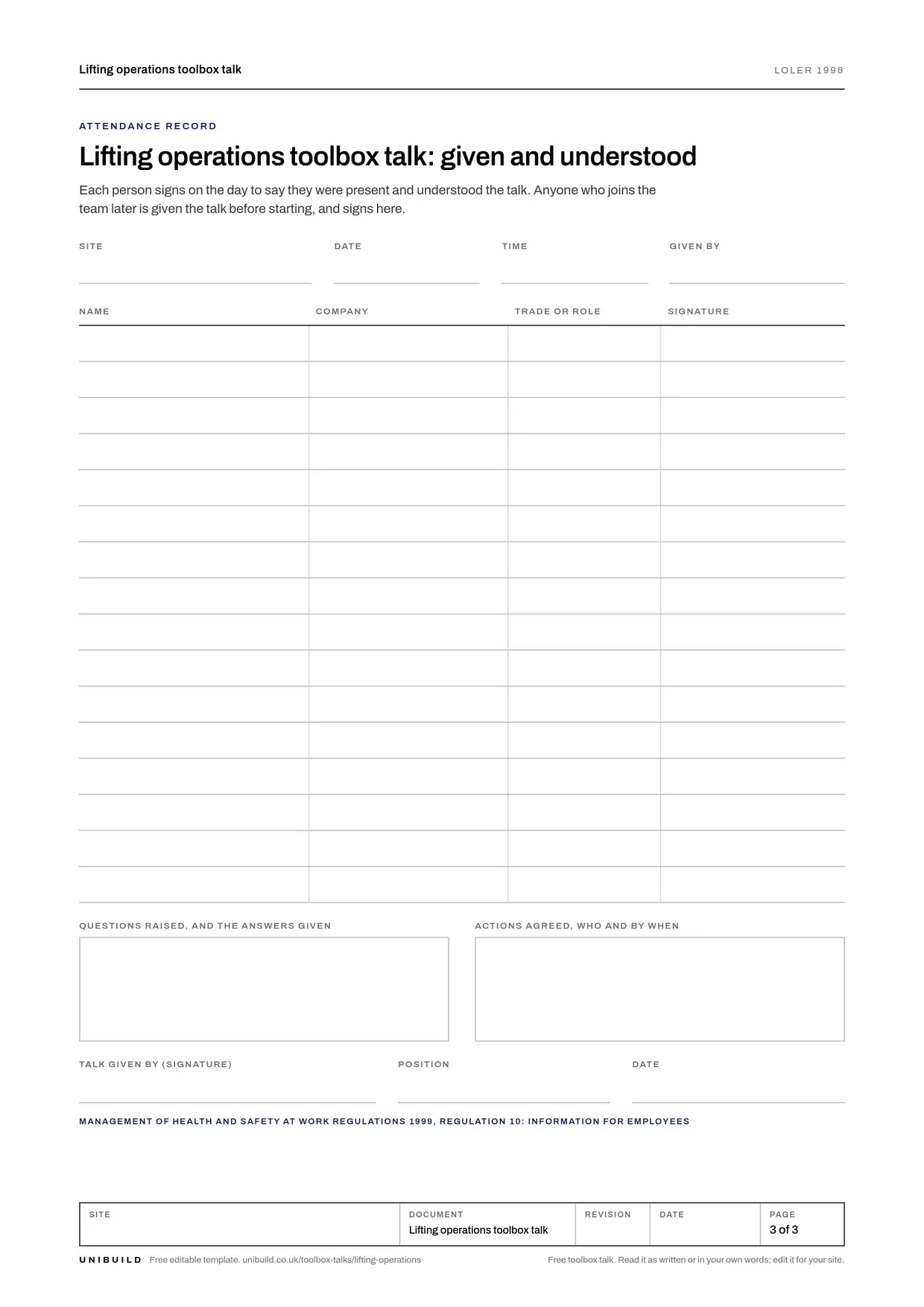
Record it. Who gave the talk, where, when, who was there and what was raised. The last page of the sheet is the record.