Free toolbox talk · Fire safety

Fire safety toolbox talk

A toolbox talk on fire safety, written to be read aloud in about seven minutes: fuel and ignition, hot works and the fire watch, flammable stores and gas cylinders, waste, escape routes and alarms, extinguishers, and what to do when the alarm goes. The last page is the attendance record.

PDF · 3 pages · 213 KB · Word 41 KB · Free to use and reuse · Terms

Law
CDM 2015 regulations 29 to 32, Fire Safety Order 2005
Time to deliver
About seven minutes
Format
PDF and Word, with a sign-off sheet
Cost
Free, always

What this toolbox talk covers

This talk is for anyone working on a construction site or in an occupied building that is being refurbished, extended or repaired. It takes about seven minutes to give and covers how fires start, the jobs and stores that start them, how to keep the escape routes open, what an extinguisher can and cannot do, and what everyone does when the alarm goes.

It is written to be read aloud, with the points a supervisor makes in the order they make them, two short lists of do and do not, and questions to put to the team so the talk is a conversation rather than a reading. The last page is the record: who gave it, who heard it and what was raised.

A site under construction has more fuel and fewer protections than a finished building: open timber, packaging, foam insulation, solvents and gas cylinders, with the fire doors, alarms and compartment walls not yet in. The hot works and welding risk assessment holds the full hazards and controls for the highest risk job, and the hot work permit is the form that controls it.

Checked against HSE guidance and legislation.gov.uk on .

Toolbox talk · About seven minutes

Fire safety: the talk

Read it as written or in your own words. Tick each point as you make it. Stop for the questions.

Why it matters

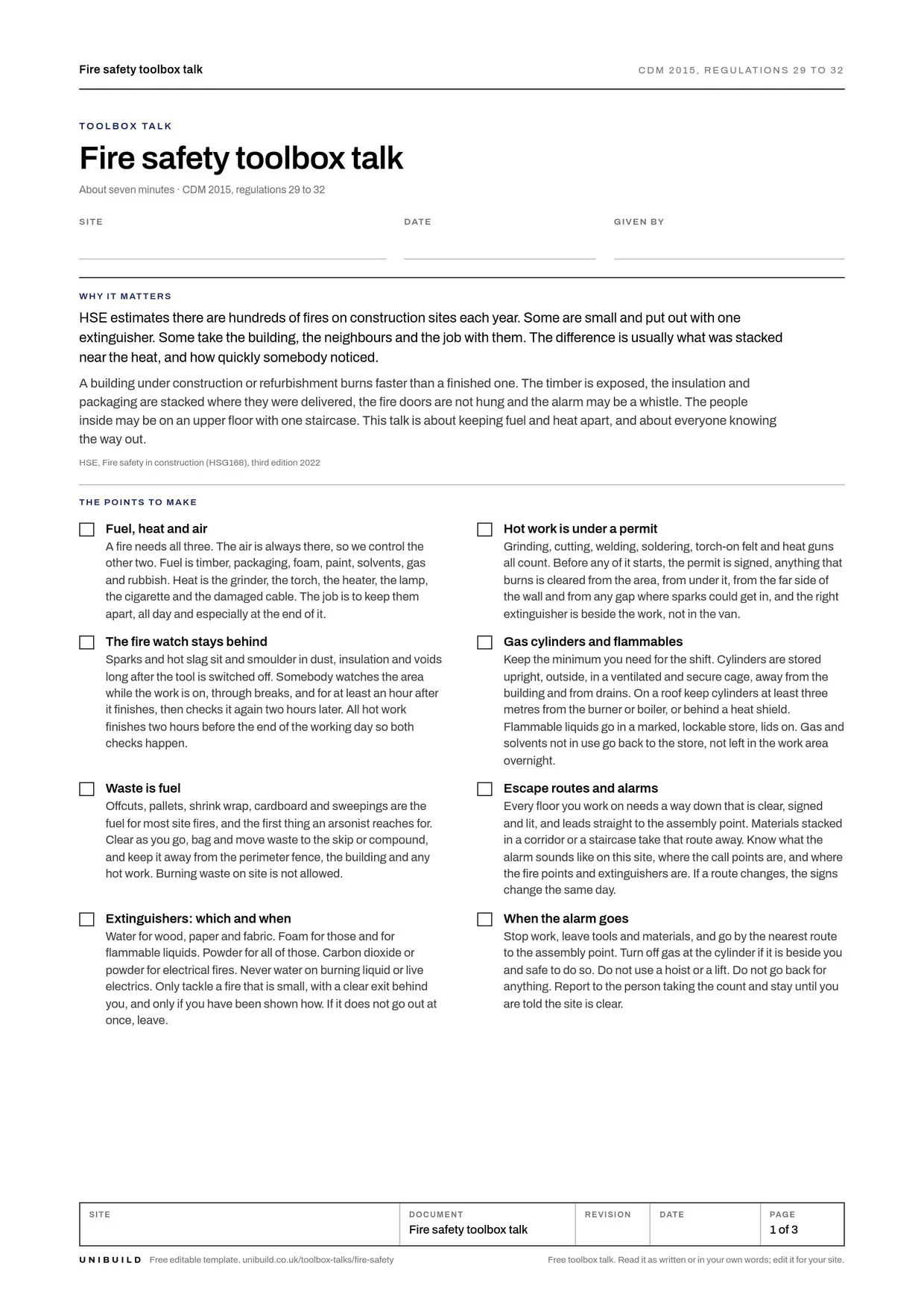
HSE estimates there are hundreds of fires on construction sites each year. Some are small and put out with one extinguisher. Some take the building, the neighbours and the job with them. The difference is usually what was stacked near the heat, and how quickly somebody noticed.

A building under construction or refurbishment burns faster than a finished one. The timber is exposed, the insulation and packaging are stacked where they were delivered, the fire doors are not hung and the alarm may be a whistle. The people inside may be on an upper floor with one staircase. This talk is about keeping fuel and heat apart, and about everyone knowing the way out.

HSE, Fire safety in construction (HSG168), third edition 2022

The points to make

Fuel, heat and air

A fire needs all three. The air is always there, so we control the other two. Fuel is timber, packaging, foam, paint, solvents, gas and rubbish. Heat is the grinder, the torch, the heater, the lamp, the cigarette and the damaged cable. The job is to keep them apart, all day and especially at the end of it.

Hot work is under a permit

Grinding, cutting, welding, soldering, torch-on felt and heat guns all count. Before any of it starts, the permit is signed, anything that burns is cleared from the area, from under it, from the far side of the wall and from any gap where sparks could get in, and the right extinguisher is beside the work, not in the van.

The fire watch stays behind

Sparks and hot slag sit and smoulder in dust, insulation and voids long after the tool is switched off. Somebody watches the area while the work is on, through breaks, and for at least an hour after it finishes, then checks it again two hours later. All hot work finishes two hours before the end of the working day so both checks happen.

Gas cylinders and flammables

Keep the minimum you need for the shift. Cylinders are stored upright, outside, in a ventilated and secure cage, away from the building and from drains. On a roof keep cylinders at least three metres from the burner or boiler, or behind a heat shield. Flammable liquids go in a marked, lockable store, lids on. Gas and solvents not in use go back to the store, not left in the work area overnight.

Waste is fuel

Offcuts, pallets, shrink wrap, cardboard and sweepings are the fuel for most site fires, and the first thing an arsonist reaches for. Clear as you go, bag and move waste to the skip or compound, and keep it away from the perimeter fence, the building and any hot work. Burning waste on site is not allowed.

Escape routes and alarms

Every floor you work on needs a way down that is clear, signed and lit, and leads straight to the assembly point. Materials stacked in a corridor or a staircase take that route away. Know what the alarm sounds like on this site, where the call points are, and where the fire points and extinguishers are. If a route changes, the signs change the same day.

Extinguishers: which and when

Water for wood, paper and fabric. Foam for those and for flammable liquids. Powder for all of those. Carbon dioxide or powder for electrical fires. Never water on burning liquid or live electrics. Only tackle a fire that is small, with a clear exit behind you, and only if you have been shown how. If it does not go out at once, leave.

When the alarm goes

Stop work, leave tools and materials, and go by the nearest route to the assembly point. Turn off gas at the cylinder if it is beside you and safe to do so. Do not use a hoist or a lift. Do not go back for anything. Report to the person taking the count and stay until you are told the site is clear.

Do

  • Get a signed hot work permit before any grinding, cutting, welding or torch work starts.
  • Keep the right extinguisher beside hot work, and keep the fire watch on for at least an hour afterwards.
  • Store gas cylinders upright, outside, in a ventilated secure cage, and take them back there at the end of the shift.
  • Clear waste as you go and keep it away from the building, the fence and any heat source.
  • Check the escape route from your floor at the start of the shift and report anything blocking it.
  • Know the alarm, the call points and the assembly point for this site before you start work.

Do not

  • Do not start hot work without the permit, the area cleared and an extinguisher within reach.
  • Do not leave hot work unattended, even for a break, and do not finish it in the last two hours of the day.
  • Do not leave gas cylinders, fuel or solvents in the work area overnight.
  • Do not stack materials or waste in corridors, staircases, doorways or in front of fire points.
  • Do not run heaters or lamps near timber, insulation or packaging, or leave them on when nobody is there.
  • Do not fight a fire that is bigger than a bin, or one between you and the way out.
  • Do not go back into the building after the alarm until the person in charge says it is clear.

Ask the team

  • What hot work is on this site today, who holds the permit, and who is the fire watch?
  • Where are the gas cylinders and flammable liquids kept overnight, and who checks they are back in the store?
  • What does the alarm sound like here, and where is the assembly point?
  • If a fire started on the top floor right now, which way would you go, and is that route clear?
  • Which extinguisher would you pick up for a fire in a grinder cable, and which one would you not?

To close

Nobody starts a fire on purpose. Fires start because the sparks landed in a void nobody could see, the cylinder was left by the work because it was raining, or the pile of offcuts was going in the skip tomorrow. Keep fuel and heat apart, keep the way out clear, and when the alarm goes, go. The job can wait. The building cannot be rebuilt around you.

Record it. Who gave the talk, where, when, who was there and what was raised. The last page of the sheet is the record.

In Unibuild a talk is read in each operative’s own language and signed on the phone. How toolbox talks work

The law behind this talk

Checked against the source

Prevent the risk from fire

Suitable and sufficient steps must be taken to prevent, so far as is reasonably practicable, the risk of injury to a person during construction work arising from fire or explosion. This is the duty behind the permit, the stores, the waste rules and the fire watch.

Construction (Design and Management) Regulations 2015, regulation 29

Emergency procedures, routes and exits

Suitable and sufficient arrangements for dealing with any foreseeable emergency must be made, including evacuation of the site, and every person they cover must be familiar with them. The arrangements are tested at suitable intervals. Enough emergency routes and exits must be provided to reach a place of safety quickly, leading as directly as possible to an identified safe area, kept clear, lit where necessary and signed.

Construction (Design and Management) Regulations 2015, regulations 30 and 31

Fire detection and fire-fighting

Suitable and sufficient fire-fighting equipment and fire detection and alarm systems must be provided, located in suitable places, examined and tested at suitable intervals, kept easily accessible and signed. Each person at work on site must, so far as is reasonably practicable, be instructed in the correct use of fire-fighting equipment they may need to use, and where an activity gives rise to a particular risk of fire, nobody carries it out unless suitably instructed.

Construction (Design and Management) Regulations 2015, regulation 32

Occupied premises: the responsible person

In an occupied building the responsible person, usually the employer, owner or occupier, must take general fire precautions for employees and for anyone else lawfully on the premises, provide appropriate fire-fighting equipment, detectors and alarms, and keep routes to emergency exits and the exits themselves clear at all times. On a construction site HSE enforces fire safety; in an occupied building the local fire and rescue authority covers the building-wide precautions. Work in a live building has to fit the building’s own fire plan.

Regulatory Reform (Fire Safety) Order 2005, articles 8, 13 and 14

What is on the sheet

3 pages, the talk and the record

The talk, over two pages

Why it matters, the points to make, do and do not, and the questions to ask, laid out to read from in the cabin or at the workface. Space at the top for the site, the date and who is giving it.

The last page, the record

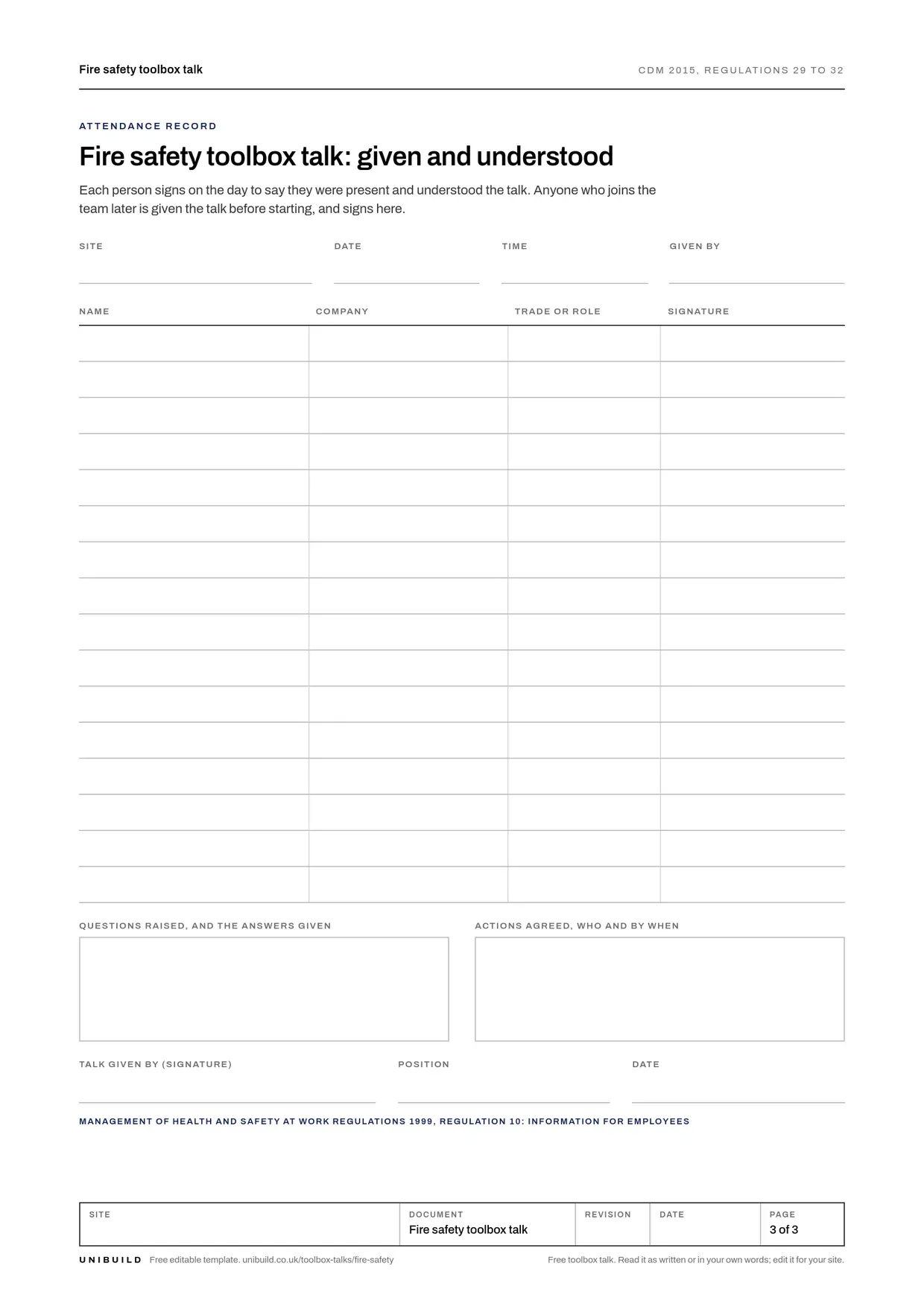
The attendance record: each person's name, company and signature, the questions raised and any actions, signed off by the person who gave the talk. Type into it or print it and pass it round.

The Word version

The same talk as a Word document, so you can put your own letterhead on it, add a site photograph or change a point to match how your job is set up.

Download the talk as PDF Word versionPDF · 3 pages · 213 KB
After it is given

Delivered on the phone, signed in the room

On Unibuild a toolbox talk is picked from the library, read by each operative on their own phone in their own language and signed there and then. The record is filed against the operative, the site and the date.

A site manager sees who has had which talk, and who has not, without a sheet going round on Thursday.

How toolbox talks work on Unibuild
How long should a fire safety toolbox talk be?
About five to ten minutes. This one reads in about seven if you make every point and stop for the questions. It is a briefing, not fire warden or extinguisher training, which are separate courses recorded in the training matrix.
How often should we give this talk?
The law sets no interval. Give it at the start of a job, when hot work begins, when the escape routes or the alarm change, after any fire or near miss on site, and as part of a rolling programme. Many sites give it again before winter when heaters and temporary lighting come out.
Who can deliver a fire safety toolbox talk?
A supervisor, site manager or a competent member of the team who knows the site’s fire plan. Whoever gives it should be able to say where the assembly point, the call points and the fire points are on this site. If they cannot, they bring someone who can.
Do we need a hot work permit for every hot job?
HSE expects hot work to be controlled, and a permit to work is the usual method, in particular on larger projects and in timber frame or high-risk buildings. Most principal contractors require one for any grinding, cutting, welding, soldering or torch work. The permit fixes the clearance, the extinguisher, the fire watch and the finish time.
How long does the fire watch last after hot work?
HSG168 says a continuous fire watch of the hot work area for at least an hour after the work ends, followed by at least one more check two hours after it ends. HSG168 also says all hot work should be complete two hours before the end of the working day so both checks happen before the site closes.
Does this talk apply to work in an occupied building?
Yes. In a live building the Fire Safety Order applies and the building has a responsible person and a fire plan of its own. Your work must not block their exits, isolate their detectors without a plan, or bring in fuel their assessment never allowed for. Agree the hot work and isolation arrangements with the building before starting.
Do we have to keep a record of the talk?
No regulation names toolbox talk records, but CDM 2015 requires every person on site to be familiar with the emergency arrangements and instructed in the fire-fighting equipment they may use. A signed attendance record with the date and topic is the evidence. The last page of the sheet is that record.
Is this fire safety toolbox talk free?
Yes. Download it, print it, give it, edit it and put your own name on it, including on paid work and for clients, with no sign-up and no email address.
Next step

The talk given, understood
and on record.

Unibuild keeps every toolbox talk against the operative who signed it, the site and the date, for seven years, ready for the principal contractor or an auditor.