
Rail RAMS and rail risk assessment template
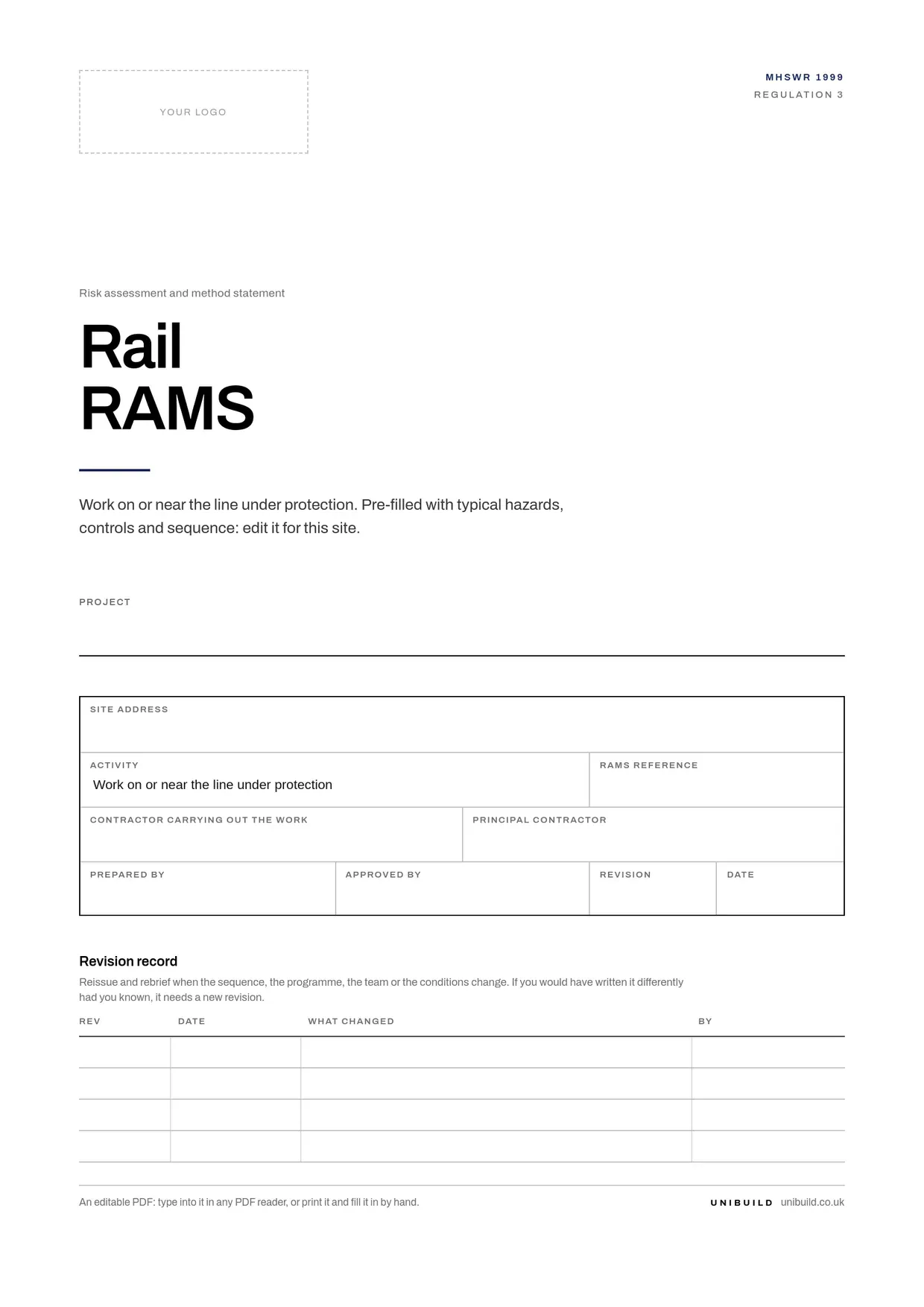
A rail risk assessment and method statement, already filled in for work on or near the line: protection, possessions, on-track plant, overhead lines and conductor rail. Edit it for your job, then brief it.
- Law
- ROGS 2006 and CDM 2015
- Rules
- Rule Book and client standards
- Format
- Editable PDF and Word
- Cost
- Free, always
Do you need a RAMS for rail work?
Yes, in practice. Every job on or near the railway needs a rail RAMS before anyone goes through the access point. The law requires a risk assessment, and a principal contractor or the infrastructure manager will expect to review it. On Network Rail infrastructure the task risks it identifies are carried into the safe work pack for the shift.
The risk assessment is the legal duty, under regulation 3 of the Management of Health and Safety at Work Regulations 1999. The method statement sets out how the team reaches the site, the protection or warning that keeps them safe from trains, the order of the work and how the line is handed back. It works alongside the Rule Book and the client's standards, such as Network Rail's NR/L2/OHS/019, and never replaces them.
A railway risk assessment also covers work near railway lines from neighbouring land: cranes, scaffold, excavations and demolition beside the boundary. Network Rail asks anyone planning that work to contact its Asset Protection team first. This template covers both, with the client's rules taking precedence wherever they say more.
Checked against legislation.gov.uk and HSE guidance on .
Rail hazards and controls
18 hazards, rated before and after controlsThe significant hazards on a typical job on or near the line, with the controls a reviewer expects to see. The client's standards and the Rule Book govern the detail: delete what does not apply and add what your site has.
Struck by a train on an open line
Track workers setting up, working or moving on or near a line where trains are running.
- Protection by a line blockage or possession, or a warning system, chosen from the hierarchy in the client's standard and set in the safe work pack.
- A COSS sets up the safe system of work, briefs it, and stays with the group while it is on or near the line.
- Position of safety identified for every location: at least 1.25 metres from the nearest line, or 2 metres where the speed is over 100 mph.
BeforeHigh 15AfterMedium 5
Warning from a lookout failing
A group relying on a site lookout to warn them of approaching trains.
- Lookouts used only where the Rule Book and safe work pack allow: approaching trains limited to 25 mph and one running line leading on. No distant or intermediate lookouts.
- No lookout warning in darkness, poor visibility or in or near a tunnel.
- Lookouts do that duty only and are never distracted. Under Network Rail's standard the person in charge is never the lookout or site warden.
BeforeHigh 15AfterMedium 5
Walking to and from the site of work
Staff walking between the access point and the site, alone or with others.
- Authorised access points and walking routes used; nobody walks on or near the line with others unless a COSS is with them.
- Anyone walking alone looks up at least every 5 seconds, to be in a position of safety at least 10 seconds before a train arrives.
- No phones while walking: stop in a position of safety first. Never step on rails or sleepers, or between the movable parts of points.
BeforeHigh 15AfterMedium 10
Engineering trains and plant in a possession
Workers inside a work site where engineering trains and on-track plant are moving.
- Movements of engineering trains and plant in the work site authorised by the engineering supervisor.
- On-track plant controlled by a machine controller, with the operator briefed on the limits of the work site.
- Exclusion zone round each machine; nobody enters it unless directed by the person in charge.
BeforeHigh 15AfterMedium 5
Plant fouling an adjacent open line
Train crews and passengers on an adjacent line, and workers if a machine slews or travels out of position.
- Adjacent line blocked where plant could foul it; where it stays open, the plan sets how plant is kept clear under the client's rules.
- Slew and height limiters set and tested before work, to the configuration in the plan.
- Machine controller watches the clearance throughout and stops the machine if it is lost.
BeforeMedium 10AfterMedium 5
Overhead line equipment at 25,000 volts
Anyone in an AC electrified area handling long tools, rail, scaffold tube or plant near the wires.
- Overhead lines treated as live unless an overhead line permit issued to the COSS states they are isolated and earthed.
- You and anything you hold stay at least 2.75 metres from live overhead line equipment, unless a method statement or company instruction allows less and its precautions are used.
- Isolation and earthing only by a nominated person under the infrastructure manager's instructions.
BeforeMedium 10AfterMedium 5
Conductor rail at 750 volts DC
Anyone working in a third rail area, especially when crossing the line or moving materials.
- Conductor rail treated as live unless a conductor rail permit is issued to the COSS, or another isolation the infrastructure manager allows is in place.
- Never step on the conductor rail, guard boarding or between the conductor rail and the running rail.
- Stay at least 1.5 metres away unless an approved method statement and electrical risk assessment allow less; within 300 mm, fit a conductor rail shield if possible.
BeforeHigh 15AfterMedium 5
Lineside cables and signalling equipment
Workers digging, driving stakes or moving troughing; and trains if signalling is damaged.
- Cable routes found from records and a survey before any ground is broken, under a permit to dig.
- Cables beside and crossing under the line treated as live; nobody interferes with them or their covers unless the plan allows it.
- Any damage reported to the signaller at once so trains can be protected, then to the electrical control operator for power cables.
BeforeMedium 12AfterLow 4
Tools and materials left near the line
Train crews and passengers, and workers hit by items moved by a passing train.
- Nothing placed closer than 2 metres to a line where a train can pass, unless it cannot be hit or moved by slipstream.
- Materials stacked and secured in the agreed laydown area, away from walking routes.
BeforeMedium 12AfterLow 4
Handing back a line that is not safe
Train crews and passengers on the first train after the work is given up.
- Person in charge checks that every person and every item that could affect the line has been removed before hand back.
- Track, points and equipment checked against the plan; any test or line clear verification the client requires is completed.
- Isolations cancelled and boards removed only in the order the client's procedures set.
BeforeMedium 10AfterMedium 5
Manual handling of rail, sleepers and ballast
Track workers lifting, carrying and placing heavy, awkward materials on uneven ground.
- Rail, sleepers and heavy components moved by plant or rail handling equipment wherever practicable.
- Team lifts planned and briefed where hand handling remains, with clear, level footing.
- Gloves with good grip; nobody carries long items over a live conductor rail.
BeforeMedium 12AfterMedium 6
Slips and trips on ballast and track
Anyone walking or working on ballast, sleepers, cable troughing and uneven cess.
- Walking routes kept clear of spoil, offcuts and stored materials.
- Safety footwear with ankle support; lamps or task lighting for night work.
BeforeMedium 8AfterLow 4
Noise masking warnings
Workers using rail saws, drills, tampers and plant who need to hear a warning or a horn.
- The warning or protection chosen in the plan works over the noise of the task.
- Hearing protection selected so that warnings can still be heard, and worn where noise assessment requires it.
- Noisy work stops the moment the warning is given; nobody leaves the position of safety until the COSS says so.
BeforeHigh 15AfterMedium 5
Dust from ballast and cutting
Workers cutting concrete sleepers, drilling or handling dry ballast.
- Water suppression or extraction on saws and drills, and ballast dampened where it is dusty.
- Face-fit tested respiratory protection where dust remains.
BeforeMedium 9AfterMedium 6
Fatigue from nights, weekends and travel
Workers on night and weekend possessions, especially after long journeys to site.
- Hours planned within the law, the client's limits and the sponsor's fatigue arrangements, whichever is shortest.
- Nobody reports for duty within 12 hours of working on the infrastructure unless the primary sponsor has risk assessed it and set controls.
- Travel time counted in the plan; anyone too tired to work safely says so and is stood down.
BeforeMedium 12AfterMedium 8
Drink and drugs
Anyone in a safety critical role, and everyone relying on them.
- Infrastructure manager's drugs and alcohol policy applied, including screening and testing where it requires.
- Anyone unfit through drink or drugs is not put to work; medication that may affect safe working is reported before work.
BeforeMedium 10AfterMedium 5
Darkness, poor visibility and tunnels
Workers on night shifts, in fog or heavy rain, and in or near tunnels.
- Safe system of work chosen for the conditions; lookout warning is not used.
- Everyone carries a suitable lamp; the site and access route are lit as the plan requires.
- Work stops and the plan is reviewed if visibility drops below what the safe system relies on.
BeforeHigh 15AfterMedium 5
Works beside the railway boundary
Train crews, passengers and track workers below cranes, scaffold or excavations on neighbouring land.
- Network Rail Asset Protection contacted before work starts, with its approval for any work on its land.
- Cranes, plant, scaffold and hoardings planned so they cannot fall onto the railway; nothing oversails the line unless Asset Protection has agreed it.
- Boundary fence kept secure throughout; any change agreed with Asset Protection first.
BeforeMedium 10AfterMedium 5
Scores are likelihood times severity on the five by five matrix in the template. They are typical ratings for this work, a starting point for your own assessment of your site.
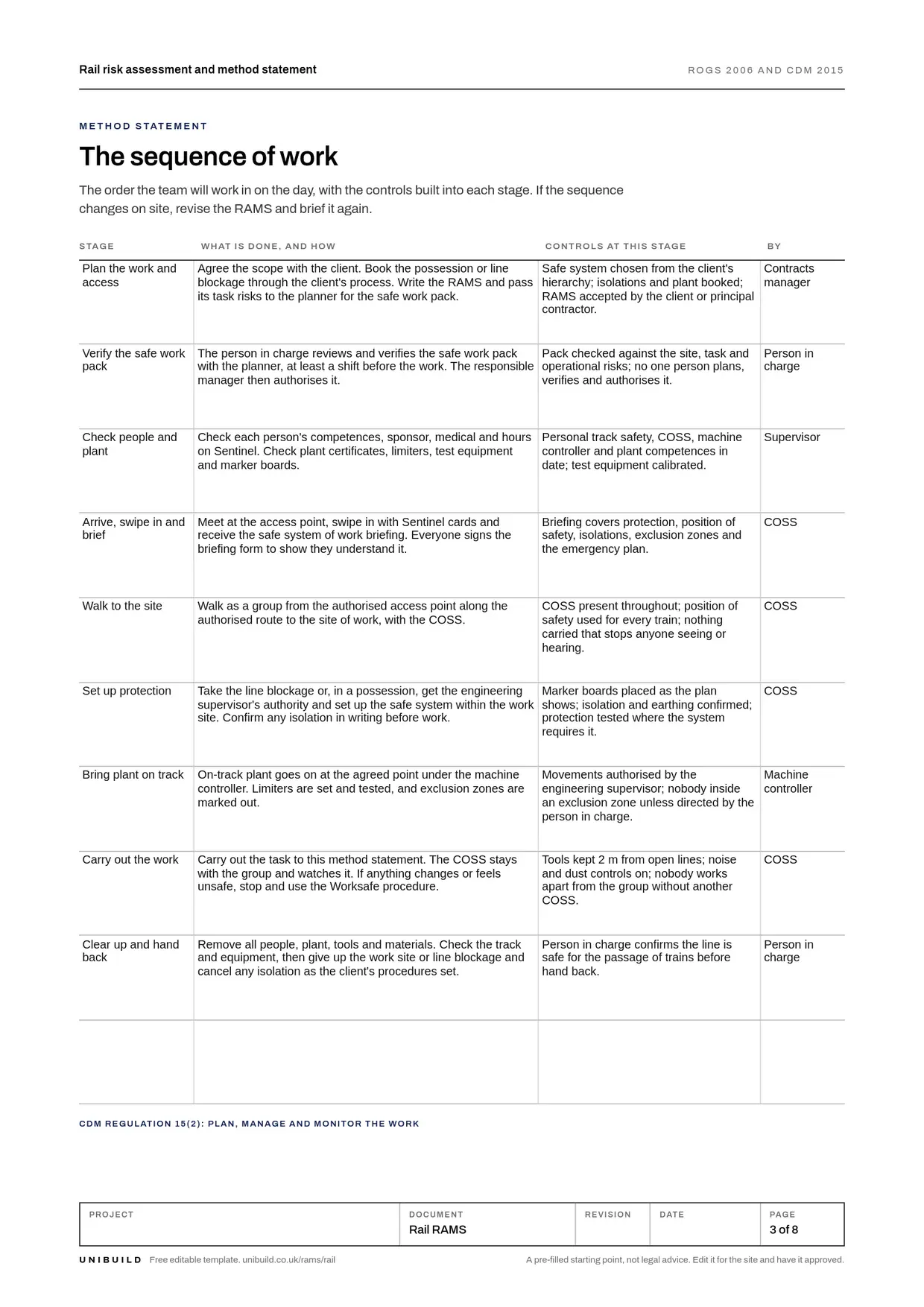
Rail method statement: the sequence of work
The order of work, with the controls at each stageThe order the shift runs in, from planning to closing out, with the controls built into each stage. If the work or the protection changes, stop, revise the safe work pack and the RAMS, and brief it again.
Plan the work and access
Agree the scope with the client. Book the possession or line blockage through the client's process. Write the RAMS and pass its task risks to the planner for the safe work pack.
ControlsSafe system chosen from the client's hierarchy; isolations and plant booked; RAMS accepted by the client or principal contractor.
Verify the safe work pack
The person in charge reviews and verifies the safe work pack with the planner, at least a shift before the work. The responsible manager then authorises it.
ControlsPack checked against the site, task and operational risks; no one person plans, verifies and authorises it.
Check people and plant
Check each person's competences, sponsor, medical and hours on Sentinel. Check plant certificates, limiters, test equipment and marker boards.
ControlsPersonal track safety, COSS, machine controller and plant competences in date; test equipment calibrated.
Arrive, swipe in and brief
Meet at the access point, swipe in with Sentinel cards and receive the safe system of work briefing. Everyone signs the briefing form to show they understand it.
ControlsBriefing covers protection, position of safety, isolations, exclusion zones and the emergency plan.
Walk to the site
Walk as a group from the authorised access point along the authorised route to the site of work, with the COSS.
ControlsCOSS present throughout; position of safety used for every train; nothing carried that stops anyone seeing or hearing.
Set up protection
Take the line blockage or, in a possession, get the engineering supervisor's authority and set up the safe system within the work site. Confirm any isolation in writing before work.
ControlsMarker boards placed as the plan shows; isolation and earthing confirmed; protection tested where the system requires it.
Bring plant on track
On-track plant goes on at the agreed point under the machine controller. Limiters are set and tested, and exclusion zones are marked out.
ControlsMovements authorised by the engineering supervisor; nobody inside an exclusion zone unless directed by the person in charge.
Carry out the work
Carry out the task to this method statement. The COSS stays with the group and watches it. If anything changes or feels unsafe, stop and use the Worksafe procedure.
ControlsTools kept 2 m from open lines; noise and dust controls on; nobody works apart from the group without another COSS.
Clear up and hand back
Remove all people, plant, tools and materials. Check the track and equipment, then give up the work site or line blockage and cancel any isolation as the client's procedures set.
ControlsPerson in charge confirms the line is safe for the passage of trains before hand back.
What the law asks for rail work
Checked against the sourceRisk assessment
Every employer must make a suitable and sufficient assessment of the risks, and record the significant findings if they employ five or more people.
Management of Health and Safety at Work Regulations 1999, regulation 3Plan, manage and monitor
A contractor must plan, manage and monitor its work so that, so far as is reasonably practicable, it is carried out without risks to health and safety. It must not appoint anyone who lacks, or is not obtaining, the skills, knowledge, training and experience for the task.
CDM 2015, regulation 15Safety critical work
Installing or maintaining the railway, and ensuring the safety of people working on or near the track, can be safety critical tasks. The controller of that work must ensure, so far as is reasonably practicable, that people are assessed as competent and fit, with a written record and monitoring.
ROGS 2006, regulations 23 and 24Fatigue
The controller of safety critical work must have arrangements to ensure, so far as is reasonably practicable, that nobody carries out that work when so fatigued that their own or others' health or safety could be significantly affected.
ROGS 2006, regulation 25Drink and drugs
It is an offence to work on a transport system in a maintenance capacity, or as a supervisor of or look-out for people doing that work, while unfit through drink or drugs. The employer also commits an offence unless it used all due diligence to prevent it.
Transport and Works Act 1992, sections 27 and 28Live conductors
Nobody works on or so near a live conductor that danger may arise unless it is unreasonable for it to be dead, it is reasonable to work on or near it live, and suitable precautions are taken to prevent injury.
Electricity at Work Regulations 1989, regulation 14Competence, equipment and PPE
Competence and cards
- Everyone on or near the line Personal track safety competence on a Sentinel card, with a primary sponsor, and medical and drugs and alcohol screening to the infrastructure manager's policy.
- COSS Controller of site safety, to Rule Book Handbook 7, for any group on or near the line. Only a COSS or an IWA (individual working alone) may work alone.
- Person in charge Named in the safe work pack under Network Rail's NR/L2/OHS/019; holds the COSS competence and is on site while the work is done.
- Protection controller Where a line blockage is shared, the PC manages it with the signaller and the COSSs work under it.
- PICOP and engineering supervisor Manage the possession and each work site, appointed under the client's arrangements.
- Machine controller and plant operator Competent for the on-track plant and the role, to Rule Book Handbook 15, with the competence on their Sentinel record.
Plant and equipment
- Road-rail vehicles and on-track plant Certificates in date; daily checks; limiters set and tested before work.
- Rail saws, drills and hand-held plant Checked before use; guards fitted; dust control and vibration time planned.
- Track warning or protection equipment Tested before use to the manufacturer's and the client's instructions.
- Possession limit and marker boards Complete, lit where required, and placed where the plan shows.
- Isolation test equipment and earths Calibrated and in date; used as the isolation instructions set out.
PPE
- High-visibility clothing issued by the employer, to the client's standard.
- Safety helmet to the client's standard, worn where it requires one.
- Safety boots with ankle support and a grip sole for ballast.
- Gloves with good grip for rail, sleepers and tools.
- Eye and hearing protection for cutting and drilling, chosen so warnings can still be heard.
Permits and plans
Possession or line blockage booked through the client, with an authorised safe work pack. An overhead line permit or conductor rail permit for any isolation, under the client's electrification procedures. A permit to dig where ground is broken near cable routes. A lift plan for any road-rail crane lift. Asset Protection approval for works beside the boundary.
Emergency and rescue
Report an accident to the signaller or Operations Control: say "This is an emergency call", then your name, exact location, whether any line is obstructed and the services needed. Stop trains with a hand danger signal if a line is in danger. Warn emergency services of live overhead lines or conductor rail. Access point, first aider and hospital named in the briefing.
Toolbox talk: working on or near the line
Read this to the team before work starts, tick each point as it is covered, and record who attended.
- Nobody goes on or near the line until they have swiped in and been briefed on the safe system of work. If you did not understand the briefing, ask.
- Know your position of safety at every point of the job. When the warning goes, stop work and move to it at once.
- The COSS stays with us. Nobody works away from the group unless another COSS is with them.
- Overhead lines and conductor rail are live until we are told otherwise. Never step on the conductor rail or the guard boarding.
- Never enter the agreed exclusion zone round the plant unless the person in charge directs you to.
- If something changes or feels unsafe, stop the job and say so. That is what the Worksafe procedure is for.
Ask the team
- Where is your position of safety from this site?
- Which lines are open, and which are blocked or in the possession?
- Where is the access point, and what do you say first on an emergency call?
What is in the rail RAMS template
8 pages, pre-filled and editableThe work, pre-filled
Scope, location and access point, interfaces with the client and other contractors, the documents the RAMS relies on, and the team with their competences.
The sequence of work
Nine stages from planning the safe work pack to handing back the line, with the controls and the person responsible at each one.
Hazards and controls
Eighteen rail hazards rated before and after controls on a five by five matrix, with room for your own.
Plant, PPE and permits
On-track plant and equipment with their checks, PPE by type, and the possessions, isolations and permits the job needs.
Emergency arrangements
The emergency call, stopping trains, live electrical equipment and first aid, set out for the briefing.
Briefing record
Twenty signatures against the revision, taken on the day before the work starts.
Brief it, and get it signed on the phone
On Unibuild a RAMS is written from a template, approved, then read by each operative on their phone in their own language and signed. Subcontract and agency workers sign through a link, with no app to install.
Every signature carries its date and time and prints as the last page of the RAMS PDF. Change the RAMS and it has to be signed again.
How RAMS work on UnibuildRail RAMS questions
Is this rail RAMS template free?
What should a rail RAMS include?
Is rail RAMS the same as RAMS under EN 50126?
What is a working near railway lines risk assessment?
What does "on or near the line" mean?
Do you need a PTS card to work on the railway?
Has the safe work leader replaced the COSS?
Who regulates health and safety on the railway?
RAMS templates for other trades and hazards
All free, pre-filled and editableBy trade
- Air conditioning and HVAC RAMS
- Bricklaying RAMS
- Carpentry and joinery RAMS
- CCTV installation RAMS
- Cleaning risk assessment
- Concrete works RAMS
- Demolition RAMS
- Drylining RAMS
- Electrical RAMS
- Facilities maintenance RAMS
- Fire alarm installation RAMS
- Glazing and window RAMS
- Groundworks RAMS
- Hot works and welding RAMS
- Insulation RAMS
- Landscaping and fencing RAMS
- Painting and decorating RAMS
- Pest control risk assessment
- Plastering and rendering RAMS
- Plumbing and heating RAMS
- Rail RAMS
- Refurbishment RAMS
- Roofing RAMS
- Rope access risk assessment
- Scaffolding RAMS
- Solar PV installation RAMS
- Steel erection RAMS
- Temporary works RAMS
- Tiling and flooring RAMS
- Tree surgery RAMS
By hazard
- Asbestos risk assessment
- Confined space risk assessment
- COSHH risk assessment
- Dust risk assessment
- Forklift and telehandler risk assessment
- Housekeeping risk assessment
- Lifting operations risk assessment
- Lone working risk assessment
- Manual handling risk assessment
- MEWP risk assessment
- Noise and vibration risk assessment
- Plant and excavator risk assessment
- Power tools risk assessment
- Traffic management risk assessment
- Working at height risk assessment
The blank RAMS template, the RAMS review checklist and every other free form are on Free downloads.
The RAMS, read and signed
before the work starts.
Unibuild keeps every RAMS with its versions, its approvals and each operative’s signature against the revision they read, for seven years, ready for the principal contractor or an auditor.