
Asbestos awareness: the talk
Read it as written or in your own words. Tick each point as you make it. Stop for the questions.
Why it matters
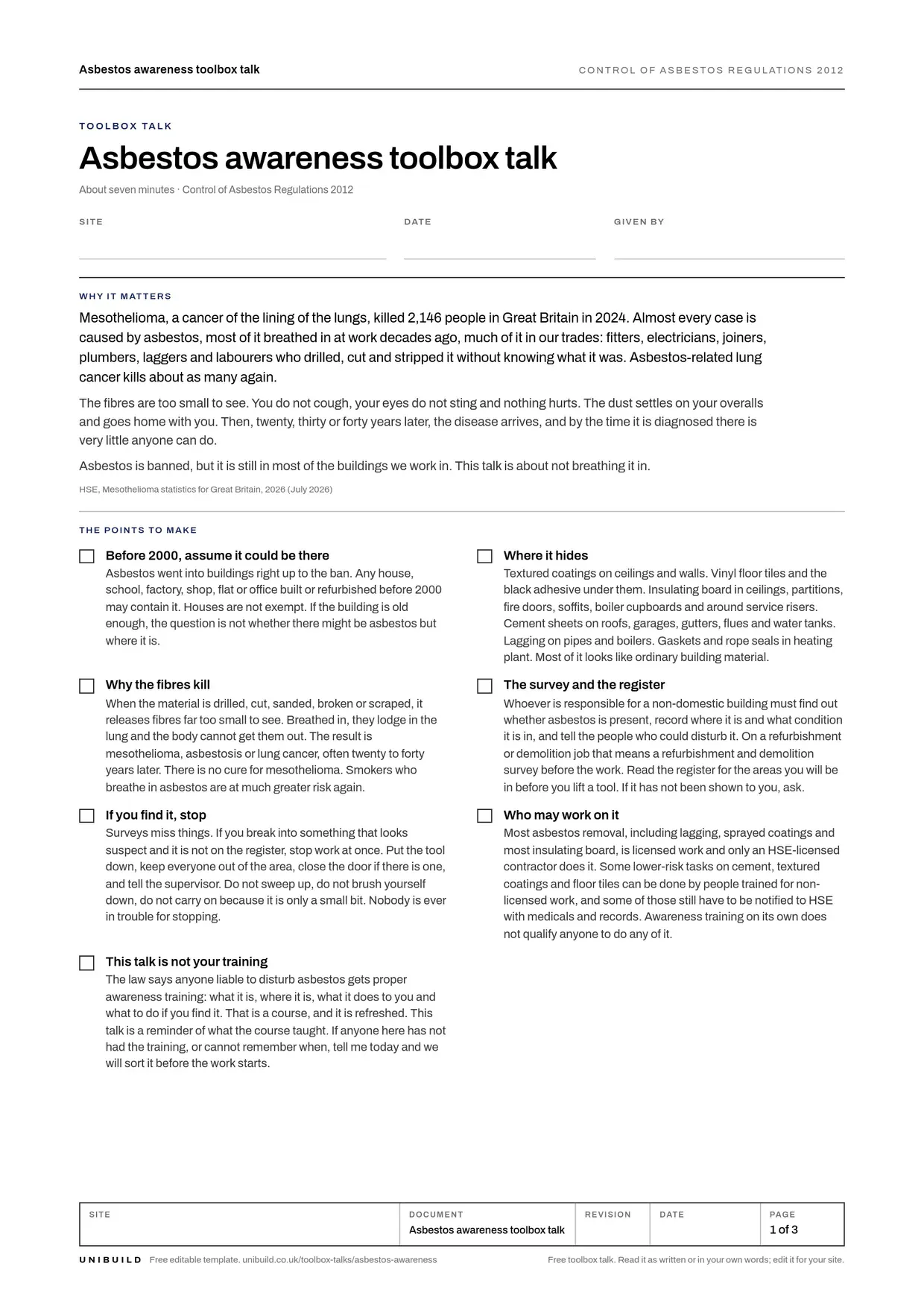
Mesothelioma, a cancer of the lining of the lungs, killed 2,146 people in Great Britain in 2024. Almost every case is caused by asbestos, most of it breathed in at work decades ago, much of it in our trades: fitters, electricians, joiners, plumbers, laggers and labourers who drilled, cut and stripped it without knowing what it was. Asbestos-related lung cancer kills about as many again.
The fibres are too small to see. You do not cough, your eyes do not sting and nothing hurts. The dust settles on your overalls and goes home with you. Then, twenty, thirty or forty years later, the disease arrives, and by the time it is diagnosed there is very little anyone can do.
Asbestos is banned, but it is still in most of the buildings we work in. This talk is about not breathing it in.
HSE, Mesothelioma statistics for Great Britain, 2026 (July 2026)The points to make
Before 2000, assume it could be there
Asbestos went into buildings right up to the ban. Any house, school, factory, shop, flat or office built or refurbished before 2000 may contain it. Houses are not exempt. If the building is old enough, the question is not whether there might be asbestos but where it is.
Where it hides
Textured coatings on ceilings and walls. Vinyl floor tiles and the black adhesive under them. Insulating board in ceilings, partitions, fire doors, soffits, boiler cupboards and around service risers. Cement sheets on roofs, garages, gutters, flues and water tanks. Lagging on pipes and boilers. Gaskets and rope seals in heating plant. Most of it looks like ordinary building material.
Why the fibres kill
When the material is drilled, cut, sanded, broken or scraped, it releases fibres far too small to see. Breathed in, they lodge in the lung and the body cannot get them out. The result is mesothelioma, asbestosis or lung cancer, often twenty to forty years later. There is no cure for mesothelioma. Smokers who breathe in asbestos are at much greater risk again.
The survey and the register
Whoever is responsible for a non-domestic building must find out whether asbestos is present, record where it is and what condition it is in, and tell the people who could disturb it. On a refurbishment or demolition job that means a refurbishment and demolition survey before the work. Read the register for the areas you will be in before you lift a tool. If it has not been shown to you, ask.
If you find it, stop
Surveys miss things. If you break into something that looks suspect and it is not on the register, stop work at once. Put the tool down, keep everyone out of the area, close the door if there is one, and tell the supervisor. Do not sweep up, do not brush yourself down, do not carry on because it is only a small bit. Nobody is ever in trouble for stopping.
Who may work on it
Most asbestos removal, including lagging, sprayed coatings and most insulating board, is licensed work and only an HSE-licensed contractor does it. Some lower-risk tasks on cement, textured coatings and floor tiles can be done by people trained for non-licensed work, and some of those still have to be notified to HSE with medicals and records. Awareness training on its own does not qualify anyone to do any of it.
This talk is not your training
The law says anyone liable to disturb asbestos gets proper awareness training: what it is, where it is, what it does to you and what to do if you find it. That is a course, and it is refreshed. This talk is a reminder of what the course taught. If anyone here has not had the training, or cannot remember when, tell me today and we will sort it before the work starts.
Do
- Read the asbestos register and the survey for your work area before you start, and ask if nobody can show you them.
- Treat any older building as containing asbestos until a survey shows otherwise.
- Stop work, keep people out and tell the supervisor the moment you find anything suspect.
- Leave suspect material where it is, undisturbed, until someone competent has looked at it.
- Keep your awareness training in date and tell us if you have not had it.
- Leave work on known asbestos to people trained and, where it applies, licensed to do it.
Do not
- Do not drill, cut, sand, scrape or break any material you have not confirmed is free of asbestos.
- Do not sweep, brush or vacuum suspect dust with ordinary site kit, and do not brush it off your clothes.
- Do not carry on because the piece is small, the job is nearly done or the client is waiting.
- Do not take suspect material or dusty overalls home, into the van or into the welfare cabin.
- Do not rely on a dust mask from the van. Work on asbestos needs face-fitted respiratory protection and a method you have been trained in.
- Do not strip textured coatings, floor tiles or boards yourself because the survey called them low risk.
Ask the team
- When was this building built or last refurbished, and have you seen the asbestos register for it?
- Where in the areas we are working today is asbestos recorded, and what condition is it in?
- If you cut into a board behind the boiler and it looks suspect, what do you do first, and who do you tell?
- Which of us has had asbestos awareness training, and when was it last refreshed?
- Who on this job is allowed to work on known asbestos, and what are they allowed to do?
To close
Nobody breathes in asbestos on purpose. It happens because the ceiling looked like plasterboard, the register was in the office, or the job was nearly done. The fibres do not warn you, and the bill comes thirty years later. If you are not sure what you are about to cut into, do not cut into it. Stop, ask, and we will get it checked.
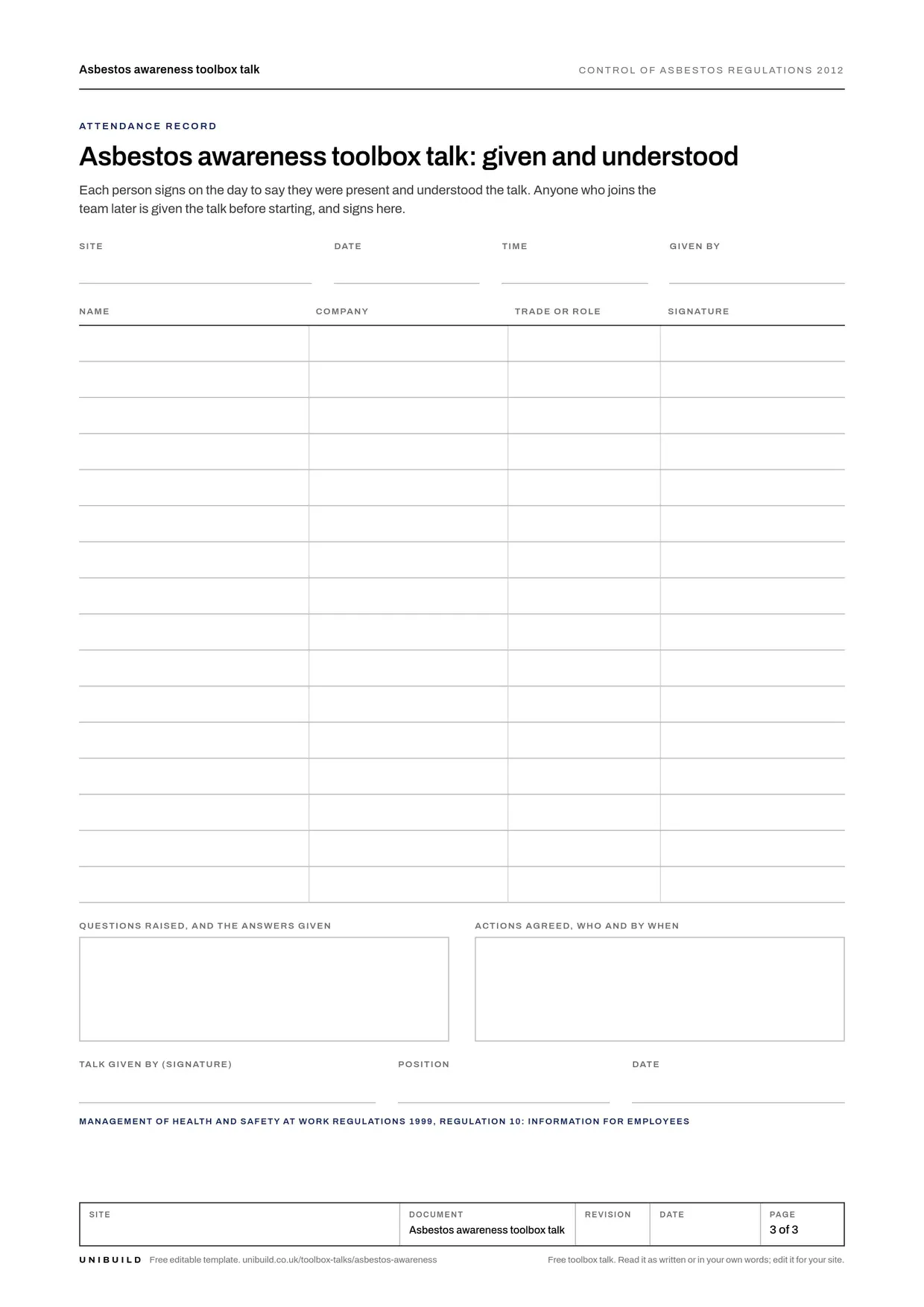
Record it. Who gave the talk, where, when, who was there and what was raised. The last page of the sheet is the record.