
Electrical risk assessment and RAMS template
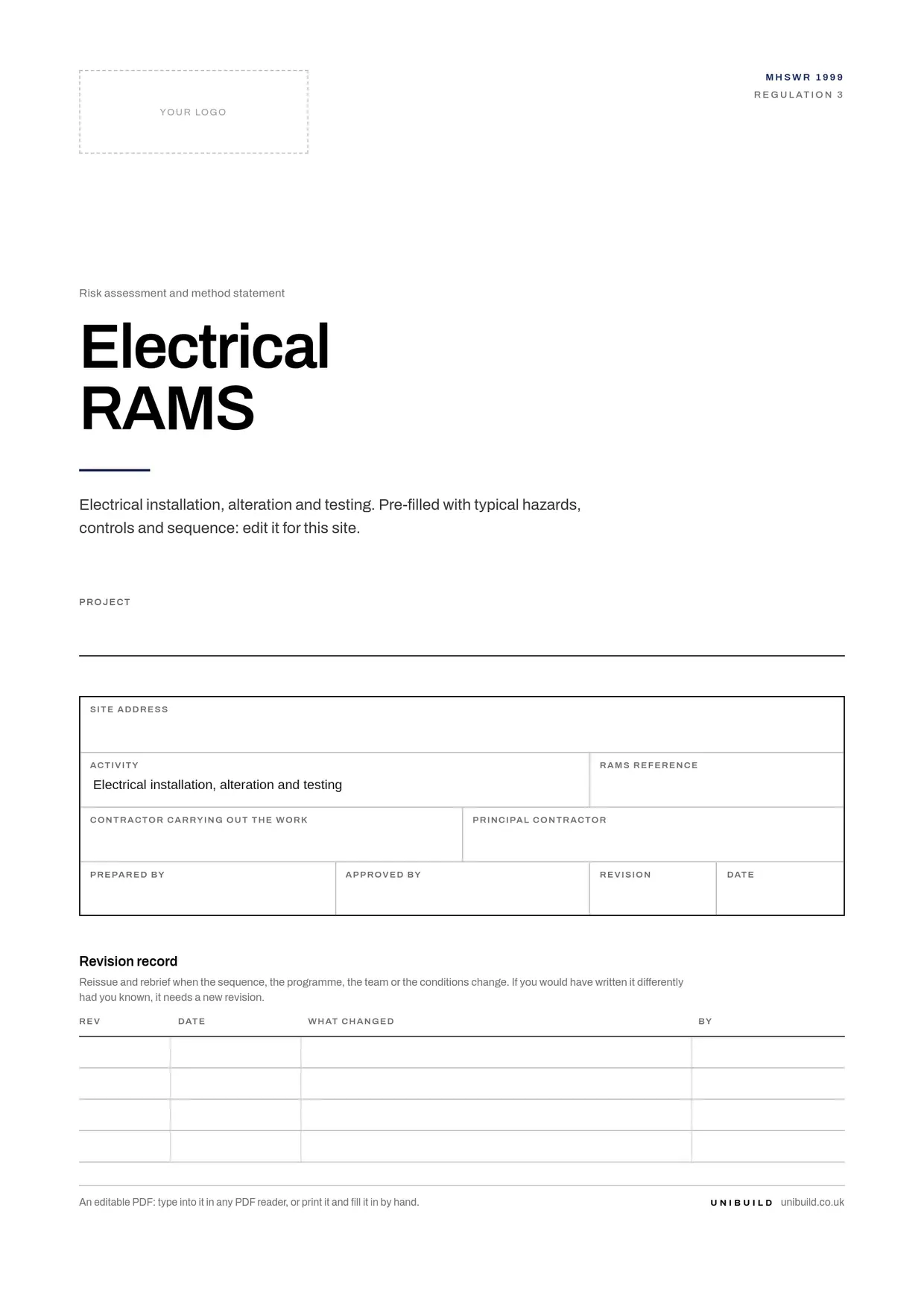
An electrical risk assessment and method statement, already filled in with the hazards, controls and sequence for installation, alteration and testing work. Edit it for your site, then brief it.
- Law
- Electricity at Work Regulations 1989
- Before work
- Isolate, lock off, prove dead
- Format
- Editable PDF and Word
- Cost
- Free, always
Do you need a RAMS for electrical work?
Yes, in practice every electrical job needs a RAMS before work starts. The law requires a risk assessment, and the Electricity at Work Regulations 1989 require electrical work to be done so that it does not give rise to danger. A principal contractor will expect a RAMS before an electrician starts.
The risk assessment is the legal duty, under regulation 3 of the Management of Health and Safety at Work Regulations 1999. The method statement shows how the work is done safely: how circuits are identified, isolated, locked off and proved dead, and what happens when a test needs the supply on.
An electrical RAMS should be written for the installation in front of you. The age of the building, what stays live, who else works nearby and where the points of isolation are make it suitable. They are what a reviewer checks first.
Electrical hazards and controls
14 hazards, rated before and after controlsThe significant hazards on a typical installation, alteration or testing job, with the controls a reviewer expects to see. Delete what does not apply and add what your site has.
Shock from circuits thought to be dead
Electricians on circuits that are wrongly identified, back-fed, or switched back on by someone else.
- Circuits identified from drawings, labels and testing, never a label alone, with every source of supply found, including generators and solar inverters.
- Isolated at a lockable device with a personal lock and unique key, and a caution notice at the point of isolation.
- Proved dead at the point of work with a two-pole voltage indicator, itself proved before and after the test.
BeforeHigh 20AfterMedium 5
Live working
Electricians testing, fault-finding or working where the supply cannot reasonably be made dead.
- Live work only where it is unreasonable to work dead, reasonable to work live, and suitable precautions are taken, as EAWR regulation 14 requires.
- Each live task justified in writing and authorised before it starts, with insulated tools, shrouding, barriers and suitable PPE.
- Where the risk calls for it, a second person trained to recognise danger, switch off and help stays close by.
BeforeHigh 15AfterMedium 5
Testing and inspection
Testers, and anyone near a board with its covers off while tests are carried out.
- Instruments and leads to GS38: CAT rating suited to the installation, finger barriers on probes, and fused leads where the risk assessment calls for them.
- Dead tests done first; live tests kept to those that need the supply on.
- Covers off only while needed, with the area barriered and a danger notice displayed.
BeforeHigh 15AfterMedium 5
Arc flash and burns at boards and intakes
Electricians working on or beside distribution boards, busbars and supply intakes.
- Work on boards and intakes done dead wherever possible, with the supply side of any isolator treated as live.
- Adjacent live parts shrouded or barriered, and danger notices posted on them.
- Flame-resistant clothing and face protection where the assessment identifies an arc risk.
BeforeMedium 10AfterMedium 5
Restoring the supply
Anyone still working on the circuit, and occupants, when the supply is switched back on.
- Locks removed only by the person who fitted them; a multiple-lock hasp where several people work under one isolation.
- Supply restored only after checking that everyone is clear and all tools, earths and covers are removed or refitted.
BeforeHigh 15AfterMedium 5
Hidden cables in existing buildings
Electricians and other trades drilling or chasing into walls, ceilings and floor voids.
- Existing services surveyed before work; cables in roof spaces, ceiling voids and floor voids treated as live until proved dead.
- Cable detector used before drilling or chasing. Non-contact detectors help find cables but are never used to prove dead.
BeforeHigh 15AfterMedium 10
Buried cables
Anyone breaking ground for cable runs, earth rods or lighting column bases.
- Utility drawings checked, then the route scanned with a cable avoidance tool and signal generator by a trained operator, as HSE guidance HSG47 describes.
- Cable positions marked on the ground and confirmed by trial holes dug with safe digging methods before any mechanical excavation.
BeforeHigh 15AfterMedium 5
Overhead power lines
Operatives using ladders, MEWPs or long materials near external overhead lines.
- Overhead lines within 10 metres of the work identified before work starts, as HSE guidance GS6 advises.
- Line owner consulted to divert or switch off the line; otherwise barriers and goal posts keep plant and materials at a safe distance.
BeforeMedium 10AfterMedium 5
Temporary site supplies
Everyone on site using temporary lighting, tools and distribution boards.
- Temporary system designed and installed by a competent electrical contractor to BS 7671, with 110V centre-tapped earth for lighting and tools where battery tools are not used.
- Any 230V socket protected by an RCD, checked daily with its test button.
- Distribution system inspected and tested every 3 months, with the records kept on site.
BeforeHigh 15AfterMedium 5
Asbestos in older buildings
Electricians drilling, chasing or lifting floors in buildings built or refurbished before 2000.
- Asbestos register or refurbishment survey checked before work; materials not covered by it are presumed to contain asbestos until sampled.
- Work stops and the area is left if suspect material is found or disturbed.
- Asbestos awareness training for everyone liable to disturb it, repeated at regular intervals.
BeforeHigh 15AfterMedium 5
Work at height on containment and lighting
Electricians installing tray, trunking, luminaires and cabling at high level.
- Height avoided where possible, for example by assembling containment runs at ground level.
- Podium steps, mobile towers or MEWPs chosen ahead of ladders, with PASMA training for towers and IPAF for MEWPs.
- Ladders only for short, low-risk tasks, checked before use and secured.
BeforeHigh 15AfterMedium 5
Working in occupied buildings
Occupants, staff and the public in homes, offices, schools or shops during the work.
- Supply interruptions agreed with the occupier in advance, with vulnerable occupants and essential equipment identified first.
- Work area barriered, open boards never left unattended, and every circuit left safe and labelled at the end of each day.
BeforeMedium 12AfterLow 4
Dust and noise from chasing and drilling
Electricians chasing walls or drilling masonry, and others nearby.
- Chasing done with on-tool extraction suited to the dust, or a wet method where practicable.
- FFP3 or other suitable RPE, face-fit tested, where extraction alone does not control the dust.
- Hearing protection where the noise assessment calls for it.
BeforeMedium 12AfterMedium 6
Manual handling of drums and equipment
Electricians and labourers moving cable drums, boards, switchgear and containment.
- Cable drums run out from drum stands or jacks; heavy boards and switchgear moved on trolleys or with lifting aids.
- Long containment lengths carried by two people, on routes kept clear.
BeforeMedium 9AfterMedium 6
Scores are likelihood times severity on the five by five matrix in the template. They are typical ratings for this work, a starting point for your own assessment of your site.
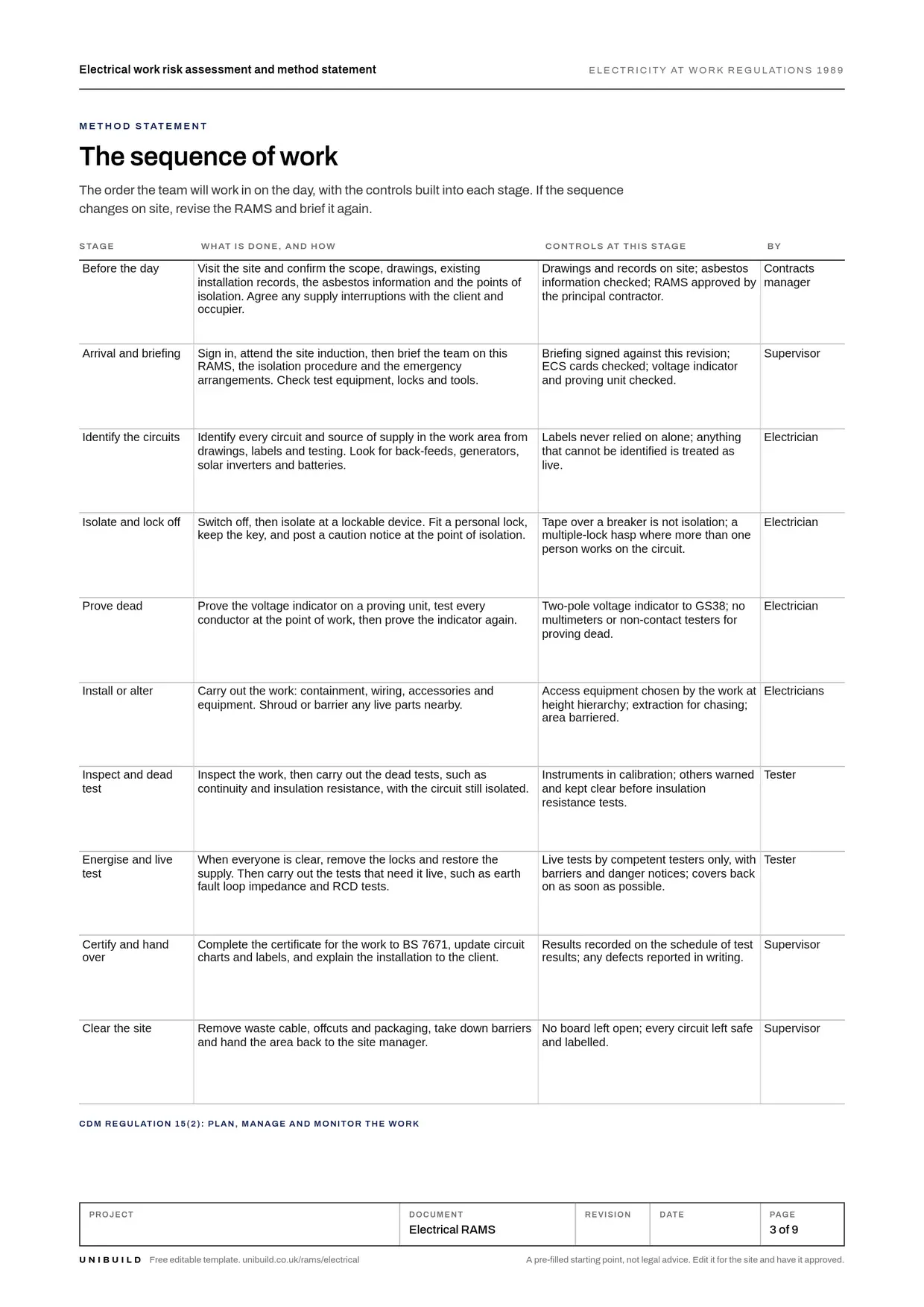
Electrical method statement: the sequence of work
The order of work, with the controls at each stageThe order the team works in, with the controls built into each stage. If the sequence changes on site, revise the RAMS and brief it again.
Before the day
Visit the site and confirm the scope, drawings, existing installation records, the asbestos information and the points of isolation. Agree any supply interruptions with the client and occupier.
ControlsDrawings and records on site; asbestos information checked; RAMS approved by the principal contractor.
Arrival and briefing
Sign in, attend the site induction, then brief the team on this RAMS, the isolation procedure and the emergency arrangements. Check test equipment, locks and tools.
ControlsBriefing signed against this revision; ECS cards checked; voltage indicator and proving unit checked.
Identify the circuits
Identify every circuit and source of supply in the work area from drawings, labels and testing. Look for back-feeds, generators, solar inverters and batteries.
ControlsLabels never relied on alone; anything that cannot be identified is treated as live.
Isolate and lock off
Switch off, then isolate at a lockable device. Fit a personal lock, keep the key, and post a caution notice at the point of isolation.
ControlsTape over a breaker is not isolation; a multiple-lock hasp where more than one person works on the circuit.
Prove dead
Prove the voltage indicator on a proving unit, test every conductor at the point of work, then prove the indicator again.
ControlsTwo-pole voltage indicator to GS38; no multimeters or non-contact testers for proving dead.
Install or alter
Carry out the work: containment, wiring, accessories and equipment. Shroud or barrier any live parts nearby.
ControlsAccess equipment chosen by the work at height hierarchy; extraction for chasing; area barriered.
Inspect and dead test
Inspect the work, then carry out the dead tests, such as continuity and insulation resistance, with the circuit still isolated.
ControlsInstruments in calibration; others warned and kept clear before insulation resistance tests.
Energise and live test
When everyone is clear, remove the locks and restore the supply. Then carry out the tests that need it live, such as earth fault loop impedance and RCD tests.
ControlsLive tests by competent testers only, with barriers and danger notices; covers back on as soon as possible.
Certify and hand over
Complete the certificate for the work to BS 7671, update circuit charts and labels, and explain the installation to the client.
ControlsResults recorded on the schedule of test results; any defects reported in writing.
Clear the site
Remove waste cable, offcuts and packaging, take down barriers and hand the area back to the site manager.
ControlsNo board left open; every circuit left safe and labelled.
What the law asks for electrical work
Checked against the sourceWork without danger
Every work activity on or near an electrical system must be done so that it does not give rise to danger, so far as is reasonably practicable. Protective equipment must be suitable, maintained and properly used.
Electricity at Work Regulations 1989, regulation 4Isolation
Suitable means must be available to cut off the supply and isolate equipment. Isolation means disconnection and separation from every source of electrical energy, in a way that is secure.
Electricity at Work Regulations 1989, regulation 12Keeping it dead
Adequate precautions must be taken to stop equipment that has been made dead from becoming charged while the work is done, if danger could arise.
Electricity at Work Regulations 1989, regulation 13Live work
No one works on or near a live conductor where danger may arise unless three conditions are met. It must be unreasonable for it to be dead and reasonable to work on it live, and suitable precautions must prevent injury.
Electricity at Work Regulations 1989, regulation 14Competence
No one does work that needs technical knowledge or experience to prevent danger unless they have it, or are under the level of supervision the work needs.
Electricity at Work Regulations 1989, regulation 16Overhead and buried cables
Overhead power cables that create a risk are diverted or isolated, or barriers and notices are used. Work that risks an underground service starts only after suitable steps have been taken to prevent the risk.
Construction (Design and Management) Regulations 2015, regulation 25Competence, equipment and PPE
Competence and cards
- Electricians ECS card for the grade of work, issued through the JIB, with apprentices and trainees supervised.
- Supervisor An experienced electrician on site, setting supervision by each person's competence and the work.
- Testers Competent in inspection and testing to BS 7671, and in the safe use of instruments under GS38.
- Live work Only people with the knowledge and experience for that task, named in the written authorisation.
- Access equipment PASMA training for mobile towers and IPAF for MEWPs.
- Asbestos Asbestos awareness training for everyone liable to disturb it.
Plant and equipment
- Voltage indicator and proving unit Indicator proved before and after each test; probes and leads to GS38.
- Multifunction tester In calibration; leads and probes checked before use.
- Lock-off kit and caution notices Personal locks with unique keys; a hasp for multiple locks.
- 110V tools and transformers Pre-use check; inspected and tested at the site interval.
- Cable avoidance tool and signal generator Checked to the maker's instructions before each use.
- Podium steps, towers and MEWPs Pre-use checks; towers inspected after erection.
PPE
- Insulating gloves rated for the voltage, where live work is authorised.
- Flame-resistant clothing and face shield where the assessment identifies an arc flash risk.
- Eye protection for drilling, chasing and cutting.
- RPE FFP3 or other suitable mask, face-fit tested, for chasing and drilling dust.
- Safety boots with toe protection and a sole suited to the site.
- Safety helmet and high-visibility clothing to the site standard.
Permits and plans
A permit to work where the principal contractor or building owner requires one, and always on high-voltage systems. A permit to dig before breaking ground near buried cables. A hot work permit for any soldering or cutting near combustible materials.
Emergency and rescue
If someone is in contact with a live conductor, do not touch them until the supply is off. Switch off at the isolator, or break the contact with insulating material. Call 999 and give CPR if trained. First aider and kit on site, and the nearest accident and emergency department named on the briefing.
Toolbox talk: safe isolation
Read this to the team before work starts, tick each point as it is covered, and record who attended.
- We work dead. If a job needs the supply on, it waits until the supervisor has authorised it in writing.
- Switching off is not isolating. Lock it off with your own lock, keep the key, and put the notice up.
- Prove the tester, test dead, prove the tester again. Every conductor, at the point of work, every time.
- Labels can be wrong. Back-feeds, generators and solar panels can make a dead circuit live.
- Nobody removes another person's lock. If a lock is left on and its owner has gone, tell the supervisor.
- If you find suspect asbestos, a cable you cannot identify or a board that looks wrong, stop and report it.
Ask the team
- Where are the points of isolation for today's work, and who holds the keys?
- When did you last prove your voltage indicator, and where is the proving unit?
- What do you do first if someone is in contact with a live conductor?
What is in the electrical RAMS template
9 pages, pre-filled and editableThe work, pre-filled
Scope, location and access, interfaces with other trades, the documents the RAMS relies on, and the team with their ECS cards.
The sequence of work
Ten stages from survey to clearing the site, with the controls and the person responsible at each one.
Hazards and controls
Fourteen electrical hazards rated before and after controls on a five by five matrix, with room for your own.
Plant, PPE and permits
Test equipment and its checks, PPE by type, and the permits the job needs.
Isolation record
A page to log each isolation: the circuit, the lock, the proving dead check, and who restored the supply.
Emergency and briefing
What to do after an electric shock, the environment section, and twenty signatures against the revision.
Brief it, and get it signed on the phone
On Unibuild a RAMS is written from a template, approved, then read by each operative on their phone in their own language and signed. Subcontract and agency workers sign through a link, with no app to install.
Every signature carries its date and time and prints as the last page of the RAMS PDF. Change the RAMS and it has to be signed again.
How RAMS work on UnibuildElectrical RAMS questions
Is this electrical RAMS template free?
What should an electrical risk assessment include?
Is an electrical risk assessment a legal requirement?
When is live working allowed?
What is the safe isolation procedure?
What is GS38?
Do you need a RAMS for electrical testing?
How often should site electrics be inspected?
RAMS templates for other trades and hazards
All free, pre-filled and editableBy trade
- Electrical RAMSSafe isolation, live work, testing and inspection, and working near other trades.
- Scaffolding RAMSErecting, altering and dismantling tube and fitting and system scaffold, with handover and inspection.
- Roofing RAMSPitched and flat roofs, fragile surfaces, edge protection, hot work and getting materials up safely.
- Groundworks RAMSExcavations, buried services, plant, trench support and inspections at the start of each shift.
- Plumbing and heating RAMSSoldering and brazing, gas work, unvented systems, lofts and occupied homes.
- Painting and decorating RAMSAccess equipment, solvents and spray, old lead paint, dust from preparation and occupied buildings.
- Hot works and welding RAMSWelding, cutting, grinding and torch-on work: permits, fire watch, fume and gas cylinders.
By hazard
- COSHH risk assessmentHazardous substances on site: dusts, solvents, cement, resins and fume, assessed and controlled.
- Manual handling risk assessmentLifting, carrying, pushing and pulling, assessed by task, individual, load and environment.
- Working at height risk assessmentLadders, towers, MEWPs, scaffolds and roofs, chosen and controlled in the order the law sets.
- Lone working risk assessmentPeople working alone on site, in empty buildings and out of hours, with check-ins and a plan if they go quiet.
- Noise and vibration risk assessmentNoise exposure and hand-arm vibration from tools, measured against the action and limit values.
- Asbestos risk assessmentFinding asbestos before work starts, deciding whether work is licensed, and controlling non-licensed work.
- Confined space risk assessmentManholes, tanks, voids and chambers: avoiding entry, a safe system of work, gas testing and rescue.
The blank RAMS template, the RAMS review checklist and every other free form are on Free downloads.
The RAMS, read and signed
before the work starts.
Unibuild keeps every RAMS with its versions, its approvals and each operative’s signature against the revision they read, for seven years, ready for the principal contractor or an auditor.