
PPE: the talk
Read it as written or in your own words. Tick each point as you make it. Stop for the questions.
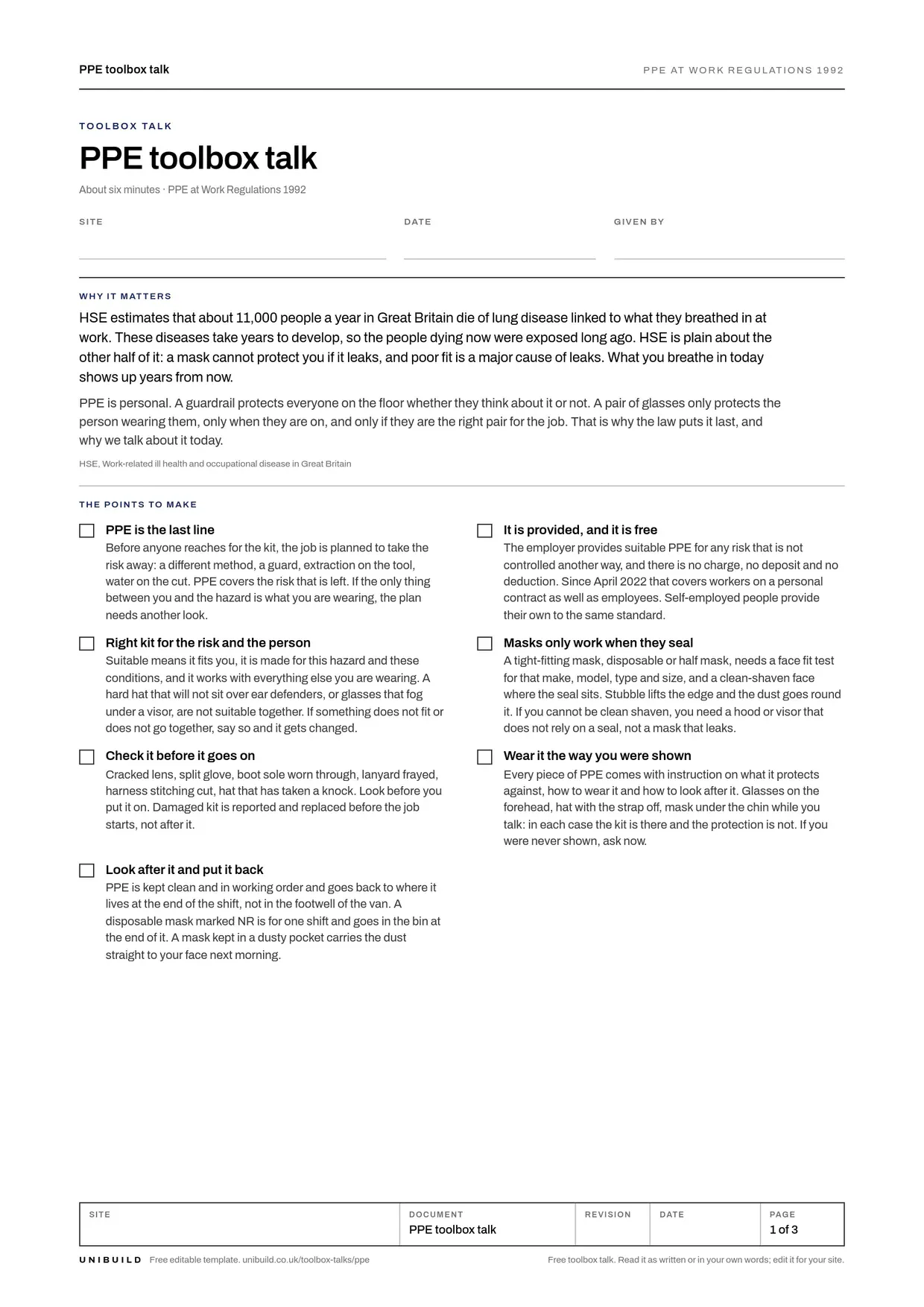
Why it matters
HSE estimates that about 11,000 people a year in Great Britain die of lung disease linked to what they breathed in at work. These diseases take years to develop, so the people dying now were exposed long ago. HSE is plain about the other half of it: a mask cannot protect you if it leaks, and poor fit is a major cause of leaks. What you breathe in today shows up years from now.
PPE is personal. A guardrail protects everyone on the floor whether they think about it or not. A pair of glasses only protects the person wearing them, only when they are on, and only if they are the right pair for the job. That is why the law puts it last, and why we talk about it today.
HSE, Work-related ill health and occupational disease in Great BritainThe points to make
PPE is the last line
Before anyone reaches for the kit, the job is planned to take the risk away: a different method, a guard, extraction on the tool, water on the cut. PPE covers the risk that is left. If the only thing between you and the hazard is what you are wearing, the plan needs another look.
It is provided, and it is free
The employer provides suitable PPE for any risk that is not controlled another way, and there is no charge, no deposit and no deduction. Since April 2022 that covers workers on a personal contract as well as employees. Self-employed people provide their own to the same standard.
Right kit for the risk and the person
Suitable means it fits you, it is made for this hazard and these conditions, and it works with everything else you are wearing. A hard hat that will not sit over ear defenders, or glasses that fog under a visor, are not suitable together. If something does not fit or does not go together, say so and it gets changed.
Masks only work when they seal
A tight-fitting mask, disposable or half mask, needs a face fit test for that make, model, type and size, and a clean-shaven face where the seal sits. Stubble lifts the edge and the dust goes round it. If you cannot be clean shaven, you need a hood or visor that does not rely on a seal, not a mask that leaks.
Check it before it goes on
Cracked lens, split glove, boot sole worn through, lanyard frayed, harness stitching cut, hat that has taken a knock. Look before you put it on. Damaged kit is reported and replaced before the job starts, not after it.
Wear it the way you were shown
Every piece of PPE comes with instruction on what it protects against, how to wear it and how to look after it. Glasses on the forehead, hat with the strap off, mask under the chin while you talk: in each case the kit is there and the protection is not. If you were never shown, ask now.
Look after it and put it back
PPE is kept clean and in working order and goes back to where it lives at the end of the shift, not in the footwell of the van. A disposable mask marked NR is for one shift and goes in the bin at the end of it. A mask kept in a dusty pocket carries the dust straight to your face next morning.
Do
- Ask what control takes the risk away before you rely on what you are wearing.
- Check your PPE before each use, and report loss or damage straight away.
- Wear it for the whole task, including the last five minutes.
- Come clean shaven on days you will wear a tight-fitting mask, and wear the make, model and size you were fit tested on.
- Wear hearing protection and eye protection whenever the task or the signs call for it, and take them off only when you are clear.
- Store PPE where it is kept and bin disposable masks at the end of the shift.
Do not
- Do not pay for PPE the job needs, and do not accept a deduction for it. Tell us if anyone asks.
- Do not wear a tight-fitting mask with stubble or a beard where it seals.
- Do not use a mask you have not been fit tested on, even if it looks the same.
- Do not modify PPE: no holes in the hat, no chin strap removed, no visor taken off a hood.
- Do not carry on with damaged or missing kit because the job is nearly done.
- Do not share masks, ear plugs or anything else issued to you alone for hygiene. Ask for your own.
Ask the team
- What are we wearing today, and what risk is each item there for?
- Who has a tight-fitting mask on this job, and when were they last fit tested on that model?
- Where does the PPE live on this site, and who do you tell when something is damaged?
- Is there anything you have been issued that does not fit, fogs up, or will not work with the rest of your kit?
- Which jobs this week could be set up so the PPE is not the only control?
To close
Nobody breathes in dust or takes a chip in the eye on purpose. It happens because the glasses were on the forehead for a second, the mask was in the pocket, or the strap was broken and the job was nearly done. The kit is provided, it is free, and it only works on you. If it is missing, damaged or wrong, stop and tell us, and we will sort it.
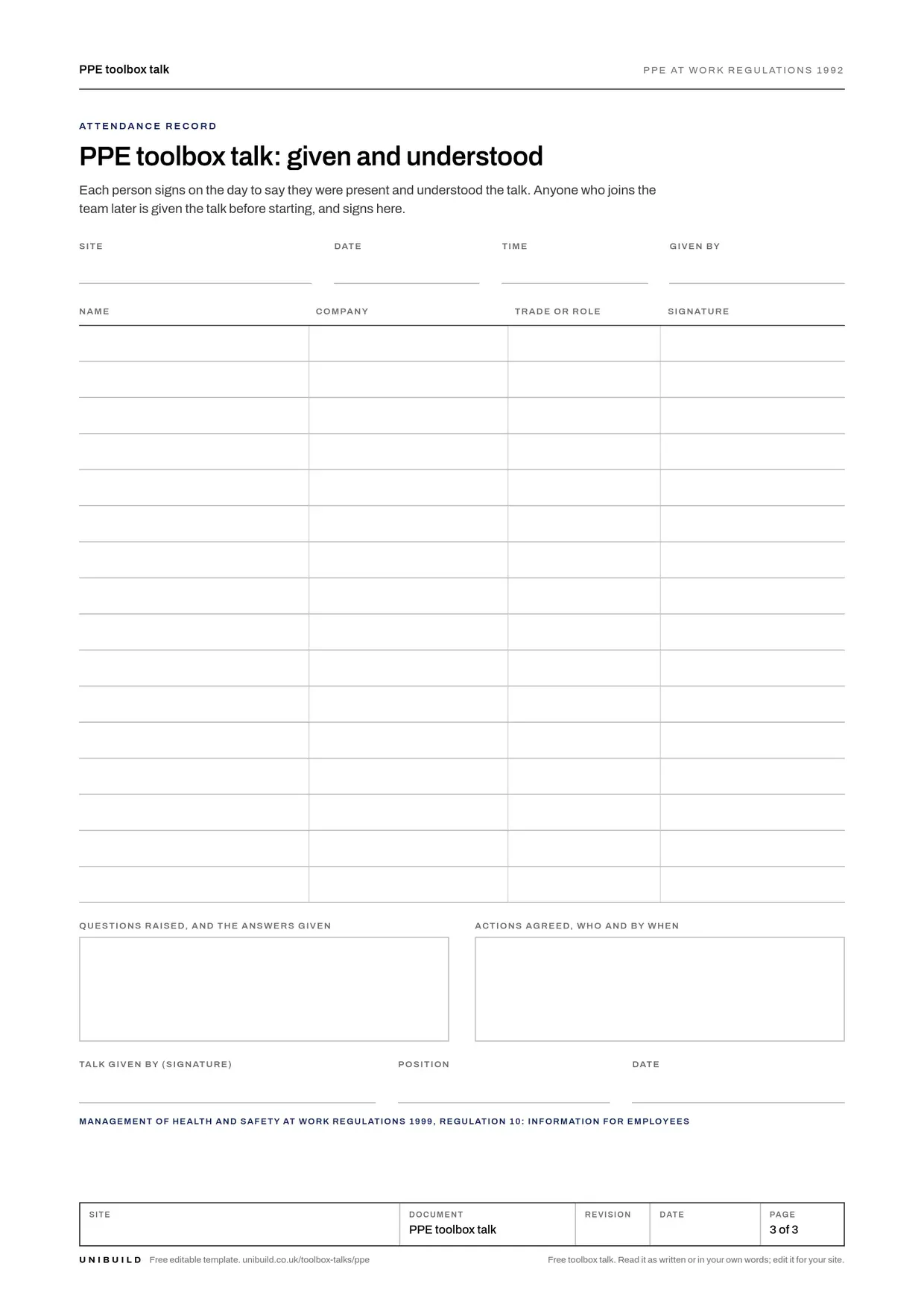
Record it. Who gave the talk, where, when, who was there and what was raised. The last page of the sheet is the record.