
Is this RAMS
worth the paper
it is on?
A free RAMS review checklist: 18 checks in plain English. What to look for before you accept a risk assessment and method statement from a subcontractor.
Published · Last reviewed
What reviewing a RAMS
actually means.
Most RAMS arrive as a template with the site name changed. Accepting one is a decision with your name on it, because the principal contractor has to satisfy itself that the work is planned, managed and monitored, and because the operatives will be briefed on whatever you accepted. Reviewing it is not proofreading. It is asking whether this document describes what will actually happen on your site.
Who has to review it, what "suitable and sufficient" means, and the tell-tales
- Where the duties sit
- The risk assessment duty is MHSWR 1999 Reg 3: every employer assesses the risks to its own employees and to others. CDM 2015 Reg 15 makes each contractor plan, manage and monitor its own work. The principal contractor coordinates and must be satisfied the arrangements are compatible with the site.
- Suitable and sufficient
- The legal test. It means proportionate to the risk, identifying the significant hazards, and reflecting what will actually be done. A generic assessment that could apply to any site fails the test however thick it is.
- The hierarchy again
- A method statement that jumps straight to PPE has skipped the hierarchy of control: eliminate, substitute, engineering controls, administrative controls, and PPE last. That is the single most common substantive failure.
- Briefing is the point
- An unbriefed RAMS controls nothing. The signature that matters is the operative's, against the revision that was current on the day, and it is the one most often missing when something goes wrong.
- What this checklist covers
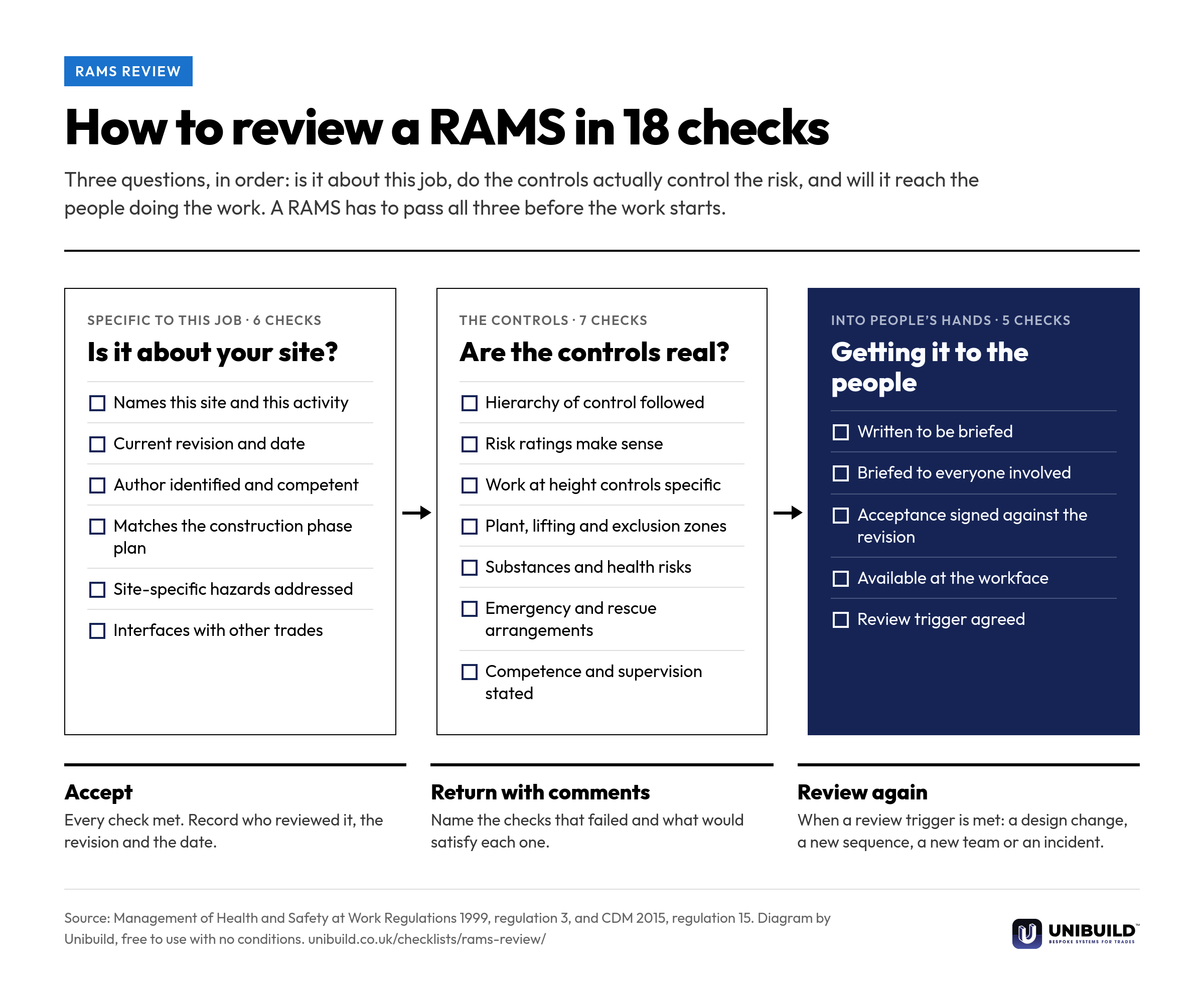
- 18 checks across three sections: 6 on whether it is specific to your job, 7 on whether the controls are real, 5 on getting it into the hands of the people doing the work.
Is it about your site?
Six tell-tales that separate a real assessment from a template with the address changed.
Are the controls real?
Seven checks on whether the document controls anything or just describes the job.
Getting it to the people.
Five checks that turn an accepted document into a controlled activity.
This browser is not letting the page store anything, so the checklist will count and print correctly but will be empty again if you reload. Save as PDF before you leave.
A starting point for your own review, not legal advice. Always check against the current regulations and HSE guidance. Put your own company in the field above and the PDF carries your name instead of ours. Ticks, notes and site details stay in your browser. Nothing is sent to us.
How to review a RAMS, as a diagram
The same 18 checks in their three stages, and what happens after the review. Print it for the site office, or use it in a briefing.
Or use it as a printable template.
Download the blank RAMS review checklist as a PDF, or work through the list above on screen and save that instead, dated and carrying the site, the person who prepared it and the score out of 18. Nothing is gated: no email address to hand over, no account to create, no trial to start.
- A blank template
- The PDF above carries all 18 checks, each with the regulation it comes from and a ruled line for the evidence, the owner and the date. Print it and fill it in on site.
- Or a completed record
- Work through it on screen first and Save as PDF produces a dated record of what was in place and what was not, with your evidence notes typed against each check.
- Your ticks stay in your browser
- Ticks, notes and site details are held on this device only. Nothing is sent to us, so you can close the tab and pick it up tomorrow on the same machine.
- Your name on it, not ours
- Put your company in the field above and the downloaded PDF carries your letterhead instead of Unibuild's. It is free: a sheet you hand to a client should be able to have your name on it.
Worth knowing. A checklist filled in once, the week of an audit, is a snapshot. The evidence behind it is either generated as the work runs or reconstructed under pressure, and that is the difference between a template and a record. It is also what the health and safety module is for.
The same review,
read by role.
These are the same checks above, grouped by whoever normally answers for them.
Principal contractor
Compatibility with the plan and the interfaces with other trades. You are not writing their assessment; you are satisfying yourself it works on your site alongside everyone else's.
The contractor who wrote it
All of it. Reg 15 makes you plan, manage and monitor your own work, and the assessment duty in MHSWR Reg 3 is yours for your own employees.
Site manager
The briefing section. An accepted RAMS that nobody has been briefed on is a filing achievement.
Supervisor
Whether the method survives contact with the actual workface, and the authority to stop when it does not.
Health and safety adviser
The hierarchy of control and the residual ratings. PPE-first documents are the ones that come back at you after an incident.
Whoever signs acceptance
Everything above, because acceptance is a decision. If it is not right, saying so is cheaper now than explaining later.
You shouldn't need
this checklist.
On the platform a RAMS is stored against the project, published to the people on that activity and accepted with a signature against a frozen version.
What people ask before
they use the checklist.
The questions that come up most often around a RAMS review checklist, answered against the regulations rather than around them.
Can we accept a subcontractor's RAMS as it arrives?
What does 'suitable and sufficient' mean?
What is the most common problem with RAMS?
Who is responsible for writing RAMS?
When does a RAMS need to be revised?
How do we show that a RAMS was briefed?
Is this checklist free, and do I have to sign up?
Can I put my own company name on the PDF?
Does Unibuild do this for me?
More checklists
All 10 →Site induction
What a site-specific induction has to cover, and what turns one into a signature exercise.Site start-up
What must be true before the first boot hits the ground, including the three things CDM says cannot wait.Weekly site inspection
The slower pass where the folder gets opened too: scaffold tickets, thorough examinations, permits and training expiry.On the next one
that lands.
Take the last RAMS you accepted and run it through this. Most fail on the first section.