Free toolbox talk · Environmental

Environmental toolbox talk

An environmental toolbox talk for site, written to be read aloud in about six minutes: what counts as pollution, drains and watercourses, fuel and spills, concrete washout, dust and noise for the neighbours, and waste under the duty of care, with who to call when something gets out. The last page is the attendance record.

PDF · 3 pages · 209 KB · Word 41 KB · Free to use and reuse · Terms

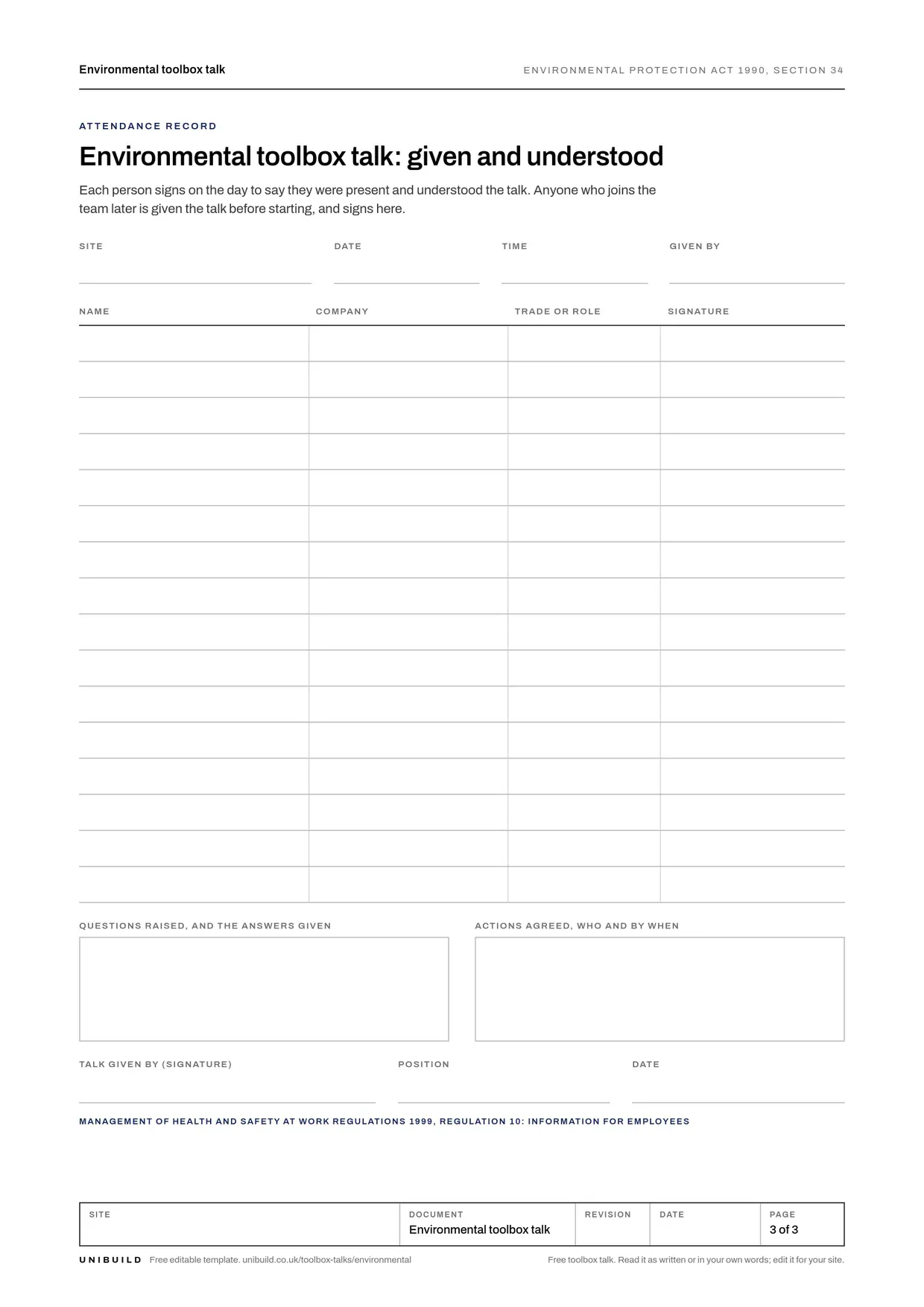
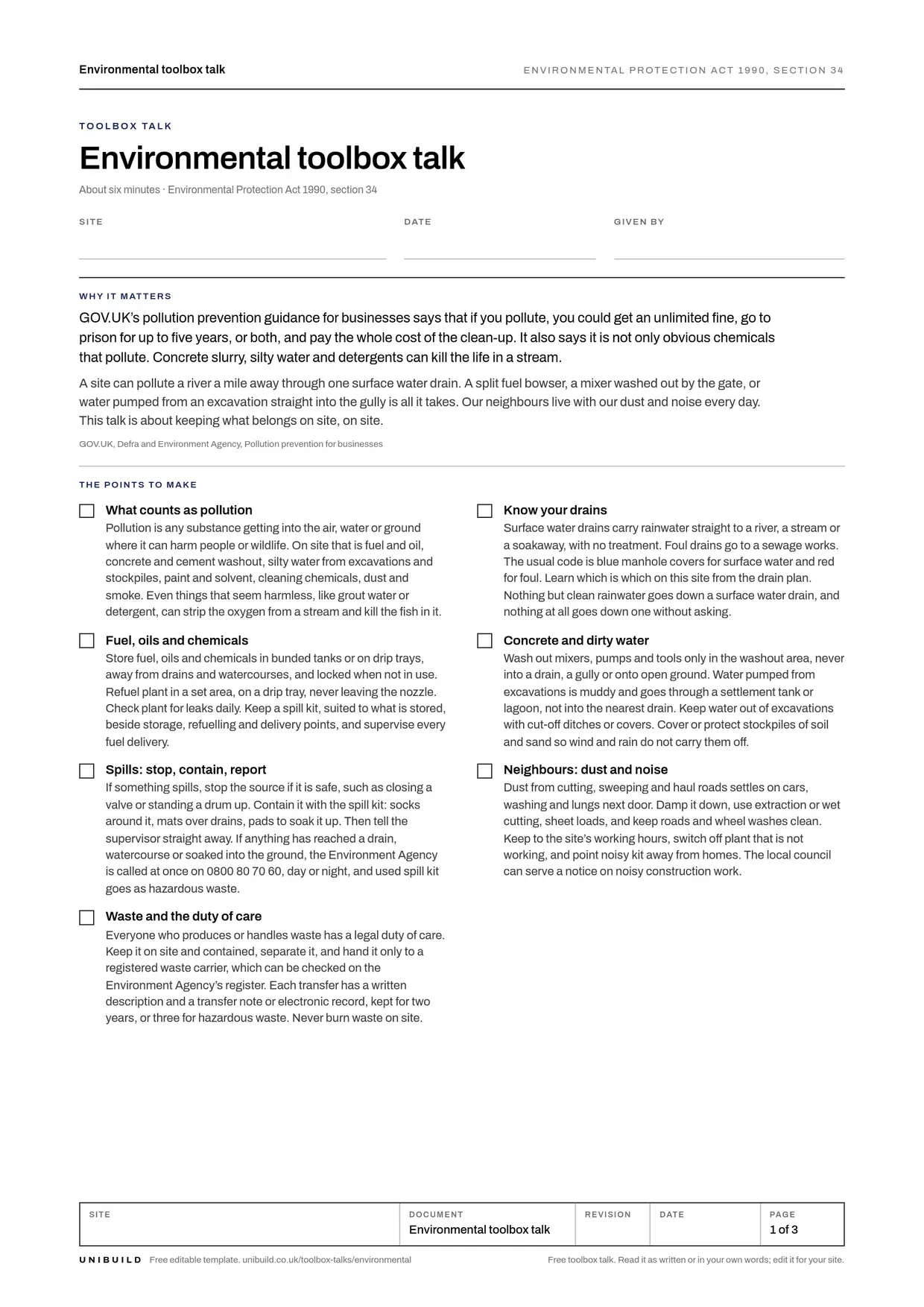
Attendance record page of the free environmental toolbox talk from Unibuild, where each person signs to say they were given the talk and understood itFront page of the free environmental toolbox talk from Unibuild
Law
Environmental Protection Act 1990, section 34
Time to deliver
About six minutes
Format
PDF and Word, with a sign-off sheet
Cost
Free, always

What this toolbox talk covers

This talk is for everyone on site, and especially anyone who refuels plant, pumps water, washes out a mixer or deals with waste. It takes about six minutes to give and covers what counts as pollution, which drains go straight to a river, fuel storage and spills, concrete and silty water, dust and noise for the neighbours, and the duty of care for waste, with the number to call if something gets out.

It is written to be read aloud, with the points in the order a supervisor makes them, short lists of do and do not, and questions about this site’s drains, stores and skips. The last page is the record: who gave it, who heard it and what was raised.

Hazardous substances on site have a talk of their own, the COSHH toolbox talk, and the housekeeping toolbox talk covers waste on the job.

Checked against HSE guidance and legislation.gov.uk on .

Toolbox talk · About six minutes

Environmental: the talk

Read it as written or in your own words. Tick each point as you make it. Stop for the questions.

Why it matters

GOV.UK’s pollution prevention guidance for businesses says that if you pollute, you could get an unlimited fine, go to prison for up to five years, or both, and pay the whole cost of the clean-up. It also says it is not only obvious chemicals that pollute. Concrete slurry, silty water and detergents can kill the life in a stream.

A site can pollute a river a mile away through one surface water drain. A split fuel bowser, a mixer washed out by the gate, or water pumped from an excavation straight into the gully is all it takes. Our neighbours live with our dust and noise every day. This talk is about keeping what belongs on site, on site.

GOV.UK, Defra and Environment Agency, Pollution prevention for businesses

The points to make

What counts as pollution

Pollution is any substance getting into the air, water or ground where it can harm people or wildlife. On site that is fuel and oil, concrete and cement washout, silty water from excavations and stockpiles, paint and solvent, cleaning chemicals, dust and smoke. Even things that seem harmless, like grout water or detergent, can strip the oxygen from a stream and kill the fish in it.

Know your drains

Surface water drains carry rainwater straight to a river, a stream or a soakaway, with no treatment. Foul drains go to a sewage works. The usual code is blue manhole covers for surface water and red for foul. Learn which is which on this site from the drain plan. Nothing but clean rainwater goes down a surface water drain, and nothing at all goes down one without asking.

Fuel, oils and chemicals

Store fuel, oils and chemicals in bunded tanks or on drip trays, away from drains and watercourses, and locked when not in use. Refuel plant in a set area, on a drip tray, never leaving the nozzle. Check plant for leaks daily. Keep a spill kit, suited to what is stored, beside storage, refuelling and delivery points, and supervise every fuel delivery.

Concrete and dirty water

Wash out mixers, pumps and tools only in the washout area, never into a drain, a gully or onto open ground. Water pumped from excavations is muddy and goes through a settlement tank or lagoon, not into the nearest drain. Keep water out of excavations with cut-off ditches or covers. Cover or protect stockpiles of soil and sand so wind and rain do not carry them off.

Spills: stop, contain, report

If something spills, stop the source if it is safe, such as closing a valve or standing a drum up. Contain it with the spill kit: socks around it, mats over drains, pads to soak it up. Then tell the supervisor straight away. If anything has reached a drain, watercourse or soaked into the ground, the Environment Agency is called at once on 0800 80 70 60, day or night, and used spill kit goes as hazardous waste.

Neighbours: dust and noise

Dust from cutting, sweeping and haul roads settles on cars, washing and lungs next door. Damp it down, use extraction or wet cutting, sheet loads, and keep roads and wheel washes clean. Keep to the site’s working hours, switch off plant that is not working, and point noisy kit away from homes. The local council can serve a notice on noisy construction work.

Waste and the duty of care

Everyone who produces or handles waste has a legal duty of care. Keep it on site and contained, separate it, and hand it only to a registered waste carrier, which can be checked on the Environment Agency’s register. Each transfer has a written description and a transfer note or electronic record, kept for two years, or three for hazardous waste. Never burn waste on site.

Do

  • Find out which drains on this site are surface water and which are foul.
  • Refuel only in the set area, on a drip tray, and stay with the nozzle.
  • Keep a spill kit at fuel stores, refuelling points and deliveries, and know how to use it.
  • Wash out concrete only in the washout area, and pump dirty water through the settlement tank.
  • Damp down dust and switch off plant that is not working.
  • Put waste in the right skip and report any skip that is overflowing or leaking.

Do not

  • Do not put anything but clean rainwater down a surface water drain.
  • Do not wash out mixers, tools or paint brushes into a drain, gully or open ground.
  • Do not pump water from an excavation straight into a drain or watercourse.
  • Do not leave fuel or chemical containers open, unbunded or near a drain.
  • Do not burn waste or let anyone take it who cannot show they are a registered carrier.
  • Do not keep a spill quiet, however small.

Ask the team

  • Where are the surface water drains on this site, and where do they go?
  • Where are the spill kits, and when were they last restocked?
  • Where do we wash out concrete and where does the water from the excavations go?
  • Who takes our waste away, and how do we know they are registered?
  • What do the neighbours complain about most, and what can we change?

To close

What leaves this site through a drain, a cloud of dust or a skip is still our responsibility. A spill that takes a minute to contain can take months to clean out of a river, and the fine has no limit. So know your drains, keep fuel bunded and spill kits ready, wash out only where it is collected, keep the dust and noise down for the neighbours, and send waste only with a registered carrier. If something gets out, stop it, contain it and tell us straight away.

Record it. Who gave the talk, where, when, who was there and what was raised. The last page of the sheet is the record.

In Unibuild a talk is read in each operative’s own language and signed on the phone. How toolbox talks work

The law behind this talk

Checked against the source

The duty of care for waste

Anyone who produces, imports, carries, keeps, treats or disposes of controlled waste, or as a dealer or broker has control of it, takes all reasonable measures to prevent its unlawful deposit or treatment, to prevent its escape, and on transfer to make sure it goes only to an authorised person with a written description of the waste. Breach is an offence with an unlimited fine on indictment.

Environmental Protection Act 1990, section 34

Discharges to water and land

A person must not cause or knowingly permit a water discharge activity or groundwater activity except under and to the extent authorised by an environmental permit. Doing so is an offence.

Environmental Permitting (England and Wales) Regulations 2016, regulations 12 and 38

Waste transfer records

The statutory code of practice sets out how to meet the duty of care: a written description agreed with the next holder, a waste transfer note, season ticket or electronic record, kept for 2 years for non-hazardous waste, and hazardous waste consignment notes kept for 3 years. Carriers are checked on the regulator’s public register.

Waste duty of care: code of practice (GOV.UK)

What is on the sheet

3 pages, the talk and the record

The talk, over two pages

Why it matters, the points to make, do and do not, and the questions to ask, laid out to read from in the cabin or at the workface. Space at the top for the site, the date and who is giving it.

The last page, the record

The attendance record: each person's name, company and signature, the questions raised and any actions, signed off by the person who gave the talk. Type into it or print it and pass it round.

The Word version

The same talk as a Word document, so you can put your own letterhead on it, add a site photograph or change a point to match how your job is set up.

Download the talk as PDF Word versionPDF · 3 pages · 209 KB
After it is given

Delivered on the phone, signed in the room

On Unibuild a toolbox talk is picked from the library, read by each operative on their own phone in their own language and signed there and then. The record is filed against the operative, the site and the date.

A site manager sees who has had which talk, and who has not, without a sheet going round on Thursday.

How toolbox talks work on Unibuild
How long should an environmental toolbox talk be?
About five to ten minutes. This one reads in about six if you make every point and stop for the questions. Give it at the start of a job, before work near a watercourse, when fuel stores or drainage change, and after any spill or complaint.
What should be in an environmental toolbox talk?
The pollution risks on this site and what to do about them: which drains go where, fuel and chemical storage, spill response, concrete washout and dirty water, dust and noise for the neighbours, and waste under the duty of care, with who to call if something gets out.
What is the Environment Agency pollution hotline?
In England the Environment Agency incident hotline is 0800 80 70 60, open 24 hours. GOV.UK says to call it immediately if polluting material has entered, or could enter, a watercourse or soak into the ground. Wales and Scotland have their own regulators and hotlines.
What colour are surface water drain covers?
The usual code in GOV.UK’s guidance is blue for surface water drains, red for foul water drains, and a red C for a combined system. Check the site drain plan, because not every cover is painted and some are wrong.
Can concrete washout go down a drain?
No. Concrete and cement washout is highly alkaline and harms watercourses. Wash out only in a designated area where the water is collected, settled and disposed of or reused properly, never into a drain, gully or onto open ground.
How long do waste transfer notes have to be kept?
Two years for non-hazardous waste, including season tickets, and three years for hazardous waste consignment notes, under the waste duty of care code of practice. Electronic records such as edoc count.
Who can take waste away from a site?
Only an authorised person, such as a registered waste carrier, broker or dealer, or a site with the right permit or exemption. Check the carrier’s registration on the Environment Agency public register before handing waste over, and get a transfer note.
Do we have to keep a record of the talk?
There is no regulation that names toolbox talk records, but showing that people were told the site’s pollution controls helps prove the duty of care was met, and most principal contractors and clients ask for the evidence. The last page of the sheet is the record.
Is this environmental toolbox talk free?
Yes. Download it, print it, give it, edit it and put your own name on it, including on paid work and for clients, with no sign-up and no email address.
Next step

The talk given, understood
and on record.

Unibuild keeps every toolbox talk against the operative who signed it, the site and the date, for seven years, ready for the principal contractor or an auditor.

Get a quote
One figure per firm · For UK firms

Right, let’s talk numbers.

Five things about your business. We work your fee out properly and put it in writing the same working day.

What we build for you

  • Your own portalIn the browser, built around your firm
  • Your own appiOS and Android, under your name
  • Everyday AI includedHeavier AI at cost, nothing added
  • One platformEverything in one place, set up by us

Would you rather see it running first? Book a 30-minute demo

Quotation request