Free toolbox talk · Housekeeping

Housekeeping toolbox talk

A toolbox talk on site housekeeping, written to be read aloud in about six minutes: clear routes, where materials and waste go, leads and hoses, lighting, and whose job it is. The last page is the attendance record.

PDF · 3 pages · 208 KB · Word 41 KB · Free to use and reuse · Terms

Law
CDM 2015 regulation 18, Workplace Regulations 1992 regulation 12
Time to deliver
About six minutes
Format
PDF and Word, with a sign-off sheet
Cost
Free, always

What this toolbox talk covers

This talk is for everyone on site, whatever their trade, because housekeeping is the one hazard every trade makes and every trade walks through. It takes about six minutes to give and covers why a tidy site has fewer injuries, what the law asks for, where materials, waste, leads and hoses should be, and who clears what and when.

It is written to be read aloud, with the points a supervisor makes in the order they make them, two short lists of do and do not, and questions to put to the team so the talk is a conversation rather than a reading. The last page is the record: who gave it, who heard it and what was raised.

Housekeeping is a plan, not a telling-off. Skips, storage areas, routes and lighting are decided before the trades arrive, and the clear-up is part of every task, with time allowed for it. The slips, trips and housekeeping risk assessment holds the full hazards and controls this talk briefs, and the slips, trips and falls talk covers what happens to people when housekeeping fails.

Checked against HSE guidance and legislation.gov.uk on .

Toolbox talk · About six minutes

Housekeeping: the talk

Read it as written or in your own words. Tick each point as you make it. Stop for the questions.

Why it matters

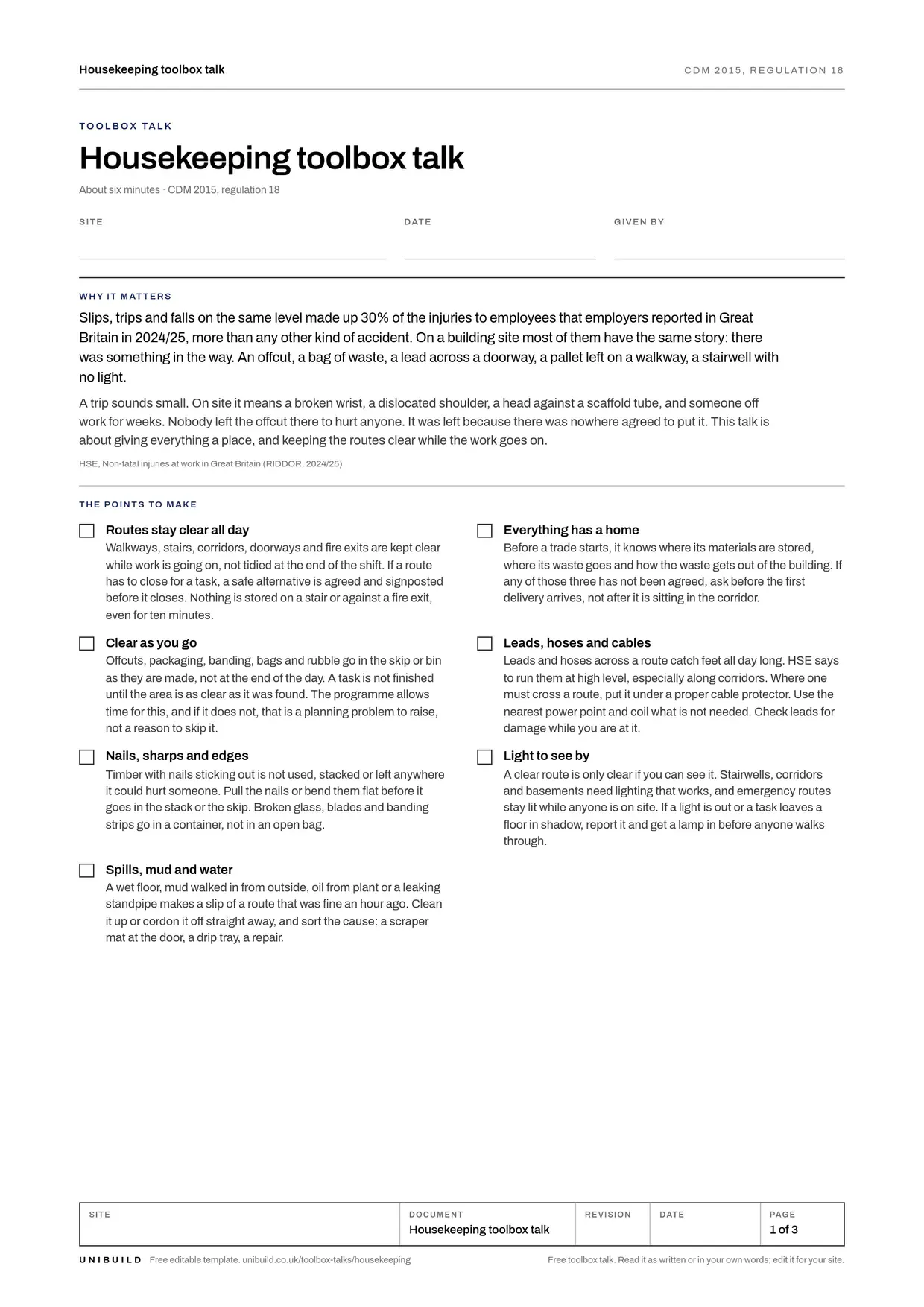
Slips, trips and falls on the same level made up 30% of the injuries to employees that employers reported in Great Britain in 2024/25, more than any other kind of accident. On a building site most of them have the same story: there was something in the way. An offcut, a bag of waste, a lead across a doorway, a pallet left on a walkway, a stairwell with no light.

A trip sounds small. On site it means a broken wrist, a dislocated shoulder, a head against a scaffold tube, and someone off work for weeks. Nobody left the offcut there to hurt anyone. It was left because there was nowhere agreed to put it. This talk is about giving everything a place, and keeping the routes clear while the work goes on.

HSE, Non-fatal injuries at work in Great Britain (RIDDOR, 2024/25)

The points to make

Routes stay clear all day

Walkways, stairs, corridors, doorways and fire exits are kept clear while work is going on, not tidied at the end of the shift. If a route has to close for a task, a safe alternative is agreed and signposted before it closes. Nothing is stored on a stair or against a fire exit, even for ten minutes.

Everything has a home

Before a trade starts, it knows where its materials are stored, where its waste goes and how the waste gets out of the building. If any of those three has not been agreed, ask before the first delivery arrives, not after it is sitting in the corridor.

Clear as you go

Offcuts, packaging, banding, bags and rubble go in the skip or bin as they are made, not at the end of the day. A task is not finished until the area is as clear as it was found. The programme allows time for this, and if it does not, that is a planning problem to raise, not a reason to skip it.

Leads, hoses and cables

Leads and hoses across a route catch feet all day long. HSE says to run them at high level, especially along corridors. Where one must cross a route, put it under a proper cable protector. Use the nearest power point and coil what is not needed. Check leads for damage while you are at it.

Nails, sharps and edges

Timber with nails sticking out is not used, stacked or left anywhere it could hurt someone. Pull the nails or bend them flat before it goes in the stack or the skip. Broken glass, blades and banding strips go in a container, not in an open bag.

Light to see by

A clear route is only clear if you can see it. Stairwells, corridors and basements need lighting that works, and emergency routes stay lit while anyone is on site. If a light is out or a task leaves a floor in shadow, report it and get a lamp in before anyone walks through.

Spills, mud and water

A wet floor, mud walked in from outside, oil from plant or a leaking standpipe makes a slip of a route that was fine an hour ago. Clean it up or cordon it off straight away, and sort the cause: a scraper mat at the door, a drip tray, a repair.

Do

  • Keep every walkway, stair, doorway and fire exit clear while you work, not just at knocking-off time.
  • Put waste in the skip or bin as you make it, and finish each task by clearing the area.
  • Store materials in the agreed area, stacked stable and off the routes.
  • Run leads and hoses overhead, along walls or under covers where they cross a route.
  • Pull or flatten nails in used timber before it is stacked or skipped.
  • Report blocked routes, missing lights, full skips and spills to the supervisor straight away.

Do not

  • Do not leave materials, tools or waste on a stair, in a corridor or across a doorway, however briefly.
  • Do not store anything against a fire exit, a fire point or an escape route.
  • Do not run a lead or hose across a walkway without a cover, and do not step over one and leave it.
  • Do not stack materials where they could topple onto a route or where someone must climb to reach them.
  • Do not leave a spill, wet patch or muddy floor for the next person to find.
  • Do not throw waste from height or push it out of an opening. Use a chute, a bin or carry it down.

Ask the team

  • Where does your waste go today, and how does it get out of the building?
  • Which route on this site is most often blocked, and what is blocking it?
  • Where are leads and hoses crossing a walkway right now?
  • Is there anywhere on this job where you cannot see the floor properly?
  • If the skip is full or the route is blocked, who do you tell, and what happens next?

To close

Nobody trips on purpose, and nobody leaves an offcut on a stair to hurt a mate. Trips happen when the plan has not given the mess a place to go, or has not given anyone the time to put it there. The routes, the skips and the storage are agreed. If any of it is not working on this job, tell me today and we will sort it.

Record it. Who gave the talk, where, when, who was there and what was raised. The last page of the sheet is the record.

In Unibuild a talk is read in each operative’s own language and signed on the phone. How toolbox talks work

The law behind this talk

Checked against the source

Good order and cleanliness

Each part of a construction site must, so far as is reasonably practicable, be kept in good order, and those parts in which construction work is being carried out must be kept in a reasonable state of cleanliness. No timber or other material with projecting nails or similar sharp objects may be used in any work, or allowed to remain in any place, if the nails or sharp objects may be a source of danger to any person.

Construction (Design and Management) Regulations 2015, regulation 18

Safe access and a safe place of work

There must, so far as is reasonably practicable, be suitable and sufficient safe access to and egress from every place where construction work is being carried out, and a construction site must be made and kept safe for, and without risks to the health of, anyone at work there. The site must have sufficient working space, arranged so that it is suitable for the people working there and the plant and materials in use.

Construction (Design and Management) Regulations 2015, regulation 17

Pedestrians and vehicles

A construction site must be organised so that, so far as is reasonably practicable, pedestrians and vehicles can move without risks to health or safety. Traffic routes must be suitable for the people or vehicles using them, sufficient in number, in suitable positions and of sufficient size, with enough separation between vehicles and pedestrians. Materials stored on a route take that separation away.

Construction (Design and Management) Regulations 2015, regulation 27

Floors and traffic routes

In workplaces where these Regulations apply, such as an occupied building being refurbished or a client premises, every floor and traffic route must be suitable for its use, with no hole, slope, unevenness or slipperiness that exposes anyone to risk, and effective drainage where needed. So far as is reasonably practicable, floors and traffic routes are kept free from obstructions and from any article or substance which may cause a person to slip, trip or fall.

Workplace (Health, Safety and Welfare) Regulations 1992, regulation 12

What is on the sheet

3 pages, the talk and the record

The talk, over two pages

Why it matters, the points to make, do and do not, and the questions to ask, laid out to read from in the cabin or at the workface. Space at the top for the site, the date and who is giving it.

The last page, the record

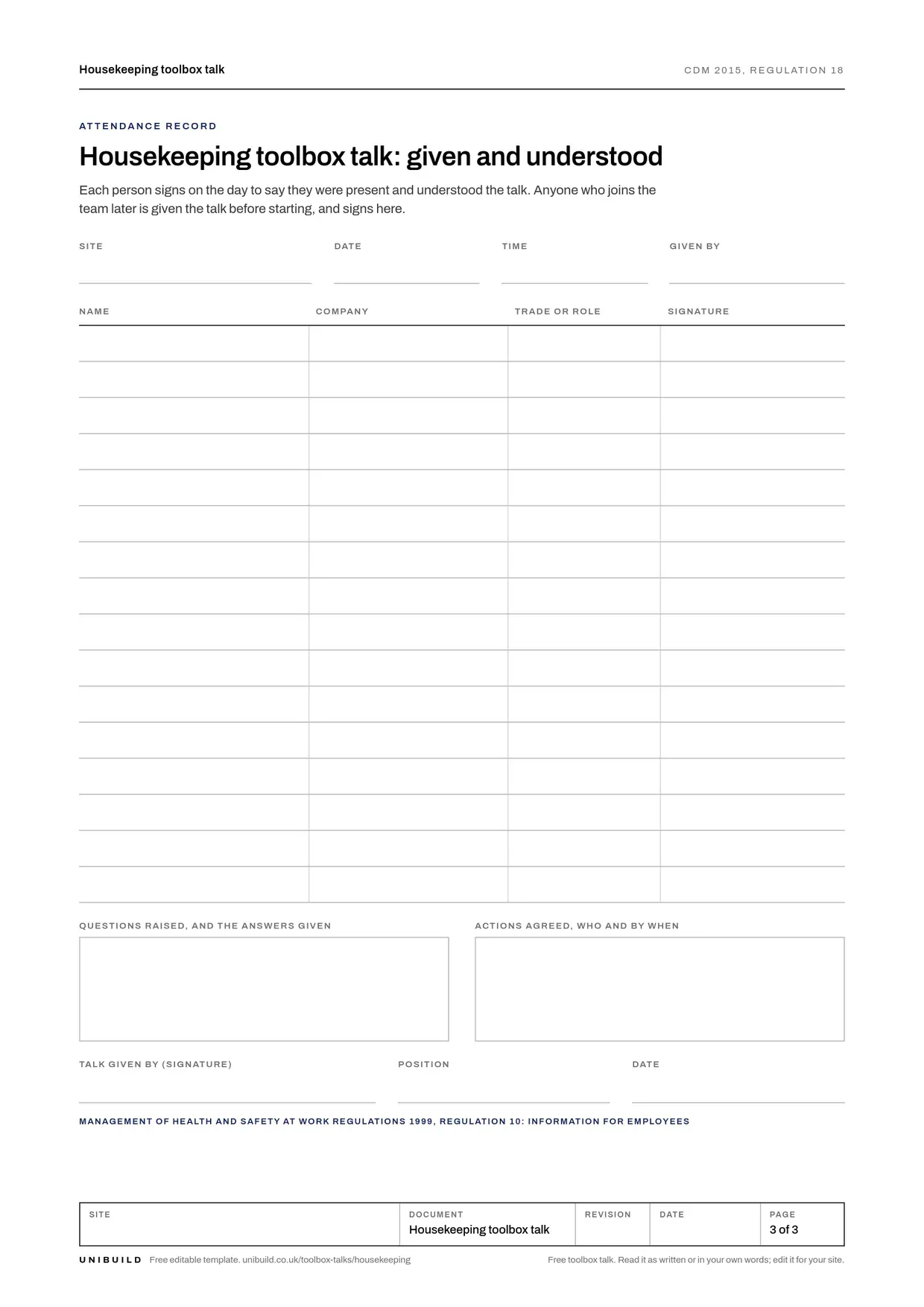
The attendance record: each person's name, company and signature, the questions raised and any actions, signed off by the person who gave the talk. Type into it or print it and pass it round.

The Word version

The same talk as a Word document, so you can put your own letterhead on it, add a site photograph or change a point to match how your job is set up.

Download the talk as PDF Word versionPDF · 3 pages · 208 KB
After it is given

Delivered on the phone, signed in the room

On Unibuild a toolbox talk is picked from the library, read by each operative on their own phone in their own language and signed there and then. The record is filed against the operative, the site and the date.

A site manager sees who has had which talk, and who has not, without a sheet going round on Thursday.

How toolbox talks work on Unibuild
How long should a housekeeping toolbox talk be?
About five to ten minutes. This one reads in about six if you make every point and stop for the questions. Keep it short and specific to this site: name the routes, the skips and the storage areas the team will actually use that week.
How often should we give a housekeeping talk?
The law does not set an interval. Give it at the start of a job, when a new trade arrives, when the site gets busy or changes layout, and after any trip or near miss. Many sites repeat it every few months as part of a rolling programme and record each delivery.
Who is responsible for housekeeping on a construction site?
Everyone, but the plan comes from the top. The principal contractor plans the storage, waste and routes for the whole site. Each contractor plans, manages and monitors its own work, including the clear-up. Each person keeps their own area and the routes they use clear. If the plan has no home for the waste, that is the contractor to fix, not the person holding the bag.
Who can deliver this talk?
A supervisor, site manager or a competent member of the team who knows the site layout and the arrangements for waste and storage. The person delivering it should be able to answer the questions on the sheet for this job. If they cannot, they bring someone who can.
Does a toolbox talk need a written record?
No regulation names toolbox talk records, but the Management Regulations require information and training to be provided and most principal contractors and auditors ask for the evidence. A signed attendance record with the date and topic is that evidence. The last page of the sheet is the record.
What does the law actually say about housekeeping?
CDM 2015 regulation 18 says every part of a construction site must be kept in good order, and working areas in a reasonable state of cleanliness, so far as is reasonably practicable. Regulation 17 asks for safe access and egress, and regulation 27 for routes where pedestrians and vehicles can move safely. In occupied workplaces, the Workplace Regulations 1992 regulation 12 asks for floors and routes free from obstructions and anything that could cause a slip or trip.
Is housekeeping the same as the slips, trips and falls talk?
They are a pair. This talk is about the system: routes, storage, waste, leads and lighting, and who does what. The slips, trips and falls talk is about what happens to people when that system fails, what to look for underfoot and what to report. Give both over a job, a few weeks apart.
Is this housekeeping toolbox talk free?
Yes. Download it, print it, give it, edit it and put your own name on it, including on paid work and for clients, with no sign-up and no email address.
Next step

The talk given, understood
and on record.

Unibuild keeps every toolbox talk against the operative who signed it, the site and the date, for seven years, ready for the principal contractor or an auditor.