
Roofing risk assessment and RAMS template
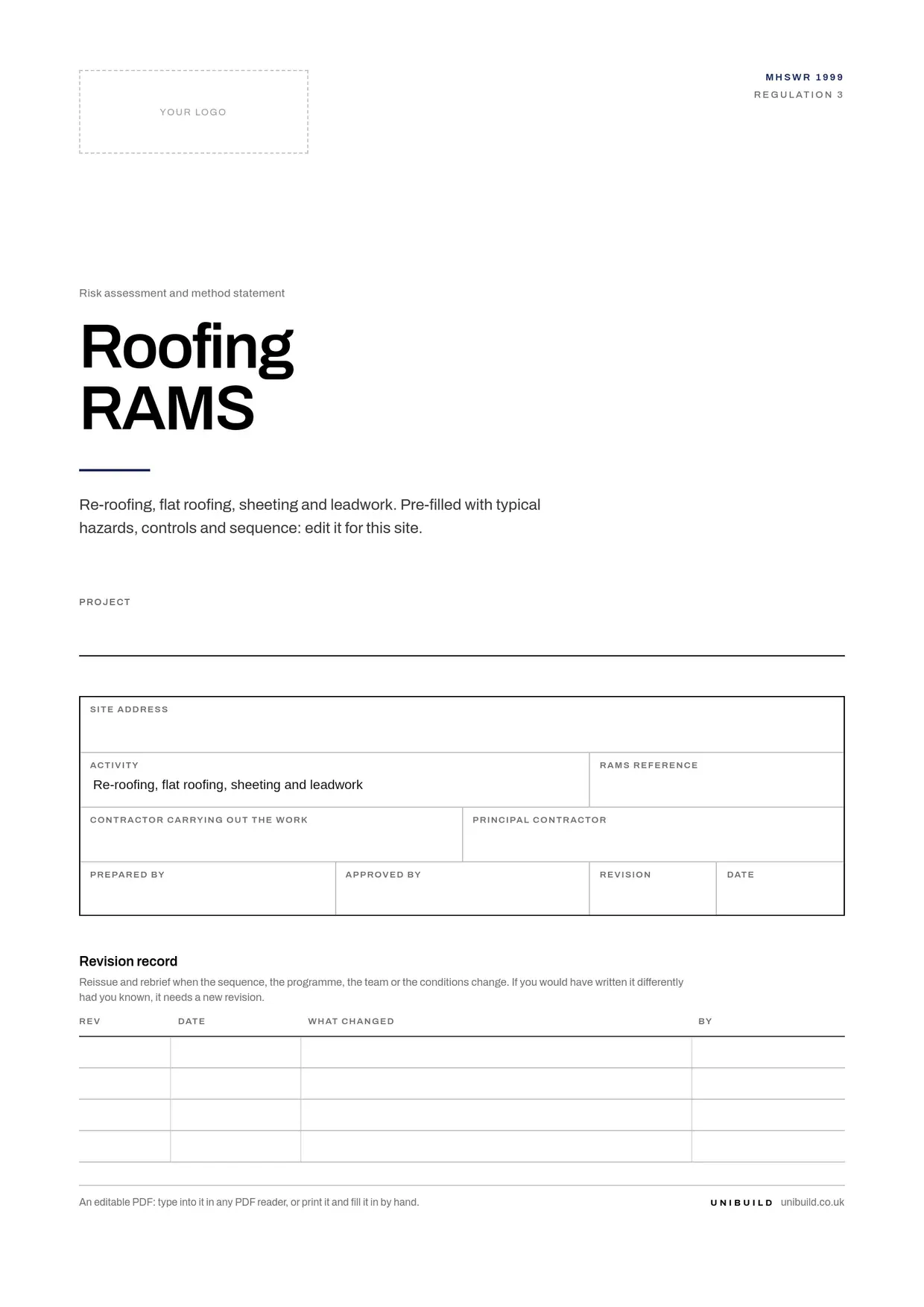
A roofing risk assessment and method statement, already filled in with the hazards, controls and sequence for re-roofing, flat roofs, sheeting and leadwork. Edit it for your roof, then brief it.
- Law
- Work at Height Regulations 2005
- Fragile roofs
- Fragile until proved otherwise
- Format
- Editable PDF and Word
- Cost
- Free, always
Do you need a RAMS for roofing work?
Yes, in practice every roofing job needs a RAMS, because roof work is work at height and the law requires it to be risk assessed, planned and supervised. A principal contractor or client will expect a roofing RAMS before the first ladder goes up.
The risk assessment is the legal duty, under regulation 3 of the Management of Health and Safety at Work Regulations 1999. The method statement shows how the roof will be done: how people get up, what stops a fall from the edge or through the roof, and how materials move.
A roofing RAMS has to describe the roof in front of you. The pitch, the covering, any fragile sheets or rooflights, the edges, the weather and the people below decide the controls. HSE guidance HSG33 sets out what good practice looks like for each type of roof.
Roofing hazards and controls
17 hazards, rated before and after controlsThe significant hazards on a typical re-roofing, flat roof or sheeting job, with the controls a reviewer expects to see. Delete what does not apply and add what your roof has.
Falls from the roof edge
Roofers at eaves, verges, gable ends and flat roof edges, and anyone else on the roof.
- Eaves scaffold or edge protection on every edge people can reach: main guard-rail at least 950mm high, no unprotected gap over 470mm.
- Edge protection chosen for the roof pitch, so it can stop a person sliding down the slope.
- For limited work on part of a large flat roof, a continuous physical barrier at least 2 metres from the edge and any fragile area.
BeforeHigh 20AfterMedium 5
Falls through fragile roofs and rooflights
Anyone on a sheeted roof or near old rooflights, asbestos cement or corroded sheets.
- Roof treated as fragile until a competent person confirms it is not; fragile areas marked on the survey and the drawing.
- Work from below or from a MEWP basket where possible; otherwise staging with guard-rails to spread the load.
- Rooflights covered or barriered; safety nets below or harnesses where staging does not cover all the work.
- Nobody walks the purlin line or the sheet laps.
BeforeHigh 20AfterMedium 5
Falls through openings and stripped areas
Roofers stripping coverings, fixing battens or working between trusses.
- Strip only the area that can be re-covered or protected the same day.
- Openings covered with fixed, marked covers or guarded; netting or boarding below where roofers work between trusses.
- Battens walked only where the rafter centres and batten size meet HSG33, and only under supervision.
BeforeHigh 15AfterMedium 5
Slipping on a pitched roof
Roofers on tiles, slates and sheets, worse in wet, icy or mossy conditions.
- Roof ladders or crawling boards that span at least three rafters, anchored over the ridge, not on the ridge tiles.
- No walking on the laid covering; roof ladder moved as the work moves.
- Roof checked for frost, moss and wet before anyone goes on it.
BeforeHigh 16AfterMedium 8
Getting on and off the roof
Anyone climbing to the roof, carrying tools and materials.
- Access by scaffold stair or ladder tower where the job allows.
- Access ladders tied at both stiles, at the 1 in 4 angle, extending at least 1 metre above the landing.
- Hands free when climbing; tools and materials go up by hoist or bag.
BeforeMedium 12AfterLow 4
Falling materials and tools
The public, residents, other trades and the team below the roof.
- Nothing thrown or tipped from the roof: waste goes down an enclosed chute into a covered skip, or in bags or skips lowered by hoist.
- Toe boards and brick guards where slates or tiles are stacked above toe board height.
- Exclusion zone below the work, with a covered walkway or closed footpath where the public pass.
BeforeHigh 16AfterLow 4
Loading materials onto the roof
The team loading out, and the roof or scaffold carrying the load.
- Hoist or crane used for heavy and long items, with a LOLER thorough examination in date and no lifting over the public.
- Materials loaded straight from the lorry to the roof where possible, to the loading the scaffold design allows.
- Stacks spread over the rafters or purlins, secured against wind, and never on fragile areas.
BeforeMedium 12AfterMedium 8
Torch-on work and roof fires
Roofers, building occupants and neighbours, from a torch igniting the deck, insulation or a cavity.
- Torch-free products specified wherever the survey shows a fire risk, following NFRC Safe2Torch.
- Hot work permit for each area, with combustibles in and below the deck checked and removed first.
- Extinguisher at the work face and a fire watch after the torch goes out, for the period the permit sets.
BeforeHigh 15AfterMedium 5
LPG cylinders and gas torches
Roofers using torches and boilers, and anyone near the cylinders.
- Cylinders upright and secured, with hoses, regulators and connections checked and leak tested before use, never with a flame.
- Spare cylinders stored in a ventilated, secure area away from the work and from combustibles.
- Gas turned off at the cylinder whenever the torch or boiler is left.
BeforeHigh 15AfterMedium 5
Hot bitumen burns and fume
Roofers using bitumen boilers or hot-melt systems on flat roofs.
- Boiler on a firm, level, non-combustible base, in a spill tray on the roof, and never inside a building.
- Boiler run only by a trained operative, never left unattended with the gas on, and barriered from the public.
- Work upwind of the boiler; gloves, eye protection and covered skin; burns first aid briefed.
BeforeMedium 12AfterLow 4
Lead in leadwork and old roofs
Roofers cutting, dressing, welding or stripping lead sheet and old lead.
- Lead risk assessed before work, with hot work on lead kept to a minimum and lead dust and fume controlled.
- No eating, drinking or smoking in the work area; hands and face washed before breaks.
- Medical surveillance by an appointed doctor where exposure is significant.
BeforeMedium 9AfterLow 3
Asbestos cement sheets and other asbestos
Roofers working on or near older sheeted roofs, soffits, gutters and flues.
- Asbestos survey checked before work; no work that disturbs suspect material until it is confirmed.
- Asbestos cement sheets removed intact by hand where possible, under the asbestos risk assessment.
- Asbestos awareness training for the whole team; licensed contractor for insulation board or sprayed coatings.
BeforeHigh 15AfterMedium 5
Wind, rain, ice and lightning
Roofers handling sheets, rolls and membranes at height.
- Forecast checked each morning, with wind measured at the roof by anemometer before sheeting or membrane work.
- Work stopped when the weather puts people at risk; nothing laid on wet or icy roofs that need a dry surface.
- Loose sheets, offcuts and fixings secured at the end of each day.
BeforeMedium 12AfterMedium 8
Manual handling of tiles, rolls and sheets
Roofers and labourers carrying materials up and across the roof.
- Long and heavy sheets and composite panels lifted by crane or hoist, never by hand.
- Materials spread along the roof by hoist in small loads; two-person lifts for awkward items.
- Rolls and bundles kept to weights the team can handle on a slope.
BeforeMedium 12AfterMedium 6
Dust from cutting tiles and slates
Roofers cutting concrete tiles, slates and fibre cement, and anyone working nearby.
- Tiles and slates cut by hand cutter or slate cropper where possible, which makes far less dust than a disc cutter.
- Where a powered saw is needed, water suppression or on-tool extraction, with cutting done away from others.
- FFP3 RPE, face-fit tested, worn on top of the dust controls, not in place of them.
BeforeHigh 16AfterMedium 8
Overhead power lines
Roofers moving ladders, long sheets or lengths of gutter near lines.
- Lines identified at the survey and the network operator contacted to divert or switch off where the work comes close.
- No metal ladders or long sheets handled within reach of a live line; non-conductive ladders where needed.
BeforeMedium 10AfterMedium 5
Rescue after a fall
A roofer suspended in a harness or injured on the roof.
- Written rescue plan before work starts, with equipment on site and the team shown how to use it.
- Nobody works alone on the roof; rescue starts at once, without waiting for the emergency services.
BeforeMedium 10AfterMedium 5
Scores are likelihood times severity on the five by five matrix in the template. They are typical ratings for this work, a starting point for your own assessment of your site.
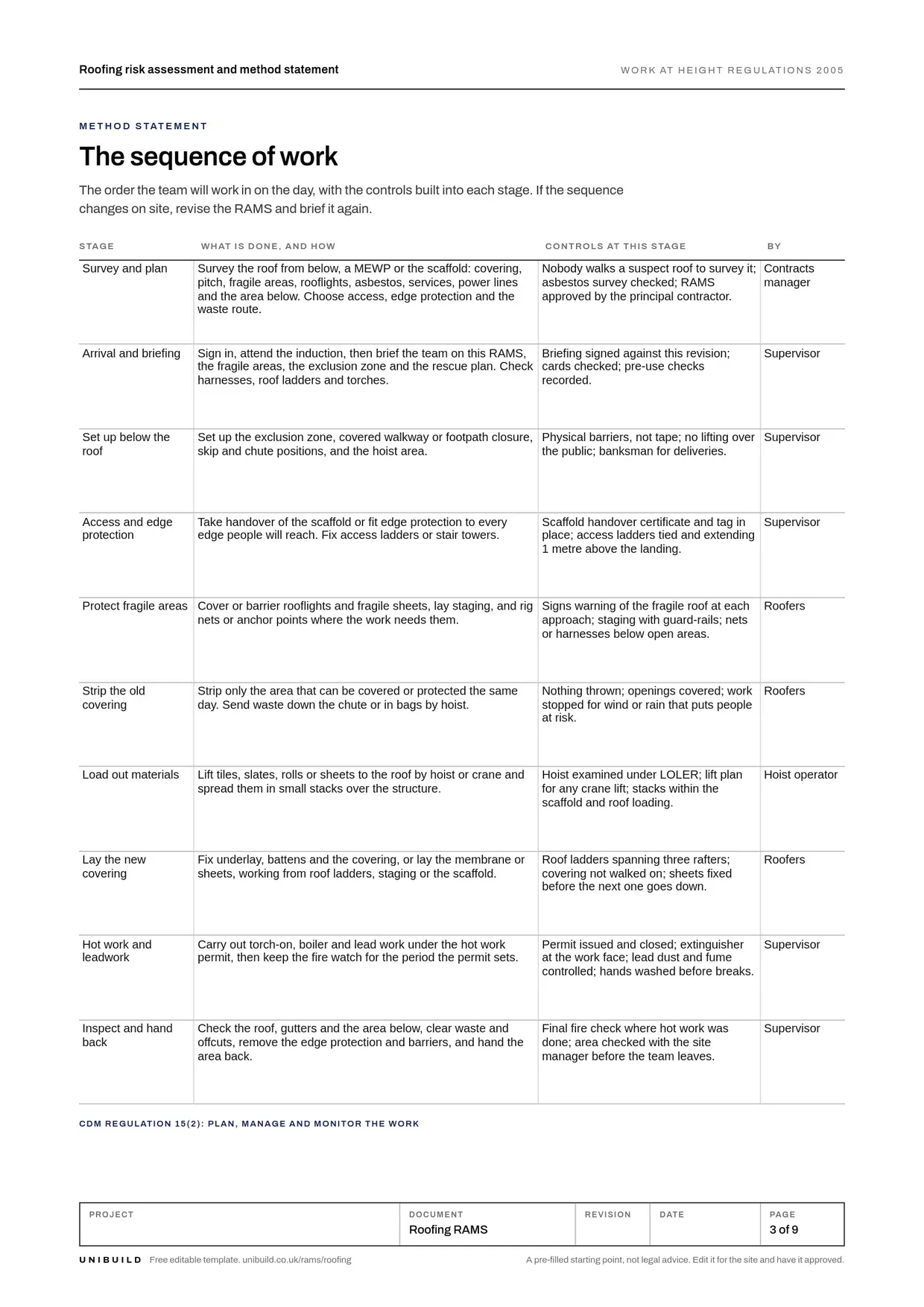
Roofing method statement: the sequence of work
The order of work, with the controls at each stageThe order the team works in, with the controls built into each stage. If the sequence changes on site, revise the RAMS and brief it again.
Survey and plan
Survey the roof from below, a MEWP or the scaffold: covering, pitch, fragile areas, rooflights, asbestos, services, power lines and the area below. Choose access, edge protection and the waste route.
ControlsNobody walks a suspect roof to survey it; asbestos survey checked; RAMS approved by the principal contractor.
Arrival and briefing
Sign in, attend the induction, then brief the team on this RAMS, the fragile areas, the exclusion zone and the rescue plan. Check harnesses, roof ladders and torches.
ControlsBriefing signed against this revision; cards checked; pre-use checks recorded.
Set up below the roof
Set up the exclusion zone, covered walkway or footpath closure, skip and chute positions, and the hoist area.
ControlsPhysical barriers, not tape; no lifting over the public; banksman for deliveries.
Access and edge protection
Take handover of the scaffold or fit edge protection to every edge people will reach. Fix access ladders or stair towers.
ControlsScaffold handover certificate and tag in place; access ladders tied and extending 1 metre above the landing.
Protect fragile areas
Cover or barrier rooflights and fragile sheets, lay staging, and rig nets or anchor points where the work needs them.
ControlsSigns warning of the fragile roof at each approach; staging with guard-rails; nets or harnesses below open areas.
Strip the old covering
Strip only the area that can be covered or protected the same day. Send waste down the chute or in bags by hoist.
ControlsNothing thrown; openings covered; work stopped for wind or rain that puts people at risk.
Load out materials
Lift tiles, slates, rolls or sheets to the roof by hoist or crane and spread them in small stacks over the structure.
ControlsHoist examined under LOLER; lift plan for any crane lift; stacks within the scaffold and roof loading.
Lay the new covering
Fix underlay, battens and the covering, or lay the membrane or sheets, working from roof ladders, staging or the scaffold.
ControlsRoof ladders spanning three rafters; covering not walked on; sheets fixed before the next one goes down.
Hot work and leadwork
Carry out torch-on, boiler and lead work under the hot work permit, then keep the fire watch for the period the permit sets.
ControlsPermit issued and closed; extinguisher at the work face; lead dust and fume controlled; hands washed before breaks.
Inspect and hand back
Check the roof, gutters and the area below, clear waste and offcuts, remove the edge protection and barriers, and hand the area back.
ControlsFinal fire check where hot work was done; area checked with the site manager before the team leaves.
What the law asks for roofing
Checked against the sourceAvoid, prevent, then mitigate
Work at height is avoided where it can be done safely another way. Where it cannot, falls are prevented, and only then are the distance and consequences of a fall reduced.
Work at Height Regulations 2005, regulation 6Fragile surfaces
Nobody works on or near a fragile surface where the work can be done safely another way. Where they must, platforms, coverings or guard-rails carry the load, and warning notices go at the approach.
Work at Height Regulations 2005, regulation 9Falling objects
The fall of materials and objects is prevented so far as is reasonably practicable. Nothing is thrown or tipped from height where it could injure anyone, and materials are stored so they cannot collapse or move.
Work at Height Regulations 2005, regulation 10Planning and weather
Work at height is properly planned, including for emergencies and rescue, and supervised. It is carried out only when the weather does not put people at risk.
Work at Height Regulations 2005, regulation 4Fire from hot work
Steps must be taken to prevent, so far as is reasonably practicable, injury from fire or explosion during construction work. Torch-on work, bitumen boilers and lead welding all come under this duty.
CDM 2015, regulation 29Lead
Work that may expose people to lead needs a lead risk assessment first. Where exposure is significant, each person is under medical surveillance by a relevant doctor, starting within 14 working days.
Control of Lead at Work Regulations 2002, regulations 5 and 10Competence, equipment and PPE
Competence and cards
- Roofers CSCS card for their roofing occupation, with trainees supervised by a qualified roofer.
- Supervisor Experienced roofer with site supervision training, on the roof or at the job throughout.
- MEWP operators IPAF PAL card for the category of machine.
- Hoist and telehandler CPCS or NPORS card for the machine, or trained and authorised for a materials hoist.
- Hot work Trained in torch-on and boiler work, and in burns first aid.
- Harness users Trained to fit, inspect and use the harness, and in the rescue plan.
Plant and equipment
- Roof ladders and crawling boards To BS 8634, checked before use, anchored over the ridge.
- Edge protection Rated for the roof pitch; inspected before use and after bad weather.
- Materials hoist LOLER thorough examination in date; daily pre-use check.
- MEWP Pre-use check; thorough examination at least every 6 months.
- Gas torch, boiler and cylinders Hoses, regulator and connections checked and leak tested.
- Harnesses and lanyards Pre-use check each day and detailed inspection in date.
PPE
- Safety helmet with chin strap where people work below or from a MEWP.
- Safety boots with a flexible, grip sole for roof work.
- Gloves for handling, and heat-resistant gloves for hot work.
- Eye protection for cutting, torch-on and hot bitumen.
- Respiratory protection FFP3 or better for dust from cutting tiles and slates.
- Harness and lanyard where collective protection does not cover the work.
Permits and plans
A hot work permit for torch-on, boilers, welding or lead burning. A permit to work for access to a fragile roof where the client or principal contractor requires one. A lift plan for any crane lift, and the scaffold handover certificate before the roof is used.
Emergency and rescue
Rescue plan for a roofer suspended in a harness or injured on the roof, with the equipment on site. Fire plan for hot work, with extinguishers at the work face and the escape route from the roof agreed. First aider and burns kit on site, and the nearest accident and emergency department named on the briefing.
Toolbox talk: roofing safety
Read this to the team before work starts, tick each point as it is covered, and record who attended.
- Treat every sheet and rooflight as fragile until we are told otherwise. Never walk the bolt line.
- On a pitched roof you work off a roof ladder or the scaffold. Nobody walks on the new tiles.
- If the edge protection is not there, you do not go there. Tell the supervisor first.
- Nothing gets thrown off the roof. Waste goes down the chute or in a bag on the hoist.
- Torch-on only under the permit, with the extinguisher next to you and the fire watch after.
- If the wind picks up or the roof gets wet, stop and tell the supervisor before anyone carries on.
Ask the team
- Where are the fragile areas and rooflights on this roof?
- Where is the rescue kit, and who has been shown how to use it?
- How long does the fire watch run after the last torch goes out today?
What is in the roofing RAMS template
9 pages, pre-filled and editableThe work, pre-filled
Scope, location and access, interfaces with other trades, the documents the RAMS relies on, and the team with their cards.
The sequence of work
Ten stages from survey to hand back, with the controls and the person responsible at each one.
Hazards and controls
Seventeen roofing hazards rated before and after controls on a five by five matrix, with room for your own.
Plant, PPE and permits
The equipment and its checks, PPE by type, bitumen, lead and dust, and the permits the job needs.
Roof access and edge protection check
A page to record access, edge protection, fragile areas and the area below, checked before work starts.
Emergency and briefing record
The rescue and fire plan, then twenty signatures against the revision, taken before the work starts.
Brief it, and get it signed on the phone
On Unibuild a RAMS is written from a template, approved, then read by each operative on their phone in their own language and signed. Subcontract and agency workers sign through a link, with no app to install.
Every signature carries its date and time and prints as the last page of the RAMS PDF. Change the RAMS and it has to be signed again.
How RAMS work on UnibuildRoofing RAMS questions
Is this roofing RAMS template free?
What should a roofing risk assessment include?
Do I need a RAMS to replace a few tiles?
When is a roof classed as fragile?
Do flat roofs need edge protection?
Does torch-on roofing need a hot work permit?
Is leadwork covered by the lead regulations?
Who signs the roofing RAMS?
RAMS templates for other trades and hazards
All free, pre-filled and editableBy trade
- Electrical RAMSSafe isolation, live work, testing and inspection, and working near other trades.
- Scaffolding RAMSErecting, altering and dismantling tube and fitting and system scaffold, with handover and inspection.
- Roofing RAMSPitched and flat roofs, fragile surfaces, edge protection, hot work and getting materials up safely.
- Groundworks RAMSExcavations, buried services, plant, trench support and inspections at the start of each shift.
- Plumbing and heating RAMSSoldering and brazing, gas work, unvented systems, lofts and occupied homes.
- Painting and decorating RAMSAccess equipment, solvents and spray, old lead paint, dust from preparation and occupied buildings.
- Hot works and welding RAMSWelding, cutting, grinding and torch-on work: permits, fire watch, fume and gas cylinders.
By hazard
- COSHH risk assessmentHazardous substances on site: dusts, solvents, cement, resins and fume, assessed and controlled.
- Manual handling risk assessmentLifting, carrying, pushing and pulling, assessed by task, individual, load and environment.
- Working at height risk assessmentLadders, towers, MEWPs, scaffolds and roofs, chosen and controlled in the order the law sets.
- Lone working risk assessmentPeople working alone on site, in empty buildings and out of hours, with check-ins and a plan if they go quiet.
- Noise and vibration risk assessmentNoise exposure and hand-arm vibration from tools, measured against the action and limit values.
- Asbestos risk assessmentFinding asbestos before work starts, deciding whether work is licensed, and controlling non-licensed work.
- Confined space risk assessmentManholes, tanks, voids and chambers: avoiding entry, a safe system of work, gas testing and rescue.
The blank RAMS template, the RAMS review checklist and every other free form are on Free downloads.
The RAMS, read and signed
before the work starts.
Unibuild keeps every RAMS with its versions, its approvals and each operative’s signature against the revision they read, for seven years, ready for the principal contractor or an auditor.