
Lifting operations risk assessment template
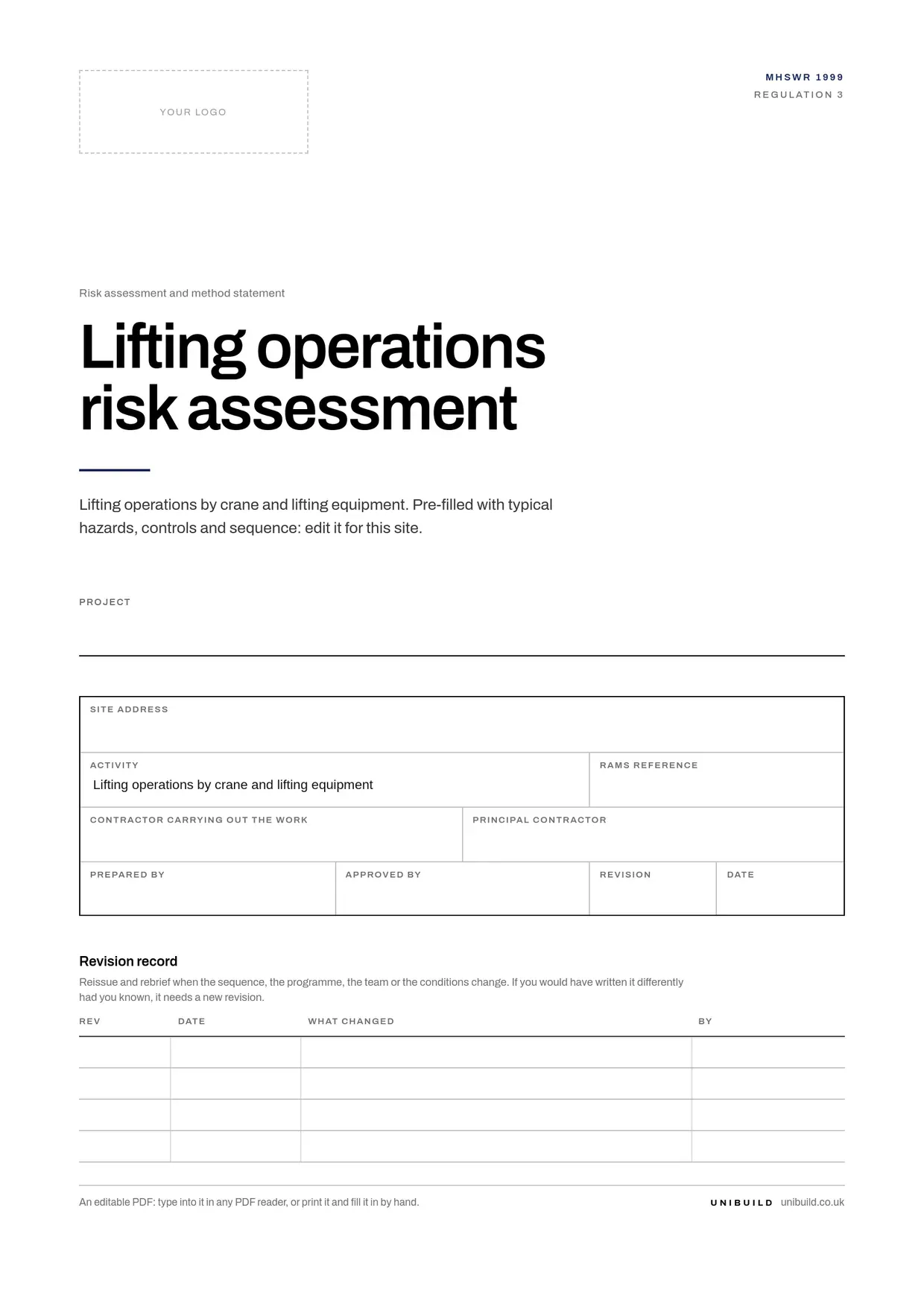
A lifting operations risk assessment, already filled in for crane, lorry loader and telehandler lifts, with a lift plan page. Edit it for your lift, then brief it to the lift team.
- Law
- LOLER 1998, regulation 8
- Lifting accessories
- Examined at least every 6 months
- Format
- Editable PDF and Word
- Cost
- Free, always
What is a lifting operations risk assessment?
A lifting operations risk assessment looks at a lift by crane, lorry loader, telehandler, hoist or chain block and sets the controls that keep the lift team and everyone nearby safe. Regulation 8 of LOLER 1998 requires every lifting operation to be properly planned by a competent person, appropriately supervised and carried out in a safe manner.
The planning grows with the lift. HSE says a single generic plan may be enough for routine lifts, while complex lifts need a written plan from someone with significant and specific competence. BS 7121, the code of practice for the safe use of cranes, sorts lifts into basic, standard and complex categories, each with its own level of planning.
The equipment has to be fit for the load. Machines and accessories are marked with their safe working load, and lifting equipment is thoroughly examined at set intervals. The lift plan page in this template records the load, the machine, the accessories, the ground, the wind limit and the team for one lift.
Checked against legislation.gov.uk and HSE guidance on .
Lifting operations hazards and controls
16 hazards, rated before and after controlsA worked example of the significant hazards in lifts by crane, lorry loader and telehandler on site, with the controls a reviewer expects to see. Delete what does not apply and add what your lift has.
Lift not planned or under-planned
The lift team and everyone nearby, when a lift goes ahead without a plan suited to its risk.
- Every lift planned by a competent person; routine lifts under a generic plan, others under a plan written for the lift.
- Lift category under BS 7121 (basic, standard or complex) set by the appointed person.
- Supervision in proportion to the risk; no lift starts until the plan has been briefed.
BeforeHigh 15AfterMedium 5
Unknown load weight or centre of gravity
The lift team, when a load is heavier than expected or tips because its weight is off centre.
- Weight taken from the manufacturer, delivery note or drawings, with attachments and packing added.
- Lifting points and centre of gravity identified; unbalanced loads rigged to hang level.
- Load lifted a short way and paused to check balance before the full lift.
BeforeHigh 15AfterMedium 5
Crane overloaded at radius
The operator and people nearby, if the crane overturns or a part fails.
- Crane chosen for the heaviest load at the greatest radius in the plan, with the load chart checked.
- Weight of hook block, accessories and spreader beams counted in the load.
- Rated capacity indicator working and never overridden; crane rigged to the configuration in the plan.
BeforeMedium 10AfterMedium 5
Ground failure under outriggers or tracks
The operator and people nearby, when the ground gives way under a loaded outrigger.
- Ground checked for voids, cellars, services, excavations and recent backfill at the set-up position.
- Outrigger loads from the crane supplier compared with what the ground can carry; mats sized to suit.
- Outriggers fully set and the crane levelled before any lift.
BeforeHigh 15AfterMedium 5
Wind on the crane and the load
The lift team, when wind swings a load or loads the crane beyond its limit.
- Forecast checked; wind limits for the crane and for loads with a large surface area set in the plan.
- Wind speed measured at the crane during the lift; work stopped when the limit is reached.
- Tag lines on loads that may spin, handled by people standing clear.
BeforeMedium 12AfterLow 4
Load falling from poor slinging
Slingers and anyone below, when a load slips, a sling is cut or a hook opens.
- Slinging done by a trained slinger to the method in the plan; edges packed to protect slings.
- Safety catches on hooks; loose items banded or put in a suitable skip or cradle.
- Nobody under the load at any stage of the lift.
BeforeHigh 15AfterMedium 5
Damaged or unmarked accessories
The lift team, when a sling, chain or shackle fails under load.
- Accessories marked with their safe working load and identified, as LOLER regulation 7 requires.
- Pre-use check by the slinger; damaged items taken out of use and quarantined.
- Thorough examination at least every six months, with reports in date and on site.
BeforeHigh 15AfterMedium 5
People under or near the load
Other trades, visitors and the public within reach of the load or the slewing crane.
- Exclusion zone set by the plan, barriered and signed; the slew path kept clear of people.
- Lift route planned so the load does not pass over people, occupied areas or public routes.
- Lift stopped if anyone enters the zone; marshals on public routes where needed.
BeforeHigh 15AfterMedium 5
Trapping and crushing at landing
Slingers and receivers guiding the load into place, at height or at ground level.
- Load landed on bearers so slings can be removed without hands under the load.
- Hands kept off the load where possible, with tag lines or push sticks used instead.
- Receivers at height work behind edge protection; nobody between the load and a fixed structure.
BeforeMedium 12AfterMedium 8
Trapping by the crane counterweight
Anyone between the slewing superstructure of a mobile crane and a fixed object.
- Tail swing area barriered so nobody can stand within it.
- Crane set up with enough clearance for the counterweight to slew past walls and stacks.
BeforeMedium 10AfterMedium 5
Overhead power lines
The lift team, if the jib, the hoist rope or the load touches or arcs to a line.
- Lines found at the planning stage; network operator asked to make dead or divert where the lift is close.
- Where lines stay live, the crane set up so it cannot reach them, with the operator's advice and a signed plan.
- Slingers trained to keep clear of the load and the crane if contact is made.
BeforeMedium 10AfterMedium 5
Striking structures, scaffold or other cranes
The lift team and others, when a jib, load or hook hits a building, scaffold or another crane.
- Proximity hazards plotted on the lift plan; other cranes on site agreed through one coordinator.
- Slew and radius limits set where the crane has them; scaffold ties and edges checked on the lift route.
- Signaller in view of the load wherever the operator cannot see it.
BeforeMedium 12AfterLow 4
Poor signals between signaller and operator
The lift team, when the operator cannot see the load and a signal is missed or misread.
- One signaller in control of each lift, agreed and briefed beforehand.
- Recognised hand signals, or radios on a dedicated channel checked before the lift.
- Lift stopped at once if contact is lost, and not restarted until it is regained.
BeforeMedium 12AfterLow 4
Lorry loader deliveries
Drivers and people at the set-down point when a lorry-mounted crane offloads materials.
- Lorry parked on firm, level ground with stabilisers fully set on mats; delivery lifts covered by the plan.
- Operator trained for the lorry loader; controls used from a position with a clear view of the load.
- People kept out of the lift area; nobody under the boom or the load.
BeforeMedium 12AfterMedium 8
Lifting people
Anyone lifted in a man-basket on a crane or carrier not made for lifting people.
- A MEWP or other equipment made for lifting people chosen first.
- Lifting equipment not designed for people used only in exceptional circumstances, under a plan for that lift.
- Equipment that lifts people examined at least every six months, and marked as such.
BeforeMedium 10AfterMedium 5
Equipment defects or out of date examination
The lift team, when the crane or a part of it fails in use.
- Thorough examination reports checked for the crane, attachments and accessories before the lift.
- Pre-use checks done and recorded by the operator; defects reported and the equipment not used until put right.
- Hired cranes accompanied by evidence of their last thorough examination, as regulation 9(4) requires.
BeforeMedium 10AfterMedium 5
Scores are likelihood times severity on the five by five matrix in the template. They are typical ratings for this work, a starting point for your own assessment of your site.
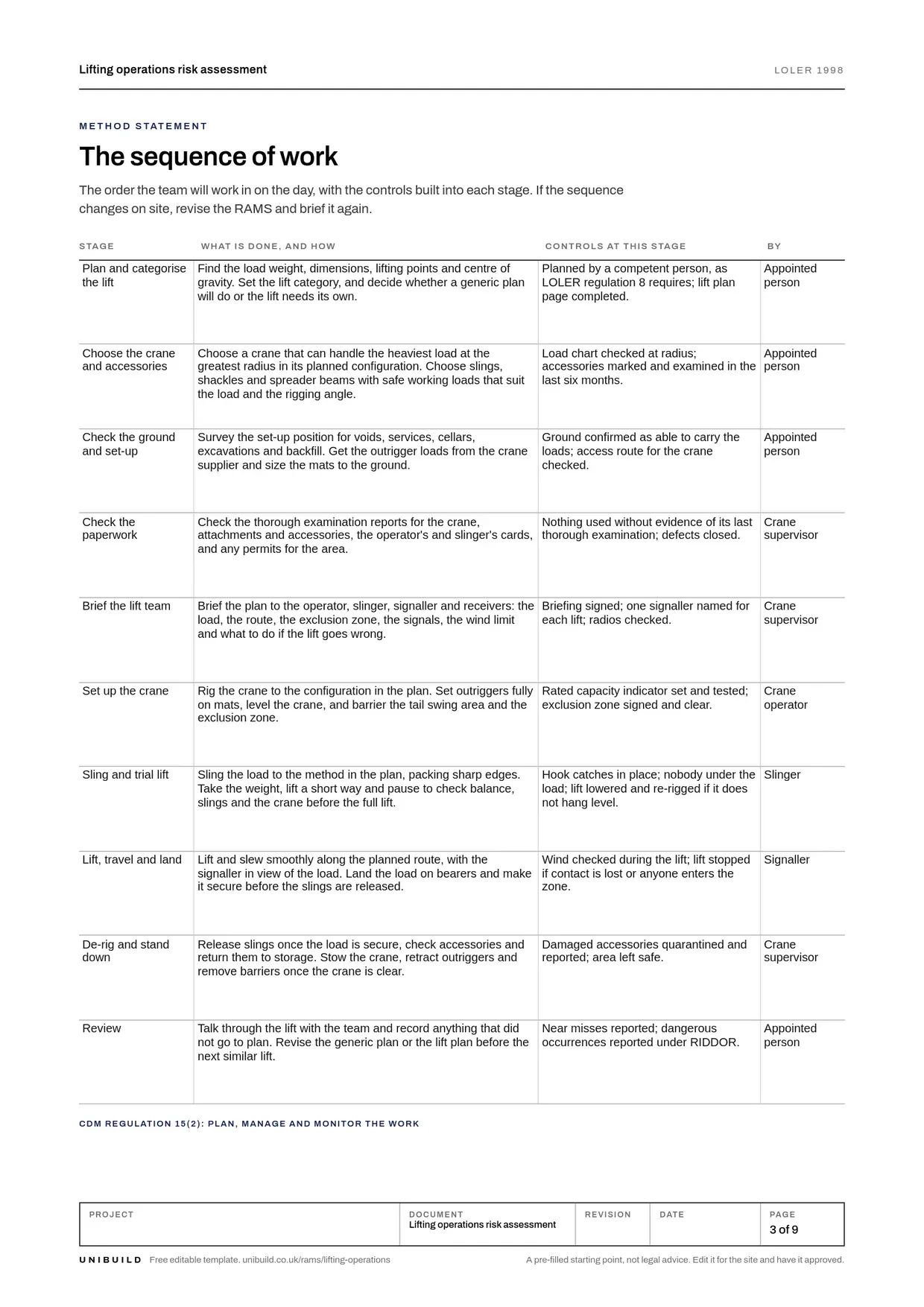
Lifting operations method statement: the sequence of work
The order of work, with the controls at each stageHow a lift is planned, set up and carried out, with the controls at each stage. If the load, the crane or the conditions change, the appointed person revises the plan and it is briefed again.
Plan and categorise the lift
Find the load weight, dimensions, lifting points and centre of gravity. Set the lift category, and decide whether a generic plan will do or the lift needs its own.
ControlsPlanned by a competent person, as LOLER regulation 8 requires; lift plan page completed.
Choose the crane and accessories
Choose a crane that can handle the heaviest load at the greatest radius in its planned configuration. Choose slings, shackles and spreader beams with safe working loads that suit the load and the rigging angle.
ControlsLoad chart checked at radius; accessories marked and examined in the last six months.
Check the ground and set-up
Survey the set-up position for voids, services, cellars, excavations and backfill. Get the outrigger loads from the crane supplier and size the mats to the ground.
ControlsGround confirmed as able to carry the loads; access route for the crane checked.
Check the paperwork
Check the thorough examination reports for the crane, attachments and accessories, the operator's and slinger's cards, and any permits for the area.
ControlsNothing used without evidence of its last thorough examination; defects closed.
Brief the lift team
Brief the plan to the operator, slinger, signaller and receivers: the load, the route, the exclusion zone, the signals, the wind limit and what to do if the lift goes wrong.
ControlsBriefing signed; one signaller named for each lift; radios checked.
Set up the crane
Rig the crane to the configuration in the plan. Set outriggers fully on mats, level the crane, and barrier the tail swing area and the exclusion zone.
ControlsRated capacity indicator set and tested; exclusion zone signed and clear.
Sling and trial lift
Sling the load to the method in the plan, packing sharp edges. Take the weight, lift a short way and pause to check balance, slings and the crane before the full lift.
ControlsHook catches in place; nobody under the load; lift lowered and re-rigged if it does not hang level.
Lift, travel and land
Lift and slew smoothly along the planned route, with the signaller in view of the load. Land the load on bearers and make it secure before the slings are released.
ControlsWind checked during the lift; lift stopped if contact is lost or anyone enters the zone.
De-rig and stand down
Release slings once the load is secure, check accessories and return them to storage. Stow the crane, retract outriggers and remove barriers once the crane is clear.
ControlsDamaged accessories quarantined and reported; area left safe.
Review
Talk through the lift with the team and record anything that did not go to plan. Revise the generic plan or the lift plan before the next similar lift.
ControlsNear misses reported; dangerous occurrences reported under RIDDOR.
What the law asks for lifting operations
Checked against the sourcePlanned, supervised, safe
Every lifting operation involving lifting equipment is properly planned by a competent person, appropriately supervised and carried out in a safe manner. A lifting operation is any operation concerned with lifting or lowering a load.
Lifting Operations and Lifting Equipment Regulations 1998, regulation 8Strength and stability
Lifting equipment is of adequate strength and stability for each load, with particular regard to the stress at its mounting or fixing point. Every part of a load, and anything attached to it for lifting, is of adequate strength.
Lifting Operations and Lifting Equipment Regulations 1998, regulation 4Positioning
Lifting equipment is positioned or installed to reduce, as low as reasonably practicable, the risk of the equipment or a load striking a person, and the risk from a load drifting, falling freely or being released unintentionally.
Lifting Operations and Lifting Equipment Regulations 1998, regulation 6Marking
Machinery and accessories are clearly marked with their safe working loads. Where it changes with configuration, each one is marked or the information kept with the machine. Accessories show what is needed for safe use, and equipment for lifting people is marked as such.
Lifting Operations and Lifting Equipment Regulations 1998, regulation 7Thorough examination
Equipment exposed to deterioration is thoroughly examined at least every six months if it lifts people or is an accessory, and every 12 months otherwise, or under an examination scheme. Equipment from another business is not used without physical evidence of its last examination.
Lifting Operations and Lifting Equipment Regulations 1998, regulation 9Defects
The examiner tells the employer at once of any defect that is or could become a danger, and reports in writing. The employer does not use the equipment until the defect is put right. Where there is a risk of serious injury, the examiner also sends a copy to the enforcing authority.
Lifting Operations and Lifting Equipment Regulations 1998, regulation 10Competence, equipment and PPE
Competence and cards
- Appointed person Plans the lift and sets its category; trained to the recommendations in BS 7121-1 for appointed persons.
- Crane supervisor Controls the lift on the day and stops it if conditions change.
- Crane operator Trained and carded for the crane category, and familiar with the model and its configuration.
- Slinger signaller Trained to sling loads and give signals, such as the CPCS A40 slinger signaller category.
- Lorry loader operator Trained for the lorry loader and for the attachments used.
- Thorough examiner A competent person with the knowledge and experience to find defects and judge their importance.
Plant and equipment
- Mobile crane Thorough examination in date; rated capacity indicator tested; load chart for the set-up.
- Lorry loader Thorough examination in date; stabilisers and controls checked before use.
- Telehandler with crane attachment Attachment approved for the machine; load chart in the cab; examined.
- Slings, chains, shackles and spreader beams Marked with safe working load; pre-use check; examined every 6 months.
- Outrigger mats Sized for the outrigger loads and the ground; checked for damage.
- Radios and anemometer Radios charged and tested on a set channel; wind meter working.
PPE
- Safety helmet for everyone in the lift area.
- High-visibility clothing with the signaller clearly identified.
- Safety boots with toe protection and a grip sole.
- Gloves for handling slings, chains and wire rope.
- Harness and short lanyard for receivers at an open edge without edge protection.
Permits and plans
A lift plan for every lift: generic for routine lifts, written for the lift where it is not. A permit to work where the principal contractor's rules require one, for example near live services. Written agreement with the network operator where overhead lines are close, and any road closure in place before the crane arrives.
Emergency and rescue
A plan for a load stuck in the air, a crane fault and a casualty at height before the lift starts. Lift stopped and the area cleared if the crane or ground moves. The collapse, overturning or failure of a load-bearing part of lifting equipment other than an accessory, or plant contact with a bare overhead line over 200 volts, is a RIDDOR dangerous occurrence.
Toolbox talk: lifting operations
Read this to the team before work starts, tick each point as it is covered, and record who attended.
- No lift goes ahead without a plan, and every lift today is in the plan we are about to go through.
- Know the weight. If you do not know what the load weighs, do not sling it. Ask.
- Check every sling, chain and shackle before you use it. If it is damaged or has no safe working load marked, take it out of use.
- Never stand under a load, and never put your hands between the load and anything solid.
- One signaller per lift. If the operator loses sight or radio contact, the lift stops.
- If the wind picks up, the ground moves or someone walks into the zone, stop the lift and tell the supervisor.
Ask the team
- Who is the signaller for each lift today, and what signal stops the lift?
- Where is the exclusion zone, and who keeps people out of it?
- At what wind speed do we stop lifting today?
What is in the lifting operations risk assessment template
9 pages, pre-filled and editableThe work, pre-filled
Scope, location and access, interfaces with other trades, the documents the assessment relies on, and the lift team.
The sequence of work
Ten stages from planning the lift to review, with the controls and the person responsible at each one.
Hazards and controls
Sixteen lifting hazards rated before and after controls on a five by five matrix, with room for your own.
Plant, PPE and permits
The cranes, attachments and accessories with their checks, PPE by type, and the permits and agreements a lift needs.
Lift plan
A page for one lift: the load, the crane, the accessories, the ground, the wind limit, the exclusion zone and the team.
Briefing record
Twenty signatures against the revision, taken on the day before the lift.
Brief it, and get it signed on the phone
On Unibuild a RAMS is written from a template, approved, then read by each operative on their phone in their own language and signed. Subcontract and agency workers sign through a link, with no app to install.
Every signature carries its date and time and prints as the last page of the RAMS PDF. Change the RAMS and it has to be signed again.
How RAMS work on UnibuildLifting operations risk assessment questions
Is this lifting operations risk assessment template free?
What is a LOLER risk assessment?
What is the difference between a lift plan and a risk assessment?
Who can plan a lifting operation?
What are the categories of lift?
How often does lifting equipment need a thorough examination?
Can you lift loads over people?
Does a telehandler or lorry loader lift need a lift plan?
RAMS templates for other trades and hazards
All free, pre-filled and editableBy trade
- Air conditioning and HVAC RAMS
- Bricklaying RAMS
- Carpentry and joinery RAMS
- CCTV installation RAMS
- Cleaning risk assessment
- Concrete works RAMS
- Demolition RAMS
- Drylining RAMS
- Electrical RAMS
- Facilities maintenance RAMS
- Fire alarm installation RAMS
- Glazing and window RAMS
- Groundworks RAMS
- Hot works and welding RAMS
- Insulation RAMS
- Landscaping and fencing RAMS
- Painting and decorating RAMS
- Pest control risk assessment
- Plastering and rendering RAMS
- Plumbing and heating RAMS
- Rail RAMS
- Refurbishment RAMS
- Roofing RAMS
- Rope access risk assessment
- Scaffolding RAMS
- Solar PV installation RAMS
- Steel erection RAMS
- Temporary works RAMS
- Tiling and flooring RAMS
- Tree surgery RAMS
By hazard
- Asbestos risk assessment
- Confined space risk assessment
- COSHH risk assessment
- Dust risk assessment
- Forklift and telehandler risk assessment
- Housekeeping risk assessment
- Lifting operations risk assessment
- Lone working risk assessment
- Manual handling risk assessment
- MEWP risk assessment
- Noise and vibration risk assessment
- Plant and excavator risk assessment
- Power tools risk assessment
- Traffic management risk assessment
- Working at height risk assessment
The blank RAMS template, the RAMS review checklist and every other free form are on Free downloads.
The RAMS, read and signed
before the work starts.
Unibuild keeps every RAMS with its versions, its approvals and each operative’s signature against the revision they read, for seven years, ready for the principal contractor or an auditor.