
Air conditioning and HVAC risk assessment template
An air conditioning and ventilation risk assessment and method statement, already filled in with the hazards, controls and sequence for units, ductwork, refrigerant pipework and roof plant. Edit it for the job, then brief it.
- Law
- F gas Regulation, as it applies in GB
- Refrigerant work
- F gas certified engineers only
- Format
- Editable PDF and Word
- Cost
- Free, always
Do you need a risk assessment for air conditioning work?
Yes, in practice every air conditioning job needs a risk assessment and method statement before work starts. The law requires a risk assessment, and the F gas rules control who may handle refrigerant. A principal contractor or client will expect to see an air conditioning risk assessment before an engineer starts.
The risk assessment is the legal duty, under regulation 3 of the Management of Health and Safety at Work Regulations 1999. The method statement shows how the job is done: access to units and ductwork at height, lifting plant onto the roof, brazing, nitrogen pressure testing, the electrical connection and charging the system.
The same template works as a ventilation or HVAC risk assessment and as a ductwork risk assessment. Write it for the building in front of you: the roof, the ceiling voids, the refrigerant, who occupies the building and where the plant goes are what make it suitable.
Checked against legislation.gov.uk and HSE guidance on .
Air conditioning and HVAC hazards and controls
18 hazards, rated before and after controlsThe significant hazards on a typical air conditioning, ventilation or ductwork job, from a split system to roof plant, with the controls a reviewer expects to see. Delete what does not apply and add what your job has.
Falls fitting units and ductwork at height
Engineers fixing indoor units, ductwork, hangers and brackets at high level.
- Ductwork sections and brackets assembled at floor level and lifted into place where practicable.
- Podium steps, mobile towers or MEWPs chosen ahead of ladders, with PASMA training for towers and IPAF for MEWPs.
- Ladders only for short, low-risk tasks, checked before use and secured.
BeforeHigh 15AfterMedium 5
Falls from roofs and roof edges
Engineers setting out and fixing condensers, fans and plant on flat and pitched roofs.
- Edge protection or scaffold in place before work near an unprotected edge; work restraint where collective protection cannot be fitted.
- Roof reached by a fixed or secured route, and plant sited away from edges where the design allows.
- Work stopped in high winds, heavy rain or ice.
BeforeHigh 15AfterMedium 5
Fragile roofs and rooflights
Engineers crossing roofs to reach plant, near rooflights and fragile sheeting.
- Fragile surfaces identified in the survey and avoided wherever reasonably practicable, as WAHR regulation 9 requires.
- Where crossing cannot be avoided, staging, covers or guard-rails, with warning notices at the approach.
BeforeHigh 15AfterMedium 5
Lifting plant onto roofs and frames
Engineers, the lifting crew and anyone below while condensers and plant are lifted into place.
- Each lift planned by a competent person, supervised and carried out safely, as LOLER regulation 8 requires, with a lift plan for crane lifts.
- Lifting equipment and accessories thoroughly examined, with the reports in date.
- Exclusion zone below the lift, barriered, with nobody under the load.
BeforeHigh 15AfterMedium 5
Refrigerant release and frostbite
Engineers connecting, charging or recovering refrigerant, and people nearby.
- Refrigerant work only by engineers holding the F gas certificate category for the work.
- Gauges, hoses and the recovery machine checked before use; refrigerant recovered into a suitable cylinder, never vented.
- Gloves and eye protection when connecting hoses, and no skin contact with liquid refrigerant.
BeforeMedium 12AfterLow 4
Flammable refrigerants such as R32
Engineers and occupants where a system uses a flammable refrigerant.
- Refrigerant type read from the unit label before work, and flammable refrigerants handled to the maker's instructions and BS EN 378.
- No sources of ignition near the work, and a leak detector suited to the refrigerant.
- A system is never charged with a refrigerant it was not designed for.
BeforeMedium 10AfterMedium 5
Toxic fume from heated refrigerant
Engineers brazing or cutting pipework that still holds refrigerant, and others nearby.
- Refrigerant recovered before any joint is heated or cut.
- Pipework purged with nitrogen before brazing, and the area ventilated.
- Safety data sheet checked for decomposition products; work stops if refrigerant is found in the circuit.
BeforeMedium 8AfterLow 4
Fire from brazing
Engineers and the building, from torch flame near ceiling voids, insulation, timber and dust.
- Flared or press-fit joints used instead of brazing where the system design allows.
- Hot work permit where the site requires one, combustibles moved or protected, and a heat mat and extinguisher within reach.
- Fire watch set by the permit, with the void and the far side of the wall checked after the last joint.
BeforeHigh 15AfterMedium 5
Nitrogen pressure testing
Engineers and others nearby if a joint, hose or fitting fails under test pressure.
- Written safe system of work for each test, with a relief valve against over-pressure, as HSE guidance GS4 sets out. Oxygen-free nitrogen through a pressure regulator.
- Pressure raised in stages, held at each, and never above the test pressure the maker sets.
- People kept out of the area while the system is under pressure; gas released slowly and vented outside.
BeforeMedium 12AfterLow 4
Lack of oxygen from nitrogen
Engineers in plant rooms, ceiling voids and risers where test or purge gas can build up.
- Test and purge gas vented outside, and the space ventilated during the work.
- Cylinders kept out of small enclosed rooms; any confined space entered only under a safe system of work.
- Oxygen never used to purge, test or freshen the air.
BeforeMedium 10AfterMedium 5
Gas cylinder handling
Engineers moving and storing nitrogen, refrigerant and brazing gas cylinders.
- Cylinders stored upright and secured, away from heat, and moved on a trolley.
- Valves closed and regulators removed before a cylinder is moved.
- Recovery cylinders within their test date and never filled beyond the limit marked on them.
BeforeMedium 9AfterLow 3
Electric shock from supplies and controls
Engineers connecting, testing or servicing units, fans and controls.
- Supply isolated at a lockable device, locked off and proved dead before work, as EAWR regulations 12 and 13 require.
- Electrical connections made and tested by a competent electrician to BS 7671.
- Inverter units left to discharge for the time the maker sets before covers come off.
BeforeHigh 15AfterMedium 5
Fans and moving parts
Engineers servicing air handling units, fan coils, extract fans and condensers.
- Unit isolated and the fan left to stop before panels or guards are removed.
- Guards and panels refitted before the unit is restarted.
BeforeMedium 8AfterLow 4
Manual handling and sharp ductwork
Engineers lifting and fixing ductwork sections, units and condensers.
- Duct lifters, hoists or two-person lifts for heavy units and long sections.
- Cut-resistant gloves for sheet metal ductwork, hangers and fixings.
- Route checked and cleared before each lift.
BeforeMedium 12AfterMedium 6
Dust and noise from drilling and coring
Engineers drilling fixings and coring walls for pipework and condensate, and people nearby.
- On-tool extraction or water suppression for core drilling.
- FFP3 or other suitable RPE, face-fit tested, where extraction alone does not control the dust.
- Hearing protection where the noise assessment calls for it.
BeforeMedium 12AfterMedium 6
Asbestos in older buildings
Engineers drilling, lifting ceiling tiles or removing old plant in buildings built or refurbished before 2000.
- Asbestos register or refurbishment survey checked before work; materials it does not cover are presumed to contain asbestos until sampled.
- Work stops and the area is left if suspect material is found or disturbed.
- Asbestos awareness training for everyone liable to disturb it.
BeforeHigh 15AfterMedium 5
Hidden cables and services
Engineers drilling ceilings and walls for brackets and pipe routes near cables, pipes and sprinkler mains.
- Existing services checked against the drawings, and a cable detector used before drilling.
- Pipe and duct routes agreed with the other trades before fixing starts.
BeforeMedium 12AfterMedium 8
Working in occupied buildings
Occupants, staff and the public below or near the work.
- Work area barriered, with tools, materials and hoses kept off walkways.
- Noisy and dusty work timed with the occupier, and heating, cooling and ventilation interruptions agreed in advance.
BeforeMedium 9AfterLow 3
Scores are likelihood times severity on the five by five matrix in the template. They are typical ratings for this work, a starting point for your own assessment of your site.
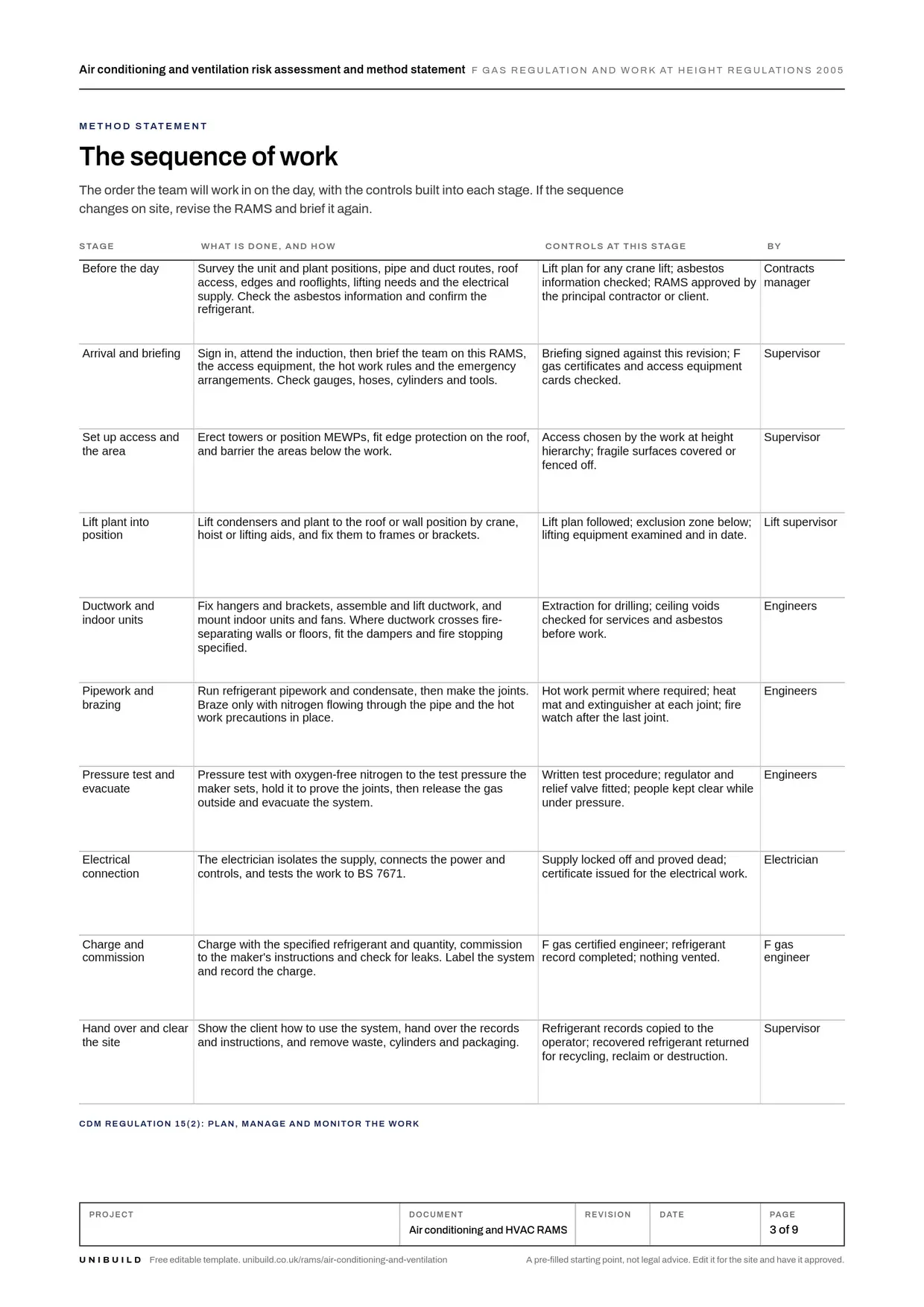
Air conditioning method statement: the sequence of work
The order of work, with the controls at each stageThe order the team works in, with the controls built into each stage. If the sequence changes on site, revise the RAMS and brief it again.
Before the day
Survey the unit and plant positions, pipe and duct routes, roof access, edges and rooflights, lifting needs and the electrical supply. Check the asbestos information and confirm the refrigerant.
ControlsLift plan for any crane lift; asbestos information checked; RAMS approved by the principal contractor or client.
Arrival and briefing
Sign in, attend the induction, then brief the team on this RAMS, the access equipment, the hot work rules and the emergency arrangements. Check gauges, hoses, cylinders and tools.
ControlsBriefing signed against this revision; F gas certificates and access equipment cards checked.
Set up access and the area
Erect towers or position MEWPs, fit edge protection on the roof, and barrier the areas below the work.
ControlsAccess chosen by the work at height hierarchy; fragile surfaces covered or fenced off.
Lift plant into position
Lift condensers and plant to the roof or wall position by crane, hoist or lifting aids, and fix them to frames or brackets.
ControlsLift plan followed; exclusion zone below; lifting equipment examined and in date.
Ductwork and indoor units
Fix hangers and brackets, assemble and lift ductwork, and mount indoor units and fans. Where ductwork crosses fire-separating walls or floors, fit the dampers and fire stopping specified.
ControlsExtraction for drilling; ceiling voids checked for services and asbestos before work.
Pipework and brazing
Run refrigerant pipework and condensate, then make the joints. Braze only with nitrogen flowing through the pipe and the hot work precautions in place.
ControlsHot work permit where required; heat mat and extinguisher at each joint; fire watch after the last joint.
Pressure test and evacuate
Pressure test with oxygen-free nitrogen to the test pressure the maker sets, hold it to prove the joints, then release the gas outside and evacuate the system.
ControlsWritten test procedure; regulator and relief valve fitted; people kept clear while under pressure.
Electrical connection
The electrician isolates the supply, connects the power and controls, and tests the work to BS 7671.
ControlsSupply locked off and proved dead; certificate issued for the electrical work.
Charge and commission
Charge with the specified refrigerant and quantity, commission to the maker's instructions and check for leaks. Label the system and record the charge.
ControlsF gas certified engineer; refrigerant record completed; nothing vented.
Hand over and clear the site
Show the client how to use the system, hand over the records and instructions, and remove waste, cylinders and packaging.
ControlsRefrigerant records copied to the operator; recovered refrigerant returned for recycling, reclaim or destruction.
What the law asks for air conditioning and HVAC work
Checked against the sourceNo venting of refrigerant
Releasing F gas to the atmosphere on purpose is prohibited where it is not technically necessary. Precautions must be taken to prevent leaks, and leaks that are found must be repaired.
Regulation (EU) No 517/2014 as it applies in Great Britain, article 3Recovery by certified people
Operators of stationary equipment must make sure refrigerant is recovered by people holding the relevant certificates, so that it is recycled, reclaimed or destroyed. Government guidance is that working with F gas without the correct qualifications is against the law.
Regulation (EU) No 517/2014 as it applies in Great Britain, article 8Leak checks and records
Equipment holding 5 tonnes of CO2 equivalent or more is leak checked, at least every 12 months at the lowest band. Hermetically sealed equipment under 10 tonnes is exempt if labelled. Operators keep records for that equipment, including gas added and recovered, for at least five years.
Regulation (EU) No 517/2014 as it applies in Great Britain, articles 4 and 6Work at height
Work is not done at height where it is reasonably practicable to do it safely otherwise. Where it is, suitable and sufficient measures must prevent, so far as is reasonably practicable, a fall liable to cause injury.
Work at Height Regulations 2005, regulation 6Fragile surfaces
Nobody works on or passes across or near a fragile surface where it is reasonably practicable to work safely without it. Where it is not, platforms, coverings or guard-rails are provided, and warning notices are fixed at the approach.
Work at Height Regulations 2005, regulation 9Lifting plant
Every lifting operation involving lifting equipment is properly planned by a competent person, appropriately supervised and carried out in a safe manner.
Lifting Operations and Lifting Equipment Regulations 1998, regulation 8Competence, equipment and PPE
Competence and cards
- Refrigerant engineers An F gas certificate for the category of work, held by each person who handles refrigerant.
- The company F gas company certification where the work is done for other businesses, renewed every 3 years.
- Electrical connection A competent electrician working to BS 7671.
- Lifting A competent person plans each lift, with a trained crew and a supervisor on the day.
- Access equipment PASMA training for mobile towers and IPAF for MEWPs.
- Asbestos Asbestos awareness training for everyone liable to disturb it.
Plant and equipment
- Refrigerant gauges and hoses Checked for damage and leaks before use.
- Recovery machine and cylinders Checked before use; cylinders in test date and not overfilled.
- Nitrogen cylinder, regulator and relief valve Regulator and relief valve checked before each test.
- Brazing torch and gas Hoses and valves checked before use; cylinders upright and secured.
- Vacuum pump and leak detector Checked before use and calibrated where the maker requires.
- Towers, MEWPs and lifting gear Pre-use checks; thorough examination reports in date.
PPE
- Gloves suited to refrigerant handling, and cut-resistant for sheet metal ductwork.
- Eye protection for refrigerant connections, drilling and overhead work, and brazing goggles with a suitable filter.
- RPE FFP3 mask, face-fit tested, for drilling dust and dusty ceiling voids.
- Harness where work restraint is used on a roof, and in a boom MEWP basket.
- Safety boots with toe protection.
- Safety helmet and high-visibility clothing to the site standard.
Permits and plans
A hot work permit for brazing where the site or building owner requires one, with the fire watch it sets. A lift plan for any crane lift of roof plant. A permit to work where the client's rules require one, for example for roof access or for isolating building services.
Emergency and rescue
For a large refrigerant leak, leave and ventilate the area, and keep ignition sources away if the refrigerant is flammable. For refrigerant on the skin or in the eyes, follow the first aid on the safety data sheet and get medical help. Rescue plan for anyone stranded at height. First aider and kit on site, and the nearest accident and emergency department named on the briefing.
Toolbox talk: air conditioning safety
Read this to the team before work starts, tick each point as it is covered, and record who attended.
- Only F gas certified engineers connect to, charge or recover from the refrigerant circuit. Nobody vents refrigerant, ever.
- Read the label before you start. If the refrigerant is flammable, no flames or sparks near the work until it is recovered.
- No brazing until the refrigerant is out and the hot work precautions are in place. Check the void and the far side of the wall afterwards.
- Pressure tests use nitrogen through a regulator. Stand clear while it is under pressure, and never use oxygen.
- Towers, podiums or MEWPs for work at height. Ladders only for short, light jobs, and nobody near a roof edge without protection.
- The supply is locked off and proved dead before any cover comes off a unit. If it is not locked off, treat it as live.
Ask the team
- What refrigerant is in this system, and is it flammable?
- Where are the fragile rooflights and unprotected edges on this roof?
- Where is the extinguisher for brazing, and who is on fire watch?
What is in the air conditioning RAMS template
9 pages, pre-filled and editableThe work, pre-filled
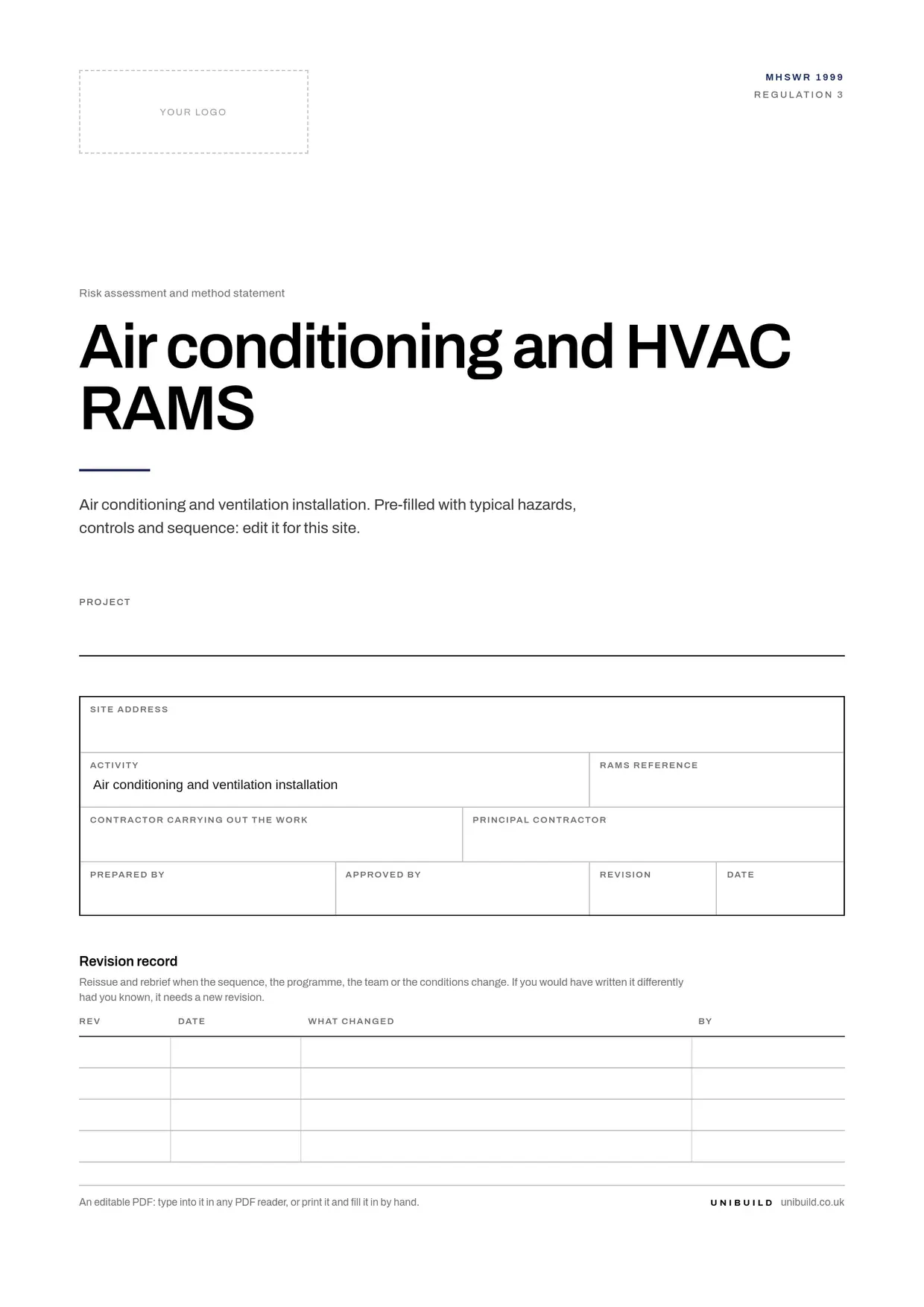
Scope, location and access, interfaces with other trades, the documents the RAMS relies on, and the team with their F gas certificates.
The sequence of work
Ten stages from survey to handover, with the controls and the person responsible at each one.
Hazards and controls
Eighteen air conditioning and ventilation hazards rated before and after controls on a five by five matrix, with room for your own.
Plant, PPE and permits
The equipment and its checks, PPE by type, the substances used, and the permits and lift plan the job needs.
Refrigerant record
A page to log each system: the refrigerant, the pressure test, gas added or recovered, and the certified engineer.
Emergency and briefing
What to do after a refrigerant leak or a fall, the environment section, and twenty signatures against the revision.
Brief it, and get it signed on the phone
On Unibuild a RAMS is written from a template, approved, then read by each operative on their phone in their own language and signed. Subcontract and agency workers sign through a link, with no app to install.
Every signature carries its date and time and prints as the last page of the RAMS PDF. Change the RAMS and it has to be signed again.
How RAMS work on UnibuildAir conditioning RAMS questions
Is this air conditioning risk assessment template free?
What should an air conditioning RAMS include?
Is an HVAC risk assessment a legal requirement?
Do air conditioning engineers need F gas certification?
Can I use this as a ventilation or ductwork risk assessment?
How often does air conditioning need a leak check?
Do the pressure systems rules apply to air conditioning?
What are the main hazards of air conditioning installation?
RAMS templates for other trades and hazards
All free, pre-filled and editableBy trade
- Air conditioning and HVAC RAMS
- Bricklaying RAMS
- Carpentry and joinery RAMS
- CCTV installation RAMS
- Cleaning risk assessment
- Concrete works RAMS
- Demolition RAMS
- Drylining RAMS
- Electrical RAMS
- Facilities maintenance RAMS
- Fire alarm installation RAMS
- Glazing and window RAMS
- Groundworks RAMS
- Hot works and welding RAMS
- Insulation RAMS
- Landscaping and fencing RAMS
- Painting and decorating RAMS
- Pest control risk assessment
- Plastering and rendering RAMS
- Plumbing and heating RAMS
- Rail RAMS
- Refurbishment RAMS
- Roofing RAMS
- Rope access risk assessment
- Scaffolding RAMS
- Solar PV installation RAMS
- Steel erection RAMS
- Temporary works RAMS
- Tiling and flooring RAMS
- Tree surgery RAMS
By hazard
- Asbestos risk assessment
- Confined space risk assessment
- COSHH risk assessment
- Dust risk assessment
- Forklift and telehandler risk assessment
- Housekeeping risk assessment
- Lifting operations risk assessment
- Lone working risk assessment
- Manual handling risk assessment
- MEWP risk assessment
- Noise and vibration risk assessment
- Plant and excavator risk assessment
- Power tools risk assessment
- Traffic management risk assessment
- Working at height risk assessment
The blank RAMS template, the RAMS review checklist and every other free form are on Free downloads.
The RAMS, read and signed
before the work starts.
Unibuild keeps every RAMS with its versions, its approvals and each operative’s signature against the revision they read, for seven years, ready for the principal contractor or an auditor.