Free toolbox talk · Dust and silica

Dust and silica toolbox talk

A toolbox talk on construction dust, written to be read aloud in about seven minutes: what silica, wood and gypsum dust do to the lungs, water and on-tool extraction, masks and face fit, and why sweeping up dry is part of the problem. The last page is the attendance record.

PDF · 3 pages · 209 KB · Word 41 KB · Free to use and reuse · Terms

Law
COSHH Regulations 2002
Time to deliver
About seven minutes
Format
PDF and Word, with a sign-off sheet
Cost
Free, always

What this toolbox talk covers

This talk is for anyone who cuts, chases, drills, grinds, scabbles, sands or sweeps on site: concrete, block, brick, mortar, stone, paving, tiles, timber and plasterboard all make dust that harms the lungs. It takes about seven minutes to give and covers the three kinds of construction dust, the diseases they cause, the controls that keep dust out of the air, and the mask rules that only work if they are followed every time.

It is written to be read aloud, with the points a supervisor makes in the order they make them, two short lists of do and do not, and questions to put to the team so the talk is a conversation rather than a reading. The last page is the record: who gave it, who heard it and what was raised.

Silica dust is the biggest risk to construction workers after asbestos, and the amount that does harm is too small to see. The dust and silica risk assessment holds the full hazards and controls this talk briefs, and the silica dust COSHH guide covers the exposure limit, health surveillance and the paperwork behind it.

Checked against HSE guidance and legislation.gov.uk on .

Toolbox talk · About seven minutes

Dust and silica: the talk

Read it as written or in your own words. Tick each point as you make it. Stop for the questions.

Why it matters

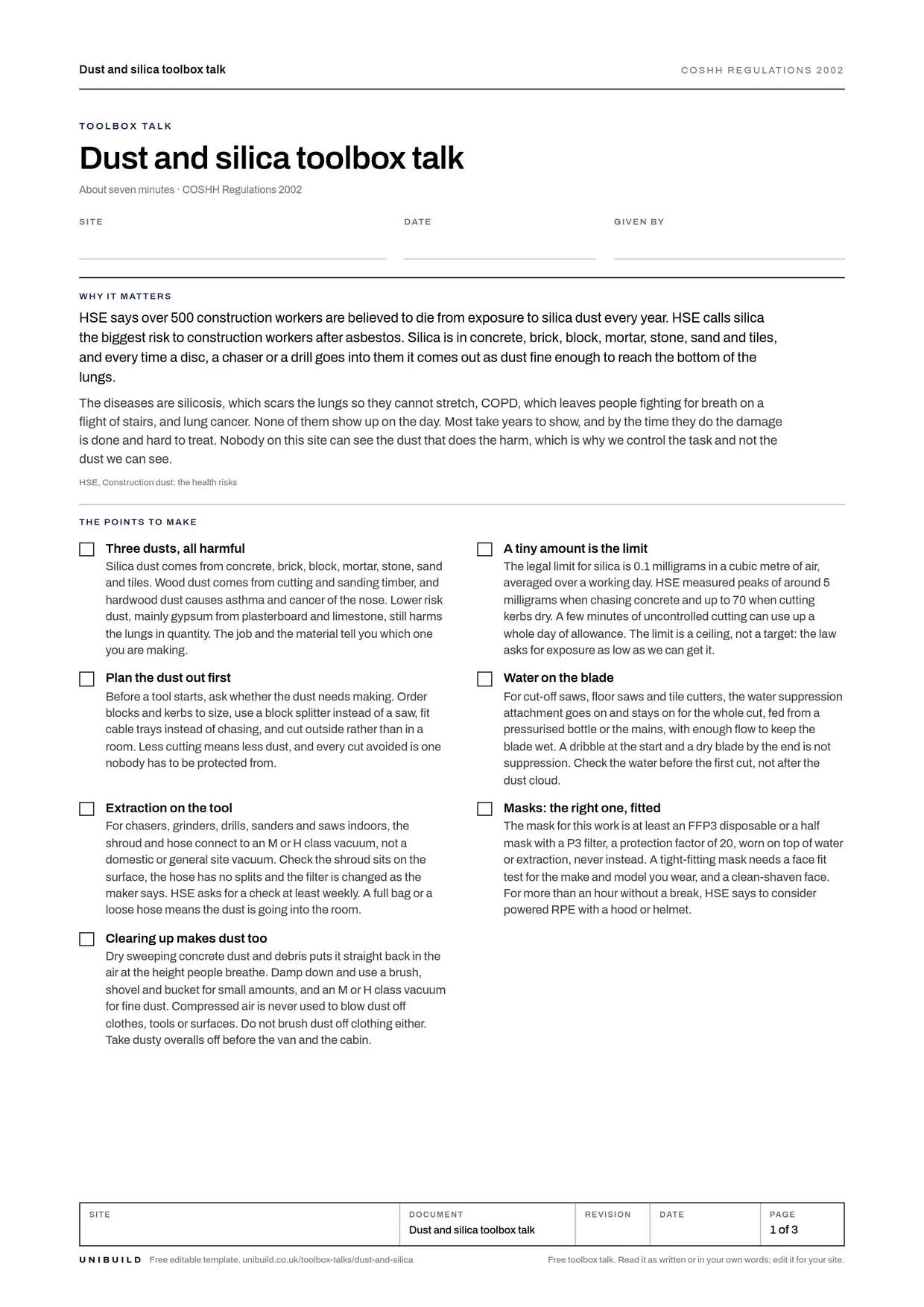
HSE says over 500 construction workers are believed to die from exposure to silica dust every year. HSE calls silica the biggest risk to construction workers after asbestos. Silica is in concrete, brick, block, mortar, stone, sand and tiles, and every time a disc, a chaser or a drill goes into them it comes out as dust fine enough to reach the bottom of the lungs.

The diseases are silicosis, which scars the lungs so they cannot stretch, COPD, which leaves people fighting for breath on a flight of stairs, and lung cancer. None of them show up on the day. Most take years to show, and by the time they do the damage is done and hard to treat. Nobody on this site can see the dust that does the harm, which is why we control the task and not the dust we can see.

HSE, Construction dust: the health risks

The points to make

Three dusts, all harmful

Silica dust comes from concrete, brick, block, mortar, stone, sand and tiles. Wood dust comes from cutting and sanding timber, and hardwood dust causes asthma and cancer of the nose. Lower risk dust, mainly gypsum from plasterboard and limestone, still harms the lungs in quantity. The job and the material tell you which one you are making.

A tiny amount is the limit

The legal limit for silica is 0.1 milligrams in a cubic metre of air, averaged over a working day. HSE measured peaks of around 5 milligrams when chasing concrete and up to 70 when cutting kerbs dry. A few minutes of uncontrolled cutting can use up a whole day of allowance. The limit is a ceiling, not a target: the law asks for exposure as low as we can get it.

Plan the dust out first

Before a tool starts, ask whether the dust needs making. Order blocks and kerbs to size, use a block splitter instead of a saw, fit cable trays instead of chasing, and cut outside rather than in a room. Less cutting means less dust, and every cut avoided is one nobody has to be protected from.

Water on the blade

For cut-off saws, floor saws and tile cutters, the water suppression attachment goes on and stays on for the whole cut, fed from a pressurised bottle or the mains, with enough flow to keep the blade wet. A dribble at the start and a dry blade by the end is not suppression. Check the water before the first cut, not after the dust cloud.

Extraction on the tool

For chasers, grinders, drills, sanders and saws indoors, the shroud and hose connect to an M or H class vacuum, not a domestic or general site vacuum. Check the shroud sits on the surface, the hose has no splits and the filter is changed as the maker says. HSE asks for a check at least weekly. A full bag or a loose hose means the dust is going into the room.

Masks: the right one, fitted

The mask for this work is at least an FFP3 disposable or a half mask with a P3 filter, a protection factor of 20, worn on top of water or extraction, never instead. A tight-fitting mask needs a face fit test for the make and model you wear, and a clean-shaven face. For more than an hour without a break, HSE says to consider powered RPE with a hood or helmet.

Clearing up makes dust too

Dry sweeping concrete dust and debris puts it straight back in the air at the height people breathe. Damp down and use a brush, shovel and bucket for small amounts, and an M or H class vacuum for fine dust. Compressed air is never used to blow dust off clothes, tools or surfaces. Do not brush dust off clothing either. Take dusty overalls off before the van and the cabin.

Do

  • Check the water feed or the extraction unit before the first cut, and stop if either fails.
  • Wear at least an FFP3 or a P3 half mask for dusty tasks, on top of water or extraction.
  • Come to work clean shaven if you wear a tight-fitting mask, and tell us if your fit test is out of date.
  • Cut outside, or screen the area off, so people nearby are not breathing the dust from your job.
  • Clean up with an M or H class vacuum or by damping down, and empty the vacuum where the dust will not blow about.
  • Tell us about coughing, wheezing or breathlessness that lasts, so health surveillance can pick it up early.

Do not

  • Do not cut concrete, stone, block, brick, kerbs or tiles dry. If the water or the extraction is not there, the cut waits.
  • Do not use a mask with a bent nose clip, a loose strap or stubble under the seal, and do not share one.
  • Do not sweep dry or blow dust off with compressed air, a leaf blower or a brush in an enclosed room.
  • Do not run a chaser or grinder with the shroud removed, even for a short cut in a corner.
  • Do not treat a short job as too small to matter: a few minutes dry can exceed a whole day of allowance.
  • Do not eat, drink or smoke where silica dust is in the air, and wash before breaks.

Ask the team

  • Which tasks on this site today make silica dust, and what is on each tool to control it?
  • Where is the water coming from for the cut-off saw, and who checks it before the cut?
  • Which vacuum do we use for the chaser, and when was its filter last changed?
  • Who here has a face fit test for the mask they are wearing today, and for which model?
  • How are we clearing up at the end of the shift, and where does the dust go?

To close

Nobody chooses to lose their breath. People get silicosis because the water bottle was empty, the hose was in the van, the mask was the wrong one or the clearing up was done with a broom. The dust that does the harm cannot be seen, so we judge the control, not the cloud. If the water or the extraction is not working, stop, ask, and we will sort it.

Record it. Who gave the talk, where, when, who was there and what was raised. The last page of the sheet is the record.

In Unibuild a talk is read in each operative’s own language and signed on the phone. How toolbox talks work

The law behind this talk

Checked against the source

Assess the risk before the work starts

An employer does not carry out work liable to expose employees to a substance hazardous to health unless a suitable and sufficient assessment of the risk to health has been made and the steps needed to control it have been put in place. The assessment covers the substance and its hazards, the level, type and duration of exposure, the workplace exposure limit, the effectiveness of the controls and the results of any monitoring or health surveillance. It is reviewed when it is no longer valid or the work changes.

COSHH Regulations 2002, regulation 6

Prevent, then control, with PPE last

Exposure is prevented or, where that is not reasonably practicable, adequately controlled. Where prevention is not possible the employer applies protection in order: design of the process and engineering controls, control at source including ventilation, and only then personal protective equipment. Control is adequate only where the principles of good practice are applied, the workplace exposure limit is not exceeded and, for a carcinogen such as respirable crystalline silica, exposure is reduced to as low a level as is reasonably practicable.

COSHH Regulations 2002, regulation 7(1), 7(3) and 7(7)

Keep the controls working

Plant, equipment and engineering controls are maintained in an efficient state, in efficient working order, in good repair and in a clean condition. Local exhaust ventilation is thoroughly examined and tested at least once every 14 months, non-disposable respiratory protective equipment at suitable intervals, and the records are kept for at least five years. Personal protective equipment is stored properly, checked regularly and replaced when defective.

COSHH Regulations 2002, regulation 9

Tell people what they are breathing

Employees liable to be exposed are given suitable and sufficient information, instruction and training, including the names of the substances, the risks to health, the exposure limits, the significant findings of the risk assessment, the precautions to take, the results of any exposure monitoring and the collective results of health surveillance. The training is adapted when the work or the methods change. A toolbox talk delivers part of that duty and the attendance record is evidence it was done.

COSHH Regulations 2002, regulation 12

What is on the sheet

3 pages, the talk and the record

The talk, over two pages

Why it matters, the points to make, do and do not, and the questions to ask, laid out to read from in the cabin or at the workface. Space at the top for the site, the date and who is giving it.

The last page, the record

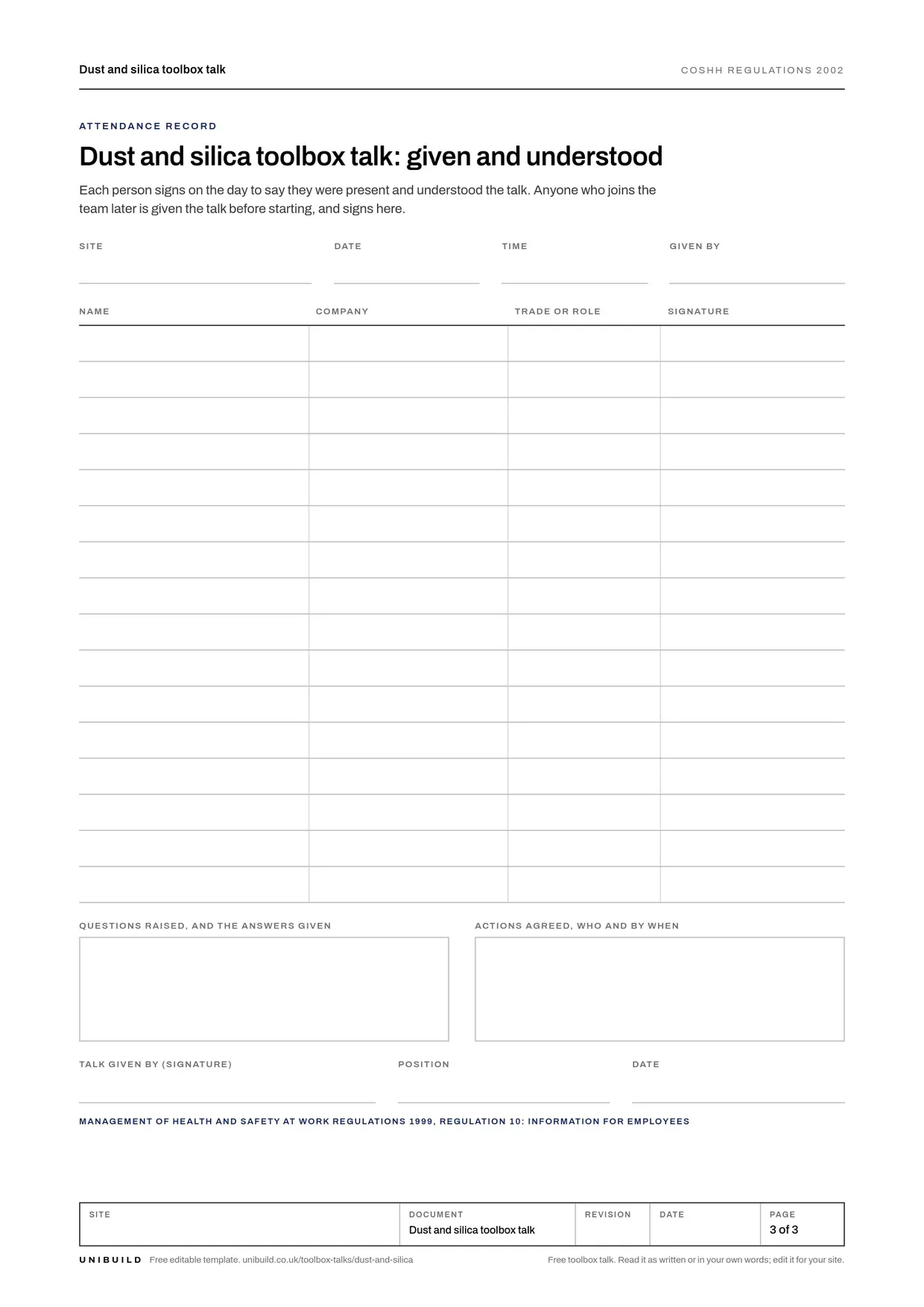
The attendance record: each person's name, company and signature, the questions raised and any actions, signed off by the person who gave the talk. Type into it or print it and pass it round.

The Word version

The same talk as a Word document, so you can put your own letterhead on it, add a site photograph or change a point to match how your job is set up.

Download the talk as PDF Word versionPDF · 3 pages · 209 KB
After it is given

Delivered on the phone, signed in the room

On Unibuild a toolbox talk is picked from the library, read by each operative on their own phone in their own language and signed there and then. The record is filed against the operative, the site and the date.

A site manager sees who has had which talk, and who has not, without a sheet going round on Thursday.

How toolbox talks work on Unibuild
How long should a dust and silica toolbox talk be?
About five to ten minutes. This one reads in about seven if you make every point and stop for the questions. It is a briefing, not a COSHH course. Training on specific tools, extraction units and masks is separate and is recorded in the training matrix.
Is the silica exposure limit really that low?
Yes. EH40 sets the workplace exposure limit for respirable crystalline silica at 0.1 mg/m³ averaged over eight hours. HSE measured peaks around 5 mg/m³ when chasing concrete and up to 70 mg/m³ cutting kerbs dry, so a short job without controls can pass a day of allowance in minutes.
Is a dust mask enough on its own?
No. COSHH puts personal protective equipment last. Water suppression or on-tool extraction controls the dust at source, and the mask covers what gets past. HSE asks for a mask with a protection factor of 20, an FFP3 disposable or a half mask with a P3 filter, on top of those controls for most cutting, chasing and grinding.
Who needs a face fit test, and how often?
Anyone who wears a tight-fitting mask, including a disposable FFP3, needs a fit test for each make and model they wear, with a clean-shaven face. HSE guidance INDG479 asks for a repeat test when the wearer changes mask, or when their face changes through weight, dental work or scarring.
Can we still dry cut if the job is small?
Short jobs produce the same peaks as long ones. HSE treats dry cutting of concrete, stone, brick, block and paving as high risk however brief, and asks for water or extraction every time. HSE says that anyone relying on a mask alone for a high risk task may be asked to justify why, so that is a decision for the risk assessment, not for the person holding the saw.
How often should we give this talk?
The law does not set an interval. Give it when a team starts cutting, chasing or demolition work on a job, when the material or the tools change, after anyone is seen working without controls, and as part of a rolling programme so no topic goes more than a few months without a refresh. Record each delivery.
Who can deliver a toolbox talk on dust?
A supervisor, site manager or a competent member of the team who knows the tasks, the kit and the masks in use. The person delivering it should be able to say where the water and the extraction units are and who holds the fit test records. If they cannot, they bring someone who can.
Do we have to keep a record of the talk?
COSHH regulation 12 requires information, instruction and training, and most principal contractors and auditors ask for the evidence. A signed attendance record, with the date and the topic, is that evidence. The last page of the sheet is the record.
Is this dust and silica toolbox talk free?
Yes. Download it, print it, give it, edit it and put your own name on it, including on paid work and for clients, with no sign-up and no email address.
Next step

The talk given, understood
and on record.

Unibuild keeps every toolbox talk against the operative who signed it, the site and the date, for seven years, ready for the principal contractor or an auditor.