
Excavations: the talk
Read it as written or in your own words. Tick each point as you make it. Stop for the questions.
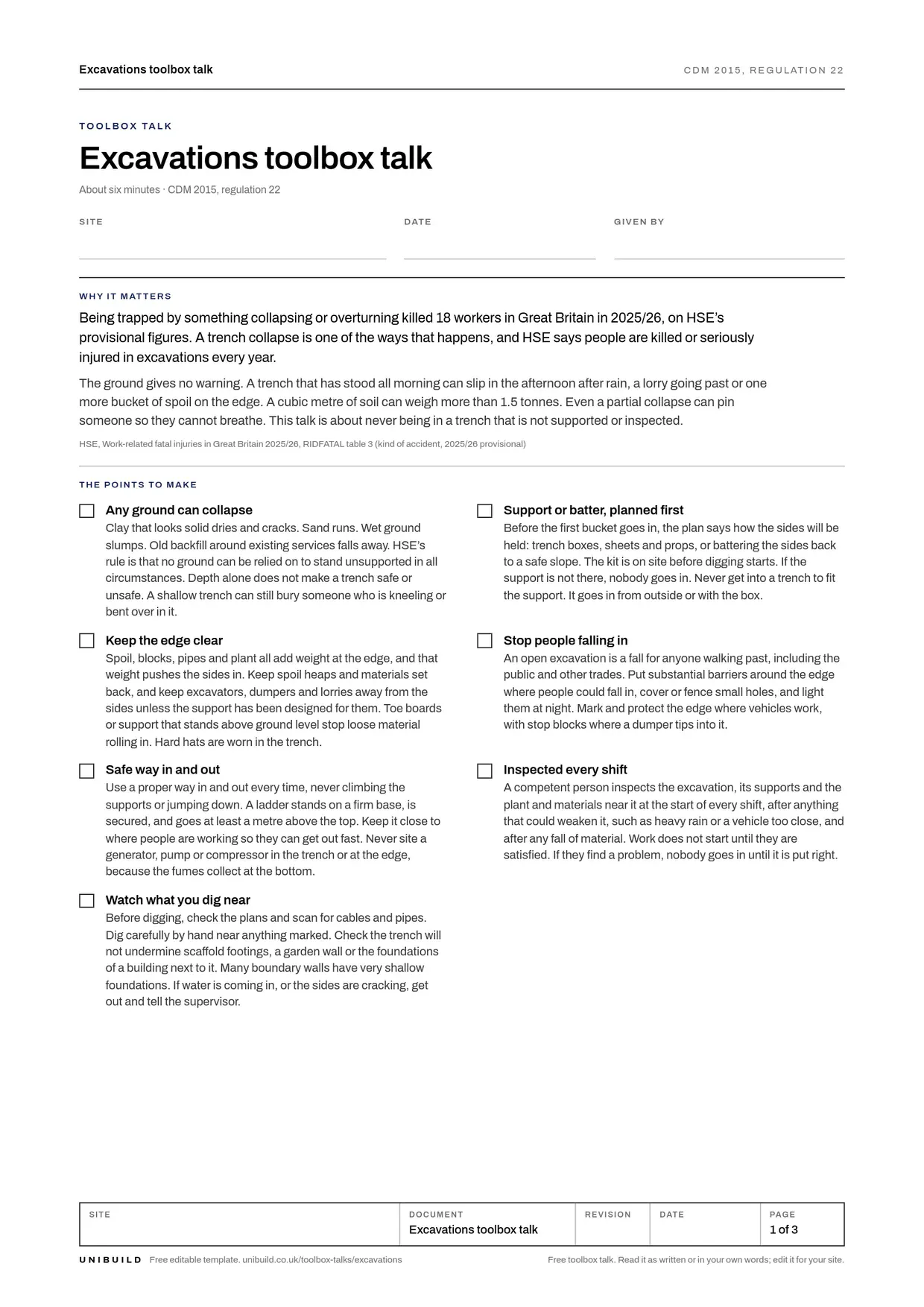
Why it matters
Being trapped by something collapsing or overturning killed 18 workers in Great Britain in 2025/26, on HSE’s provisional figures. A trench collapse is one of the ways that happens, and HSE says people are killed or seriously injured in excavations every year.
The ground gives no warning. A trench that has stood all morning can slip in the afternoon after rain, a lorry going past or one more bucket of spoil on the edge. A cubic metre of soil can weigh more than 1.5 tonnes. Even a partial collapse can pin someone so they cannot breathe. This talk is about never being in a trench that is not supported or inspected.
HSE, Work-related fatal injuries in Great Britain 2025/26, RIDFATAL table 3 (kind of accident, 2025/26 provisional)The points to make
Any ground can collapse
Clay that looks solid dries and cracks. Sand runs. Wet ground slumps. Old backfill around existing services falls away. HSE’s rule is that no ground can be relied on to stand unsupported in all circumstances. Depth alone does not make a trench safe or unsafe. A shallow trench can still bury someone who is kneeling or bent over in it.
Support or batter, planned first
Before the first bucket goes in, the plan says how the sides will be held: trench boxes, sheets and props, or battering the sides back to a safe slope. The kit is on site before digging starts. If the support is not there, nobody goes in. Never get into a trench to fit the support. It goes in from outside or with the box.
Keep the edge clear
Spoil, blocks, pipes and plant all add weight at the edge, and that weight pushes the sides in. Keep spoil heaps and materials set back, and keep excavators, dumpers and lorries away from the sides unless the support has been designed for them. Toe boards or support that stands above ground level stop loose material rolling in. Hard hats are worn in the trench.
Stop people falling in
An open excavation is a fall for anyone walking past, including the public and other trades. Put substantial barriers around the edge where people could fall in, cover or fence small holes, and light them at night. Mark and protect the edge where vehicles work, with stop blocks where a dumper tips into it.
Safe way in and out
Use a proper way in and out every time, never climbing the supports or jumping down. A ladder stands on a firm base, is secured, and goes at least a metre above the top. Keep it close to where people are working so they can get out fast. Never site a generator, pump or compressor in the trench or at the edge, because the fumes collect at the bottom.
Inspected every shift
A competent person inspects the excavation, its supports and the plant and materials near it at the start of every shift, after anything that could weaken it, such as heavy rain or a vehicle too close, and after any fall of material. Work does not start until they are satisfied. If they find a problem, nobody goes in until it is put right.
Watch what you dig near
Before digging, check the plans and scan for cables and pipes. Dig carefully by hand near anything marked. Check the trench will not undermine scaffold footings, a garden wall or the foundations of a building next to it. Many boundary walls have very shallow foundations. If water is coming in, or the sides are cracking, get out and tell the supervisor.
Do
- Check the support is in place and the excavation has been inspected before going in.
- Keep spoil, materials and plant set back from the edge.
- Use the ladder or steps provided, and keep them close to where you are working.
- Put barriers around open excavations and light them at night.
- Get out straight away if the sides crack, bulge, move or let water in.
- Scan for services and dig by hand near anything marked.
Do not
- Do not go into an unsupported trench that could collapse, even for a minute.
- Do not climb the supports or jump in and out.
- Do not park plant or vehicles near the edge unless the support is designed for it.
- Do not run engines in or beside an excavation where fumes can collect.
- Do not dig under walls, footings or slabs without checking first.
Ask the team
- What is holding the sides of each excavation on this job, and who decided?
- Who inspects the excavations at the start of the shift, and where is the record?
- Where does the spoil go, and how far is it from the edge?
- How do we get out of this trench fast if the side starts to go?
- What services are in the ground here, and how do we know?
To close
Most people who die in trench collapses had been in that trench before and it had been fine. The ground does not warn you. So the rules are simple: no support, nobody in. Keep the edge clear, use the ladder, keep the engines away, and do not start until it has been inspected this shift. If the ground starts to move, or water starts to come in, get out first and tell us after. We will make it safe before anyone goes back down.
Record it. Who gave the talk, where, when, who was there and what was raised. The last page of the sheet is the record.