
Hot works: the talk
Read it as written or in your own words. Tick each point as you make it. Stop for the questions.
Why it matters
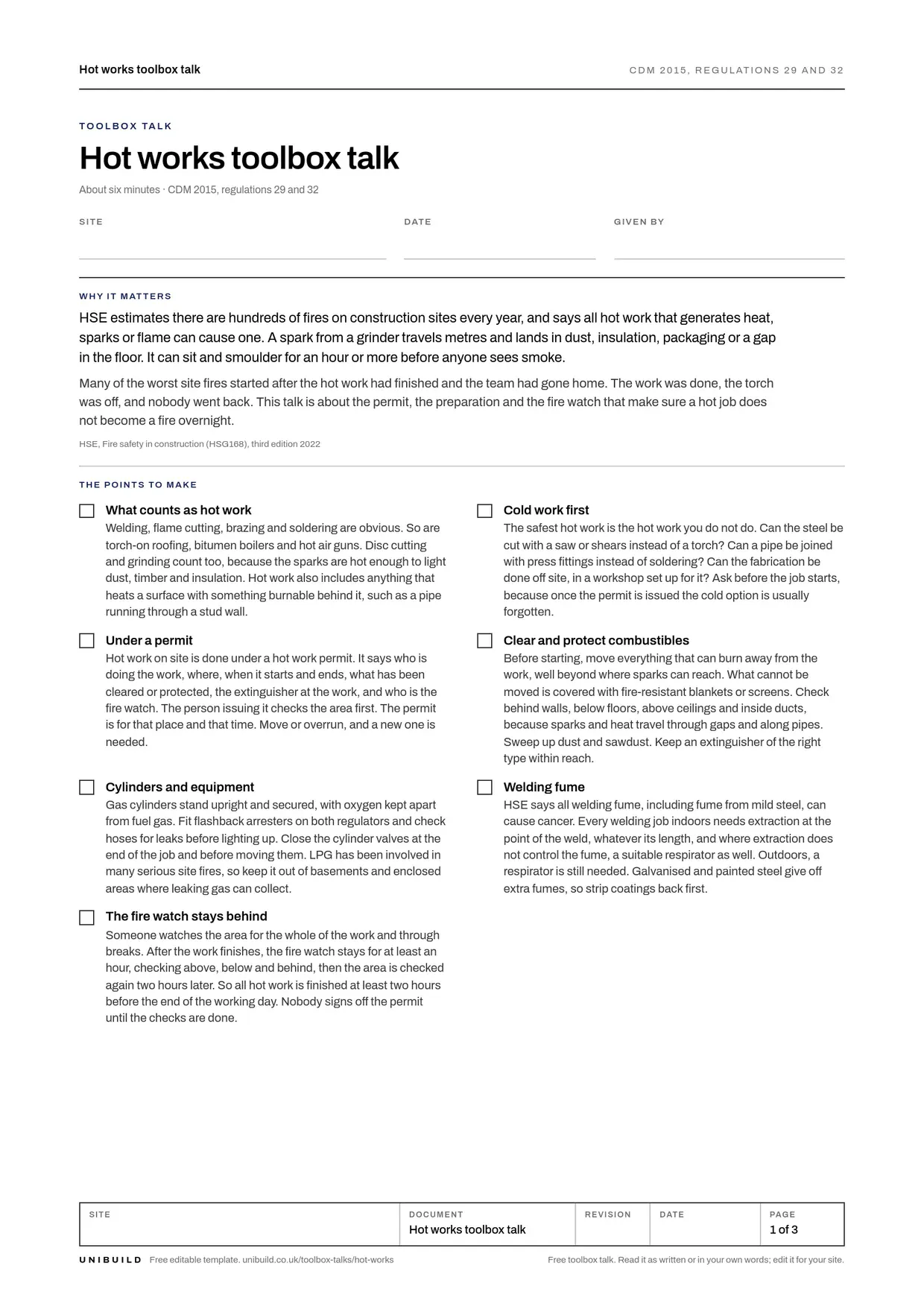
HSE estimates there are hundreds of fires on construction sites every year, and says all hot work that generates heat, sparks or flame can cause one. A spark from a grinder travels metres and lands in dust, insulation, packaging or a gap in the floor. It can sit and smoulder for an hour or more before anyone sees smoke.
Many of the worst site fires started after the hot work had finished and the team had gone home. The work was done, the torch was off, and nobody went back. This talk is about the permit, the preparation and the fire watch that make sure a hot job does not become a fire overnight.
HSE, Fire safety in construction (HSG168), third edition 2022The points to make
What counts as hot work
Welding, flame cutting, brazing and soldering are obvious. So are torch-on roofing, bitumen boilers and hot air guns. Disc cutting and grinding count too, because the sparks are hot enough to light dust, timber and insulation. Hot work also includes anything that heats a surface with something burnable behind it, such as a pipe running through a stud wall.
Cold work first
The safest hot work is the hot work you do not do. Can the steel be cut with a saw or shears instead of a torch? Can a pipe be joined with press fittings instead of soldering? Can the fabrication be done off site, in a workshop set up for it? Ask before the job starts, because once the permit is issued the cold option is usually forgotten.
Under a permit
Hot work on site is done under a hot work permit. It says who is doing the work, where, when it starts and ends, what has been cleared or protected, the extinguisher at the work, and who is the fire watch. The person issuing it checks the area first. The permit is for that place and that time. Move or overrun, and a new one is needed.
Clear and protect combustibles
Before starting, move everything that can burn away from the work, well beyond where sparks can reach. What cannot be moved is covered with fire-resistant blankets or screens. Check behind walls, below floors, above ceilings and inside ducts, because sparks and heat travel through gaps and along pipes. Sweep up dust and sawdust. Keep an extinguisher of the right type within reach.
Cylinders and equipment
Gas cylinders stand upright and secured, with oxygen kept apart from fuel gas. Fit flashback arresters on both regulators and check hoses for leaks before lighting up. Close the cylinder valves at the end of the job and before moving them. LPG has been involved in many serious site fires, so keep it out of basements and enclosed areas where leaking gas can collect.
Welding fume
HSE says all welding fume, including fume from mild steel, can cause cancer. Every welding job indoors needs extraction at the point of the weld, whatever its length, and where extraction does not control the fume, a suitable respirator as well. Outdoors, a respirator is still needed. Galvanised and painted steel give off extra fumes, so strip coatings back first.
The fire watch stays behind
Someone watches the area for the whole of the work and through breaks. After the work finishes, the fire watch stays for at least an hour, checking above, below and behind, then the area is checked again two hours later. So all hot work is finished at least two hours before the end of the working day. Nobody signs off the permit until the checks are done.
Do
- Ask whether the job can be done cold before planning hot work.
- Get the permit signed before any welding, cutting, grinding or torch work starts.
- Clear or cover combustibles, including behind walls and under floors.
- Keep the right extinguisher within reach of the work.
- Use extraction for every welding job, and a respirator where it is not enough.
- Keep the fire watch on for at least an hour after, and check again at two hours.
Do not
- Do not start hot work without a permit, a cleared area and an extinguisher.
- Do not leave hot work unattended, even for a short break.
- Do not carry on past the time or outside the area on the permit.
- Do not start hot work in the last two hours of the working day.
- Do not take gas cylinders into basements, voids or enclosed spaces.
- Do not weld or cut painted or galvanised steel without stripping it and controlling the fume.
Ask the team
- What hot work is planned on this job this week, and could any of it be done cold?
- Who issues the hot work permits here, and who is the fire watch?
- What is behind, above and below the area we are working in today?
- Where is the nearest extinguisher to the hot work, and is it the right type?
- How are we controlling welding fume on this job?
To close
Hot work starts many site fires, often after the team has left. Sparks hide in dust and insulation and smoulder before they flame. So do it cold if you can. If you cannot, get the permit, clear and cover, keep the extinguisher close, control the fume, and keep the fire watch on long after the torch is off. Finish early enough for the checks. A hot job done right ends with nothing burning.
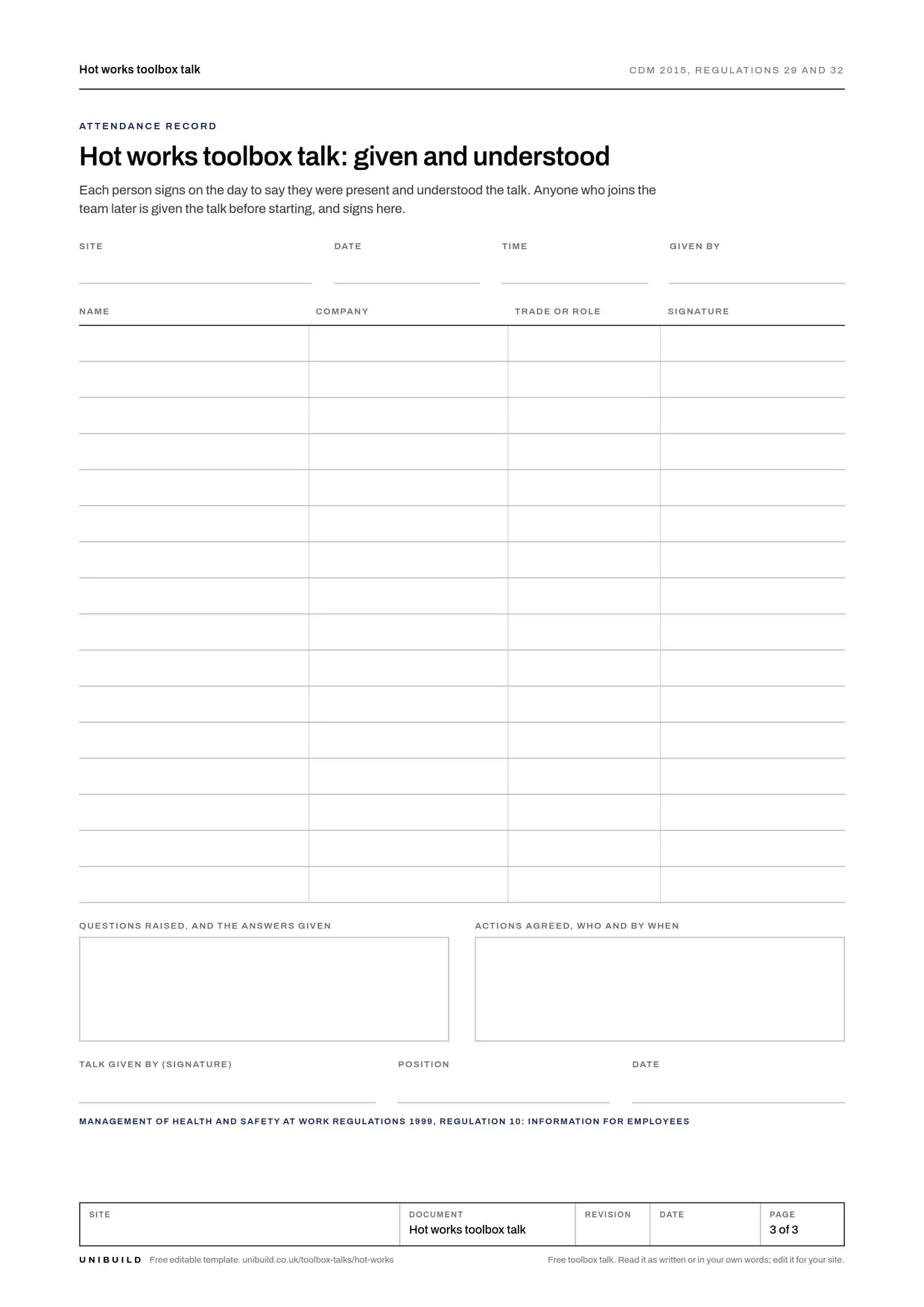
Record it. Who gave the talk, where, when, who was there and what was raised. The last page of the sheet is the record.