Free toolbox talk · First aid

First aid toolbox talk

A toolbox talk on first aid arrangements on site, written to be read aloud in about six minutes: who the first aiders are, where the kit is, the first steps in an emergency, bleeding, burns, eyes and breaks, calling 999 and recording every injury. The last page is the attendance record.

PDF · 3 pages · 208 KB · Word 41 KB · Free to use and reuse · Terms

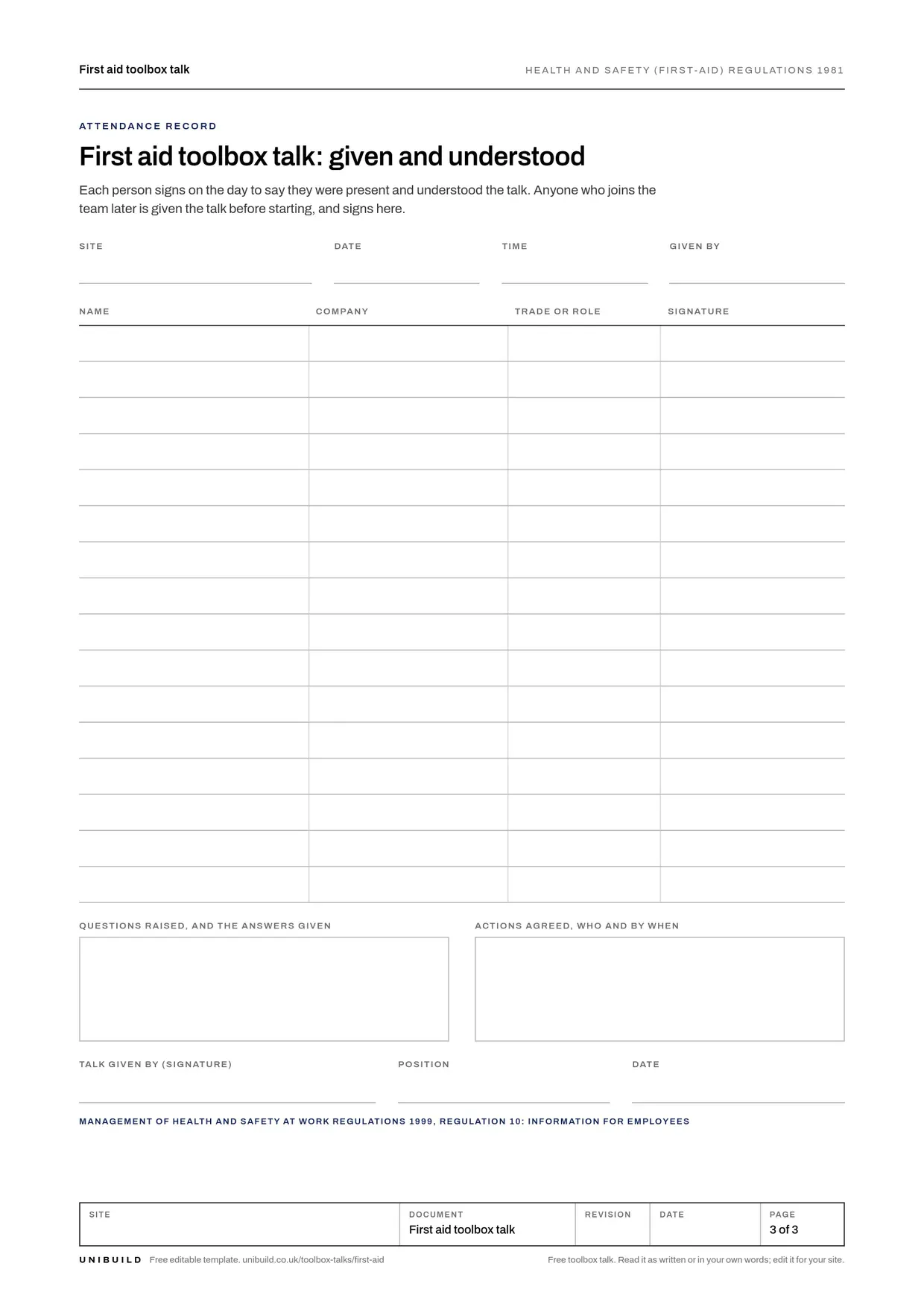
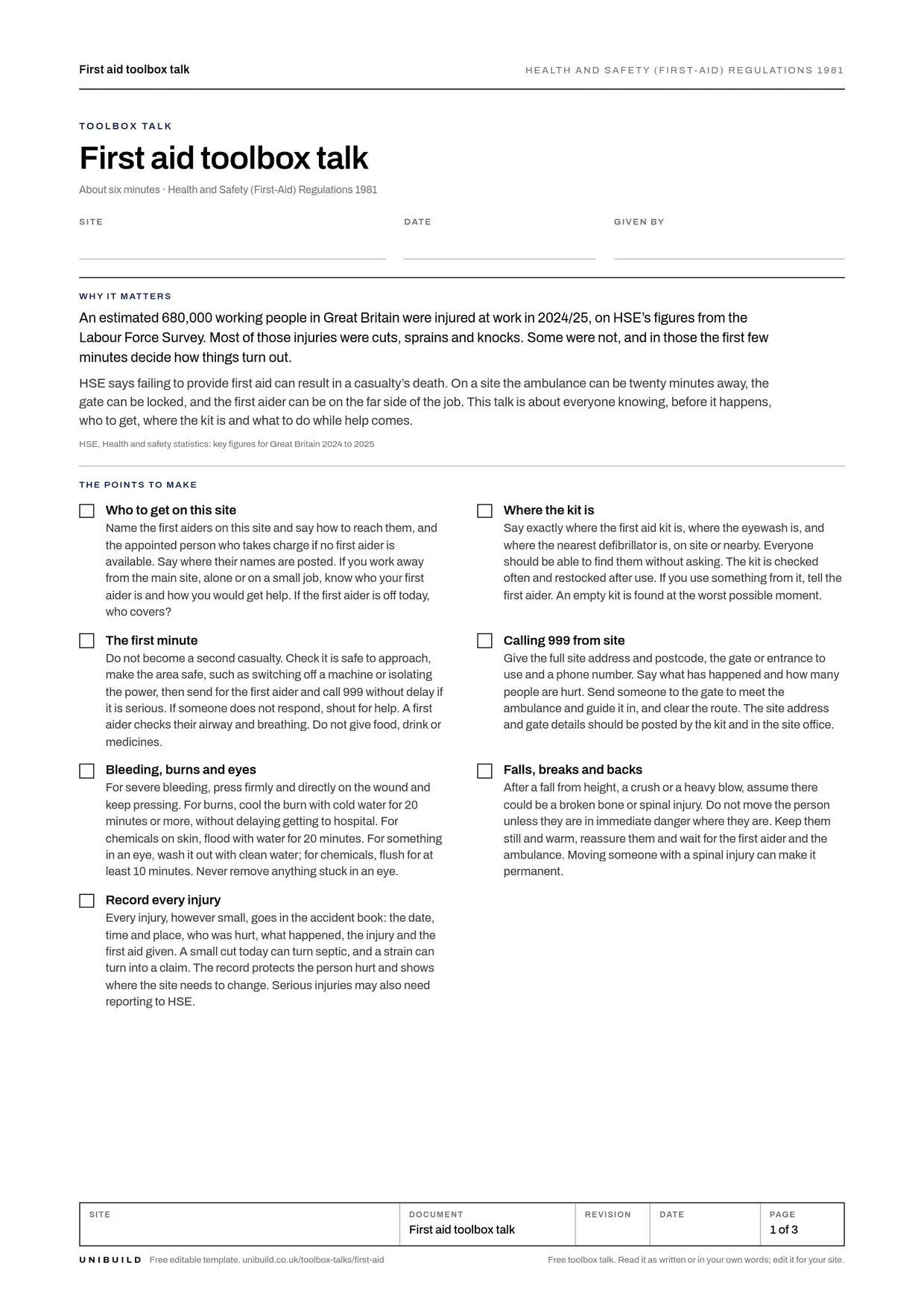
Attendance record page of the free first aid toolbox talk from Unibuild, where each person signs to say they were given the talk and understood itFront page of the free first aid toolbox talk from Unibuild
Law
Health and Safety (First-Aid) Regulations 1981
Time to deliver
About six minutes
Format
PDF and Word, with a sign-off sheet
Cost
Free, always

What this toolbox talk covers

This talk is for everyone on site, not just the first aiders. It takes about six minutes to give and covers who the first aiders and appointed person are on this site, where the first aid kit, eyewash and defibrillator are, what to do in the first minutes of an emergency, the basics for bleeding, burns, eye injuries and suspected breaks, calling 999 with the right directions, and recording every injury however small.

It is written to be read aloud, with the points in the order a supervisor makes them, short lists of do and do not, and questions that check everyone knows the arrangements on this site. It is not first aid training. The last page is the record: who gave it, who heard it and what was raised.

Fill in the names and locations for this site before giving the talk. The health and safety page covers the wider site arrangements.

Checked against HSE guidance and legislation.gov.uk on .

Toolbox talk · About six minutes

First aid: the talk

Read it as written or in your own words. Fill in the names and locations for this site. Tick each point as you make it.

Why it matters

An estimated 680,000 working people in Great Britain were injured at work in 2024/25, on HSE’s figures from the Labour Force Survey. Most of those injuries were cuts, sprains and knocks. Some were not, and in those the first few minutes decide how things turn out.

HSE says failing to provide first aid can result in a casualty’s death. On a site the ambulance can be twenty minutes away, the gate can be locked, and the first aider can be on the far side of the job. This talk is about everyone knowing, before it happens, who to get, where the kit is and what to do while help comes.

HSE, Health and safety statistics: key figures for Great Britain 2024 to 2025

The points to make

Who to get on this site

Name the first aiders on this site and say how to reach them, and the appointed person who takes charge if no first aider is available. Say where their names are posted. If you work away from the main site, alone or on a small job, know who your first aider is and how you would get help. If the first aider is off today, who covers?

Where the kit is

Say exactly where the first aid kit is, where the eyewash is, and where the nearest defibrillator is, on site or nearby. Everyone should be able to find them without asking. The kit is checked often and restocked after use. If you use something from it, tell the first aider. An empty kit is found at the worst possible moment.

The first minute

Do not become a second casualty. Check it is safe to approach, make the area safe, such as switching off a machine or isolating the power, then send for the first aider and call 999 without delay if it is serious. If someone does not respond, shout for help. A first aider checks their airway and breathing. Do not give food, drink or medicines.

Calling 999 from site

Give the full site address and postcode, the gate or entrance to use and a phone number. Say what has happened and how many people are hurt. Send someone to the gate to meet the ambulance and guide it in, and clear the route. The site address and gate details should be posted by the kit and in the site office.

Bleeding, burns and eyes

For severe bleeding, press firmly and directly on the wound and keep pressing. For burns, cool the burn with cold water for 20 minutes or more, without delaying getting to hospital. For chemicals on skin, flood with water for 20 minutes. For something in an eye, wash it out with clean water; for chemicals, flush for at least 10 minutes. Never remove anything stuck in an eye.

Falls, breaks and backs

After a fall from height, a crush or a heavy blow, assume there could be a broken bone or spinal injury. Do not move the person unless they are in immediate danger where they are. Keep them still and warm, reassure them and wait for the first aider and the ambulance. Moving someone with a spinal injury can make it permanent.

Record every injury

Every injury, however small, goes in the accident book: the date, time and place, who was hurt, what happened, the injury and the first aid given. A small cut today can turn septic, and a strain can turn into a claim. The record protects the person hurt and shows where the site needs to change. Serious injuries may also need reporting to HSE.

Do

  • Know the names of the first aiders on this site and how to reach them.
  • Know where the first aid kit, eyewash and nearest defibrillator are.
  • Make the area safe before you go to help.
  • Call 999 early for anything serious and send someone to meet the ambulance.
  • Tell the first aider when you use something from the kit.
  • Record every injury in the accident book.

Do not

  • Do not put yourself in danger to reach a casualty.
  • Do not move someone who may have a broken bone or spinal injury unless they are in danger.
  • Do not remove anything stuck in a wound or an eye.
  • Do not give a casualty food, drink or medicines.
  • Do not treat injuries beyond your training. Get the first aider.
  • Do not leave a minor injury unrecorded.

Ask the team

  • Who are the first aiders on this site today, and who covers when they are off?
  • Where is the first aid kit, where is the eyewash, and where is the nearest defibrillator?
  • What is the full address and postcode for this site, and which gate would an ambulance use?
  • What would you do first if you found someone unconscious on the floor next to a machine?
  • When did you last record an injury in the accident book?

To close

Most days the first aid kit is just a green box on the wall. On the day it matters, the minutes before the ambulance arrives are down to the people standing nearby. So know who the first aiders are and where the kit, the eyewash and the defibrillator are. Make it safe, get help, call 999 early and send someone to the gate. Do what you have been trained to do and no more. And record every injury, however small. That is how we look after each other.

Record it. Who gave the talk, where, when, who was there and what was raised. The last page of the sheet is the record.

In Unibuild a talk is read in each operative’s own language and signed on the phone. How toolbox talks work

The law behind this talk

Checked against the source

Equipment, facilities and first aiders

An employer provides such equipment and facilities as are adequate and appropriate in the circumstances for first aid to be given to employees who are injured or become ill at work, and such number of suitable persons, trained and qualified as appropriate, as is adequate and appropriate. Where that is adequate, a person appointed to take charge of the situation and the equipment may be provided instead.

Health and Safety (First-Aid) Regulations 1981, regulation 3

Telling employees the arrangements

An employer informs employees of the arrangements made for first aid, including the location of equipment, facilities and personnel.

Health and Safety (First-Aid) Regulations 1981, regulation 4

The accident book

An employer who normally employs 10 or more people at the same time on or about the same premises keeps readily accessible a means, in a book or electronically, by which an employee can record the particulars of any accident causing personal injury, and keeps every record for at least 3 years.

Social Security (Claims and Payments) Regulations 1979, regulation 25(3)

What is on the sheet

3 pages, the talk and the record

The talk, over two pages

Why it matters, the points to make, do and do not, and the questions to ask, laid out to read from in the cabin or at the workface. Space at the top for the site, the date and who is giving it.

The last page, the record

The attendance record: each person's name, company and signature, the questions raised and any actions, signed off by the person who gave the talk. Type into it or print it and pass it round.

The Word version

The same talk as a Word document, so you can put your own letterhead on it, add a site photograph or change a point to match how your job is set up.

Download the talk as PDF Word versionPDF · 3 pages · 208 KB
After it is given

Delivered on the phone, signed in the room

On Unibuild a toolbox talk is picked from the library, read by each operative on their own phone in their own language and signed there and then. The record is filed against the operative, the site and the date.

A site manager sees who has had which talk, and who has not, without a sheet going round on Thursday.

How toolbox talks work on Unibuild
How long should a first aid toolbox talk be?
About five to ten minutes. This one reads in about six if you make every point and stop for the questions. It tells everyone the arrangements on this site. It is not first aid training, which is given by a competent first aid training provider.
How many first aiders do we need on a construction site?
HSE says there are no hard and fast rules on numbers. The employer’s first aid needs assessment decides, taking account of the hazards, the number of people, how spread out the work is, shifts, and how far away emergency help is. Construction sites usually need trained first aiders because of the higher risks.
What is the difference between a first aider and an appointed person?
A first aider holds a valid certificate in first aid at work, emergency first aid at work, or other training suited to the circumstances. An appointed person takes charge of the first aid arrangements, looks after the kit and calls the emergency services, and does not need formal first aid training.
How long does a first aid certificate last?
HSE says first aid at work certificates last three years. First aiders requalify before the certificate expires, and HSE strongly recommends annual refresher training to keep skills up to date.
What should be in a site first aid kit?
The needs assessment decides. HSE gives guidance on minimum contents, and many sites use a kit to the British Standard for workplace first aid kits, with extra items such as eyewash, burns dressings, foil blankets and shears where the work calls for them. Kits are checked often and restocked after use.
Do we need a defibrillator on site?
The law does not name one. Where the needs assessment leads an employer to provide one, HSE says PUWER applies, with instructions on its use. Whether or not the site has one, everyone should know where the nearest public defibrillator is.
Do we have to keep an accident book?
An employer who normally has 10 or more people working at the same premises must keep an accident book, on paper or electronically, and keep entries for at least 3 years. HSE’s first aid guidance also recommends recording every incident a first aider deals with.
Do we have to keep a record of the talk?
There is no regulation that names toolbox talk records, but employers must tell employees the first aid arrangements, and most principal contractors and auditors ask for the evidence. A signed attendance record with the date and the topic is that evidence. The last page of the sheet is the record.
Is this first aid toolbox talk free?
Yes. Download it, print it, give it, edit it and put your own name on it, including on paid work and for clients, with no sign-up and no email address.
Next step

The talk given, understood
and on record.

Unibuild keeps every toolbox talk against the operative who signed it, the site and the date, for seven years, ready for the principal contractor or an auditor.

Get a quote
One figure per firm · For UK firms

Right, let’s talk numbers.

Five things about your business. We work your fee out properly and put it in writing the same working day.

What we build for you

  • Your own portalIn the browser, built around your firm
  • Your own appiOS and Android, under your name
  • Everyday AI includedHeavier AI at cost, nothing added
  • One platformEverything in one place, set up by us

Would you rather see it running first? Book a 30-minute demo

Quotation request