
Pest control risk assessment template
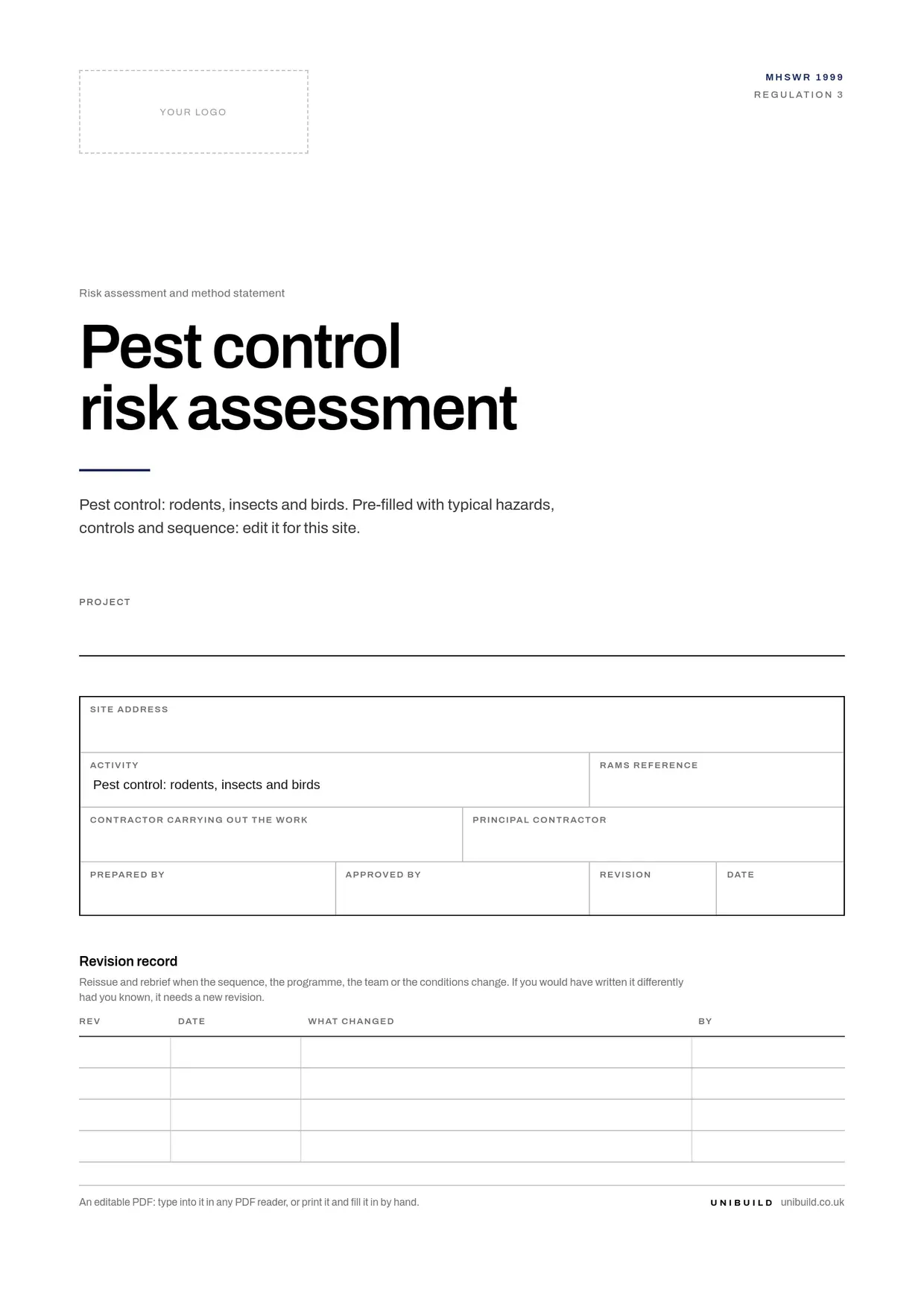
A pest control risk assessment and method statement, already filled in for rodenticides, insecticides, lofts and voids, bird work at height, disease from droppings and lone visits. Edit it for your job, then brief it.
- Law
- COSHH 2002 and GB biocides rules
- Rodenticides
- Stewardship regime for professionals
- Format
- Editable PDF and Word
- Cost
- Free, always
Do you need a risk assessment for pest control?
Yes. Every pest control business must assess the risks of its work, and a pest control risk assessment template saves writing the same hazards out for every visit. The record must be written down if you employ five or more people, and most clients ask for one before the first treatment.
The general duty is regulation 3 of the Management of Health and Safety at Work Regulations 1999. COSHH adds an assessment for the rodenticides and insecticides, and for the diseases carried in rat urine and bird droppings. Biocides must be used as their authorisation and label allow, and professional anticoagulant rodenticides come under a stewardship regime.
A pest control risk assessment should describe the premises in front of you: the pest, the treatment, where baits and traps go, who could reach them, and how lofts, voids and roofs are reached. A method statement then sets out the order of the visit and the follow-up.
Checked against legislation.gov.uk and HSE guidance on .
Pest control hazards and controls
17 hazards, rated before and after controlsThe significant hazards on a typical rodent, insect or bird control contract, with the controls a client or reviewer expects to see. Delete what does not apply and add what your job has.
Handling rodenticides
Technicians loading bait stations and handling blocks, pastes and grain baits.
- Only authorised products, used as the label allows, by technicians who meet the stewardship regime.
- Gloves worn for all bait handling; no eating, drinking or smoking until hands are washed.
- Baits carried and stored in their original, labelled containers in a locked store.
BeforeMedium 12AfterLow 4
Baits reaching people and other animals
Children, occupants, pets and wildlife who could reach or eat bait or poisoned rodents.
- Baits in secured, tamper-resistant stations, or placed where only the target pest can reach them, as the label requires.
- Every bait point recorded and checked at the interval set in the plan; carcasses searched for and removed.
- Baits removed at the end of the treatment unless the label and plan allow otherwise.
BeforeMedium 12AfterLow 4
Insecticide sprays and dusts
Technicians and occupants, from mist, vapour and dust inhaled or on the skin.
- Product and method chosen to suit the pest and the room; gels, baits and traps before sprays where they work.
- Room cleared of people, pets and exposed food; label re-entry time given to the occupant in writing.
- Gloves, eye protection and RPE as the label and COSHH assessment specify.
BeforeMedium 9AfterLow 3
Weil's disease from rat urine
Technicians working where rats are active, in voids, drains, bin stores and around water.
- Gloves worn; cuts and grazes covered with waterproof dressings before work.
- Hands washed before eating, drinking or smoking; breaks taken away from the work area.
- Flu-like illness after work in rat areas reported, and the doctor told about the work.
BeforeMedium 12AfterLow 4
Psittacosis and other disease from droppings
Technicians clearing droppings, nests and dead birds from roofs, lofts and ledges.
- Droppings damped down and removed with hand tools into sealed bags. Never pressure washed, which creates contaminated droplets.
- RPE with an assigned protection factor of 20, such as FFP3, face fit tested; disposable overalls and gloves.
- Sheeting to limit spread; hands washed and overalls bagged before leaving; no one with a weakened immune system on this task.
BeforeMedium 12AfterLow 4
Falls in lofts and through ceilings
Technicians baiting and inspecting in lofts, roof spaces and above suspended ceilings.
- Crawl boards laid across the joists; nobody steps between joists or onto plasterboard.
- Loft hatch ladder secured; lighting set up before work; the hatch guarded while open.
- Bait points placed so they can be checked from boarded areas.
BeforeMedium 12AfterLow 4
Cables, services and insulation in voids
Technicians in lofts and voids with chewed cables, hot pipes and loose fibres.
- Rodent damage to cables treated as live; damaged wiring left alone and reported to the client.
- Asbestos information checked in older buildings; suspect materials not disturbed.
- Long sleeves, gloves and FFP3 RPE where insulation or dust will be disturbed.
BeforeMedium 12AfterLow 4
Bird work at height
Technicians fitting nets, spikes and wires, and clearing nests on roofs, ledges and canopies.
- Work planned from a MEWP or tower where possible, operated by IPAF trained operators with a restraint lanyard in a boom.
- Roof work only with edge protection; fragile rooflights and sheets covered or kept off.
- Exclusion zone below for falling tools, fixings and debris.
BeforeHigh 15AfterMedium 5
Ladder work
Technicians reaching hatches, eaves, wasp nests and high bait points.
- Ladders only for light work of short duration; checked before use and footed or tied.
- Three points of contact; tools and products carried in a bag, not by hand.
BeforeMedium 12AfterMedium 8
Wasp and bee stings
Technicians treating nests, and occupants nearby, including anyone with a sting allergy.
- Bee suit, veil and gloves for nest treatments; occupants kept indoors with windows shut.
- Technicians asked about known allergies; no nest work at height without a safe working position.
- Honey bees referred to a beekeeper rather than treated.
BeforeMedium 12AfterLow 4
Needles and sharps
Technicians reaching into voids, bin stores, ducts and undergrowth.
- No blind reaching; torch and mirror used to look first.
- Needles picked up only with tongs into a sharps box, wearing puncture-resistant gloves.
- Wound encouraged to bleed, washed with soap and water, and urgent medical advice sought.
BeforeMedium 12AfterLow 4
Traps and rodent bites
Technicians setting and clearing traps, and handling live or dead rodents.
- Traps set with the setting tool or safety catch; placed in stations or where people and pets cannot reach them.
- Rodents and carcasses handled only in gloves, bagged and disposed of through the agreed route.
BeforeMedium 9AfterLow 3
Drains, sewers and manholes
Technicians inspecting and baiting drains and manholes.
- Baiting and inspection from the surface; no one enters a drain or manhole without a confined space assessment and a trained team.
- Open covers guarded; covers lifted with a lifter, not by hand.
BeforeMedium 10AfterMedium 5
Fumigation by others
Technicians, occupants and neighbours near a fumigation by a specialist contractor.
- Fumigation, including gassing of burrows, only by a specialist trained for that fumigant under its own RAMS; this team does not fumigate.
- No entry to the area until the fumigator has declared it clear and warning notices are removed.
BeforeMedium 10AfterMedium 5
Lone visits
Technicians working alone in empty buildings, lofts and outbuildings, or meeting hostile occupants.
- Lone work agreed in the risk assessment, with check-ins at arrival, at set times and on leaving, and action on a missed one.
- Someone told before entering a loft, void or roof; no MEWP or roof work alone.
- Technician leaves and reports any visit where they feel threatened.
BeforeMedium 12AfterMedium 8
Pesticides in the vehicle
Technicians and the public, from spills, theft or fire involving products in the van.
- Products in a secured, locked and ventilated compartment, separate from the cab, in their original containers.
- Spill kit carried; only the quantities needed for the day loaded.
BeforeMedium 8AfterLow 4
Manual handling
Technicians carrying ladders, sprayers, bait stations and bird proofing materials.
- Equipment carried in smaller loads; two people for long ladders and heavy rolls of netting.
- Kit staged near the work, with sprayers filled where they will be used.
BeforeMedium 6AfterLow 4
Scores are likelihood times severity on the five by five matrix in the template. They are typical ratings for this work, a starting point for your own assessment of your site.
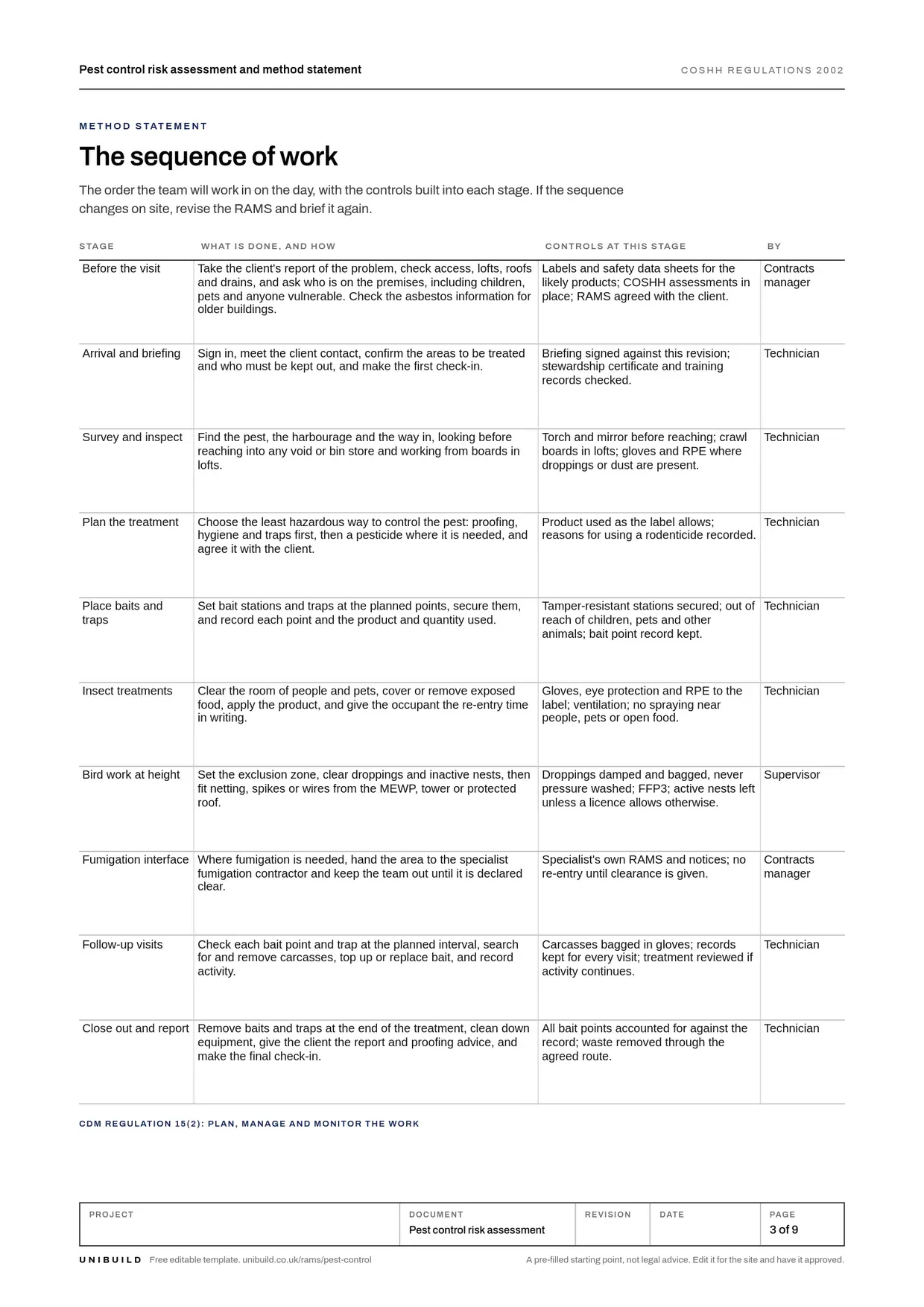
Pest control method statement: the sequence of work
The order of work, with the controls at each stageThe order a visit follows, with the controls built into each stage. If the treatment changes on site, revise the method statement and brief it again.
Before the visit
Take the client's report of the problem, check access, lofts, roofs and drains, and ask who is on the premises, including children, pets and anyone vulnerable. Check the asbestos information for older buildings.
ControlsLabels and safety data sheets for the likely products; COSHH assessments in place; RAMS agreed with the client.
Arrival and briefing
Sign in, meet the client contact, confirm the areas to be treated and who must be kept out, and make the first check-in.
ControlsBriefing signed against this revision; stewardship certificate and training records checked.
Survey and inspect
Find the pest, the harbourage and the way in, looking before reaching into any void or bin store and working from boards in lofts.
ControlsTorch and mirror before reaching; crawl boards in lofts; gloves and RPE where droppings or dust are present.
Plan the treatment
Choose the least hazardous way to control the pest: proofing, hygiene and traps first, then a pesticide where it is needed, and agree it with the client.
ControlsProduct used as the label allows; reasons for using a rodenticide recorded.
Place baits and traps
Set bait stations and traps at the planned points, secure them, and record each point and the product and quantity used.
ControlsTamper-resistant stations secured; out of reach of children, pets and other animals; bait point record kept.
Insect treatments
Clear the room of people and pets, cover or remove exposed food, apply the product, and give the occupant the re-entry time in writing.
ControlsGloves, eye protection and RPE to the label; ventilation; no spraying near people, pets or open food.
Bird work at height
Set the exclusion zone, clear droppings and inactive nests, then fit netting, spikes or wires from the MEWP, tower or protected roof.
ControlsDroppings damped and bagged, never pressure washed; FFP3; active nests left unless a licence allows otherwise.
Fumigation interface
Where fumigation is needed, hand the area to the specialist fumigation contractor and keep the team out until it is declared clear.
ControlsSpecialist's own RAMS and notices; no re-entry until clearance is given.
Follow-up visits
Check each bait point and trap at the planned interval, search for and remove carcasses, top up or replace bait, and record activity.
ControlsCarcasses bagged in gloves; records kept for every visit; treatment reviewed if activity continues.
Close out and report
Remove baits and traps at the end of the treatment, clean down equipment, give the client the report and proofing advice, and make the final check-in.
ControlsAll bait points accounted for against the record; waste removed through the agreed route.
What the law asks for pest control
Checked against the sourceRisk assessment
Every employer must make a suitable and sufficient assessment of the risks to their employees and to anyone else affected by the work, such as occupants and neighbours. With five or more employees, the significant findings are recorded.
Management of Health and Safety at Work Regulations 1999, regulation 3COSHH assessment
No work that could expose employees to a hazardous substance is carried out until the risk has been assessed. That covers the pesticides used, and the biological agents in rat urine and bird droppings. Exposure is prevented first, then controlled.
COSHH Regulations 2002, regulations 6 and 7Use biocides as authorised
Biocidal products, which include rodenticides and insecticides, are used in compliance with the terms and conditions of their authorisation and the labelling requirements. Proper use combines physical, biological and chemical measures, with biocides kept to the minimum necessary.
GB Biocidal Products Regulation, Article 17(5)Rodenticide stewardship
Professional users of anticoagulant rodenticides in the UK must follow one of the UK rodenticide stewardship regimes. The CRRU UK regime covers a code of best practice, training, certification, auditing and checks of competence at the point of sale.
HSE, RodenticidesWild birds and nests
It is an offence to intentionally kill, injure or take a wild bird, take, damage or destroy its nest while in use or being built, or take or destroy its eggs. Lethal control and nest removal rely on a licence; in England, general licences such as GL41 set the species and purposes.
Wildlife and Countryside Act 1981, section 1Fumigation notices
Fumigation with hydrogen cyanide, phosphine or methyl bromide needs 24 hours' notice to those in Schedule 9, such as the police and, for space fumigation of a building, the fire service. Open-air gassing of mammal pests needs no advance notice, but warning notices go at points of reasonable access.
COSHH Regulations 2002, regulation 14 and Schedule 9Competence, equipment and PPE
Competence and cards
- Technicians A recognised pest management qualification, and for professional anticoagulant rodenticides, a certificate approved under the stewardship regime.
- Supervisor Experienced technician able to review treatments, records and this RAMS, and act on a missed check-in.
- MEWP operators IPAF PAL card for the category of machine.
- Ladder users Trained in safe ladder use and pre-use checks.
- RPE wearers Face fit tested for tight-fitting masks, and clean shaven where the mask seals.
- Fumigation A specialist fumigation contractor only, under its own RAMS.
Plant and equipment
- Bait stations Tamper-resistant, lockable and secured; labelled with the product and contact.
- Sprayers and dusters Seals, hoses and nozzles checked; washed out after use away from drains.
- Ladders Pre-use check each day; detailed inspection on a set schedule.
- MEWP Pre-use check; thorough examination at least every 6 months.
- Vehicle product store Locked, ventilated and separate from the cab; spill kit stocked.
- Traps and setting tools Springs and catches checked; set only with the tool or catch.
PPE
- Gloves nitrile or as the label specifies for baits and pesticides; puncture-resistant for voids and waste.
- Respiratory protection FFP3 for droppings and loft dust; as the label specifies for sprays.
- Eye protection for spraying, dusting and overhead work.
- Disposable overalls for droppings, dusty voids and insecticide work.
- Bee suit and veil for wasp and bee nest treatments.
- Helmet and harness for MEWP and roof work, with a restraint lanyard in a boom.
Permits and plans
A permit to work where the client requires one, for example for roofs, plant rooms or restricted areas. A confined space entry permit before anyone enters a drain, manhole or similar space. A MEWP plan where the site rules ask for one. Fumigation is notified and permitted by the specialist contractor.
Emergency and rescue
First aider and first aid kit available, with eyewash. Anyone who may have swallowed bait or been exposed to a pesticide gets medical help at once, with the product label. Stings with signs of a severe allergic reaction mean calling 999. Needlestick injuries get urgent medical advice. Missed check-ins are acted on at once.
Toolbox talk: pest control safety
Read this to the team before work starts, tick each point as it is covered, and record who attended.
- Read the label before you use any product. It sets where, how and how much, and it is the law.
- Every bait point is secured, out of reach of children and pets, and written on the record. No exceptions.
- Gloves on for bait, traps, carcasses and droppings. Wash your hands before you eat, drink or smoke.
- Never pressure wash droppings. Damp them down, bag them, and wear your FFP3 mask.
- In lofts, stay on the boards. Look before you reach into any void, and treat chewed cables as live.
- If you get flu-like symptoms after a job, see your doctor and tell them about rats and birds at work.
Ask the team
- Who on these premises could reach a bait point, and how have we stopped them?
- Are there active nests here, and what are we allowed to do about them?
- Who do you call before you go into the loft, and when?
What is in the pest control risk assessment template
9 pages, pre-filled and editableThe work, pre-filled
Scope, location and access, interfaces with the client and occupants, the documents the RAMS relies on, and the team.
The sequence of work
Ten stages from the first call to closing out the treatment, with the controls and the person responsible at each one.
Hazards and controls
Seventeen pest control hazards rated before and after controls on a five by five matrix, with room for your own.
Equipment, PPE and products
Bait stations, sprayers, ladders and MEWPs with their checks, PPE by type, and the products with their COSHH references.
Bait point and treatment record
A page for each bait point and trap: where it is, the product and amount, when it was placed, checked and removed.
Emergency and briefing record
Poisoning, stings, needlestick injuries and missed check-ins, then twenty signatures against the revision.
Brief it, and get it signed on the phone
On Unibuild a RAMS is written from a template, approved, then read by each operative on their phone in their own language and signed. Subcontract and agency workers sign through a link, with no app to install.
Every signature carries its date and time and prints as the last page of the RAMS PDF. Change the RAMS and it has to be signed again.
How RAMS work on UnibuildPest control risk assessment questions
Is this pest control risk assessment template free?
What should a pest control risk assessment include?
Is a pest control risk assessment a legal requirement?
Do I need a COSHH assessment for rodenticides and insecticides?
What do I need to buy professional rodenticides?
Can pest controllers remove bird nests?
How do you protect against Weil's disease and psittacosis?
Does fumigation need its own risk assessment?
RAMS templates for other trades and hazards
All free, pre-filled and editableBy trade
- Air conditioning and HVAC RAMS
- Bricklaying RAMS
- Carpentry and joinery RAMS
- CCTV installation RAMS
- Cleaning risk assessment
- Concrete works RAMS
- Demolition RAMS
- Drylining RAMS
- Electrical RAMS
- Facilities maintenance RAMS
- Fire alarm installation RAMS
- Glazing and window RAMS
- Groundworks RAMS
- Hot works and welding RAMS
- Insulation RAMS
- Landscaping and fencing RAMS
- Painting and decorating RAMS
- Pest control risk assessment
- Plastering and rendering RAMS
- Plumbing and heating RAMS
- Rail RAMS
- Refurbishment RAMS
- Roofing RAMS
- Rope access risk assessment
- Scaffolding RAMS
- Solar PV installation RAMS
- Steel erection RAMS
- Temporary works RAMS
- Tiling and flooring RAMS
- Tree surgery RAMS
By hazard
- Asbestos risk assessment
- Confined space risk assessment
- COSHH risk assessment
- Dust risk assessment
- Forklift and telehandler risk assessment
- Housekeeping risk assessment
- Lifting operations risk assessment
- Lone working risk assessment
- Manual handling risk assessment
- MEWP risk assessment
- Noise and vibration risk assessment
- Plant and excavator risk assessment
- Power tools risk assessment
- Traffic management risk assessment
- Working at height risk assessment
The blank RAMS template, the RAMS review checklist and every other free form are on Free downloads.
The RAMS, read and signed
before the work starts.
Unibuild keeps every RAMS with its versions, its approvals and each operative’s signature against the revision they read, for seven years, ready for the principal contractor or an auditor.