
Housekeeping risk assessment template
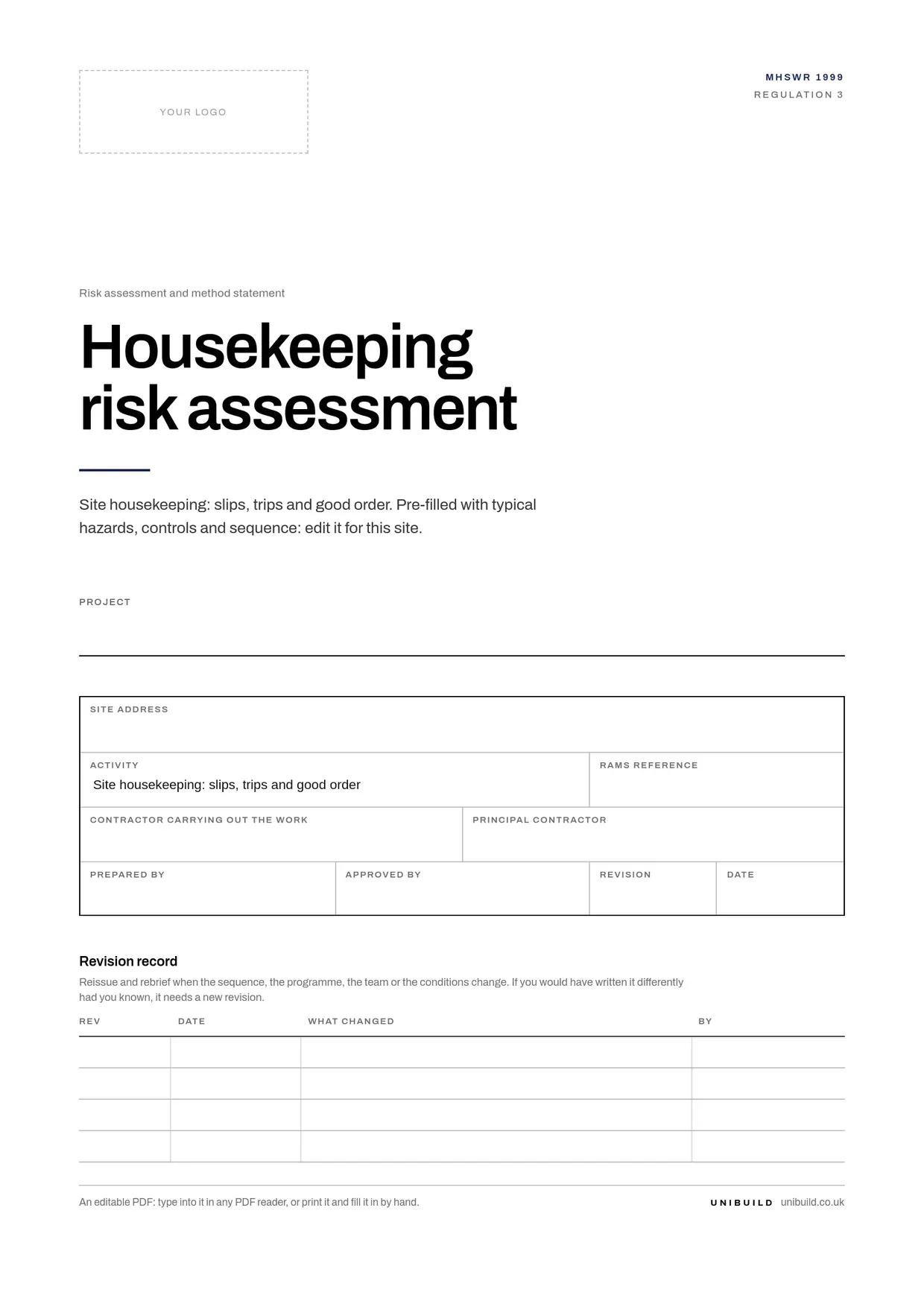
A housekeeping risk assessment for construction sites, already filled in for slips and trips on routes, stairs, stores and welfare areas, with a daily inspection page. Edit it for your site, then brief it.
- Law
- CDM 2015, regulation 18
- Applies to
- Every construction site
- Format
- Editable PDF and Word
- Cost
- Free, always
What is a housekeeping risk assessment?
A housekeeping risk assessment sets out how a construction site is kept tidy, clear and safe to walk, so people do not slip, trip or fall on the same level. It covers access routes, stored materials, waste, trailing cables, lighting, wet and icy ground, stairs and changes of level, and the welfare areas.
On a construction site the duty sits in Part 4 of CDM 2015. Regulation 18 requires each part of the site to be kept in good order, and the areas where work is going on in a reasonable state of cleanliness, so far as is reasonably practicable. Where construction work is the only activity, only a few of the Workplace Regulations 1992 apply.
HSE says several thousand construction workers are injured each year in a slip or trip on site, and around 1000 of those injuries involve broken bones or dislocated joints. Most could be avoided by managing working areas and access routes. This template, in PDF and Word, includes a daily housekeeping inspection.
Checked against legislation.gov.uk and HSE guidance on .
Housekeeping hazards and controls
16 hazards, rated before and after controlsA worked example of the significant slip and trip hazards on a construction site, with the controls a reviewer expects to see. Delete what does not apply and add what your site has.
Obstructed access routes and walkways
Anyone walking to and from the workface, especially when carrying, with materials or tools left in the way.
- Pedestrian routes marked out on the site layout plan and kept clear of materials, plant and waste at all times.
- Nothing set down on a route, even for a moment; deliveries taken straight to the storage area.
- Routes checked at the start of each shift and after any change in layout.
BeforeMedium 12AfterMedium 6
Uneven, rutted or muddy ground
Operatives and visitors crossing open ground between gates, cabins, stores and the building.
- Designated walkways with good conditions underfoot: levelled where rutted, stoned where muddy.
- Walkways separated from vehicle routes, so plant does not churn them up.
- Mechanical aids for unwieldy loads, so nobody carries anything that blocks the view of the ground ahead.
BeforeMedium 12AfterMedium 6
Materials stored in the wrong place
Anyone walking past stacks set down in corridors, on stairs or at the foot of ladders.
- Storage areas set out for each trade, close to where the materials are used and away from routes.
- Deliveries planned to keep the amount of material on site to what the next few days need.
- Stacks kept stable, level and within their footprint, with nothing leaning against walls across a route.
BeforeMedium 12AfterMedium 6
Offcuts, packaging and debris at the workface
The trade doing the work and the next trade in the area, tripping over waste left where it fell.
- Clean as you go: offcuts, banding and packaging bagged or binned as the work goes, not at the end of the week.
- Wheeled bins or bags at each work area, so nobody has to walk far to throw waste away.
- Each contractor clears its own waste, written into the order and the site rules.
BeforeMedium 12AfterMedium 6
Skips, chutes and waste areas
Labourers loading skips, and people walking near overfilled skips, chute outlets and waste bays.
- Waste areas marked on the layout plan, on firm ground, with clear access for loading and collection.
- Skips not filled above the sides; chutes enclosed at the bottom and the area below fenced off.
- In England and Wales, a skip on the highway only with the highway authority's permission, on its conditions.
BeforeMedium 9AfterMedium 6
Trailing cables and hoses
Anyone using corridors, stairs and doorways where extension leads and hoses cross the route.
- Cordless tools used wherever possible, so fewer cables are needed.
- Leads for temporary lighting and mains tools run at high level on hooks, especially along corridors.
- Where a cable or hose must cross a route at floor level, it goes under a cable protector and is kept short.
BeforeMedium 12AfterMedium 6
Wet floors, spills and slurry
Operatives on screeded, tiled or painted floors, and near mixing points, wash-outs and water leaks.
- Spills cleaned up at once and the area signed until it is dry.
- Mixing and wash-out points set away from routes, with drainage or a tray.
- Wet trades programmed so other trades are not sent across fresh screed or wet floors.
BeforeMedium 9AfterMedium 6
Ice, frost and snow
Everyone arriving early on winter mornings, on paths, ramps, scaffold boards and cabin steps.
- Grit and salt stocked before cold weather and spread on main routes, ramps and steps before the shift starts.
- Routes that cannot be treated closed and signed, with a treated alternative.
- Weather forecast checked the afternoon before, and early arrivals told which routes are safe.
BeforeMedium 9AfterMedium 6
Poor lighting
Anyone working early, late or inside the building, in basements, risers and stair cores.
- Temporary lighting to every route, stair and work area that daylight does not reach, including the approach to the site.
- Failed lamps reported and replaced the same day; lighting moved as the work moves.
- Secondary lighting where a failure of the main lighting would put people at risk, such as stair cores.
BeforeMedium 9AfterMedium 6
Stairs, steps and changes of level
People using temporary stairs, unfinished stairs, door thresholds and kerbs, often while carrying.
- Temporary ramps for small changes in level such as doorways; warning signs where a ramp cannot be fitted.
- Stairs kept clear and lit, with handrails fitted as the stairs are built, and nothing stored on them.
- Good conditions kept at the foot of access stairs and ladders.
BeforeMedium 9AfterMedium 6
Small holes, ducts and floor openings
Anyone walking across floors with service holes, gully pots, open ducts or missing boards.
- Openings covered with a fixed cover strong enough for the load and marked, or fenced off.
- Covers only lifted by the trade that needs the opening, and replaced before they leave it.
- Openings that someone could fall through treated as work at height, under its own assessment.
BeforeMedium 12AfterLow 4
Projecting nails and sharp offcuts
Labourers clearing up, and anyone stepping on stripped formwork, battens or pallets.
- Nails removed or knocked flat as timber is stripped, before it is stacked or left anywhere.
- Sharp offcuts of metal, glass and banding bagged at once in a container that will not split.
- Safety boots with a sole that resists penetration, as the site standard requires.
BeforeMedium 9AfterLow 3
Floor protection and sheeting
Anyone walking on protective boards, sheets and films laid over finished floors and stairs.
- Protection laid flat, taped down at joints and edges, and chosen so it does not create a slip or trip.
- Lifted, curled or torn protection repaired or replaced the same day.
- Dust sheets kept off routes and stairs, where they can slide underfoot.
BeforeMedium 6AfterLow 4
Welfare areas and cabin steps
Everyone using the canteen, toilets, drying room and cabin steps, often in wet boots.
- Steps to cabins properly built, with a handrail, a level landing and a grip surface.
- Welfare areas cleaned daily; toilets and washing facilities kept clean and orderly, as Schedule 2 requires.
- Boot cleaning point or mats at the entrance, and floors mopped when wet.
BeforeMedium 9AfterMedium 6
Blocked emergency routes and exits
Everyone on site, if materials or waste stop people reaching a place of safety quickly.
- Emergency routes and exits shown on the layout plan, signed, and lit where needed.
- Nothing stored on an emergency route or in front of an exit, even for a short time.
- Routes checked as part of the daily housekeeping inspection and after each change in layout.
BeforeMedium 12AfterLow 4
Visitors and people new to the site
Clients, surveyors, inspectors, delivery drivers and new starters who do not know the site layout.
- Site induction for everyone, showing the routes, the waste areas and the areas they must not enter.
- Visitors signed in, given the PPE the site requires and escorted by someone who knows the site.
- Delivery drivers kept to the delivery route and the set-down area.
BeforeMedium 9AfterMedium 6
Scores are likelihood times severity on the five by five matrix in the template. They are typical ratings for this work, a starting point for your own assessment of your site.
Housekeeping method statement: the sequence of work
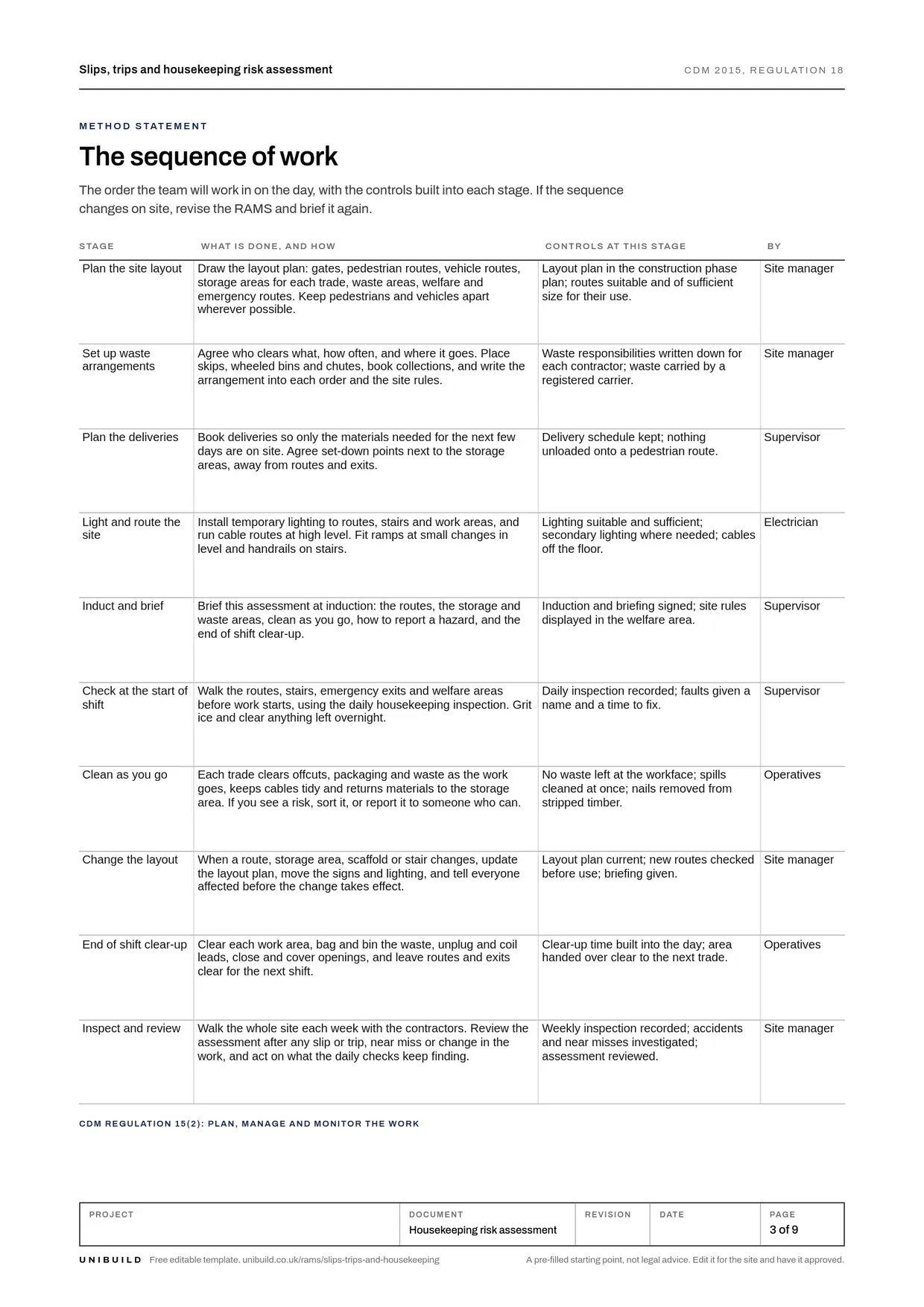
The order of work, with the controls at each stageHow the site is set up and kept in good order from the first day to handover, and the controls at each stage. If the layout or the trades change, revise the assessment and brief it again.
Plan the site layout
Draw the layout plan: gates, pedestrian routes, vehicle routes, storage areas for each trade, waste areas, welfare and emergency routes. Keep pedestrians and vehicles apart wherever possible.
ControlsLayout plan in the construction phase plan; routes suitable and of sufficient size for their use.
Set up waste arrangements
Agree who clears what, how often, and where it goes. Place skips, wheeled bins and chutes, book collections, and write the arrangement into each order and the site rules.
ControlsWaste responsibilities written down for each contractor; waste carried by a registered carrier.
Plan the deliveries
Book deliveries so only the materials needed for the next few days are on site. Agree set-down points next to the storage areas, away from routes and exits.
ControlsDelivery schedule kept; nothing unloaded onto a pedestrian route.
Light and route the site
Install temporary lighting to routes, stairs and work areas, and run cable routes at high level. Fit ramps at small changes in level and handrails on stairs.
ControlsLighting suitable and sufficient; secondary lighting where needed; cables off the floor.
Induct and brief
Brief this assessment at induction: the routes, the storage and waste areas, clean as you go, how to report a hazard, and the end of shift clear-up.
ControlsInduction and briefing signed; site rules displayed in the welfare area.
Check at the start of shift
Walk the routes, stairs, emergency exits and welfare areas before work starts, using the daily housekeeping inspection. Grit ice and clear anything left overnight.
ControlsDaily inspection recorded; faults given a name and a time to fix.
Clean as you go
Each trade clears offcuts, packaging and waste as the work goes, keeps cables tidy and returns materials to the storage area. If you see a risk, sort it, or report it to someone who can.
ControlsNo waste left at the workface; spills cleaned at once; nails removed from stripped timber.
Change the layout
When a route, storage area, scaffold or stair changes, update the layout plan, move the signs and lighting, and tell everyone affected before the change takes effect.
ControlsLayout plan current; new routes checked before use; briefing given.
End of shift clear-up
Clear each work area, bag and bin the waste, unplug and coil leads, close and cover openings, and leave routes and exits clear for the next shift.
ControlsClear-up time built into the day; area handed over clear to the next trade.
Inspect and review
Walk the whole site each week with the contractors. Review the assessment after any slip or trip, near miss or change in the work, and act on what the daily checks keep finding.
ControlsWeekly inspection recorded; accidents and near misses investigated; assessment reviewed.
What the law asks for housekeeping on site
Checked against the sourceGood order and cleanliness
Each part of a construction site is kept in good order, and the parts where work is going on in a reasonable state of cleanliness, so far as is reasonably practicable. Timber or other material with projecting nails or similar sharp objects is not used or left anywhere it may be a danger.
CDM 2015, regulation 18(1) and (3)Safe access and working space
There must be suitable and sufficient safe access to and from every place of work, so far as is reasonably practicable. The site is made and kept safe for people at work there, with sufficient working space for the work and the equipment used.
CDM 2015, regulation 17Traffic routes
The site is organised so that pedestrians and vehicles can move without risk, so far as is reasonably practicable. Each traffic route is signed where necessary, regularly checked and properly maintained.
CDM 2015, regulation 27(1) and (4)Lighting and emergency routes
The site, its approaches and traffic routes have suitable and sufficient lighting, with secondary lighting where a failure would be a risk. Emergency routes and exits, and the routes to them, are kept clear and free from obstruction.
CDM 2015, regulations 35 and 31(4)Who carries the duty
Every contractor complies with Part 4 so far as it affects its own workers or matters within its control. The principal contractor ensures welfare facilities that meet Schedule 2, which requires toilets and washing facilities to be kept clean and orderly.
CDM 2015, regulations 16(2) and 13(4)(c), Schedule 2Where the Workplace Regulations apply
The Workplace Regulations 1992 do not apply to a site where the only activity is construction work, save a few regulations. Indoors these include regulation 12: floors and traffic routes kept free from obstructions and anything that may cause a slip, trip or fall.
Workplace (Health, Safety and Welfare) Regulations 1992, regulation 3(1)(b)Record and review
Employers assess the risks to their employees and to others affected by their work. Employers with five or more employees record the significant findings, and the assessment is reviewed when it may no longer be valid or the work has changed significantly.
Management of Health and Safety at Work Regulations 1999, regulation 3Competence, equipment and PPE
Competence and cards
- Site manager Owns the layout plan, the waste arrangements and the weekly inspection, and acts on what the daily checks find.
- Supervisor Carries out the daily housekeeping inspection, briefs the team and makes sure each area is cleared at the end of the shift.
- Operatives Induction and this briefing; clear their own work area as they go, and report what they cannot sort.
- Labourer for clear-up Named for shared areas, routes, skips and welfare, with the time to do it built into the day.
- Electrician Competent to install temporary lighting and run cable routes at high level.
Plant and equipment
- Skips and wheeled bins On firm ground, not filled above the sides; highway permit conditions met.
- Rubbish chute Fixed to the manufacturer's instructions; outlet enclosed; checked each day.
- Temporary lighting Fittings and leads checked each day; failed lamps replaced; moved as work moves.
- Cable hooks and protectors Enough hooks for high-level runs; protectors where cables cross a route.
- Grit, salt and stone Stock checked before cold weather; bins at gates and on main routes.
- Site vacuum M or H class for construction dust; filters and hose checked before use.
PPE
- Safety boots with toe protection and a sole that grips, and resists penetration where the site requires it.
- Gloves for handling waste, banding and sharp offcuts.
- High-visibility clothing wherever plant moves around site.
- Safety helmet to the site standard.
- Respiratory protection for clearing dust where the dust assessment requires it.
Permits and plans
No permit is normally needed for housekeeping. In England and Wales a skip placed on the highway needs the highway authority's permission. Covers over openings are only lifted by agreement with the site manager. Clear-up of asbestos, contaminated ground or hazardous waste is outside this assessment and follows its own plan.
Emergency and rescue
Any slip, trip or fall is reported the same day and recorded in the accident book. First aider and first aid kit on site. A worker's fracture diagnosed by a doctor, other than to a finger, thumb or toe, is reportable under RIDDOR, as is an injury that keeps a worker off routine work for more than seven consecutive days.
Toolbox talk: housekeeping, slips and trips
Read this to the team before work starts, tick each point as it is covered, and record who attended.
- Slips and trips injure several thousand construction workers a year, and about 1000 break bones or dislocate joints. Most could be avoided by keeping the site tidy.
- Clean as you go. Offcuts, banding and packaging go in the bin now, not at the end of the day.
- Nothing is stored on routes, stairs or in front of exits, not even for five minutes.
- Leads go up on hooks. If a lead or hose has to cross a route, use a cable protector.
- See it, sort it. If you cannot sort it, report it: spills, ice, a failed light or a missing cover.
- Before you leave, clear your area, coil your leads and put the covers back over any openings.
Ask the team
- Where are the waste areas and bins for your trade on this site?
- Which route on this site is the worst to walk, and why?
- Who do you tell about ice, spills, a failed light or a missing cover?
What is in the housekeeping risk assessment template
9 pages, pre-filled and editableThe work, pre-filled
Scope, location and access, interfaces with other trades, the documents the assessment relies on, and the team.
The sequence of work
Ten stages from planning the site layout to the weekly inspection, with the controls and the person responsible at each one.
Hazards and controls
Sixteen slip, trip and housekeeping hazards rated before and after controls on a five by five matrix, with room for your own.
Equipment, PPE and permits
Skips, chutes, lighting, cable hooks and grit, with their checks, and PPE by type.
Daily housekeeping inspection
A page for the start of each shift: routes, stairs, storage, waste, cables, lighting, ground conditions, welfare and exits.
Briefing record
Twenty signatures against the revision, taken on the day before the work starts.
Brief it, and get it signed on the phone
On Unibuild a RAMS is written from a template, approved, then read by each operative on their phone in their own language and signed. Subcontract and agency workers sign through a link, with no app to install.
Every signature carries its date and time and prints as the last page of the RAMS PDF. Change the RAMS and it has to be signed again.
How RAMS work on UnibuildHousekeeping risk assessment questions
Is this housekeeping risk assessment template free?
What should a housekeeping risk assessment on a construction site include?
Which regulations cover housekeeping on a construction site?
Who is responsible for housekeeping on site?
How often should site housekeeping be checked?
Do I need a risk assessment for visitors on site?
Is a slip or trip at work reportable under RIDDOR?
Is a housekeeping risk assessment a legal requirement?
RAMS templates for other trades and hazards
All free, pre-filled and editableBy trade
- Air conditioning and HVAC RAMS
- Bricklaying RAMS
- Carpentry and joinery RAMS
- CCTV installation RAMS
- Cleaning risk assessment
- Concrete works RAMS
- Demolition RAMS
- Drylining RAMS
- Electrical RAMS
- Facilities maintenance RAMS
- Fire alarm installation RAMS
- Glazing and window RAMS
- Groundworks RAMS
- Hot works and welding RAMS
- Insulation RAMS
- Landscaping and fencing RAMS
- Painting and decorating RAMS
- Pest control risk assessment
- Plastering and rendering RAMS
- Plumbing and heating RAMS
- Rail RAMS
- Refurbishment RAMS
- Roofing RAMS
- Rope access risk assessment
- Scaffolding RAMS
- Solar PV installation RAMS
- Steel erection RAMS
- Temporary works RAMS
- Tiling and flooring RAMS
- Tree surgery RAMS
By hazard
- Asbestos risk assessment
- Confined space risk assessment
- COSHH risk assessment
- Dust risk assessment
- Forklift and telehandler risk assessment
- Housekeeping risk assessment
- Lifting operations risk assessment
- Lone working risk assessment
- Manual handling risk assessment
- MEWP risk assessment
- Noise and vibration risk assessment
- Plant and excavator risk assessment
- Power tools risk assessment
- Traffic management risk assessment
- Working at height risk assessment
The blank RAMS template, the RAMS review checklist and every other free form are on Free downloads.
The RAMS, read and signed
before the work starts.
Unibuild keeps every RAMS with its versions, its approvals and each operative’s signature against the revision they read, for seven years, ready for the principal contractor or an auditor.