
Painting and decorating risk assessment template
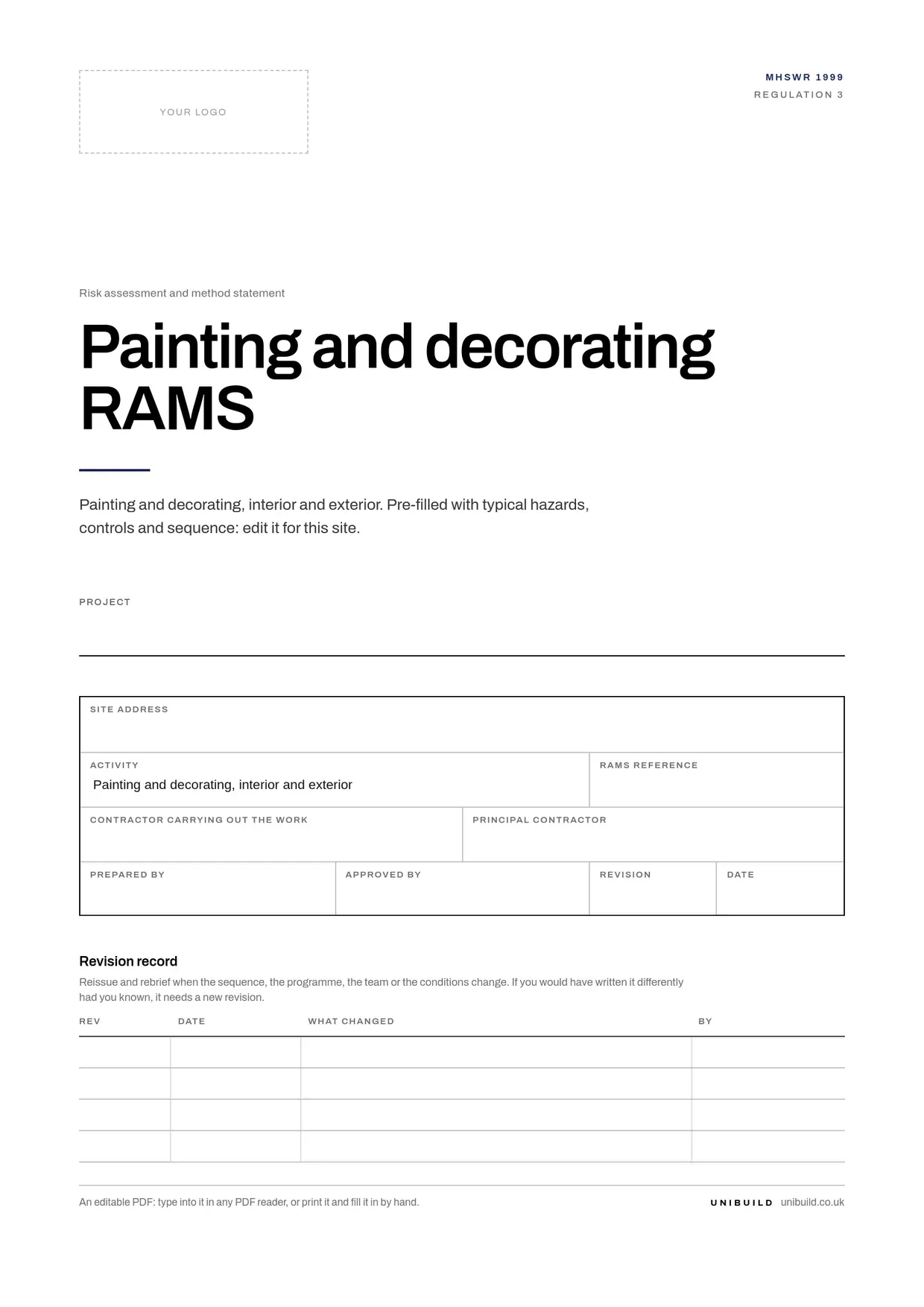
A painting and decorating risk assessment and method statement, already filled in for access equipment, coatings, spraying, preparation and old lead paint. Edit it for your job, then brief it.
- Law
- COSHH 2002 and Work at Height 2005
- Old lead paint
- Hot air guns kept below 500°C
- Format
- Editable PDF and Word
- Cost
- Free, always
Do you need a risk assessment for painting and decorating?
Yes. Every employer must assess the risks of the work, and painting and decorating brings three that the law treats separately: work at height, hazardous substances and flammable vapour.
The general duty is regulation 3 of the Management of Health and Safety at Work Regulations 1999, recorded if you employ five or more people. COSHH adds an assessment for the paints, thinners, fillers and dusts, and DSEAR covers the fire risk from solvents.
A painting and decorating RAMS should describe the building in front of you. The height of the walls, the age of the paintwork, whether it is occupied, and whether anything is sprayed decide the controls. A principal contractor will expect to see each of those covered.
Painting and decorating hazards and controls
16 hazards, rated before and after controlsThe significant hazards on a typical interior or exterior redecoration, with the controls a reviewer expects to see. Delete what does not apply and add what your job has.
Falls from ladders and stepladders
Decorators cutting in, painting ceilings, stairwells and window heads.
- Ladders used only for light, short work where a podium, tower or MEWP is not justified; HSE suggests other equipment beyond 30 minutes.
- Stepladders face on, all four feet level, locks engaged, three points of contact, and no standing on the top three steps without a handhold.
- Pre-use check before each use; leaning ladders at 1 in 4 and secured.
BeforeHigh 16AfterMedium 8
Falls from towers, podiums and MEWPs
Decorators working on high walls, ceilings, atriums and exterior elevations.
- Towers erected to the manufacturer's instructions by PASMA-trained people, with guard-rails, toe boards and castors locked.
- Podium steps with gates closed; MEWPs operated by IPAF card holders, with a restraint lanyard in a boom.
- Towers and MEWPs kept off slopes, voids and soft ground, and never moved with anyone on them.
BeforeHigh 15AfterMedium 5
Falls through stairwells and openings
Decorators working over stairs, landings, voids and open windows.
- Stairwell access by a stair platform or tower made for stairs, never ladders on treads.
- Voids and open edges guarded; windows opened only as far as the work needs.
BeforeHigh 15AfterMedium 5
Solvent vapour from paints and thinners
Decorators and anyone nearby, from headaches, dizziness and skin damage.
- Water-based or low-solvent products used wherever they do the job.
- Ventilation in every room being painted: doors and windows open, mechanical ventilation in enclosed spaces.
- Lids on tins, minimum quantities in the room; gloves and RPE with a vapour filter where the COSHH assessment calls for them.
BeforeMedium 9AfterMedium 6
Fire from flammable solvents
Decorators and occupants, where vapour from paints, thinners or cleaners meets an ignition source.
- Ignition sources kept out of rooms with solvent vapour: no smoking, no naked flames, no sparking tools.
- Flammable products stored in a ventilated, lockable store away from exits, in quantities kept to the day's needs.
- Used rags kept in a sealed metal container and removed from the building daily; extinguisher on hand.
BeforeMedium 10AfterMedium 5
Spraying isocyanate coatings
Sprayers and anyone nearby, from occupational asthma caused by the spray mist.
- Brush or roller where it does the job; isocyanate-free products where possible.
- Spraying in an enclosed, extracted area with non-essential people kept out until the mist has cleared.
- Constant flow air-fed breathing apparatus, visor kept down until clear of the area; annual lung function testing and questionnaire.
BeforeHigh 15AfterMedium 5
Airless spray equipment
Sprayers and helpers, from paint injected through the skin or hose failures.
- Tip guard and trigger lock fitted; pressure released before cleaning, unblocking or changing tips.
- Hoses and fittings checked before use and replaced if damaged; correct tip size and pressure.
BeforeMedium 12AfterLow 4
Old lead paint
Decorators preparing old paintwork, and occupants, especially children and pregnant women.
- Paintwork in buildings from before the 1980s treated as lead until tested; sound paint keyed with wet abrasive paper and left in place.
- No dry sanding, blowlamps or gas torches; hot air guns below 500°C, wet methods or on-tool extraction.
- FFP3 RPE, disposable overalls, area sheeted off; no eating or smoking there; medical surveillance where exposure is significant.
BeforeMedium 12AfterLow 4
Dust from sanding and preparation
Decorators sanding wood, MDF, filler and old paint, and people in the building.
- Sanders with on-tool extraction to an M or H class unit; wet abrasives where suitable.
- FFP3 or equivalent RPE, face fit tested, for dusty work.
- Clean up with an M class vacuum, never by dry sweeping.
BeforeMedium 12AfterMedium 6
Asbestos in textured coatings and boards
Decorators sanding, scraping or drilling older textured ceilings, panels and boards.
- Asbestos survey checked before any preparation in buildings from before 2000.
- No sanding or scraping of suspect textured coatings; drill only under the asbestos risk assessment.
- Removal only by trained workers under the asbestos plan, or a licensed contractor where the work needs one.
BeforeHigh 15AfterMedium 5
Chemical paint strippers
Decorators stripping old finishes, and occupants nearby.
- Strippers free of dichloromethane used; DCM stripper only by people certified under HSE's competence scheme.
- Ventilation, chemical-resistant gloves chosen from the safety data sheet, and eye protection.
BeforeMedium 9AfterLow 3
Hot air guns
Decorators stripping paint, from burns and from fires starting behind the surface.
- Temperature kept to the lowest that works; gun never pointed into gaps, eaves or behind boards.
- Hot work permit where the site requires one, with a check of the area before leaving.
- Gun stood on its stand to cool, away from dust sheets and solvents.
BeforeMedium 12AfterLow 4
Skin contact and dermatitis
Decorators handling paints, solvents, fillers and cleaners every day.
- Single-use nitrile gloves or gloves chosen from the safety data sheet.
- No solvents used to clean the skin; washing facilities and skin care products provided.
- Skin checks by a responsible person where dermatitis is reasonably likely.
BeforeMedium 9AfterMedium 6
Occupied buildings and the public
Residents, staff, pupils and visitors walking through the work area.
- Work areas barriered and signed, with wet paint signs and a safe route kept open.
- Noisy, dusty and solvent work timed with the building manager, with rooms ventilated before reoccupation.
- Access equipment never left unattended where children or the public can reach it.
BeforeMedium 12AfterLow 4
Manual handling
Decorators carrying paint, towers, podiums and ladders up stairs and across sites.
- Paint delivered in sizes the team can carry; trolleys for heavy tins and tower components.
- Two people for long ladders and tower frames, and on stairs.
BeforeMedium 6AfterLow 4
Slips and trips
Decorators and occupants, on dust sheets, cables and spilled paint.
- Dust sheets laid flat and taped at edges and stairs; cables run along walls.
- Spills cleaned straight away; work areas kept clear at the end of each day.
BeforeMedium 6AfterLow 4
Scores are likelihood times severity on the five by five matrix in the template. They are typical ratings for this work, a starting point for your own assessment of your site.
Painting and decorating method statement: the sequence of work
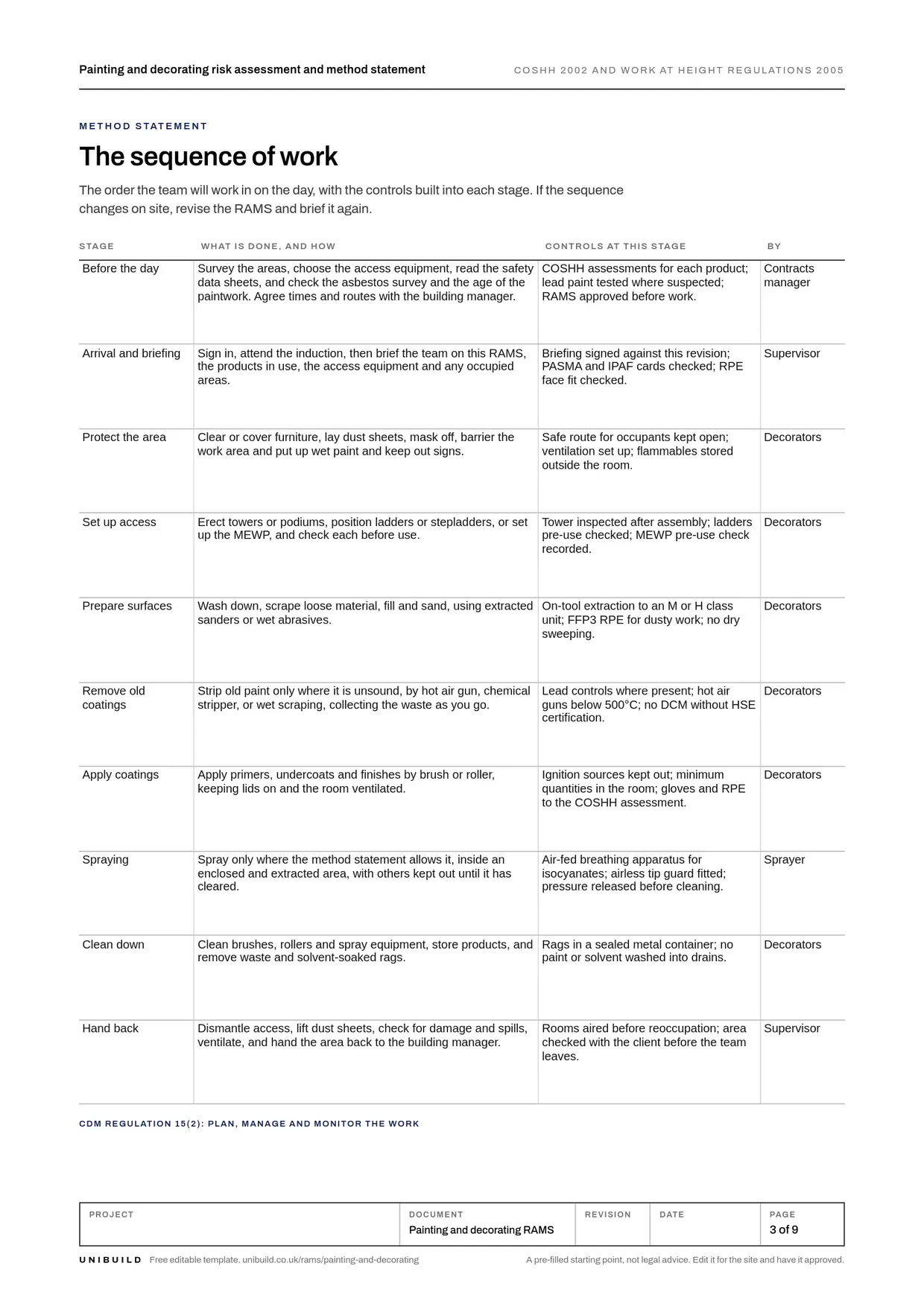
The order of work, with the controls at each stageThe order the team works in, with the controls built into each stage. If the sequence changes on site, revise the RAMS and brief it again.
Before the day
Survey the areas, choose the access equipment, read the safety data sheets, and check the asbestos survey and the age of the paintwork. Agree times and routes with the building manager.
ControlsCOSHH assessments for each product; lead paint tested where suspected; RAMS approved before work.
Arrival and briefing
Sign in, attend the induction, then brief the team on this RAMS, the products in use, the access equipment and any occupied areas.
ControlsBriefing signed against this revision; PASMA and IPAF cards checked; RPE face fit checked.
Protect the area
Clear or cover furniture, lay dust sheets, mask off, barrier the work area and put up wet paint and keep out signs.
ControlsSafe route for occupants kept open; ventilation set up; flammables stored outside the room.
Set up access
Erect towers or podiums, position ladders or stepladders, or set up the MEWP, and check each before use.
ControlsTower inspected after assembly; ladders pre-use checked; MEWP pre-use check recorded.
Prepare surfaces
Wash down, scrape loose material, fill and sand, using extracted sanders or wet abrasives.
ControlsOn-tool extraction to an M or H class unit; FFP3 RPE for dusty work; no dry sweeping.
Remove old coatings
Strip old paint only where it is unsound, by hot air gun, chemical stripper, or wet scraping, collecting the waste as you go.
ControlsLead controls where present; hot air guns below 500°C; no DCM without HSE certification.
Apply coatings
Apply primers, undercoats and finishes by brush or roller, keeping lids on and the room ventilated.
ControlsIgnition sources kept out; minimum quantities in the room; gloves and RPE to the COSHH assessment.
Spraying
Spray only where the method statement allows it, inside an enclosed and extracted area, with others kept out until it has cleared.
ControlsAir-fed breathing apparatus for isocyanates; airless tip guard fitted; pressure released before cleaning.
Clean down
Clean brushes, rollers and spray equipment, store products, and remove waste and solvent-soaked rags.
ControlsRags in a sealed metal container; no paint or solvent washed into drains.
Hand back
Dismantle access, lift dust sheets, check for damage and spills, ventilate, and hand the area back to the building manager.
ControlsRooms aired before reoccupation; area checked with the client before the team leaves.
What the law asks for painting and decorating
Checked against the sourceAvoid, prevent, then mitigate
Work at height is avoided where it can be done safely another way. Where it cannot, falls are prevented, and only then are the distance and consequences of a fall reduced. Collective protection comes before personal.
Work at Height Regulations 2005, regulations 6 and 7COSHH assessment
No work that could expose people to a hazardous substance starts until its risk has been assessed. The assessment uses the safety data sheet, the level and length of exposure, and how the product is used.
COSHH Regulations 2002, regulation 6Substitute, then control
Exposure is prevented first, by substituting a safer product or process where reasonably practicable. Where it cannot be prevented, it is controlled at source, with PPE and RPE as the last measure.
COSHH Regulations 2002, regulation 7Health surveillance
Health surveillance is needed where a disease such as occupational asthma or dermatitis is reasonably likely from the work and can be detected. A health record is kept for each person.
COSHH Regulations 2002, regulation 11Flammable vapour
Fire and explosion risk from flammable paints, thinners and cleaners is assessed, then removed or reduced. Safer substances come first, then smaller quantities, ventilation and keeping ignition sources away.
DSEAR 2002, regulations 5 and 6Lead paint
Work that may expose people to lead, such as preparing old lead paint, needs a lead risk assessment first. Where exposure is significant, each person is under medical surveillance by a relevant doctor.
Control of Lead at Work Regulations 2002, regulations 5 and 10Competence, equipment and PPE
Competence and cards
- Decorators CSCS card for painting and decorating, with apprentices supervised.
- Supervisor Experienced decorator with site supervision training.
- Tower users PASMA training for anyone erecting or moving an aluminium tower.
- MEWP operators IPAF PAL card for the category of machine.
- Sprayers Trained on the equipment, and in diisocyanate use before using products that contain them.
- RPE wearers Face fit tested for tight-fitting masks, and clean shaven where the mask seals.
Plant and equipment
- Ladders and stepladders Pre-use check each day; detailed inspection on a set schedule.
- Mobile tower and podiums Built to the instructions; inspected after assembly and before use.
- MEWP Pre-use check; thorough examination at least every 6 months.
- Airless sprayer Tip guard, trigger lock and hoses checked before use.
- Air-fed breathing apparatus Air quality tested; flow and low flow alarm checked.
- Sanders and extraction unit M or H class unit; filters and hoses checked.
PPE
- Gloves single-use nitrile or as the safety data sheet specifies.
- Eye protection for overhead work, stripping, spraying and mixing.
- Respiratory protection FFP3 for dust, vapour filter for solvents, air-fed for isocyanate spray.
- Overalls disposable for spraying and lead paint work.
- Safety footwear to the site standard, with grip soles on access equipment.
- Safety helmet and high visibility where the site rules require them.
Permits and plans
A hot work permit for hot air guns where the site requires one. A permit to work for access to roofs, plant rooms or other controlled areas. An asbestos check before any preparation of textured coatings or old boards, and the building manager's agreement for work in occupied areas.
Emergency and rescue
First aider and first aid kit on site, with eyewash for splashes. Anyone overcome by vapour is moved to fresh air and given first aid. Fire procedure and extinguisher known before solvents are used. Plan for getting someone down from a tower or MEWP. Nearest accident and emergency department named on the briefing.
Toolbox talk: painting and decorating safety
Read this to the team before work starts, tick each point as it is covered, and record who attended.
- Use the tower or podium for anything more than a quick, light job. Ladders are for short work.
- Read the tin and the data sheet. If it says flammable, no smoking, no flames and keep the window open.
- Old paint may be lead. No dry sanding and no blowlamps. Hot air guns stay on the lowest setting that works.
- If you spray two-pack, the air-fed mask stays on and the visor stays down until the area has cleared.
- Sand with the extractor plugged in, and wear your mask. Vacuum up, never sweep.
- Wash your hands before you eat, drink or smoke, and never clean paint off your skin with thinners.
Ask the team
- Which products on this job are flammable, and where are they stored?
- How do we know whether the old paint here contains lead?
- Who in the building needs to know when we are working near them?
What is in the painting and decorating RAMS template
9 pages, pre-filled and editableThe work, pre-filled
Scope, location and access, interfaces with the building and other trades, the documents the RAMS relies on, and the team.
The sequence of work
Ten stages from survey to hand back, with the controls and the person responsible at each one.
Hazards and controls
Sixteen painting and decorating hazards rated before and after controls on a five by five matrix.
Equipment, PPE and substances
Access equipment and its checks, PPE by type, and the coatings with their COSHH references.
Products and coatings register
A page listing each product with its hazards, how it is applied, its controls and RPE.
Emergency and briefing record
First aid, fire and rescue arrangements, then twenty signatures against the revision.
Brief it, and get it signed on the phone
On Unibuild a RAMS is written from a template, approved, then read by each operative on their phone in their own language and signed. Subcontract and agency workers sign through a link, with no app to install.
Every signature carries its date and time and prints as the last page of the RAMS PDF. Change the RAMS and it has to be signed again.
How RAMS work on UnibuildPainting and decorating RAMS questions
Is this painting and decorating RAMS template free?
What should a painting and decorating risk assessment include?
Do I need a COSHH assessment for paint?
What does a spray painting risk assessment need?
Can decorators use ladders?
How do I deal with old lead paint?
Is a paint stripper with dichloromethane allowed?
Who signs the painting and decorating RAMS?
RAMS templates for other trades and hazards
All free, pre-filled and editableBy trade
- Electrical RAMSSafe isolation, live work, testing and inspection, and working near other trades.
- Scaffolding RAMSErecting, altering and dismantling tube and fitting and system scaffold, with handover and inspection.
- Roofing RAMSPitched and flat roofs, fragile surfaces, edge protection, hot work and getting materials up safely.
- Groundworks RAMSExcavations, buried services, plant, trench support and inspections at the start of each shift.
- Plumbing and heating RAMSSoldering and brazing, gas work, unvented systems, lofts and occupied homes.
- Painting and decorating RAMSAccess equipment, solvents and spray, old lead paint, dust from preparation and occupied buildings.
- Hot works and welding RAMSWelding, cutting, grinding and torch-on work: permits, fire watch, fume and gas cylinders.
By hazard
- COSHH risk assessmentHazardous substances on site: dusts, solvents, cement, resins and fume, assessed and controlled.
- Manual handling risk assessmentLifting, carrying, pushing and pulling, assessed by task, individual, load and environment.
- Working at height risk assessmentLadders, towers, MEWPs, scaffolds and roofs, chosen and controlled in the order the law sets.
- Lone working risk assessmentPeople working alone on site, in empty buildings and out of hours, with check-ins and a plan if they go quiet.
- Noise and vibration risk assessmentNoise exposure and hand-arm vibration from tools, measured against the action and limit values.
- Asbestos risk assessmentFinding asbestos before work starts, deciding whether work is licensed, and controlling non-licensed work.
- Confined space risk assessmentManholes, tanks, voids and chambers: avoiding entry, a safe system of work, gas testing and rescue.
The blank RAMS template, the RAMS review checklist and every other free form are on Free downloads.
The RAMS, read and signed
before the work starts.
Unibuild keeps every RAMS with its versions, its approvals and each operative’s signature against the revision they read, for seven years, ready for the principal contractor or an auditor.