Solar panel installation risk assessment and RAMS template
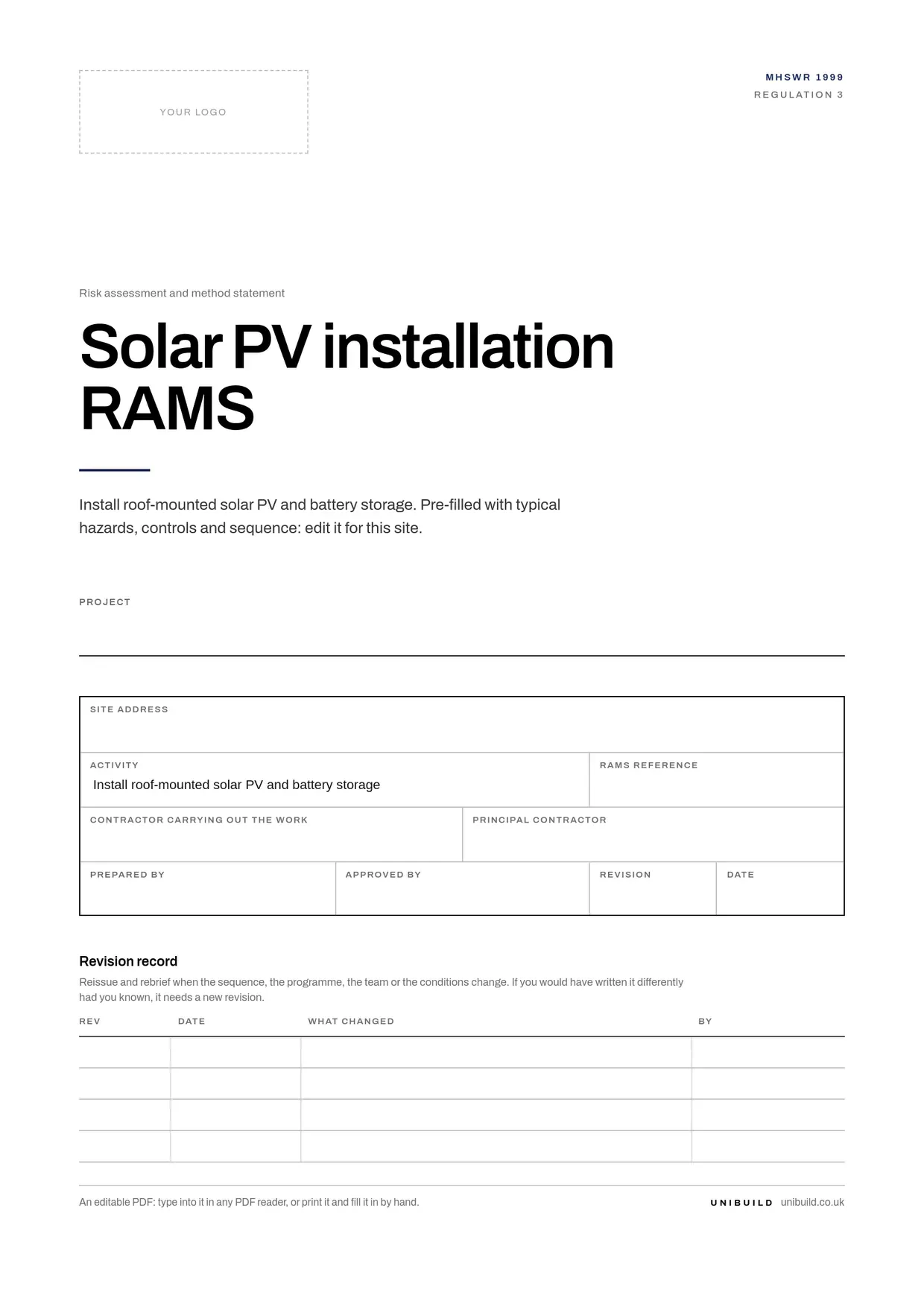
A risk assessment and method statement for solar panel installation, already filled in with the hazards, controls and sequence for roof work, DC cabling, inverters and battery storage. Edit it for your job, then brief it.
- Law
- Work at Height Regulations 2005
- DC cabling
- Live whenever there is daylight
- Format
- Editable PDF and Word
- Cost
- Free, always
Do you need a risk assessment for solar panel installation?
Yes. A risk assessment for solar panel installation is needed before anyone goes on the roof, and a client or principal contractor will expect a solar panel method statement with it. This template gives you both, pre-filled for roof work, DC cabling, inverters and battery storage.
The risk assessment is the legal duty, under regulation 3 of the Management of Health and Safety at Work Regulations 1999. The MCS solar installation standard also asks for risk assessments before work on site starts. It notes that solar work brings falls, electric shock and handling large panels at height together: roofers know the first and last, electricians the second.
A solar PV RAMS should describe the roof and the building in front of you. The roof covering, fragile areas, edges, the route for panels, where the inverter and battery go and how the system connects decide the controls.
Checked against legislation.gov.uk and HSE guidance on .
Solar PV installation hazards and controls
17 hazards, rated before and after controlsThe significant hazards on a typical roof-mounted solar PV and battery storage job, with the controls a reviewer expects to see. Delete what does not apply and add what your job has.
Falls from the roof edge
Installers fixing rails and panels, and anyone else working on the roof.
- Scaffold with a boarded platform, double guard-rails and toe boards along the eaves of the roof slope being worked on.
- Edge protection extending 2 metres past each side of the work area, as CITB guidance advises, with gable end protection where the array is closer than that.
- Scaffold handover certificate in place, and inspected at least every 7 days and after high winds.
BeforeHigh 20AfterMedium 5
Falls through fragile roofs and rooflights
Installers on sheeted commercial and farm roofs, and near rooflights on any roof.
- Roof treated as fragile until a competent person confirms it is not; fragile areas marked on the survey.
- Nobody stands on or works within 2 metres of a fragile surface unless barriers or covers stop them reaching it.
- Staging to cross the roof, safety nets below where needed, and warning notices at each approach.
BeforeHigh 20AfterMedium 5
Slipping on the roof covering
Installers on tiles, slates, sheets and membranes, worse when wet, icy or covered in moss.
- Roof ladders or staging anchored over the ridge, and no walking on fitted panels.
- Roof checked for frost, moss and wet before anyone goes on it, and work stopped when the weather puts people at risk.
BeforeMedium 12AfterMedium 8
Getting panels onto the roof
The team loading out and anyone below, from panels dropped while being raised.
- Panels raised by ladder hoist, scaffold hoist or crane, not carried up a ladder.
- Lifting equipment thoroughly examined under LOLER, with the report in date; lift plan for any crane lift.
- Exclusion zone below the lift, and nobody under a panel being raised.
BeforeMedium 12AfterLow 4
Handling panels on the roof
Installers carrying and positioning large panels on a slope or at the edge.
- Panels moved along the scaffold platform rather than across the roof wherever possible.
- Two people to carry and place each panel, with a clear route and stacks kept within the scaffold loading.
- Panels kept in their packaging or secured flat until each one is fixed.
BeforeMedium 9AfterMedium 6
Wind catching panels
Installers carrying panels at height, where a gust can pull a person off balance.
- Forecast checked each morning and wind checked at roof level before panels go up.
- Panel handling stopped when wind makes panels hard to control; loose panels and offcuts secured at the end of each day.
BeforeMedium 12AfterMedium 8
Falling materials and tools
The public, residents, other trades and the team below the roof.
- Toe boards on the scaffold, and brick guards where materials are stacked above toe board height.
- Nothing thrown or dropped from the roof; packaging and offcuts lowered in bags or by hoist.
- Exclusion zone below the work, with the footpath closed or protected where the public pass.
BeforeMedium 12AfterLow 4
Roof structure overloaded or damaged
Installers on the roof, and occupants below a roof that cannot take the extra load.
- Building assessed by a competent person before design, including the roof structure and fixings.
- Mounting kit approved to work together and fixed to the manufacturer's instructions and the MCS standard.
- Panels and rails stacked in small loads spread over the structure, never on a fragile area.
BeforeMedium 8AfterLow 4
Electric shock from live DC cabling
Installers connecting panels and strings, which are live in daylight and cannot be switched off.
- Every PV conductor treated as live in daylight; tested for voltage before touching any part of the system.
- Strings connected so that positive and negative are never exposed together; ends kept in an isolation box until connected.
- Where live working cannot be avoided, insulated gloves and tools, or the array covered with opaque sheeting.
- Warning signs and barriers while live DC cables are run.
BeforeHigh 15AfterMedium 5
DC arcs and fire from poor connections
Installers and occupants, from connectors pulled apart under load or badly crimped.
- DC connectors never used as a switch; AC off and DC isolator opened before any connector is separated.
- Connectors assembled with the correct tools and procedure, as the MCS standard requires, and only mated with the same make and type.
- Connectors kept out of standing water, and arc fault detection in the inverter enabled where it has one.
BeforeHigh 15AfterMedium 5
Connecting to the AC supply
Electricians working at the consumer unit or distribution board, and occupants of the building.
- Safe isolation at the point of supply: isolate, lock off, post a notice, then prove dead with a proved tester.
- Every source of supply found, including an existing PV system, generator or battery, before work starts.
- Work tested and certified to BS 7671 before the system is switched on.
BeforeHigh 15AfterMedium 5
Battery storage installation
Installers handling and connecting heavy battery units, and occupants of the building.
- Battery treated as live at all times; connected last, to the maker's instructions, with insulated tools.
- In homes, battery location agreed to PAS 63100: outdoors where practicable, never in a loft or roof void.
- Units moved by trolley or two-person lift, to the data sheet weight.
- A dropped or damaged unit is not fitted; it is kept outdoors, away from the building, and returned.
BeforeHigh 15AfterMedium 5
Working in lofts and roof spaces
Installers running cables and fixing equipment in roof spaces.
- Boards laid across joists to work from, so nobody steps through a ceiling.
- Loft checked for bare wires and damaged cables before work, and lighting provided.
- Time in hot lofts limited in summer, with water and breaks.
BeforeMedium 9AfterMedium 6
Asbestos in older roofs and roof spaces
Installers on fibre cement sheet roofs, and in lofts, soffits and flues of older buildings.
- Asbestos survey checked before work; where there is doubt, suspect material assumed to be asbestos.
- No drilling or cutting into suspect sheets or boards; fixings and routes moved or the material dealt with first.
- Asbestos awareness training for the whole team.
BeforeHigh 15AfterMedium 5
Dust from cutting tiles and drilling
Installers cutting tiles for hooks and drilling through walls for cables.
- Tiles cut with a hand cutter where possible, or a saw with water or on-tool extraction.
- On-tool extraction for drilling through masonry, with FFP3 RPE on top of the dust controls.
BeforeMedium 9AfterMedium 6
Overhead power lines
Installers raising panels, rails and ladders near lines at the roof or the property boundary.
- Lines identified at the survey and the network operator contacted where the work or a lift comes close.
- No panels, rails or metal ladders raised within reach of a live line.
BeforeMedium 10AfterMedium 5
Rescue after a fall or shock
An installer injured on the roof, suspended in a harness or hurt by an electric shock.
- Written rescue plan before work starts, with equipment on site and the team shown how to use it.
- Nobody works alone on the roof or on electrical connections; first aider on site.
BeforeMedium 10AfterMedium 5
Scores are likelihood times severity on the five by five matrix in the template. They are typical ratings for this work, a starting point for your own assessment of your site.
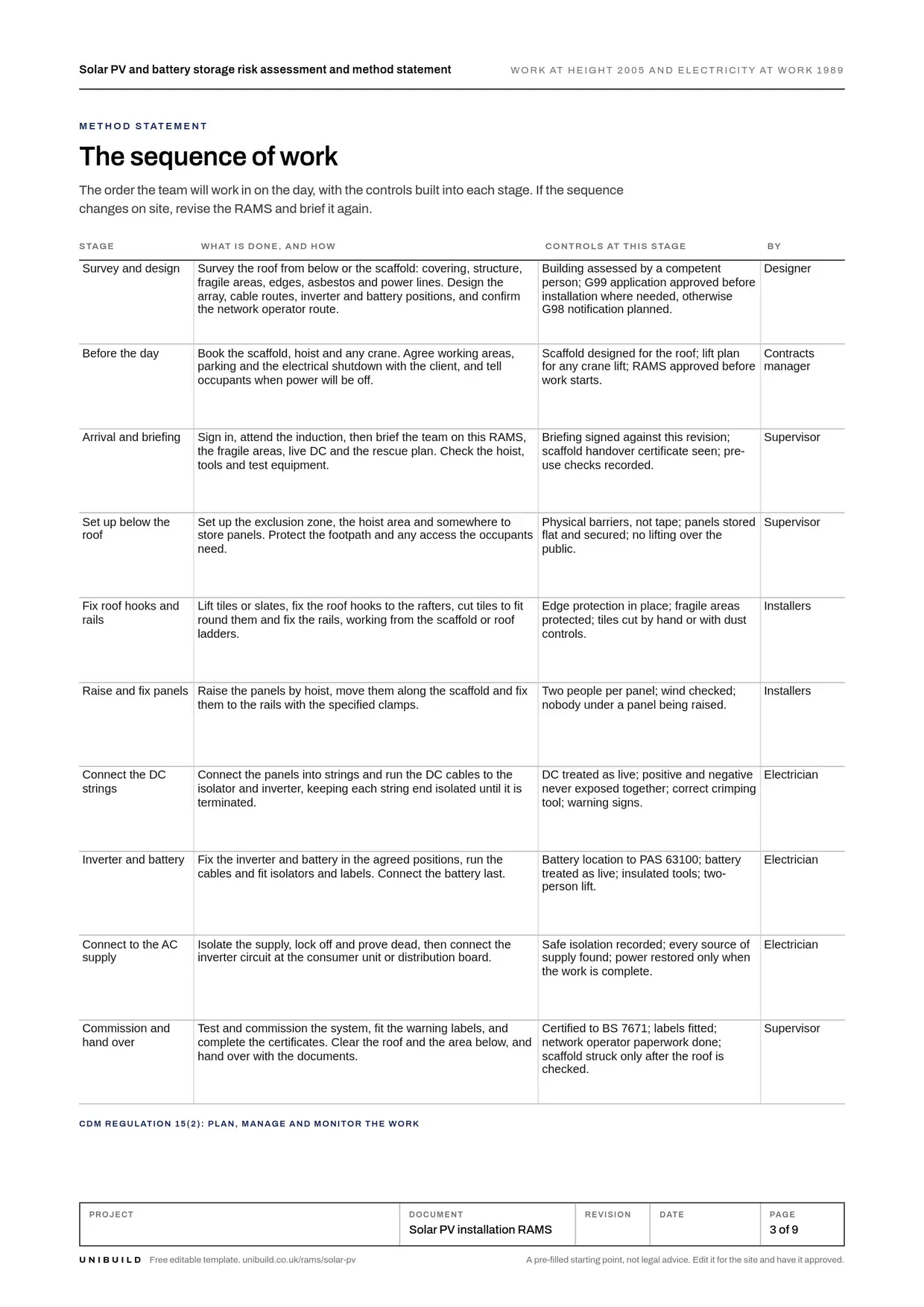
Solar panel method statement: the sequence of work
The order of work, with the controls at each stageThe order the team works in, with the controls built into each stage. If the sequence changes on site, revise the RAMS and brief it again.
Survey and design
Survey the roof from below or the scaffold: covering, structure, fragile areas, edges, asbestos and power lines. Design the array, cable routes, inverter and battery positions, and confirm the network operator route.
ControlsBuilding assessed by a competent person; G99 application approved before installation where needed, otherwise G98 notification planned.
Before the day
Book the scaffold, hoist and any crane. Agree working areas, parking and the electrical shutdown with the client, and tell occupants when power will be off.
ControlsScaffold designed for the roof; lift plan for any crane lift; RAMS approved before work starts.
Arrival and briefing
Sign in, attend the induction, then brief the team on this RAMS, the fragile areas, live DC and the rescue plan. Check the hoist, tools and test equipment.
ControlsBriefing signed against this revision; scaffold handover certificate seen; pre-use checks recorded.
Set up below the roof
Set up the exclusion zone, the hoist area and somewhere to store panels. Protect the footpath and any access the occupants need.
ControlsPhysical barriers, not tape; panels stored flat and secured; no lifting over the public.
Fix roof hooks and rails
Lift tiles or slates, fix the roof hooks to the rafters, cut tiles to fit round them and fix the rails, working from the scaffold or roof ladders.
ControlsEdge protection in place; fragile areas protected; tiles cut by hand or with dust controls.
Raise and fix panels
Raise the panels by hoist, move them along the scaffold and fix them to the rails with the specified clamps.
ControlsTwo people per panel; wind checked; nobody under a panel being raised.
Connect the DC strings
Connect the panels into strings and run the DC cables to the isolator and inverter, keeping each string end isolated until it is terminated.
ControlsDC treated as live; positive and negative never exposed together; correct crimping tool; warning signs.
Inverter and battery
Fix the inverter and battery in the agreed positions, run the cables and fit isolators and labels. Connect the battery last.
ControlsBattery location to PAS 63100; battery treated as live; insulated tools; two-person lift.
Connect to the AC supply
Isolate the supply, lock off and prove dead, then connect the inverter circuit at the consumer unit or distribution board.
ControlsSafe isolation recorded; every source of supply found; power restored only when the work is complete.
Commission and hand over
Test and commission the system, fit the warning labels, and complete the certificates. Clear the roof and the area below, and hand over with the documents.
ControlsCertified to BS 7671; labels fitted; network operator paperwork done; scaffold struck only after the roof is checked.
What the law asks for solar PV installation
Checked against the sourceAvoid, prevent, then mitigate
Work is not done at height where it can be done safely another way. Where it cannot, falls are prevented, and only then are the distance and consequences of a fall reduced.
Work at Height Regulations 2005, regulation 6Fragile surfaces
Nobody works on or near a fragile surface where the work can be done safely another way. Where they must, platforms, coverings or guard-rails are provided, and warning notices go at the approach.
Work at Height Regulations 2005, regulation 9Planning and weather
Work at height is properly planned, including for emergencies and rescue, and supervised. It is carried out only when the weather does not put people at risk.
Work at Height Regulations 2005, regulation 4Equipment that makes its own power
Where needed to prevent danger, there must be a way to cut off the supply and isolate equipment. That duty does not cover equipment that is itself a source of energy, as panels and batteries are, so other precautions must prevent danger so far as is reasonably practicable.
Electricity at Work Regulations 1989, regulation 12Live work
No one works on or near a live conductor where danger may arise unless it is unreasonable for it to be dead, reasonable to work on it live, and suitable precautions, including protective equipment, prevent injury.
Electricity at Work Regulations 1989, regulation 14Lifting operations
Every lifting operation, including raising panels by hoist or crane, is properly planned by a competent person, appropriately supervised and carried out safely.
LOLER 1998, regulation 8Competence, equipment and PPE
Competence and cards
- Electricians Qualified electrician, competent in PV and battery systems, with an ECS card for the grade of work.
- Roof installers CSCS card for their occupation, and experienced in roof work, with trainees supervised.
- Supervisor Experienced installer, on the roof or at the job throughout.
- Designer Competent in solar PV design, to assess the building and roof before the system is designed.
- Hoist and crane lifts Trained in the hoist; crane lifts planned by a competent person.
- Asbestos Asbestos awareness training for everyone liable to disturb it.
Plant and equipment
- Ladder hoist or scaffold hoist LOLER thorough examination in date; pre-use check daily.
- Roof ladders and staging Checked before use, anchored over the ridge.
- Voltage tester and proving unit Rated for the DC voltage; proved before and after each test.
- DC connector crimping tool The tool the connector maker specifies; checked before use.
- Insulated hand tools Checked for damage to the insulation before use.
- Battery trolley Rated for the battery weight; checked before use.
PPE
- Safety helmet below the roof and on the scaffold where people work above.
- Safety boots with a flexible grip sole for roof work.
- Gloves for handling, and insulating gloves for any live DC work.
- Eye protection when cutting tiles, drilling and working on live parts.
- Respiratory protection FFP3 for cutting tiles and drilling masonry.
- High-visibility clothing to the site standard, at ground level and loading out.
Permits and plans
A permit to work for any live working, and for access to a fragile roof where the client or principal contractor requires one. A lift plan for any crane lift. Scaffold handover certificate before the roof is used. Network operator notification or approval under G98 or G99 as the system size requires.
Emergency and rescue
Rescue plan for an installer injured on the roof. Electric shock procedure briefed: isolate where it is safe to, do not touch the person until they are clear of the supply, call 999. First aider on site, and the nearest accident and emergency department named on the briefing.
Toolbox talk: solar PV installation safety
Read this to the team before work starts, tick each point as it is covered, and record who attended.
- If the edge protection is not there, you do not go there. Tell the supervisor first.
- Treat every rooflight and sheet as fragile until we are told otherwise.
- Panels go up on the hoist, not up the ladder. Two people to every panel on the roof.
- The DC side is live whenever it is light. Test before you touch, and never expose positive and negative together.
- Never pull a DC connector apart under load. AC off and DC isolator open first.
- If the wind picks up or the roof gets wet, stop and tell the supervisor before anyone carries on.
Ask the team
- Where are the fragile areas and rooflights on this roof?
- Who is doing the DC connections today, and how are the string ends kept safe until then?
- Where is the rescue kit, and who has been shown how to use it?
What is in the solar PV RAMS template
9 pages, pre-filled and editableThe work, pre-filled
Scope, location and access, interfaces with other trades and occupants, the documents the RAMS relies on, and the team with their cards.
The sequence of work
Ten stages from survey to hand over, with the controls and the person responsible at each one.
Hazards and controls
Seventeen solar PV and battery hazards rated before and after controls on a five by five matrix, with room for your own.
Plant, PPE and permits
Hoists, test equipment and tools and their checks, PPE by type, and the permits and notifications the job needs.
DC isolation and roof check
A page to record roof access, edge protection, fragile areas and the DC and battery checks before work starts.
Emergency and briefing record
The rescue and electric shock plan, then twenty signatures against the revision, taken before work starts.
Brief it, and get it signed on the phone
On Unibuild a RAMS is written from a template, approved, then read by each operative on their phone in their own language and signed. Subcontract and agency workers sign through a link, with no app to install.
Every signature carries its date and time and prints as the last page of the RAMS PDF. Change the RAMS and it has to be signed again.
How RAMS work on UnibuildSolar panel installation RAMS questions
Is this solar panel RAMS template free?
What should a solar panel installation risk assessment include?
Do solar installers need scaffolding?
Can you switch solar panels off before working on them?
Does battery storage need its own risk assessment?
Do I need to be MCS certified to install solar panels?
Do I need to tell the network operator?
Who can connect a solar system to the supply?
RAMS templates for other trades and hazards
All free, pre-filled and editableBy trade
- Air conditioning and HVAC RAMS
- Bricklaying RAMS
- Carpentry and joinery RAMS
- CCTV installation RAMS
- Cleaning risk assessment
- Concrete works RAMS
- Demolition RAMS
- Drylining RAMS
- Electrical RAMS
- Facilities maintenance RAMS
- Fire alarm installation RAMS
- Glazing and window RAMS
- Groundworks RAMS
- Hot works and welding RAMS
- Insulation RAMS
- Landscaping and fencing RAMS
- Painting and decorating RAMS
- Pest control risk assessment
- Plastering and rendering RAMS
- Plumbing and heating RAMS
- Rail RAMS
- Refurbishment RAMS
- Roofing RAMS
- Rope access risk assessment
- Scaffolding RAMS
- Solar PV installation RAMS
- Steel erection RAMS
- Temporary works RAMS
- Tiling and flooring RAMS
- Tree surgery RAMS
By hazard
- Asbestos risk assessment
- Confined space risk assessment
- COSHH risk assessment
- Dust risk assessment
- Forklift and telehandler risk assessment
- Housekeeping risk assessment
- Lifting operations risk assessment
- Lone working risk assessment
- Manual handling risk assessment
- MEWP risk assessment
- Noise and vibration risk assessment
- Plant and excavator risk assessment
- Power tools risk assessment
- Traffic management risk assessment
- Working at height risk assessment
The blank RAMS template, the RAMS review checklist and every other free form are on Free downloads.
The RAMS, read and signed
before the work starts.
Unibuild keeps every RAMS with its versions, its approvals and each operative’s signature against the revision they read, for seven years, ready for the principal contractor or an auditor.