Free toolbox talk · Ladders and stepladders

Ladders and stepladders toolbox talk

A toolbox talk on ladder and stepladder safety, written to be read aloud in about six minutes: when a ladder is the right kit, the pre-use check, where it stands, the 1 in 4 angle, tying it, three points of contact and the jobs a ladder is not for. The last page is the attendance record.

PDF · 3 pages · 209 KB · Word 41 KB · Free to use and reuse · Terms

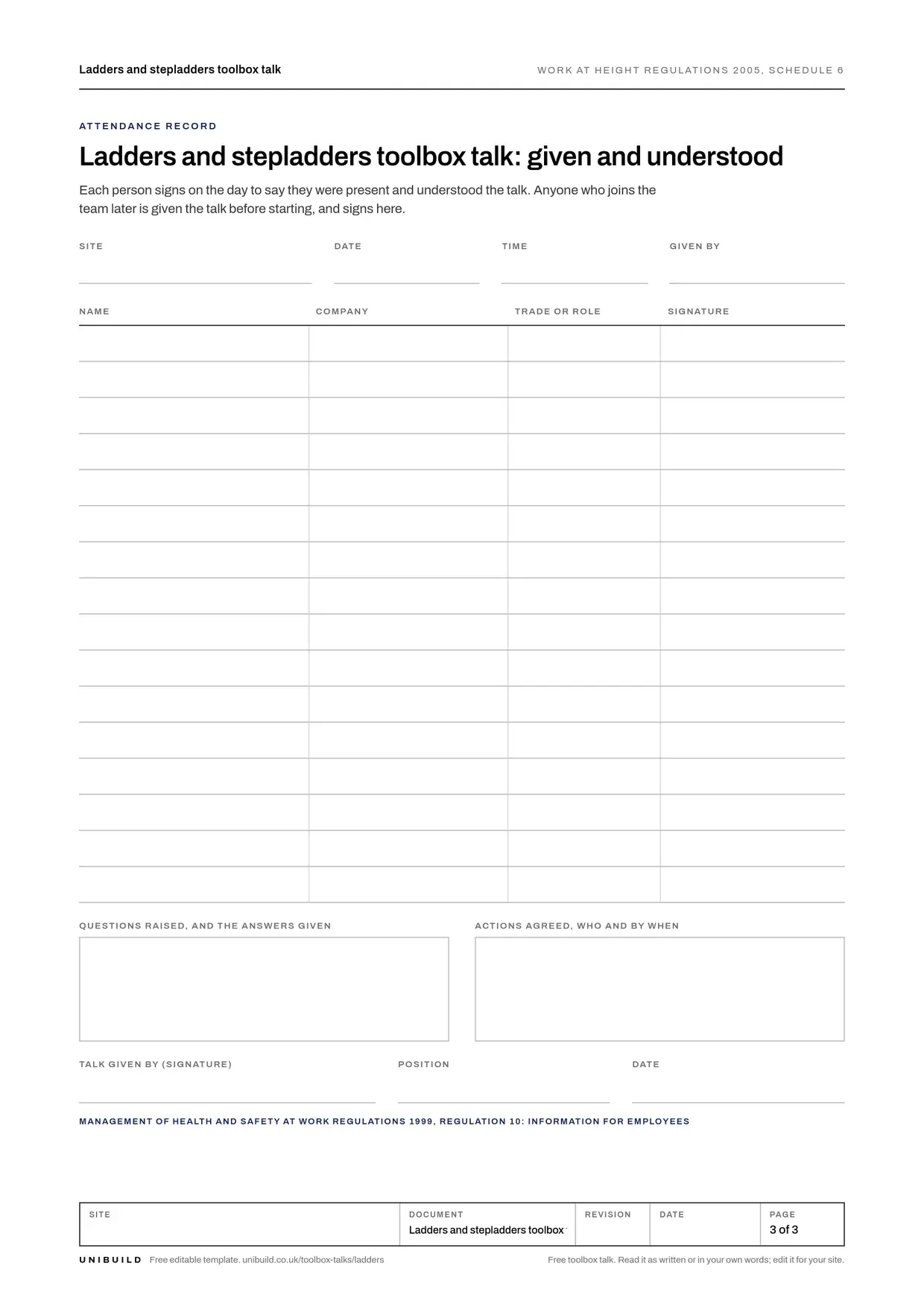
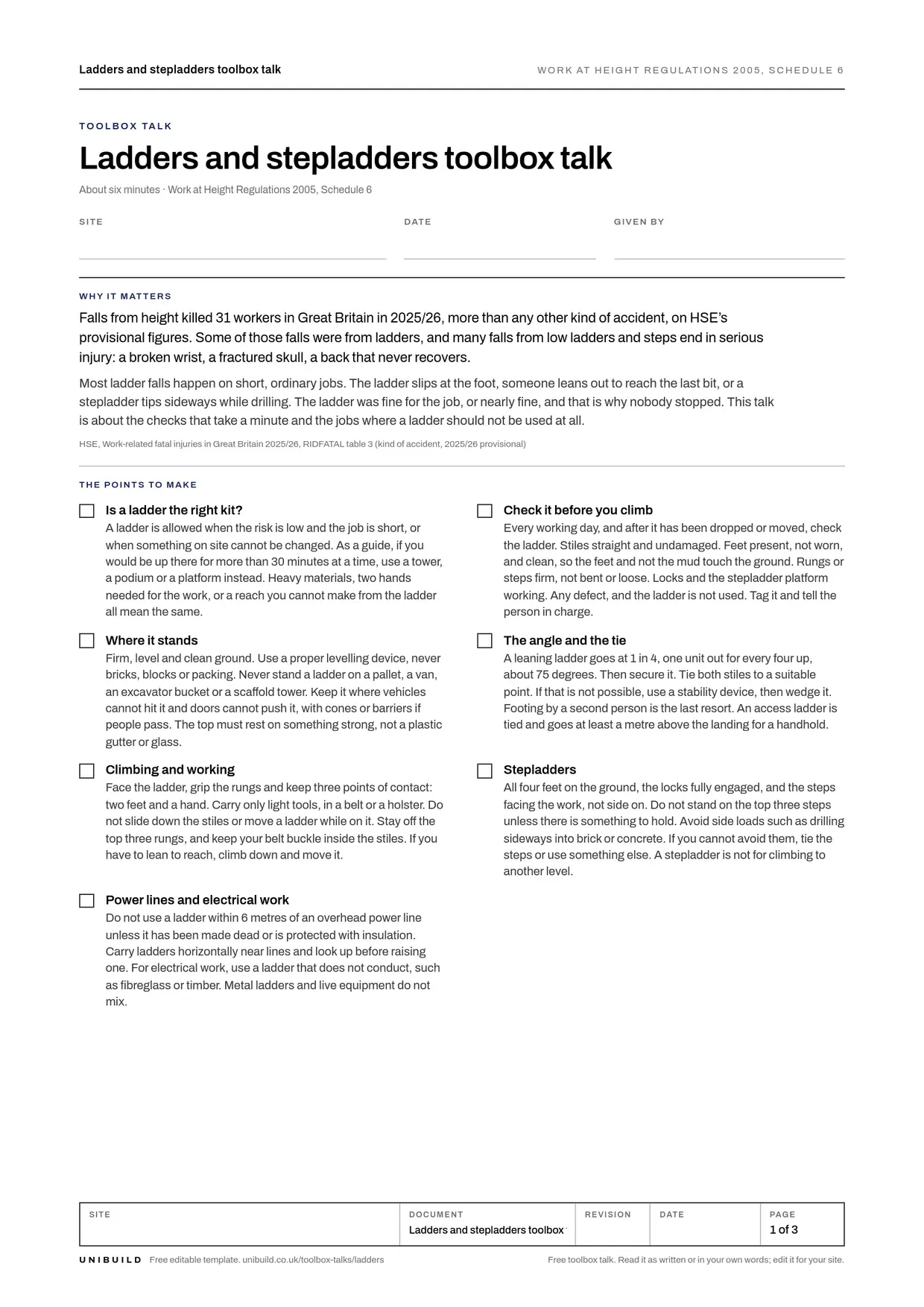
Attendance record page of the free ladders and stepladders toolbox talk from Unibuild, where each person signs to say they were given the talk and understood itFront page of the free ladders and stepladders toolbox talk from Unibuild
Law
Work at Height Regulations 2005, Schedule 6
Time to deliver
About six minutes
Format
PDF and Word, with a sign-off sheet
Cost
Free, always

What this toolbox talk covers

This talk is for anyone who climbs a leaning ladder, a stepladder or a combination ladder at work, from a bricklayer on a short reach to an electrician on steps indoors. It takes about six minutes to give and covers when a ladder is the right kit and when it is not, the check before use, where a ladder can stand, the angle, securing it, and how to work from it without overreaching.

It is written to be read aloud, with the points in the order a supervisor makes them, short lists of do and do not, and questions to put to the team about the ladders on this job. The last page is the record: who gave it, who heard it and what was raised.

Ladders are one part of working at height. The working at height toolbox talk covers edges, platforms and fragile roofs, and the working at height risk assessment holds the full hazards and controls.

Checked against HSE guidance and legislation.gov.uk on .

Toolbox talk · About six minutes

Ladders and stepladders: the talk

Read it as written or in your own words. Tick each point as you make it. Stop for the questions.

Why it matters

Falls from height killed 31 workers in Great Britain in 2025/26, more than any other kind of accident, on HSE’s provisional figures. Some of those falls were from ladders, and many falls from low ladders and steps end in serious injury: a broken wrist, a fractured skull, a back that never recovers.

Most ladder falls happen on short, ordinary jobs. The ladder slips at the foot, someone leans out to reach the last bit, or a stepladder tips sideways while drilling. The ladder was fine for the job, or nearly fine, and that is why nobody stopped. This talk is about the checks that take a minute and the jobs where a ladder should not be used at all.

HSE, Work-related fatal injuries in Great Britain 2025/26, RIDFATAL table 3 (kind of accident, 2025/26 provisional)

The points to make

Is a ladder the right kit?

A ladder is allowed when the risk is low and the job is short, or when something on site cannot be changed. As a guide, if you would be up there for more than 30 minutes at a time, use a tower, a podium or a platform instead. Heavy materials, two hands needed for the work, or a reach you cannot make from the ladder all mean the same.

Check it before you climb

Every working day, and after it has been dropped or moved, check the ladder. Stiles straight and undamaged. Feet present, not worn, and clean, so the feet and not the mud touch the ground. Rungs or steps firm, not bent or loose. Locks and the stepladder platform working. Any defect, and the ladder is not used. Tag it and tell the person in charge.

Where it stands

Firm, level and clean ground. Use a proper levelling device, never bricks, blocks or packing. Never stand a ladder on a pallet, a van, an excavator bucket or a scaffold tower. Keep it where vehicles cannot hit it and doors cannot push it, with cones or barriers if people pass. The top must rest on something strong, not a plastic gutter or glass.

The angle and the tie

A leaning ladder goes at 1 in 4, one unit out for every four up, about 75 degrees. Then secure it. Tie both stiles to a suitable point. If that is not possible, use a stability device, then wedge it. Footing by a second person is the last resort. An access ladder is tied and goes at least a metre above the landing for a handhold.

Climbing and working

Face the ladder, grip the rungs and keep three points of contact: two feet and a hand. Carry only light tools, in a belt or a holster. Do not slide down the stiles or move a ladder while on it. Stay off the top three rungs, and keep your belt buckle inside the stiles. If you have to lean to reach, climb down and move it.

Stepladders

All four feet on the ground, the locks fully engaged, and the steps facing the work, not side on. Do not stand on the top three steps unless there is something to hold. Avoid side loads such as drilling sideways into brick or concrete. If you cannot avoid them, tie the steps or use something else. A stepladder is not for climbing to another level.

Power lines and electrical work

Do not use a ladder within 6 metres of an overhead power line unless it has been made dead or is protected with insulation. Carry ladders horizontally near lines and look up before raising one. For electrical work, use a ladder that does not conduct, such as fibreglass or timber. Metal ladders and live equipment do not mix.

Do

  • Ask whether a tower, podium or platform would do the job better before reaching for a ladder.
  • Check the stiles, feet, rungs and locks before use and after the ladder has been moved or dropped.
  • Set leaning ladders at 1 in 4 on firm, level ground and tie both stiles.
  • Keep three points of contact and carry tools in a belt or holster.
  • Move the ladder rather than lean out. Keep your belt buckle inside the stiles.
  • Tag and report a damaged ladder so nobody else uses it.

Do not

  • Do not use a ladder for jobs over about 30 minutes, heavy materials or work needing both hands.
  • Do not stand a ladder on bricks, pallets, a van, a bucket or a tower.
  • Do not work off the top three rungs or steps.
  • Do not drill side on from a stepladder unless it is tied.
  • Do not use or raise a ladder within 6 metres of an overhead line that is live.
  • Do not use a stepladder to climb up to another level.

Ask the team

  • Which jobs on this site are we doing from ladders, and should any of them be on a tower or podium instead?
  • When did you last check the feet and locks on the ladder you use?
  • Where can our ladders be tied, and who has the stability devices?
  • Where are the overhead lines near this job, and how close do our ladders get?
  • What would you do with a ladder that has a bent stile or a missing foot?

To close

A ladder is a simple bit of kit, and that is why it hurts so many people. It goes up for a quick job, it is not tied, someone leans out to finish, and the foot slides. None of that takes long to fix. Check it, stand it right, tie it, keep three points of contact and climb down to move it. And if the job is long, heavy or needs both hands, it is not a ladder job. Ask for the right kit and we will get it.

Record it. Who gave the talk, where, when, who was there and what was raised. The last page of the sheet is the record.

In Unibuild a talk is read in each operative’s own language and signed on the phone. How toolbox talks work

The law behind this talk

Checked against the source

A ladder only where more suitable equipment is not justified

A ladder is used for work at height only if a risk assessment has shown that more suitable work equipment is not justified because of the low risk and either the short duration of use or existing features on site which the employer cannot alter. Collective protection is given priority over personal protection when selecting equipment.

Work at Height Regulations 2005, regulation 7 and Schedule 6, paragraph 1

Stable, secured and long enough

The surface a ladder rests on is stable, firm, strong enough and suitable, so the rungs stay horizontal. The ladder is positioned so it is stable in use, and a portable ladder is prevented from slipping by securing the stiles, an effective anti-slip or stability device, or an arrangement of equivalent effectiveness. A ladder used for access protrudes far enough above the landing, unless other measures give a firm handhold.

Work at Height Regulations 2005, Schedule 6, paragraphs 2 to 6

Handhold and support

Every ladder is used so that a secure handhold and secure support are always available, and so the user can keep a safe handhold when carrying a load. For a stepladder, a handhold may not be practicable while carrying a load only where a risk assessment shows the stepladder is justified because of the low risk and the short duration of use.

Work at Height Regulations 2005, Schedule 6, paragraph 10

What is on the sheet

3 pages, the talk and the record

The talk, over two pages

Why it matters, the points to make, do and do not, and the questions to ask, laid out to read from in the cabin or at the workface. Space at the top for the site, the date and who is giving it.

The last page, the record

The attendance record: each person's name, company and signature, the questions raised and any actions, signed off by the person who gave the talk. Type into it or print it and pass it round.

The Word version

The same talk as a Word document, so you can put your own letterhead on it, add a site photograph or change a point to match how your job is set up.

Download the talk as PDF Word versionPDF · 3 pages · 209 KB
After it is given

Delivered on the phone, signed in the room

On Unibuild a toolbox talk is picked from the library, read by each operative on their own phone in their own language and signed there and then. The record is filed against the operative, the site and the date.

A site manager sees who has had which talk, and who has not, without a sheet going round on Thursday.

How toolbox talks work on Unibuild
How long should a ladder safety toolbox talk be?
About five to ten minutes. This one reads in about six if you make every point and stop for the questions. A toolbox talk is a short briefing, not ladder training, which covers assessing the risk, choosing the ladder and using it, and is recorded in the training matrix.
Are ladders banned on construction sites?
No. HSE says ladders and stepladders are not banned under health and safety law. They can be a sensible choice for low risk, short duration tasks, but they should not be the first choice. Many principal contractors set stricter site rules, and those rules apply on their sites.
How long can you work on a ladder?
The law does not set a time. HSE’s guide is that if a task would mean staying up a leaning ladder or stepladder for more than 30 minutes at a time, other equipment is recommended. Short duration alone does not decide it; the risk is considered first.
What is the 1 in 4 rule for ladders?
A leaning ladder should be one unit out at the base for every four units up, which is an angle of about 75 degrees. Many ladders have an angle marker on the stile to help set it.
What is the three points of contact rule?
Two feet and one hand on the ladder at all times when climbing, and wherever possible at the work position. On a stepladder, when both hands are needed for a brief moment, two feet and the body supported by the steps counts. If you cannot keep a handhold for more than a brief moment, other measures are needed.
Do ladder checks have to be recorded?
HSE says pre-use checks, done by the user before each use, do not need to be recorded, but problems are reported. The detailed visual inspections the employer arranges at fixed intervals are recorded, and the record shows the condition of each ladder over time.
What standard should a ladder meet?
HSE refers to EN 131 for portable ladders and steps. Ladders made to the older, withdrawn British Standards can still be used if they are in good condition and the user instructions and guidance on safe use are followed.
Can someone foot a ladder instead of tying it?
Only as a last resort. HSE’s order is to tie both stiles to a suitable point, then use an effective stability device, then wedge the ladder, and only if none of those is possible, have someone foot it.
Do we have to keep a record of the talk?
There is no regulation that names toolbox talk records, but employers must give information, instruction and training, and most principal contractors and auditors ask for the evidence. A signed attendance record with the date and the topic is that evidence. The last page of the sheet is the record.
Is this ladder safety toolbox talk free?
Yes. Download it, print it, give it, edit it and put your own name on it, including on paid work and for clients, with no sign-up and no email address.
Next step

The talk given, understood
and on record.

Unibuild keeps every toolbox talk against the operative who signed it, the site and the date, for seven years, ready for the principal contractor or an auditor.

Get a quote
One figure per firm · For UK firms

Right, let’s talk numbers.

Five things about your business. We work your fee out properly and put it in writing the same working day.

What we build for you

  • Your own portalIn the browser, built around your firm
  • Your own appiOS and Android, under your name
  • Everyday AI includedHeavier AI at cost, nothing added
  • One platformEverything in one place, set up by us

Would you rather see it running first? Book a 30-minute demo

Quotation request