Free toolbox talk · Working at height

Working at height toolbox talk

A toolbox talk on working at height, written to be read aloud in about six minutes: why falls keep killing, the checks before anyone steps up, ladders, platforms, edges and fragile roofs. The last page is the attendance record.

PDF · 3 pages · 208 KB · Word 41 KB · Free to use and reuse · Terms

Law
Work at Height Regulations 2005
Time to deliver
About six minutes
Format
PDF and Word, with a sign-off sheet
Cost
Free, always

What this toolbox talk covers

This talk is for anyone who works off the ground: on a ladder, a tower, a scaffold, a roof, a mobile platform or near an edge or an opening. It takes about six minutes to give and covers why falls still kill more site workers than anything else, the order the law asks you to think in, and the checks to make before a job at height starts.

It is written to be read aloud, with the points a supervisor makes in the order they make them, two short lists of do and do not, and questions to put to the team so the talk is a conversation rather than a reading. The last page is the record: who gave it, who heard it and what was raised.

Working at height means any place where a person could fall a distance liable to cause injury. There is no two-metre rule. A fall from a van tailgate or a stepladder can kill, and the Regulations apply from the first rung. The working at height risk assessment holds the full hazards and controls this talk briefs.

Checked against HSE guidance and legislation.gov.uk on .

Toolbox talk · About six minutes

Working at height: the talk

Read it as written or in your own words. Tick each point as you make it. Stop for the questions.

Why it matters

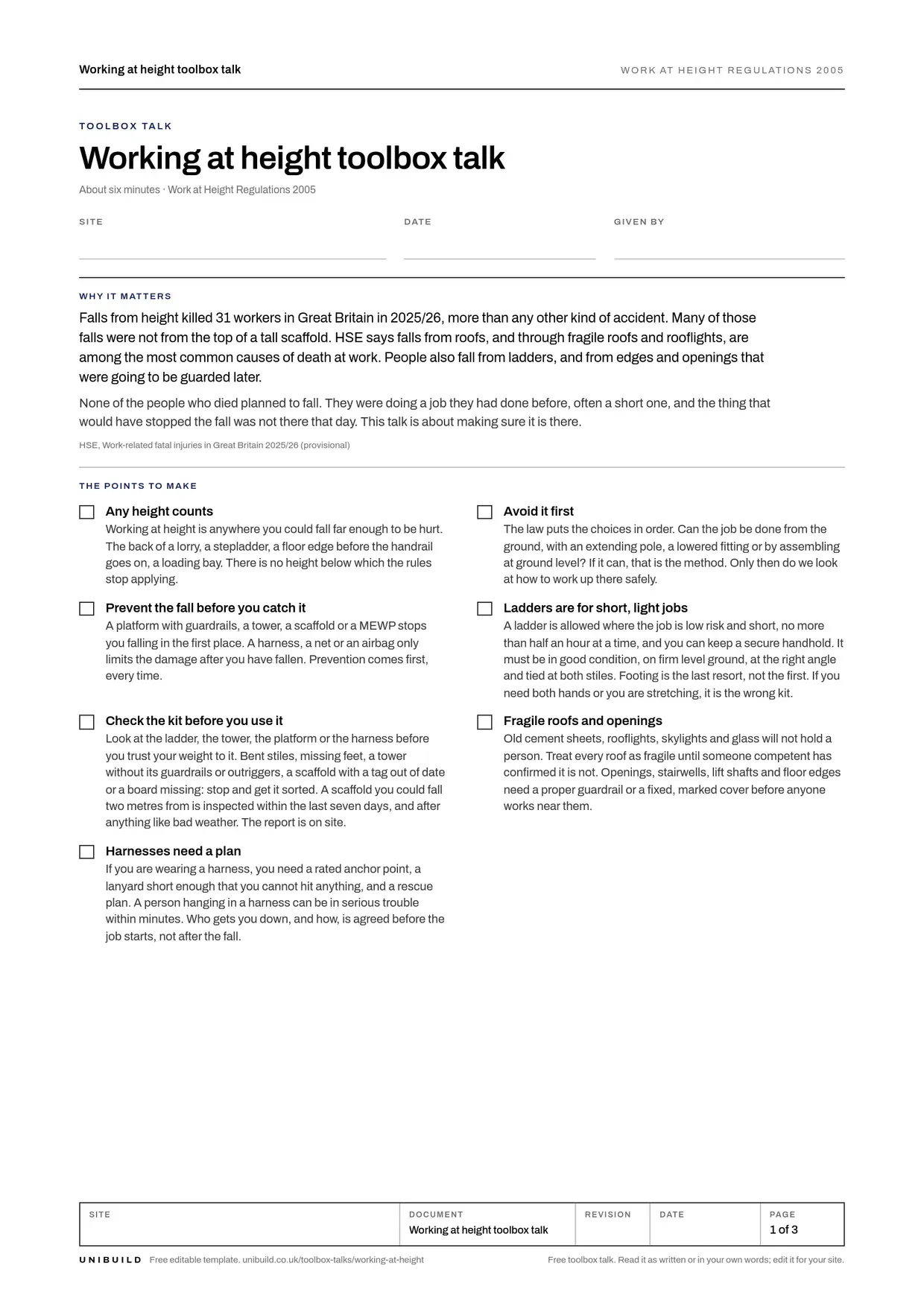
Falls from height killed 31 workers in Great Britain in 2025/26, more than any other kind of accident. Many of those falls were not from the top of a tall scaffold. HSE says falls from roofs, and through fragile roofs and rooflights, are among the most common causes of death at work. People also fall from ladders, and from edges and openings that were going to be guarded later.

None of the people who died planned to fall. They were doing a job they had done before, often a short one, and the thing that would have stopped the fall was not there that day. This talk is about making sure it is there.

HSE, Work-related fatal injuries in Great Britain 2025/26 (provisional)

The points to make

Any height counts

Working at height is anywhere you could fall far enough to be hurt. The back of a lorry, a stepladder, a floor edge before the handrail goes on, a loading bay. There is no height below which the rules stop applying.

Avoid it first

The law puts the choices in order. Can the job be done from the ground, with an extending pole, a lowered fitting or by assembling at ground level? If it can, that is the method. Only then do we look at how to work up there safely.

Prevent the fall before you catch it

A platform with guardrails, a tower, a scaffold or a MEWP stops you falling in the first place. A harness, a net or an airbag only limits the damage after you have fallen. Prevention comes first, every time.

Ladders are for short, light jobs

A ladder is allowed where the job is low risk and short, no more than half an hour at a time, and you can keep a secure handhold. It must be in good condition, on firm level ground, at the right angle and tied at both stiles. Footing is the last resort, not the first. If you need both hands or you are stretching, it is the wrong kit.

Check the kit before you use it

Look at the ladder, the tower, the platform or the harness before you trust your weight to it. Bent stiles, missing feet, a tower without its guardrails or outriggers, a scaffold with a tag out of date or a board missing: stop and get it sorted. A scaffold you could fall two metres from is inspected within the last seven days, and after anything like bad weather. The report is on site.

Fragile roofs and openings

Old cement sheets, rooflights, skylights and glass will not hold a person. Treat every roof as fragile until someone competent has confirmed it is not. Openings, stairwells, lift shafts and floor edges need a proper guardrail or a fixed, marked cover before anyone works near them.

Harnesses need a plan

If you are wearing a harness, you need a rated anchor point, a lanyard short enough that you cannot hit anything, and a rescue plan. A person hanging in a harness can be in serious trouble within minutes. Who gets you down, and how, is agreed before the job starts, not after the fall.

Do

  • Ask whether the job can be done from the ground before anyone goes up.
  • Use a platform with guardrails over a ladder whenever you can.
  • Check ladders, towers, platforms and harnesses before every use, and report defects.
  • Keep a secure handhold on a ladder, face it, and do not overreach.
  • Keep tools and materials from falling: toe boards, tool lanyards, nothing left on the edge.
  • Stop and ask if the weather turns, the ground is soft or the kit is not what the method statement says.

Do not

  • Do not work off the top three rungs of a leaning ladder, or the top three steps of a stepladder unless there is a suitable handhold.
  • Do not step onto a roof, rooflight or fragile sheet without confirmation it will take your weight and the controls in place.
  • Do not alter a scaffold, remove a guardrail or move a tower with people or materials on it.
  • Do not use a pallet on a forklift, a bucket on an excavator or a stack of materials as a working platform.
  • Do not work at height alone where nobody would know you had fallen.
  • Do not wear a harness without a rated anchor point and a rescue plan you have been told.

Ask the team

  • Where on this site today could someone fall far enough to be hurt?
  • What are we using to get up there, and why is that the safest option that would do the job?
  • When was the scaffold last inspected, and where is the tag or the report?
  • Which roofs or rooflights on this job are fragile, and how do we know?
  • If someone is left hanging in a harness, who gets them down and how?

To close

Nobody falls on purpose. People fall because the handrail was off for ten minutes, the ladder was handy, the rooflight looked solid, or the job was nearly done. If what you are about to stand on would not hold a friend, do not stand on it. Stop, ask, and we will sort it.

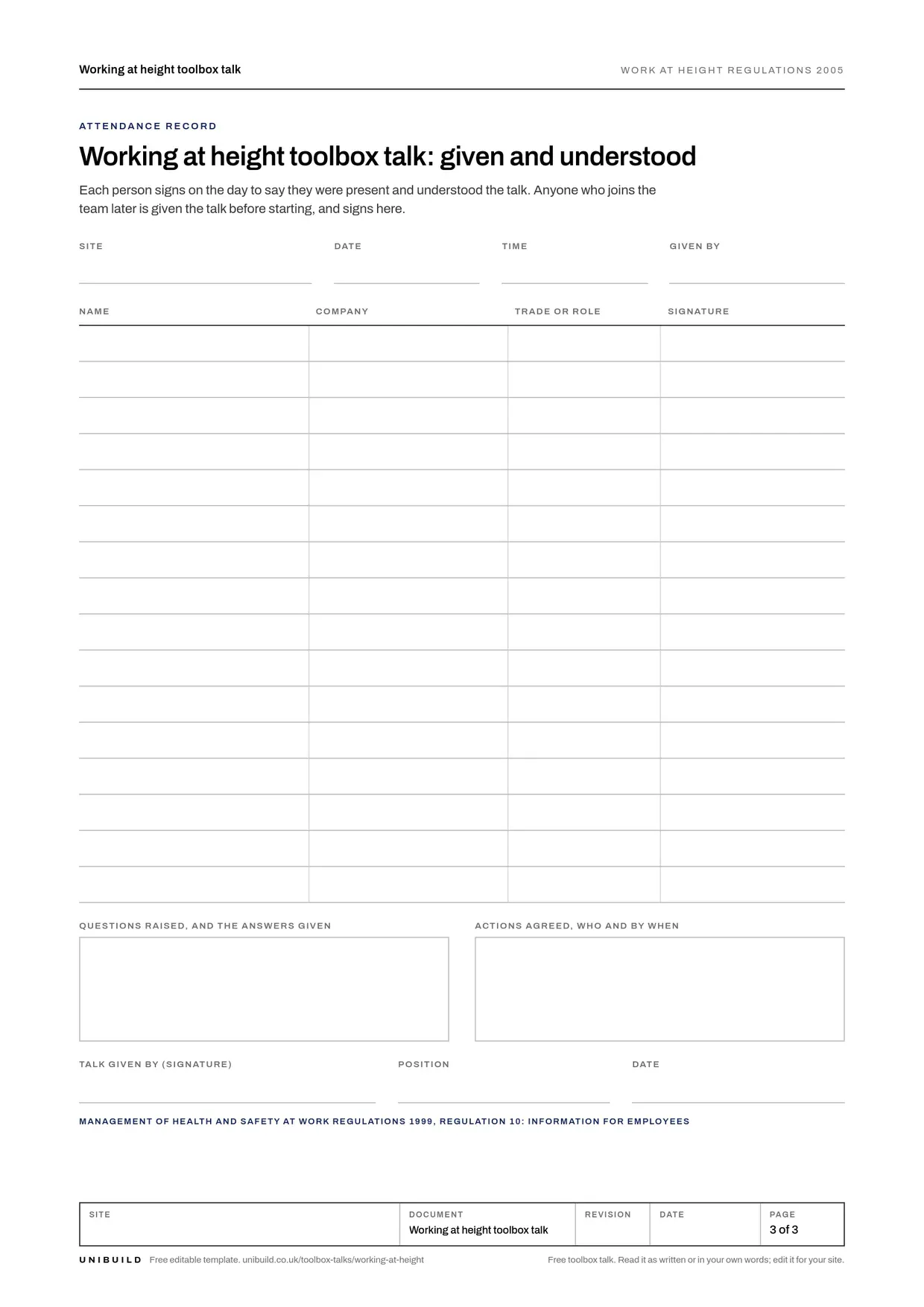
Record it. Who gave the talk, where, when, who was there and what was raised. The last page of the sheet is the record.

In Unibuild a talk is read in each operative’s own language and signed on the phone. How toolbox talks work

The law behind this talk

Checked against the source

Avoid, prevent, minimise

Every employer must take suitable and sufficient measures to prevent anyone falling a distance liable to cause personal injury. Work at height is avoided where reasonably practicable; where it is not, the employer prevents falls by work equipment or other measures, and where a fall cannot be prevented, minimises the distance and consequences. In choosing equipment, collective measures such as guardrails take priority over personal measures such as harnesses.

Work at Height Regulations 2005, regulations 6(2) to 6(5) and 7(1)

Planned, supervised and done by competent people

Work at height is properly planned, appropriately supervised and carried out in a manner which is, so far as is reasonably practicable, safe. Planning includes selecting the equipment and planning for emergencies and rescue. Work is not carried out when weather conditions could put health or safety at risk. Nobody is engaged in work at height, or in organising, planning or supervising it, unless they are competent or being trained under supervision.

Work at Height Regulations 2005, regulations 4 and 5

Fragile surfaces

No person at work passes across or near, or works on, from or near, a fragile surface where it is reasonably practicable to do the work safely without doing so. Where it is not, suitable and sufficient platforms, coverings, guardrails or similar means of support are provided and used, the distance and consequences of any fall are minimised, and warning notices are fixed at the approach to the surface or people are made aware of it another way.

Work at Height Regulations 2005, regulation 9

Ladders, and inspection

A ladder is used for work at height only where a risk assessment shows that more suitable equipment is not justified because of the low risk and the short duration of use, or because of features of the site that cannot be altered. Work equipment whose safety depends on how it was installed is inspected in position before first use, and again after anything likely to affect its safety. A working platform used for construction work, from which a person could fall two metres or more, is not used unless it has been inspected within the previous seven days, and the result is recorded.

Work at Height Regulations 2005, regulation 12 and Schedule 6

What is on the sheet

3 pages, the talk and the record

The talk, over two pages

Why it matters, the points to make, do and do not, and the questions to ask, laid out to read from in the cabin or at the workface. Space at the top for the site, the date and who is giving it.

The last page, the record

The attendance record: each person's name, company and signature, the questions raised and any actions, signed off by the person who gave the talk. Type into it or print it and pass it round.

The Word version

The same talk as a Word document, so you can put your own letterhead on it, add a site photograph or change a point to match how your job is set up.

Download the talk as PDF Word versionPDF · 3 pages · 208 KB
After it is given

Delivered on the phone, signed in the room

On Unibuild a toolbox talk is picked from the library, read by each operative on their own phone in their own language and signed there and then. The record is filed against the operative, the site and the date.

A site manager sees who has had which talk, and who has not, without a sheet going round on Thursday.

How toolbox talks work on Unibuild
How long should a working at height toolbox talk be?
About five to ten minutes. This one reads in about six if you make every point and stop for the questions. A toolbox talk is a short, focused briefing, not a training course. Working at height training is separate and is recorded in the training matrix.
Is there a minimum height for work at height?
No. The Work at Height Regulations 2005 apply to any place where a person could fall a distance liable to cause personal injury. The old two-metre rule went in 2005. A fall from a stepladder or a vehicle tailgate counts.
Can we still use ladders?
Yes, for low-risk, short-duration work where a risk assessment shows nothing safer is justified, and for site features that cannot be changed. HSE describes short duration as no more than 30 minutes at a time. The ladder still has to be in good condition, on firm, level ground, at the right angle, secured, and used with a secure handhold and without overreaching.
When do we need a harness?
When a fall cannot be prevented by a guardrail, a platform or another collective measure, and the harness is the remaining way to minimise the consequences. A harness needs a rated anchor point, the right lanyard and a rescue plan. It is the last choice, not the first.
How often should we give this talk?
The law does not set an interval. Give it when a team starts work at height on a job, when the access changes, after a near miss or a fall anywhere on site, and as part of a rolling programme so no topic goes more than a few months without a refresh. Record each delivery.
Who can deliver a toolbox talk on working at height?
A supervisor, site manager or a competent member of the team who knows the job and the controls. The person delivering it should be able to answer the questions on the sheet for this site. If they cannot, they bring someone who can.
Do we have to keep a record of the talk?
There is no regulation that names toolbox talk records, but the Management Regulations require health and safety training, repeated where appropriate, and most principal contractors and auditors ask for the evidence. A signed attendance record, with the date and the topic, is the evidence. The last page of the sheet is that record.
Is this working at height toolbox talk free?
Yes. Download it, print it, give it, edit it and put your own name on it, including on paid work and for clients, with no sign-up and no email address.
Next step

The talk given, understood
and on record.

Unibuild keeps every toolbox talk against the operative who signed it, the site and the date, for seven years, ready for the principal contractor or an auditor.