
Steel erection risk assessment and method statement
A steel erection RAMS, pre-filled for structural steelwork: offloading, crane lifts, bolting up at height, temporary bracing and the decking interface. Edit it for your frame, then brief it.
- Law
- CDM 2015 and LOLER 1998
- Frame stability
- CDM 2015, regulation 19
- Format
- Editable PDF and Word
- Cost
- Free, always
What goes in a steel erection risk assessment?
A steel erection risk assessment, or risk assessment for structural steel works, covers getting the frame up safely: offloading, crane lifts, bolting up at height, keeping the part-built frame stable and protecting people below. The steel erection method statement sets out the order the members go up and how the erectors are protected at each stage.
The law requires a suitable and sufficient risk assessment, and CDM 2015 lists the assembly of heavy prefabricated components as work involving particular risks. Regulation 19 adds that all practicable steps are taken so a structure in a temporary state of weakness does not collapse. A principal contractor will expect the RAMS, the lift plans and the bracing details before the first column goes up.
HSE says the erection sequence should be developed with the frame designer or a structural engineer, with bracing, guys or stays keeping the frame stable at every stage. A steel structure erection method statement written for the actual frame, ground and crane is what a reviewer reads first.
Checked against legislation.gov.uk and HSE guidance on .
Steel erection hazards and controls
18 hazards, rated before and after controlsThe significant hazards on a typical structural steel frame, single storey or multi-storey, with the controls a reviewer expects to see. Delete what does not apply and add what your frame has.
Falls while bolting up connections
Erectors making connections at column heads and beam ends before the floor or roof is in.
- Connections made from MEWPs or other working platforms wherever the ground and the frame allow.
- Safety nets below the work where platforms cannot reach, rigged and handed over before erectors work above them.
- Full harness with twin lanyard as the backup, clipped to an anchor the designer or supervisor has confirmed.
BeforeHigh 20AfterMedium 5
Walking or straddling beams
Erectors tempted to walk a top flange or sit on a beam to reach a connection.
- Walking on the top flange of a beam is banned on this job, as HSE guidance says it must never be done.
- Beam straddling only on I-beams, for short specific tasks named in the method statement, sitting astride with both feet on the bottom flange.
- Harness and twin lanyard worn and clipped whenever straddling.
BeforeHigh 15AfterMedium 5
Collapse of the part-erected frame
Erectors on the frame and anyone nearby, when columns or bays are left unbraced or out of sequence.
- Erection sequence and temporary bracing agreed with the frame designer and written into the method statement.
- Each column held by its holding down bolts, braces or guys as the method statement shows before release, and each bay made stable before the next starts.
- Frame checked for line, level and plumb at the end of each shift, and left stable overnight.
BeforeHigh 15AfterMedium 5
Temporary bracing removed too early
Everyone on and near the frame, if bracing comes out before the permanent structure is complete.
- Bracing, guys and props recorded as temporary works, with a named person who controls them.
- Nothing struck until the designer confirms the permanent bracing, floors or walls are in and connected.
- Removal recorded in the temporary works register; other trades told not to touch bracing.
BeforeHigh 15AfterMedium 5
Foundations and holding down bolts
Erectors landing columns on bases that are out of position, under strength or not ready.
- Bases handed over in writing by the principal contractor, with holding down bolt positions and levels checked.
- Packs and shims to the drawing; nuts and washers fitted to every holding down bolt before the crane releases a column.
- Grouting carried out to the method statement and the designer's timing.
BeforeHigh 15AfterMedium 5
Steel falling during the lift
Slingers and anyone below, when a member slips, a sling fails or a hook opens.
- Every lift under a lift plan from a competent person; slinging by trained slinger signallers.
- Accessories marked with their safe working load, checked before use and examined at least every six months.
- Nobody under a suspended load, and lifts routed away from people.
BeforeHigh 15AfterMedium 5
Struck or trapped by swinging steel
Erectors guiding members into place at height and slingers at ground level.
- Tag lines on long members, handled by people standing clear of the swing.
- Hands kept off the member until it is close to its connection; nobody between the steel and a fixed structure.
- Hook held until the connection has the bolts the method statement calls for.
BeforeMedium 12AfterMedium 8
Crane or MEWP overturning
Operators and people nearby, when ground gives way under outriggers or wheels.
- Ground under crane positions and MEWP routes assessed, with the bearing information from the principal contractor.
- Outriggers set fully on mats sized to the loads; MEWPs kept off fresh backfill, covers and slopes beyond the manual.
- Site traffic kept clear of plant in use.
BeforeHigh 15AfterMedium 5
Offloading steel from trailers
Drivers and erectors on or beside the trailer while members are slung and lifted off.
- Steel delivered in erection order and slung from the ground where practicable, so nobody works on the bed.
- Load checked as stable before straps are released; bearers between layers.
- Offloading area barriered, away from the public, with a banksman for reversing.
BeforeMedium 12AfterLow 4
Dropped bolts, tools and materials
Other trades, visitors and erectors working below the frame.
- Exclusion zone below the erection area, barriered and signed, and no trades working underneath.
- Bolts carried in bags or buckets; tools on lanyards at height.
- Toe boards or edge protection fitted at open edges as soon as the frame allows.
BeforeHigh 16AfterMedium 8
Decking bundles landed on the steel
Erectors and deckers, when bundles overload a beam, slide or are opened before the area is ready.
- Bundles landed only at the positions agreed with the decking contractor and the designer, on connected and braced steel.
- Bundles secured against sliding and wind, and not opened until the decking team is ready to fix.
- Nets or other fall protection in place below before decking starts.
BeforeHigh 15AfterMedium 5
Falls at the decking leading edge
Deckers laying and fixing sheets, and anyone walking onto an unfixed sheet.
- Decking laid and fixed to the decking contractor's method statement, following the BCSA code of practice for metal decking.
- Safety nets below and edge protection at the perimeter; loose sheets fixed or removed at the end of each shift.
- Openings covered or guarded as soon as they are formed.
BeforeHigh 15AfterMedium 5
Wind on the frame and on lifts
Erectors at height and lift teams, when wind moves members, bundles or the part-built frame.
- Forecast checked each morning; wind limits for lifts and for work at height set in the lift plan.
- Lifting stopped at the limit; members with large areas lifted only in calm conditions.
- Frame and loose materials made secure before the team leaves.
BeforeMedium 12AfterLow 4
Overhead power lines
Lift teams and MEWP operators, if the jib, load or platform comes close to a line.
- Lines found at the planning stage; the network operator asked to make them dead or divert them.
- Where lines stay live, barriers and goal posts set out to HSE GS6 so plant cannot reach them.
BeforeMedium 10AfterMedium 5
Manual handling of members and bolts
Erectors and labourers moving small members, bolt boxes and packs.
- Members lifted by crane, telehandler or trolley; only small items handled by hand.
- Bolt boxes split into bags that are light enough to carry and pass up.
- Grip gloves worn; team briefed on lifting technique.
BeforeMedium 9AfterMedium 6
Vibration and noise from bolting tools
Erectors using impact wrenches and torque tools for long periods while bolting up.
- Bolting tools chosen for low vibration, maintained, and use planned to keep daily exposure down.
- Hearing protection worn when using impact wrenches.
- Regular users under health surveillance where the noise or vibration assessment calls for it.
BeforeMedium 9AfterMedium 6
Site welding and cutting
Erectors and others near site welds, cut-outs and stud welding.
- Hot work done under a hot work permit and the separate hot works RAMS, with a fire watch.
- Fume, sparks and falling slag controlled below the work, with the area under it kept clear.
BeforeMedium 12AfterLow 4
Rescue after a fall
An erector suspended in a harness or caught in a safety net.
- Written rescue plan before work starts, with MEWP or rescue kit on site and the team trained in it.
- Never working alone at height; rescue started at once, without waiting for the emergency services.
BeforeMedium 10AfterMedium 5
Scores are likelihood times severity on the five by five matrix in the template. They are typical ratings for this work, a starting point for your own assessment of your site.
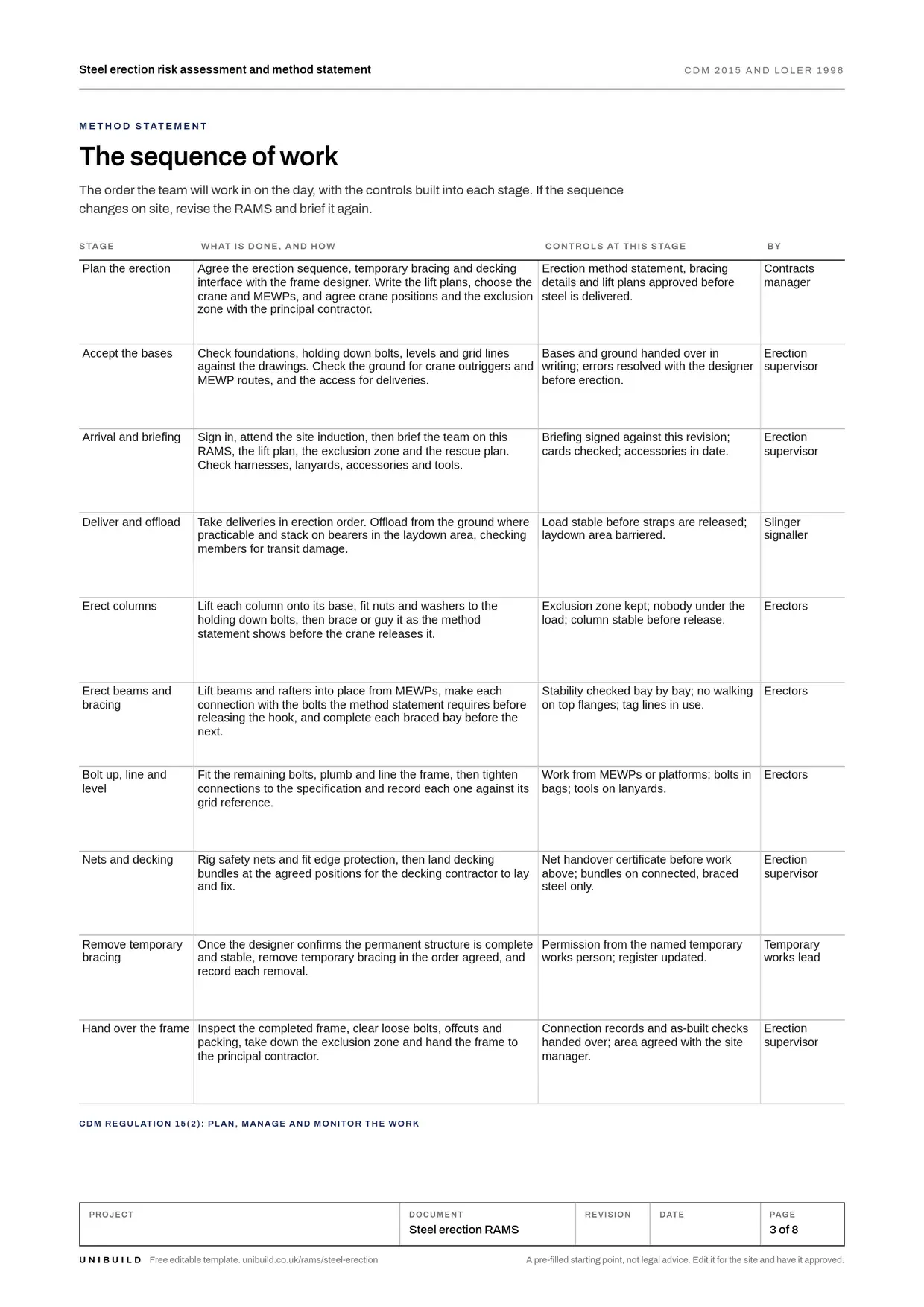
Steel erection method statement: the sequence of work
The order of work, with the controls at each stageThe order the erection team works in, with the controls built into each stage. If the sequence, the crane or the bracing changes, revise the RAMS and brief it again.
Plan the erection
Agree the erection sequence, temporary bracing and decking interface with the frame designer. Write the lift plans, choose the crane and MEWPs, and agree crane positions and the exclusion zone with the principal contractor.
ControlsErection method statement, bracing details and lift plans approved before steel is delivered.
Accept the bases
Check foundations, holding down bolts, levels and grid lines against the drawings. Check the ground for crane outriggers and MEWP routes, and the access for deliveries.
ControlsBases and ground handed over in writing; errors resolved with the designer before erection.
Arrival and briefing
Sign in, attend the site induction, then brief the team on this RAMS, the lift plan, the exclusion zone and the rescue plan. Check harnesses, lanyards, accessories and tools.
ControlsBriefing signed against this revision; cards checked; accessories in date.
Deliver and offload
Take deliveries in erection order. Offload from the ground where practicable and stack on bearers in the laydown area, checking members for transit damage.
ControlsLoad stable before straps are released; laydown area barriered.
Erect columns
Lift each column onto its base, fit nuts and washers to the holding down bolts, then brace or guy it as the method statement shows before the crane releases it.
ControlsExclusion zone kept; nobody under the load; column stable before release.
Erect beams and bracing
Lift beams and rafters into place from MEWPs, make each connection with the bolts the method statement requires before releasing the hook, and complete each braced bay before the next.
ControlsStability checked bay by bay; no walking on top flanges; tag lines in use.
Bolt up, line and level
Fit the remaining bolts, plumb and line the frame, then tighten connections to the specification and record each one against its grid reference.
ControlsWork from MEWPs or platforms; bolts in bags; tools on lanyards.
Nets and decking
Rig safety nets and fit edge protection, then land decking bundles at the agreed positions for the decking contractor to lay and fix.
ControlsNet handover certificate before work above; bundles on connected, braced steel only.
Remove temporary bracing
Once the designer confirms the permanent structure is complete and stable, remove temporary bracing in the order agreed, and record each removal.
ControlsPermission from the named temporary works person; register updated.
Hand over the frame
Inspect the completed frame, clear loose bolts, offcuts and packing, take down the exclusion zone and hand the frame to the principal contractor.
ControlsConnection records and as-built checks handed over; area agreed with the site manager.
What the law asks for steel erection
Checked against the sourceStability of structures
All practicable steps must be taken to stop a structure collapsing where construction work leaves it unstable or in a temporary state of weakness. Temporary supports must be designed, installed and maintained for the foreseeable loads, and no structure may be loaded so as to make it unsafe.
CDM 2015, regulation 19Work with particular risks
The assembly or dismantling of heavy prefabricated components is listed as work involving particular risks. Where it applies, the construction phase plan must include specific measures for it, and every contractor plans, manages and monitors its own work.
CDM 2015, regulations 12(2) and 15(2), Schedule 3Lifting operations
Every lifting operation involving lifting equipment must be properly planned by a competent person, appropriately supervised and carried out in a safe manner.
LOLER 1998, regulation 8Avoiding falls
Work at height is avoided where it is reasonably practicable to work safely otherwise. Where it is not, work equipment that prevents a fall comes first, and equipment that minimises the distance and consequences of a fall comes after that.
Work at Height Regulations 2005, regulation 6Nets and rescue
A safety net is used only where safer equipment is not reasonably practicable, enough people are trained in it, including rescue, and it is securely attached to anchors strong enough for a fall. Planning work at height includes planning for emergencies and rescue.
Work at Height Regulations 2005, regulation 4(2) and Schedule 4Risk assessment
Every employer must make a suitable and sufficient assessment of the risks, and record the significant findings if they employ five or more people.
Management of Health and Safety at Work Regulations 1999, regulation 3Competence, equipment and PPE
Competence and cards
- Steel erectors Trained and experienced erectors; a CSCS card backed by an NVQ Level 2 in steel erection is what most principal contractors expect.
- Erection supervisor An experienced erector with supervisory training, on site throughout erection.
- Appointed person Plans the lifts and writes the lift plans, trained to the BS 7121 recommendations.
- Slinger signallers Trained to sling steel and give signals, such as the CPCS A40 category.
- MEWP operators IPAF trained for the MEWP category and familiarised on the model.
- Net riggers FASET trained riggers who install nets to BS EN 1263-2 and issue a handover certificate.
Plant and equipment
- Mobile crane Thorough examination in date; load chart for the set-up; rated capacity indicator tested.
- Slings, chains, shackles Marked with safe working load; pre-use check; examined every 6 months.
- Boom and scissor MEWPs Thorough examination in date; daily pre-use check; ground controls tested.
- Safety nets Installed to BS EN 1263-2; handover certificate; checked after any impact.
- Harnesses and twin lanyards Pre-use check; detailed inspection every three months, as HSE suggests for steel erection.
- Impact wrenches and torque tools Checked before use; torque tools calibrated; tool lanyards at height.
PPE
- Safety helmet with chin strap, worn at all times in the erection area.
- Full body harness with twin lanyard, where collective protection is not in place, and in boom MEWPs.
- Safety boots with toe protection and a grip sole.
- Gloves with good grip, for handling steel, slings and bolts.
- High-visibility clothing with the slinger signaller clearly identified.
Permits and plans
A lift plan for every lift. Temporary works design and a named person to permit removal of temporary bracing. A hot work permit for any site welding, cutting or stud welding. A permit to work where the principal contractor's rules require one, for example near live services.
Emergency and rescue
Rescue plan for an erector suspended in a harness or caught in a net, with a MEWP or rescue kit on site and the team practised. First aider on site, the nearest accident and emergency department named on the briefing, and lifting stopped and the frame made safe if a member, the crane or the ground moves.
Toolbox talk: steel erection safety
Read this to the team before work starts, tick each point as it is covered, and record who attended.
- We erect in the order in the method statement. Nobody changes the sequence or skips a brace without the supervisor and the designer.
- Nobody walks a top flange. Connections are made from the MEWP or the platform, and straddling is only for the tasks we have planned.
- The hook stays on until the connection has its bolts. Columns are braced or guyed before the crane lets go.
- Nobody stands under a load or works under the frame while we are erecting. The exclusion zone stays up.
- Bolts go in bags, tools go on lanyards, and nothing is thrown down.
- Temporary bracing is not ours to remove on a whim. It comes out only with permission, and we record it.
Ask the team
- Where is the rescue kit, and who has been shown how to use it?
- Which bays must be braced before we leave site tonight?
- At what wind do we stop lifting today?
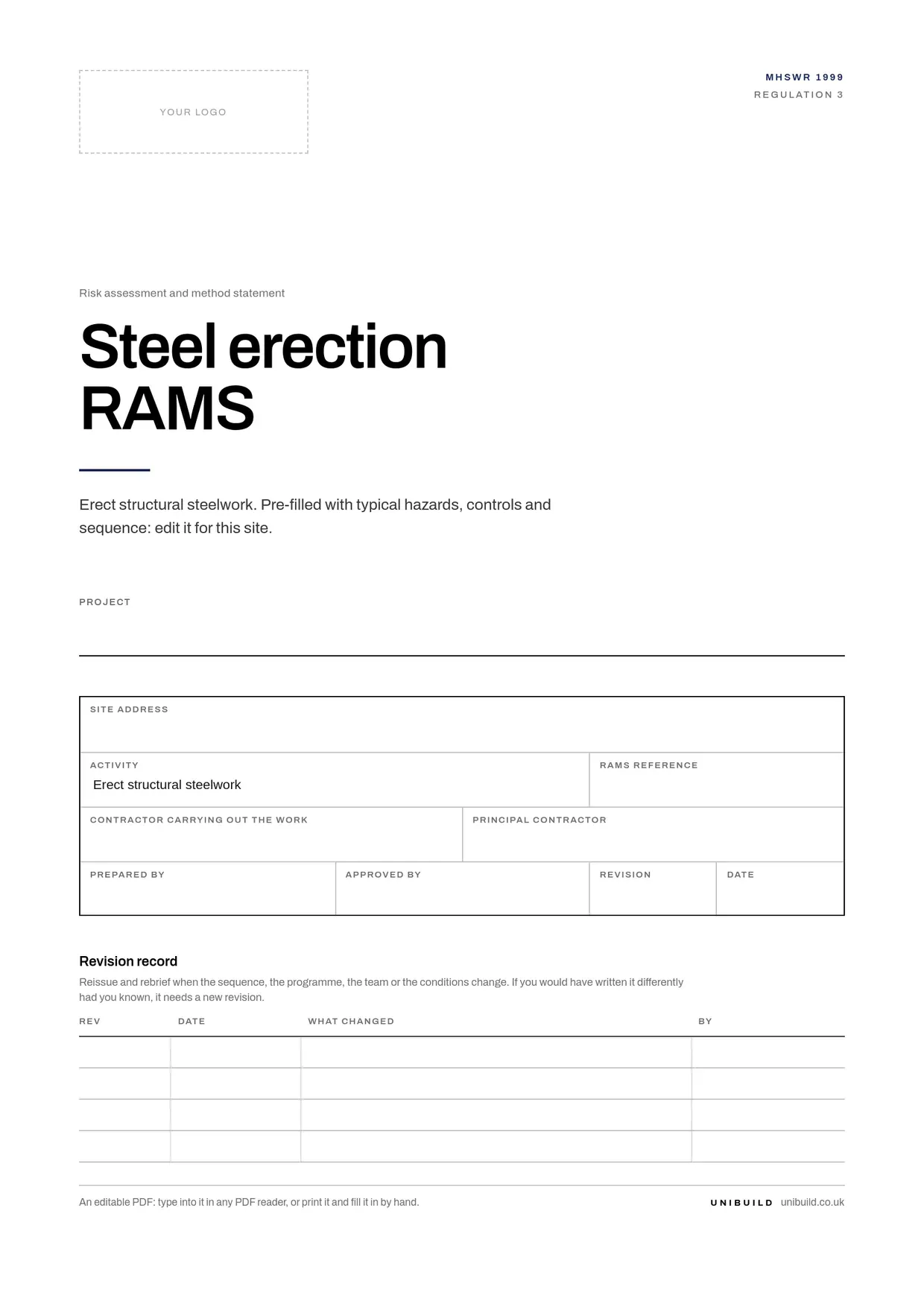
What is in the steel erection RAMS template
8 pages, pre-filled and editableThe work, pre-filled
Scope, location and access, interfaces with the decking contractor and other trades, the documents the RAMS relies on, and the team.
The sequence of work
Ten stages from planning the erection to handing over the frame, with the controls and the person responsible at each one.
Hazards and controls
Eighteen steel erection hazards rated before and after controls on a five by five matrix, with room for your own.
Plant, PPE and permits
Cranes, MEWPs, nets and accessories with their checks, PPE by type, and the permits and plans the job needs.
Emergency and rescue
The rescue plan for an erector suspended in a harness or caught in a net, first aid and the environment section.
Briefing record
Twenty signatures against the revision, taken on the day before the work starts.
Brief it, and get it signed on the phone
On Unibuild a RAMS is written from a template, approved, then read by each operative on their phone in their own language and signed. Subcontract and agency workers sign through a link, with no app to install.
Every signature carries its date and time and prints as the last page of the RAMS PDF. Change the RAMS and it has to be signed again.
How RAMS work on UnibuildSteel erection RAMS questions
Is this steel erection RAMS template free?
What should a steel erection method statement include?
Is a risk assessment for structural steel works a legal requirement?
Who is responsible for the stability of the frame during erection?
Can steel erectors walk on beams?
When can temporary bracing be removed?
Do steel erectors need a harness in a MEWP?
Does site welding need its own RAMS?
RAMS templates for other trades and hazards
All free, pre-filled and editableBy trade
- Air conditioning and HVAC RAMS
- Bricklaying RAMS
- Carpentry and joinery RAMS
- CCTV installation RAMS
- Cleaning risk assessment
- Concrete works RAMS
- Demolition RAMS
- Drylining RAMS
- Electrical RAMS
- Facilities maintenance RAMS
- Fire alarm installation RAMS
- Glazing and window RAMS
- Groundworks RAMS
- Hot works and welding RAMS
- Insulation RAMS
- Landscaping and fencing RAMS
- Painting and decorating RAMS
- Pest control risk assessment
- Plastering and rendering RAMS
- Plumbing and heating RAMS
- Rail RAMS
- Refurbishment RAMS
- Roofing RAMS
- Rope access risk assessment
- Scaffolding RAMS
- Solar PV installation RAMS
- Steel erection RAMS
- Temporary works RAMS
- Tiling and flooring RAMS
- Tree surgery RAMS
By hazard
- Asbestos risk assessment
- Confined space risk assessment
- COSHH risk assessment
- Dust risk assessment
- Forklift and telehandler risk assessment
- Housekeeping risk assessment
- Lifting operations risk assessment
- Lone working risk assessment
- Manual handling risk assessment
- MEWP risk assessment
- Noise and vibration risk assessment
- Plant and excavator risk assessment
- Power tools risk assessment
- Traffic management risk assessment
- Working at height risk assessment
The blank RAMS template, the RAMS review checklist and every other free form are on Free downloads.
The RAMS, read and signed
before the work starts.
Unibuild keeps every RAMS with its versions, its approvals and each operative’s signature against the revision they read, for seven years, ready for the principal contractor or an auditor.