Free toolbox talk · Slips, trips and falls

Slips, trips and falls toolbox talk

A toolbox talk on slips, trips and falls on the same level, written to be read aloud in about six minutes: why they are the commonest injury on site, walkways, cables, mud, spills, light and footwear. The last page is the attendance record.

PDF · 3 pages · 209 KB · Word 41 KB · Free to use and reuse · Terms

Law
Workplace Regulations 1992 regulation 12, CDM 2015 regulations 17 and 18
Time to deliver
About six minutes
Format
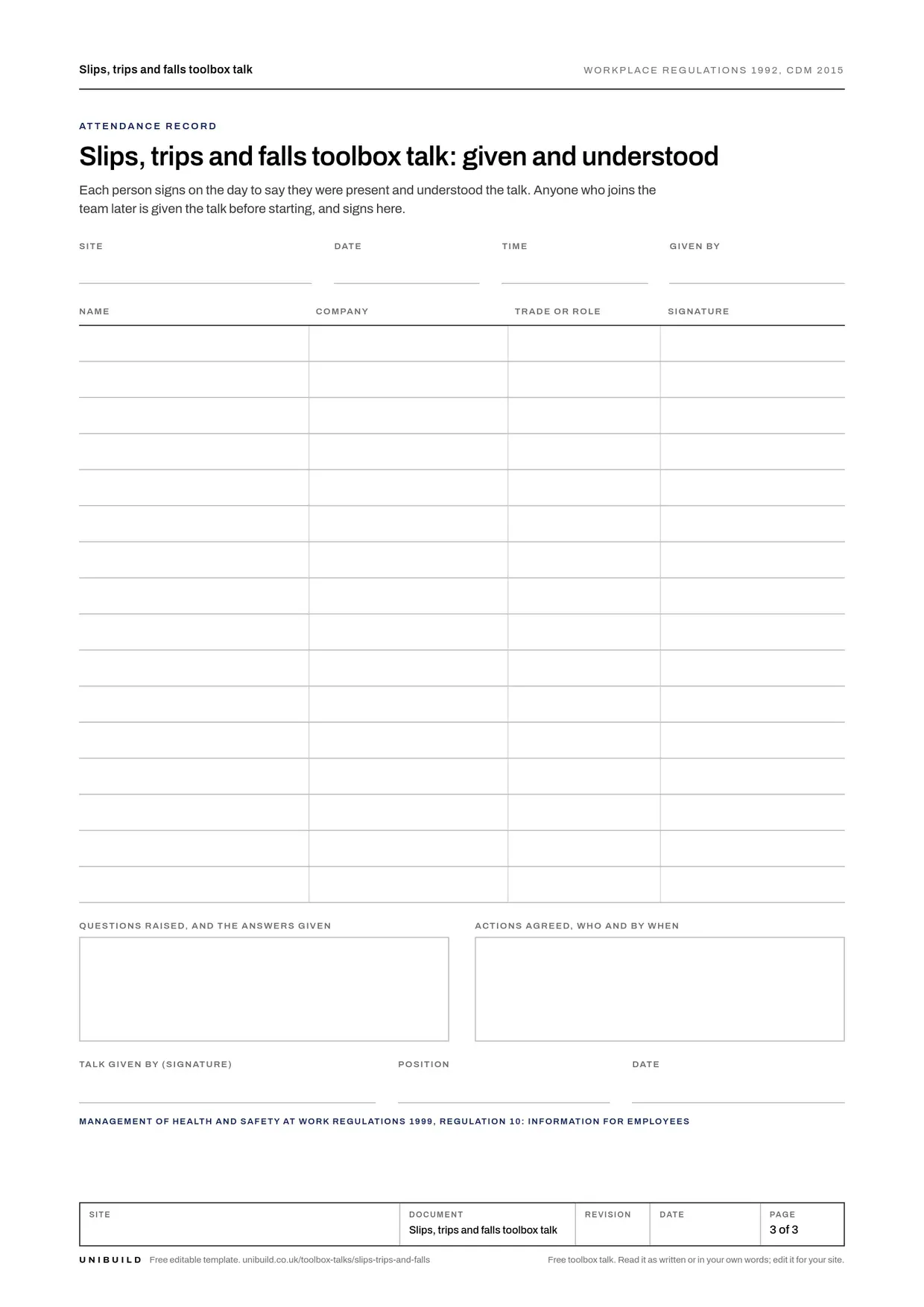
PDF and Word, with a sign-off sheet
Cost
Free, always

What this toolbox talk covers

This talk is for everyone on site, because everyone walks across it. It covers slips, trips and falls on the same level: the mud at the gate, the cable across the corridor, the offcuts left where the next trade has to walk, the spill nobody owned, the stairwell with no light. It takes about six minutes to give and ends with the questions that turn it into a walk round.

It is written to be read aloud, with the points a supervisor makes in the order they make them, two short lists of do and do not, and questions to put to the team. The last page is the record: who gave it, who heard it and what was raised.

Falls from height are a different subject with their own law and their own briefing, the working at height toolbox talk. The slips, trips and housekeeping risk assessment holds the full hazards and controls this talk briefs.

Checked against HSE guidance and legislation.gov.uk on .

Toolbox talk · About six minutes

Slips, trips and falls: the talk

Read it as written or in your own words. Tick each point as you make it. Stop for the questions.

Why it matters

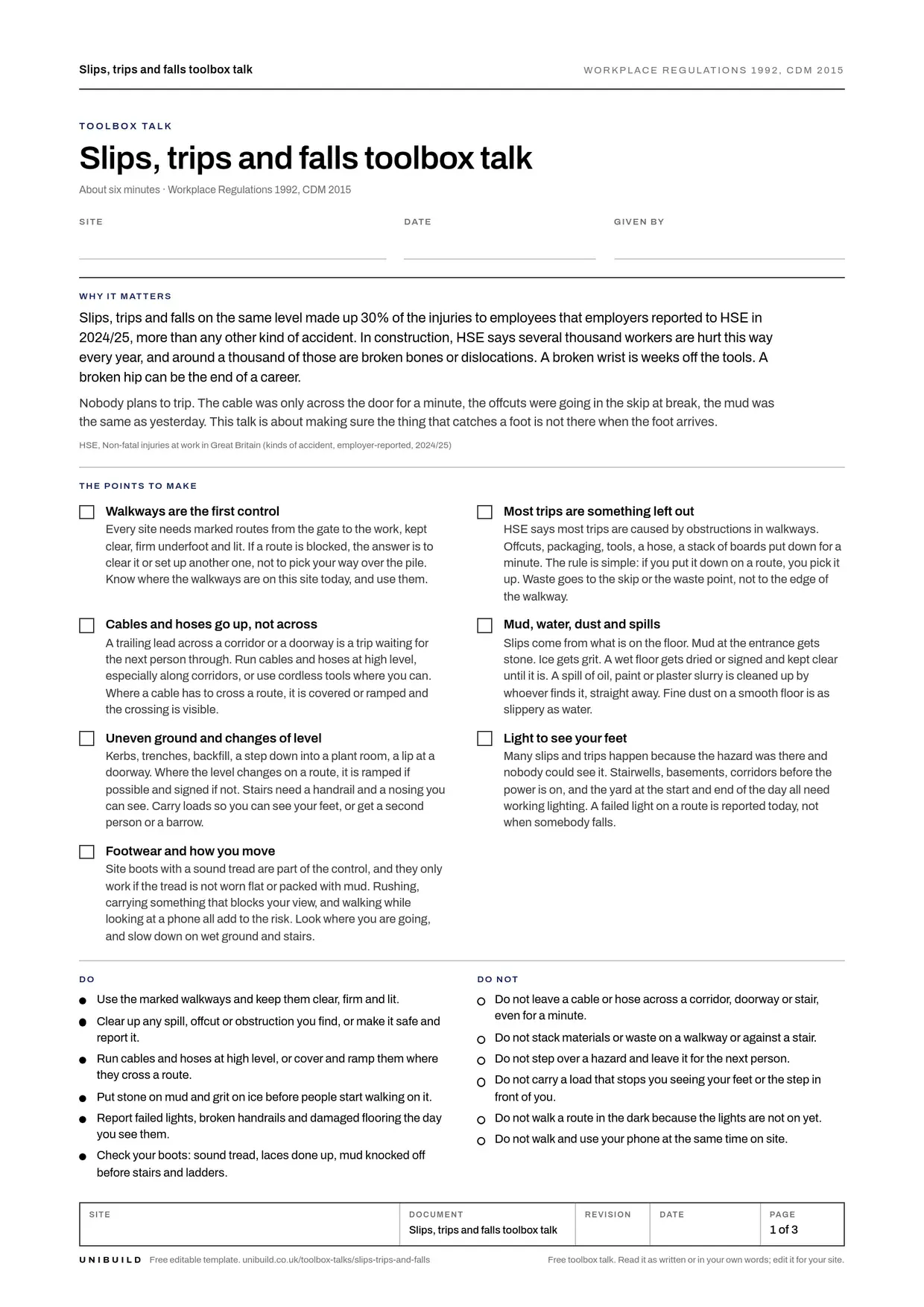
Slips, trips and falls on the same level made up 30% of the injuries to employees that employers reported to HSE in 2024/25, more than any other kind of accident. In construction, HSE says several thousand workers are hurt this way every year, and around a thousand of those are broken bones or dislocations. A broken wrist is weeks off the tools. A broken hip can be the end of a career.

Nobody plans to trip. The cable was only across the door for a minute, the offcuts were going in the skip at break, the mud was the same as yesterday. This talk is about making sure the thing that catches a foot is not there when the foot arrives.

HSE, Non-fatal injuries at work in Great Britain (kinds of accident, employer-reported, 2024/25)

The points to make

Walkways are the first control

Every site needs marked routes from the gate to the work, kept clear, firm underfoot and lit. If a route is blocked, the answer is to clear it or set up another one, not to pick your way over the pile. Know where the walkways are on this site today, and use them.

Most trips are something left out

HSE says most trips are caused by obstructions in walkways. Offcuts, packaging, tools, a hose, a stack of boards put down for a minute. The rule is simple: if you put it down on a route, you pick it up. Waste goes to the skip or the waste point, not to the edge of the walkway.

Cables and hoses go up, not across

A trailing lead across a corridor or a doorway is a trip waiting for the next person through. Run cables and hoses at high level, especially along corridors, or use cordless tools where you can. Where a cable has to cross a route, it is covered or ramped and the crossing is visible.

Mud, water, dust and spills

Slips come from what is on the floor. Mud at the entrance gets stone. Ice gets grit. A wet floor gets dried or signed and kept clear until it is. A spill of oil, paint or plaster slurry is cleaned up by whoever finds it, straight away. Fine dust on a smooth floor is as slippery as water.

Uneven ground and changes of level

Kerbs, trenches, backfill, a step down into a plant room, a lip at a doorway. Where the level changes on a route, it is ramped if possible and signed if not. Stairs need a handrail and a nosing you can see. Carry loads so you can see your feet, or get a second person or a barrow.

Light to see your feet

Many slips and trips happen because the hazard was there and nobody could see it. Stairwells, basements, corridors before the power is on, and the yard at the start and end of the day all need working lighting. A failed light on a route is reported today, not when somebody falls.

Footwear and how you move

Site boots with a sound tread are part of the control, and they only work if the tread is not worn flat or packed with mud. Rushing, carrying something that blocks your view, and walking while looking at a phone all add to the risk. Look where you are going, and slow down on wet ground and stairs.

Do

  • Use the marked walkways and keep them clear, firm and lit.
  • Clear up any spill, offcut or obstruction you find, or make it safe and report it.
  • Run cables and hoses at high level, or cover and ramp them where they cross a route.
  • Put stone on mud and grit on ice before people start walking on it.
  • Report failed lights, broken handrails and damaged flooring the day you see them.
  • Check your boots: sound tread, laces done up, mud knocked off before stairs and ladders.

Do not

  • Do not leave a cable or hose across a corridor, doorway or stair, even for a minute.
  • Do not stack materials or waste on a walkway or against a stair.
  • Do not step over a hazard and leave it for the next person.
  • Do not carry a load that stops you seeing your feet or the step in front of you.
  • Do not walk a route in the dark because the lights are not on yet.
  • Do not walk and use your phone at the same time on site.

Ask the team

  • Where are the marked walkways on this site today, and is any of them blocked right now?
  • Which cables or hoses on this job cross a route, and how are they covered?
  • Where does mud, water or dust build up here, and who is sorting it this morning?
  • Which stairs, corridors or rooms have no working light yet?
  • When did somebody last nearly go over on this site, and what changed afterwards?

To close

Nobody trips on purpose. People trip because the lead was across the door, the offcuts were going at break, the light had gone and the mud was the same as yesterday. Most of what causes a slip or a trip can be seen and sorted in under a minute by the person who finds it. See it, sort it. If you cannot sort it, tell me and we will.

Record it. Who gave the talk, where, when, who was there and what was raised. The last page of the sheet is the record.

In Unibuild a talk is read in each operative’s own language and signed on the phone. How toolbox talks work

The law behind this talk

Checked against the source

Floors and traffic routes

Every floor and the surface of every traffic route in a workplace must be suitable for its purpose, with no hole, slope, unevenness or slipperiness that exposes a person to a risk to their health or safety, and with effective drainage where necessary. So far as is reasonably practicable, floors and traffic routes are kept free from obstructions and from any article or substance which may cause a person to slip, trip or fall. Staircases have suitable and sufficient handrails, and guards where appropriate, unless a handrail would obstruct the route.

Workplace (Health, Safety and Welfare) Regulations 1992, regulation 12

Safe places of construction work

There must, so far as is reasonably practicable, be suitable and sufficient safe access to and egress from every construction site and every place of work on it, and the site is made and kept safe for, and without risks to the health of, any person at work there. A construction site has sufficient working space and is arranged so that it is suitable for any person who works or is likely to work there.

Construction (Design and Management) Regulations 2015, regulation 17

Good order on site

Each part of a construction site must, so far as is reasonably practicable, be kept in good order, and the parts where construction work is being carried out are kept in a reasonable state of cleanliness. Timber or other material with projecting nails or similar sharp objects is not used in work, or allowed to remain on site, where it could be a source of danger to any person.

Construction (Design and Management) Regulations 2015, regulation 18

What is on the sheet

3 pages, the talk and the record

The talk, over two pages

Why it matters, the points to make, do and do not, and the questions to ask, laid out to read from in the cabin or at the workface. Space at the top for the site, the date and who is giving it.

The last page, the record

The attendance record: each person's name, company and signature, the questions raised and any actions, signed off by the person who gave the talk. Type into it or print it and pass it round.

The Word version

The same talk as a Word document, so you can put your own letterhead on it, add a site photograph or change a point to match how your job is set up.

Download the talk as PDF Word versionPDF · 3 pages · 209 KB
After it is given

Delivered on the phone, signed in the room

On Unibuild a toolbox talk is picked from the library, read by each operative on their own phone in their own language and signed there and then. The record is filed against the operative, the site and the date.

A site manager sees who has had which talk, and who has not, without a sheet going round on Thursday.

How toolbox talks work on Unibuild
How long should a slips, trips and falls toolbox talk be?
About five to ten minutes. This one reads in about six if you make every point and stop for the questions. The questions work best if you then walk the route the team is about to use and look for the things the talk named.
Does this talk cover falls from height?
No. This talk is about slips, trips and falls on the same level: walkways, cables, mud, spills, steps and lighting. Falls from height come under the Work at Height Regulations 2005 and have their own talk, the working at height toolbox talk. Give them as two separate briefings.
How often should we give this talk?
The law does not set an interval. Give it at the start of a job, when the site layout changes, when the weather turns wet or icy, after a slip, trip or near miss anywhere on site, and as part of a rolling programme so no topic goes more than a few months without a refresh. Record each delivery.
Who can deliver a toolbox talk on slips and trips?
A supervisor, site manager or a competent member of the team who knows the site and its routes. The person giving it should be able to answer the questions on the sheet for this site: where the walkways are, which cables cross a route, which lights are out. If they cannot, they bring someone who can.
Whose job is housekeeping on a shared site?
The contractor in control of the site must arrange it so people can move around safely and keep it in good order under CDM 2015. In practice every trade clears what it creates, waste goes to agreed points, and the site team walks the routes daily. The talk asks the team to see it and sort it rather than leave it for someone else.
Do we have to keep a record of the talk?
There is no regulation that names toolbox talk records, but the Management Regulations require information and training to be provided and most principal contractors and auditors ask for the evidence. A signed attendance record, with the date and the topic, is the evidence. The last page of the sheet is that record.
What should we do after a slip or trip with no injury?
Treat it as a near miss. Record it, find out what was on the floor or in the walkway, put it right the same day, and tell the team at the next briefing. HSE encourages near miss reporting because the next person to meet the same hazard may not walk away from it.
Is this slips, trips and falls toolbox talk free?
Yes. Download it, print it, give it, edit it and put your own name on it, including on paid work and for clients, with no sign-up and no email address.
Next step

The talk given, understood
and on record.

Unibuild keeps every toolbox talk against the operative who signed it, the site and the date, for seven years, ready for the principal contractor or an auditor.