
Underground services: the talk
Read it as written or in your own words. Tick each point as you make it. Stop for the questions.
Why it matters
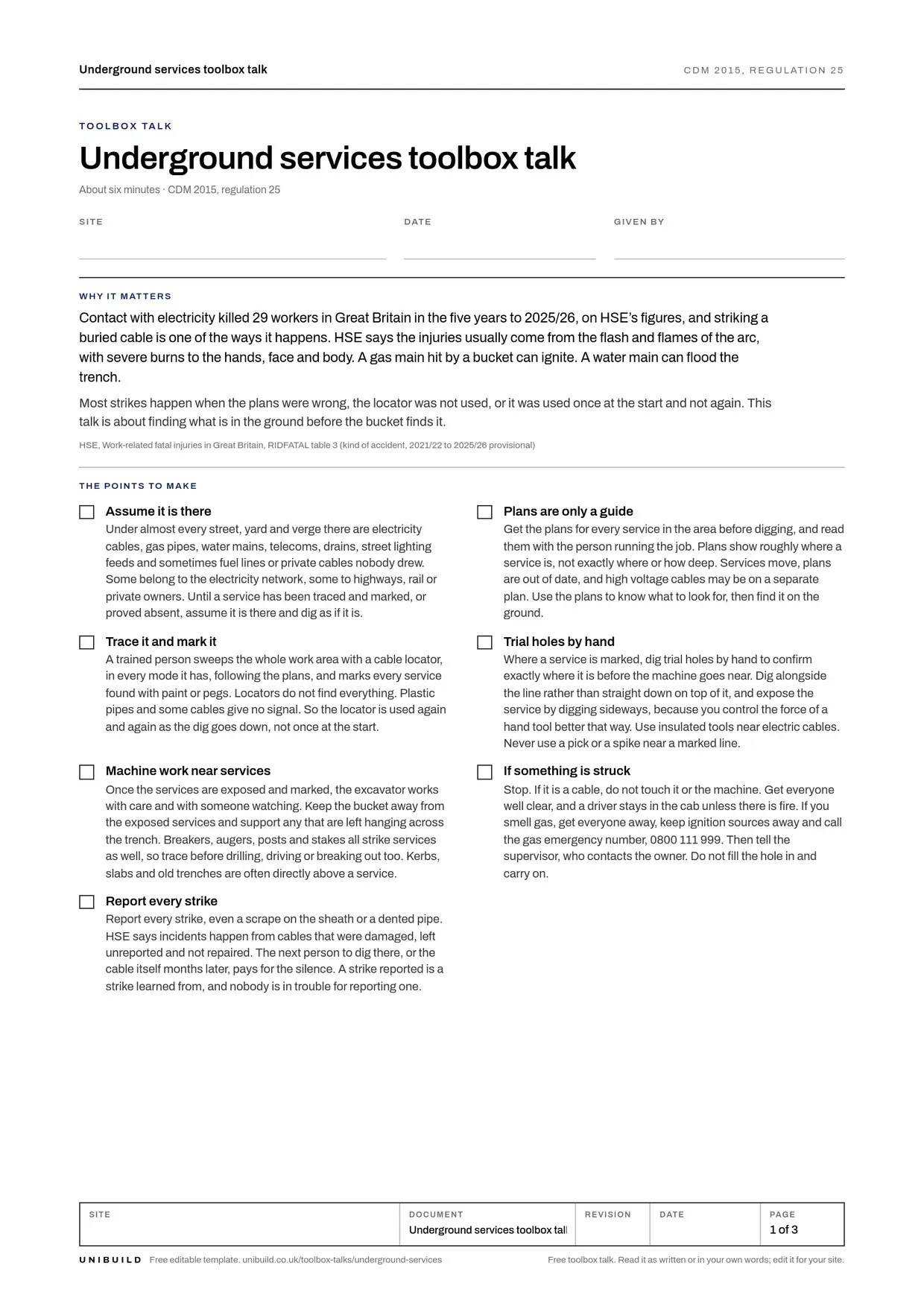
Contact with electricity killed 29 workers in Great Britain in the five years to 2025/26, on HSE’s figures, and striking a buried cable is one of the ways it happens. HSE says the injuries usually come from the flash and flames of the arc, with severe burns to the hands, face and body. A gas main hit by a bucket can ignite. A water main can flood the trench.
Most strikes happen when the plans were wrong, the locator was not used, or it was used once at the start and not again. This talk is about finding what is in the ground before the bucket finds it.
HSE, Work-related fatal injuries in Great Britain, RIDFATAL table 3 (kind of accident, 2021/22 to 2025/26 provisional)The points to make
Assume it is there
Under almost every street, yard and verge there are electricity cables, gas pipes, water mains, telecoms, drains, street lighting feeds and sometimes fuel lines or private cables nobody drew. Some belong to the electricity network, some to highways, rail or private owners. Until a service has been traced and marked, or proved absent, assume it is there and dig as if it is.
Plans are only a guide
Get the plans for every service in the area before digging, and read them with the person running the job. Plans show roughly where a service is, not exactly where or how deep. Services move, plans are out of date, and high voltage cables may be on a separate plan. Use the plans to know what to look for, then find it on the ground.
Trace it and mark it
A trained person sweeps the whole work area with a cable locator, in every mode it has, following the plans, and marks every service found with paint or pegs. Locators do not find everything. Plastic pipes and some cables give no signal. So the locator is used again and again as the dig goes down, not once at the start.
Trial holes by hand
Where a service is marked, dig trial holes by hand to confirm exactly where it is before the machine goes near. Dig alongside the line rather than straight down on top of it, and expose the service by digging sideways, because you control the force of a hand tool better that way. Use insulated tools near electric cables. Never use a pick or a spike near a marked line.
Machine work near services
Once the services are exposed and marked, the excavator works with care and with someone watching. Keep the bucket away from the exposed services and support any that are left hanging across the trench. Breakers, augers, posts and stakes all strike services as well, so trace before drilling, driving or breaking out too. Kerbs, slabs and old trenches are often directly above a service.
If something is struck
Stop. If it is a cable, do not touch it or the machine. Get everyone well clear, and a driver stays in the cab unless there is fire. If you smell gas, get everyone away, keep ignition sources away and call the gas emergency number, 0800 111 999. Then tell the supervisor, who contacts the owner. Do not fill the hole in and carry on.
Report every strike
Report every strike, even a scrape on the sheath or a dented pipe. HSE says incidents happen from cables that were damaged, left unreported and not repaired. The next person to dig there, or the cable itself months later, pays for the silence. A strike reported is a strike learned from, and nobody is in trouble for reporting one.
Do
- Get and read the service plans before any digging, drilling or driving.
- Have a trained person trace and mark every service with a locator, and keep scanning as the dig goes down.
- Dig trial holes by hand alongside a marked service, with insulated tools near cables.
- Support exposed services and keep the bucket well away from them.
- Stop, get clear and report straight away if you hit anything.
Do not
- Do not trust a plan to show exactly where or how deep a service is.
- Do not dig with a machine, pick or spike near a marked line.
- Do not touch a damaged cable or anything in contact with it.
- Do not backfill over a damaged service and say nothing.
- Do not assume there is nothing there because the locator was quiet.
Ask the team
- Which services are shown on the plans for this job, and who has the plans?
- Who here is trained on the cable locator, and when was it last checked?
- Where are the marked services right now, and are the marks still visible?
- What do we do if the excavator hits a cable, and what if we smell gas?
- Has anyone ever hit a service and not reported it? What happened next?
To close
Every service strike is a guess that went wrong: the plan was trusted, the locator was skipped, or the machine went in where a spade should have. Assume it is there. Get the plans, trace and mark it, scan again as you go down, and dig by hand near the line. If you hit something, stop, get clear and tell us, even if it is only a scrape. A strike reported today is one that does not hurt somebody next month.
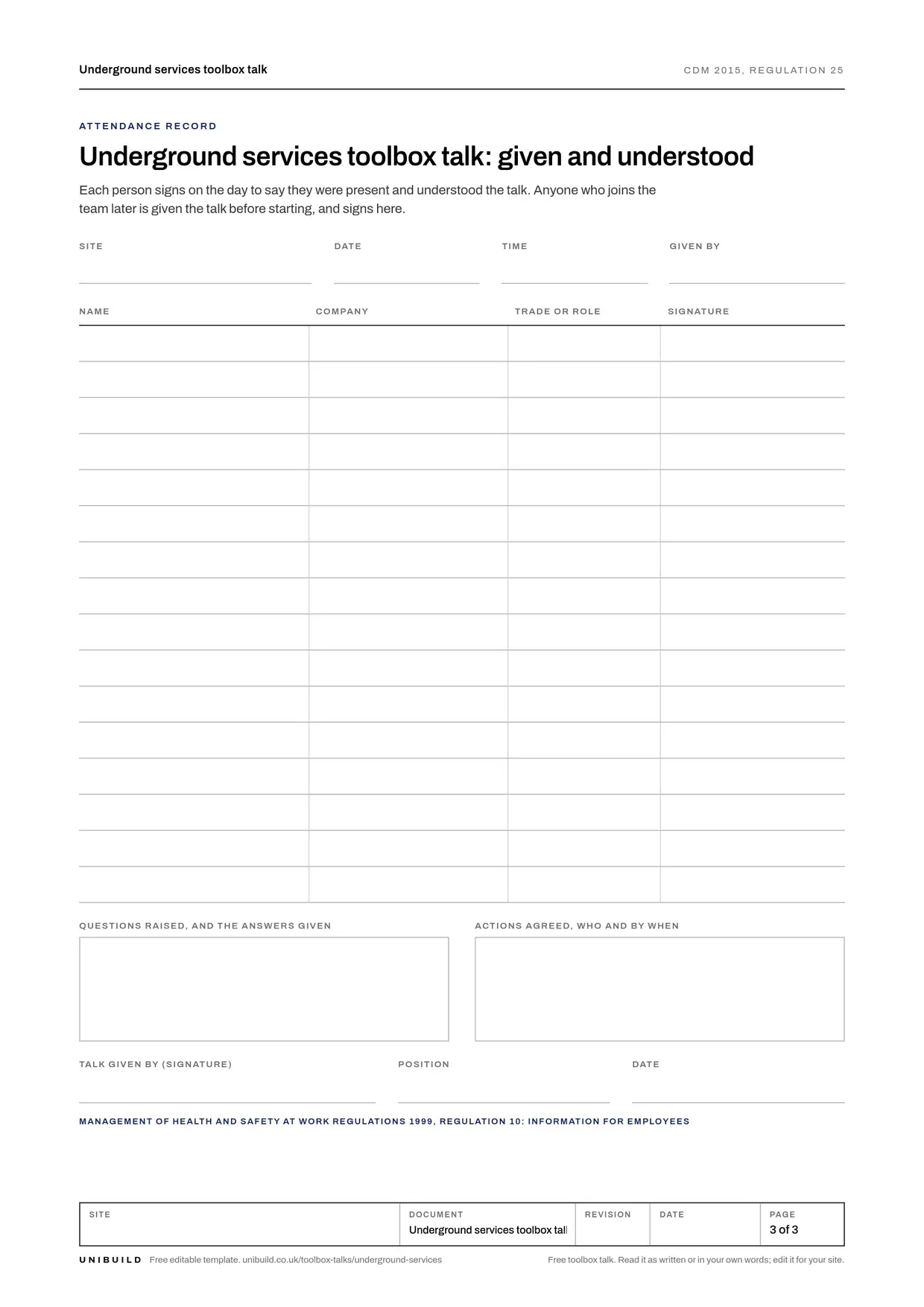
Record it. Who gave the talk, where, when, who was there and what was raised. The last page of the sheet is the record.